
Science of viral content diffusion in 2026
The mechanics of online content diffusion in 2026 are defined by the convergence of psychological emotional triggers, artificial intelligence-driven recommendation engines, and highly specialized media modalities. The era of chronological social media feeds and social-graph-based distribution has been entirely superseded by interest-graph algorithms. These modern systems evaluate behavioral signals - such as dwell time, completion rates, and biometric proxies - in real time to match content resonance with optimal distribution pathways 123. Consequently, the phenomenon of content "virality" is no longer an unpredictable, organic occurrence. It is a quantifiable byproduct of aligning psychological arousal with algorithmic classification parameters.
This research report examines the empirical science of content diffusion in 2026. It provides a comprehensive analysis of the psychological architecture of emotional contagion, the technical mechanics of platform-specific algorithmic routing, the dominance of short-form and immersive augmented media, the impact of synthetic media generation on sharing behaviors, and the demographic shifts in digital news consumption.
Psychological Architecture of Emotional Contagion
The psychological motivation to share information is heavily mediated by the emotional states that the content evokes in the consumer. While early models of virality relied on binary positive-versus-negative sentiment analysis, contemporary research utilizes multidimensional frameworks to predict diffusion cascades accurately 45. The foundational framework that researchers apply to modern social media content is the PAD (Pleasure, Arousal, Dominance) emotional state model, which evaluates affective responses across three continuous dimensions 4.
The first dimension, valence or pleasure, assesses the degree to which an emotion is perceived as positive, such as joy or awe, versus negative, such as anger or disgust. The second dimension, arousal, measures the level of physiological and psychological activation. Low-arousal states include sadness and relaxation, while high-arousal states encompass excitement, fear, and frustration 46.
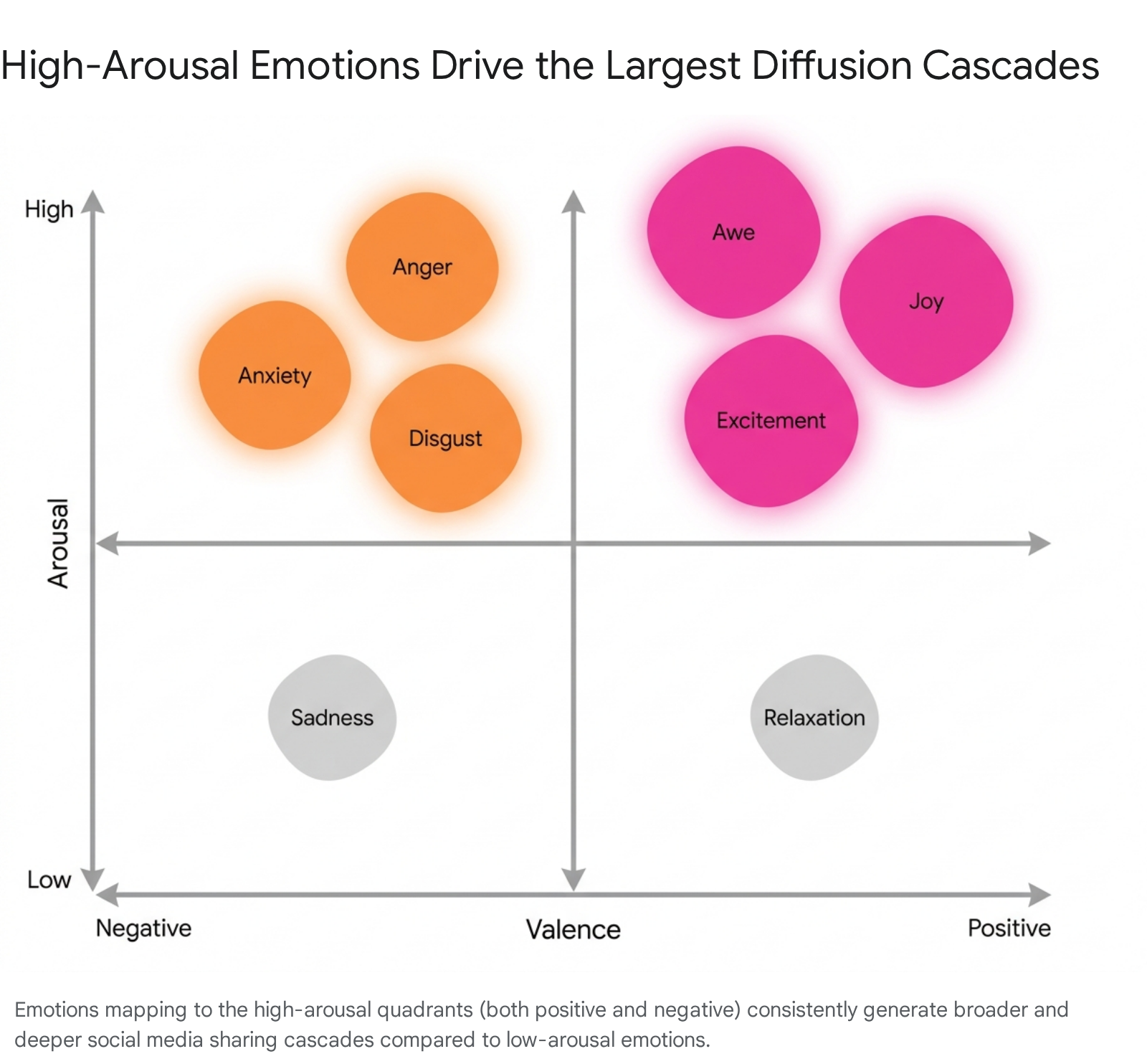
The third dimension, dominance, quantifies the degree of control an individual feels over their emotional state and environment. High-dominance emotions, such as admiration and righteous anger, empower action and self-expression, whereas low-dominance emotions, such as fear, induce a sense of submission or unpredictability 47.
Empirical evidence consistently indicates that emotional arousal is the primary catalyst for information communication. High-arousal events allocate greater cognitive resources to the relevant information, improving memory encoding, consolidation, and retrieval processes 4. High-arousal emotions stimulate the autonomic nervous system and trigger social sharing behaviors as a mechanism for emotional regulation, identity signaling, and social bonding 8910. Conversely, low-arousal emotions generally inhibit widespread sharing. Sadness, a low-arousal negative emotion, typically motivates deep internal reflection rather than outward information broadcasting, resulting in smaller and shallower diffusion networks 45.
Dominance and Emotional Complexity in Content Cascades
High arousal alone does not guarantee algorithmic amplification; the dominance dimension plays a critical moderating role. Content that evokes high arousal paired with high dominance provides individuals with strong self-confidence and social agency. In these states, users are highly willing to share information as a means of expressing self-worth, enforcing moral boundaries, and influencing their broader network 47.
When analyzing viral news stories, researchers identified that content generating intense, prolonged discussion often pairs high-arousal emotions, such as anger or happiness, with elements of low dominance, such as fear or unpredictability. This combination prompts users to seek consensus and social validation through commentary and debate 7. Furthermore, content that is objectively negative and low-arousal, such as depressing economic or environmental news, can still achieve virality if the creator introduces a strong element of surprise. Surprise acts as an instantaneous spike in arousal that disrupts the viewer's cognitive baseline, magnifying the viral potential of otherwise unengaging subject matter 7.
Empirical Characteristics of Diffusion Topologies
The structural patterns of viral cascades differ fundamentally depending on the specific discrete emotion driving them. A comprehensive analysis of 387,486 articles shared by over six million WeChat users demonstrated that anxiety, love, and surprise are the most effective emotions for pushing diffusion cascades to reach broader audiences and penetrate deeper into network layers 8. In this specific ecosystem, anger, sadness, and joy correlated with smaller or shallower network cascades 8.
However, tracking data from X (formerly Twitter) analyzing over one million tweets during high-profile tragedies revealed divergent patterns based on the context of the event. In these scenarios, disgust operated as an exceptionally contagious emotion, spreading rapidly, widely, and with sustained longevity 5. The same study found that anger and surprise generated extremely fast but highly bursty and short-lived cascades. Fear, despite its high arousal profile, spread weakly, likely due to its low-dominance nature inhibiting the user's desire to broadcast vulnerability 5.
Demographic and Cross-Cultural Emotional Sharing Profiles
The mechanics of emotional contagion are not uniform; they vary significantly across demographics and cultural backgrounds. Research utilizing extensive sentiment analysis on social media posts comparing users in the United States and Japan found that populations generally produce content aligned with their established cultural affective values. U.S. users primarily post high-arousal positive content, demonstrating an inclination toward public excitement and enthusiasm, while Japanese users predominantly produce low-arousal, moderate content 9. However, the vectors of influence operate inversely to production. Users across both cultures were most influenced by, and likely to propagate, content that violated their baseline cultural norms. U.S. users were highly responsive to and influenced by sudden influxes of high-arousal negative posts, such as collective anger or outrage. Conversely, Japanese users demonstrated peak influence metrics when exposed to high-arousal positive posts 9.
Age acts as another significant variable in emotional sharing. Developmental and aging studies tracking the trajectory of emotion perception indicate a documented "positivity effect" among older demographics. Older adults generally exhibit better affect regulation and experience lower levels of sustained high-arousal negative emotions, as maintaining these states is physiologically costly 6. Consequently, their sharing habits differ markedly from younger generations. Network analyses reveal that older users show a stronger propensity for sharing articles steeped in targeted anxiety or formal anger, particularly regarding political or economic news 8. In contrast, younger cohorts are highly drawn to disgust-laden, surprise-driven, and highly visual content, which often serves as a mechanism for establishing ingroup boundaries and cultural signaling 810.
| Emotion Profile | Arousal Level | Dominance Level | Cascade Characteristics | Primary Demographic / Context |
|---|---|---|---|---|
| Awe / Joy | High | High | Deep, broad, enduring cascades. High structural virality. | General audiences; shared for social currency and identity signaling 514. |
| Disgust | High | Variable | Rapid initial spread with high longevity. Highly contagious. | Younger demographics; associated with out-group moral policing 58. |
| Anger | High | High | Fast, highly bursty, but often short-lived cascades. Fosters intense debate. | Strong network ties; older demographics 578. |
| Anxiety | High | Low | Broad maximum reach. Effective at cross-network penetration. | Information-seeking scenarios; older demographics 78. |
| Sadness | Low | Low | Shallow cascades. Inhibits widespread broadcasting behavior. | Context-specific empathy appeals; niche micro-communities 48. |
Algorithmic Architecture and Recommendation Systems
The infrastructure of social media in 2026 relies almost entirely on artificial intelligence-powered algorithmic recommendation systems. These complex systems process an estimated 181 zettabytes of behavioral data annually across consumer and enterprise environments 15. Algorithms categorize content contextually and map it to individualized interest graphs, effectively eliminating the historical reliance on explicit user following mechanisms. A platform no longer requires a creator to manually label a video with hashtags for the system to understand its contents and route it to the optimal audience 2.
The Prioritization of Watch Time and Depth Scores
Algorithms across major platforms such as TikTok, Instagram Reels, and YouTube Shorts evaluate user intent through micro-behaviors rather than traditional vanity metrics like total followers or rudimentary likes. Watch time, completion rate, and rewatch rate are the near-universal priorities dictating distribution 21617.
TikTok's recommendation engine evaluates videos by analyzing spoken words via automated transcriptions, on-screen text overlays, and visual contexts utilizing advanced natural language processing and computer vision 1211. This multifaceted analysis establishes a video's "Search Value," allowing the algorithm to match content to specific search queries, rewarding videos that provide direct, high-value answers 11. If a video sustains user attention through the critical first three seconds - widely recognized as the "hook" phase - and achieves a high completion rate, the algorithm identifies a positive user experience signal and amplifies the content's reach 11912. The algorithmic architecture inherently favors short-form video because shorter content naturally yields higher completion rates. A 60-second video with a 70 percent completion rate generates a cleaner, more definitive algorithmic signal of user satisfaction than a 10-minute video with a 40 percent completion rate, allowing platforms to conduct rapid A/B testing across hundreds of videos daily for each individual user 12.
Professional and text-centric networks have mirrored this pivot toward deep engagement. In a sweeping 2026 update, LinkedIn implemented a fundamental algorithmic shift that replaced surface-level engagement metrics with a proprietary "Depth Score" 13. The Depth Score acts as the platform's primary distribution signal, meticulously measuring the exact dwell time users spend reading or viewing content before scrolling away. Under this refined model, document carousels generate two to three times more dwell time than standard text or image posts, establishing them as the strongest native format for achieving organic reach 13. Furthermore, platforms actively disincentivize platform exit; LinkedIn's algorithm explicitly penalizes off-platform linking, reducing the organic distribution of posts containing external links in the main body by roughly 60 percent 13.
Suppression of Artificial Amplification Tactics
As the financial incentives for achieving virality expanded, sophisticated tactics for artificial amplification emerged, prompting severe and automated algorithmic countermeasures. "Engagement pods" - coordinated groups of users who artificially trade likes, comments, and saves to trick ranking classifiers into granting reach - have been aggressively targeted and dismantled by platform integrity teams in 2026 1415.
Platforms now deploy advanced AI detection systems that map reciprocal engagement patterns, analyze static comment velocities, and identify the use of third-party automation scripts designed to mimic human interaction 132425. When these patterns are detected, platforms apply immediate "reach penalties" or shadowbans without warning to the offending accounts, effectively terminating the content's visibility outside the creator's immediate, pre-existing network 1314. Additionally, algorithms now utilize active suppression against "engagement bait." Tactics such as demanding users to "Comment YES if you agree" or utilizing reaction polling are heavily penalized, as large language models categorize these tactics as low-quality, artificial interactions that fail to reflect genuine viewer satisfaction 13.
The Conflict Between Safety Constraints and Engagement Optimization
The algorithms driving content virality face intense geopolitical and social scrutiny regarding the fundamental trade-offs between engagement optimization and user safety. Internal research from major social media conglomerates has demonstrated that outrage-driven and borderline harmful content - including medical conspiracy theories, targeted misogyny, and extreme political polarization - often yields the highest engagement rates and longest session durations 161718.
Whistleblower reports and leaked internal audits revealed that when platforms introduced algorithmically driven, infinite-scroll short-form video feeds, the prevalence of bullying, hate speech, and incitement to violence rose significantly compared to legacy chronological feeds 1718. One specific internal study indicated that a short-form video feed exhibited 75 percent higher rates of bullying and harassment, and 19 percent higher rates of hate speech, relative to traditional text and image feeds 17. Despite public commitments to safety protocols, the core mathematical incentives of maximizing session duration and daily active user metrics frequently resulted in management teams suppressing safety interventions or allowing borderline material to proliferate to maintain financial performance 1617.
This "algorithm arms race" for human attention has resulted in sweeping regulatory crackdowns across the European Union, Australia, and parts of Asia. Governments have forced platforms to integrate stricter age verification protocols, modify their classification weights to actively demote borderline material, and increase transparency regarding how proprietary recommendation models function 1619.
Modalities and Format Performance
The specific format and medium of the content fundamentally dictate its viral potential and its ability to penetrate algorithmic filters. By 2026, internet traffic is overwhelmingly visual, with video media accounting for an estimated 82 percent of all global data traffic 12. However, the structural constraints of these modalities have evolved specifically to exploit algorithmic reward systems.
The Engineering of Short-Form Video
Short-form video is the absolute dominant vehicle for content diffusion and audience acquisition.
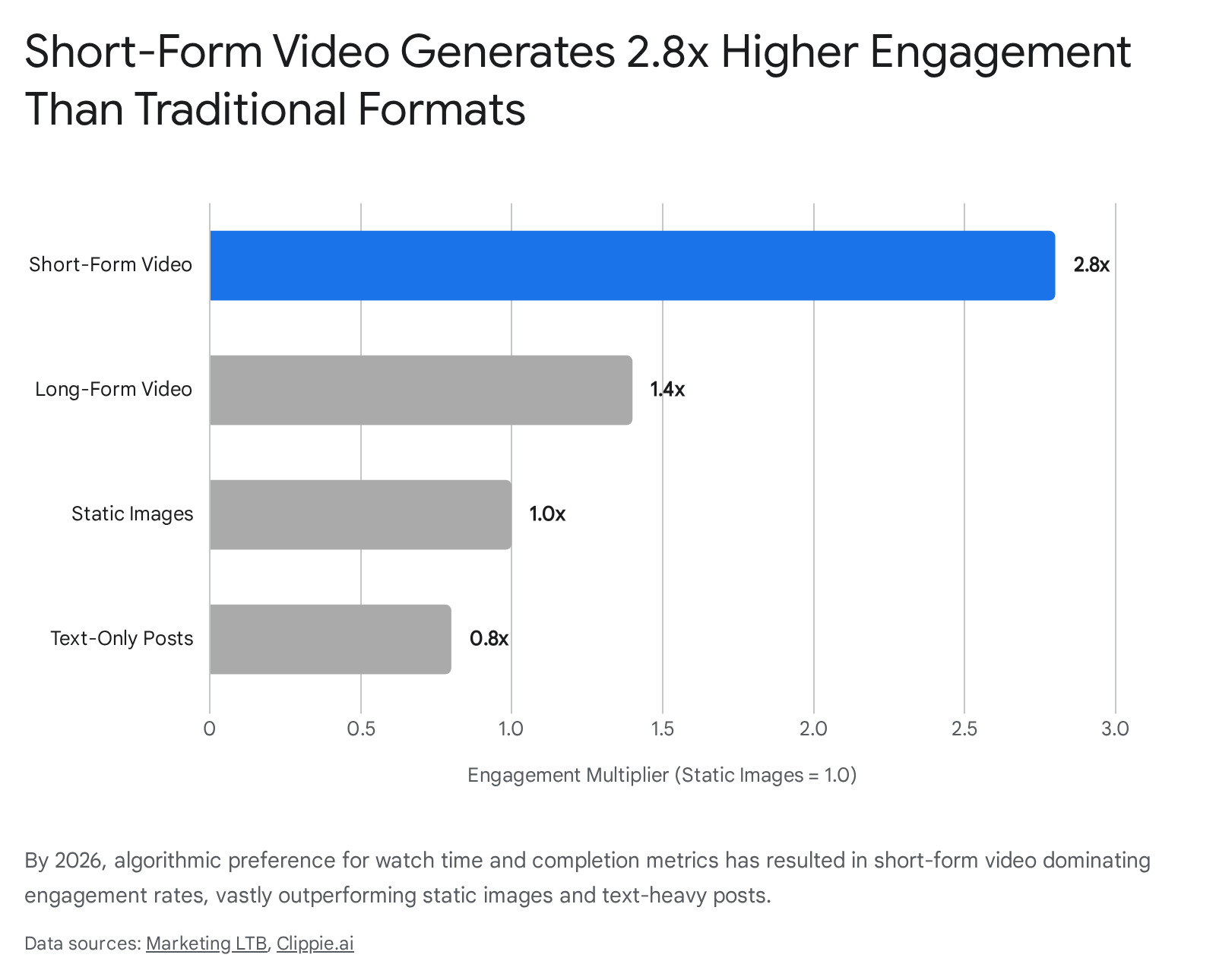
In 2026, 73 percent of consumers prefer learning about products, services, or complex concepts through short videos, and the average daily consumption of this specific format has risen to 52 minutes per user 1230. Because the average sustained attention span for digital content has compressed to roughly 8.25 seconds, platform interfaces are optimized for immediate gratification, rapid context switching, and continuous scrolling 12.
The anatomy of a highly viral short-form video in 2026 requires strict, systematic adherence to specific structural rules: 1. The 3-Second Hook Optimization: The opening moments must immediately establish value or shock. Creators utilize rapid movement, pattern interrupts, or bold curiosity-inducing statements to halt the user's scroll. Failure to retain a significant percentage of viewers in this initial window results in immediate algorithmic demotion, preventing the video from entering broader distribution pools 11931. 2. Pacing and Visual Density: Successful videos eliminate dead air and utilize rapid jump cuts, dynamic on-screen text overlays, and shifting camera angles to maintain high cognitive stimulation. This density prevents audience drop-off and maintains the critical watch-time metric 1. 3. The 1-Minute Threshold Evolution: While extreme brevity was historically essential, platforms have shifted to heavily reward "longer short-form" videos that cross the 60-second mark. This shift is driven by platform monetization goals - longer videos accommodate more ad inventory - and the desire for deeper session retention. Videos spanning 60 to 90 seconds often see exponentially higher reach, provided they can maintain strong completion rates throughout the extended runtime 11.
Interestingly, high production value does not correlate with virality in short-form feeds. Audiences have developed an active rejection of overly polished, heavily scripted corporate content, viewing it as fundamentally inauthentic and interruptive to the user experience. Instead, raw, smartphone-shot footage - often termed "yap videos" or creator-led user-generated content (UGC) - drastically outperforms studio-grade content because it feels native to the platform and triggers peer-to-peer social trust mechanisms 19313233.
The Rise of Immersive Media and Augmented Reality
While video dominates passive media consumption, Augmented Reality (AR) and Mixed Reality (MR) have emerged as the primary drivers of highly engaged, interactive virality. By 2026, global AR/VR user penetration is expanding rapidly, with projections indicating over 3.7 billion users by the end of the decade, heavily driven by consumer applications rather than enterprise utility 2021.
AR filters act as highly potent viral mechanics due to their inherently interactive nature. An effective AR filter blends virtual elements with the physical world, offering users a novel tool to express their identity, modify their appearance, or engage in gamified storytelling 2223. The performance metrics associated with AR campaigns significantly outpace traditional media: * Engagement Duration: AR campaigns generate active interaction times ranging from 20 to 40 seconds, which is up to four times longer than average mobile video viewing durations 2023. * Conversion and Retention: The immersive, participatory nature of AR yields a 70 percent higher memory recall rate than traditional video content. In social commerce applications, integrating 3D and AR content for virtual try-ons can increase sales conversion rates by up to 94 percent while simultaneously reducing product return rates by 25 percent 2038.
The virality of AR relies entirely on user-generated distribution architectures. When an individual utilizes a branded filter or lens on platforms like TikTok or Snapchat, the resulting video acts as a highly personalized, authentic endorsement. This peer-to-peer sharing mechanism effectively bypasses traditional ad blockers and algorithmic suppression, relying instead on network effects as viewers utilize the same filter to participate in the cultural trend 222339. The maturation of the Spatial Web (WebXR) further accelerates this phenomenon by allowing digital AR assets to persist in specific geographic locations without requiring users to download dedicated applications, seamlessly integrating viral digital mechanics into real-world, localized environments 3940.
| Modality Type | Primary Platforms | Core Virality Drivers | Typical Engagement Outcomes |
|---|---|---|---|
| Short-Form Video | TikTok, Reels, Shorts | 3-second hook, high completion rates, visual density. | Broadest reach, high algorithmic discoverability, 2.8x baseline engagement 111230. |
| Long-Form Serialized | YouTube, Substack | High narrative value, episodic structure, creator authority. | Deep audience retention, high trust building, higher direct monetization 191241. |
| Augmented Reality (AR) | Snapchat, TikTok, WebAR | Interactive novelty, identity expression, gamification. | 20 - 40 second dwell times, 70% memory recall, high conversion lift 202338. |
| Text-First Threads | Threads, X, Reddit | High conversational utility, controversial takes, deep replies. | Intimate community building, niche authority, slower but sustained spread 3342. |
Artificial Intelligence in Content Generation and Distribution
By 2026, the content velocity required to maintain algorithmic relevance is functionally impossible to achieve through manual production alone. Artificial intelligence has transitioned from an experimental novelty into the foundational infrastructure for content creation, strategic optimization, and predictive distribution.
Generative Workflows and Sustained Content Velocity
Industry data indicates that 88 percent of digital content marketers utilize AI daily, and nearly 87 percent rely on generative AI models in at least one core recurring workflow 243. The integration of agentic AI workflows dramatically accelerates content velocity; teams utilizing fully integrated AI systems report a 77 percent increase in content output volume and a 42 percent reduction in per-unit production costs 43. AI is widely utilized to rapidly generate video scripts, create localized dialect translations, produce automated voiceovers, and edit transcripts. This systemic integration enables creators and brands to scale a single piece of core research or content into dozens of platform-specific formats within minutes 32242526.
Furthermore, AI powers the sophisticated execution of Dynamic Creative Optimization (DCO). Machine learning algorithms automatically construct and test hundreds of ad variations simultaneously - mixing different emotional hooks, visual elements, and calls-to-action - in real-time to identify the exact combination that resonates with specific, highly granular audience micro-segments 47.
The Transition to Answer Engine Optimization (AEO)
The structural convergence of traditional search architecture and social media platforms is a defining consumer trend of 2026. A significant portion of users, particularly Gen Z and Millennials, now bypass traditional search engines entirely, initiating product research and information discovery directly on TikTok, YouTube, or Instagram 3327.
Simultaneously, Large Language Models (LLMs) and integrated Answer Engines (such as ChatGPT, Perplexity, and Google AI Overviews) process billions of user queries monthly. This technological shift has forced the industry to pivot from traditional Search Engine Optimization (SEO) toward Answer Engine Optimization (AEO) 472850. Achieving virality and broad visibility in 2026 requires content to be structured explicitly so that AI models can easily ingest, analyze, and cite it. This process involves prioritizing clear entity-based writing, highly structured formatting (utilizing clear headings, bullet points, and concise definitions), and the publication of first-hand original data that LLMs deem authoritative enough to aggregate into their synthesized, zero-click responses 432851. While traditional organic traffic from standard search links has dropped significantly across the web, visitors arriving via specific AI-driven citations exhibit up to 4.4 times higher conversion rates, reflecting exceptionally high user intent and trust 28.
AI Fatigue and the Authenticity Premium
The mass proliferation of AI-generated content has predictably triggered a psychological and behavioral counter-trend among consumers: AI Fatigue. Audiences are increasingly overwhelmed by flawless, hyper-personalized, and synthetically generated media 52. Approximately 46 percent of social media users express active discomfort with brands or campaigns that utilize fully virtual "AI Influencers," viewing them as inherently manipulative 33.
As the sheer volume of machine-produced content approaches infinity, human imperfection has ironically become the ultimate indicator of scarcity and a vital trust signal. Observable flaws, natural speech pacing, unscripted moments, and even minor typographical errors signal genuine human origin to wary consumers 3329. The most successful creators and organizational brands in 2026 employ a strict hybrid model. They utilize AI extensively in the backend for data analysis, production logistics, and scaling format variations, while ensuring the forward-facing creative elements remain entirely driven by human empathy, lived experience, and cultural nuance 3325.
Network Topologies and Influencer Economics
The pathways through which viral content travels have decentralized significantly. The previous era, defined by a single piece of content reaching a massive, homogenous audience through a few central nodes (such as celebrity mega-influencers), has fractured into complex, interlocking topologies of micro-communities.
Micro-Influencer Networks and Distributed Trust
In 2026, societal trust has shifted dramatically away from large, centralized institutions and mainstream celebrities toward decentralized, niche experts and peer groups. Consumers operate almost exclusively on "Micro-Trust," seeking validation from specific individuals who genuinely use, understand, and critique specialized products or complex ideas 52.
To achieve sustained virality and commercial impact, organizations have largely abandoned reliance on individual mega-influencers. Instead, they deploy "Network-Based Influencer Campaigns." This strategy involves recruiting dozens to hundreds of nano- or micro-creators, providing them with a loose thematic content brief, and allowing them to interpret the core message authentically for their highly specific audiences 47. These authentic, localized posts are then frequently whitelisted for paid social amplification by the brand. The combined, synchronized reach of a distributed nano-influencer network regularly exceeds that of a single mega-influencer at a fraction of the budget, generating a flood of content that appears entirely organic and omnipresent within specific digital subcultures 4730.
Coordinated Inauthentic Behavior (CIB) and Misinformation
The precise mechanics used to organically engineer virality are frequently weaponized by state and non-state actors in the form of Coordinated Inauthentic Behavior (CIB). During critical geopolitical events, elections, or corporate crises, malicious actors deploy vast networks of automated, semi-automated, or loosely managed accounts to artificially amplify specific, often divisive, narratives 55.
Historically, CIB detection frameworks focused almost entirely on text-based platforms, analyzing exact phrase repetition or hashtag hijacking. In 2026, the vanguard of influence operations targets video-first ecosystems like TikTok and YouTube Shorts. Computational detection frameworks have evolved to map user similarity networks based on multi-modal signals. These include analyzing synchronized posting timestamps, the repeated use of specific underlying audio segments, and the subtle reuse of multimedia assets - such as AI-generated voiceovers layered onto manufactured, split-screen background videos 55. While platform-native features like Duets and Stitches are routinely used for organic engagement, the synchronized deployment of these interactive features by previously unconnected accounts serves as a primary forensic signal for identifying hidden networks attempting to game the algorithm and force inorganic content into viral distribution 55.
Similarly, in regions heavily dependent on encrypted, closed messaging networks like WhatsApp, researchers note that the viral propagation of political, health, and religious narratives relies heavily on private network topologies. Misinformation in these intimate networks proves highly resilient to external moderation. False narratives frequently continue to recirculate through deep, trusted community ties and family group chats long after being definitively debunked by centralized journalistic or fact-checking organizations 31.
Social Media News Consumption Dynamics
The science of virality is inextricably linked to how modern populations consume and internalize civic information. A critical demographic divergence has occurred regarding news consumption on social platforms, fundamentally altering how journalistic and political entities must format information to achieve reach. According to extensive 2025 and 2026 survey data, 53 percent of all U.S. adults regularly source news from social media, but the variance across demographic stratifications is massive 32.
There is a stark 48 percentage point gap between young adults (ages 18 to 29) and older adults (ages 65 and older) who report getting news on social media at least sometimes (76 percent versus 28 percent, respectively) 33. Furthermore, young adults inherently trust algorithmic delivery systems, overwhelmingly preferring platforms like TikTok, Instagram, and Reddit for breaking news over traditional publishers' websites or television broadcasts 3233. Data indicates that just over half (55 percent) of all TikTok users regularly source their news directly from the application's For You Page, representing a massive increase from previous years 32.
This demographic reality ensures that the formats required for news virality must conform strictly to the stylistic and algorithmic requirements of the host platforms. Complex geopolitical events, localized policy changes, or nuanced economic data must be distilled into 60-second, high-arousal vertical videos, ideally presented directly by relatable creators rather than faceless institutional brands. Consequently, traditional journalistic institutions that fail to optimize for these algorithmic "hooks," visual storytelling norms, and high-dominance emotional framing suffer severe visibility deficits and irrelevance in the modern information ecosystem 3233.
Predictive Analytics and Virality Measurement
As the financial and political stakes of content virality have increased, the tools used to measure, predict, and monitor diffusion have grown highly sophisticated. Marketing analysts and data scientists no longer rely solely on retrospective vanity metrics, but instead utilize advanced platforms capable of analyzing billions of data points to identify emerging trends before saturation occurs 3435.
The concept of "structural virality" has become a vital metric. It evaluates not just the total number of individuals a piece of content reaches, but the shape and depth of its spread through multiple generations of reshares 8. Content that spreads deep into a network - where users share a post, their followers share it, and the cycle continues repeatedly - demonstrates higher resonance and resistance to algorithmic suppression than content that achieves a high view count solely through paid amplification or a single massive broadcast 8.
By utilizing large-scale monitoring tools to analyze the velocity of shares across domains and social platforms, strategists can identify the exact lifecycle stage of a given topic. This capability is critical for avoiding the "content shock" phase, where the volume of content published on a topic vastly outpaces audience interest, leading to diminished returns and falling average engagement rates 36. To secure a competitive advantage in 2026, content creators must identify rising trends early, format the information for AEO and short-form algorithms, and deploy it across micro-influencer networks before the topic reaches algorithmic saturation 143637.
Conclusion
The science of viral content in 2026 represents a highly quantified, adversarial relationship between human psychological vulnerabilities and machine learning recommendation algorithms. Ideas spread effectively online when they successfully exploit high-arousal emotional triggers - such as anxiety, awe, or targeted disgust - and map onto the dominance dimension that compels users to share for social validation and identity signaling. However, this psychological resonance is merely the prerequisite for visibility; true diffusion requires strict adherence to algorithmic ranking signals. Specifically, content must maximize dwell time, search value, and completion rates within the constraints of short-form vertical video or immersive augmented media formats.
As generative artificial intelligence completely automates the volume and optimization of content, and as answer engines continually bypass traditional search architectures, the strategic advantage in digital communication has shifted. Virality is no longer reliably achieved through mass reach or highly polished studio production. Instead, it is secured through hyper-personalized, authentic resonance deployed systematically across dense, decentralized micro-communities. Understanding these interconnected psychological, technical, and demographic dynamics is essential for navigating the complex and rapidly accelerating digital landscape of 2026.