
Why Do We Share What Everyone Else Is Sharing
Humans share content online to satisfy an innate psychological need for social validation and belonging, utilizing the behavior of the crowd as a cognitive shortcut to determine what is valuable. When this evolutionary trait meets modern social media algorithms, it triggers digital herd behavior, causing content to spread exponentially based on its early popularity rather than its objective quality. Ultimately, the compulsion to click "share" is driven less by the intrinsic merit of the information and more by the social currency it provides within an individual's digital community.
The Psychological Engine of Viral Content
The architecture of digital networks is fundamentally built upon the human desire for social connection. When users encounter content online, their decision to amplify it is rarely the result of a slow, deliberate calculation of the content's objective merit. Instead, sharing behavior is triggered by a combination of emotional arousal, identity signaling, and the instinctual drive to conform to group norms.
High-Arousal Emotions and the Brain's Reward System
Psychological research indicates that not all emotions drive human action equally. Content that triggers high-arousal emotions is significantly more likely to be shared than content that evokes low-arousal states 12. Studies demonstrate that digital content evoking awe, excitement, amusement, anger, or anxiety is 34% more likely to be shared than neutral material 23. Conversely, low-arousal emotions like sadness or contentment may prompt a user to pause and reflect, but they rarely generate the psychological urgency required to hit the share button 2.
These emotional spikes are intimately connected to the brain's reward circuitry. Receiving notifications, likes, or shares releases dopamine, reinforcing the behavior and driving compulsive interactions with the platform 45. In the digital sphere, positive social interactions no longer require face-to-face engagement; they have been distilled into quantifiable metrics like "likes," which provide immediate, micro-doses of social affirmation 4. Over time, this creates a habit loop. Platforms capitalize on this by designing infinite scrolling feeds, ensuring that the dopamine-seeking behavior becomes as automatic as checking the refrigerator when not hungry 5.
Furthermore, the Fundamental Interpersonal Relations Orientation (FIRO) theory posits that human behavior is driven by the need for inclusion, control, and affection 6. When a user shares an awe-inspiring scientific discovery or an anger-inducing political scandal, they are actively participating in a digital ecosystem that fulfills these core interpersonal needs, utilizing the content as a vehicle for emotional exchange 16.
Social Currency and Identity Signaling
Beyond raw emotion, individuals share content to build and define their digital identities, a concept popularized by behavioral scientists as "social currency." People share information that makes them appear knowledgeable, humorous, or ahead of the curve to their peers 27. In this context, sharing acts as a form of self-expression. When someone shares a sophisticated industry insight or an exclusive tip, they are essentially telling their network, "This reflects who I am" 2.
This behavior satisfies core psychological needs outlined in Social Identity Theory, which explains that people align themselves with groups that reflect their aspirations and values 8. The desire for belonging pushes users to conform to group behaviors to minimize perceived social risks 58. Solomon Asch's famous conformity experiments demonstrated that individuals will agree with a crowd even when they know the crowd is wrong, simply to avoid standing out 8. On social media, this manifests as users sharing popular opinions or participating in viral challenges merely to establish credibility and safety within their chosen digital tribe.
Homophily, Social Ties, and the Drive to Belong
The tendency to associate with similar individuals, known as homophily, deeply influences digital herd behavior 4. Users do not value all social proof equally. The decision to engage with or share content is heavily weighted by the perceived closeness or expertise of the individuals who have already engaged with it 4.
A Qualitative Comparative Analysis (QCA) examining herd behavior and social tie strength revealed that click-through intentions on sponsored content are significantly higher when a user observes a "like" from a socially close contact or a perceived expert 4. A "like" from a close friend deemed highly informed can even persuade a user to click on content they previously considered invaluable 4.
This dynamic fosters digital echo chambers. The psychological necessity to appease the in-group can push individuals to interact with content solely to maintain social standing, often leaning heavily into confirmation bias 24. In highly polarized environments, expressing allegiance to an in-group often takes the form of sharing content that expresses outrage toward an out-group, a behavior heavily rewarded by platform algorithms 45.
Social Proof in the Digital Landscape
Social proof is the psychological phenomenon wherein people copy the actions of others in an attempt to undertake normative behavior in a given situation 6. In the absence of complete information or when faced with an overwhelming volume of data, the crowd acts as a proxy for truth, reducing the cognitive load required to make an independent decision 127.
The Bandwagon Effect and Irrational Herding
In marketing and consumer behavior, social proof is a foundational pillar of persuasion. Evidence of a product's popularity drastically alters consumer decision-making, a phenomenon known as the bandwagon effect 68. The presence of testimonials, user ratings, and embedded social mentions creates an environment where individuals adopt a behavior simply because others are doing it 815.
The impact of this is highly measurable. Adding customer reviews to a website has been shown to increase e-commerce conversion rates by 67% compared to pages without visible reviews 16. A 2022 study of B2C websites found that reviews by verified buyers were ranked as the second most important attribute for attracting shoppers, trailing only behind fast and accurate search functionality 8. When people are uncertain about a product or service, they subconsciously apply persuasion principles - often remembered by the acronym CRAVENS (Credibility, Relevance, Attractiveness, Visual appeal, Ease of understanding, Nearby, Specific) - and heavily weigh the perceived value that others have already assigned to it 16.
The power of social proof extends beyond digital commerce into physical human behavior. In a comprehensive 14-week study of hospital visitors involving 246,098 individuals, researchers tested various psychological messaging strategies to encourage hand sanitization 8. The message relying on social proof - "Our hospital visitors disinfect their hands" - was one of only two strategies (alongside Authority) that significantly increased hand-washing compliance, vastly outperforming standard medical warnings 8. The message succeeded not by providing data on pathogens, but by tapping into the desire to act in keeping with the herd 8.
Cumulative Advantage and the Salganik Music Lab Experiment
The assumption that the most popular content online is inherently the highest quality is a persistent fallacy. The relationship between quality and popularity is heavily distorted by "cumulative advantage," a process where early popularity leads to increased visibility, which in turn breeds more popularity independent of intrinsic worth 91810.
This phenomenon was forcefully demonstrated in the seminal "Music Lab" experiment conducted by researchers Matthew Salganik, Peter Dodds, and Duncan Watts 1011. In this massive web-based experiment involving 14,341 subjects, participants were asked to listen to, rate, and download songs by unknown bands 910. The participants were split into two primary groups: an independent condition where they only saw the song names, and a social influence condition where they also saw the number of times each song had been downloaded by previous users 10.
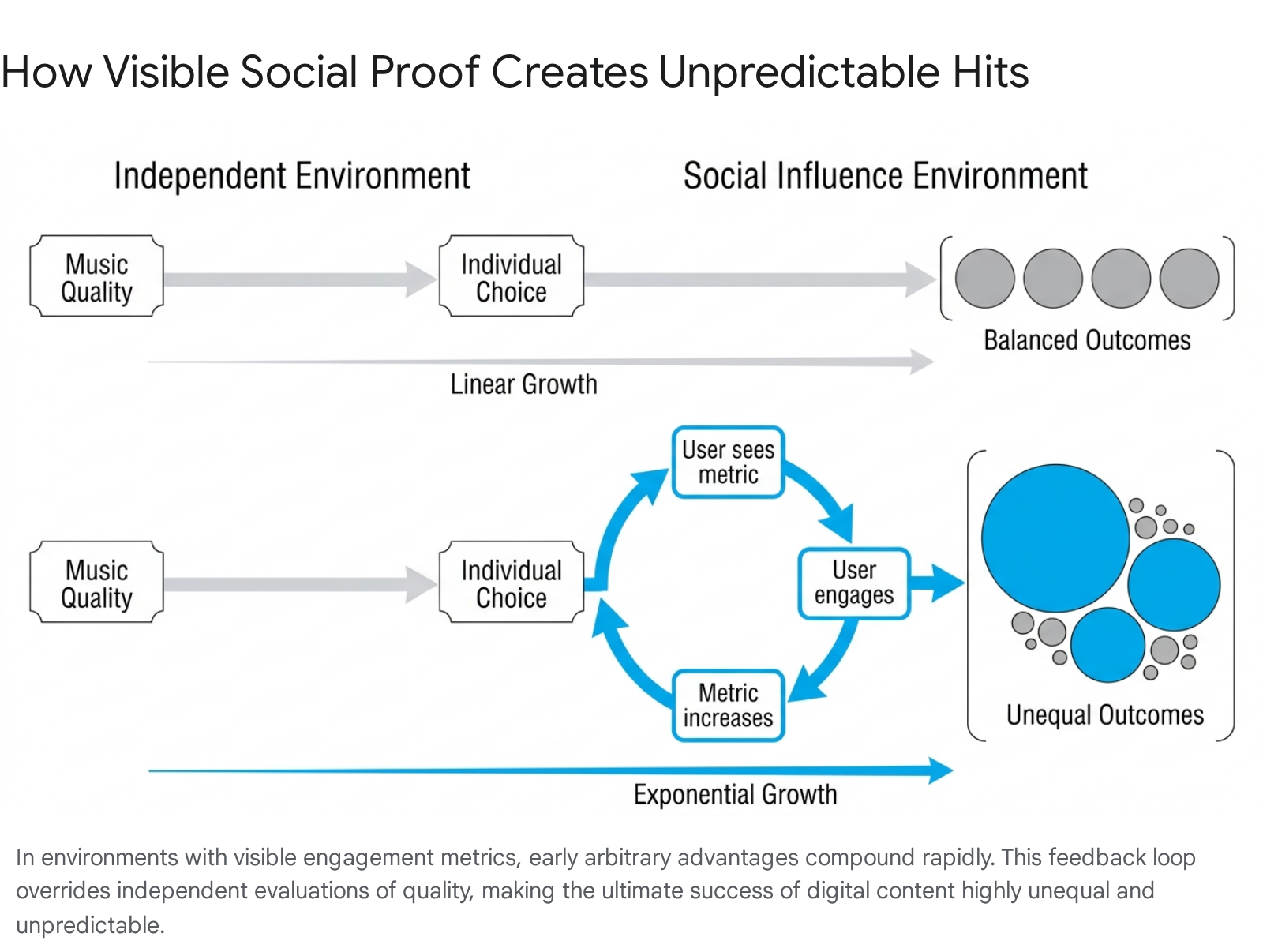
To test predictability, the social influence group was further divided into eight isolated, parallel "worlds" that all started with identical initial conditions .
The experimental results revealed three critical realities about digital herding: 1. Extreme Inequality: Introducing visible social proof created extreme inequality in the outcomes. A small initial advantage in downloads quickly snowballed, leading to a "Matthew effect" where the most popular songs became disproportionately more popular, and the least popular songs were ignored 91011. 2. Unpredictability: The ultimate "hit" songs varied wildly across the eight parallel worlds. A song that became a blockbuster in World 1 might languish at the bottom in World 6 1810. This proved that success was determined more by early, random social influence than by the intrinsic quality of the music 1011. 3. Decoupling of Quality: While a song's base quality provided some boundary conditions (the absolute worst songs rarely became the absolute top hits), the impact of a listener's own reaction was easily overwhelmed by their reaction to the behavior of others 1011. Social influence effectively distorted the quality perceived by the participants 11.
Algorithmic Amplification of Herd Behavior
While human psychology provides the foundation for herd behavior, modern social media algorithms are the engines that accelerate it to unprecedented speeds. Platforms engineer their content delivery systems to maximize user attention, deeply intertwining algorithmic distribution with visible social proof.
TikTok's "For You" Page and the Virality Loop
Platforms like TikTok have shifted away from purely chronological, follower-based feeds toward algorithmic, recommendation-based systems like the "For You" Page (FYP). This architecture allows content to be discovered far beyond a user's immediate social network, amplifying the visibility and virality of specific trends 1213.
TikTok's algorithm relies heavily on user behavior components to evaluate content. According to insights into the algorithm's structure, the system calculates a score based on variables heavily reliant on the behavior of others, represented conceptually as Plike X Vlike + Pcomment X Vcomment + Eplaytime X Vplaytime + Pplay X Vplay 14. If a piece of content is well-received by a small initial test group, the algorithm pushes it to a progressively larger audience.
This system fundamentally institutionalizes herd mentality. Users are presented with videos precisely because the crowd has already validated them. The psychological effect is profound; observing massive view counts and engagement metrics provides immediate social proof, prompting further engagement in a self-sustaining cycle 121415.
Consumer behavior researchers evaluating TikTok via the Antecedents - Decisions - Outcomes (ADO) framework have identified several key drivers of sharing on the platform. The perceived charisma of macro-influencers significantly boosts the volume of likes and shares, while parasocial relationships - the one-sided emotional bonds users form with creators - foster loyalty and directly enhance content sharing 16. Because the algorithm prioritizes hedonic and emotional appeal over factual credibility, the platform frequently accelerates the dissemination of sensationalized content. For example, a study on TikTok nutrition content revealed that 82% of posts lacked transparent advertising, and 55% failed to provide evidence-based information, yet completely inaccurate posts frequently garnered massive engagement simply because they utilized highly entertaining, viral formats 17.
The Velocity of Engagement on X (formerly Twitter)
On text and news-heavy platforms like X (formerly Twitter), the visibility of social proof metrics severely impacts both public discourse and individual well-being. Millions of users leverage tweets, likes, and retweets to bolster social currency, creating a highly visible scorecard of public opinion 5.
The scale of this algorithmic herding is vast. In 2024, X users spent an estimated 364 billion active seconds per day on the platform, translating to six billion minutes daily 18. The volume of visible social proof generated is staggering, with the United States alone generating 41.5 billion influencer engagements in a single year 29.
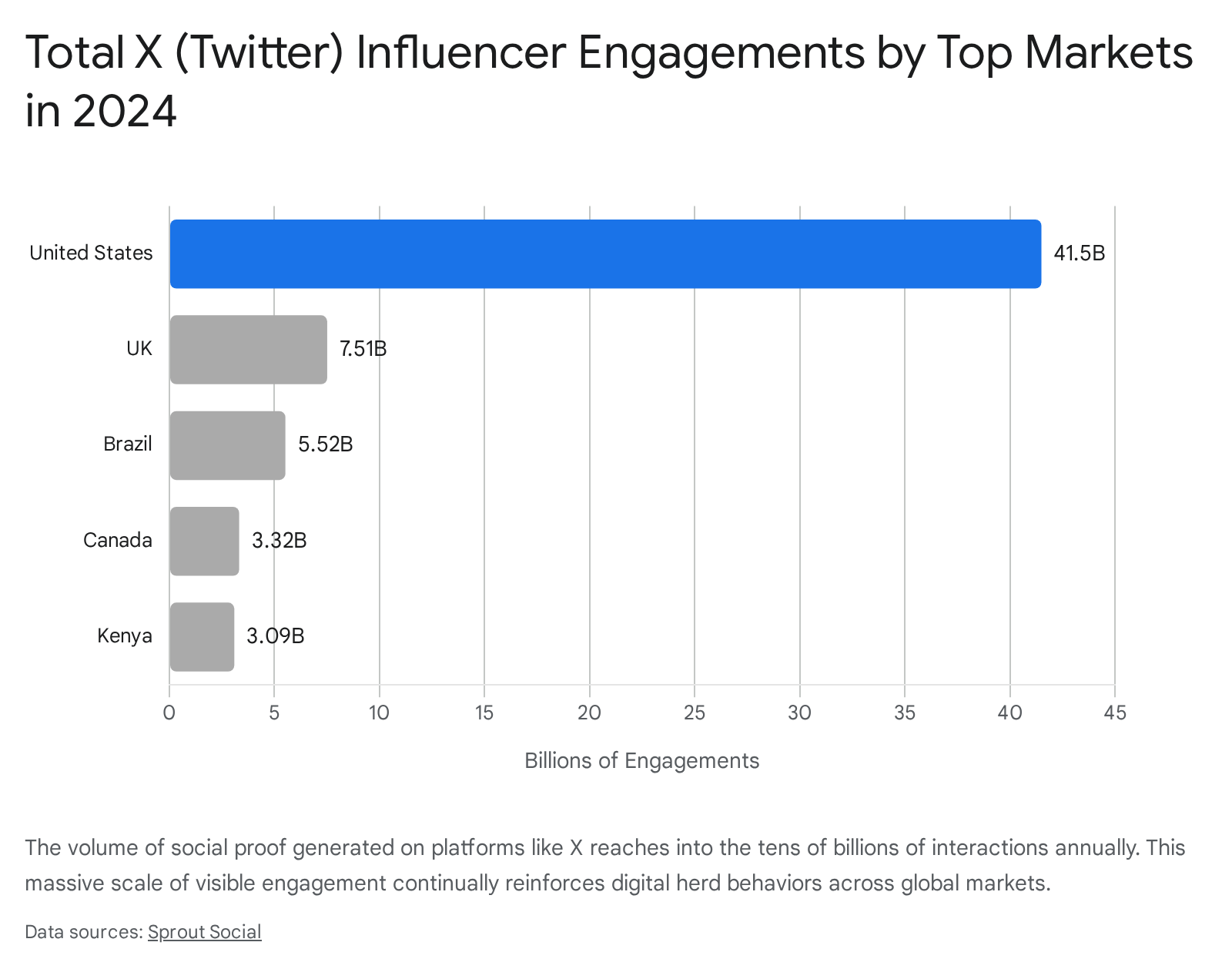
Engagement rates on X vary significantly by industry and media format. Audio tweets, for instance, have been shown to be more engaging than text or video tweets from the same users, suggesting that format novelties can temporarily bypass standard scrolling fatigue 19. To contextualize how social proof is measured by marketers on X, the following table outlines the 2024 engagement benchmarks across the platform:
| Engagement Performance Level | Average Engagement Rate | Context |
|---|---|---|
| Excellent | > 0.102% | Typical for top-tier brands and highly engaged sports teams 31. |
| Good | 0.045% - 0.102% | Indicates strong community resonance and healthy social currency sharing 31. |
| Average | ~ 0.029% | The overall platform average across all industries 31. |
| Below Average | < 0.029% | Typical for passive accounts or media organizations (which average ~0.009%) 31. |
The psychological toll of participating in this high-velocity engagement loop is severe. A rigorous experience-sampling study of 252 representative U.S. users on X, querying them five times a day over a week (generating 6,218 observations), demonstrated immediate cognitive impacts. The data revealed that using X is related to significant within-person decreases in subjective well-being, and concurrent increases in political polarization, outrage, and sense of belonging over the subsequent 30 minutes 2021.
Crucially, different usage patterns yielded different outcomes. Passive scrolling was linked to lower well-being, social usage increased the sense of belonging, and active information-seeking directly correlated with increased outrage 20. Because the algorithm elevates content that provokes high-arousal emotions, moralizing and manufactured controversy become highly visible, further validating extreme viewpoints and creating fortified echo chambers 5.
Misinformation and the Illusion of Consensus
The reliance on social proof creates critical vulnerabilities in the digital information ecosystem. Because human beings use engagement metrics as a proxy for credibility, viral content is frequently assumed to be true simply because it is popular 722.
Content that triggers moral outrage or awe spreads much faster than nuanced factual reporting, circumventing the slow, methodical process of scientific peer review 13523. Misinformation expert Dr. Claire Wardle notes that the internet has fractured into "splintered realities" where parallel universes of users consume entirely different sets of facts 35. In closed community spaces - such as specialized subreddits or dedicated social media groups - users find validation through shared anecdotes rather than scientific consensus. When an individual expresses a fringe medical belief or a folk theory and receives immediate validation through likes and community support, the belief becomes entrenched 35.
This illusion of consensus is easily manipulated. Bad actors utilize "dark patterns" such as fake reviews to artificially inflate the perceived credibility of a product or claim. Consumers, reacting to the default display of high ratings and positive feedback, fall victim to the bandwagon effect, purchasing products or adopting beliefs they would otherwise approach with skepticism 6. Furthermore, national surveys indicate that while 82% of adults perceive some or a lot of false health information on social media, a staggering 67% report being completely unable to accurately assess whether the social media information they are looking at is actually true or false 24. The herd mentality overrides independent critical thinking, allowing misleading information to achieve massive scale before fact-checking mechanisms can intervene.
Cross-Cultural Differences in Digital Herding
While the psychological vulnerability to social proof is a universal human trait, the mechanics of online sharing and herd behavior manifest distinctly across global cultures. Cross-cultural research, utilizing frameworks like Hofstede's cultural dimensions, indicates that the divide between Individualism and Collectivism significantly alters how and why users participate in digital herds 2526402728.
Individualism vs. Collectivism on Social Media
In collectivist cultures - predominantly found in East Asia, Latin America, and parts of the Middle East (e.g., India, Brazil, Indonesia) - societies are characterized by an emphasis on communal goals, group conformity, and interdependence 25264029. Individuals in these cultures typically possess an interdependent self-construal, viewing themselves as fundamentally connected to others and defining themselves by their relationships and group memberships 2627.
Consequently, online sharing is utilized primarily as a tool to create and maintain social capital, providing emotional support and strengthening interpersonal ties 253031. Collectivist users rely heavily on strong-tie networks, peer recommendations, and group norms to dictate their digital behavior. For example, research demonstrates that individuals in collectivist cultures hold larger strong-tie networks and trust these strong ties implicitly, making them highly responsive to community-driven marketing and localized storytelling 25402932. In the Brazilian market, for instance, marketing strategies heavily emphasize emotional and relational interactions to foster deep connections between brands and consumers, leaning into the collectivist desire for socialization 3233.
Conversely, individualistic cultures - such as the United States, the United Kingdom, and Germany - prioritize autonomy, personal freedom, and individual decision-making 252640. Users in these environments possess an independent self-construal and define themselves based on stable personal traits rather than external contexts 26. While individualists are still highly susceptible to social proof and virality, their motivations for sharing center around personal identity expression, individual reputation building, and self-actualization, rather than communal duty 252729. An individualist will share a viral article to demonstrate their own unique intelligence, whereas a collectivist might share it to maintain harmony and relevance within their social circle.
Privacy, Data Valuation, and Marketing Receptivity
These cultural disparities deeply impact digital privacy behaviors and marketing receptivity. Studies show that users from collectivist societies are more likely to adapt their privacy settings based on the perceived value of their personal data to the group. They actively self-regulate to avoid sharing "self-individuating" information or emotional states that might reflect poorly on their in-group or disrupt cohesion 30. However, a comparative study found that Indian (collectivist) participants' privacy behavior was highly sensitive to personal data value, whereas US (individualist) participants' behavior was not 30. Individualistic users, prioritizing independence, show less correlation between their behavioral caution and the valuation of their personal data, often disclosing information regardless of the potential impact on interdependent relationships 30.
To demonstrate how digital behavior diverges across the cultural spectrum, the following table summarizes the key differences in social media herding mechanisms:
| Cultural Dimension | Primary Sharing Motivation | Susceptibility to Social Proof | Digital Privacy Behavior | Effective Engagement Strategies |
|---|---|---|---|---|
| Collectivist (e.g., Brazil, India, Indonesia) | Maintaining social capital, strengthening ties, and ensuring communal harmony 2531. | Very high; heavily relies on group consensus, peer reviews, and strong-tie recommendations 62532. | Highly sensitive to data value; self-regulates sharing to protect group cohesion and avoid conflict 30. | Community engagement, influencer partnerships, and culturally relevant group narratives 4032. |
| Individualistic (e.g., USA, UK, Germany) | Self-expression, personal reputation building, and signaling unique identity 252629. | High; influenced by social proof, but personal attitudes play a stronger role in overriding group norms 29. | Less aligned with data value; privacy concerns often do not translate to actual behavioral caution 30. | Personalization, data-driven targeting, and campaigns appealing to individual success 40. |
The Impact of Modifying Visible Metrics
If visible metrics - such as view counts, likes, and shares - are the primary catalysts for herd behavior and the associated psychological distress, altering their visibility should fundamentally shift the digital ecosystem.
The Experiment of Hiding Likes on Instagram
Recognizing the immense pressure that public metrics place on users, platforms have experimented with obscuring these numbers. Instagram implemented a feature allowing users to hide public like counts, explicitly stating the goal was to "depressurize" the platform, reduce social comparison, and shift the focus away from a popularity contest toward genuine content creation and inspiration 3435.
Internal research driving this decision at Facebook (Instagram's parent company) suggested that users frequently experienced deep embarrassment when their posts received minimal engagement, leading them to delete content or post less frequently 34. By hiding public likes, the psychological barrier of performance anxiety was lowered. The theory held that without the constant, visible reminder of their position in the social hierarchy, users would post more freely and authentic content would replace engagement-baiting 3435.
However, the psychological benefits of hiding metrics remain heavily debated. A cross-sectional survey of 116 Instagram users examined whether utilizing the "hide like" feature was associated with improved self-esteem, body satisfaction, and lowered disordered eating symptoms 36. The study found that participants who used the feature demonstrated significantly lower scores on the Eating Attitudes Test, indicating a lower risk for developing eating disorders, likely due to reduced body-image comparison 36. However, contrary to the researchers' hypothesis, hiding likes yielded no statistically significant difference in baseline self-esteem or overall body dissatisfaction compared to users who kept likes visible 36. Many psychological experts note that while hiding metrics is a positive step, it is not a panacea for the deeper mental health issues exacerbated by constant digital connection .
Why Social Signals Remain Stubbornly Powerful
Ultimately, hiding metrics from the user interface does not alter the underlying architecture of the internet. Even when users cannot see the like counts on a post, the platform's algorithm continues to track engagement invisibly. Likes, watch-time, and shares continue to dictate how posts are prioritized in the feed 35. Therefore, the distribution of content remains governed by the laws of cumulative advantage and herd behavior, even if the mechanics are hidden from the naked eye.
Furthermore, humans are highly adaptable in their pursuit of social proof. When exact numbers are hidden, users seek validation through other visible cues, such as the volume of comments, the aesthetic quality of the user-generated content, or the presence of prestigious verified checkmarks 162237. The evolutionary drive to assess the behavior of the crowd and share what others are sharing cannot be entirely programmed away with a software update; it is an indelible feature of how the human brain processes information in complex, saturated environments.
Bottom line
The phenomenon of sharing what everyone else is sharing is a fundamental feature of human psychology amplified by modern digital architecture. Driven by the biological need for social belonging, high emotional arousal, and the cognitive shortcut of social proof, individuals consistently rely on the crowd to dictate value, resulting in cumulative advantages that make digital popularity highly unequal and unpredictable. While cultural dimensions dictate whether users share to strengthen communal ties or express individual identity, the underlying mechanics of algorithmic distribution ensure that visibility and engagement will continue to dominate user behavior. As long as platforms reward high-arousal content with rapid distribution, the digital ecosystem will remain permanently susceptible to irrational herding and the rapid spread of both viral trends and misinformation.