
Why We Forget Things We Just Learned
Forgetting newly learned information is not a cognitive failure, but an active, biologically essential process driven by the brain to prevent information overload. Unless new facts are anchored by strong emotions, meaningful context, or repeated practice, neural circuits actively prune them away to keep the mind flexible and ready for present challenges. Ultimately, the brain is designed to constantly filter out the irrelevant so it can adapt to an ever-changing environment.
The Mathematical Reality of Memory Decay
We have all experienced the frustration of closing a book, walking away from a lecture, or leaving a meeting, only to realize that the information we just absorbed has seemingly vanished. The systematic study of this rapid memory loss is not a new scientific pursuit; in fact, it forms the bedrock of modern cognitive psychology.
In the late nineteenth century, German psychologist Hermann Ebbinghaus pioneered the experimental study of memory 11. Before his groundbreaking work from 1880 to 1885, memory was largely considered a philosophical concept that was far too subjective to measure scientifically 1. To eliminate the influence of prior knowledge, meaning, and emotional attachment, Ebbinghaus invented "nonsense syllables" - meaningless consonant-vowel-consonant combinations like "WID", "ZOL", and "BUP" 12.
By acting as his own test subject, he spent over two years memorizing lists of these syllables and testing himself at precise time intervals to quantify exactly how much information he retained 11. The result of his grueling self-experimentation was the "forgetting curve," which stands as the first quantitative mathematical model of human memory decay 13.
The Pure Measure of "Savings"
Ebbinghaus measured memory using a concept he called a "savings score" 25. Rather than simply counting how many syllables he could freely recall at a later date, he measured how much less time it took to relearn the exact same list after a delay compared to the original learning session 4.
For example, if it took him 25 repetitions to perfectly memorize a list on Monday, and 20 repetitions to relearn it to perfection on Tuesday, the reduction of 5 repetitions represented a 20% "savings" in effort 45. Recent mathematical analyses of Ebbinghaus's 1885 monograph have proven that this savings measure is independent of initial encoding strength and learning time, making it an exceptionally "pure" and robust measure of memory retention 6.
The original data revealed an uncomfortable truth about the human brain: the vast majority of what we learn without immediate reinforcement is discarded within hours. If plotted on a graph, the Ebbinghaus Forgetting Curve shows a stark, continuous drop in memory retention over the first 24 hours. The slope of memory loss is exceptionally steep within the first 20 minutes to one hour, before leveling off into a much longer, gradual tail of exponential decay over the subsequent 31 days 19.
| Time Since Learning | Approximate Percentage Forgotten | Percentage Retained (Savings) |
|---|---|---|
| 20 minutes | 42% | 58% |
| 1 hour | 56% | 44% |
| 9 hours | 64% | 36% |
| 24 hours (1 day) | 67% | 33% |
| 6 days | 75% | 25% |
| 31 days (1 month) | 79% | 21% |
Data derived from Ebbinghaus's original 1885 publication, based on savings scores from nonsense syllable experiments 12. Exact percentages may vary slightly depending on the specific mathematical fit applied.
Modern Replications and the 24-Hour Jump
For over a century, Ebbinghaus's findings were accepted as foundational, yet his original study was essentially a sample size of one 1. It was not until 2015 that researchers Jaap Murre and Joeri Dros published a rigorous, modern replication of the classic experiment in the peer-reviewed journal PLOS ONE 78.
To replicate the study, a single human subject spent 70 hours learning and relearning 70 lists of nonsense syllables 57. To ensure accuracy, the modern researchers controlled variables tightly: the stimuli conformed to the phonotactics of the Dutch language, lists were printed in 11-point Calibri font, and a pre-experimental practice phase was used to prevent general learning effects from skewing the early data 59. The subject learned the syllables over intervals ranging from 20 minutes to 31 days 57.
The researchers analyzed the resulting data using various mathematical equations and found that the modern results were strikingly similar to Ebbinghaus's original 1880 data 78. They concluded that the forgetting curve is a robust, replicable phenomenon that maintains a similar shape across variations in language, culture, and historical time period 13.
Interestingly, the replication study uncovered a nuance that Ebbinghaus missed: the forgetting curve is not perfectly smooth 57. Murre and Dros found strong evidence for a sudden "jump" or upward stabilization in memory retention starting at the 24-hour mark 57. Neuroscientists theorize this bump in retention is directly related to the memory-consolidating effects of sleep 513. During deep sleep, the brain actively replays and strengthens newly formed neural connections, momentarily pushing back against the tide of exponential decay 513.
The Attention Bottleneck and Short-Term Memory
While the biological decay of established memories explains why we forget things over days and weeks, it does not explain why we might forget someone's name three seconds after shaking their hand. This incredibly common experience is rarely a failure of memory decay; rather, it is a failure of encoding 1011.
The Limits of Working Memory
Memory formation operates in three distinct stages: encoding, storage, and retrieval 1213. Short-term memory - often referred to as working memory when we are actively manipulating information - has severe biological limitations.
In 1956, cognitive psychologist George A. Miller published a highly cited paper in Psychological Review suggesting that humans can hold roughly 7 ± 2 items in their short-term memory at any given time 1415. Miller noted that this capacity limit applied strictly to unidimensional stimuli, such as random numbers or letters 1415. Modern research suggests the true capacity without mental grouping (chunking) may be even lower, perhaps around four individual items 15. Short-term memory is estimated to last only 15 to 30 seconds unless the information is actively rehearsed, repeated, or processed into long-term storage 1617.
When you meet someone new, or when you are bombarded with instructions at a new job, your brain is overwhelmed with stimuli 1118. You are evaluating facial expressions, navigating the social anxiety of making a good impression, scanning the room, and planning what to say next 1112. Because your attention is divided and your working memory is full, the new information never passes through the cognitive bottleneck into the hippocampus for encoding 1112. You simply cannot forget what you never truly learned in the first place.
The Baker/Baker Paradox and Semantic Hooks
Even when we do pay adequate attention, we forget some things much faster than others. In cognitive psychology, this discrepancy is perfectly illustrated by the "Baker/baker paradox" 13.
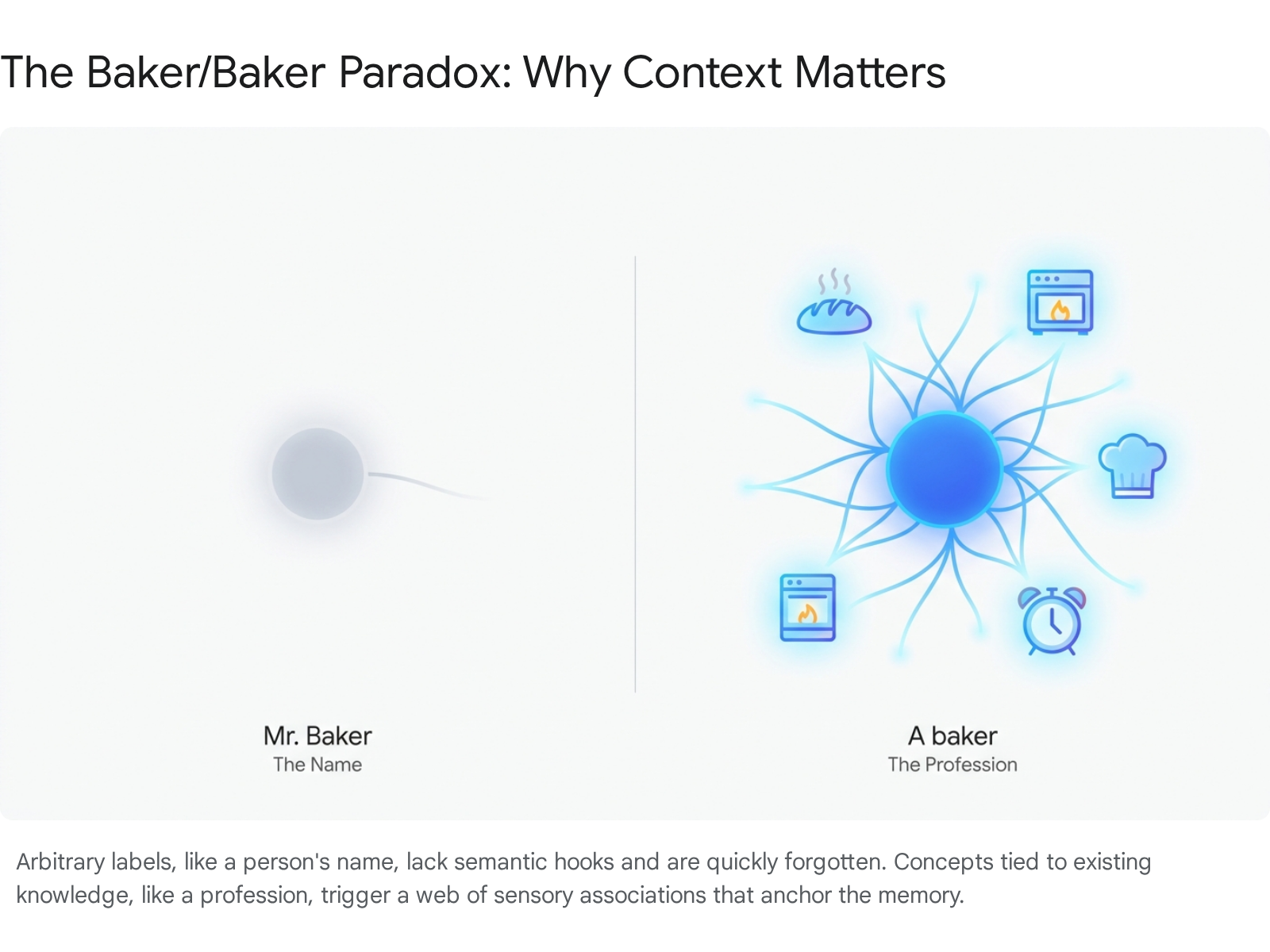
If you are introduced to a man and told, "This is Mr. Baker," you are highly likely to forget his name almost immediately. However, if you are introduced to a man and told, "This man is a baker," you are highly likely to remember his profession 13.
The biological reasoning behind this phenomenon is elegant. The word "baker" as a profession provides your brain with a wealth of semantic hooks. The moment you hear the profession, your brain subconsciously activates established, widespread neural networks related to the smell of fresh bread, early mornings, white aprons, and pastries 13. The new information easily latches onto these pre-existing networks, integrating seamlessly into long-term memory.
Conversely, "Mr. Baker" as a proper name is an arbitrary label 1112. It holds no inherent meaning and lacks sensory or semantic hooks. The brain struggles to encode isolated, meaningless data, which is exactly why Ebbinghaus had to use nonsense syllables to measure pure, rapid forgetting in his foundational experiments 111.
The Neuroscience of Active Forgetting
For decades, the prevailing psychological theory was that forgetting was simply the passive decay of memory traces - a slow, inevitable erosion of neural connections over time, much like a photograph fading in the sun 1924. However, modern neuroscience has completely overturned this view. Forgetting is not a glitch, a failure, or a passive fading; it is a highly active, finely tuned, and biologically regulated mechanism 1920.
The Dual Role of Dopamine
The most profound discoveries regarding active forgetting have come from studying simple organisms, such as the fruit fly (Drosophila melanogaster) and the microscopic nematode Caenorhabditis elegans 2021. Because these creatures have short life cycles and relatively simple nervous systems, yet share vast amounts of genetic pathways with humans, they serve as perfect models for decoding the molecular basis of memory 2021.
Researchers have discovered that dopamine - a neurotransmitter famous for its role in reward, pleasure, and motor control - is also the brain's primary architect of forgetting 2022. In a landmark study published in Cell Reports, scientists demonstrated that a small subset of dopamine neurons actively regulates both the acquisition of new memories and the rapid erasure of them 2223.
How can a single chemical perform two completely opposite functions? The secret lies in the diverse receptors that receive the chemical signal. When a fruit fly learns to associate a specific new smell with an electric shock, a specific dopamine receptor called dDA1 (a homolog of the mammalian D1 receptor) becomes highly stimulated, forming the memory 222324.
However, once the memory is successfully acquired, those exact same dopamine neurons continue firing. This ongoing, baseline dopamine release targets a completely different receptor called DAMB, which is highly expressed in the insect's mushroom bodies (the brain structures vital for learning) 2223. The DAMB receptor, signaling via a specific Gq protein pathway, acts as a biological eraser. It continuously works to dismantle recently acquired, but not yet consolidated, memories by altering intracellular calcium levels and activating the small GTPase Rac1 pathway 192325.
If scientists artificially block the DAMB receptor, or inhibit dopamine signaling immediately after learning, the organisms exhibit "super memory" - they hold onto the learned information much longer than normal 2022. Conversely, hyperactivating these specific dopamine neurons erases the memory completely 22. Further genetic studies have shown that a memory suppressor gene known as sickie (whose human homolog is NAV2) functions within a single dopamine neuron to support this process of active forgetting 26. Knocking down the sickie gene impairs forgetting by reducing the calcium influx and dopamine release required to prune the memory 26.
Executive Control in the Mammalian Brain
This active, dopamine-driven forgetting mechanism is heavily conserved across species, operating fundamentally similarly from worms to mammals 2027. In humans and other mammals, active forgetting is deeply tied to the prefrontal cortex - the brain's executive control center 27.
When we try to recall specific information, our brain often has to suppress competing or outdated memories. This psychological phenomenon is known as "retrieval-induced forgetting." For example, if you get a new bank PIN, actively trying to remember the new numbers will cause your brain to actively suppress and eventually forget your old PIN 1928.
In rodent studies, researchers found that this targeted, adaptive forgetting of competing memories is driven by dopamine release in the medial prefrontal cortex acting through D1 receptors 27. When scientists block these specific receptors as the animals encounter a familiar object, the animals fail to actively forget competing object memories, rendering them cognitively inflexible 27.
If we remembered every license plate we ever saw, every irrelevant conversation, and every mundane detail of our daily commute, our brains would be paralyzed by severe information overload 20. Active dopamine-driven forgetting ensures that our neural circuitry remains focused, flexible, and updated with only the most relevant survival data 20.
Engrams and Synaptic Pruning
To fully understand the mechanics of why we forget, we must look at how a memory physically exists in the physical architecture of the brain. Memories are not stored in a single "file cabinet" area. Instead, they are distributed as distinct networks of interconnected cells called engrams 2930.
When you learn something new, a specific ensemble of neurons activates simultaneously. Through a process called memory allocation, neurons with higher intrinsic excitability (driven by increased phosphorylation of proteins like CREB) "win" the biological competition to become part of the new engram 30. As you consolidate the memory, profound structural changes occur: dendritic spines (the receiving branches of neurons) increase in density, and synaptic connections between the specific engram cells are physically strengthened 3031.
The Inaccessibility Hypothesis
For years, scientists fiercely debated whether forgetting meant the engram was physically destroyed and erased entirely, or whether the engram was still intact but the brain had simply lost the internal "map" to find it (retrieval failure) 3132. Recent breakthroughs in optogenetics - a revolutionary technique that allows scientists to turn specific, genetically tagged neurons on and off using precise bursts of laser light - have provided a definitive answer.
When a memory is forgotten naturally over time, the dendritic spine density of the specific engram cells shrinks, and the synaptic connections weaken 2933. If you place a mouse in an environment where it previously learned something it has now forgotten, it shows no behavioral memory of the event 3234. However, if researchers use targeted optogenetic lasers to artificially stimulate the exact engram cells associated with that "forgotten" memory, the mouse instantly recalls the behavior perfectly 2934.
This demonstrates unequivocally that "forgotten" memories often leave silent, latent traces deep in the brain 3032. Forgetting is an adaptive form of engram plasticity that switches an ensemble of cells from an "accessible" state to an "inaccessible" state 29. The memory is not gone; it is simply locked away because the brain deemed it subjectively irrelevant to current environmental demands 2933.
Neurophysiological Noise and Circuit Remodeling
The probability of an engram becoming inaccessible naturally increases due to normal brain activity. Ongoing neurogenesis (the birth of new neurons, primarily in the dentate gyrus of the hippocampus) and standard neurophysiological "noise" constantly remodel brain circuits 313536. As new synapses form and old ones are repurposed to learn new skills, the pathways leading to older engrams become contaminated or destabilized 3642.
Interestingly, this active remodeling isn't strictly happening in gray matter. Recent 2025 research indicates that environmental enrichment - being exposed to highly stimulating, complex environments - induces significant plasticity in the brain's white matter tracts, such as the corpus callosum and fimbria 36. Using ex vivo brain diffusion-weighted MRI, researchers found that myelin-related plasticity in these white matter tracts actually promotes the active forgetting of older, less relevant contextual memories to make room for complex new environmental data 36.
How Emotion Anchors Memory
If an event is mundane and devoid of context, we forget it quickly. If an event is emotionally charged, it becomes seared into our minds. We routinely forget what we had for lunch last Tuesday, but most people vividly remember where they were on major historical dates or the details of the day their first child was born 37.
Neuroscience research reveals that integrating emotion into information significantly alters how the brain handles it 38. When an experience triggers a strong emotional response, it highly engages the amygdala - the brain's primary emotional processing center 3839. The amygdala then sends powerful, synchronized signals to the hippocampus, the region critical for episodic memory formation 3839.
In a 2020 study out of Columbia University, researchers tracked hippocampal neurons in mice reacting to fearful stimuli. They found that these neurons synchronized heavily when the memory was recalled, and the greater the synchrony between the hippocampus and the amygdala, the stronger and more resilient the memory became 37. This synchronized neural firing acts as a physiological stamp of immense importance, effectively shielding the memory from the dopamine-driven active forgetting processes discussed earlier 2237. From an evolutionary standpoint, fear and intense emotion act as paramount survival signals: the brain must remember what caused extreme danger or extreme pleasure to navigate the future successfully 37.
However, emotion is a double-edged sword when it comes to memory retention. While it amplifies explicit memory, emotional saturation can cause cognitive interference 38. High-stress scenarios, such as panic, intense anger, or severe crisis, can trigger "emotional interference," which overwhelms factual content 38. This hinders associative memory - the ability to connect different pieces of rational information together - leading to distorted memories or decision fatigue in high-stakes environments 38.
Cultural and Linguistic Influences on Memory
While the biological hardware of memory formation is universal across the human species, the cognitive software - how we process, prioritize, and retrieve information - is deeply shaped by culture and language 4640. For decades, cognitive science relied heavily on WEIRD (Western, Educated, Industrialized, Rich, and Democratic) populations, missing the profound impact of cultural upbringing on the forgetting curve 4041.
The Cultural Lens of Visual Recall
Accumulating peer-reviewed research shows that individuals from independent, individualistic cultures (such as North America) and interdependent, collectivistic cultures (such as East Asia) encode and forget visual and autobiographical information differently 4942.
When asked to recall a visual scene, Americans typically focus their attention on specific, central objects and fine feature details 4649. Consequently, Americans generally demonstrate a higher memory specificity for recognizing exact objects and distinguishing them from highly similar lures (a cognitive process called pattern separation) 4143. Conversely, East Asians tend to process visual information much more holistically, prioritizing the background context and the relationship between various objects 4649.
These cultural differences have measurable neurological correlates. During memory retrieval tasks using functional MRI (fMRI), Americans and Taiwanese participants show significantly different recruitment patterns in brain regions like the left inferior frontal gyrus (LIFG) and the left superior parietal cortex 4252. Furthermore, spatial frequency research indicates that Westerners prioritize high-spatial-frequency information (sharp details, fine edges), whereas East Asians prioritize low-spatial-frequency information (overall shape and global layout), leading to different rates of short-term memory retention depending on what type of visual data is presented 44.
Language and Short-Term Memory Capacity
Even the speed at which we speak our native language significantly impacts our baseline short-term memory capacity. Remember George Miller's "Magical Number 7 ± 2" for digit span 1415? Modern cross-cultural research reveals that this limit is not a universal constant, but is heavily dependent on the acoustic length of words in a given language 14.
Short-term memory relies heavily on a "phonological loop" - essentially an internal acoustic voice that constantly rehearses information. Humans have a roughly two-second biological capacity limit on the amount of sound they can hold in this active acoustic loop 14. Because numbers in Mandarin Chinese are incredibly short and extremely fast to pronounce, native Chinese speakers can hold an average of 9.9 digits in their short-term memory 14. In stark contrast, speakers of Welsh - a language with much longer, multi-syllabic digit names and slower speech rates - have an average short-term memory capacity of only 5.8 digits 14.
When Is Forgetting Abnormal?
While rapid forgetting is a normal, healthy part of daily brain function, there are points where memory loss transitions from functional pruning to pathological impairment.
Short-term memory loss is a normal part of aging for many people, often presenting as occasionally forgetting an acquaintance's name, misplacing keys, or momentarily forgetting why you walked into a room (a classic failure of working memory attention) 1645. This normal transience does not disrupt a person's ability to live independently 46.
However, when short-term memory loss becomes progressive and interferes with daily tasks, it may signal mild cognitive impairment or dementia, such as Alzheimer's disease 4647. Alzheimer's disease typically attacks the hippocampus first, devastating short-term memory encoding 47. This explains why a patient might vividly remember their wedding day from fifty years ago (long-term memories stored broadly across the cerebral cortex) but cannot recall what they ate for breakfast ten minutes prior 47.
Not all significant memory loss is permanent. Several treatable conditions can severely disrupt the brain's ability to encode and retain information. Chronic stress, anxiety, and depression consume working memory resources, preventing new information from being processed 1646. Severe Vitamin B12 deficiency impairs nerve cell health, and obstructive sleep apnea actively prevents the deep sleep required for memory consolidation, both leading to severe but reversible cognitive fogginess and forgetfulness 4647.
Evidence-Based Strategies to Stop Forgetting
If the brain is biologically programmed to actively prune unreinforced memories, how can we fight back? Cognitive psychology and neuroscience have identified several highly effective, evidence-based methods for bypassing the brain's internal erasure systems.
1. Spaced Repetition and Retrieval Practice
The single most effective way to defeat the Ebbinghaus forgetting curve is spaced repetition 1324. Instead of massed practice (cramming), which only temporarily pools information in short-term memory and leads to rapid decay, spaced repetition involves reviewing material at gradually increasing intervals 2448.
Every time you actively retrieve a memory just as you are about to forget it, you flatten the slope of the forgetting curve 9. The biological mechanism here is profound: forcing the brain to recall information signals to the neural circuitry that this engram is highly relevant for survival. This triggers cellular processes that physically alter the engram, increasing dendritic spine growth and hardwiring the memory into long-term storage 3034. Meta-analyses show that distributed practice combined with active retrieval consistently outperforms cramming by 10% to 30% 19.
2. Protecting Attention and Single-Tasking
Because encoding requires directed attention, protecting your focus is paramount. Neuropsychologists strongly recommend single-tasking over multitasking 4950. When you divide your attention between reading an article, checking a smartphone, and listening to background chatter, you limit the working memory resources available to encode any single stream of data 1151.
Practicing mindfulness - focusing attention entirely on the present moment - has been shown to literally rewire the brain over time. It reduces baseline activity in the default mode network (the brain areas associated with mind-wandering) and strengthens sustained attention 4952. Even just 5 to 10 minutes of daily mindfulness meditation can significantly improve your ability to concentrate, ensuring that new information successfully passes from short-term perception into encoded memory 4950.
3. Cognitive Training and Neuroplasticity
While the efficacy of commercial brain-training games has long been debated, recent rigorous meta-analyses suggest they can effectively improve working memory and processing speed in healthy adults when designed correctly 5354. A landmark 2025 clinical trial led by McGill University demonstrated that an evidence-backed application directly improved neural networks associated with learning and memory in older adults 55. The 10-week intervention successfully enhanced "cholinergic function" - a chemical system vital for attention, memory, and decision-making that typically decays with age - restoring it to levels typically seen in individuals a decade younger 55.
4. Sleep and Consolidation
As Murre and Dros discovered in their Ebbinghaus replication, memory retention stabilizes significantly at the 24-hour mark 513. This highlights that sleep is not a passive resting state for the brain; it is a highly active period of systems consolidation 35. During sleep, the brain actively replays the day's events, pruning away the irrelevant neural connections (forgetting) while reinforcing the important engrams 13. Without adequate, high-quality sleep, this consolidation process is severely disrupted, leading to mental fogginess and severe deficits in long-term memory formation 1346.
Bottom line
Forgetting is not a flaw in our mental hardware; it is a critical, dopamine-driven biological feature that prevents our brains from becoming paralyzed by irrelevant data. Memories are not simply erased; instead, their neural engrams are actively weakened and rendered inaccessible unless we prove their value to our survival. To successfully retain what we just learned, we must actively hack this system by anchoring new facts to deep meaning and emotion, protecting our attention during encoding, and utilizing spaced repetition to signal to the brain that the information is worth keeping.