
Why We Forget and How Memory Works
Forgetting is not a biological failure or a glitch in your neural hardware; rather, it is an active, highly regulated mechanism designed to clear cognitive clutter and ensure your brain remains adaptable to a changing environment. While we often blame a fading memory on time or aging, cutting-edge neuroscience reveals that specialized cellular processes - from dopamine-driven erasure to nightly spinal fluid washes - are constantly working to prune our neural networks, ensuring we only hold onto what truly matters.
The Myth of the Video Camera Brain
To understand why we forget, it is crucial to dismantle the most pervasive cultural myth about human memory: the idea that the brain operates like a digital hard drive or a video camera. This misconception suggests that memory records events perfectly as they happen, storing them in a pristine archive for later playback. Under this framework, forgetting is viewed as a corrupted file, a damaged tape, or a lack of storage space 123.
In reality, human memory is a dynamic, highly reconstructive process. Every time you recall a past event, your brain does not simply press "play." Instead, it pieces together fragments of information - visual data from the occipital lobe, emotional context from the amygdala, and spatial maps from the hippocampus - to actively rebuild the experience in real time. Because the brain's primary evolutionary goal is to help you survive and make good decisions in the present, it frequently reframes, alters, and edits past events to fit your current worldview 133. The information that is relevant right now can seamlessly overwrite what was originally encoded, which explains why two people can experience the exact same event and recall it entirely differently, and why the phenomenon of "false memories" is so common 13.
Interestingly, while experts have long lamented the public's belief in the "video camera" myth, recent sociological research suggests the general public actually understands memory better than they are given credit for. A 2020 study from University College London found that when people compare memory to a video camera, they do not literally mean an infallible recording; rather, they are describing the subjective experience of recalling sequential scenes. The vast majority of people readily acknowledge that memories decay, become distorted, and can be entirely mistaken 2.
Furthermore, the brain's storage capacity is rarely the limiting factor in why we forget. Neuroscientists estimate that the human brain's theoretical storage capacity is somewhere in the vicinity of a million gigabytes, which equates to hundreds of years of continuous high-definition video 4. The difference between remembering and forgetting is not a matter of running out of space. It is a matter of how information is originally encoded, the physical strength of the neural connections formed, and the availability of the right cues to retrieve the data when needed.
The Physical Reality of Memory: Engrams and Synapses
When you learn a new fact or experience a new event, that information must take on a physical form in the brain to survive. This physical embodiment of a memory is called an "engram." For over a century, the engram was a theoretical construct, first proposed by Richard Semon, but modern neuroscience - using advanced optogenetics and cellular tagging - has allowed researchers to physically map, observe, and even manipulate these specific cellular traces in awake animals 5769.
The lifespan of an engram consists of four primary stages: encoding, consolidation, retrieval, and forgetting. During the encoding phase, sensory experiences activate specific populations of neurons. Cell-intrinsic properties dictate which cells are recruited into an engram network. For instance, neurons exhibiting temporary enhancements in intrinsic excitability, often driven by the phosphorylation of a protein called CREB, are primed to be selectively recruited into the new memory trace 67.
Following encoding, the fragile new memory must undergo consolidation to become permanent. This involves a rapid phase of synaptic consolidation within the first few hours, marked by the expression of immediate early genes and epigenetic reprogramming like DNA methylation 67. Over the ensuing days and weeks, the memory undergoes systems-level consolidation, gradually shifting its primary reliance from the hippocampus (the brain's short-term clearinghouse) to the broader, more permanent networks of the neocortex 576. Throughout this maturation process, the engram transitions from a silent, unstable state to a functionally mature configuration characterized by enduring structural adaptations 7.
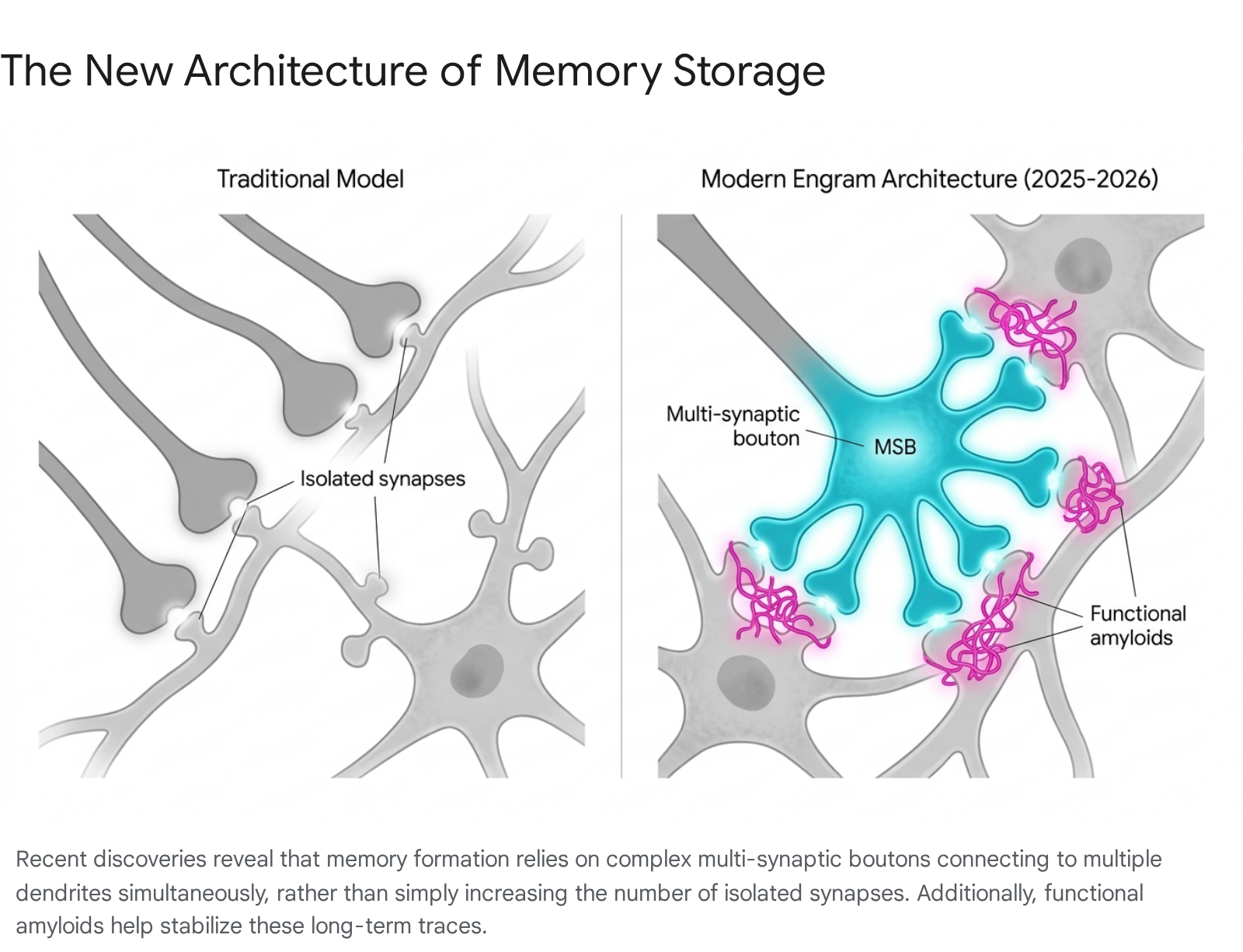
Historically, the dominant theory of how these structures adapted was rooted in Hebbian plasticity, often summarized as "neurons that fire together, wire together." Scientists believed that learning primarily resulted in a bulk increase in the number of isolated synapses between engaged neurons 812. However, the biological understanding of memory storage underwent a massive paradigm shift in 2025 and 2026.
A landmark March 2025 study from the Scripps Research Institute utilized cutting-edge genetic tools, artificial intelligence, and 3D electron microscopy to reconstruct memory circuits at the nanometer scale. The researchers discovered that the total number and arrangement of isolated synapses actually remained unchanged after a memory formed. Instead, neurons allocated to an engram expanded their physical connectivity through "multi-synaptic boutons" (MSBs). These specialized axonal terminals can simultaneously signal to up to six different dendrites rather than just one. This complex expansion recruits surrounding neurons that were not even engaged during the initial learning, creating a highly robust, interconnected web supported by metabolic glial cells called astrocytes 89.
Even more surprising was a January 2026 breakthrough from the Stowers Institute, which revealed that the brain deliberately forms functional amyloids - proteins that fold and clump together - to solidify these long-term memories. While amyloids have long been villified by the medical community for their destructive role in neurodegenerative diseases like Alzheimer's, this research demonstrates that "chaperone proteins" in a healthy nervous system actively guide standard proteins to change shape and form protective amyloid structures that house permanent memory traces. This flips a long-standing biological dogma on its head, suggesting the brain uses controlled protein clumping as a protective memory vault 10.
The Classic Psychological Theories of Forgetting
Before neuroscientists could view memory at the microscopic level, cognitive psychologists debated the mechanics of forgetting through behavioral observation. Over decades of research, these theories consolidated into three primary frameworks to explain why we lose access to information: trace decay, interference, and retrieval failure 151617.
Trace Decay and the Limits of Short-Term Memory
The most intuitive explanation for forgetting is the trace decay theory, which posits that memory traces simply fade away over time if they are not actively rehearsed. Much like a path in the woods becoming overgrown with disuse, the physical and chemical changes in the nervous system associated with a memory gradually weaken 1516.
While decay theory makes logical sense, modern psychology suggests it is highly applicable to short-term memory, but largely inadequate for explaining long-term forgetting. Human short-term working memory acts as a highly limited cognitive buffer, holding information for only 15 to 30 seconds unless it is consciously rehearsed. Without rehearsal, that specific trace rapidly decays to make room for new environmental stimuli 16. However, decay theory struggles to explain why people frequently recall ancient, unrehearsed memories - like the name of a childhood pet or a traumatic event - with startling clarity decades later. If time alone caused decay, these unaccessed memories should be entirely gone 151617.
Interference Theory: Memories in Competition
Interference theory is widely considered the dominant psychological explanation for forgetting from long-term memory. Rather than a memory dissolving into nothingness, this theory proposes that memories remain entirely intact but actively block, impair, or overwrite one another during the retrieval process 1718.
The prefrontal cortex, which is critical for cognitive control and conflict resolution, attempts to sort through competing memory traces, but the more similar the memories are, the greater the interference 18. This competition manifests in two primary directions. Proactive interference occurs when older, deeply entrenched memories disrupt your ability to recall newly learned information. For example, if you change your email password, the deeply encoded muscle memory of typing your old password will persistently interfere when you try to recall the new one 151819.
Conversely, retroactive interference occurs when newly acquired information disrupts your access to older memories. If you learned French vocabulary last year, and spend this month intensely studying Spanish, the new Spanish neural pathways may overwrite or suppress your ability to retrieve the French words 151819. Research confirms that forgetting is significantly greater when the time between learning and testing is filled with similar activities, highlighting how new data aggressively crowds out the old 1819.
Cue-Dependent Forgetting (Retrieval Failure)
Have you ever struggled to remember an actor's name during a conversation, only for it to effortlessly pop into your head three hours later while washing dishes? This frustrating experience highlights the retrieval failure theory, also known as cue-dependent forgetting. According to this framework, the memory is safely stored in the long-term archive, but the brain simply lacks the appropriate biological "search terms" or cues to locate it 151619.
When the brain encodes a memory, it does not do so in a vacuum. It simultaneously encodes the surrounding environment (external context cues) and the individual's physiological and emotional state (internal state cues). If the environment or your mood during the retrieval attempt drastically differs from the time of encoding, access to the memory is severely impaired 1619. Foundational research by psychologists Tulving and Psotka demonstrated that participants who seemingly "forgot" long lists of words could easily recall them when provided with simple category cues, proving the information had not been erased but was merely inaccessible without a proper trigger 17. Similarly, researchers Baddeley and Godden famously demonstrated that scuba divers who learned word lists underwater recalled them significantly better when tested underwater compared to when tested on dry land, proving the environment itself is woven into the memory trace 19.
What Causes the "Doorway Effect"?
One of the most universally relatable experiences of cue-dependent forgetting happens in a matter of seconds: you stand up from the couch, walk into the kitchen to grab a pen, and the moment you cross the threshold, your mind goes completely blank. Psychologists refer to this sudden, frustrating amnesia as the "doorway effect" or the "location updating effect" 201122.
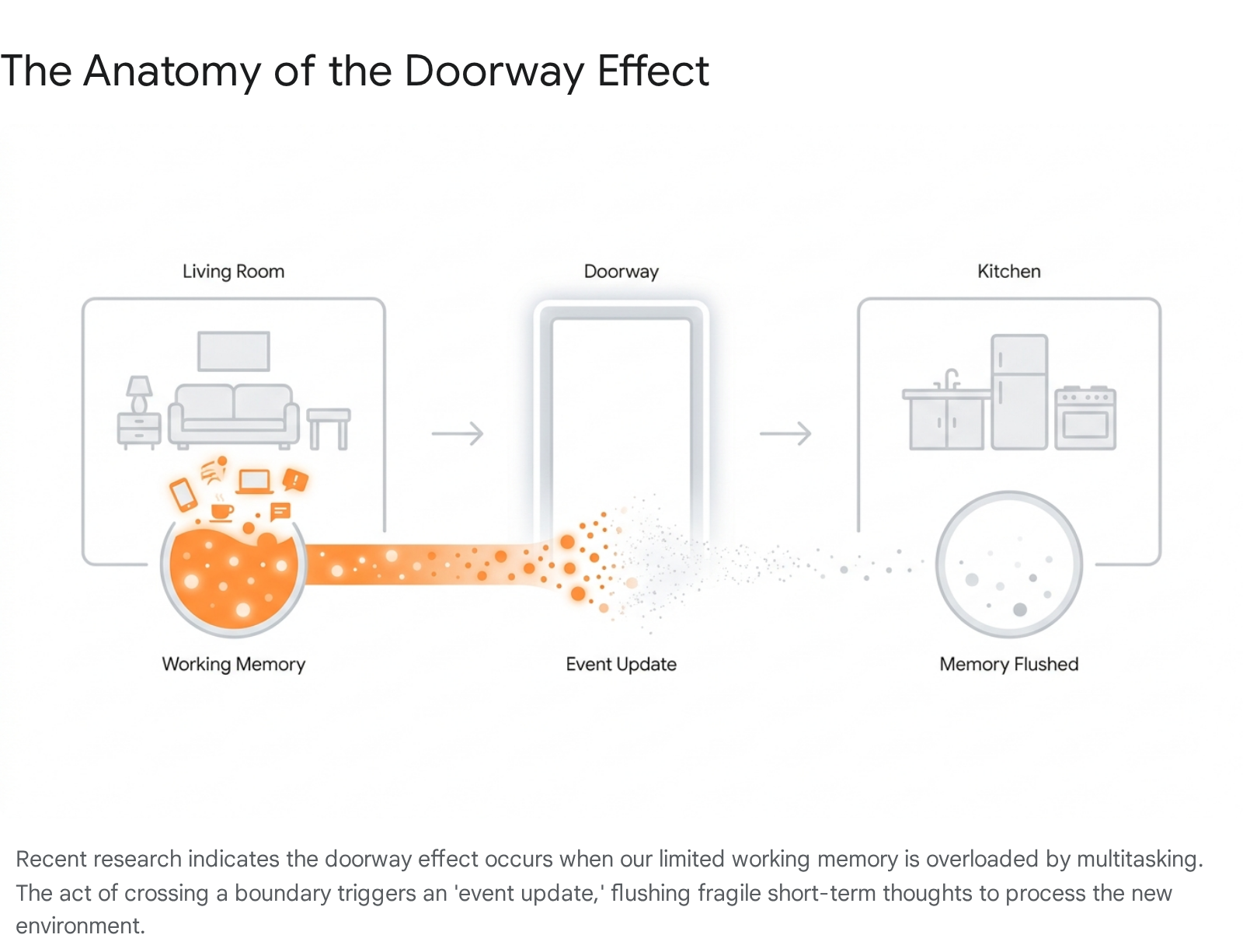
For years, the prevailing explanation was the "Event Horizon Model." Developed following a foundational 2011 study at the University of Notre Dame, this model suggests that the human brain does not process reality as a continuous, uninterrupted video feed. Instead, the brain heavily chunks reality into distinct, manageable episodes or "events" 201122. Crossing a physical boundary, such as a doorway, serves as a hard cognitive trigger. The brain perceives entering a new room as the start of a new event, effectively closing the cognitive file on the previous room and relegating its contents to the background.
As study co-author Gabriel Radvansky explained, the doorway serves as an event boundary in the mind, separating episodes of activity. Recalling a decision made in the living room while standing in the kitchen is difficult because the thought has been compartmentalized 20. The physical act of moving through the doorway initiates an upload of new sensory data - the hum of the refrigerator, the layout of the countertops - which aggressively pushes the fragile short-term goal of finding a pen out of the working memory window 22.
However, more recent research has added crucial nuance to this phenomenon, proving that physical doors alone do not magically erase thoughts. A 2021 study out of Bond University utilized 3D virtual reality to test the doorway effect under varying psychological conditions. To their surprise, they found that when participants had their full attention on a memorization task, walking through virtual doorways had absolutely no effect on their memory. They remembered everything perfectly 201213.
The researchers discovered that the doorway effect only became pronounced when the participants' working memory was actively overloaded. When participants were asked to memorize objects while simultaneously counting backward, the failure rate skyrocketed 201213. Human working memory is highly fragile and heavily restricted in capacity. When we are multitasking, distracted, or deep in thought about our day, our cognitive buffer is pushed to its absolute limit. In this vulnerable state, the subtle context shift of crossing a doorway provides just enough cognitive interference to flush the fragile goal out of the active buffer 1213. Ultimately, the doorway effect is less about the physical architecture of our homes and more about the fragility of human attention in shifting contexts.
The Biology of Active Forgetting: A Feature, Not a Bug
Historically, forgetting was viewed purely as a malfunction - a passive decay or an unfortunate consequence of disease. Yet, cutting-edge neurobiology paints a radically different picture: forgetting is a highly tuned, metabolically expensive, and active process orchestrated by specific molecular pathways. The brain explicitly wants to forget.
In an unpredictable world, retaining every minute detail of every day would result in massive cognitive overload, behavioral rigidity, and an inability to generalize rules for future survival 1415. A 2022 theory published in Nature Reviews Neuroscience formally proposed that natural forgetting is fundamentally a form of learning. Rather than erasing the physical engram entirely, the brain remodels neural circuits based on environmental feedback, actively switching engram cells from an "accessible" state to an "inaccessible" state 14. The memory remains locked in the vault, but the brain deliberately changes the combination in response to a changing environment.
Dopamine: The Brain's Master Eraser
One of the most fascinating discoveries regarding this active erasure involves dopamine - a neurotransmitter famous for its role in reward, motivation, and the acquisition of new memories. Paradoxically, dopamine is also the brain's master eraser 151617.
A 2025 study from Flinders University utilizing C. elegans (microscopic worms that share key genetic brain pathways with humans) demonstrated that the brain actively forgets using the exact same chemical it uses to learn. Worms that were genetically engineered to lack dopamine held onto old memories significantly longer than normal worms, proving that without dopamine, the erasure process stalled 15. The researchers identified that two specific dopamine receptors - DOP-2 and DOP-3, which closely resemble human receptors - work in tandem to drive this active forgetting behavior 15. In mammals and insects, external factors like physical arousal, exercise, and stress increase the ongoing activity of these dopamine neurons, which effectively accelerates the forgetting of less relevant background information 18.
The Rac1 Pathway and Cellular Erosion
At the microscopic level, this dopamine signaling triggers a destructive molecular cascade within the neurons. It heavily activates a small protein called Rac1. Operating alongside downstream scaffolding proteins like Scribble and Cofilin, the Rac1 pathway physically alters the actin cytoskeleton of dendritic spines - the very structures that hold synapses together 161819.
By reshaping and degrading the physical structure of the synapse, this Rac1-cofilin pathway achieves true biological erosion of the memory trace 19. Studies on mice have shown that artificially activating Rac1 rapidly accelerates the forgetting of object recognition tasks, while inhibiting Rac1 allows mice to remember objects for days longer than they naturally would 16. Furthermore, research on a specific memory suppressor gene known as sickie in fruit flies has shown that the brain must carefully maintain the physical architecture of presynaptic "active zones" via proteins like Bruchpilot (Brp) just to ensure a steady release of dopamine to fuel this ongoing memory suppression 18. The brain expends considerable structural energy simply to wipe the slate clean.
Synaptic Pruning: The Brain's Spring Cleaning
This concept of biological erosion scales up dramatically when looking at the overall development of the human brain. Active forgetting is deeply tied to a lifelong neurodevelopmental process known as "synaptic pruning."
When an infant is born, their brain is packed with roughly 100 billion neurons - approximately 15% more than it will have as an adult 3120. In the first two to three years of life, the brain undergoes explosive synaptogenesis, creating an overabundance of neural connections in an attempt to wire up for every possible environmental contingency. In the visual cortex alone, a 12-month-old baby boasts approximately 560 million connections per cubic millimeter, drastically outnumbering an adult 31.
If the brain kept all these connections, the neural network would be overwhelmed by inefficient, noisy fluctuations 2033. To optimize function, the brain acts like a meticulous gardener, initiating a massive pruning phase that peaks during adolescence and stabilizes in adulthood 3121. Relying on the biological "use it or lose it" principle, the brain preserves and strengthens the pathways that are frequently accessed, while elements of the immune system - specifically microglia - actively seek out and engulf weak, unused synapses 2021.
This targeted elimination refines a coarse neural map into a mature, highly efficient circuit tailored exactly to the environment the individual actually lives in 20. Analogous to a hotel management system pushing important tasks up the chain of command and eliminating unnecessary lower-level noise, synaptic pruning hones the brain into a leaner machine 35. In artificial intelligence and machine learning, this is known as the stability-plasticity dilemma: a system must be plastic enough to learn new stimuli but stable enough to retain vital information 36. When this pruning process goes awry in human development, it can have severe consequences; researchers increasingly view neurodevelopmental conditions like autism as connectopathies resulting from delayed or insufficient pruning, while conditions like schizophrenia may be linked to overly aggressive pruning 312021.
The Night Shift: Sleep, Consolidation, and the Glymphatic System
It is impossible to comprehensively discuss memory and forgetting without examining the profound biological role of sleep. Far from a passive state of physical rest, sleep is a period of intense neurological administration where the brain makes critical decisions about what data to keep and what to discard.
During sleep, the brain actively replays the neural firing patterns experienced during the day, facilitating systems-level consolidation that transfers short-term memories from the hippocampus into the robust, long-term storage of the neocortex 922. This hippocampal replay relies on long-range oscillatory activity between brain regions 9. Fascinatingly, a 2025 study from the University of Toyama utilizing advanced light-based neural observation techniques found that the brain also uses sleep to prepare for the future. The researchers observed that entirely new engram cell populations - those responsible for acquiring new memories the following day - were already being assembled and primed during sleep, firing in tandem with the consolidation of past memories 23. The brain proactively formats blank drives for tomorrow's data.
The Glymphatic Wash
Beyond cellular networking, sleep serves an absolutely critical physical maintenance function via the glymphatic system. Discovered by neuroscientist Dr. Maiken Nedergaard in the early 2010s, the glymphatic system acts as the brain's biological dishwasher 24. When we enter deep sleep, the channels between neurons physically widen, allowing cerebrospinal fluid (CSF) to rush through the brain's perivascular spaces and exchange with interstitial fluid 2440.
This fluid dynamics system washes away toxic metabolic waste products that inevitably build up as byproducts of daytime neuronal activity, most notably amyloid-beta and phosphorylated tau proteins 404142. A landmark 2026 clinical study by Applied Cognition provided the first causal human evidence of this phenomenon. By capturing brain electrical activity and cerebrovascular dynamics overnight, they showed that normal sleep directly drives the clearance of these neurotoxic proteins out of the brain tissue and into the peripheral bloodstream 41.
When sleep neurophysiology is disrupted, this clearance system fails. Toxins accumulate rapidly, directly impairing synaptic homeostasis and driving profound memory decline 4142. Advanced neuroimaging tracking the DTI-ALPS index (a proxy for glymphatic functioning) has shown that poor sleep physically disrupts the coupling between structural and functional brain networks, serving as the foundational neurophysiological mechanism underpinning age-related memory decline 25.
Normal Aging vs. Pathological Memory Loss
As the brain ages, cumulative cellular and chemical changes naturally alter our memory capacity. A common source of anxiety for older adults is distinguishing between normal, age-related forgetfulness and the onset of pathological cognitive decline, such as Alzheimer's disease or other dementias 222645.
A primary difference lies in the impact on daily function and the nature of the forgotten information. Forgetting where you placed your glasses or momentarily blanking on an acquaintance's name is standard and benign. Forgetting what glasses are used for, or becoming entirely disoriented in a highly familiar neighborhood, signals a structural pathology 2646.
Recent breakthroughs in 2026 have shed immense light on the upstream biological drivers of these pathological changes. Researchers at INSERM established for the first time that malfunctioning mitochondria - the energy powerhouses of the cells - directly cause cognitive decline in neurodegenerative diseases. Before brain cells even die, a failure in energy production prevents neurons from communicating and forming new engrams. By temporarily boosting mitochondrial activity in the brain, researchers successfully reversed memory loss in animal models 27. Concurrently, scientists discovered that declining levels of a brain protein called Menin in the hypothalamus acts as a hidden biological switch, triggering brain-wide inflammation and physical deterioration. Supplementing with D-serine, an amino acid linked to Menin, notably restored cognitive function 28.
The table below outlines the established clinical distinctions between normal aging, Mild Cognitive Impairment (MCI), and Dementia.
| Feature / Capability | Normal Age-Related Aging | Mild Cognitive Impairment (MCI) | Dementia |
|---|---|---|---|
| Impact on Daily Life | None. Activities of daily living (ADLs) remain fully intact. 264629 | Minimal. Complex routines may take more effort, but general independence is maintained. 262930 | Severe. Progressive inability to complete familiar tasks, handle finances, or live safely alone. 26454630 |
| Nature of Memory Loss | Occasional forgetfulness; slower recall of names/events. Usually recalled later. 264546 | Noticeable decline in short-term episodic memory; confirmed by objective neuropsychological testing. 264530 | Consistent loss of recent events; rapid forgetting of new material; eventually losing deep fragments of the past. 454630 |
| Language & Navigation | May occasionally struggle to find the right word. 2646 | Mild difficulties with complex language or logic, but generally coherent and oriented. 2629 | Severe language impairment (speaking/reading); frequently getting lost on highly familiar routes. 454630 |
| Self-Awareness | Individual is often more worried about their memory than family members are. 2645 | Both the individual and close family members recognize a distinct change in cognition. 2630 | Individual is often entirely unaware of the extent of their decline; family members notice profound changes. 264530 |
Note: MCI is a transitional state. While it drastically increases the risk of developing dementia, it does not guarantee progression. Some individuals with MCI remain stable for years, and treating underlying factors can sometimes revert them to normal cognition 264529.
Why Diversity Matters in Memory Research
The precise mechanisms of encoding and forgetting are deeply intertwined with the cultural and environmental contexts in which a brain develops. However, historically, psychological generalizations about human memory have been drawn almost entirely from "WEIRD" populations (Western, Educated, Industrialized, Rich, and Democratic). Recent analyses reveal that over 95% of psychological research samples continue to be drawn from Western societies, minimizing the profound impact of global cognitive diversity 3132.
The WEIRD Bias and Cross-Cultural Memory
Recent cross-cultural cognitive research demonstrates that the culture you are raised in heavily dictates the actual neural mechanics of what your brain prioritizes for retention. For example, individuals from North American cultures - which generally emphasize analytical processing, individualism, and isolated focal points - tend to encode and remember significantly more discrete details of specific objects and autobiographical events 313334.
In contrast, individuals from East Asian cultures - which often emphasize holistic processing and relationality - show diverging performance in recognition memory, often prioritizing context and relationships over isolated objects 3133. Furthermore, these culturally ingrained information-processing strategies influence the trajectory of age-related memory decline. Studies examining pattern separation (the brain's ability to discriminate a new, similar experience from a previously encoded one) suggest that the accumulation of culturally specific lifetime experiences may actually enlarge cultural differences in memory specificity as people age 3334.
Expanding Global Research and Indigenous Knowledge
Recognizing these diverse epistemologies is not just an academic exercise; it is crucial for developing accurate dementia screening tools and risk-prediction models. Standard diagnostic tools risk misdiagnosing culturally distinct memory behaviors as pathological decline if they are not calibrated correctly 313536. For example, evaluating risk models like the CAIDE or BDSI on African American and White cohorts reveals stark differences in predictive power over 10 to 15-year horizons, highlighting the critical need for race-specific and culturally tailored clinical models to address disparities in dementia care 3738.
To correct this imbalance, global neurology consortiums are actively expanding into the Global South. Initiatives like DIAN-LatAm and ReDLat are currently tracking genetic, socioeconomic, and environmental risks for Alzheimer's and frontotemporal dementia across populations in Mexico, Brazil, Argentina, Colombia, and Peru, combining genomic and neuroimaging data to improve dementia characterization in underserved populations 3538.
Furthermore, the integration of Indigenous ways of knowing is reshaping how scientists view memory research entirely. Historically, Western researchers have acted like "mosquitoes" in Indigenous communities - extracting data and leaving without providing communal benefit 3639. However, Indigenous knowledge systems - which view humans as interconnected participants in an ecosystem rather than detached observers - offer vital lessons on holistic brain health. The practice of "Tobe Tutu," or sacred community storytelling, demonstrates how memory is not just an individual biological function, but a collective relational practice essential for cultural continuity and well-being 39404162. Integrating these holistic perspectives ensures a more comprehensive, globally applicable understanding of how human memory truly functions 62.
Science-Backed Ways to Remember More
While the brain's innate forgetting mechanisms - driven by dopamine and Rac1 - operate constantly on autopilot, cognitive science offers robust, evidence-backed strategies to manually override the decay process and shift vital information securely into long-term storage 22634243.
The foundation of memory retention relies on how information is actively processed. Passively rereading notes or textbooks is widely proven to be an ineffective memorization strategy because it does not challenge the brain's retrieval networks 122. Instead, the act of active recall (or retrieval practice) - testing yourself without looking at the answers - forces the brain to struggle to locate the information. This cognitive struggle signals to the hippocampus that the data is highly important, prompting the brain to structurally reinforce the underlying neural pathways 226342. While reading information out loud (the production effect) can help encode short grocery lists, it generally fails to improve long-term comprehension of complex topics 42.
Furthermore, the timing of this practice is critical. Because systems-level memory consolidation takes time and happens "offline" during rest, reviewing information at gradually increasing intervals - a technique known as spaced repetition - aligns perfectly with the brain's biological consolidation rhythms, significantly reducing the rate of trace decay 22634243.
The brain also remembers information best when it can attach new data to existing, mature neural networks. Chunking involves breaking vast amounts of random data into meaningful, manageable clusters, which reduces the immediate strain on fragile working memory 6342. If a strict sequence must be remembered, the ancient Method of Loci (or "Mind Palace") remains highly effective. By converting abstract items into vivid images and mentally placing them along a highly familiar physical route (like the rooms of your house), you piggyback on deep evolutionary pathways built for spatial navigation, yielding extraordinary recall capabilities 122.
Ultimately, all cognitive interventions fail without strong biological foundations. Alongside adequate sleep for glymphatic clearance, regular aerobic cardiovascular exercise physically increases the volume of the hippocampus and stimulates the release of essential growth factors 174344. Combining this with a nutrient-rich diet to limit neuroinflammation and maintaining active social engagement provides the dynamic, unpredictable stimulation required to maintain neuroplasticity and combat age-related cognitive atrophy 22424344.
Bottom line
Forgetting is not a flaw in our cognitive machinery, but a vital, highly active biological process driven by specific cellular mechanisms, dopamine pathways, and nightly glymphatic cleansing. While breakthroughs in 2025 and 2026 have illuminated the complex architecture of memory - from multi-synaptic boutons to functional amyloids - how we encode and retrieve information remains highly vulnerable to cognitive overload, contextual shifts, and interference. Understanding that memory is reconstructive and highly malleable allows us to utilize evidence-based tools like spaced repetition and active recall to signal to our brains precisely what is worth keeping in an ever-changing world.