
Why ADA, AAIC, and ESC Matter in Summer 2026
The summer 2026 medical conference circuit will deliver practice-changing clinical trial results in obesity, Alzheimer's disease, and cardiology. Key highlights include highly anticipated readouts for next-generation weight-loss pills, at-home subcutaneous dementia treatments, and novel cardiovascular interventions targeting systemic inflammation. For patients, physicians, and industry analysts, the data unveiled at these summits will directly shape the global standard of care for the remainder of the decade.
The 2026 Summer Conference Circuit at a Glance
Before diving into the specific medical breakthroughs, it helps to understand the timeline and scope of the season's most anticipated medical meetings. Each conference acts as the primary global stage for a specific therapeutic area.
| Conference | Dates | Location | Core Medical Focus | Key 2026 Anticipated Readouts |
|---|---|---|---|---|
| ADA 86th Scientific Sessions | June 5 - 8, 2026 | New Orleans, USA | Diabetes, Obesity, Metabolism | Foundayo (oral GLP-1), Retatrutide, CagriSema |
| AAIC 2026 | July 12 - 15, 2026 | London, UK | Alzheimer's & Dementia | Remternetug, AR1001 |
| ESC Congress 2026 | Aug 28 - 31, 2026 | Munich, Germany | Cardiology & Vascular Disease | ZEUS Trial (IL-6), Asundexian, New Guidelines |
ADA 2026: The Next Wave of Cardiometabolic Drugs
The American Diabetes Association (ADA) Scientific Sessions in early June will serve as the premier battleground for the next generation of cardiometabolic treatments 12. While current injectable medications like Wegovy (semaglutide) and Zepbound (tirzepatide) have revolutionized obesity and type 2 diabetes care, they face two major hurdles: many patients experience injection fatigue, and the specialized pens required for these biologics have caused severe, prolonged supply chain shortages globally 14.
At ADA 2026, the focus shifts entirely to solving these accessibility problems through convenient oral pills, as well as introducing multi-hormone combination drugs designed to push past current weight-loss plateaus.
The Rise of the Daily Pill: Foundayo
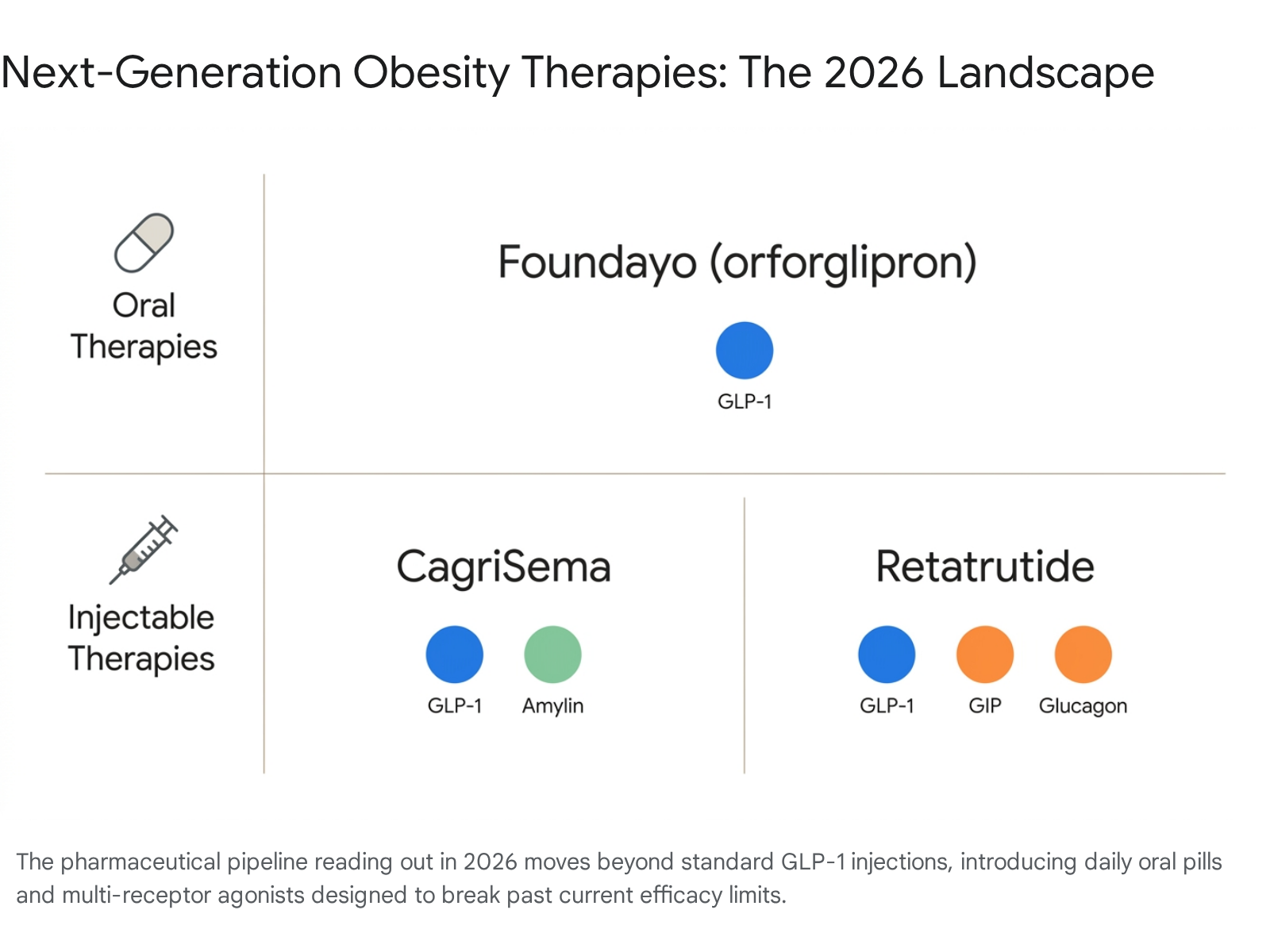
Eli Lilly is set to present extensive Phase 3 data on Foundayo (orforglipron), which secured FDA approval in April 2026 for chronic weight management 25. Foundayo represents a massive leap forward in pharmaceutical engineering because it is a small-molecule, non-peptide oral GLP-1 receptor agonist 5.
Currently, the only oral GLP-1 on the market is Rybelsus (oral semaglutide). Because semaglutide is a peptide, it breaks down easily in the stomach. Patients taking Rybelsus must take it on an empty stomach with a very specific, small amount of water and wait 30 minutes before eating, drinking, or taking other medications 5. Foundayo bypasses this completely. Because it is a non-peptide small molecule, it can be taken at any time of day, with or without food and water 25. Furthermore, because it does not require the complex manufacturing of peptides or injector pens, Lilly expects to deploy it without the supply constraints that have plagued the market 12.
The ADA 2026 symposium will detail results from several massive clinical trials evaluating Foundayo's efficacy: * The ACHIEVE Program (Type 2 Diabetes): Foundayo demonstrated superior blood sugar control compared to existing treatments. In the ACHIEVE-3 trial, it showed a 73.6% greater relative weight loss compared to oral semaglutide at 52 weeks in patients with type 2 diabetes, along with a 2.2% drop in A1C levels 34. In ACHIEVE-2, it significantly outperformed dapagliflozin, and in ACHIEVE-5, it outperformed a placebo when added to baseline insulin glargine therapy 24. * The ATTAIN Program (Obesity): Foundayo showed a mean weight reduction of 12.4% (about 27.3 lbs) in adults with obesity 5. Notably, ADA presentations will feature subgroup analyses showing Foundayo drives significant weight loss across all stages of menopause - a demographic that historically struggles with metabolic slowdowns - with peri- and post-menopausal women experiencing more than a 14% weight reduction 24.
Pushing the Boundaries: Retatrutide and Triple Agonists
While oral pills solve the convenience problem, researchers are also trying to push the absolute biological limits of pharmacological weight loss. Currently, patients on the most powerful approved drugs lose roughly 15% to 22% of their body weight 10.
At ADA, Lilly will also showcase massive Phase 3 data for retatrutide, the first "triple agonist" to reach late-stage readouts 2411. Retatrutide simultaneously activates three distinct metabolic receptors: GLP-1, GIP, and glucagon 11.
The addition of the glucagon mechanism is the true game-changer. While GLP-1 slows digestion and GIP improves insulin sensitivity to reduce appetite, glucagon receptor activation actually increases resting energy expenditure and promotes lipolysis (fat breakdown) 10. Retatrutide forces the body to burn fat rather than just suppressing the urge to eat. Results from the TRIUMPH-1 study indicate retatrutide drives an unprecedented average weight loss of 28.3% (up to an average of 70.3 pounds) over 80 weeks in adults with obesity, redefining the ceiling for medical weight management 2410. In the TRANSCEND-T2D-1 trial, it lowered A1C by up to 2.0% in adults with type 2 diabetes 4.
Novo Nordisk's Counterplay: CagriSema and Zenagamtide
Not to be outdone, Novo Nordisk will present its own deep dive into multi-hormone combinations, bringing 40 abstracts to the ADA sessions 156. The centerpiece of their presentation is Phase 3 data from the REIMAGINE 1 - 3 trials focusing on CagriSema 156715.
CagriSema takes a completely different molecular route than retatrutide. It is a fixed-dose combination of a GLP-1 agonist (semaglutide, the active ingredient in Wegovy) and a long-acting amylin analogue (cagrilintide) 716. Amylin is a hormone co-secreted with insulin that manages satiety, gastrointestinal motility, and glucagon secretion 7. By attacking obesity and high blood sugar through both the GLP-1 and amylin pathways simultaneously, CagriSema aims to deliver additive, synergistic effects. Early top-line data has already shown that CagriSema provides superior glycemic management and greater weight loss than either semaglutide or cagrilintide alone 716.
Novo Nordisk will also unveil Phase 2 data on zenagamtide, a novel unimolecular GLP-1/amylin receptor agonist that represents the company's next-generation push to maintain market dominance beyond the semaglutide era 156.
AAIC 2026: Expanding Access in Alzheimer's Care
In July, the global neurology and dementia care community will gather in London for the Alzheimer's Association International Conference (AAIC), the largest international meeting dedicated to dementia science 8.
Over the last few years, the FDA approval of anti-amyloid monoclonal antibodies like Leqembi (lecanemab) and Kisunla (donanemab) proved that clearing toxic amyloid plaques from the brain can modestly slow cognitive decline in early-stage Alzheimer's disease 910. However, these treatments are burdensome. They require patients to travel to specialized clinical centers for regular intravenous (IV) infusions, which severely limits access for elderly patients who may not live near major medical hubs or who lack reliable transportation 10.
Remternetug: The Subcutaneous Successor
The most highly anticipated Alzheimer's readout of 2026 surrounds Eli Lilly's remternetug. Like its predecessor Kisunla, remternetug targets N3pG-Aβ, a highly aggregated, pyroglutamated form of amyloid plaque 201112. However, remternetug has been explicitly formulated to be administered via a subcutaneous injection - similar to an EpiPen or an insulin autoinjector 1013.
The Phase 3 TRAILRUNNER-ALZ 1 trial, which finished its blinded observation period in early 2024, is scheduled to complete its full cycle by March 2026, making AAIC the ideal venue for a major data presentation 911.
The medical community will be scrutinizing three specific metrics: 1. Feasibility of Self-Administration: For remternetug to transform the market, it must be easy to use at home. Early interim analyses presented at prior conferences indicated promising feasibility; in a cohort of 197 patients, nearly 30% successfully self-administered the drug, and of all non-healthcare professional injections, over 88% were safely handled by the patient or a study partner 13. 2. Speed of Plaque Clearance: In early-stage Phase 1 and 2 trials, remternetug demonstrated a staggering ability to clear amyloid plaques rapidly. At high doses, every participant dropped below the amyloid positivity threshold within three months, and interim data showed plaque clearance in 75% of high-dose patients in just 85 days 2011. 3. Safety Profile (ARIA): All amyloid-clearing drugs carry a risk of Amyloid-Related Imaging Abnormalities (ARIA), which present as localized brain swellings (ARIA-E) or micro-bleeds (ARIA-H) 91011. Because remternetug clears plaques so aggressively, neurologists will carefully review the full Phase 3 data to see if its ARIA incidence rates are manageable, particularly for patients carrying the APOE ε4 genetic risk factor 1113.
Exploring Non-Amyloid Pathways: AR1001
Because amyloid-clearing drugs are not a cure and carry bleeding risks, researchers are aggressively pursuing alternative mechanisms. While the amyloid theory has been validated, there is broad consensus that a multi-pronged approach will be necessary to stop dementia 9.
AAIC 2026 is expected to feature updates on alternative drugs like AR1001 (mirodenafil), an oral PDE5 inhibitor currently in Phase 3 trials (POLARIS-AD) 914. Rather than scrubbing plaques from the brain, this daily pill aims to improve cerebral blood flow, reduce toxic amyloid-beta oligomers, and boost neuroplasticity 914. With its global trial of over 1,500 patients scheduled to report top-line results in mid-2026, it represents a crucial shift toward convenient, non-infusion therapeutic approaches 914.
ESC Congress 2026: Cardiology Guidelines and Inflammation
Rounding out the summer, the European Society of Cardiology (ESC) Congress in Munich (August 28 - 31) will highlight major shifts in how heart disease is classified, prevented, and treated 1516.
The ZEUS Trial: A Paradigm Shift Toward Inflammation
For decades, preventative cardiology has focused almost exclusively on lowering LDL cholesterol and controlling blood pressure 17. However, a new frontier has emerged: treating chronic, systemic inflammation. Research confirms that even when patients have their cholesterol perfectly controlled by statins, a residual risk of heart attack remains if their arteries are chronically inflamed 1718.
At ESC, the industry expects vital updates from the Phase 3 ZEUS trial 1718. Sponsored by Novo Nordisk, the ZEUS trial tests ziltivekimab, a once-monthly subcutaneous injection that inhibits Interleukin-6 (IL-6), a primary cytokine driver of the inflammatory cascade 1718.
The trial targets a highly specific and vulnerable population: patients with established atherosclerotic cardiovascular disease, moderate-to-severe chronic kidney disease (CKD stages 3 - 4), and high levels of systemic inflammation (indicated by high-sensitivity C-reactive protein levels ≥ 2 mg/L) 17. If ziltivekimab successfully reduces the rate of major adverse cardiovascular events (like heart attacks and strokes) in this group, it will officially validate IL-6 as a therapeutic target and fundamentally alter the standard of care for millions of patients whose heart disease is driven primarily by an overactive immune response 17.
Breakthroughs in Stroke and Heart Failure
ESC will also feature critical late-breaking science and follow-ups on major trials that have recently reshaped cardiovascular care: * Factor XIa Inhibitors for Stroke: Traditional blood thinners (anticoagulants) prevent strokes but inherently increase the risk of dangerous bleeding. A new class of drugs, Factor XIa inhibitors, aims to decouple these effects. Following the presentation of the OCEANIC-STROKE trial earlier in 2026 - which showed that Bayer's oral asundexian reduced the risk of recurrent ischemic stroke by 26% without increasing major bleeding risks compared to a placebo - ESC will likely host deeper clinical evaluations of how to integrate this ultra-safe blood thinner into secondary prevention strategies 19202122. * Heart Failure Advancements: Heart failure with mildly reduced or preserved ejection fraction (HFmrEF/HFpEF) has historically been incredibly difficult to treat, leaving patients with few options. Recent trials like FINEARTS-HF proved that finerenone (a non-steroidal mineralocorticoid receptor antagonist) significantly reduces cardiovascular death and worsening heart failure events 232425. Similarly, pooled data from the VICTOR and VICTORIA trials established that vericiguat lowers the risk of cardiovascular mortality across a broad spectrum of heart failure patients 363726. ESC 2026 will feature extensive discussions on real-world implementation of these life-saving therapies.
Major 2026 Guideline Updates
Beyond clinical trials, the ESC Congress is the primary venue for releasing updated clinical practice guidelines, which dictate how physicians across Europe and the globe treat patients. In 2026, the ESC will release several highly anticipated documents 1527: 1. The 5th Universal Definition of Myocardial Infarction: Developed alongside the American College of Cardiology and the American Heart Association, this massive update will redefine the global medical consensus on exactly how a heart attack is diagnosed and classified, with specific new frameworks for secondary and procedure-related infarctions 152829. 2. 2026 ESC Guidelines for the Management of Heart Failure 152728. 3. 2026 ESC Guidelines for the Management of Cardiovascular Disease and Chronic Kidney Disease 152728.
Bottom line
The summer 2026 medical conference calendar promises to rewrite the rules for treating some of the world's most pervasive chronic diseases. At ADA, the arrival of oral GLP-1 pills like Foundayo and triple-agonists like retatrutide suggest the supply and efficacy limitations of early obesity injectables are ending. At AAIC, subcutaneous treatments like remternetug could finally make Alzheimer's disease-modifying therapies accessible outside of specialized infusion centers. Meanwhile, at ESC, the cardiology community is preparing to officially embrace anti-inflammatory therapies as a core pillar of heart disease prevention. While the efficacy data appears remarkably strong across these pipelines, the true test will be how regulatory bodies interpret their long-term safety profiles - and whether healthcare systems can afford to deploy these breakthroughs at a global scale.