
Who Qualifies for College Fee Waivers and How to Get One
College application fee waivers allow eligible students, typically those meeting specific low-income thresholds or facing sudden financial hardship, to apply to universities without paying standard processing costs. Students can obtain these waivers through automated features on platforms like the Common App, by submitting standardized forms verified by school counselors, or by participating in state-sponsored free application periods. By leveraging these tools alongside emerging direct admissions programs, applicants can confidently cast a wide net for higher education regardless of their economic background.
The True Cost of College Applications
Applying to college involves significant hidden costs that can easily overwhelm a family's budget. While the average application fee for a four-year university hovers around $50, highly selective institutions frequently charge between $75 and $90 simply to review an applicant's materials 123. For a student applying to a balanced list of eight to ten colleges, these fees can quickly snowball into a $500 to $900 expense before tuition is even discussed.
To prevent these upfront costs from becoming an insurmountable barrier to higher education, the college admissions ecosystem has developed multiple fee waiver pathways. These waivers are not loans or deferred payments; they completely erase the application fee for eligible students. In recent years, as the cost of living has risen alongside application volumes, the utilization of fee waivers has surged. This systemic financial relief has allowed historically underrepresented, first-generation, and low-income students to apply to college at record rates, fundamentally shifting the demographic makeup of the applicant pool 23.
Surging Application Volumes and Demographic Shifts
The landscape of college admissions is currently experiencing record-breaking volume. During recent admissions cycles, the Common App recorded over 1.5 million distinct first-year applicants submitting more than 10 million individual applications 4. This surge is heavily driven by students who utilize fee waivers to expand their college lists.
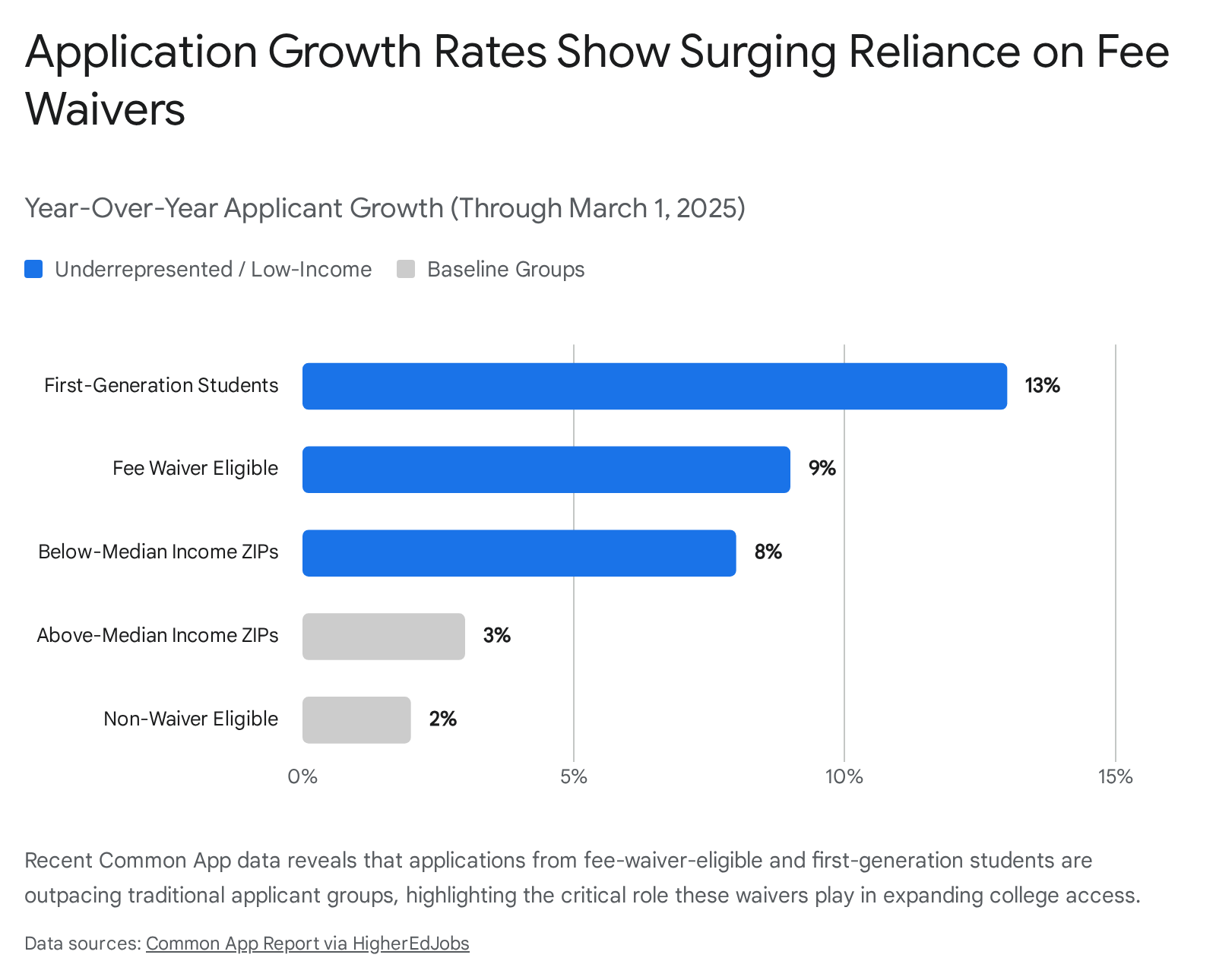
Recent data reveals a 12% increase in underrepresented minority applicants, alongside a 13% increase in both first-generation college students and Latinx applicants 3. Regionally, the Southwestern United States has seen explosive growth, with Texas becoming the number one state for application volume, growing by an astounding 37% to 43% year-over-year 35. Notably, domestic applicant growth has begun to outpace international applicant growth for the first time since 2019, while public universities are seeing a massive 10% application growth compared to a mere 2% for private institutions 35.
The Test-Optional Movement's Impact on Application Strategy
The reliance on fee waivers is also intricately tied to the nationwide shift toward test-optional admissions. Since the COVID-19 pandemic forced widespread testing cancellations in 2020, the college admissions landscape has undergone a radical transformation. Going into the 2025 and 2026 application cycles, an overwhelming majority - over 80%, or roughly 1,825 bachelor-degree granting institutions - remain test-optional or test-blind 67.
This structural change has profound implications for how students obtain fee waivers. Historically, low-income students who registered for the SAT or ACT using a testing fee waiver automatically received a bundle of college application fee waivers deposited directly into their College Board or ACT accounts 28. However, because thousands of students now bypass standardized testing entirely, they miss out on this automatic pipeline. Consequently, students and high school counselors must be more proactive in securing independent fee waivers directly through application platforms or institutional requests.
It is worth noting that the test-optional consensus is currently facing pushback from highly selective universities. Institutions such as Dartmouth College, the Massachusetts Institute of Technology (MIT), and Yale University have recently reinstated mandatory testing, citing internal data that suggests standardized test scores, when viewed in context, remain strong predictors of collegiate success 91011. Public university systems are also debating reversals; for example, the University of North Carolina (UNC) system is actively considering policies that would require test scores from applicants whose GPAs fall between 2.5 and 2.8, balancing concerns over grade inflation against the equity barriers of standardized testing 1412. Despite these high-profile reversals, test-optional policies remain the operational standard for the vast majority of applicants navigating the application fee landscape.
Standard Need-Based Eligibility Criteria
Colleges, testing agencies, and major application platforms utilize a broadly standardized set of criteria to determine which students qualify for financial hardship waivers. If a student meets just a single indicator from the established federal or educational guidelines, they are universally recognized as eligible to have their college application fees waived 313141519.
| Eligibility Criterion | Description & Required Documentation |
|---|---|
| Federal Lunch Program | The student is enrolled in or eligible to participate in the Federal Free or Reduced Price Lunch (FRPL) program at their local high school. |
| USDA Income Guidelines | The student's annual family income falls within the USDA Food and Nutrition Service guidelines. For the 2025 - 2026 academic year, a family of four qualifies at $59,478 or below for reduced-price meals, and $41,795 or below for free meals 819. |
| Standardized Test Waivers | The student has already received or is eligible for an SAT or ACT testing fee waiver. Approval for one test inherently verifies financial need for college applications 38. |
| Public Assistance | The student's immediate family receives local, state, or federal public assistance, such as housing subsidies or SNAP benefits 31319. |
| State Ward or Orphan Status | The student is legally a ward of the state, an orphan, placed in foster care, or is experiencing homelessness under federal definitions 31315. |
| College Access Programs | The student is actively enrolled in a federal, state, or local educational program that aids students from low-income families, including TRIO programs like Upward Bound or GEAR UP 151920. |
Extenuating Circumstances and Missing the Cutoff
Strict income tables generated by federal agencies often fail to account for sudden life changes or exorbitant local costs of living. If your family does not perfectly align with the USDA income guidelines but still genuinely cannot afford the application fees, the system retains flexibility.
Most official fee waiver forms - including those generated by the National Association for College Admission Counseling (NACAC) and the Common App - feature an "Other Request" or extenuating circumstances clause 81316. This crucial loophole allows a high school principal, guidance counselor, or college financial aid officer to use their professional judgment to vouch for your financial hardship. Valid extenuating circumstances generally involve acute financial shocks, such as a recent and unexpected job loss, the death of a primary household earner, sudden and severe medical expenses, or the immediate threat of eviction 1317. In these scenarios, the school official provides a brief supporting statement confirming the hardship, and universities almost universally honor the waiver request.
Transfer and Nontraditional Student Pathways
There is a pervasive misconception that application fee waivers are exclusively reserved for traditional high school seniors. In reality, robust pathways exist for adult learners and transfer students.
NACAC provides a specific Request for Transfer Admission Application Fee Waiver Form specifically engineered for students moving between institutions. Transfer students automatically qualify to use this form if they are eligible for a Federal Pell Grant, which can be easily verified by providing a FAFSA Submission Summary or obtaining written verification from a financial aid officer at their current college 19. Nontraditional adult students returning to higher education after a prolonged gap can also utilize standard fee waiver forms. Because they may lack a high school counselor, these applicants can have their economic eligibility certified by an authorized professional, such as a community-based organization staff member, a social services representative, or a religious leader 19.
Primary Mechanisms for Securing a Fee Waiver
Depending on the specific college and the application portal being utilized, there are four primary avenues through which a student can formally secure and submit a fee waiver.
1. Centralized Platforms: Common App and Coalition App
The most streamlined method for obtaining fee waivers is through centralized application platforms. The Common App, which serves over 1,000 member colleges globally, integrates fee waivers directly into its user interface. When navigating the newly redesigned Common App platform - which recently shifted its navigation tabs to a left-hand panel and consolidated features under the "My Common Application" header - students will find a dedicated fee waiver subsection within their profile 413.
By selecting "Yes" to the eligibility question, checking the specific economic indicators that apply to their household, and digitally signing the form, the student triggers a universal fee waiver across all participating colleges on their list 813. The system automatically routes a verification request to the student's designated high school counselor. Once the counselor digitally approves the request, no further financial documentation is required by the individual colleges 815. The Coalition App functions identically, extending waivers not only for federal lunch qualifiers but frequently expanding access to veterans, active military members, and first-generation college students 19.
2. The NACAC Application Fee Waiver Form
For universities that require students to apply directly through proprietary institutional portals rather than the Common App, the NACAC Request for Admission Application Fee Waiver serves as the industry gold standard 15.
To utilize this method, students download the standardized PDF, complete the applicant details, and present it to their high school counselor or TRIO representative for verification. A critical requirement for the NACAC form is authentication; it must feature the high school's official raised seal or stamp to be considered valid by admissions offices 15. The completed form is then mailed or securely emailed directly to the specific college's admissions department. While NACAC officially recommends that students limit their use of this form to four colleges to prevent abuse of the system, many students successfully submit it to additional schools with the explicit support of their counseling staff 1516.
3. Automatic Standardized Testing Waivers
As previously mentioned, qualifying for an SAT or ACT fee waiver serves as pre-verified proof of financial need. The College Board and ACT programs automatically provide college application fee waivers to students who utilize their testing waivers 238.
For the College Board, these waivers are deposited directly into the student's online account, offering unlimited use at participating colleges. Furthermore, if a student links their College Board account to the Common App, the platform will automatically detect the pre-existing SAT waiver and bypass the counselor verification step entirely, instantly unlocking free applications 8.
4. Direct Institutional Requests and Hardship Appeals
If a student does not fit into any standardized demographic box or lacks access to a traditional high school counselor, they can appeal directly to the university. Every college admissions office maintains an internal process for reviewing individual fee waiver requests, even if the procedure is not prominently advertised on their admissions website 2.
To execute a direct request, students should email the admissions office at least two to three weeks prior to the application deadline, as processing can take up to ten business days 2. The email should feature a clear, actionable subject line, such as "Fee Waiver Request - [Applicant Name] - Fall 2026." The body of the message must be polite, strictly avoiding any tone that blames the institution for its fees, while clearly articulating the specific financial barrier 2023. Mentioning concrete hardships - such as the recent accumulation of medical debt, sudden unemployment, or displacement due to a natural disaster - provides necessary context. Applicants should always offer to provide supporting documentation upon request, such as a recent tax return, a letter of termination, or a financial aid award letter from another institution 2324. In most cases, admissions officers are highly receptive to these sincere appeals and will issue a unique digital promo code allowing the student to bypass the application payment screen.
International Student Fee Waivers and Financial Documentation
Navigating the U.S. college application process is exceptionally costly for international students. Due to unfavorable currency exchange rates, the standard $50 to $100 application fee can translate to a massive financial burden. For example, Indian applicants routinely pay between ₹6,000 and ₹8,500 per application, meaning a modest list of target schools can cost up to ₹60,000 in non-refundable upfront fees 25.
Fortunately, many U.S. institutions recognize this barrier and extend fee waivers to international applicants, though the process requires more rigorous documentation than domestic requests.
Navigating the International Application Process
International students can utilize the standard NACAC fee waiver form by checking the "Other Request" box and writing a concise explanation of their financial barriers, such as local economic crises or restrictive currency exchange controls 81618.
Beyond standardized forms, many large, research-focused universities actively waive fees for international graduate and undergraduate students to attract top global talent. Institutions like the University of Alabama, Virginia Tech, the University of Illinois Chicago (UIC), Missouri University of Science and Technology (Missouri S&T), and Lehigh University frequently offer application fee waivers to international students who attend their virtual open houses, informational webinars, or apply during specific early-action promotional windows 251928. Highly selective institutions, such as Rice University and Harvard University, also assess international fee waivers based on demonstrated extreme financial hardship 192021.
Required Proof of Financial Support
When an international student requests a need-based fee waiver or subsequently applies for a student visa, universities and government agencies require exhaustive proof of financial standing. Documentation must be presented in English or accompanied by certified translations 22. Acceptable forms of financial proof typically include:
- Bank Statements: Certified statements from the past three to eighteen months showing liquid assets in checking or savings accounts 222333.
- Official Income Documentation: Recent tax assessments, pay stubs, or pension statements from the student or their primary sponsor. For Canadian applicants seeking specific fee exemptions, a Notice of Assessment (NOA) from the Canada Revenue Agency is standard 222324.
- Affidavits of Support: A sworn, notarized statement from a parent, family member, or private sponsor declaring their legal intent to fund the student's education 22.
- Loan and Scholarship Letters: Official approval letters from recognized international student lenders (such as MPOWER Financing) or award letters from government scholarships serve as robust proof of available funds 22.
- USCIS Hardship Forms: For immigrant students already within the U.S. adjusting their status or applying for specific domestic benefits, forms like the I-912 Request for Fee Waiver require deep detailing of assets, debts, and household income measured against federal poverty guidelines 173525.
State-Sponsored Free Application Weeks (2025 - 2026)
Even if a student does not qualify for a need-based waiver, they can still apply for free by timing their submissions strategically. Recognizing that application fees actively suppress college enrollment and workforce development, numerous state governments host localized "Free Application Weeks" or "College Application Months."
During these specific legislative windows, state public universities - and frequently in-state private colleges - waive all application fees for state residents. These initiatives are highly successful; a recent iteration of Colorado's Free Application Days yielded over 71,000 applications and saved students more than $2.4 million in processing fees 2627.
Below is a detailed summary of confirmed and recurring state initiatives for the 2025 - 2026 academic cycles:
| State | 2025 - 2026 Free Application Dates | Eligibility & Administrative Details |
|---|---|---|
| Colorado | October 7 - 9, 2025 (and Oct 20 - 22, 2026) | Open to all state residents applying for undergraduate programs at 32 public colleges and participating private institutions. Requires specific portal promo codes (e.g., FreeAppDayCO or FREEAPPDAYSCO) 12627. |
| Texas | October 12 - 18, 2026 | Mandated by state law (Senate Bill 2231); all public colleges waive admission fees for Texas residents applying strictly through the ApplyTexas portal to undergraduate programs 28. |
| New York | October 20 - November 3, 2025 | Prospective students can apply to up to five State University of New York (SUNY) campuses entirely free of charge using ApplySUNY or the Common App 29. |
| Minnesota | June 23 - 27, 2025 | Waives fees for 26 colleges and seven state universities during College Knowledge Month. Over 50 institutions generally participate, including Bemidji State and Augsburg University 4142. |
| South Dakota | October 1 - November 30, 2025 | Two full months of free applications to public technical colleges and universities. Uniquely open to residents of "SD Advantage" neighboring states, including CO, IA, IL, KS, MN, MO, MT, ND, NE, WI, and WY 4130. |
| Georgia | November 1 - 30, 2025 (and March 2026) | Month-long initiative covering over 60 USG, TCSG, and private institutions. Students applying through the GEORGIA MATCH direct admissions dashboard automatically receive waivers 314632. |
| North Carolina | October 20 - 26, 2025 | "NC Countdown to College" week allows students to use the CFNC college search tool to apply to participating state institutions for free 141. |
| Indiana | September 22 - 26, 2025 | Standard College Application Week covering both public and private colleges across the state 141. |
Note: Administrative dates occasionally shift year-over-year. Applicants must verify the exact promo codes required by checking their state's Department of Higher Education website or the specific instructions on the college's application portal prior to submission 27.
The Direct Admissions Revolution and No-Fee Institutions
Beyond individual waivers and state promotional weeks, the higher education sector is undergoing a massive structural shift aimed at making college applications fundamentally free and frictionless.
No-Fee Colleges: Currently, over 160 U.S. colleges and universities do not charge an application fee at any point during the year. This includes prominent institutions like Colorado College, Regis University, and Metropolitan State University of Denver 3334. When researching schools, students should audit admissions pages carefully; a waiver may not be necessary simply because the institution has permanently abolished the fee to encourage a wider applicant pool.
The Scope of Common App Direct Admissions: To bypass the anxiety, gatekeeping, and cost of the traditional application process, platforms like the Common App have launched massive "Direct Admissions" programs. For the 2025 - 2026 application season, 215 member colleges across 45 states are participating in this transformative initiative 35.
In the Direct Admissions ecosystem, the traditional application paradigm is flipped. College-interested students who meet specific baseline academic requirements and identify as first-generation or low-to-middle income receive proactive offers of admission directly within their Common App portal 3637. Because the college initiates the offer and actively recruits the student, the traditional application fee is entirely bypassed, and requirements like essays or letters of recommendation are frequently waived 435.
The scale of this program is immense. In recent cycles, over 800,000 eligible students received at least one direct admission offer. This proactive outreach radically alters student behavior; data indicates a 32% higher application completion rate among offer recipients, with roughly 25% of students choosing to add a college to their list that they had never previously considered 353638.
Furthermore, these direct admissions offers are increasingly paired with state-level financial aid guarantees to completely eliminate the cost of attendance for low-income families. For example, qualifying students receiving direct admissions to Kean, Stockton, or Rider University can utilize New Jersey's Garden State Guarantee for free tuition, while students admitted to Buffalo State can leverage New York's Excelsior Scholarship 37.
Bottom line
College application fee waivers are vital, highly accessible tools designed to ensure that standard processing costs do not block qualified students from pursuing higher education. If your household meets federal income guidelines, qualifies for free lunch, or is enduring a sudden financial crisis, you can seamlessly secure waivers through automated centralized platforms like the Common App, standard NACAC forms verified by your school counselor, or direct institutional appeals. Even if you do not qualify for a traditional need-based waiver, applying during your state's designated "Free Application Week" or engaging with emerging, fee-free direct admissions programs can save you hundreds of dollars and drastically expand your collegiate options.