
How First-Gen Students Can Navigate Admissions and Aid
First-generation college students face a unique gauntlet of hurdles, from decoding the unwritten cultural rules of academia to navigating notoriously complex financial aid systems. By participating in targeted campus visit programs, avoiding the trap of applying to less selective schools, and utilizing alternative state aid applications, these students can overcome systemic barriers. Mastering these strategies ensures first-generation students not only gain college admission but also successfully graduate with minimal debt.
Decoding the Hidden Curriculum
The transition from high school to higher education is often framed purely as a matter of academic preparation and financial readiness. However, for first-generation students - typically defined as individuals whose parents did not complete a four-year college degree - the most formidable barrier is often conceptual 123. Students whose parents are college graduates arrive on campus with inherited "navigational capital," a hand-me-down wisdom that allows them to seamlessly decode collegiate environments and bureaucratic structures 14. First-generation students, lacking this insider knowledge, immediately collide with the hidden curriculum 156.
First coined by sociologist Philip Jackson in 1968, the hidden curriculum encompasses the unwritten social and academic norms, unofficial expectations, and implicit behaviors that institutions assume students already know 668. Because these expectations are rarely articulated in orientation materials or syllabi, their absence creates an invisible barrier to success. When students fail to navigate these unspoken codes, institutions often misattribute their struggles to a lack of effort or academic deficiency, rather than recognizing a systemic failure to transfer cultural capital 9.

The hidden curriculum manifests in daily academic life through institutional jargon and behavioral expectations. First-generation students frequently face the pressure of learning a new collegiate language completely on their own, encountering terms like provost, registrar, or bursar without any prior context 1267. A classic example is the concept of "office hours." A first-generation student might interpret this term as the time a professor is busy working in their office and should not be disturbed, completely missing that this is dedicated time specifically meant for student engagement, mentorship, and clarification 68. To combat this, experts suggest renaming the block to "student hours" and explicitly explaining its purpose on the syllabus 8.
The consequences of this cultural disconnect are measurable and severe. Recent large-scale research involving over 100,000 undergraduates reveals that first-generation students invest between 14 percent and 26 percent less time in high-return hidden actions - such as cold-emailing alumni for networking, joining student organizations, or engaging faculty for strategic references - while over-investing their energy purely into formal coursework 6. This gap in strategic engagement directly correlates with lower internship attainment and weaker early-career outcomes, even when grade point averages are held constant 6.
Overcoming these barriers requires universities to adopt transparent teaching protocols. By explicitly outlining the task, purpose, and evaluation criteria for every assignment, and by dedicating time to explain campus resources and professional etiquette, faculty can bridge the cultural capital gap 489. Furthermore, students are increasingly encouraged to combat these systemic blind spots by practicing self-advocacy, asking clarifying questions, and actively seeking out peer and alumni mentors who have successfully navigated similar environments 61011.
The Dangers of Academic Undermatching
Beyond the classroom, a lack of navigational capital heavily influences where first-generation students choose to apply. This leads to a pervasive phenomenon known as undermatching. Undermatching occurs when highly qualified students, armed with excellent grades and standardized test scores, either choose to attend less selective colleges than their credentials permit, default to open-admission community colleges, or forego higher education entirely 1213. Research indicates that each year, approximately 400,000 low-income, academically strong graduates fail to enroll in any college, while another 200,000 enroll in institutions well below their academic tier 12. Currently, only one-third of high-achieving students from the lowest income quartile attend any of the nation's roughly 238 most selective colleges 12.
First-generation and low-income students are uniquely vulnerable to undermatching because they often lack specialized college advising and assume that elite, highly selective universities are financially impossible 121415. They look at the high sticker price of selective private institutions and preemptively opt out, unaware that generous institutional financial aid and endowment-funded grants often make these elite schools significantly cheaper to attend than local public universities 1213.
The stakes for correcting this behavior are remarkably high. Students who undermatch experience graduation rates that are 15 to 20 percentage points lower than their equally qualified peers who matched with appropriately selective institutions 12. Furthermore, undermatched students report feeling less challenged by their coursework, face fewer opportunities for competitive undergraduate research, and ultimately experience reduced long-term upward mobility 12.
Elite universities are attempting to combat this trend through targeted recruitment and highly transparent financial aid policies. Through concerted efforts, highly selective institutions have succeeded at increasing the representation of high-performing, low-income students. For instance, the proportion of first-generation students at Harvard increased to 19.4 percent for the class of 2026, while Yale reached 18 percent and Princeton reached 17 percent - a massive leap from historical baselines 13. However, researchers note that once these students gain formal access, elite universities must still actively work to support them against the persistent forces of the hidden curriculum 13.
Leveling the Playing Field with Fly-In Programs
To prevent undermatching and to demystify the campus environment, prospective first-generation students are encouraged to aggressively pursue fly-in programs. These programs represent one of the most underutilized opportunities in the entire college admissions ecosystem 19. Created to address structural inequities and expand access to historically underrepresented, rural, and low-income communities, fly-in programs are immersive, multi-day campus visits funded entirely or partially by the host institution 191617.
During these programs, which typically run for two or three days in the fall of a student's senior year, participants are matched with an undergraduate host and placed in a residence hall 1916. The itinerary is densely packed with class visits, financial aid workshops, meetings with admissions officers, and social events designed to provide a comprehensive, unfiltered view of campus life 1918. Beyond the immediate benefit of a free trip, participating in a fly-in program practically guarantees an application fee waiver, heavily boosts a student's demonstrated interest metric for colleges that track it, and provides critical networking opportunities with faculty and staff prior to application submission 191723.
Because fly-in programs target high-achieving students from low-income or first-generation backgrounds, the application process is competitive. It mirrors the actual college application, generally requiring high school transcripts, recommendation letters, a brief essay, and demographic or financial information 1617. Students who apply but are not selected for the program should not be discouraged; many students denied a fly-in slot are ultimately accepted during the regular admissions cycle, and their application to the program still successfully signals their deep interest in the institution 17.
Students can search for these opportunities through specialized databases curated for first-generation access, such as College Greenlight, Scholar Match, Get Me to College, and Appily 23241920.
Prominent Fly-In Programs and Alternatives
Institutions across the country offer varying formats for their access programs. While some are fully funded overnight trips, others have pivoted to highly structured virtual environments or regional drive-in models.
| Host Institution | Program Name | Typical Timing | Target Demographic and Program Details |
|---|---|---|---|
| Amherst College | Access to Amherst (A2A) | Late September / Early October | Prioritizes first-generation and historically excluded groups. The application essay can be reused for the actual college application 16. |
| Barnard College | Barnard Bound | Fall | Offered in both in-person and virtual formats. Targets first-generation students and those from low-income backgrounds interested in women's colleges 1916. |
| Dartmouth College | Dartmouth Bound | Summer (Rising Seniors) | Priority given to first-generation, low-income, and rural students. It is a fully funded four-day summer program 19. |
| Mass. Institute of Technology | MIT WISE | Fall | Aimed at underrepresented, rural, and first-generation students. Fully covers travel and focuses heavily on engineering access 16. |
| Colorado College | Discover Colorado College | Fall | Fully funded program targeting first-generation, socioeconomically disadvantaged, and Title I school students 1618. |
| Wellesley College | Access the Wellesley Experience (AWE) | Fall | A regional drive-in program targeting high school seniors living in Massachusetts, Rhode Island, Southern New Hampshire, or Southern Maine 16. |
For students unable to attend in-person programs, taking virtual tours on platforms like YouVisit or CampusTours provides a valuable alternative. While it cannot replace the experience of sleeping in a dorm or dining with current undergraduates, it allows students to familiarize themselves with the campus architecture and overall environment 241927.
Cracking the Financial Aid Bureaucracy
If the hidden curriculum is the conceptual barrier to higher education, the financial aid bureaucracy is the mechanical one. The Free Application for Federal Student Aid (FAFSA) acts as the absolute gatekeeper to federal Pell Grants, work-study funds, federal student loans, and vast amounts of institutional and state-level aid 21222324. Historically, first-generation students exhibit deep loan aversion and a general mistrust of financial institutions, which depresses their FAFSA completion rates 2526. Students whose parents did not attend college are highly likely to avoid borrowing out of fear, sometimes choosing to work full-time to their academic detriment rather than accept favorable federal loans or failing to claim the free aid they are entitled to 26. On average, completing the FAFSA unlocks $16,810 in aid per undergraduate student, making its completion critical for college access 23.
Recent attempts to overhaul this system resulted in chaos. The rollout of the Better FAFSA for the 2024-2025 academic year, mandated by the FAFSA Simplification Act, was intended to streamline the form and expand Pell Grant eligibility 2728. Instead, severe technical glitches, delayed launches, and systemic formula errors caused nationwide panic and massive submission drops, including a 30 percent decline in states like Florida 212728.
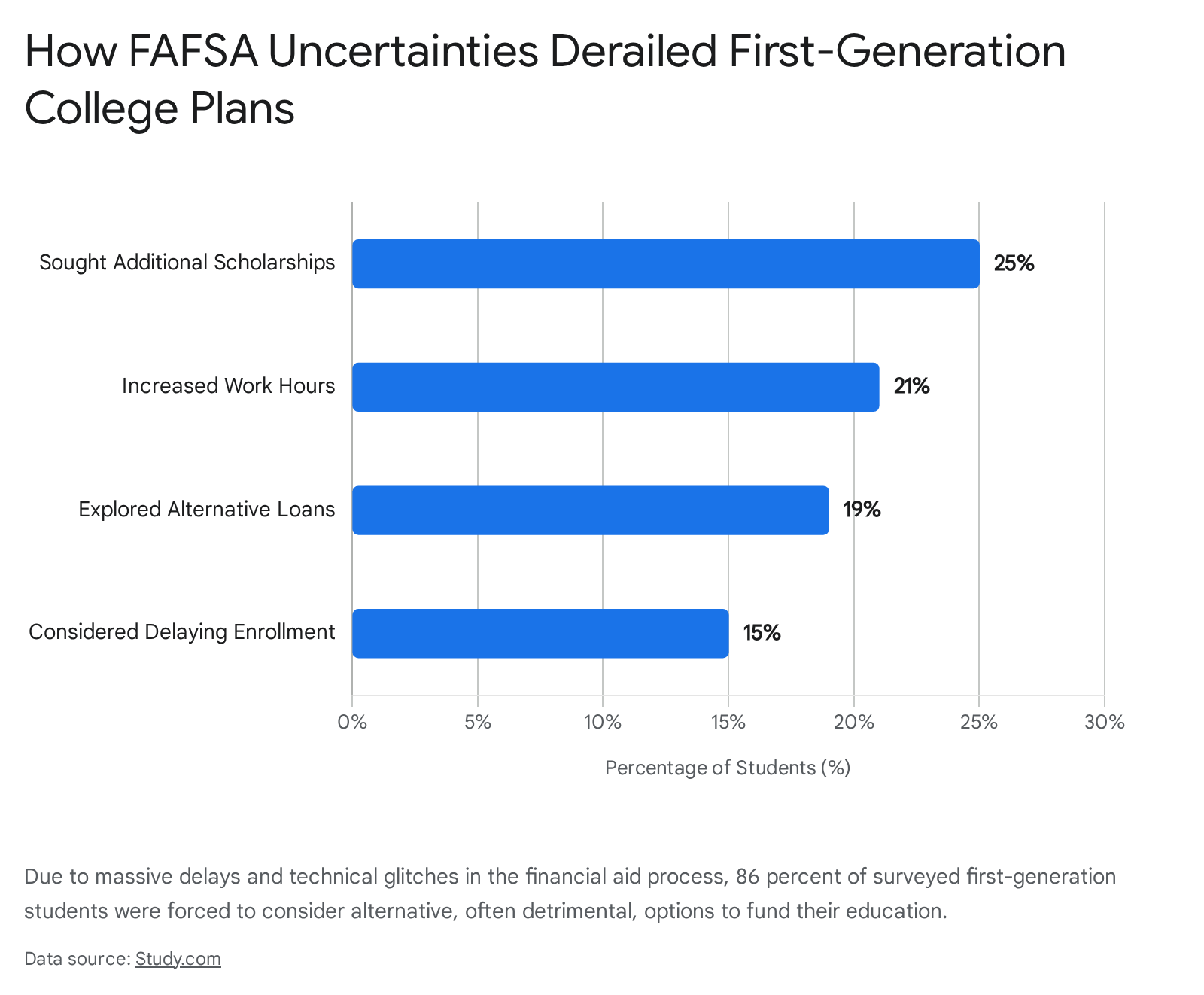
First-generation students bore the brunt of this bureaucratic failure. Survey data from the crisis indicates that nearly half of all first-generation applicants failed their initial attempt to submit the new FAFSA, and nearly a third spent more than seven hours navigating technical errors 21. The downstream effects were devastating for college access: the uncertainty drove massive numbers of first-generation students to drastically alter their postsecondary plans, shifting away from four-year universities to take on more employment or delay enrollment entirely 2129.
Navigating the Updated 2026-2027 FAFSA Timeline
Following immense backlash, the U.S. Department of Education implemented emergency fixes and restructured the timeline to stabilize the system. The 2026-2027 FAFSA cycle returned to a standardized fall release schedule, opening on September 24, 2025, with a final federal submission deadline of June 30, 2027 223031.
Crucially, the 2026-2027 application introduces faster identity verification for all users and allows students to invite contributors (such as parents or spouses) via a simple email link, drastically reducing account creation errors 22. The new Student Aid Index (SAI) formula introduces asset exemptions that heavily benefit rural and entrepreneurial first-generation students: the net worth of small businesses with fewer than 100 employees, family farms, and family-controlled fishing operations are now completely excluded from aid calculations 2232.
However, students must be aware of shifting grant rules. The foreign earned income exclusion is now added back into the Adjusted Gross Income (AGI) when determining Pell Grant eligibility, which may impact students whose parents work abroad 32. Furthermore, applicants with an SAI equal to or greater than twice the maximum Pell Grant award amount are strictly ineligible; for the 2026-2027 award year, this threshold is $14,790 32. The government also introduced a new $257,500 lifetime borrowing limit on all federal student loans, excluding borrowed Parent PLUS loan amounts 32.
The Financial Aid Crisis for Mixed-Status Families
The recent FAFSA overhauls were particularly severe for mixed-status families - households where a citizen student has at least one undocumented parent 2433. Because the new system required every contributor to create a Federal Student Aid (FSA) ID via identity verification, parents without Social Security Numbers (SSNs) were entirely locked out of the process for months 2433.
These parents were forced into a convoluted manual verification loop that required emailing sensitive identity documents to an unmonitored inbox or waiting on hold for hours with federal help desks 3334. This systemic failure effectively gatekept thousands of eligible citizen students from receiving state and institutional aid that is disbursed on a first-come, first-served basis, signaling to marginalized students that higher education systems were not built to support them 3335.
Fortunately, the 2026-2027 FAFSA introduces structural fixes for these families. Parents without an SSN can now generate an FSA ID using knowledge-based identity validation through credit bureaus 3436. If immediate verification fails, contributors without an SSN can bypass the block by manually inputting their tax data while identity validation remains pending, allowing the student to meet strict state and institutional deadlines 2436.
State-Specific Aid for Undocumented and DACA Students
While federal policy fixes assist mixed-status families with citizen children, the rules for undocumented students themselves - including Deferred Action for Childhood Arrivals (DACA) recipients - are absolute: they are strictly ineligible for any federal financial aid, including Pell Grants and federal student loans 37383940. Consequently, they must never fill out the FAFSA, as doing so can trigger systemic confusion and processing delays at the university level 404142.
Instead, higher education funding for undocumented students relies entirely on institutional scholarships, private grants, and comprehensive state-level legislation 3839. A growing coalition of states - including California, Texas, Washington, Oregon, Illinois, New York, and New Jersey - have passed laws allowing undocumented residents to pay in-state tuition and access millions of dollars in state-funded financial aid 3738.
Accessing these funds requires navigating alternative, highly secure state applications specifically designed to protect the immigration data of undocumented students and their families 394143. Because state grant money is finite, these applications strictly operate on priority deadlines; missing a deadline often means forfeiting thousands of dollars in guaranteed aid 4445.
Prominent State Alternative Financial Aid Applications
Students filling out alternative applications must diligently track their institution's specific requirements, as colleges frequently demand supplemental documentation, such as physical residency affidavits or notarized tax transcripts, to finalize the financial aid packages 46.
| State | Application Name | Key Grants Accessed | Residency Requirement for Undocumented Students |
|---|---|---|---|
| Texas | TASFA (Texas Application for State Financial Aid) 4447 | Texas Public Educational Grant (TPEG), State Work-Study 4447 | Graduated from a TX high school; lived in TX 3 years prior to graduation, and 12 months before college enrollment (Senate Bill 1528). Males must register for Selective Service 47. |
| Washington | WASFA (Washington Application for State Financial Aid) 4248 | Washington College Grant, College Bound Scholarship 4148 | High school diploma or equivalent; lived in WA for one year immediately prior to starting the college program 4849. |
| Oregon | ORSAA (Oregon Student Aid Application) 3940 | Oregon Opportunity Grant, Oregon Promise Grant 3950 | Must live and study in Oregon; specific tuition equity qualifying questions have been phased out for the 2026-2027 cycle 3950. |
| New Jersey | NJ Alternative Financial Aid Application 43 | Garden State Guarantee, State Tuition Aid Grants 43 | Attended an NJ high school for at least 3 years and graduated; must sign an affidavit promising to legalize status as soon as eligible 46. |
| Illinois | Alternative Application for Illinois Financial Aid 20 | Monetary Award Program (MAP) grants 20 | Governed by the Retention of Illinois Students & Equity (RISE) Act 20. |
Building Developmental Networks and Mentorship
The sheer volume of bureaucratic obstacles - from decoding the hidden curriculum and avoiding undermatching, to battling FAFSA glitches and complex state residency laws - means that first-generation students cannot navigate the admissions and aid process in isolation. Sustained success relies heavily on developmental networks and dedicated mentorship 61151.
Research proves that naturally occurring mentoring relationships with teachers, high school counselors, and eventual college faculty heavily predict college attendance and academic goal-striving 51. However, first-generation students frequently lack mentors who can provide highly specific, practical advice for collegiate success, unlike continuing-generation students whose parents serve as built-in advisors 5152. The lack of institutionalized mentorship for this demographic has historically been viewed as a massive "blown opportunity" in higher education 53.
To bridge this gap, modern universities are aggressively institutionalizing mentorship. Across the country, specialized programs pair incoming first-generation students with faculty, staff, and alumni who were themselves the first in their families to attend college 515354. * At the University of Wisconsin-Madison, the "First-Generation Badgers" program centralizes resources and hosts dialogues to build a sense of belonging among students facing imposter syndrome 64. * At the University of North Carolina at Charlotte, the "First-Gen Niners" network provides students with a specialized directory to connect directly with first-generation faculty members 64. * At the University of North Georgia, the "Gen 1" mentoring program reported that their cohorts achieved a highly competitive 3.29 average GPA and a 96 percent retention rate, proving the massive impact of structured peer and faculty intervention 54.
Beyond institutional programs, national organizations are filling the void. Educational Opportunity Programs (EOP) provide pre-college workshops and tutoring specifically tailored to students transitioning without family guidance 10. Nonprofits like FirstGen Mentors provide high school and college students with direct, personalized mentorship sessions with professionals in their desired industries, effectively teaching the hidden curriculum of the professional job market before graduation 65. Furthermore, national honor societies like Alpha Alpha Alpha (Tri-Alpha) offer first-generation students a formalized platform to celebrate their academic excellence, transforming a demographic label that was historically viewed as a deficit into a badge of resilience and honor 15455.
Bottom line
Successfully navigating college as a first-generation student requires overcoming the hidden curriculum of unwritten academic and social rules, aggressively avoiding undermatching, and leveraging resources like fully funded fly-in programs. Funding this education demands early and accurate completion of the FAFSA or state-specific alternative applications (like the TASFA or WASFA) to bypass bureaucratic barriers, particularly for mixed-status and undocumented families. Ultimately, engaging with dedicated mentorship networks and first-generation campus organizations remains the most reliable strategy to transform college admission into college graduation.