
Common App vs Coalition App vs Direct: Which to Use
For students applying to a broad mix of out-of-state and private institutions, the Common Application is the universally accepted standard that maximizes efficiency and reach. Conversely, the Coalition Application on Scoir is the optimal choice for under-resourced students seeking frictionless fee waivers and holistic portfolio building, while direct and regional portals remain necessary for navigating specific state university systems or capitalizing on institutional financial incentives. Understanding the strategic nuances of each system is essential for modern college planning.
Think of application platforms as the administrative plumbing of a student's higher education journey. Choosing the right platform saves hours of redundant data entry - sparing applicants from re-typing their address, demographic information, and extracurricular achievements dozens of times - while choosing poorly complicates fee waivers, creates disjointed essay formatting, or results in missed deadlines. In an era marked by an impending demographic enrollment cliff and record-breaking application volumes at highly selective universities, understanding the mechanical and philosophical differences between the Common App, the Coalition on Scoir, and direct application portals is a critical strategic imperative for educators, administrators, and applicants alike.
What are the fundamental differences between the Common App and the Coalition on Scoir?
At their core, both the Common Application and the Coalition Application exist to streamline the path to higher education by allowing prospective undergraduates to input their foundational data once and distribute it to multiple institutions. However, their underlying missions, market penetration, and technological architectures differ significantly. The Common App, established in 1975, is the dominant utility in the higher education admissions space. Accepted by over 1,100 colleges and universities worldwide - including nearly all highly selective private universities and a growing number of public flagships - it processes millions of applications annually 123. In the 2025 - 2026 admissions cycle alone, data indicates that students submitted over 9.4 million applications to more than 900 participating colleges by March, representing a 5 percent increase from the previous year 4. The platform is built for sheer scale and efficiency, offering a standardized 650-word personal statement, a rigid 10-slot activities list, and a highly familiar interface for high school counselors 56.
Conversely, the Coalition Application was launched in 2015 with a strict ideological filter: member institutions must prove their commitment to access, affordability, and student success. To be a Coalition member, a college must demonstrate robust financial aid programs, strong graduation rates, and a track record of graduating students with low or no debt 127. As a result, the Coalition's network is much smaller, hovering around 150 to 170 institutions 132. The Coalition Application was expressly designed to support historically underrepresented, low-income, and first-generation students by providing tools that help them prepare for college earlier in their high school careers.
How has the Coalition App's integration with Scoir altered the application landscape?
In 2022, the Coalition for College fundamentally altered its technological delivery by abandoning its proprietary portal (previously known as "MyCoalition") and partnering with Scoir, a rapidly growing college and career readiness software platform, alongside Technolutions (the creator of the Slate CRM used by most university admissions offices) 310. This integration transformed the Coalition App from a standalone submission form into a multi-year, networked portfolio designed to track student progress from the ninth grade onward.
For students whose high schools utilize Scoir for college counseling, the integration is seamless. Students can begin building a digital "Locker" early in their high school journey. This Locker allows users to store multimedia content, essays, videos, and academic projects over four years, creating a holistic repository of their high school career that can later be attached to their applications 6211. This aligns with the Coalition's ethos of holistic admissions, demonstrating to universities that a student is more than their standardized test scores and grade point average. Furthermore, Scoir introduced an "Admission Intelligence" suite (Scoir AI 2.0) in recent cycles, which provides students with data-driven predictive chances of acceptance and helps counselors construct balanced college lists 45.
The actual submission process via the Coalition on Scoir is bifurcated into two distinct steps. First, students complete their core application profile within the Scoir environment, which auto-populates personal details, demographic data, and test scores directly from their existing Scoir account. Second, once the core profile is submitted, the student utilizes single sign-on (SSO) to seamlessly transition to the specific college's portal to complete any institutional supplements or additional essays 678. This architecture frees the student from repetitive administrative tasks and allows colleges to utilize their native Slate environments to collect specialized data.
Which platform offers a more streamlined experience for fee waivers in 2025?
Application fees, which routinely range from $50 to over $100 per institution, represent a severe barrier to entry for low-income and first-generation students. While both the Common App and the Coalition on Scoir offer robust fee waiver programs, the mechanisms through which they are verified differ, directly impacting the user experience and the workload of secondary school counselors.
The Common App utilizes a verification model. A student can request a fee waiver by indicating that they meet specific federal guidelines - such as eligibility for the federal free or reduced-price lunch program (FRPL), receipt of a Pell Grant, residency in federally subsidized public housing, or participation in a TRIO program like Upward Bound 910. However, simply checking the box does not finalize the process; the Common App triggers a notification to the student's high school counselor, who must officially confirm that the student meets the financial eligibility criteria 1911. While students can technically submit their applications while this verification is pending, the reliance on a counselor creates a potential bottleneck, particularly in under-resourced public high schools where student-to-counselor ratios are exceptionally high.
The Coalition on Scoir, aligning with its mission to dismantle barriers, utilizes a remarkably frictionless, honor-based fee waiver system. If a student indicates "Yes" to any of the qualifying socioeconomic questions in their Scoir Application Profile - including status as a veteran or active duty member of the U.S. Armed Forces - the system immediately highlights colleges where they can apply for free 1213. Crucially, the Coalition does not require any additional documentation, secondary verification, or counselor approval 612. This immediate, no-questions-asked approach significantly reduces anxiety for vulnerable applicants and ensures that bureaucratic delays do not hinder their ability to apply to top-tier institutions.
How do the platforms compare at a glance?
The following Markdown table synthesizes the operational and strategic differences between the two primary national platforms to aid administrators, counselors, and applicants in their planning processes.
| Feature / Dimension | Common Application | Coalition on Scoir |
|---|---|---|
| Participating Colleges | 1,100+ globally (near-universal acceptance among private U.S. colleges and major public flagships) 323. | ~150-170 institutions (strictly vetted for strong financial aid and low-debt graduation rates) 12. |
| Application Limits | Hard cap of 20 applications per student account 242526. | No hard cap; students can apply to as many participating institutions as desired 2425. |
| Fee Waiver Mechanics | Requires secondary counselor verification of financial need (e.g., FRPL, Pell Grant) to finalize 1911. | Honor-based system; checking qualifying boxes instantly waives fees with no verification required 612. |
| Portfolio Integration | Standard data entry; allows PDF uploads for resumes but lacks native long-term multimedia storage 27. | Integrates with Scoir's "Locker" feature, allowing students to store multimedia and documents from 9th grade 211. |
| Extracurricular Format | Strict limit of 10 activities (150 characters for description) and 5 separate honors 528. | Limit of 8 activities (255 characters for description), allowing for slightly more narrative detail 2829. |
| Counselor Workflow | Universally understood; integrates with almost all third-party counseling platforms (e.g., Naviance, MaiaLearning) 2530. | Deeply integrated for schools paying for Scoir; requires slight workflow adjustments for non-Scoir schools 125. |
| Ideal User Profile | High-volume applicants aiming for a diverse mix of public, private, and out-of-state schools 62. | Students at Scoir-partnered high schools; low-income applicants needing zero-friction fee waivers 1130. |
Do colleges secretly prefer direct applications over shared platforms?
A pervasive source of anxiety among applicants is the myth that colleges view the Common Application or Coalition Application as the lazy route to admission. Many students and parents operate under the assumption that navigating a college's proprietary, direct application portal demonstrates a higher degree of commitment - often referred to in admissions parlance as "demonstrated interest" - which supposedly yields an advantage in the admissions review 3132.
This is fundamentally false. Admissions data, policy statements, and surveys conducted by industry observers like Inside Higher Ed and the Chronicle of Higher Education consistently debunk this misconception. Institutions do not care how the administrative data enters their Customer Relationship Management (CRM) databases. As noted by admissions officials at highly selective institutions like the University of Southern California (USC), admissions offices generally do not track application platform selection as a metric of demonstrated interest; the act of taking the time to apply and paying the application fee is evidence enough of a student's intent 1434. Furthermore, university data systems are designed to strip the formatting of the Common or Coalition apps and import the raw text directly into their reading software. The admissions reader reviewing the file rarely, if ever, knows which platform the student utilized to submit the materials.
The most definitive proof that institutions harbor no secret preference for direct applications is the overwhelming trend of elite universities abandoning their proprietary portals to join shared platforms. For decades, Georgetown University famously held out, requiring applicants to use its separate, multi-step direct application, distinguishing it from almost all other top-50 national universities 3515. However, Georgetown recently announced a three-year pilot program to accept the Common Application beginning in August 2026 for the Fall 2027 entering class 3516. The university's administration explicitly cited the need to reduce friction and eliminate systemic barriers for first-generation and low-income students who lacked the robust counseling support necessary to navigate a bespoke portal 1638. When even the most staunch holdouts surrender their direct applications in favor of national aggregators to foster social mobility, it signals an undeniable industry consensus: shared platforms are the preferred, equitable standard.
Are there tangible benefits to applying directly through a college's own portal?
While applying directly does not confer an artificial boost to acceptance odds, there are distinct, pragmatic scenarios where utilizing a direct application is highly advantageous for specific institutional initiatives.
The most basic advantage of a direct application is circumventing the Common App's strict application limit. The Common App strictly limits students to a maximum of 20 applications per account 242526. In an increasingly anxious admissions climate where some students adopt a "serial applier" strategy - submitting materials to dozens of universities - hitting this ceiling is a genuine possibility. Direct applications, or secondary platforms like the Coalition App, provide an overflow valve, allowing students to apply to their twenty-first or twenty-second school without abandoning their primary Common App ecosystem 2539.
More importantly, many universities actively incentivize the use of their direct portals to avoid the processing fees associated with third-party platforms and to capture applicant data earlier in the funnel. It is common for institutions to offer automatic fee waivers, expedited review timelines, or priority consideration for specific departmental scholarships if a student applies directly. For example, some regional and private colleges will email targeted "VIP" or "Priority" direct applications to prospective students that completely bypass the main essay requirement and waive the standard fee 394017. Furthermore, specific financial aid initiatives, such as Maine's Promise programs for free community college or San Diego State University's internal fellowships, often operate alongside direct application pathways or require specific portal engagement outside the Common App ecosystem 1843.
Finally, a growing trend highlighted by the Chronicle of Higher Education is the implementation of "Direct Admissions," where colleges proactively reach out to students with an offer of admission based on their GPA and standardized test scores, bypassing the traditional application process entirely 44. While platforms like the Common App and Scoir are beginning to facilitate these matches on a national scale, individual colleges often execute these initiatives through direct institutional links to capture enrollment and yield more efficiently.
How do regional and state-specific application systems compare to national platforms?
While the Common App dominates the private and out-of-state public university sector, students applying within heavily populated states must navigate specialized regional portals. These systems are purposefully engineered to evaluate students against distinct state curriculum standards, legislative mandates, and massive applicant volumes. The six regional accreditation agencies in the United States (such as the Higher Learning Commission or the Middle States Commission on Higher Education) oversee the academic rigor of these institutions, but the states themselves dictate the admissions infrastructure 4546.
What makes the University of California (UC) and California State University (CSU) systems entirely distinct?
The state of California operates two parallel, massive public university systems, neither of which accepts the Common Application or the Coalition Application 52447. Because these systems manage extraordinary volume, their portals are distinct from national norms.
The UC Application serves the nine undergraduate campuses of the University of California system (including UC Berkeley and UCLA). Because the UC system receives a record-breaking volume of applications - with UCLA routinely exceeding 173,000 applications alone in a single cycle - its portal is designed to process candidates through a highly structured, objective lens 48. Unlike the Common App's 10-slot limit, the UC Application provides 20 slots for activities and awards combined, encouraging students to list everything from traditional clubs to substantial family responsibilities 524. The UC system completely eschews the traditional 650-word personal statement. Instead, applicants must respond to four out of eight "Personal Insight Questions" (PIQs), each capped at 350 words. These responses are expected to read less like creative, narrative prose and more like direct, interview-style answers 54749. Furthermore, the UC system is fiercely independent in its evaluation metrics. It is permanently "test-blind," meaning SAT and ACT scores are not considered for admission under any circumstances, shifting the entire weight of the academic review to GPA and course rigor 2449. The UC application also explicitly forbids letters of recommendation during the initial review 4750.
The CSU Application (Cal State Apply) serves the 23 campuses of the California State University system. This application is hyper-streamlined and entirely numbers-driven. It relies almost exclusively on a student's self-reported "A-G" coursework (California's standard college-preparatory curriculum) and their calculated GPA 495019. The platform integrates with the California College Guidance Initiative (CCGI) to automatically import high school transcript data for participating districts 19. For the vast majority of CSU programs, there are no essays, no activities lists, and no letters of recommendation required 495019. The application serves purely as a data-intake mechanism to verify state eligibility requirements, charging a $70 fee per campus unless the student qualifies for an automatic waiver 5019.
How are ApplyTexas and SUNY evolving alongside the Common App?
In states like Texas and New York, the line between regional portals and national aggregators is blurring, creating strategic opportunities - and occasional technical headaches - for applicants navigating overlapping systems.
For decades, students aiming for Texas public universities were mandated to use the state's proprietary ApplyTexas portal. However, the landscape shifted dramatically in recent cycles when major flagships, including the University of Texas at Austin and Texas A&M University, joined the Common Application 5253. Despite this migration, these universities still require applicants to answer the traditional ApplyTexas prompt ("Tell us your story. What unique opportunities or challenges have you experienced..."), which conveniently overlaps with the standard Common App personal statement 5253.
ApplyTexas remains highly relevant for the state's smaller, regional public universities and two-year colleges. Unfortunately, the platform underwent a major backend transition to Amazon Web Services in 2024 that resulted in severe glitches, interface problems, and data-routing errors 5455. Consequently, high school counselors strongly advised students to route their UT Austin and Texas A&M applications through the more stable Common App 54. That said, ApplyTexas still retains one unique regional advantage: "Texas Free Week" in October, during which state residents can submit applications to participating public universities without paying the customary fees, saving families hundreds of dollars across multiple submissions 56.
The State University of New York (SUNY) system, encompassing 64 diverse campuses, operates a hybrid model. Students can apply via the proprietary "applySUNY" portal, or they can use the Common App, which is now accepted by 25 of the most popular SUNY campuses (including Binghamton, Stony Brook, and Buffalo) 5720. Using the Common App is significantly more efficient for students already applying to private colleges out of state, as it prevents the redundant entry of demographic data, parental education history, and high school profiles 5960. However, the applySUNY portal is highly optimized for students taking advantage of state-specific fee waivers. For instance, transfer students graduating with an associate degree from a SUNY or CUNY institution automatically receive seven free applications, and students attending New York high schools with high percentages of free-lunch eligibility also receive automatic waivers through the state system 20.
Why is the University of Washington's platform strategy notable?
The University of Washington (UW) presents a unique case study in application platform strategy. As a highly sought-after public flagship in the Pacific Northwest, UW historically utilized the Coalition Application. However, for the Autumn 2025 - 2026 application cycle, the University of Washington officially dropped the Coalition Application and moved exclusively to the Common App 2122.
The UW application process is notable for its strict adherence to self-reported data. Applicants are required to self-report all coursework to ensure they meet the College Academic Distribution Requirements (CADRs), and the university explicitly asks students not to send official high school transcripts or letters of recommendation during the initial review phase 2122. Applying to UW incurs an $80 fee for domestic students and $90 for international applicants, though the university actively promotes its "Husky Promise" to guarantee full tuition coverage for Pell-eligible Washington residents 2223. This shift by UW further consolidates the Common App's dominance among major public research universities.
How do the platforms handle test-optional admissions and self-reported scores in 2025?
The widespread adoption of test-optional admissions policies has required national platforms to overhaul their data-reporting interfaces. As the admissions landscape stabilizes post-pandemic, colleges rely heavily on these platforms to accurately capture a student's strategic choice regarding standardized test scores. Interestingly, Common App data from 2025 indicates that the number of applicants choosing to submit SAT or ACT scores is rising for the first time since the pandemic, reflecting a growing strategy among students to strengthen competitive applications 4.
The Common App introduced significant interface changes for the 2025 - 2026 admissions cycle to optimize how students present their academic records. Previously, if a student reported an ACT score, the platform forcibly included the ACT Science section in the data sent to colleges. Under the new updates, students possess granular control and can selectively hide their ACT Science subscore, allowing them to highlight only their strongest quantitative and verbal metrics 64. Furthermore, the interface has been redesigned to better spotlight Advanced Placement (AP) and International Baccalaureate (IB) scores, which colleges are increasingly utilizing to validate academic rigor in the absence of mandatory standardized testing 6424. Additionally, the Common App replaced its specific "COVID-19 Disruption" question with a broader "Challenges and Circumstances" prompt, allowing students to check off boxes related to household responsibilities or systemic challenges (e.g., homelessness, long commutes) to provide essential context to admissions readers 64.
Both the Common App and the Coalition on Scoir employ a "Self-Reported Academic Record" (SRAR) philosophy 2364. Rather than forcing students to pay the College Board or ACT to send official score reports to every college on their list, the platforms allow students to self-report their scores directly in the application. The platforms also feature conditional logic: before submitting an application to a specific college, the platform prompts the student, asking if they wish their self-reported scores to be included in the data file generated for that specific institution 2466. This empowers a student to seamlessly send their 1450 SAT to a state university where it falls in the 75th percentile, while withholding that exact same score from an Ivy League submission where it might fall below the median - all without creating separate application accounts.
What are the practical takeaways calibrated to different applicant profiles?
Because there is no universal "best" platform, strategic selection hinges entirely on the applicant's demographic background, high school resources, and specific college list.
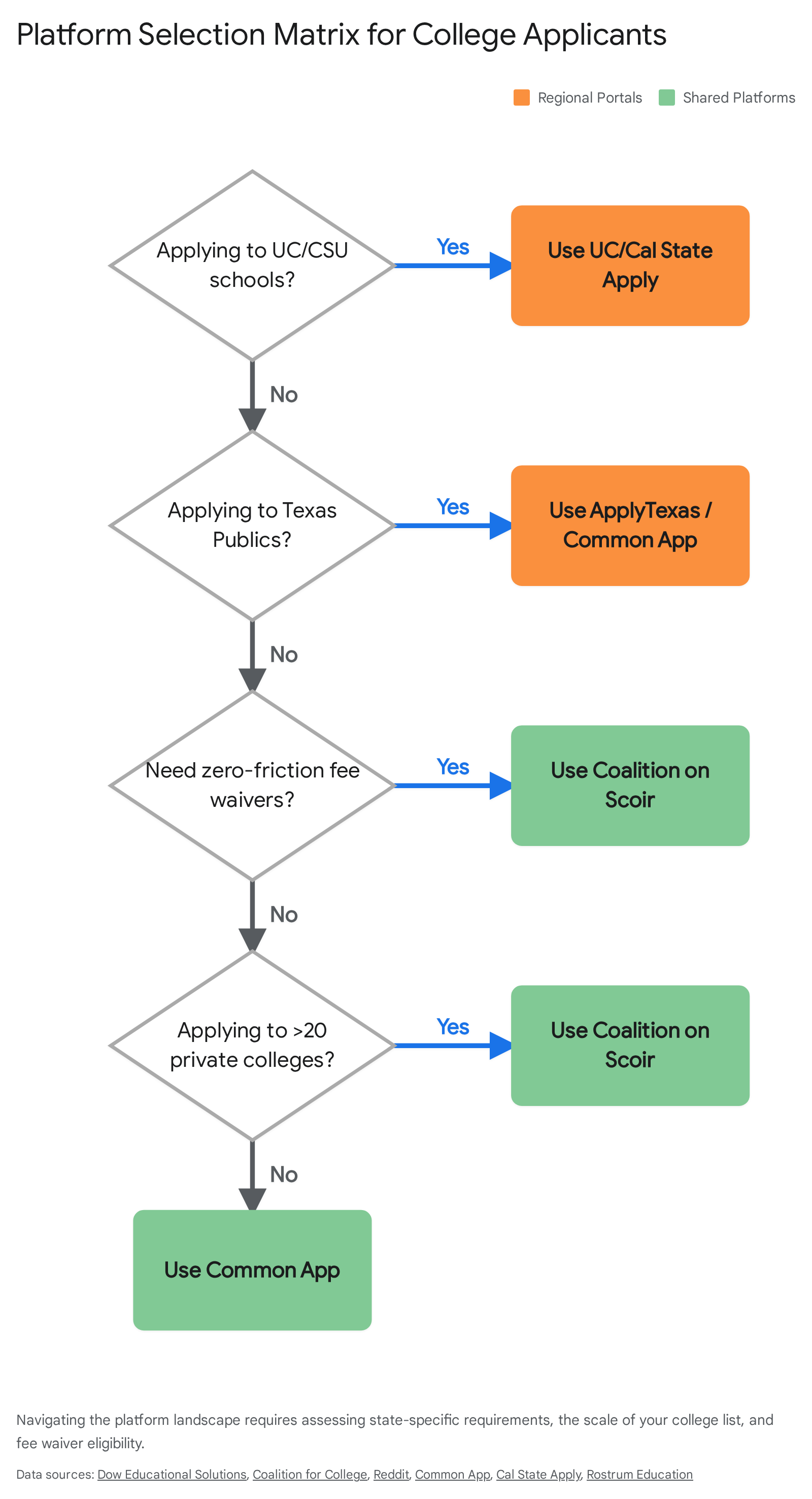
Profile 1: The High-Volume, National Applicant For the student applying to a mix of 10 to 15 selective private institutions (e.g., Ivy League, NESCAC liberal arts colleges) and out-of-state public flagships (e.g., University of Michigan, UVA), the Common App is the only logical choice. Its ubiquity ensures that the student will only have to draft one 650-word personal statement and curate one list of 10 extracurricular activities. The ecosystem's integration with high school counseling software guarantees that teachers and counselors only have to upload letters of recommendation and transcripts once, minimizing administrative errors across a large portfolio of applications 263249.
Profile 2: The Under-Resourced or First-Generation Student Bureaucratic friction is the enemy of college access. For students relying heavily on fee waivers, the Common App's requirement that a high school counselor actively verify their financial need can result in missed deadlines if the counselor is overwhelmed by high caseloads. The Coalition on Scoir's honor-system fee waiver - where simply checking the FRPL or Pell eligibility box instantly zeroes out application fees without requiring secondary verification - is a massive advantage 1213. Furthermore, by restricting its membership to colleges with proven track records of graduating students with low debt, the Coalition actively funnels first-generation students toward institutions that are statistically safer financial investments 116.
Profile 3: The State-System Focused Resident (California, Texas, or New York) A resident of California targeting the UC system has no choice but to master the UC Application and its distinct four-essay PIQ format 547. Because the UC essays are shorter and more direct, they rarely translate perfectly to the Common App's narrative personal statement, meaning this student must prepare two entirely separate blocks of writing 47. In Texas, a resident aiming for UT Austin or Texas A&M should utilize the Common App due to its superior stability and cleaner user interface compared to ApplyTexas 5254. However, if that same student intends to apply to five smaller, regional Texas public universities during "Texas Free Week," they must maintain an active ApplyTexas account to capitalize on the financial savings 56. In New York, a student applying solely to state schools should use the applySUNY portal to maximize automatic fee waivers, but if they are applying to a mix of SUNY and private colleges, routing the SUNY applications through the Common App saves hours of redundant data entry 2059.
Bottom line
Choosing an application platform is an exercise in administrative strategy, not an opportunity to signal preference to admissions officers. If a college list heavily features private institutions and out-of-state flagships, default to the Common Application for its unmatched efficiency, granular test-reporting controls, and massive 1,100-school network. If an applicant is an under-resourced student who requires immediate, zero-friction fee waivers, or if their high school relies entirely on Scoir for counseling, the Coalition on Scoir offers a highly supportive, financially vetted ecosystem. Ultimately, the strongest application is the one submitted well before the deadline, free of rushed typos and missing supplementary documents - an outcome achieved by selecting the platform that aligns closest with a student's specific college list and financial needs.