
How to Choose and Get Into the Right US College
Successfully navigating the United States college admissions landscape requires prospective students to build a balanced list of reach, target, and safety schools driven by academic and financial fit, rather than prestige alone. In an era marked by the return of standardized testing at elite institutions, the elimination of race-conscious admissions, and sweeping overhauls to the federal financial aid formula, applicants must adopt a multi-year strategy to optimize their academic profiles. Understanding the nuances of binding early admission plans, demonstrating authentic extracurricular depth, and evaluating the true net cost of attendance are essential for securing admission and avoiding debilitating student debt.
Defining the Right College Fit
The foundation of a successful admissions cycle lies in developing a well-researched, balanced list of prospective institutions. Educational consultants and admissions professionals universally caution against relying exclusively on national rankings or institutional prestige, as these metrics primarily reflect selectivity and endowment size rather than student outcomes or personal well-being 12. Instead, the most effective strategies prioritize an applicant's "fit" across several core dimensions 13.
The concept of academic fit involves examining student-to-faculty ratios, the availability of highly specific majors, undergraduate research opportunities, and the flexibility of the core curriculum 12. Social and campus culture is equally critical. Institutional environments vary dramatically; small liberal arts colleges, typically enrolling 1,500 to 3,000 students, offer intimate, discussion-based academic settings and close-knit communities. In contrast, large public research universities, often exceeding 10,000 or even 40,000 students, provide massive alumni networks, diverse club offerings, and large lecture-style courses 145. Neither structure is inherently superior, but they foster vastly different daily experiences for the undergraduate 1.
Geographic location and physical setting further dictate the undergraduate experience. The environment - whether a dense urban center offering immediate corporate internship access, a self-contained traditional college town, or an isolated rural campus with proximity to environmental research sites - heavily influences both career networking and student travel logistics 13.
Finally, financial fit serves as the ultimate limiting factor. An institution only represents a viable option if the student's family can afford the ultimate cost of attendance after grants, scholarships, and institutional aid are applied 12. Identifying a pristine academic and social match is counterproductive if the resulting financial burden proves unsustainable.
Strategizing the College List: Reach, Target, and Safety
To manage the inherent uncertainty of modern college admissions, applicants must categorize their prospective college list into reach, target, and safety schools using objective, data-driven metrics 348. The most reliable source for this data is an institution's Common Data Set, a standardized report detailing the exact academic profiles of enrolled freshmen 48.
Relying on overall acceptance rates alone leads to frequent miscalculations. An applicant must compare their own high school Grade Point Average (GPA) and standardized test scores to the middle 50% range of historically admitted students at a specific university 45.
| School Category | Applicant Profile vs. Admitted Student Data | Overall Institutional Acceptance Rate | Admission Probability |
|---|---|---|---|
| Safety (Likely) | The applicant's GPA and standardized test scores exceed the 75th percentile of admitted students. | Typically above 50% to 65%. | Highly likely (>75% probability of acceptance) 3456. |
| Target (Match) | The applicant's GPA and test scores fall between the 25th and 75th percentiles of historically admitted students. | Typically moderate, ranging from 30% to 50%. | Reasonable chance (~50% probability of acceptance) 3456. |
| Reach (Aspirational) | The applicant's GPA and test scores fall below the 25th percentile, OR the institution itself is highly selective. | Typically below 20%. | Uncertain (<25% probability of acceptance) 3456. |
A widespread misconception is that an exceptional applicant can treat highly selective universities as target or safety options. Admissions experts emphasize that any university with an overall acceptance rate below 15% - a threshold that includes all Ivy League institutions and comparable elite universities - must be universally categorized as a reach school, regardless of how perfect an applicant's academic credentials may appear 485. Standard industry guidance suggests that a finalized college list should contain approximately 25% safety schools, 50% target schools, and 25% reach schools to ensure options across the selectivity spectrum 6.
The Four-Year Application Timeline
The college application process technically spans all four years of high school, as grades, course rigor, and extracurricular commitments compound over time. However, the actionable phases of testing, list curation, and application submission are concentrated heavily in the junior and senior years 117.
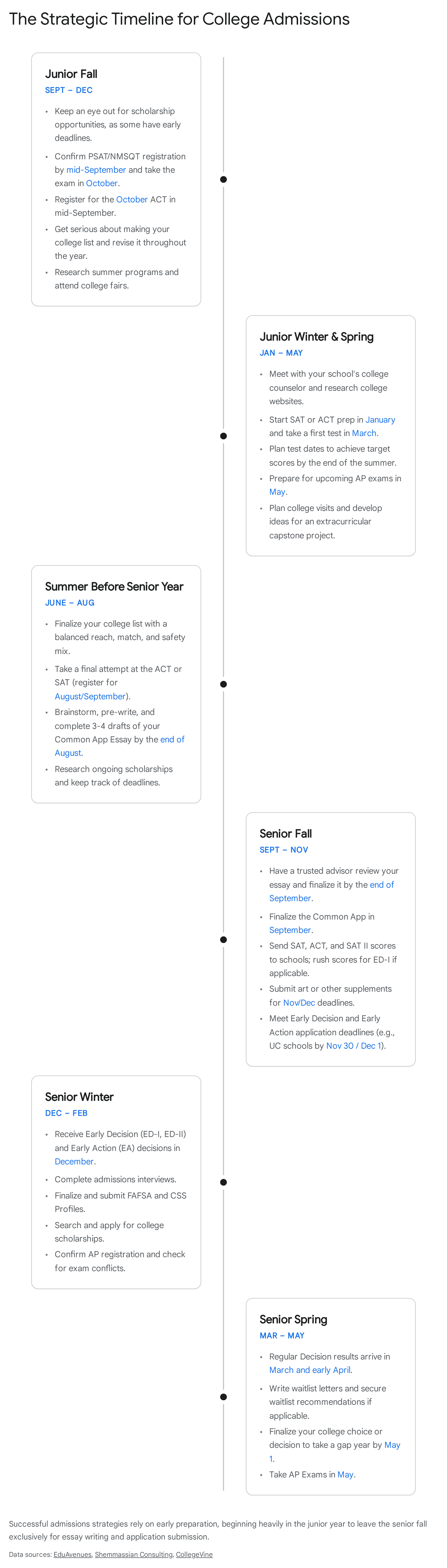
During the freshman and sophomore years, the primary objective is establishing a solid academic foundation. Treating the ninth grade as a practice round is a costly error, as early grades permanently impact cumulative GPAs 7. Sophomores are advised to narrow their extracurricular commitments from a wide exploratory range to four or six core activities, stepping up academic rigor by adding Advanced Placement (AP) or honors courses in their strongest subjects 7.
The junior year is widely recognized as the most critical academic period. Admissions officers scrutinize junior-year transcripts intensely, as they represent the most advanced coursework an applicant has completed prior to the application review 78. In the fall of the junior year, students typically take the PSAT, which serves as the qualifying exam for National Merit Scholarships 789. The winter and spring are reserved for intensive standardized test preparation, with most students taking their first official SAT or ACT exams between January and May 79. The spring of junior year is also the optimal time to request letters of recommendation, allowing teachers the summer to draft thoughtful endorsements 8.
The summer preceding senior year is viewed by admissions consultants as the single most valuable stretch of the entire process 715. During these months, applicants should finalize their balanced college lists and write the bulk of their Common Application essays and supplemental materials 7915.
By the fall of the senior year, the focus shifts to execution. Early applications are typically submitted by November 1 or 15, while financial aid forms such as the FAFSA and CSS Profile open for completion 7910. Regular Decision applications are due in January, and by late March, students receive their final admissions verdicts, initiating a one-month window to compare financial aid offers before the universal National College Decision Day on May 1 11710.
Navigating Admission Decision Plans
Applicants must carefully select the specific admission plan under which they submit their application to each university. The strategic choice between Rolling, Early, and Regular decision models dictates both the timeline of the outcome and the applicant's future financial leverage 101112.
| Admissions Plan | Application Deadline | Notification Timeline | Binding Commitment | Financial Aid Implications |
|---|---|---|---|---|
| Rolling Admissions | Flexible; open until the incoming class is filled. | Typically 4 to 8 weeks after submission. | Non-binding. | First-come, first-served aid. Applying early maximizes scholarship chances 10111213. |
| Regular Decision (RD) | Early January to mid-February. | March or early April. | Non-binding. | Allows full comparison of financial aid packages across multiple institutions before May 1 101112. |
| Early Action (EA) | Early to mid-November. | Mid-December to January. | Non-binding. | Highly advantageous. Allows for early peace of mind while retaining the right to compare aid offers in the spring 10111213. |
| Early Decision (ED I & II) | November (ED I) or January (ED II). | December (ED I) or February (ED II). | Binding. The student must enroll if admitted and withdraw all other applications. | High risk. Prevents students from comparing financial aid offers. Forces commitment before the final cost is known 10111213. |
Evaluating Early Decision When Financial Aid Matters
Applying Early Decision (ED) often provides a statistical advantage in acceptance rates. Universities favor ED applicants because binding acceptances guarantee enrollment, thereby protecting the institution's yield rates 2014. Data indicates that Early Decision acceptance rates can be significantly higher than Regular Decision rates at the same institution 2014.
However, this advantage comes with profound financial risks for families relying on need-based or merit aid 142223. Because an ED acceptance is an ethical and contractual commitment, the applicant forfeits the critical ability to compare financial aid packages across competing universities 14232425. If a student is admitted ED but the accompanying financial aid package is insufficient, the family is placed in a highly precarious situation. While applicants can theoretically back out of an ED agreement if the financial aid is demonstrably insufficient, they must prove this inability to pay, and by the time they do, the deadlines to apply to other top-tier universities may have already passed 24.
Educational consultants generally advise that students who require substantial financial assistance should opt for Early Action or Regular Decision. The only exception is if the family has utilized the institution's official Net Price Calculator, accurately inputted their financial data, and is absolutely certain they can afford the estimated cost 14222324.
The Shifting Landscape of Standardized Testing
The criteria by which universities evaluate academic readiness have undergone seismic shifts in recent years, heavily influenced by the COVID-19 pandemic and subsequent data analysis.
The Pandemic Shift and the Return to Mandatory Testing
In 2020, the widespread closure of testing centers forced over 1,600 colleges to adopt "test-optional" or "test-blind" policies 15. A test-optional policy allows students to decide whether submitting their scores will strengthen their application, whereas a test-blind (or test-free) policy dictates that the admissions committee will not review standardized test scores under any circumstances, even if they are submitted 16282917. The public university systems in California (the University of California and California State University) remain permanently test-blind 1718.
However, as the pandemic receded, a clear divergence emerged. Admissions data revealed a severe increase in high school grade inflation; by 2016, 47% of high school seniors were graduating with an "A" average, rendering GPAs a less reliable metric for academic differentiation 15. Consequently, research at highly selective institutions indicated that standardized test scores remained the most robust predictor of a student's success in demanding college curricula 1519.
Heading into the 2025 - 2026 admissions cycle, a formidable wave of prestigious institutions reversed their pandemic-era policies and reinstated mandatory testing requirements. This list now includes the Massachusetts Institute of Technology (MIT), Harvard, Stanford, Yale, Brown, Dartmouth, the California Institute of Technology (Caltech), Georgetown, Johns Hopkins, Carnegie Mellon, the University of Texas at Austin, and the state university systems of Florida and Georgia 16193334. MIT's Dean of Admissions noted explicitly that the math component of standardized tests proved critically necessary to predict whether applicants could survive the institution's intense STEM coursework 19.
Strategies for Test-Optional Schools
For the hundreds of universities that remain test-optional - including many leading liberal arts colleges and national research universities - applicants must evaluate whether to submit their scores strategically 16281735.
If an applicant's SAT or ACT score falls within or above the middle 50% range of the institution's previously admitted class, submitting the score will generally strengthen the profile 161735. Conversely, withholding a score is advised if it falls below the 25th percentile, allowing the admissions committee to weigh the applicant's GPA and extracurricular achievements more heavily 35. It is important to note that even at test-optional institutions, a significant majority of admitted students at highly selective tier schools still submit test scores 28.
Extracurricular Activities: Quality Over Quantity
Beyond basic academic thresholds, applicants must differentiate themselves in a saturated applicant pool through their activities outside the classroom. A pervasive myth among high school students is the need to present a massive "laundry list" of club memberships to appear well-rounded. Admissions data explicitly contradicts this approach 3637.
The Primacy of Academic Rigor
It is critical to understand that extracurricular activities operate as secondary supplements, not primary drivers of admission. In national surveys conducted by the National Association for College Admission Counseling (NACAC), approximately 75% of colleges rated an applicant's high school GPA as "considerably important," with the rigor of the high school curriculum (such as the number of AP or IB courses taken) ranking closely behind at 64% 363738. An extensive list of extracurricular activities cannot compensate for a weak academic transcript; an applicant must first meet the institution's academic threshold before their activities are evaluated seriously 3638.
Developing a Deep Extracurricular "Spike"
When admissions officers evaluate activity lists, they prioritize quality, depth, and tangible leadership over sheer quantity 36373940. An applicant who dedicates significant time to two or three core interests - achieving leadership roles, state-level recognition, or measurable community impact over several years - will routinely outperform an applicant who claims superficial involvement in ten different clubs 373940.
This focused dedication is often referred to in admissions consulting as developing a "spike" 39. Colleges are attempting to build a well-rounded incoming class comprised of highly specialized, passionate individuals, rather than a class where every individual student is mildly engaged in everything. Furthermore, attempting to juggle too many activities frequently leads to applicant burnout, which negatively impacts mental health and the primary academic metrics that matter most 40.
The Role of Demonstrated Interest
Another nuanced factor in the admissions process is "demonstrated interest" - the behavioral metrics a college tracks to determine how likely an applicant is to actually enroll if offered admission 202143. Because universities are protective of their yield rates (the percentage of admitted students who choose to attend), many institutions prioritize applicants who show genuine enthusiasm, as it improves the college's predictability metrics and national rankings 202143.
It is vital to note that the most elite institutions - such as Ivy League schools, Stanford, MIT, and massive public universities - do not track demonstrated interest, as they assume high yield rates inherently 20. However, for many selective private colleges, demonstrated interest is a crucial metric 20. Applicants can signal this interest effectively by taking official campus tours, attending virtual information sessions, participating in alumni interviews, applying via Early Action, and consistently engaging with marketing emails dispatched by the admissions office 20214445. Conversely, visiting a campus without officially registering or flooding an admissions office with generic emails yields no strategic benefit 2044.
Admissions After the Supreme Court Affirmative Action Ban
In June 2023, the U.S. Supreme Court issued a landmark ruling in Students for Fair Admissions v. Harvard and UNC, holding that race-based affirmative action in college admissions violated the Equal Protection Clause of the Fourteenth Amendment 4647. The ruling effectively banned higher education institutions from using an applicant's race as a demographic checkbox or a "plus factor" in holistic reviews 4648.
The immediate demographic fallout was stark. In the first admissions cycle following the ruling (Fall 2024), highly selective universities reported significant drops in minority representation. Black student enrollment at the Massachusetts Institute of Technology plummeted from 15% to 5%, while Harvard University experienced a drop from 18% to 14%, and the University of North Carolina saw a decline from 10.5% to 7.8% 4647.
The Shift to Identity and Background Essays
However, the Supreme Court majority opinion explicitly stated that the ruling should not be construed as prohibiting universities from considering "an applicant's discussion of how race affected his or her life, be it through discrimination, inspiration, or otherwise," provided that the discussion highlights the applicant's courage, determination, or unique ability to contribute to the university 22232452.
This legal nuance fundamentally altered the college essay landscape 225325. In response, dozens of universities pivoted rapidly, introducing new supplemental essay prompts focusing on "lived experiences," "community backgrounds," and "adversity" 22235325. For example, the University of Virginia instituted a prompt asking how an applicant's "background, perspective, or experience will serve as a source of strength," while Harvard updated its prompt to ask how "life experiences that shape who you are today enable you to contribute" 235355.
Rather than relying on demographic data, admissions committees now look to personal statements to understand a student's cultural background 2225. Successful applicants must focus on the impact of their identity, demonstrating how their specific cultural or socioeconomic experiences fostered skills, intellectual curiosity, or resilience, rather than simply stating their heritage 2253.
Department of Education Guidance and the Compliance Chill
Following the ruling, the U.S. Department of Education issued guidance encouraging universities to continue holistic reviews and targeted outreach to diverse communities 5626. However, the broader legal environment has created a chilling effect on traditional admissions practices. Legal experts warn that the new interpretation of the law casts suspicion on any data point that might serve as a proxy for race, such as ZIP codes or specific high schools attended 4824. Universities, fearful of federal investigations and massive financial penalties, are increasingly shifting toward anonymized, quantifiable inputs, demanding that any advantage given to an applicant based on adversity be tied strictly to their individual character and verified achievements 4824.
Decoding the True Cost of College
Understanding the true financial burden of higher education requires distinguishing between published prices and actual out-of-pocket expenses.
The "sticker price" of a college is the advertised Cost of Attendance (COA) for a single academic year. This figure encompasses direct expenses billed by the university (tuition, mandatory fees, and on-campus housing) as well as estimated indirect expenses (books, travel, and personal costs) 585927. For premier private institutions, the sticker price can now easily exceed $80,000 annually.
However, the sticker price is rarely the amount a typical family actually pays 58596162. The critical figure is the "net price" - the sticker price minus all non-repayable gift aid, which includes institutional merit scholarships, federal Pell grants, and state aid 5859. Federal student loans and work-study funds do not reduce the net price, as they represent future debt and earned wages, respectively 5859.
A pervasive misconception leads families to immediately dismiss expensive private colleges due to sticker shock 5961. In reality, elite private colleges frequently possess massive multibillion-dollar endowments, allowing them to distribute deep institutional grants 61. Consequently, a private college with an $80,000 sticker price may offer a middle-class family so much financial aid that its actual net price is significantly lower than that of a local in-state public university 592762. All institutions are mandated to feature a Net Price Calculator on their websites to provide custom estimates based on a family's financial profile 5827.
The FAFSA Simplification and Its Fallout
The gateway to federal, state, and institutional financial aid is the Free Application for Federal Student Aid (FAFSA) 28646566. The FAFSA Simplification Act mandated massive structural changes to the system beginning with the 2024 - 2025 academic cycle, aiming to streamline the form and link it directly to IRS tax data 646768.
The most significant overhaul was the replacement of the decades-old Expected Family Contribution (EFC) metric with the new Student Aid Index (SAI) 68697029. While both metrics serve to assess financial strength, the SAI introduced several consequential mathematical shifts: * The Negative SAI Floor: While the EFC bottomed out at $0, the SAI can drop to -$1,500. This modification allows financial aid offices to better identify the most deeply impoverished students and award them maximum aid 686970. * The Loss of the Sibling Discount: Under the previous EFC formula, families with multiple children enrolled in college simultaneously saw their expected contribution divided, reflecting the strain of paying double tuition. The SAI completely eliminates this multiple-in-college discount, drastically reducing aid eligibility for middle-class families with overlapping college students 68697030. * Small Business and Farm Assets: The SAI formula now forces families to report the net worth of small businesses and family farms, which were entirely excluded from the old EFC calculation. This change severely alters the aid landscape for rural and entrepreneurial families 68697030.
The Disastrous Rollout
Unfortunately, the rollout of the newly simplified FAFSA was widely considered a disaster 2865. Plagued by persistent technical glitches, formula miscalculations by the Department of Education, and a delayed launch that pushed the opening date from October to late December 2023, the federal government struggled to send accurate data to universities 286567.
This systemic failure caused a chain reaction of delayed financial aid offer letters, forcing hundreds of thousands of students to make binding enrollment decisions without knowing their true out-of-pocket costs 286465. The chaos disproportionately impacted low-income and mixed-documentation families, ultimately resulting in an overall drop of over 430,000 FAFSA submissions compared to previous academic years 2866.
The Reality of Student Loan Debt
For the majority of American families, navigating the financial aid system ultimately necessitates borrowing. As of early 2025, the total outstanding student loan debt in the United States reached an astonishing $1.77 trillion, with federal loans accounting for roughly 92% of that total burden 73.
Approximately 50% of students graduating with a bachelor's degree from a four-year institution leave with debt. The average student loan debt per borrower hovers between $29,300 and $38,883, depending on the specific demographic and institutional data analyzed 7374753177.
The burden of this debt is not distributed equally across the population. Systemic inequities mean that Black borrowers carry an average of $53,430 in student debt, a figure significantly higher than the $46,140 average for white borrowers and the $26,460 average for Hispanic borrowers 3177. Furthermore, students attending private, for-profit institutions generally accumulate significantly more debt (averaging over $40,000) than their peers at public or private non-profit universities 7477. Over 3.6 million borrowers currently owe more than $100,000 in federal student loans, reflecting the compounding nature of interest and the high cost of graduate-level education 7377.
The Complete Guide for International Students
International applicants face a distinctly higher barrier to entry when applying to US colleges, encompassing language testing, rigorous visa documentation, and severely restricted financial aid ecosystems.
Demonstrating English Proficiency
Because English is the primary language of instruction, non-native speakers must formally demonstrate linguistic proficiency, typically via standardized tests like the TOEFL or IELTS 32798081. Cutoff scores correlate strictly with institutional prestige. Elite universities (e.g., Harvard, Stanford, Columbia, MIT) generally require a minimum TOEFL iBT score of 100, though average admitted students frequently score closer to 105 - 110 3383. Mid-tier and state universities typically accept TOEFL scores between 80 and 90, or an IELTS band score of 6.0 to 7.0 803383.
The F-1 Student Visa and Financial Proof
To legally study in the United States, international students must secure an F-1 Student Visa 3485. This bureaucratic process begins only after a student is admitted, at which point the university issues a Form I-20 (Certificate of Eligibility) 8586.
Crucially, before an institution will issue the I-20, the applicant must provide stringent proof of financial stability. This typically requires submitting certified bank statements covering a 3-to-6-month period, demonstrating immediate access to liquid funds sufficient to cover the entire first year of tuition and living expenses 8586353637. Depending on the university, this sum can range from $30,000 to over $80,000 8636. U.S. immigration laws mandate this strict financial proof to ensure that international students do not drop out or engage in unauthorized, illegal labor due to a lack of funds 3537.
Need-Blind vs. Need-Aware Admissions
The reality of financial aid for international students is grim. Federal US student aid - including Pell Grants and subsidized federal loans - is legally restricted to US citizens and eligible noncitizens; international students do not qualify 34379091.
Consequently, an overwhelming majority of US universities are "need-aware" for international applicants 90. This means that the admissions committee will evaluate an international student's ability to pay the full sticker price; if the student requires heavy financial aid, that need can and will be used as a primary reason for rejection 9091.
However, a highly exclusive subset of wealthy institutions operates under a "need-blind" policy for international students. These institutions evaluate international applications entirely without regard to the applicant's financial situation, and they guarantee to meet 100% of the demonstrated financial need for all admitted students via grants and campus jobs, rather than loans 91929394.
| The 8 US Universities That Are Need-Blind for International Students (2025) | Description of Aid Policy |
|---|---|
| Amherst College | Meets 100% of need without requiring loans 92939495. |
| Bowdoin College | Follows a strict no-loan policy, providing grants and campus employment 9293949596. |
| Brown University | Became need-blind for international applicants beginning with the Class of 2029 92939495. |
| Dartmouth College | Adopted need-blind international admissions in 2022, meeting full demonstrated need 92939495. |
| Harvard University | Families earning under roughly $200,000 pay virtually nothing for tuition 9293949596. |
| Massachusetts Institute of Technology (MIT) | Meets 100% of financial need without including loans in offers 9293949596. |
| Princeton University | The first US university to replace all loans with grants 92939495. |
| Yale University | Packages consist entirely of grants, allowing students to graduate debt-free 9293949596. |
While these eight institutions eliminate systemic financial barriers, their overall admission rates frequently hover below 5%, making the competition among global applicants incredibly fierce regardless of financial standing 9293.
Bottom line
The US college admissions process demands a highly calculated blend of sustained academic excellence, authentic extracurricular depth, and strategic foresight. Applicants must navigate a shifting landscape defined by the reinstatement of mandatory standardized testing at elite institutions and the rise of nuanced identity essays in a post-affirmative action environment. Ultimately, securing acceptance to a well-fitting target school is only half the battle; families must meticulously evaluate the net cost of attendance, navigate the complexities of the updated FAFSA, and weigh the severe financial risks of binding early admission plans to avoid crippling long-term student debt.