
Marketing job market and skill trends in 2026
Global Labor Market Context
The global labor market in 2026 is characterized by a fragile stability, operating under the dual pressures of macroeconomic uncertainty and the rapid acceleration of artificial intelligence. Broad workforce metrics indicate a global unemployment rate holding steady at 4.9%, representing approximately 186 million individuals, which points to continued resilience following post-pandemic economic volatility 12. However, this aggregate stability obscures significant structural transformations and widening inequalities beneath the surface. Macroeconomic analyses from the International Labour Organization (ILO) reveal a broader global jobs gap - capturing individuals who desire paid employment but cannot secure it - projected to reach 408 million 13. Furthermore, persistent demographic inequalities continue to shape access to high-quality work; female labor force participation remains significantly lower than that of men, and global youth unemployment stands at an elevated 12.4%, with nearly 260 million young people classified as not in employment, education, or training (NEET) 124.
Against this backdrop, the World Economic Forum (WEF) projects a massive structural labor-market transformation over the coming years. By 2030, an estimated 22% of all current jobs will undergo fundamental structural changes, resulting in the displacement of 92 million roles alongside the creation of 170 million new opportunities, yielding a net global growth of 78 million jobs 567. Broadening digital access and the integration of artificial intelligence are cited as the most transformative trends by global employers, fundamentally divergent in their impacts across different industries 58.
Within the marketing sector specifically, the manifestation of these global trends is particularly acute. The marketing profession has crossed a critical threshold, transitioning from an era of experimental artificial intelligence adoption to deep, structural integration. With 72% to 94% of organizations now utilizing AI in their marketing and sales operations, the technology has ceased to be a peripheral utility and has become fundamental enterprise infrastructure 910. This integration has triggered a paradigm shift in the marketing job market, fundamentally redefining skill valuations, altering compensation structures, compressing traditional career pathways, and altering the baseline expectations for both junior and senior professionals.
Marketing Workforce Contraction and Expansion
In early 2026, the overarching sentiment among marketing and creative leaders is one of cautious optimism, with 81% expressing confidence in their organization's business outlook and 65% planning to expand permanent headcount 11. Yet, this headcount expansion is highly selective and unevenly distributed across the marketing hierarchy. The total volume of work required of marketing departments is escalating, but the distribution of human labor is increasingly bifurcated between high-level strategic oversight and automated execution.
The Ghost Workforce Phenomenon
The integration of generative artificial intelligence has not resulted in the immediate, wholesale elimination of human marketers. Only 11% of surveyed organizations explicitly report having replaced workers directly with AI tools 1213. However, the efficiency narratives surrounding AI adoption have permeated corporate boardrooms, leading to significantly inflated expectations regarding human output. This dynamic has catalyzed the emergence of a "ghost workforce," an invisible labor pool comprised of individual marketers who are absorbing the responsibilities of two or three traditional roles simultaneously 1213.
Approximately 76% of surveyed marketers report executing the workload of more than one job, and 50% have absorbed entirely new functional responsibilities without receiving corresponding promotions or pay increases 13. Despite the theoretical efficiency gains promised by automation, 91% of marketing professionals state they are expected to handle a higher volume of work without adequate structural or personnel support, leading to widespread burnout and diminished job satisfaction 12.
The severity of this phenomenon correlates directly with an organization's level of AI maturity. In entities classified as "highly disrupted" by AI - where intelligent systems extensively reshape workflows - 47% of marketers expect the technology to replace or significantly alter their roles within five years, compared to just 26% in low-disruption organizations 12. Furthermore, highly disrupted marketing departments are experiencing a higher rate of hidden layoffs; 45% of these organizations report active team staff reductions, compared to 30% in less automated environments 12. Companies are actively allowing natural attrition, quiet layoffs, and slowed hiring cycles to shrink the executional layers of their marketing workforce, expecting the remaining staff to bridge the productivity gap using generative tools 13.
Entry-Level Pipeline Compression
The most severe labor market disruption within the marketing sector is occurring at the entry level. The traditional entry-level marketing position has historically functioned as an operational training ground. Junior staff were tasked with deterministic, volume-based activities: drafting social media copy, scheduling multi-channel posts, compiling preliminary performance reports, and conducting baseline market research 1415. Through the repetition of these executional tasks, young professionals developed the contextual business judgment, brand intimacy, and strategic acumen required to advance to senior management 14.
In 2026, the economic rationale for human execution of these tasks has collapsed. The unit cost of a decision or draft generated by an AI agent is now marginally close to zero, rendering the human-led execution of high-volume, low-risk tasks financially unviable for many firms 16. Bloomberg data indicates that artificial intelligence can currently automate 53% of the tasks traditionally performed by junior market research analysts, compared to only 9% of the tasks executed by senior counterparts 14. Consequently, entry-level job postings have plummeted globally, with estimates showing year-over-year declines ranging from 15% to 29% 1417. The Stanford Digital Economy Lab has identified early-career workers, specifically those aged 22 to 25, as the "canaries in the coal mine" of the AI transition, noting a 16% relative decline in employment for this demographic even as experienced employment remains stable 18.
Within the marketing sector, one in three companies is actively reducing entry-level hiring, a reduction rate occurring at nearly 2.5 times the pace of any reported increase, resulting in a severe net contraction score of -19.8 points for junior roles 12. Unemployment rates for recent graduates have surged to 5.6%, reaching their highest levels since the pandemic disruptions 19. The entry-level positions that do remain have been fundamentally redefined. Rather than executing singular campaigns or drafting press releases, new graduates are now expected to orchestrate AI systems, design complex prompts, and evaluate algorithmic outputs from their first day of employment 15. Internship postings routinely emphasize AI enablement and data-driven decision-making as baseline expectations, effectively compressing the traditional career ladder and forcing new entrants to contribute at a strategic level immediately 15.
This dynamic poses a severe, long-term structural risk to the marketing industry. By eliminating the junior executional layer to secure immediate capital savings, the industry risks hollowing out its future leadership pipeline 1418. The paradox of the 2026 labor market is the demand for junior talent to possess strategic oversight - a capability historically acquired through the exact executional repetitions that have now been automated out of existence.
Skill Demand and Compensation Shifts
While the bottom of the marketing career ladder is hollowing out, overall demand for marketing professionals remains net positive, driven entirely by an aggressive expansion in hiring for experienced, specialized talent 12. The market is actively shifting compensation models to reward professionals who can move beyond tactical execution and operate as systems architects.
Transition from Execution to Orchestration
The defining characteristic of high-value marketing labor in 2026 is orchestration. As agentic AI systems become increasingly capable of reasoning, planning, and using software tools independently, the economic advantage of human execution continues to erode 16. Instead, human labor is migrating toward the edges of the workflow: defining the strategic constraints at the beginning of a process and evaluating the qualitative outcomes at the end 16.
This shift has catalyzed the creation of entirely new job categories, most notably the AI Content Orchestrator and the Revenue Intelligence Architect. An AI Content Orchestrator is fundamentally different from a traditional content writer. While a writer focuses on the manual creation of individual assets, an orchestrator designs comprehensive content ecosystems 2022. They build prompt architectures that generate brand-consistent narrative variants across multiple platforms, establish quality governance frameworks, and analyze performance data to continuously optimize the algorithmic production system 20.
The compensation for these orchestration roles reflects their immediate impact on enterprise scale. Orchestrators who combine domain marketing expertise with complex AI systems management secure significant salary premiums. For instance, while a traditional content writer typically earns between $35,000 and $50,000 annually, an AI Content Orchestrator commands a salary ranging from $85,000 to $125,000, representing an increase of up to 150% 162021. Similarly, Revenue Intelligence Architects, who design the data infrastructures powering autonomous sales and marketing motions, command base salaries between $110,000 and $210,000 212425.
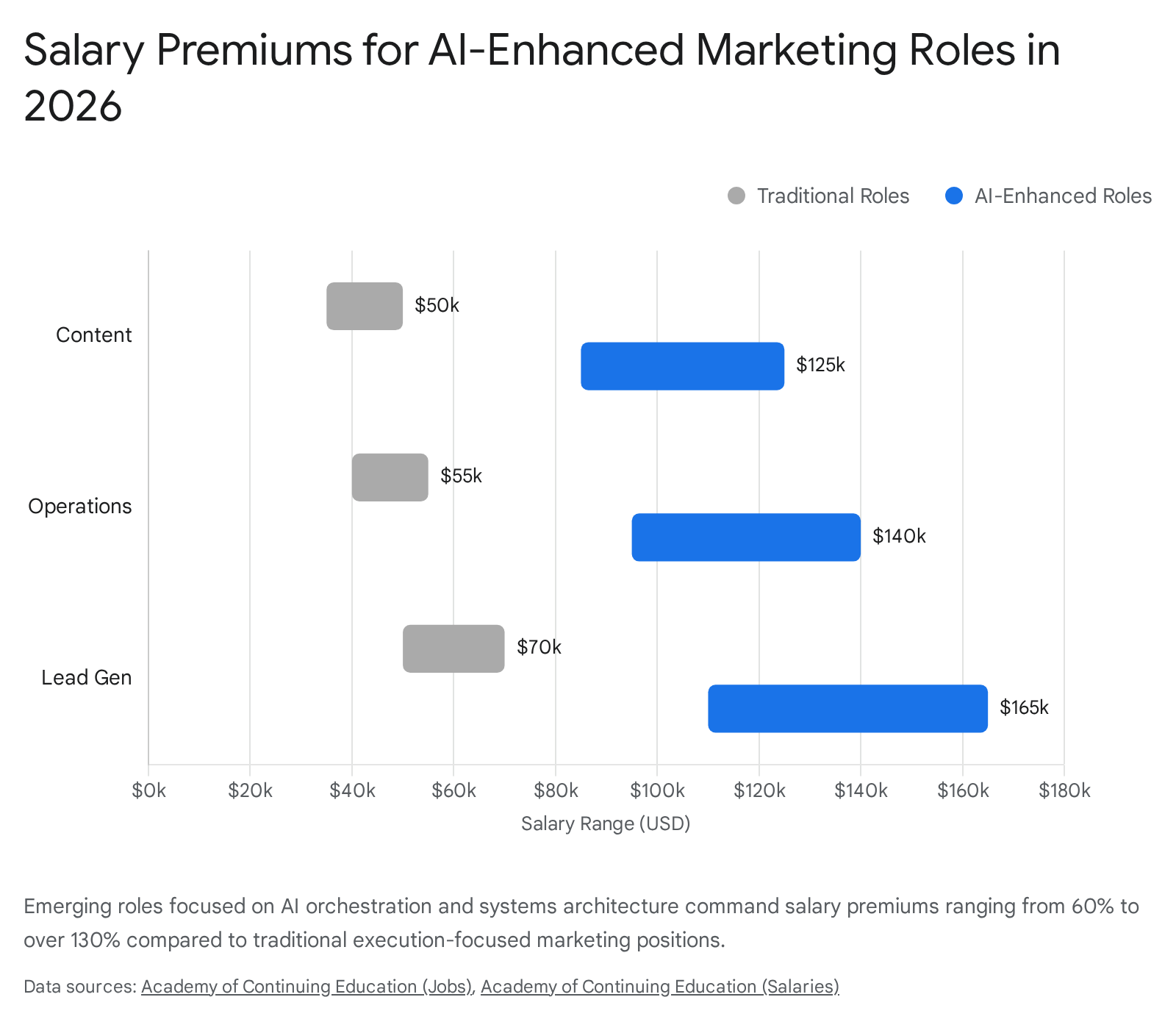
Market data spanning over 7,600 job postings confirms this systemic shift. Marketing roles that explicitly mandate artificial intelligence competencies in their descriptions offer average salaries 20.26% higher than identical roles lacking AI requirements 26. In generalist marketing roles, the premium for AI proficiency expands to 32.19% 26. This skills premium is geographically resilient, maintaining a consistent 63% to 67% advantage across major metropolitan and remote markets alike, reflecting the pure value creation of intelligent system design over geographic cost-of-living adjustments 21.
Data Literacy and First-Party Strategy
Beyond direct AI orchestration, the most critical foundational skill for marketers in 2026 is advanced data literacy. The digital marketing ecosystem has experienced severe data deprecation over the past several years, driven by the elimination of third-party cookies, stringent global privacy legislation, and Apple's continued tightening of tracking parameters 22. Consequently, organizations are fundamentally reliant on first-party data, zero-party data, and advanced predictive modeling to understand consumer behavior 2223.
Marketers are no longer valued merely for their ability to gather vast quantities of data, but for their capacity to interpret it contextually. Technical proficiency in platforms such as Google Analytics 4 (GA4) and cloud-based business intelligence dashboards is considered a baseline requirement 24. High-value professionals are expected to understand complex attribution modeling, perform nuanced cohort analysis, and execute incrementality testing to prove actual return on investment (ROI) against baseline outcomes 22.
Organizations that prioritize and achieve high levels of data literacy outperform their competitors by 20% in customer acquisition efficiency 22. The modern marketer must transition fluidly from tactical metric monitoring - such as click-through rates (CTR) and return on ad spend (ROAS) - to strategic data storytelling, translating raw numerical anomalies into cohesive business narratives that guide executive decision-making 2224.
Automation Vulnerability Across Marketing Functions
The division of labor between humans and machines in 2026 is strictly delineated by the nature of the task. Routine, deterministic processes have achieved high levels of automation, while highly contextual, empathetic, and strategic functions remain exclusively human. Top-performing marketing agencies utilize a Human-in-the-Loop (HITL) model, leveraging AI as an accelerant workflow layer while retaining human personnel for final governance, brand stewardship, and originality assessment 2526.
Marketing Tasks Automation vs Human Strategy
| Marketing Function | Automation Potential (2026) | Primary AI Application | Critical Human Augmentation Role |
|---|---|---|---|
| Content Drafting & Repurposing | 80% - 85% 10 | Generating outlines, long-form first drafts, format transformations (e.g., webinar to social thread), and multi-lingual translation 1027. | Fact-checking, ensuring brand voice consistency, injecting proprietary insights, and preventing narrative entropy 252829. |
| Email & Lifecycle Marketing | 80% 10 | Predictive list segmentation, dynamic subject line generation, send-time optimization, and behavioral trigger activation 1030. | Designing holistic customer journey architecture, establishing empathy guidelines, and guarding against intrusive personalization 2330. |
| Social Media Operations | 75% 10 | Bulk caption generation, automated scheduling, sentiment tracking, and basic Tier-1 community response 2731. | Managing nuanced crisis communications, establishing authentic thought leadership, and interpreting shifting cultural zeitgeists 1023. |
| Media Buying & Ad Bidding | 65% - 87% 1032 | Real-time pacing, cross-channel budget allocation, multivariate creative rotation, and predictive cost-per-acquisition (CPA) targeting 3233. | Defining overarching financial parameters, testing novel value propositions, and synthesizing multi-platform brand experiences 3233. |
| Data Analysis & Reporting | 50% - 60% 40 | Real-time anomaly detection, ingestion of unstructured competitor data, and generation of baseline narrative summaries 3233. | Contextualizing data failures (e.g., macro-economic shifts), determining actionable strategic pivots, and communicating to the C-suite 2240. |
| Brand Strategy & Trust | 10% - 20% 10 | Synthesizing massive qualitative datasets into initial buyer persona hypotheses 3334. | Establishing long-term corporate identity, navigating ethical frameworks, and building authentic, emotional connections with consumers 1023. |
The Transformation of Media Planning and Buying
The media buying sub-sector provides one of the clearest examples of the shift from manual execution to strategic oversight. Prior to the widespread adoption of AI, media buyers spent significant portions of their workweek logging into disparate platforms to adjust bids, reallocate pacing budgets, and pull fragmented performance reports 32. This workflow was inherently reactive; anomalies were identified only after budgets had already been burned 32.
In 2026, AI algorithms evaluate combinations of audience clustering, geographic targeting, inventory availability, and creative variations at a velocity unattainable by human teams 33. Machine learning models automate budget pacing and bid optimization across multiple channels simultaneously, acting on real-time predictive data rather than historical, last-click attribution models 32. Agencies utilizing AI for media optimization report productivity improvements of up to 87%, alongside an average 20% increase in overall ROI 32.
Consequently, the role of the media buyer has elevated. Rather than managing daily bid adjustments, these professionals act as financial strategists. They set the boundary conditions - target ROAS, maximum budget caps, and negative audience parameters - and focus their time on deep customer psychology research and high-level experimental design, allowing the algorithm to execute the micro-transactions necessary to achieve the stated macro-goals 3233.
Predictive Marketing Strategy
This automation capacity has facilitated the transition from reactive analytics to predictive marketing. By combining historical enterprise data with real-time behavioral signals, machine learning models can forecast a customer's subsequent actions with high statistical confidence 35. Marketers use these predictive engines to identify high-intent audiences earlier in the buying cycle, preemptively detect churn risks based on subtle usage anomalies, and deliver dynamically personalized journeys without relying on manual, rules-based segmentation 35. The strategic value of the marketer now lies in designing the interventions that trigger when a predictive model flags a specific risk or opportunity.
Evolution of Search and Discovery
Perhaps the most structurally disruptive shift in the 2026 marketing ecosystem is the rapid evolution of search engine dynamics. The foundational architecture of digital discovery - traditionally dominated by the pursuit of ranking within a list of "ten blue links" on Google or Bing - has been irreversibly altered by the proliferation of artificial intelligence 3637.
Generative AI search platforms, including Google's AI Overviews, Microsoft Copilot, OpenAI's ChatGPT, and Perplexity, now synthesize information from multiple sources to provide direct, conversational answers to user queries 3638. This shift has precipitated a projected 25% decline in traditional search volume, as users increasingly bypass standard organic results in favor of immediate, AI-generated summaries 3438. Consequently, the discipline of Search Engine Optimization (SEO) has necessarily evolved to include Generative Engine Optimization (GEO) and Answer Engine Optimization (AEO) 263639.
Generative Engine Optimization (GEO) Frameworks
While traditional SEO focuses on earning clicks by convincing an algorithm of a page's relevance to a specific keyword, GEO aims to position a brand's content as the authoritative source cited directly within an AI model's generated response 40. The success metric has shifted from sheer website traffic to citation frequency, AI share of voice, and brand inclusion within zero-click environments 3637.
This paradigm shift requires marketers to address the distinct operational principles of large language models. Generative engines do not evaluate domain authority or backlink profiles using the exact mechanisms of traditional search algorithms. Instead, they prioritize content structured for machine readability, rigorous factual density, and clear entity relationships 4041.
To achieve visibility in generative environments, marketing teams are deploying specific GEO tactics. First, the technical foundation must be flawless; marketers utilize advanced schema markup (particularly Article, Organization, FAQ, and HowTo schemas) and maintain specialized llms.txt files to explicitly guide AI crawlers on how to interpret site architecture 38. Second, content strategy has pivoted toward "Information Gain." AI models prioritize sources that introduce novel data, proprietary statistics, or unique conceptual frameworks not broadly represented in their foundational training data 4041. Marketers are intentionally creating "citation bait" - highly structured, easily parsable definitions and original research designed specifically to be ingested and regurgitated by conversational agents 40.
Search Paradigm Comparison: SEO vs. GEO vs. AEO
| Strategic Element | Search Engine Optimization (SEO) | Generative Engine Optimization (GEO) | Answer Engine Optimization (AEO) |
|---|---|---|---|
| Target Ecosystem | Traditional SERPs (Google, Bing) 36 | AI-enhanced search interfaces (Google AI Overviews, Bing Copilot) 3639 | Direct conversational AI assistants (ChatGPT, Claude, Perplexity) 36 |
| Primary Objective | Rank highly in a list to secure user clicks and drive inbound web traffic 373940. | Earn inclusion as a synthesized source within AI-generated query summaries 3739. | Act as the definitive cited source in direct, conversational Q&A interactions 4041. |
| Key Performance Indicators | Keyword ranking position, Organic click-through rate (CTR), Unique website visitors 36. | Generative visibility rate, brand mention frequency, citation presence 36. | Direct referral traffic from AI platforms, LLM brand association 36. |
| Optimization Mechanics | Keyword density, robust backlink profiles, domain age, traditional user experience metrics 364041. | Information Gain, factual density, E-E-A-T signals, verifiable author credentials 3741. | Prompt-driven content structures, clear and concise definitions, proprietary data inclusion 40. |
Crucially, GEO is not a replacement for traditional SEO, but a cumulative layer built upon it. An organization's content must still be accessible via traditional indexing and crawling mechanisms to be included in the training or retrieval-augmented generation (RAG) datasets utilized by AI platforms 3641. The most successful brands in 2026 execute a cohesive strategy that maintains traditional search foundations while aggressively structuring their intellectual property for machine ingestion .
The Reorganization of Revenue Operations
The widespread adoption of artificial intelligence has transcended the marketing department, forcing a comprehensive reorganization of how enterprise go-to-market (GTM) functions operate. The discipline of Revenue Operations (RevOps) - which aligns sales, marketing, and customer success under a unified data and process framework - has evolved into the most critical operational layer within modern B2B organizations 5042.
Agentic Artificial Intelligence in GTM Strategies
Prior to 2026, AI applications within RevOps were largely analytical and predictive. Tools focused on conversational intelligence (e.g., analyzing sales calls for keyword mentions) or pipeline forecasting through static dashboards 4344. The paradigm in 2026 has shifted fundamentally to agentic AI 4454. AI is no longer merely surfacing insights for human review; it is taking autonomous action across the commercial technology stack 44.
Modern RevOps architecture utilizes AI agents that seamlessly update Customer Relationship Management (CRM) records bi-directionally, route incoming leads based on predictive scoring, generate board-ready forecast slides, detect nuanced churn signals from product usage telemetry, and execute personalized outbound communication sequences - all without direct human intervention 434454. This agentic capability aims to invert the traditional sales and marketing time deficit, automating the administrative periphery of commercial work so that human practitioners can focus exclusively on complex relationship building and strategic negotiation 44.
Data Governance as a Core Competency
The deployment of autonomous agents introduces severe operational risks if the underlying data infrastructure is flawed. Agentic AI deployed atop incomplete, siloed, or inaccurate CRM data will execute errors at machine speed, amplifying misalignment between marketing and sales rather than resolving it 4244. Consequently, data governance has transitioned from a backend IT concern to a premier strategic imperative 55.
The defining role within this new paradigm is the GTM Engineer or Revenue Intelligence Architect 5645. These highly technical operators bridge the gap between commercial strategy and complex data engineering. They utilize platforms like Snowflake and dbt to architect continuous data pipelines, enforce strict CRM field definitions, deploy automated data enrichment protocols (via tools like Clay or Demandbase), and ensure that AI agents across different departments are operating from a single, unified source of truth 44555645.
This automation of operational maintenance is dramatically reshaping RevOps team structures. Organizations are sunsetting manual reporting meetings and reducing their reliance on junior data-crunching roles 4354. The traditional RevOps workload - historically split as 60% manual administration and 40% strategy - has inverted to an 80/20 split favoring strategic AI orchestration 43. This evolution allows companies to reduce baseline RevOps headcount requirements by up to 40% while simultaneously increasing forecast accuracy and overall revenue engine velocity 43. As a result, senior RevOps leaders capable of governing these intelligent systems are experiencing massive demand, with Chief Revenue Operations Officers and VP-level architects commanding compensation packages frequently exceeding $200,000 2558.
Regional Hiring Variations and Regulatory Impact
While the technological shifts driving the marketing labor market are global, their manifestation is highly dependent on regional economic conditions, demographic trends, and legislative frameworks. The 2026 recruitment landscape is characterized by divergent regional strategies, requiring multinational organizations to adopt highly localized talent acquisition models 46.
Global Recruitment Dynamics
The global market for specialized marketing and technology talent remains intensely competitive, though the specific drivers vary significantly by continent.
| Global Region | 2026 Market Characteristics & Hiring Trends | Key Strategic Pressures |
|---|---|---|
| North America (U.S. & Canada) | The market is experiencing a period of stabilization following severe post-pandemic volatility . Hiring is highly strategic, prioritizing roles that cannot be automated (advanced RevOps, data architecture, and predictive strategy) 46. | A pronounced "local and loyal" trend where candidates prefer hybrid/local roles over relocation; acute pressure to bridge expectation gaps regarding compensation and AI tooling . |
| Europe | Modest, stable economic growth with a heavy emphasis on regulatory compliance and internal mobility . Organizations are prioritizing the reskilling of their existing workforce over net-new external hiring to address deep technical skills shortages 61. | Long-term demographic decline and aging populations limit labor pool expansion; rising intra-EU talent mobility driven by varying remote-work policies and tax incentives 47. |
| Asia-Pacific (APAC) | The region leads global hiring optimism, driven by massive foreign direct investment in technology and digital infrastructure 46. Emerging hubs like Vietnam are experiencing wage growth up to 7.5% specifically for AI and data roles . | Extreme skills shortages persist despite massive population bases; 77% of APAC employers report severe difficulty sourcing senior talent capable of orchestrating complex AI systems . |
European Union Artificial Intelligence Act Compliance
For marketing professionals operating within Europe or managing campaigns that target European consumers, regulatory compliance has emerged as a fundamental, non-negotiable skill requirement 48. The European Union's Artificial Intelligence Act (EU AI Act) is a comprehensive legal framework governing the deployment of AI systems, with its most significant transparency rules and high-risk system requirements taking full effect in August 2026 484950.
The Act has broad extraterritorial reach, applying to any organization whose AI systems produce outputs utilized within the EU, regardless of where the company is headquartered 4950. For the marketing sector, Article 50 of the Act is profoundly impactful. It dictates strict transparency obligations, requiring advertisers to explicitly disclose when content - including text, audio, and visual media - has been artificially generated or manipulated 4850. Marketing teams must embed technical markers, such as watermarks or metadata, into their AI-generated assets, and any content constituting a "deepfake" must be clearly labeled to prevent consumer deception 48.
Furthermore, the EU AI Act enforces a strict "Human-in-the-Loop" requirement for systems classified as high-risk, specifically to prevent algorithmic bias in automated decision-making processes related to employment, credit scoring, or biometric categorization 5066. The penalties for non-compliance are severe, with potential fines reaching up to €15 million or 3% of an organization's global annual turnover 4850.
Consequently, digital marketing and RevOps teams are rapidly integrating compliance audits into their foundational workflows. The ability to manage transparent, human-edited content ecosystems is no longer merely a legal necessity but a strategic differentiator. In a digital environment increasingly saturated with automated material, organizations that demonstrate responsible AI governance and radical transparency are successfully leveraging compliance to build durable consumer trust and maintain brand equity 5066.
Talent Management and Organizational Adaptation
The profound changes in skill requirements and role definitions are forcing human resources and talent management functions to rethink how they attract, develop, and retain marketing professionals. Traditional linear talent models - revolving around degree prerequisites and static job descriptions - are inadequate for a market where technological capabilities evolve faster than standard educational curricula 6151.
The Shift to Skills-Based Hiring and Internal Mobility
Organizations are increasingly abandoning rigid university degree requirements in favor of skills-based hiring, focusing on a candidate's practical ability to orchestrate AI systems, interpret complex datasets, and demonstrate agile strategic thinking 751. By 2028, Gartner projects that half of all large organizations will rely heavily on skills-intelligence technology to map competencies rather than credentials 51.
Simultaneously, the rising cost of external acquisition and the scarcity of highly specialized talent have prompted a massive pivot toward internal mobility. With the ILO estimating severe global skills gaps, roughly 85% of global employers rank workforce upskilling as a top strategic priority 517. Approximately one-third of corporate recruiting capacity is shifting inward, focusing on identifying internal personnel with high adaptability and transitioning them from declining executional roles into emerging orchestration and data governance positions 561. Gartner estimates that as automation alters workflows, up to 20% of the existing enterprise workforce will require redeployment by 2030, necessitating a fundamental overhaul of how organizations manage continuous learning and career pathing 6152.
Conclusions
The marketing job market in 2026 is fundamentally bifurcated. The industry is experiencing a simultaneous contraction of execution-focused, entry-level positions and an aggressive expansion in demand for specialized, strategic talent. Artificial intelligence has not catalyzed mass, indiscriminate unemployment within the sector, but it has irreversibly altered the unit economics of content production, data processing, and media execution.
The automation of high-volume tasks has eliminated the historical training ground for junior marketers, creating an immediate operational efficiency but a long-term pipeline vulnerability. The current marketing workforce is grappling with the realities of the "ghost workforce," where human practitioners are expected to leverage automation to execute the workload of multiple traditional roles, shifting the required competency from singular task completion to complex systems orchestration.
To remain competitive and command wage premiums in the 2026 landscape, marketing professionals must transcend traditional channel specialization. The highest-valued skills are advanced data literacy, predictive analytics, Generative Engine Optimization (GEO), and the architectural design of Revenue Operations. The future of the marketing profession lies at the intersection of technological governance and human empathy. As intelligent agents increasingly mediate the tactical interactions between consumers and brands, the irreplaceable value of the human marketer is the application of context, ethical judgment, and creative strategy - ensuring that the speed of automation ultimately serves the overarching commercial and emotional objectives of the organization.