
Which High-Risk EU AI Act Rules Apply in August 2026
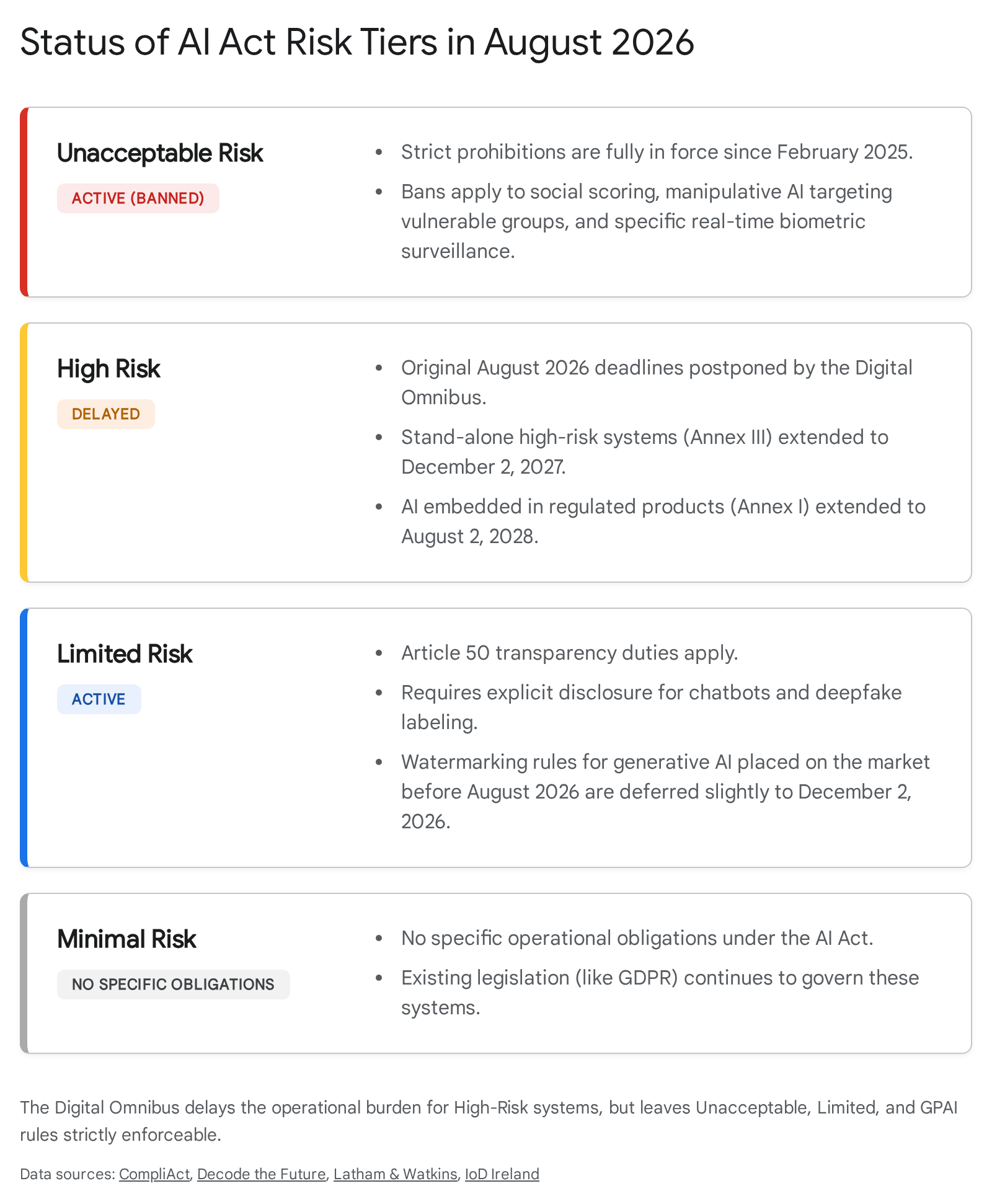
The recent Digital Omnibus agreement delays the core engineering and compliance deadlines for high-risk AI systems to late 2027 and 2028, but August 2, 2026, remains a critical enforcement cliff. Transparency requirements - such as labeling AI-generated content and disclosing human-AI interactions - will still take full legal effect this August. Furthermore, technology companies must continue to adhere to the already active bans on prohibited AI practices and the strict governance rules for general-purpose AI models, backed by the threat of severe financial penalties.
The Imminent August 2026 Compliance Cliff
Since the European Union's Artificial Intelligence Act officially entered into force in August 2024, the global technology sector has been bracing for the summer of 2026. For two years, August 2, 2026, stood as the monumental deadline when the bulk of the regulation's most stringent, technically demanding rules were scheduled to become fully enforceable 123. The legislation was designed to end the era of permissionless innovation for high-stakes technology, carrying the threat of devastating penalties for non-compliance that reach up to €35 million or 7% of a company's global annual turnover 436.
However, the regulatory landscape shifted dramatically in the spring of 2026. On May 7, 2026, negotiators from the European Parliament and the Council of the European Union reached a provisional political agreement on a legislative amendment known as the "Digital Omnibus on AI" 48. Driven by concerns over delayed technical standards, rising compliance costs, and fears that the rules might stifle European technological competitiveness, the Omnibus fundamentally reshapes the AI Act's implementation timeline 456.
The agreement effectively decouples the implementation schedule, postponing the most arduous engineering and documentation requirements for high-risk systems while leaving other vital obligations firmly in place for August 2026. For product managers, legal counsel, and engineers navigating the EU market, understanding exactly which rules survived the Omnibus cuts - and which have been delayed - is no longer a matter of future planning. It is an immediate operational necessity that dictates how software is built and deployed worldwide.
Understanding the Digital Omnibus Package
To comprehend the shifting deadlines, one must first understand the vehicle enacting them. The Digital Omnibus is part of a broader "competitiveness compass" strategy introduced by the European Commission in early 2025 to simplify the European Union's sprawling digital rulebook, which includes the General Data Protection Regulation (GDPR), the Data Act, and various cybersecurity frameworks 71213. The term "Omnibus," originating from Latin for "for all," signals a holistic attempt to resolve regulatory overlaps and reduce administrative burdens by up to 25% for general businesses and 35% for small and medium enterprises by 2029 7.
When it comes to the AI Act specifically, the Omnibus was born out of an impending logistical crisis. The original legislation mandated that high-risk AI developers comply with rigorous quality management systems and conformity assessments by August 2026. However, the harmonized technical standards required to actually prove this compliance - being drafted by European standards bodies like CEN-CENELEC's Joint Technical Committee 21 - were significantly delayed, with finalized versions unlikely to arrive before December 2026 67. Without these foundational standards, organizations would have been forced to guess at the legal interpretations of complex engineering requirements, creating immense legal liability 14.
Faced with massive pushback from international tech giants, who threatened to delay product rollouts in Europe, alongside domestic startups fearful of the compliance costs and even international trade pressure, Brussels opted for pragmatism 515. The resulting political agreement offers temporary compliance relief, though it still requires formal enactment and publication in the Official Journal - expected in June or July 2026 - to take binding legal effect before the original August deadline 6817.
High-Risk AI Systems and the New Timeline
The most significant change introduced by the Digital Omnibus is the staggered delay of obligations for high-risk AI systems, categorized under Chapter III of the AI Act. Rather than a single enforcement date, the new timeline splits high-risk systems into two distinct categories with separate deadlines, granting organizations significant breathing room to build structured compliance programs.
Annex III: Stand-alone High-Risk Uses
Annex III covers AI systems that operate as stand-alone software applications used in highly sensitive contexts that can significantly impact human health, safety, or fundamental rights. This broad category includes systems utilized in employment and human resources, such as automated CV-sorting software, worker performance monitoring, and algorithmic recruitment tools 149. It also encompasses educational technology used for scoring exams or determining institutional access, algorithmic credit scoring for financial loans, systems determining eligibility for public benefits, and software used in law enforcement, migration, and border control 19.
Originally slated for August 2026, the obligations for these systems require extensive technical documentation, robust data governance protocols, human oversight design, and formal conformity assessments 414. The Omnibus defers these requirements by 16 months to December 2, 2027 48. This extension provides product teams with the necessary time to finalize risk classifications and deploy post-market monitoring infrastructure, applying specifically to systems placed on the market or put into service after this new date 1920.
Annex I: Embedded High-Risk Systems
Annex I covers a different breed of AI systems: those that function as safety components within physical products already subject to existing European Union product safety legislation. This includes artificial intelligence embedded in medical devices, aviation software, heavy machinery, vehicles, and connected consumer products like AI-enabled toys 148.
These embedded systems were originally granted a longer transition period until August 2027 to allow time for the AI Act's novel requirements to be harmonized with dense sector-specific rules, such as the Medical Devices Regulation 14. The Omnibus pushes this deadline back a further 12 months to August 2, 2028 88. Furthermore, to address industry complaints regarding overlapping bureaucratic rules, the Omnibus empowers the European Commission to limit the application of AI Act requirements via delegated acts if sectoral product legislation already imposes equivalent obligations 489. For instance, under the political deal, AI in machinery products will generally only need to comply with the existing Machinery Directive's safety rules rather than facing double-regulation under the AI Act, provided the AI does not create unique, unaddressed health or safety risks 49.
Comparing the Compliance Timelines
To illustrate how the Digital Omnibus alters the compliance landscape for AI developers, the following table summarizes the shift from the original legislative text to the newly agreed-upon deadlines.
| AI System Category | Original AI Act Deadline | New Omnibus Deadline | Length of Delay | Example Use Cases |
|---|---|---|---|---|
| Annex III High-Risk (Stand-alone uses) | August 2, 2026 | December 2, 2027 | 16 Months | Credit scoring, HR sorting, biometrics |
| Annex I High-Risk (Embedded in products) | August 2, 2027 | August 2, 2028 | 12 Months | Medical devices, AI toys, vehicles |
| National AI Sandboxes | August 2, 2026 | August 2, 2027 | 12 Months | State-run regulatory testing environments |
(Sources: 4868)
The Rules That Still Apply on August 2, 2026
The delay of the high-risk engineering requirements has led some corporate legal departments to mistakenly view the Omnibus as a complete pause on the AI Act. Regulators and legal analysts warn that this is a dangerous misconception 817. The overarching structure of the legislation persists, and several vital obligations enter into force right on schedule. August 2, 2026, remains a live compliance date for transparency, governance, and enforcement.
Article 50 Transparency and Watermarking
The most operationally demanding rules activating in August 2026 fall under Article 50, which governs transparency 121011. Regardless of whether an AI system is deemed high-risk or limited-risk, the way it interacts with human users and generates synthetic content will be heavily regulated.
From August 2, 2026, providers and deployers must ensure that users are explicitly informed when they are interacting with an AI system. Whether a human is engaging with an automated customer service chatbot, an AI therapeutic companion, or an automated email agent, the machine's artificial nature must be clearly disclosed so the user can make an informed decision 129. Additionally, providers of generative AI must ensure that AI-generated or manipulated content - particularly deepfakes or text published to inform the public on matters of public interest - is clearly and visibly labeled in a machine-readable format 19.
For enterprise software and complex agentic AI architectures, these transparency rules represent a significant technical challenge. As technical experts point out, if an AI agent works autonomously across multiple channels - such as responding via email, embedded in a corporate portal, and interacting via voice - the labeling must be ubiquitous and consistent across all mediums 11. Companies must build traceability and logging directly into their backend architectures to prove the provenance of the AI's outputs, moving compliance from a legal policy document to a core engineering requirement 2011.
The Omnibus did introduce one highly specific, targeted exception to these transparency rules to ease the transition for legacy systems. For generative AI systems specifically intended to generate synthetic text, images, audio, or video that are already placed on the European market before August 2, 2026, the obligation to embed machine-readable watermarks is postponed by four months, taking effect on December 2, 2026 86819. Systems launched after August 2, 2026, enjoy no such grace period and must comply immediately upon deployment 86.
General-Purpose AI (GPAI) Governance
The rules governing massive foundation models, known as General-Purpose AI, do not change under the Digital Omnibus. In fact, these rules will have already been in force for a full year by August 2026, having successfully activated on August 2, 2025 231023.
Providers of GPAI models - including the frontier labs developing massive large language models - are already bound by obligations to maintain technical documentation, comply with European Union copyright laws, and publish summaries of the data used for training 210. Models deemed to pose a systemic risk, which is currently defined as those trained with cumulative computing power exceeding the threshold of 10^25 floating-point operations (FLOPs), face even stricter regulatory scrutiny 324. Providers of these systemic models must conduct mandatory adversarial testing, track energy consumption, and maintain rigorous incident reporting protocols 324.
The Digital Omnibus further reinforced the regulatory framework around these models by clarifying the supervisory role of the European AI Office. The AI Office holds exclusive supervisory competence over AI systems built on GPAI models, provided the model and the downstream system are developed by the same provider, as well as over AI systems integrated into very large online platforms under the Digital Services Act 81712. This centralization prevents regulatory fragmentation across different member states and firmly establishes the AI Office as the primary oversight authority for global tech giants deploying systemic models in Europe 124.
Active Prohibitions and the New "Nudifier" Ban
The AI Act is fundamentally a risk-based framework, and its strictest tier - deemed unacceptable risk - results in outright bans. The original list of prohibited AI practices entered into application early in the regulatory lifecycle, becoming enforceable on February 2, 2025 2310. These actively banned practices include social scoring systems operated by public authorities, AI systems that deploy subliminal manipulation or exploit the vulnerabilities of specific demographic groups, certain uses of real-time remote biometric identification in publicly accessible spaces by law enforcement, and emotion recognition systems used in workplaces and educational institutions 61491923.
While these prohibitions remain in full force in 2026, the Digital Omnibus introduced a vital new addition to Article 5 of the AI Act. Driven by the alarming global rise in synthetic exploitation, the co-legislators agreed to explicitly ban AI systems used to generate non-consensual sexually explicit or intimate images of real identifiable persons - colloquially known as nudification or deepfake-nude tools - as well as AI systems used to generate child sexual abuse material (CSAM) 46817.
Crucially, this new prohibition extends far beyond systems that are explicitly intended or marketed for such illicit use. For AI providers, the ban applies if generating such material is a reasonably foreseeable and reproducible outcome of the model, and the system lacks adequate, reliable technical safeguards to prevent that generation 68. Because this is a newly introduced rule within the Omnibus, it was granted a transitional period. The ban on nudifier and CSAM generation becomes strictly applicable on December 2, 2026 646819. Legal analysts warn that these new prohibited-practice provisions carry some of the highest penalty exposure in the Act and require immediate audits of safety controls across image-generation and content-editing pipelines 17.
Bureaucratic Relief and Targeted Simplifications
Beyond moving deadlines, the Digital Omnibus implemented several surgical changes intended to reduce administrative bloat, resolve contradictions with existing European privacy laws, and protect the broader European technology ecosystem from being smothered by compliance costs. These adjustments will heavily influence corporate compliance strategies moving into late 2026.
The Rise of Small Mid-Caps
Historically, the European Union has offered regulatory exemptions and financial support mechanisms primarily to Small and Medium Enterprises (SMEs). The Omnibus formally introduces a highly impactful new category of company to the AI Act: the Small Mid-Cap, or SMC. An SMC is defined as a medium-sized enterprise that has outgrown the traditional SME definition but remains significantly smaller than a massive multinational corporate enterprise 426.
Under the Omnibus deal, SMCs will now benefit from the simplified compliance measures previously reserved exclusively for SMEs 4926. This includes allowances for simplified technical documentation when proving high-risk compliance, access to more proportionate penalty scales in the event of an infraction, and less prescriptive requirements for internal quality management systems 9. By introducing the SMC category, legislators have expanded the pathway to practical compliance for a much larger group of growing European and international businesses that form the backbone of the enterprise software supply chain.
AI Literacy and Bias Detection Processing
The original text of the AI Act required private providers and deployers to actively take measures to ensure a sufficient level of AI literacy among their staff and any personnel interacting with AI systems on their behalf, a sweeping mandate that took effect in February 2025 1237. The Omnibus significantly alters this dynamic by lifting the mandatory AI-literacy obligation from private businesses and transforming it into an obligation for the European Commission and individual Member States 726. Governments are now tasked with encouraging and promoting AI literacy through non-binding measures, relieving individual businesses from the disproportionate administrative burden of proving compliance via complex internal training audits 3726.
Simultaneously, the Omnibus addressed a critical tension between the AI Act and the GDPR. One of the core technical challenges of building fair, unbiased AI models is that detecting and correcting bias inherently requires analyzing demographic data. However, the GDPR severely restricts the processing of special categories of personal data, such as race, sexual orientation, or health status. The Omnibus resolves this conflict by introducing a new Article 4a, which provides a concrete, aligned legal basis allowing providers and deployers to process sensitive personal data specifically for the purpose of bias detection and correction 826. The legal threshold to justify this data usage was lowered from strictly necessary to simply necessary, providing data scientists with the legal cover needed to debug their datasets, provided the processing remains subject to appropriate safeguards for fundamental rights 7826.
Delays to Regulatory Sandboxes
To foster innovation while ensuring safety, the AI Act requires Member States to establish national AI regulatory sandboxes. These are controlled environments overseen by competent authorities where developers can test high-risk AI models prior to commercial deployment without immediate fear of regulatory reprisal. Because the compliance deadlines for deploying high-risk systems were delayed, the Omnibus correspondingly delayed the mandate for states to have these sandboxes operational, pushing the deadline from August 2026 back by one year to August 2, 2027 4868. Additionally, the agreement outlined plans for an EU-level regulatory sandbox prioritizing access for SMEs and the newly designated SMCs, ensuring smaller innovators retain a competitive avenue for testing systemic models 71217.
Extraterritorial Reach and the Brussels Effect
The EU AI Act is widely recognized for its aggressive extraterritorial scope. It applies to any company, regardless of where its headquarters or servers are physically located, if it places an AI system on the EU market or if the downstream outputs of that system are used within the European Union 3623. A software-as-a-service vendor based in Texas or a cloud infrastructure provider operating out of South Korea is equally bound by the Act if their products interface with European citizens or businesses 627.
The Global Compliance Burden
Historically, the sheer size and purchasing power of the European market has forced global multinational companies to adopt stringent EU regulations as their worldwide operational baseline - a phenomenon scholars refer to as the Brussels Effect, most notably observed in the wake of the GDPR's implementation 2813. However, the AI compliance landscape differs from data privacy. Asian technology firms embedded in the global AI ecosystem, ranging from semiconductor manufacturers in Taiwan to software developers in India, face what analysts term a regulatory fragmentation tax 27.
While the EU boasts a single, legally binding artificial intelligence framework, tech-related laws in the United States remain decentralized and largely innovation-based, while parts of Asia pursue entirely different governance models 27. Building parallel compliance architectures to satisfy disparate global jurisdictions is financially draining 27.
Will the Brussels Effect Hold?
With the Digital Omnibus delaying the toughest compliance hurdles for high-risk systems, questions have emerged regarding whether the Brussels Effect for AI governance is fundamentally weakening 513. The longer the EU delays strict implementation, the more time global companies have to build hardened, jurisdiction-specific compliance systems rather than adopting Europe's rules globally 13.
Industry analysts suggest that the delay is a double-edged sword born of genuine political and economic pressure. Companies like Meta, Google, and OpenAI have publicly cited European regulatory hurdles and privacy concerns as primary reasons for delaying the rollout of cutting-edge models and multimodal agents across the continent 524. Meta, for instance, refused to sign the voluntary Code of Practice for general-purpose AI models, warning that the rules introduced legal uncertainties that exceeded the AI Act's intended scope, leading to early investigations by the AI Office 524. Against the backdrop of these delays and threats of retaliatory tariffs from the US administration, the Omnibus delay is viewed by some critics as Brussels bending to Big Tech to avoid slowing regional innovation 515.
However, the delay does not negate the structural reality of the AI Act. The core risk tiers, the prohibited practices, and the extraterritorial GPAI obligations remain firmly intact, meaning the fundamental framework that drives the Brussels Effect persists 1928. Major AI providers continue to aggressively expand their regulatory presence in Brussels to coordinate safety pipelines for next-generation models 24. Rather than using the Omnibus delay to abandon European compliance, sophisticated international firms are utilizing the extra 16 months to solidify their technical documentation, refine their post-market monitoring algorithms, and build robust AI governance frameworks 68. The delay provides a margin of safety, but the European standard is still heavily favored to become the de facto global baseline for enterprise AI development by the time the high-risk rules finally activate in late 2027 2028.
Strategic Next Steps for Enterprise Software
For organizations developing or deploying artificial intelligence in 2026, the Omnibus package necessitates a strategic pivot in sequencing, not a cessation of effort. The European Commission has made it clear that while deadlines have shifted, regulatory expectations have not softened. Recent draft guidance on high-risk classification spans nearly 170 pages, clearly indicating that regulators intend to interpret the rules broadly and focus intensely on the real-world impacts of AI systems rather than simply how they are marketed 30.
Firms operating in this space must prioritize several immediate actions. First, engineering teams must conduct comprehensive audits for transparency readiness. With Article 50 obligations going live in August 2026, companies must guarantee that chatbots, generative tools, and autonomous agentic pipelines possess the backend capability to label interactions and watermark synthetic content reliably across all user interfaces 911.
Second, content generation pipelines require immediate review. The December 2026 ban on systems capable of generating nudifiers and CSAM carries immense legal and financial liability 17. Providers must implement rigorous, demonstrably reliable technical safeguards to prevent these foreseeable misuses, ensuring that content moderation filters are robust and fail-safe 8.
Finally, organizations with systems destined for Annex III or Annex I classification must continue their high-risk engineering work uninterrupted. Building a compliant quality management system, executing thorough conformity assessments, and creating defensible data governance frameworks requires significant engineering lead time 414. Furthermore, companies that fine-tune or significantly modify third-party foundation models must carefully assess whether these actions legally reclassify them as providers under the AI Act, thereby transferring the heavy compliance burden directly onto their own shoulders 30.
Bottom line
The Digital Omnibus on AI provides a vital, pragmatic reprieve for the global technology industry by postponing the most complex, standards-dependent high-risk engineering requirements to December 2027 and August 2028. However, August 2, 2026, remains a critical and legally enforceable milestone for the EU AI Act. Sweeping transparency obligations, strict regulations on massive general-purpose AI models, and active prohibitions against harmful practices - including a new impending ban on deepfake nudifiers - will be actively monitored by a fully empowered EU AI Office. Organizations that treat the Omnibus delay as a reason to halt their compliance investments risk catastrophic financial penalties for ignoring the rules that still firmly apply.