
What New AI Laws Mean for US Companies in 2026
The Direct Answer: United States companies face an unprecedented and highly fragmented regulatory environment regarding artificial intelligence this summer. The landscape is defined by an impending collision between aggressive state-level legislation, a federal government actively attempting to preempt state authority through litigation, and the sweeping extraterritorial enforcement of the European Union's AI Act. By August 2026, enterprises deploying everyday artificial intelligence tools - ranging from automated resume screeners to customer service chatbots - must comply with stringent new transparency, detection, and anti-discrimination mandates across multiple jurisdictions. The failure to reconcile domestic operational practices with the converging deadlines of California's Transparency Act, Connecticut's automated decision-making laws, and the European Union's sweeping regulations exposes organizations to millions of dollars in potential fines.
The Everyday Hook: Consider a mid-sized enterprise that recently integrated an off-the-shelf generative artificial intelligence chatbot for customer service, alongside an automated applicant tracking system for its human resources department. Prior to 2026, these deployments were largely celebrated as necessary operational upgrades meant to drive efficiency. Today, they represent profound enterprise risk. In California, that customer service chatbot must soon provide a free public application programming interface (API) to detect its own synthetic outputs. In Connecticut, the human resources tool's usage strips the company of traditional defenses against employment discrimination claims. In Colorado, the deployment of such systems is currently the subject of a fierce constitutional battle involving the United States Department of Justice. Simultaneously, if any data from these tools touches a European resident, the company falls under the jurisdiction of the EU AI Act - a regulation with penalties reaching €35 million. The era of deploying artificial intelligence in a regulatory vacuum has officially ended, replaced by an era where compliance must be coded directly into the product lifecycle.
The Bottom Line: Corporate leadership can no longer delay establishing robust artificial intelligence governance. The summer of 2026 represents the operational tipping point where theoretical legal frameworks transform into active enforcement mechanisms. While federal intervention and state-level legislative rewrites have injected massive uncertainty into the timeline, the core mandates - demanding algorithmic transparency, human oversight, and auditable data lineage tracking - remain unavoidable. Organizations must immediately inventory their algorithmic systems, classify them by risk, and build compliance architectures capable of satisfying the strictest standards globally, as non-compliance is rapidly becoming an uninsurable liability.
Frequently Asked Questions on the 2026 AI Legal Landscape
Why is there no single U.S. federal AI law, and what is the DOJ doing about it?
The United States has yet to pass a comprehensive, omnibus federal law governing artificial intelligence. Instead, federal policy has swung dramatically between administrations, creating a whiplash effect for corporate compliance officers. The previous administration's Executive Order 14110, which established rigorous reporting requirements for frontier models, was rescinded in January 2025 and immediately replaced by Executive Order 14179 11. The current federal posture, outlined in the March 2026 National AI Policy Framework, relies heavily on existing agencies to handle risks within their specific domains while aggressively attempting to preempt state-level regulations that the administration views as stifling technological innovation 24.
This federal-state tension has recently escalated from policy memos to active constitutional litigation. The most striking example is the United States Department of Justice (DOJ) intervening in a lawsuit filed by the artificial intelligence company xAI against the state of Colorado. Colorado's original 2024 AI Act (SB 24-205) required developers and deployers of high-risk systems to use "reasonable care" to prevent algorithmic discrimination 34. The DOJ's AI Litigation Task Force intervened in the Denver federal court, arguing that this state mandate violates the Equal Protection Clause of the Fourteenth Amendment 447. The federal government's legal theory asserts that forcing developers to correct disparate impacts "by statistics alone" effectively compels them to engineer their models using race, sex, and religion as determining factors 47. Assistant Attorney General Harmeet K. Dhillon of the Civil Rights Division publicly characterized such laws as requiring companies to "infect their products with woke DEI ideology," while Assistant Attorney General Brett A. Shumate argued that forcing models to promote ideological bias threatens national and economic security 438.
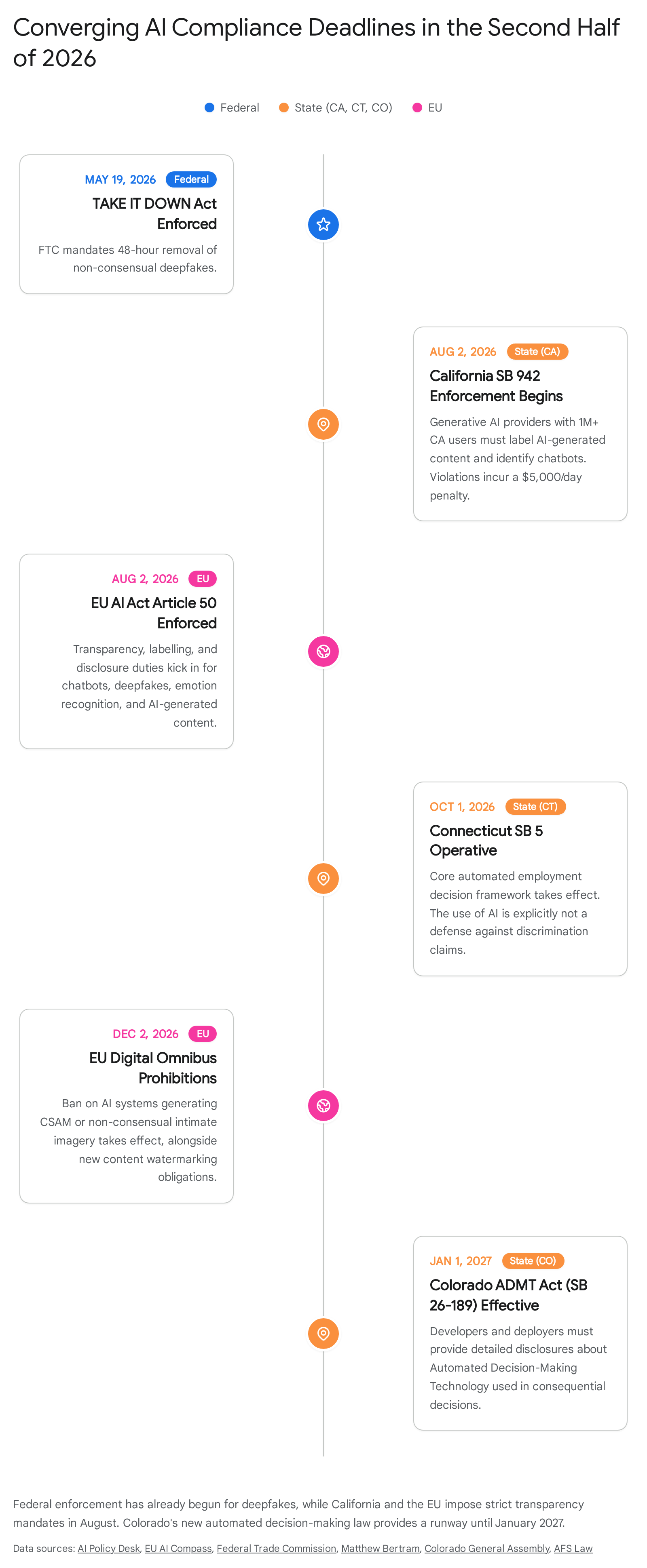
The DOJ's intervention effectively halted Colorado's original law and signaled a clear federal intent to dismantle state-level algorithmic discrimination statutes nationwide 47. However, targeted federal legislation has advanced where bipartisan consensus exists regarding specific, tangible harms. The TAKE IT DOWN Act (Public Law 119-12), signed in May 2025, criminalizes the publication of non-consensual intimate deepfakes, providing penalties of up to two years of imprisonment, and three years if minors are involved 56. Starting in May 2026, the Federal Trade Commission (FTC) began actively enforcing this law, requiring covered platforms to remove such synthetic content within 48 hours of receiving a valid takedown notice 567. The FTC has established dedicated complaint-intake infrastructure to strictly enforce these provisions, representing the most aggressive federal action on generative content to date 7.
What are the strictest U.S. state AI laws going into effect this summer?
In the absence of a comprehensive federal standard, individual states have moved aggressively to fill the regulatory void, creating a complex patchwork of compliance obligations that change strictly by zip code 112.
California's Transparency Mandate (August 2026) California opted for a multi-bill, fragmented approach rather than passing a single comprehensive act 13. While training data transparency laws (AB 2013) took effect in January 2026, the most significant hurdle for generative system developers arrives on August 2, 2026, with the enforcement of the California AI Transparency Act (SB 942), as amended and delayed by AB 853 8910. The law applies to "covered providers" - defined as entities producing generative systems publicly accessible in California with over one million monthly visitors 811. These providers must offer a free, publicly accessible content detection tool equipped with an API, allowing third-party social media platforms and news organizations to verify content provenance at scale 811. The statute prohibits logging user uploads for model training without explicit consent during the detection process 8. Furthermore, developers licensing their systems to third parties must contractually require licensees to maintain latent disclosure capabilities, ensuring watermarking mechanisms cannot be stripped 8. Noncompliance carries severe penalties of $5,000 per violation per day, enforced exclusively by the California Attorney General 1213.
Colorado's Legislative Whiplash (January 2027) Colorado has experienced the most turbulent regulatory journey in the nation. Facing the aforementioned DOJ lawsuit and massive industry pushback regarding the "unworkable" nature of the original 2024 law, Governor Jared Polis signed SB 26-189 into law on May 14, 2026 1415. This new statute completely repealed the controversial algorithmic discrimination mandates of SB 24-205, shifting the state's focus entirely toward operational transparency 1516. The newly minted Colorado Automated Decision-Making Technology (ADMT) Act, which takes effect January 1, 2027, drops the requirement for extensive algorithmic impact assessments and formal risk management programs 1623. Instead, it requires pre-use notices and post-adverse-outcome disclosures whenever an ADMT materially influences consequential decisions in covered domains, which include education, employment, housing, financial services, healthcare, and essential government services 141617. Notably, the provision of legal services was dropped as a covered domain in the rewrite 17. Violations of the ADMT Act are considered deceptive trade practices under the Colorado Consumer Protection Act, carrying civil penalties of up to $20,000 per violation 814.
Connecticut's Sector-Specific Approach (October 2026) Passed by the legislature on May 1, 2026, and signed shortly after by Governor Ned Lamont, Connecticut's SB 5 represents a highly targeted, multi-front approach 17181920. SB 5 is not a broad governance statute, but rather a bundle of specific regulations spanning consumer protection, employment, and government operations 2122. Effective October 1, 2026, the law implements stringent rules regarding "automated employment-related decision technology" 1922. Most notably, SB 5 amends the state's employment discrimination law to explicitly state that an employer's reliance on an automated system is not a defense against a discrimination claim 1819. The law also extends whistleblower protections to employees at large-scale frontier model developers who report catastrophic safety risks 1921.
Emerging Frontiers: Minnesota, Georgia, and Tennessee Other states are aggressively defining their own specialized rules. Minnesota lawmakers introduced a sweeping five-bill package in 2026, including HF 4654 (The AI Transparency Act), which establishes a regional floor for transparency compliance by August 1, 2026 302332. Additionally, Minnesota advanced legislation requiring employers to provide a 90-day notice to labor representatives and state officials before deploying technology that could displace workers, carrying fines of $10,000 per employee for non-compliance 24. In the South, Georgia enacted SB 540 and SB 444, taking effect in 2027, which mandate strict disclosures for companion chatbots and completely prohibit health insurance coverage decisions from being based solely on automated outputs 132535. Tennessee enacted SB 1580, effective July 1, 2026, which outright bans marketing an automated system as a qualified mental health professional and crucially provides a private right of action for consumers 1335.
How does the conservative pushback in Virginia and Florida complicate the patchwork?
The drive for state-level regulation is not uniform, and significant political pushback has complicated the national compliance map. In March 2025, Virginia Governor Glenn Youngkin vetoed HB 2094, a bill that closely mirrored Colorado's original high-risk algorithmic discrimination framework 262728. The Virginia bill would have mandated risk assessments and plain-language consumer disclosures for systems making consequential decisions in employment and finance 2729. Governor Youngkin issued a veto statement arguing that the rigid framework failed to account for the rapidly evolving industry and placed an excessively onerous burden on smaller firms and startups 2630. He noted the bill risked turning back the clock on Virginia's economic growth and tech job creation, opting instead to rely on existing privacy and anti-discrimination laws alongside state government guidelines established by Executive Order 30 2630.
Similarly, in May 2026, the Florida House of Representatives effectively killed Governor Ron DeSantis's highly publicized "AI Bill of Rights" (HB 1395) during a special legislative session 3143. The sweeping Florida legislation would have required strict parental consent for minors using companion chatbots, prohibited commercial use of digital likenesses without consent, and established severe penalties for deceptive synthetic media 324546. Despite passing the Senate, Florida House Speaker Daniel Perez refused to hear the bill 4333. Perez argued that establishing a confusing 50-state patchwork of regulations was fundamentally flawed, maintaining that advanced technology regulation should strictly remain the domain of the federal government in alignment with the current administration's preemptive goals 4333.
How do these laws impact everyday enterprise AI tools?
Regulatory scrutiny is no longer reserved for frontier models developed by massive tech conglomerates; it directly impacts companies deploying off-the-shelf, everyday enterprise software. The legal tests applied to these tools vary wildly depending on the jurisdiction in which they are deployed.
Human Resources and Applicant Tracking Systems (ATS) An enterprise utilizing an algorithmic resume screener faces immediate, overlapping operational hurdles. Under New York City's Local Law 144, the tool must undergo an annual, independent bias audit assessing disparate impacts based on race, ethnicity, or sex, and the results must be published publicly 134. Under Connecticut's SB 5 (effective October 2026), the enterprise cannot use the software's autonomous recommendation as a legal shield if a rejected applicant sues for discrimination under state fair employment laws 19. In Illinois, amendments to the Human Rights Act explicitly ban the use of zip codes as a proxy for protected classes in algorithm-driven employment decisions 1313. Furthermore, if the company recruits candidates residing in the European Union, the ATS is classified as a "High-Risk" system under Annex III of the EU AI Act, requiring extensive technical documentation, mandatory human oversight logging, and formal conformity assessments before deployment 355051.
Customer Service and Companion Chatbots Customer-facing conversational agents are heavily regulated to prevent consumer deception and psychological harm. California's existing regulations require chatbots to clearly identify themselves as artificial 1213. The regulatory perimeter has expanded significantly in 2026 to target "companion chatbots" - systems designed to simulate ongoing, personalized human-like relationships. Georgia's newly enacted SB 540 requires operators of these companions to continuously disclose their synthetic nature, implement rigorous age verification, and establish automated protocols for responding to users expressing suicidal ideation or self-harm 1325. Crucially, the Georgia law contains no exemption for companion bots embedded within larger social media platforms 25. Connecticut's SB 5 includes similar requirements for companion bots, mandating referrals to the 9-8-8 National Suicide Prevention Lifeline when self-harm is detected, and strictly prohibiting the provision of such bots to minors under eighteen if it is foreseeable they could encourage unlawful behavior 1721.
Marketing and Synthetic Media Generation Marketing departments utilizing generative platforms to create commercial imagery or text face intense new labeling requirements. California's SB 942 mandates machine-readable watermarks for synthetic content generated by systems with over one million users 5812. Concurrently, under the EU AI Act's Article 50, any enterprise generating synthetic text, audio, or video must mark the outputs in a machine-readable format to ensure they are detectable as artificially generated 52. Furthermore, deployers who publish synthetic text intended to inform the public on matters of public interest must explicitly disclose its artificial origin unless it has undergone substantial human editorial review 52.
To understand the sheer complexity of this fragmented landscape, a direct comparison of the regulatory philosophies between the major state frameworks and the European model is necessary.
| Regulatory Framework | Jurisdiction Focus | Primary Trigger Threshold | Key Enforcement Mechanism | Extraterritorial Impact |
|---|---|---|---|---|
| EU AI Act (Regulation 2024/1689) 5153 | Comprehensive, Multi-Sector | Risk-tier classification (Annex I & Annex III High-Risk). | Conformity assessments; Fines up to €35M or 7% global turnover. | High: Applies to any provider/deployer whose AI output is used in the EU. |
| California (SB 942 / AB 853) 812 | Transparency & Synthetic Media | >1 Million monthly visitors; publicly accessible in CA. | CA Attorney General; $5,000 fine per violation per day. | Moderate: Captures non-CA companies serving major CA user bases. |
| Colorado (SB 26-189 ADMT Act) 1623 | Transparency & Notice (ADMT) | Material influence on a consequential decision for a CO resident. | CO Attorney General; Deceptive trade practice; $20,000 per violation. | Low: Protects Colorado residents; requires deployers doing business in CO. |
| Connecticut (SB 5) 1819 | Sectoral: Employment & AI Companions | Use of an AEDP as a "substantial factor" in employment decisions. | State Attorney General (Consumer Protection laws); 60-day cure period. | Low: Strictly limits oversight to state boundaries and state employees. |
| New York City (LL 144) 134 | Sectoral: Employment (AEDT) | Use of automated tools for hiring or promotion in NYC. | Mandatory annual independent bias audits; public website disclosures. | Low: Specific to hiring and promotional actions within the city limits. |
What are the most common misconceptions about AI compliance in 2026?
Misconception 1: "We do not have a European office, so the EU AI Act does not apply to us." This is perhaps the most dangerous legal blind spot for United States enterprises. The EU AI Act features a sweeping extraterritorial scope designed to follow the data, similar to the General Data Protection Regulation (GDPR) 5154. Article 2 explicitly applies the law to non-EU providers and deployers if the output of their system is used within the European Union 535455. A U.S.-based software-as-a-service company processing data for a European client, or generating synthetic content viewed by European citizens, is fully in scope 5455. The penalties for non-compliance are severe, reaching up to €35 million or 7 percent of global annual turnover for prohibited practices, and up to €15 million or 3 percent for high-risk system violations 5054. Enforcement actions will likely be triggered by EU-based corporate customers demanding compliance documentation from their American vendors long before Brussels regulators intervene 55.
Misconception 2: "Colorado gutted its AI law, so the compliance pressure is off domestically." It is true that Colorado's replacement legislation, SB 26-189, removed the heaviest bureaucratic burdens of algorithmic impact assessments and formal risk management programs 1623. However, the core liability remains intensely active. The new law introduces strict notification requirements and uniquely targets employment decisions, giving job applicants and current employees the explicit right to human review following adverse automated decisions - a population largely excluded from the state's traditional data privacy act 1623. Furthermore, the law explicitly voids any contractual indemnification clauses where a technology developer attempts to hold a corporate deployer harmless for the developer's underlying anti-discrimination violations 1617. Fines of $20,000 per violation ensure the law has formidable teeth 814.
Misconception 3: "The federal government will preempt these state laws, so we should wait out the litigation." While the DOJ is actively litigating against Colorado's law 34, and the executive branch favors federal preemption to prevent a patchwork 2, constitutional litigation takes years to resolve. Furthermore, Congress has not passed a comprehensive, overriding preemption statute. Companies that halt their compliance programs waiting for a federal rescue risk massive daily fines from active state laws in California, Illinois, and targeted sectoral laws in places like Georgia and Tennessee 11213. The federal government itself is enforcing baseline standards through other avenues; the FTC's "Operation AI Comply" targeted companies utilizing deceptive practices under Section 5 of the FTC Act, establishing that federal enforcement of consumer protection in automated systems is already a reality regardless of new legislation 32.
How does the impending EU AI Act impact U.S. companies this summer?
The European Union AI Act stands as the world's first comprehensive, risk-tiered regulation of artificial intelligence, serving as the benchmark for global governance 135354. The law categorizes systems into unacceptable, high, limited, and minimal risk, with compliance obligations scaling accordingly 5051. The unacceptable risk category - which bans practices like social scoring and emotion recognition in the workplace - has been fully enforceable since February 2025 15356. For the vast majority of global businesses, the most critical deadline has long been understood as August 2, 2026, the date when the core obligations for High-Risk AI systems (Annex III) and Transparency rules (Article 50) were slated to go live 50535636.
However, the regulatory timeline became highly fluid in May 2026. The European Parliament and the Council of the EU reached a provisional political agreement on the "Digital Omnibus on AI" - a legislative package of targeted amendments aimed at simplifying compliance to boost European competitiveness 3738. Henna Virkkunen, Executive Vice-President for Tech Sovereignty, Security and Democracy, stated that the agreement provides "simpler and innovation-friendly rules," ensuring businesses can innovate without lowering the bar on safety 37. If formally adopted, the Omnibus will postpone the compliance deadline for standalone high-risk systems to December 2, 2027, and extend the deadline for systems integrated into regulated physical products to August 2028 355437.
Despite this highly publicized potential relief, legal experts globally advise United States companies to continue treating August 2, 2026, as the binding operational deadline 566061. The Digital Omnibus agreement is entirely provisional; it must be formally enacted into binding law before the August 2026 date to take legal effect 543839. If the formal adoption process fails or stalls during final negotiations, the original statutory hammer of the EU AI Act will fall unmitigated 60.
Furthermore, the transparency obligations under Article 50 are largely immune to major structural delays. Article 50 applies broadly across risk categories to systems that interact directly with natural persons, generate synthetic content, or process emotion recognition data 5240. While the Digital Omnibus proposes a minor four-month delay specifically for the watermarking of synthetic content (shifting the requirement from August to December 2026), the broader transparency requirements for chatbots, deepfakes, and public interest text generation will still activate in August 2026 353840. To assist with these fast-approaching requirements, the EU AI Office is currently finalizing a Code of Practice to guide organizations on the technical implementation of marking and labeling rules 5241.
To further emphasize the financial severity of ignoring the extraterritorial reach of these frameworks, corporate officers must understand the European penalty structure, which is explicitly designed to make compliance less costly than non-compliance, regardless of a multinational corporation's size.
| Violation Type (EU AI Act) | Maximum Fixed Fine | Global Turnover Cap | Comparison Context |
|---|---|---|---|
| Prohibited AI Practices (Article 5) 505354 | €35,000,000 | 7% | Nearly double the GDPR maximum. |
| High-Risk AI Obligations (Annex III) 5053 | €15,000,000 | 3% | Equivalent to GDPR mid-tier fines. |
| Misleading Regulatory Authorities 50 | €7,500,000 | 1.5% | Lower tier, but carries severe reputational damage. |
Actionable Practical Takeaways for Enterprise Leaders
The operational chaos generated by state-level repeals, gubernatorial vetoes, and provisional European delays makes adopting a passive "wait and see" approach a highly tempting corporate strategy. However, relying on legislative gridlock is a critical miscalculation. The foundational expectations of regulatory bodies worldwide - from the FTC in Washington to the AI Office in Brussels - are rapidly converging on a strict set of core operational principles: transparency, data lineage, and persistent human oversight. Organizations can bulletproof their operations against this shifting legal landscape by integrating the following structural takeaways into their engineering and compliance pipelines.
Establish a Unified, Audit-Ready Model Inventory An enterprise cannot govern a shadow infrastructure that it cannot see. Regulatory bodies assessing compliance, whether under the EU AI Act's Article 11 technical documentation standards or emerging domestic state mandates, will immediately demand an exhaustive accounting of all automated systems operating within the corporate environment 65. Enterprises must construct a centralized, dynamic registry documenting every algorithm, prompt chain, and machine-learning rule currently deployed in production 6165. This inventory must explicitly tag each system with its designated business owner, its formal risk classification (particularly mapping against the high-risk use cases listed in the EU's Annex III), the specific validation dates, and the precise lineage of the datasets utilized for its initial training or subsequent fine-tuning 65. "Orphaned AI" - models running in production that no specific executive claims accountability for - represents the single most common, and easily preventable, governance failure cited by regulators 65.
Conduct Rigorous Audits for "Covered Domain" Exposure Legal and product teams must systematically assess whether any deployed software systems materially influence consequential decisions in highly scrutinized economic sectors. If an automated tool touches human resources, credit and lending evaluation, healthcare claims processing, housing, or educational enrollment, it operates squarely in the crosshairs of both the European Union and the surviving United States state laws 1735. If an inventory audit reveals systems operating in these covered domains, the enterprise must immediately evaluate the system's underlying bias mitigation testing protocols 23. Furthermore, the organization must establish clear, fully documented procedural pathways that allow consumers or employees to request human intervention and review of the automated output, a requirement central to Colorado's ADMT Act and the EU framework 162365.
Accelerate Content Provenance and Synthetic Labeling Marketing and communication departments cannot afford to wait for California's August 2026 API deadline or the European Union's December 2026 watermarking mandates to begin retrofitting their content generation pipelines. Any enterprise utilizing generative platforms to produce synthetic text, video, or audio for external, public-facing consumption should immediately integrate cryptographic metadata and visible watermarking protocols into their output streams 51252. The integration of standards like C2PA (Coalition for Content Provenance and Authenticity) will likely define what constitutes "reasonable" technical compliance during future regulatory enforcement or civil litigation 5. Concurrently, user-interface designs across digital properties must be comprehensively updated to clearly and conspicuously notify users when they are interacting with an artificial chatbot, a baseline transparency requirement that satisfies both emerging domestic state laws in places like Georgia and Connecticut, as well as the overarching mandates of European Article 50 132166.
Aggressively Review Third-Party Vendor Indemnification Clauses Enterprises relying on third-party vendors for their machine learning infrastructure must initiate an aggressive review of their existing software licenses and service level agreements. The legal relationship between the developer of a model and the enterprise deploying it has fundamentally shifted. Under new statutory frameworks like Colorado's SB 26-189, contractual provisions that attempt to indemnify, defend, or hold a deployer harmless for the developer's underlying anti-discrimination violations are explicitly considered void and entirely contrary to public policy 1617. Similarly, California's transparency laws mandate that upstream developers enforce disclosure capabilities down the licensing chain, legally tethering the enterprise to the compliance posture of its vendors 8. Vendor risk management is no longer a peripheral procurement issue; it is now a primary, structural pillar of corporate artificial intelligence compliance.
Integrate Federal Standards as the Baseline Defense While state laws dominate the headlines, federal guidance documents are quietly becoming the de facto standard of care in civil litigation. The National Institute of Standards and Technology (NIST) AI Risk Management Framework, recently updated to version 1.1 in March 2026, is cited across dozens of federal agency directives and serves as the benchmark against which the FTC evaluates whether a company's practices are "unfair or deceptive" 326768. Enterprises must align their internal testing and measurement protocols with the NIST RMF, treating it not as optional guidance, but as the foundational legal shield against federal regulatory actions 3267.
The regulatory honeymoon phase for artificial intelligence is permanently over. While the exact dates of enforcement may continue to shift through judicial stays or legislative omnibuses, the ultimate trajectory of global technology policy is firmly locked. Enterprises that choose to treat algorithmic governance as a deeply integrated product capability - rather than a reactive bureaucratic afterthought managed by isolated legal teams - will not only avoid catastrophic regulatory fines but will secure a distinct, unassailable competitive advantage in a highly scrutinized and deeply fragmented global market.