
How the EU AI Act Regulates Chatbots and Deepfakes
Starting August 2, 2026, Article 50 of the EU AI Act requires companies to explicitly disclose when users are interacting with chatbots, visually label deepfakes, and embed machine-readable watermarks into artificially generated content. These transparency rules carry strict fines of up to €15 million and apply globally to any business whose AI outputs reach European users, regardless of where the company is headquartered.
The Transparency Baseline of the AI Economy
The European Union Artificial Intelligence Act (EU AI Act) represents the world's first comprehensive legislative framework for artificial intelligence, officially entering into force in August 2024 12. While much of the global regulatory discourse has concentrated on the heavy compliance requirements placed upon "high-risk" AI systems - such as those used in healthcare, law enforcement, and critical infrastructure - Article 50 operates entirely differently 21.
Article 50 functions as the transparency baseline for the modern AI economy 1. It establishes fundamental hygiene rules for four specific scenarios: AI systems interacting directly with people, the technical watermarking of synthetic content, emotion recognition systems, and the visible labeling of deepfakes 1.
These rules are not restricted to high-risk models. They apply horizontally across the market to any AI system used in these specified contexts 2. This is a critical distinction that many enterprise leaders misunderstand: an organization with zero high-risk tools may still face significant, immediate transparency obligations if it deploys a customer-facing chatbot or utilizes AI to generate marketing imagery 2.
The core regulatory focus of Article 50 is the prevention of deception and the establishment of digital provenance 34. As generative AI drives the marginal cost of synthetic media production to near zero, the European Commission aims to ensure that natural persons can always recognize whether they are interacting with a machine or consuming artificially manipulated content 35. The rules are designed to protect consumer trust, prevent fraud, and mitigate the risks of synthetic disinformation at scale 35.
Does the EU AI Act Apply to US Companies?
A pervasive misconception among technology startups and multinational enterprises is that the EU AI Act only governs companies physically headquartered within Europe. However, under Article 2(1)(c) of the legislation, the AI Act asserts explicit extraterritorial reach 69.
The regulation applies to any company whose AI system produces outputs that are used within the European Union, regardless of where the corporate entity is based, where the underlying servers are hosted, or where the foundational model was trained 610. Jurisdiction follows the technological output, not the physical infrastructure 6.
If a United States-based Software-as-a-Service (SaaS) provider includes an automated chatbot feature, a synthetic image generator, or an AI-driven recommendation engine within its product, and a European customer accesses that product, the US company is fully within the scope of Article 50 97.
Legal analysts have increasingly noted that this extraterritorial net is potentially even broader than that of the General Data Protection Regulation (GDPR) 6. Under GDPR, compliance is typically triggered by the targeted processing of personal data belonging to EU residents. Under the AI Act, there is no strict "targeting" requirement or personal data threshold; the mere utilization of the AI system's output within EU borders serves as the jurisdictional trigger 610.
The "GDPR Effect" on Global Operations
This extraterritoriality creates a secondary enforcement mechanism driven by the private market rather than state regulators. Because European businesses (acting as deployers) face their own strict liability under the Act, they are legally compelled to ensure their third-party software vendors provide compliant tools 10.
Consequently, even if an American startup never intends to interact directly with the European Commission, its European enterprise clients will mandate AI Act transparency obligations within their procurement contracts and Terms of Service agreements 910. Companies that treated GDPR compliance as a competitive enterprise advantage are currently applying the same strategic approach to the AI Act, recognizing that verifiable transparency accelerates enterprise sales cycles 912.
| Company Profile | Physical Location | AI Tool Used | Scope of EU AI Act Application |
|---|---|---|---|
| B2B SaaS Startup | California, USA | In-app customer support chatbot. | In Scope. If EU clients use the app, the chatbot must disclose its AI nature upfront. |
| Marketing Agency | London, UK | Generating social media deepfakes for global campaigns. | In Scope. If the campaign targets or reaches EU consumers, visible deepfake labeling is required. |
| Internal HR Platform | Texas, USA | Emotion recognition tool for US-only employee interviews. | Out of Scope. Outputs and usage are strictly contained outside the European Union. |
Deciphering the AI Value Chain: Providers vs. Deployers
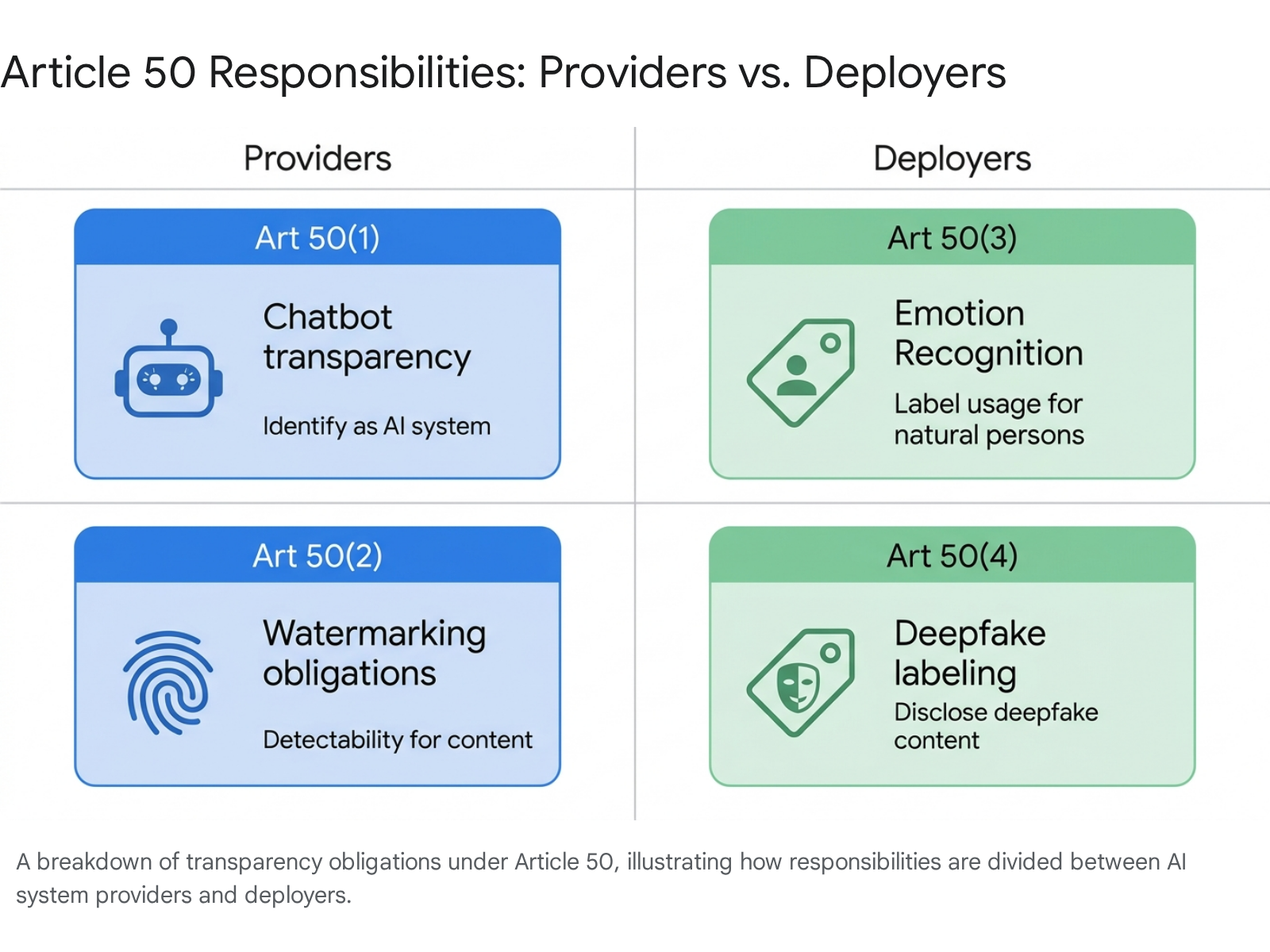
To successfully navigate Article 50, an organization must first determine its legal role within the AI supply chain. The legislation carefully distinguishes between two primary actors, distributing the four transparency obligations accordingly 189.
A Provider is the entity that develops an AI system - or has it developed - and places it on the market under its own name or trademark 110. Providers carry the heavy technical burdens of the legislation, including building the underlying architectures for disclosure and watermarking 9.
A Deployer is any business, agency, or individual utilizing the AI system under their own authority within a professional context 108. Private individuals using AI purely for non-professional, personal recreation are exempt from the deployer obligations 8. Deployers largely sidestep the complex backend engineering requirements, but they face immense front-end, visible compliance duties regarding how content is presented to the public 1.
Article 50 distributes four separate transparency obligations across these two groups. Importantly, a single organization can simultaneously act as both a provider and a deployer depending on how it builds and utilizes AI tools 10.
Pillar 1: Chatbot and Interactive AI Disclosure (Article 50(1))
Under Article 50(1), providers of AI systems intended to interact directly with natural persons must design and develop those systems so that users are explicitly informed they are interacting with artificial intelligence 1117.
This requirement encompasses customer service chatbots, virtual assistants, automated recruitment screeners, and interactive recommendation interfaces 27. The primary goal is to prevent situations where a human user believes they are conversing with a human employee, thereby mitigating the risk of emotional manipulation or undue reliance on automated advice 3.
Stringent UI and UX Requirements
The disclosure must be executed in a clear, distinguishable manner that conforms to applicable digital accessibility requirements 211. Furthermore, the notification must be provided at the latest at the time of the first interaction or exposure, meaning it cannot be delivered retroactively 211.
The European Commission's May 2026 draft guidelines take a firm stance against deceptive design patterns regarding these disclosures 2. Explicitly identified as insufficient and non-compliant practices include: * Utilizing an exceptionally small snippet of text hidden at the very bottom of a website footer 2. * Burying the artificial intelligence disclosure deep within multi-page Terms and Conditions (T&Cs) or privacy policies 2. * Employing faint, low-contrast text overlays on images or brief disclaimers that flash for only a fraction of a second during a video clip 2.
To achieve compliance, SaaS companies and digital platforms must integrate these disclosures prominently within the product interface before the conversation initiates 7. In highly sensitive contexts - such as healthcare triage or legal advice - a one-time, initial disclosure may be deemed insufficient, requiring the interface to persistently remind the user of the AI's presence 2.
The "Obviousness" Threshold and Agentic AI
The legislation provides a narrow exception to the disclosure rule. It does not apply if it is "obvious" to a reasonably well-informed, observant, and circumspect natural person that they are interacting with an AI system, taking into account the circumstances and context of the interaction 11. However, regulatory guidelines suggest this threshold is exceptionally high. What seems obvious to a software engineer may not be obvious to a general consumer, meaning companies should default to explicit disclosure 11.
Another critical nuance involves the rapid rise of "agentic AI" - autonomous systems capable of executing multi-step tasks across the internet. While the AI Act text does not explicitly define "agents," the Commission's guidelines state that if a provider cannot reliably determine whether their autonomous agent will interact with a human or another machine API, the agent must be designed to proactively self-disclose its artificial nature in every situation where human interaction is reasonably foreseeable 12.
An additional carve-out exists for law enforcement. AI systems authorized by law to detect, prevent, investigate, or prosecute criminal offenses are exempt from this specific interaction disclosure, provided appropriate safeguards for fundamental rights are maintained 11.
Pillar 2: Watermarking Synthetic Content (Article 50(2))
While Article 50(1) focuses on the visible user interface during live interactions, Article 50(2) targets the underlying digital architecture of the generated files. Providers of generative AI systems - encompassing text-to-speech, image generation, video synthesis, and Large Language Models (LLMs) - must ensure their outputs are marked in a machine-readable format and are inherently detectable as artificially generated or manipulated 1211.
This is a deep, upstream technical obligation 2. By forcing model developers to embed provenance signals at the moment of creation, the EU aims to shift the burden of establishing digital authenticity away from vulnerable end consumers and onto the technical infrastructure of the files themselves 213.
The Mandate for a Multi-Layered Defense
The legal text of the AI Act remains deliberately technology-neutral, refusing to mandate a specific, proprietary watermarking standard 3. Instead, the legislation dictates that the technical solutions must be effective, interoperable, robust, and reliable as far as technically feasible 311.
However, the specific mechanisms are detailed in the Code of Practice on Transparency of AI-Generated Content, a supplementary framework drafted by industry experts and the AI Office 12. The May 2026 drafts of the Code make it abundantly clear that no single watermarking technique is considered robust enough to stand alone, largely due to the ease with which metadata can be stripped by social media compression algorithms or malicious actors 1920.
Providers are expected to implement a "defense-in-depth" or multi-layered approach, combining several techniques 14:
| Technical Approach | Mechanism | Strengths & Vulnerabilities |
|---|---|---|
| Cryptographic Manifests (C2PA) | Binds digitally signed metadata directly to the file, recording provenance, tool used, and editing history 12021. | Pro: Highly detailed audit trail; industry-standard. Con: Frequently stripped accidentally by social media platforms during upload pipelines 20. |
| Imperceptible Watermarking | Embeds robust signals directly into pixel values or audio frequencies (e.g., Google's SynthID) 2214. | Pro: Survives cropping, screenshots, and heavy compression 422. Con: Often requires proprietary detection tools rather than open, interoperable standards 22. |
| System Fingerprinting / Logging | Acts as a backend safety net, matching content hashes against a secure database to verify origin ex-post 1913. | Pro: Impossible to strip from the file. Con: Raises privacy concerns regarding user query logging; technically complex at scale 113. |
The Role of C2PA and Open Source Tooling
To meet these interoperability requirements, the global tech industry is rapidly coalescing around the Coalition for Content Provenance and Authenticity (C2PA) standard 24. Backed by Adobe, Microsoft, Google, Sony, and the BBC, C2PA provides an open technical specification for certifying the source and history of media 524.
C2PA operates similarly to a digital "nutrition label." It utilizes standard Public Key Infrastructure (PKI) cryptography - the same technology securing HTTPS web traffic - to encode details about a file's origin, binding cryptographic hashes to the media 5. If a malicious actor tampers with the image, the cryptographic signature breaks, making the manipulation instantly detectable to compatible software 515.
For startups and independent developers worried about the cost of implementing compliance features, the Content Authenticity Initiative (CAI) provides robust open-source Software Development Kits (SDKs). These include repositories like c2pa-rs (Rust), c2pa-python, and libraries for JavaScript and C++, allowing lean teams to embed verifiable provenance without exorbitant licensing fees 1516.
Pillar 3: Emotion Recognition and Biometric Categorization (Article 50(3))
Article 50(3) shifts the regulatory focus from providers back to deployers. Any entity utilizing an emotion recognition system or a biometric categorization system in a professional context must explicitly inform the natural persons exposed to the operation of that system 211.
Biometric categorization involves using physical, physiological, or behavioral data to assign individuals to specific categories (such as inferring gender, age, or ethnic origin) 11. Emotion recognition represents a highly controversial subset of AI that attempts to identify or infer the internal emotional states, intentions, or psychological conditions of individuals based on their biometric data 17.
It is vital to recognize that the AI Act completely prohibits the use of emotion recognition systems in certain high-risk environments, specifically within workplaces and educational institutions 2. However, for environments where deployment is still legally permitted, Article 50(3) demands clear, unmissable notification to the exposed individuals before the processing begins 22. Deployers must screen their planned deployments against the absolute prohibitions of Article 5 before even attempting to design compliance notices under Article 50 2.
Pillar 4: Deepfakes and Public Interest Text (Article 50(4))
While the technical watermarks mandated by Article 50(2) are designed to be machine-readable by downstream verification tools, Article 50(4) demands human-readable, visible disclosures. If a deployer uses an AI system to generate or manipulate image, audio, or video content that constitutes a "deepfake," they bear the legal responsibility to disclose that the content has been artificially altered 911.
The AI Act defines a deepfake quite specifically. Under Article 3(60), it is AI-generated or manipulated media that resembles existing persons, objects, places, entities, or events, and would falsely appear to a reasonable person to be authentic or truthful 12.
This visibility obligation also extends beyond multimedia into the written word. Deployers publishing AI-generated text with the express purpose of informing the public on matters of public interest - a regulation primarily targeting automated journalism, corporate public relations, and political communications - must disclose that the text is AI-generated 29.
Modality-Specific UI Requirements
The physical execution of this disclosure must adapt to the modality of the content. Current regulatory guidance suggests specific approaches based on the medium: * Audio Content: Requires explicit audible warnings or disclaimers at the beginning of the clip 2. * Video Content: Necessitates opening disclaimers or persistent visual overlays 2. Real-time video (such as a livestream featuring an AI avatar) requires a continuous, non-intrusive icon present throughout the broadcast 1. * Static Imagery: Demands a permanently visible, distinct label, typically located in a corner of the image 1.
To avoid a fragmented digital landscape filled with confusing, proprietary warning labels, the draft Code of Practice proposes the adoption of a standardized "Common Icon." As an interim solution, the Code suggests a visual label containing the acronym "AI" (or the local language equivalent, such as "KI" in Germany or "IA" in France) 12.
The Artistic, Editorial, and "Mere Distribution" Exceptions
European legislators recognized that an absolute mandate on deepfake labeling could severely stifle creative industries, satirical commentary, and standard media workflows. Therefore, Article 50(4) includes highly nuanced exceptions.
The Artistic Exception: If a deepfake forms part of an evidently artistic, creative, satirical, fictional, or analogous work (such as a feature film or a comedy sketch), the transparency obligation is significantly softened. The deployer is not required to place an immersion-breaking watermark directly over the subjects face mid-scene. Instead, the disclosure must simply be made in an "appropriate manner that does not hamper the display or enjoyment of the work," such as an unobtrusive label in the closing credits or opening loading screen 81112.
The Standard Editing Exception: The visible labeling obligation does not apply if the AI systems merely perform an assistive function for standard editing - such as basic color correction or noise reduction - provided they do not substantially alter the core semantics or meaning of the original input data 11.
The Human Editorial Review Exception: For AI-generated public-interest text, the labeling requirement is waived if the content has undergone genuine human review and a natural or legal person assumes full editorial responsibility for its accuracy 239. The Code of Practice clarifies that this requires a documented, structured editorial workflow, not merely a cursory glance 1.
Finally, the Commission's draft guidelines clarify the status of massive online platforms like YouTube, X, and Meta. Actors whose role is strictly limited to disseminating or transmitting third-party AI-generated content are not classified as "deployers" under the AI Act. Therefore, the platforms themselves are not liable under Article 50(4) for failing to label a user's uploaded deepfake, though they remain heavily regulated regarding systemic content moderation under the separate European Digital Services Act (DSA) 1012.
The Implementation Gap: Current Tooling Deficiencies
Despite the looming legal deadlines, a profound compliance gap currently exists in the enterprise software ecosystem. Many popular AI image and text generation platforms produce breathtaking, photorealistic outputs, yet they entirely lack the required compliance metadata out of the box 22.
For creative agencies, ecommerce merchants, and marketing departments racing to meet the 2026 deadlines, the tools that win on creative quality often fail on legal readiness 2227. Regulators are demanding standardized C2PA Content Credentials and verifiable audit trails, but standard industry tools frequently rely on proprietary watermarks (which fail the machine-readability standard for broad interoperability) or strip metadata entirely during export 22.
While giants like Adobe have deeply integrated C2PA protocols into their "Content Credentials" system - allowing creators to batch-apply cryptographic signatures and track comprehensive version histories - many standalone models leave the compliance workflow entirely up to the deployer 2022. OpenAI has recently begun embedding C2PA metadata in images generated via the DALL-E 3 API, but the metadata is only applied when using specific export paths 422. Google is similarly expanding its SynthID technology while pledging eventual broader support for C2PA 2214.
For ecommerce sellers relying on AI for product background removal or virtual try-on features, this tooling gap poses an immediate risk. Under Article 50, these merchants must maintain technical documentation proving oversight, and failure to label AI-enhanced product imagery could result in regulatory action if consumers are misled regarding the physical product 27. Companies cannot simply wait for SaaS vendors to perfectly integrate compliance; they must audit their current publishing pipelines to ensure cryptographic manifests survive the journey from creation to digital asset management (DAM) systems to final web deployment 2228.
Deadlines and the Digital Omnibus Agreement
The compliance timeline for the EU AI Act was designed to be phased, a structure intended to grant organizations sufficient time to prepare. However, this staggered rollout has resulted in widespread industry confusion 17.
The critical date for the vast majority of transparency obligations is August 2, 2026 171819.
In May 2026, negotiators from the European Parliament, the Council, and the Commission reached a provisional agreement on a legislative package known as the "Digital Omnibus on AI" 73233. The primary purpose of this Omnibus was to provide targeted deadline relief for complex "high-risk" system conformity assessments, pushing those dates well into 2027 and 2028 3233.
However, regarding Article 50, the Omnibus agreement offered only a very narrow, highly specific grandfathering rule. It granted an extension exclusively for the machine-readable watermarking requirement under Article 50(2), and only for legacy AI systems already placed on the market prior to August 2026. These specific legacy systems have until December 2, 2026 to comply 101832.
| AI Act Article | Transparency Obligation | Actor Responsible | Enforcement Deadline |
|---|---|---|---|
| Article 50(1) | Chatbot & Interactive AI Disclosure | Providers | August 2, 2026 710 |
| Article 50(4) | Deepfake & Public Text Labeling | Deployers | August 2, 2026 710 |
| Article 50(3) | Emotion Recognition Notice | Deployers | August 2, 2026 10 |
| Article 50(2) | Watermarking (New Systems) | Providers | August 2, 2026 1232 |
| Article 50(2) | Watermarking (Legacy Systems)* | Providers | December 2, 2026 1032 |
| * Legacy systems are defined as those placed on the EU market before August 2, 2026. |
It is paramount that compliance officers understand this distinction. If a SaaS provider launches a new generative AI feature on August 3, 2026, the watermarking requirement applies on day one without any grace period 71233. Furthermore, the customer-facing visible disclosures for chatbots and deepfakes (Articles 50(1) and 50(4)) remain firmly locked to the original August 2, 2026 deadline for absolutely all systems 71233.
Penalties and Regulatory Enforcement
The European Union has established a severe, heavily calibrated penalty structure intended to ensure multinational compliance with the AI Act. Violations of the Article 50 transparency obligations are met with highly punitive financial consequences 721.
For standard corporate undertakings, fines for breaching Article 50 can reach up to €15 million or 3% of the company's total worldwide annual turnover for the preceding financial year, whichever figure is higher 101721. This fine structure deliberately mirrors, and in some metrics exceeds, the maximum penalties associated with GDPR 7.
The legislation includes protective mechanisms to avoid financially devastating nascent innovation. For startups and Small and Medium-sized Enterprises (SMEs), the regulatory fine is calibrated to be the lower of the two figures (the percentage of turnover or the absolute EUR amount) 10. Furthermore, EU institutions, bodies, and agencies are subject to a separate, capped fine ceiling of €750,000, enforced by the European Data Protection Supervisor (EDPS) 10.
Member-state competent authorities retain significant discretion when determining the final fine amount. According to Article 99(7) of the Act, regulators will consider the nature, gravity, and duration of the infringement, any prior non-compliant conduct, and the overarching financial health of the entity 10. Crucially, the "degree of cooperation" with authorities plays a major role; documented, good-faith efforts to remedy a breach and mitigate consumer damage have historically resulted in massive fine reductions in European regulatory enforcement actions 10.
Conversely, attempting to obfuscate non-compliance is heavily penalized. Supplying incorrect, incomplete, or deliberately misleading information when responding to an enforcement query regarding Article 50 can trigger a separate, secondary fine of up to €7.5 million or 1% of global turnover 10.
Bottom line
Article 50 of the EU AI Act fundamentally transforms the technological landscape by mandating proactive, visible disclosure whenever humans interact with chatbots or consume AI-generated media. These rules apply globally, bringing any US or international company whose AI outputs reach European users into strict regulatory scope, with potential penalties reaching €15 million or 3% of worldwide turnover. While a recent Omnibus agreement provided a brief four-month watermarking extension exclusively for older AI systems, businesses must urgently audit their product pipelines, adopt multi-layered technical standards like C2PA, and overhaul their user interfaces to meet the hard, immovable customer disclosure deadline of August 2, 2026.