
What Businesses Need to Know About AI Regulation in 2026
In 2026, global artificial intelligence regulation is defined by a stark divergence: the European Union's strict, risk-tiered AI Act is forcing global compliance through immense market gravity, while the United States is embroiled in a legal and political battle between state-level consumer protections and an aggressive federal push for deregulation. For businesses, navigating this fractured landscape requires abandoning regional checklists in favor of a unified governance framework that aligns the U.S. NIST Risk Management Framework, ISO 42001 certification, and strict EU legal baselines.
The End of the Innovation Honeymoon
For years, the development and deployment of artificial intelligence operated in a regulatory gray area, governed primarily by voluntary commitments, theoretical debates, and self-policing by frontier model developers. By 2026, that era has definitively ended. The transition from theoretical risk to widespread enterprise deployment has triggered a global regulatory awakening. AI governance is no longer an academic exercise; it is a rigid legal requirement backed by severe financial penalties, market access restrictions, and mounting litigation.
Recent data from the 2026 Stanford Institute for Human-Centered Artificial Intelligence (HAI) AI Index Report underscores this shift, revealing a widening gap between what AI systems can do and how prepared society is to manage them 1. As AI continues its rapid integration into the global economy, the frameworks needed to govern, evaluate, and understand this technology have struggled to keep pace 1. However, the industry is responding. Investing in AI governance has transitioned from a theoretical best practice to a pragmatic requirement for market entry. This professionalization is evident in the workforce, with AI-specific governance roles expanding by 17% over the last year alone, as companies shift ownership away from general data analytics functions toward dedicated risk professionals 1.
The global market is currently evolving under two fundamentally different legal paradigms. On one side sits the European Union, which has enacted the world's first comprehensive, enforceable regulatory regime designed around consumer protection and fundamental rights 2. On the other sits the United States, where the absence of a federal legislative framework has birthed a chaotic patchwork of state laws, leading the executive branch to attempt unprecedented federal preemption to protect domestic tech dominance and prioritize rapid capital deployment 334. For multinational corporations, and even domestic companies serving global clients, this divergence shapes how AI systems must be designed, tested, documented, and governed from the earliest stages of development 2.
The EU AI Act and the Indestructible Brussels Effect
The EU AI Act (Regulation EU 2024/1689) remains the gravitational center of global AI regulation. Rather than regulating specific underlying technologies, the framework differentiates AI systems by the potential harm they pose to health, safety, and fundamental rights, imposing escalating obligations as risks increase 5.
Many U.S.-based enterprises initially assumed that lacking physical operations or direct revenue in Europe rendered them exempt from the Act. This has proven to be a dangerous misconception. The AI Act features a sweeping extraterritorial scope akin to the General Data Protection Regulation (GDPR) 67. It applies to any company - regardless of where it is headquartered - that places AI systems on the EU market or whose AI outputs are utilized within the EU 8. If a U.S. software vendor sells an AI tool exclusively to a North American enterprise client, but that client uses the tool to evaluate employees or interact with customers in a European subsidiary, the U.S. vendor is pulled directly into the Act's regulatory scope 9.
Understanding the Mechanics of the Brussels Effect
The phenomenon of American companies adopting European regulations globally is known as the "Brussels Effect," a term coined by Columbia Law School professor Anu Bradford 9. It describes the EU's unique ability to set global standards unilaterally through sheer market leverage, rather than through international diplomacy or trade agreements 79. In the context of artificial intelligence, the Brussels Effect operates through two distinct but complementary mechanisms.
The first is the de jure Brussels Effect, where other global jurisdictions adopt domestic legislation modeled heavily on the European framework 10. In 2026, nations such as South Korea, Brazil, and Canada, as well as individual U.S. states like Colorado, are advancing legislation that is visibly inspired by the EU's risk-tiered structure 79. Even where countries diverge, they frequently react to the baseline that Europe has already established, solidifying the EU's role as the default standard-setter 7.
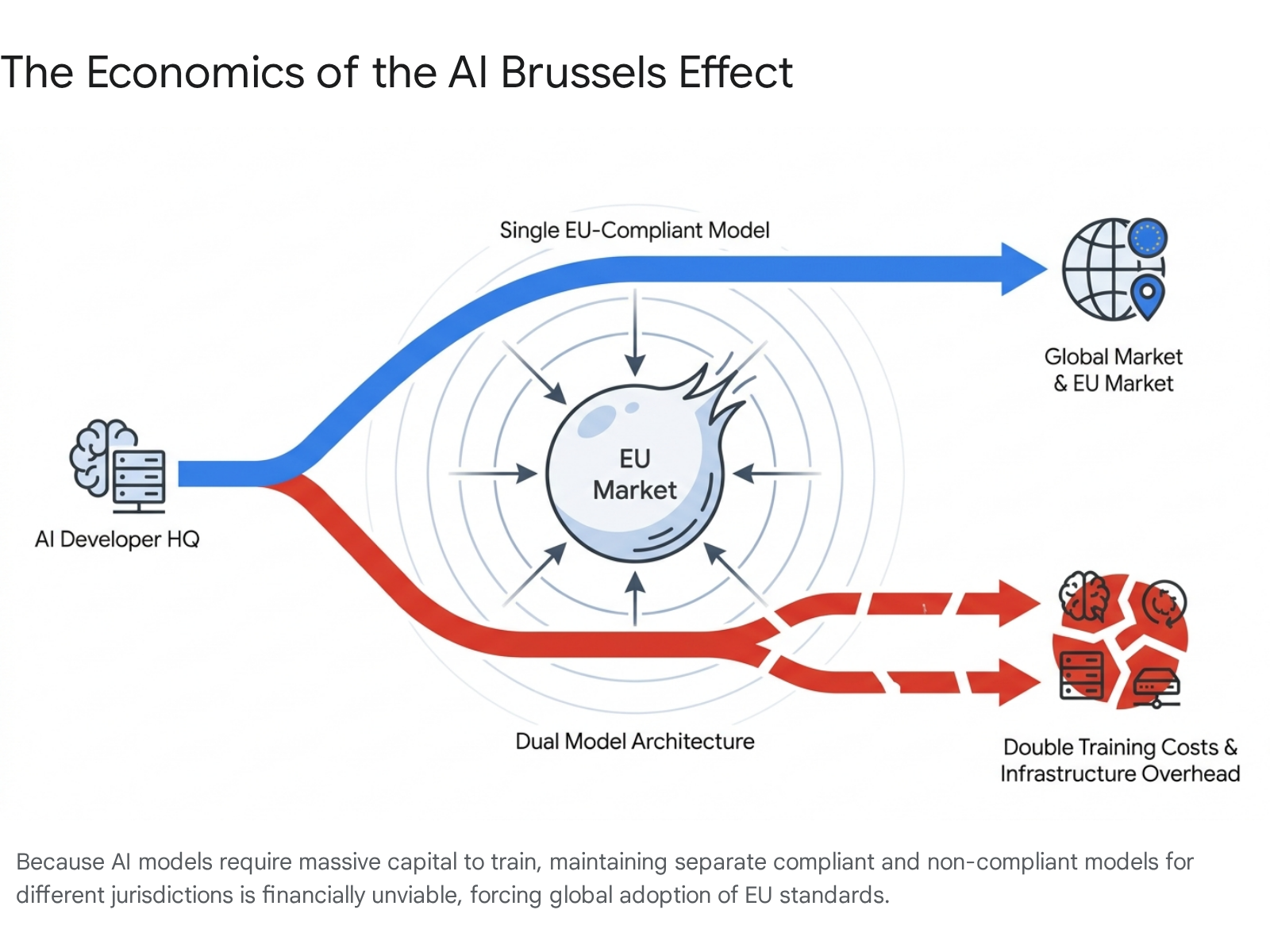
The second, and more powerful, mechanism is the de facto Brussels Effect. This occurs when companies voluntarily adopt EU standards globally because maintaining separate, bifurcated product versions is prohibitively expensive and technically complex 910. The requirements of the EU AI Act heavily implicate practices that occur prior to or during foundational model training 11. If a U.S. company wished to remain non-compliant outside the EU, it would likely need to incur the astronomical costs of training and maintaining two entirely separate foundational models - one scrubbed of copyrighted data and heavily aligned to EU standards, and a less restrictive one for the rest of the world 11. Because the potential revenue in the massive European market far exceeds the costs of universal compliance, building a single, high-standard global product is the most economically rational choice 7911.
The Digital Omnibus: 2026 Compliance Timeline Shifts
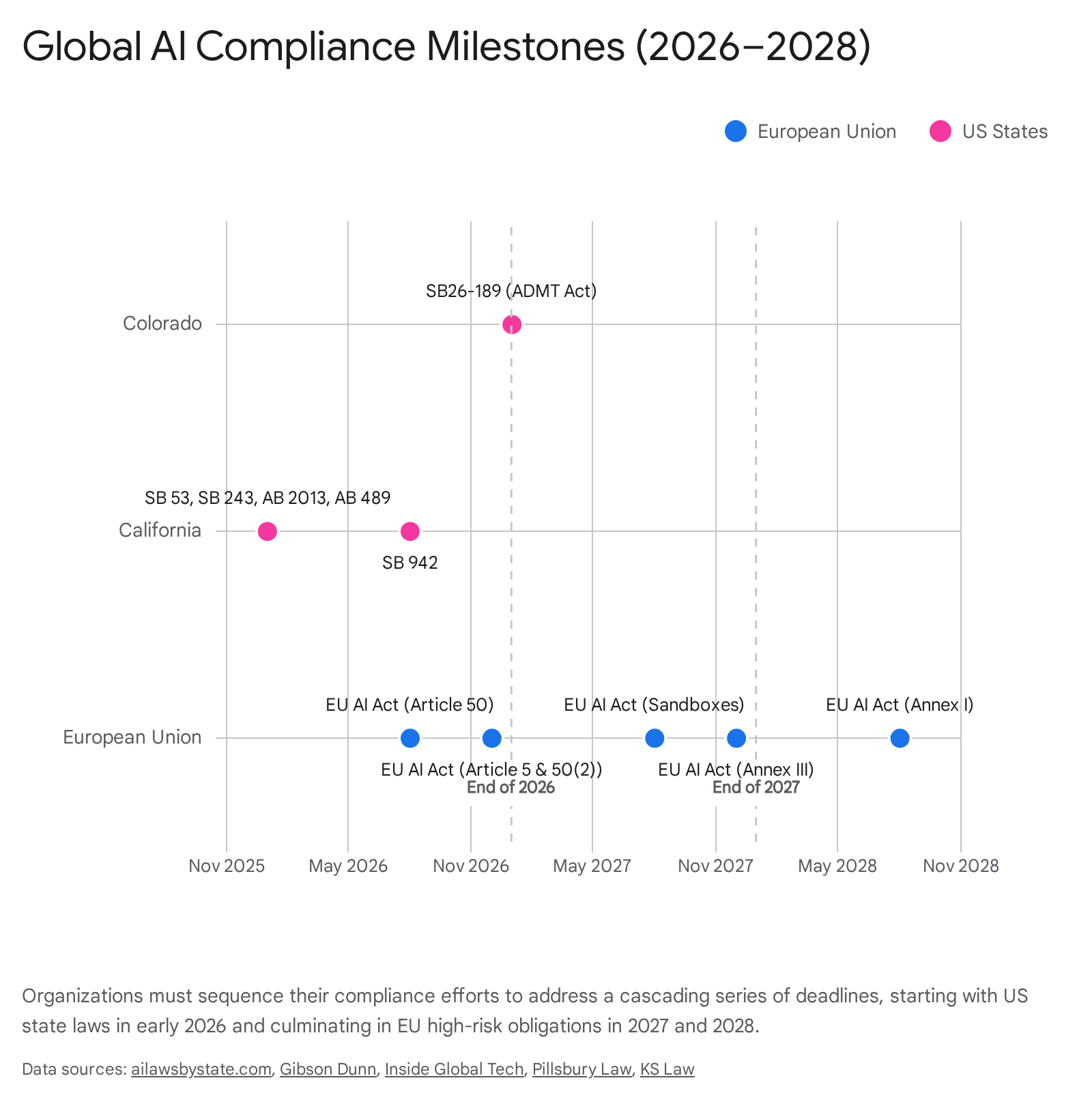
The EU AI Act officially entered into force in August 2024, but its rollout was designed to be staggered over several years. By late 2025, it became evident that implementation was visibly off track. The European Union was facing mounting pressure regarding its global economic competitiveness, particularly as Chinese AI providers prepared to invest an estimated $70 billion in data centers in 2026 alone 9121314. In response, negotiators from the Council of the European Union, the European Parliament, and the European Commission reached a provisional political agreement in May 2026 on the "Digital Omnibus on AI" 121415.
This Omnibus package introduced targeted simplifications and significant timeline deferrals to ease the immediate regulatory burden on enterprises. While prohibitions on "unacceptable risk" systems - such as social scoring by governments, workplace emotion recognition, and real-time biometric surveillance - have remained actively enforced since February 2025, the Omnibus significantly altered the deadlines for High-Risk AI Systems 5815.
Obligations for standalone high-risk systems listed under Annex III, which encompass heavily utilized enterprise tools in employment, education, credit scoring, and law enforcement, were deferred by sixteen months. The compliance deadline for these systems was moved from August 2026 to December 2, 2027 1215. Similarly, for Annex I systems - where AI is embedded in physical products already covered by sectoral safety legislation, such as medical devices, toys, and machinery - the deadlines were pushed to August 2, 2028 1215. Furthermore, the obligation for EU Member States to establish at least one national AI regulatory sandbox was delayed by a full year to August 2027 1215. The Omnibus also shifted the burden of AI literacy obligations away from private providers and deployers, transforming it into a promotional duty for the Commission and Member States, while centralizing enforcement authority for general-purpose AI under the Commission's AI Office 1314.
Despite these deferrals, August 2, 2026, remains a highly active and critical compliance date for a vast array of provisions 1215. The broad transparency obligations outlined under Article 50 remain on schedule 12. These rules require providers to ensure that humans are informed when they are interacting with an AI system, and mandate that outputs from systems generating synthetic content are marked in a machine-readable format to be detectable as artificially generated 1516. For systems already placed on the market before August 2, 2026, the agreement provides a brief four-month grace period until December 2, 2026, to implement these watermarking obligations 1215.
Additionally, the Omnibus introduced a highly sensitive new prohibition into Article 5 of the Act. Effective December 2, 2026, the EU institutes an outright ban on the market placement or use of AI systems that generate non-consensual realistic depictions of intimate parts ("nudifiers") or child sexual abuse material (CSAM) 1215. The penalties for violating the core tenets of the EU AI Act remain staggering, reaching up to €35 million or 7% of global annual revenue for engaging in prohibited practices, and up to €15 million or 3% of global turnover for violations regarding high-risk systems 68.
| Regulatory Domain | EU AI Act Classification | Effective Deadline | Key Compliance Obligations |
|---|---|---|---|
| Prohibited Practices | Unacceptable Risk | Active (Feb 2025) | Immediate cessation of social scoring, workplace emotion tracking, and real-time biometric surveillance. 58 |
| User Transparency | Transparency Risk (Art. 50) | Aug 2, 2026 | Mandatory disclosure of AI interaction; machine-readable watermarking of synthetic content. 1215 |
| Intimate Content Ban | Unacceptable Risk (Updated) | Dec 2, 2026 | Complete ban on AI generation of CSAM and non-consensual synthetic intimate imagery. 1215 |
| Enterprise Use Cases | Annex III High-Risk | Dec 2, 2027 | Conformity assessments, rigorous data governance, and human oversight for HR, lending, and education AI. 1215 |
| Embedded Systems | Annex I High-Risk | Aug 2, 2028 | Strict safety and documentation requirements for AI integrated into regulated hardware like medical devices. 1215 |
The United States' Patchwork Paradigm
If the European approach is defined by centralization and a precautionary risk philosophy, the United States' approach has historically been characterized by fragmented decentralization, a focus on rapid capital deployment, and a reliance on sector-specific agencies rather than sweeping federal statutes 2614.
As of mid-2026, the United States lacks any comprehensive horizontal federal AI law 3618. Governance is instead distributed across a myriad of federal agencies that are applying their existing statutory authority to AI-enabled conduct 6. The Federal Trade Commission (FTC) polices deceptive AI capability claims and algorithmic price fixing under its consumer protection mandate, while the Equal Employment Opportunity Commission (EEOC) enforces Title VII against algorithmic bias in hiring 617. Meanwhile, the Food and Drug Administration (FDA) has updated its Quality Management System Regulation framework to align with international standards for medical device software, and financial regulators continue to heavily scrutinize model risk management in credit decisions 617.
Despite this agency-level activity, actual adoption of AI within the federal government itself remains structurally hindered. According to a 2026 report by the Brookings Institution assessing the state of federal AI adoption, the pace and scope of use have accelerated, yet implementation remains heavily concentrated among a handful of large agencies 18. Systemic bottlenecks continue to slow progress, primarily driven by workforce capacity constraints, an entrenched risk-averse culture, and archaic procurement challenges that make acquiring cutting-edge technology difficult for government entities 18.
The State-Level Legislative Explosion
In the absence of a unified federal voice to govern the private sector, state legislatures have aggressively moved to fill the vacuum, creating a complex and often contradictory web of compliance standards. By 2026, the trajectory of AI regulation mirrors the earlier evolution of U.S. privacy laws, with more than half of all U.S. states introducing or passing AI-related legislation 142119. In 2025 alone, over 1,200 AI-related bills were introduced across all fifty states, with 145 successfully enacted 14.
An analysis of these state-level bills by the Brookings Institution reveals distinct patterns in what successfully passes versus what stalls in committee. Bills proposing to ban non-consensual intimate imagery and child sexual abuse material generated the highest volume of legislative proposals across the country, though broader bills focusing on algorithmic fairness in employment demonstrated the highest actual passage rates 20. The analysis also notes a demographic correlation: younger, wealthier, and Democratic-leaning states have led the nation in drafting and enacting complex AI regulations 20.
Colorado has served as a major focal point in this state-level legislative drama. In 2024, the state passed the nation's first comprehensive AI law (SB 24-205). However, facing intense pushback from the business community over high compliance costs and implementation feasibility, lawmakers and Governor Jared Polis agreed the original act was too broad 2421. In May 2026, following a special legislative session, the governor signed SB26-189, which repealed and replaced the original law with the newly titled Colorado Automated Decision-Making Technology (ADMT) Act 21. The amended law significantly narrowed the regulatory scope and pushed the effective enforcement date to January 1, 2027 21. The revision stripped out several burdensome centerpiece obligations, including the algorithmic-discrimination "duty of care," the mandate for annual impact assessments, and the requirement to maintain a risk-management program aligned to the NIST framework 21. Instead, the revised Colorado law now focuses strictly on transparency, requiring clear consumer notice at the point of interaction, post-adverse-outcome disclosures, and honoring consumer rights when AI materially influences consequential decisions in domains like education, employment, and housing 21.
California, by contrast, continues to leverage its massive economic weight to push an aggressive slate of regulations, with a sweeping package of over twenty new AI laws taking effect on January 1, 2026 322. A centerpiece of this effort is SB 53, the Transparency in Frontier Artificial Intelligence Act, which forces large AI developers to publish catastrophic risk frameworks, submit periodic summaries to the state's Office of Emergency Services, and mandate internal whistleblower protections with anti-retaliation safeguards for employees reporting critical safety incidents 2227. California also enacted SB 243, establishing a rigorous safety framework for "companion chatbots," requiring platforms to proactively implement evidence-based protocols to prevent self-harm content and apply heightened protections for minors, including blocking sexually explicit material 322. Another major legislative pillar, the California AI Transparency Act (SB 942) - which mandates large platforms provide free AI-content detection tools and embed manifest watermarks - was slightly delayed and will now become effective in August 2026 322.
The Executive Order and the Federal Preemption War
The increasingly fragmented state-by-state approach created an environment that the technology industry argued was hostile to innovation and impossibly burdensome for startups, who lack the vast compliance departments of legacy tech giants 42329. In response, the federal executive branch initiated a highly controversial intervention. On December 11, 2025, President Trump signed an executive order titled "Ensuring a National Policy Framework for Artificial Intelligence" 3419.
The Executive Order explicitly declares that United States policy is to sustain and enhance global AI dominance through a "minimally burdensome, uniform national policy framework" 41924. Recognizing that Congress had repeatedly failed to pass a legislative moratorium on state AI laws, the administration turned to executive authority to lay the groundwork for federal preemption - attempting to use federal mechanisms to legally invalidate or financially starve state laws deemed overly restrictive or ideologically driven 42924.
The administration's strategy operationalizes this preemption through several aggressive tactics: 1. The DOJ AI Litigation Task Force: The Attorney General was directed to establish a dedicated task force explicitly tasked with identifying and challenging state AI laws in federal court 32425. The anticipated legal arguments posit that state regulations - such as California's frontier model oversight or algorithmic discrimination laws - unconstitutionally infringe on the federal government's authority to regulate interstate commerce under the Dormant Commerce Clause, or violate First Amendment protections by forcing developers to "alter truthful outputs" to satisfy state-mandated fairness metrics 342324. 2. Federal Funding Leverage: The order directs the Secretary of Commerce to identify state laws that merit referral to the litigation task force and weaponizes federal grant money to enforce compliance. Specifically, the order attempts to condition highly lucrative federal infrastructure funds, such as the Broadband Equity Access and Deployment (BEAD) program grants, on states' willingness to abandon or refrain from enforcing "onerous" AI legislation 32526. Federal agencies have been instructed to require states to enter into binding agreements not to enforce conflicting AI laws as a condition of receiving discretionary funding 2526. 3. Agency Directives to Override States: The order pushes the Federal Communications Commission (FCC) to initiate a proceeding for a baseline federal AI reporting standard explicitly intended to preempt conflicting state transparency rules. It also directs the Federal Trade Commission (FTC) to issue policy statements describing circumstances under which state laws requiring the alteration of AI outputs are preempted by federal law 32325.
The legal viability and ultimate impact of this Executive Order remain deeply contested in mid-2026. Legal scholars point out that invoking the Dormant Commerce Clause to strike down state-level consumer protection laws is historically difficult; the Supreme Court has recently recognized that state regulations are not automatically invalid merely because they impose effects beyond state borders 23. Similarly, attempting to mandate federal preemption through agency policy statements - without a clear, underlying statutory basis passed by Congress - pushes the boundaries of executive authority and will undoubtedly face fierce resistance from state attorneys general 2326.
Consequently, the Executive Order has not provided the regulatory clarity businesses sought; instead, it has amplified legal uncertainty 192933. Enterprise leaders are caught in a period of intense regulatory whiplash. They must allocate resources to comply with complex state laws currently taking effect, while simultaneously knowing those exact laws are actively targeted for destruction by the Department of Justice 192934.
The Global Mosaic: Beyond the Transatlantic Divide
While the EU and the United States dominate much of the geopolitical discourse regarding artificial intelligence, multinational corporations must also build compliance programs capable of accommodating distinctly different regulatory philosophies in other major markets 1827.
The United Kingdom has explicitly rejected the European Union's horizontal, centralized legislative approach. To avoid stifling domestic innovation with heavy-handed preemptive rules, the UK relies on an agile, sector-led strategy. Rather than creating a new centralized AI agency, the UK empowers existing regulatory bodies - such as the Financial Conduct Authority, the Information Commissioner's Office, and the Competition and Markets Authority - to apply a set of five cross-cutting AI principles within their specific domains, updating guidance as technology evolves 618.
China approaches AI regulation through an entirely different lens, prioritizing state security, ideological alignment, and content control 18. Rather than pursuing a single massive overarching act, Chinese regulators have rapidly deployed narrowly targeted, binding regulations addressing specific technologies as they emerge. Under China's 2023 Generative AI Measures and algorithmic recommendation rules, providers face mandatory government filing requirements, must label AI-generated content, are required to conduct rigorous security assessments prior to public release, and crucially, must ensure that the political content of any generated output conforms strictly to state ideology 618.
India is also emerging as a complex regulatory environment as privacy and AI governance increasingly intersect. Discussions at the 2026 IAPP Global Summit highlighted the operational challenges posed by India's Digital Personal Data Protection Act (DPDPA), which diverges significantly from the GDPR model. The DPDPA imposes rapid breach notification timelines requiring reports to the government within six hours of discovery without minimum thresholds, demands that consent notices be made available in all 22 recognized Indian languages, and mandates that all processor compliance flow entirely through vendor contracts rather than independent statutory obligations 36.
The Unified AI Governance Stack: NIST, ISO 42001, and the EU AI Act
Because no two major jurisdictions regulate artificial intelligence in exactly the same way, attempting to build isolated, localized compliance programs is a recipe for operational failure and massive duplicate spending 1828. The most mature enterprise organizations in 2026 are abandoning reactive, jurisdiction-specific checklists. Instead, they are building a "Unified AI Governance Stack" 283829.
This strategic architecture leverages three distinct but highly complementary frameworks. None is sufficient on its own, but together they serve specific, overlapping corporate functions, allowing organizations to manage risk, satisfy disparate regulators, and demonstrate credibility to enterprise partners 2838.
1. The Foundation: NIST AI RMF (The Methodology)
The U.S. National Institute of Standards and Technology's AI Risk Management Framework (NIST AI RMF) serves as the foundational methodology for how an organization functionally identifies and mitigates risk 182829. While it remains a voluntary framework at the federal level without direct penalty mechanisms, it has evolved into the de facto baseline standard 384041. Federal agencies, enterprise procurement teams, and cyber insurance underwriters increasingly demand NIST alignment, and state laws (like Texas's TRAIGA) cite the RMF as an accepted basis for demonstrating "reasonable care" to shield against liability 284041.
The NIST framework structures risk management across four continuous, non-linear functions. First, the "Govern" function requires organizations to establish a risk-aware culture, define leadership accountability, and form cross-functional oversight teams bridging legal, data science, and business units 4243. Moving to the "Map" phase, organizations must deeply inventory their AI systems, identify third-party supply chain dependencies, and document the specific context and potential harms of each deployment - a process that typically generates an AI Bill of Materials (AI-BOM) 4244. The "Measure" function demands the use of quantitative and qualitative metrics to rigorously test systems for bias, data drift, security vulnerabilities, and reliability before and during deployment 4243. Finally, the "Manage" function requires the deployment of operational controls to treat identified risks, such as implementing "human-in-the-loop" validation workflows or model hardening techniques 4243. Recognizing the rapid evolution of the technology, the 2025 - 2026 updates to the NIST framework expanded its scope by introducing specific profiles tailored for Generative AI and explicitly pushing organizations away from ad hoc, periodic reviews toward continuous, maturity-based monitoring 4142.
2. The Verification Layer: ISO/IEC 42001 (The Evidence)
While NIST provides the methodological instruction manual for risk management, ISO/IEC 42001 provides the auditable proof that the manual is actually being followed 28. Published as the first certifiable international standard for an Artificial Intelligence Management System (AIMS), ISO 42001 focuses on organizational processes rather than specific product outputs 283845. It allows organizations to undergo rigorous third-party audits to externally verify their governance structures 2838. In 2026, possessing an ISO 42001 certification has rapidly transitioned from being a competitive differentiator to an absolute prerequisite in B2B enterprise procurement, serving as verifiable evidence to global partners that AI risks are managed systemically 2838.
3. The Compliance Ceiling: The EU AI Act (The Law)
The capstone of the governance stack is the binding legal requirement of the EU AI Act. It is a critical operational reality that adopting the NIST methodology and achieving ISO 42001 certification does not automatically grant compliance with the EU AI Act 38. ISO and NIST address program-level organizational governance, whereas the European regulation dictates strict, product-level compliance 38. The EU Act enforces specific use-case bans, mandates distinct legal duties depending on whether an entity is acting as a "provider" (builder) or a "deployer" (user), and requires highly prescriptive conformity assessments before a product can enter the market 38.
However, an organization that has deeply integrated the NIST and ISO frameworks into its daily operations will find that the heavy lifting is mostly complete. By utilizing industry crosswalk matrices, organizations map the specific legal clauses of the EU AI Act directly to their existing NIST controls 282946. This approach reveals that roughly 70% to 80% of the EU's rigorous requirements regarding technical documentation, data quality management, human oversight mechanisms, and post-market logging are already satisfied by workflows established under the voluntary frameworks, transforming a massive legal compliance exercise into a streamlined mapping task 182829.
| Framework | Primary Function | Legal Status | Global Relevance |
|---|---|---|---|
| NIST AI RMF | Risk Methodology (How to manage risk) | Voluntary (U.S. standard) | High baseline for U.S. B2B, federal procurement, and proving "reasonable care" in court. 28384041 |
| ISO/IEC 42001 | Management System (How to prove it) | Voluntary (Auditable) | International standard increasingly demanded as a prerequisite by enterprise procurement teams. 283845 |
| EU AI Act | Product Compliance (What is legally allowed) | Binding Law | Mandatory for EU market access; sets the de facto global standard via the Brussels Effect. 182838 |
Operationalizing Compliance: The End of "Paper Compliance"
The central theme echoing from regulatory authorities at the 2026 IAPP Global Privacy Summit was a stark warning to the enterprise sector: "paper compliance" is officially dead 4748. Developing static policies, posting privacy notices, and drafting internal ethical frameworks remain necessary first steps, but they are no longer sufficient to withstand regulatory scrutiny. Enforcement bodies are increasingly focused on operational execution, demanding proof that governance programs function effectively in practice, are continuously monitored, and are backed by rigorous board-level accountability 4748.
This shift is driven by the reality that AI systems are dynamic, probabilistic, and continuously learning, making traditional enterprise risk management - which treats technology as static assets with predictable threat models - entirely inadequate 46. As highlighted during summit discussions, an organization might thoroughly vet and approve a vendor's AI tool in January, completing all required impact assessments. However, if the vendor quietly updates their underlying model by March, the organization's static documentation now describes a system that no longer exists, leaving them exposed to undocumented risks and model drift 36. Regulators, recognizing these complexities, are moving toward audit-style oversight and pooling their investigative resources through mechanisms like the multistate Consortium of Privacy Regulators, signaling a highly coordinated, outcomes-based enforcement environment 4748.
The Third-Party Minefield: Human Resources Liability
One of the most profound areas of risk exposure for businesses in 2026 lies in the deployment of third-party AI tools, particularly within Human Resources departments. Many small and medium-sized business owners operate under the dangerous assumption that because they purchased an AI applicant tracking system or resume screener from a large, established software vendor, the compliance burden and legal liability rest entirely with the provider 2149. Under almost all modern employment and AI legislation, this assumption is false.
Human Resources decisions - who gets interviewed, hired, promoted, or terminated - affect the most heavily protected domains in law, and injecting artificial intelligence into these processes adds massive new layers of legal exposure 50. The U.S. Equal Employment Opportunity Commission (EEOC) has firmly established through technical guidance that employers are ultimately liable for discriminatory outcomes produced by the AI screening tools they use, regardless of whether the employer intended the bias or fully understood how the algorithm functioned 1750.
State and municipal laws have codified these liabilities with severe penalties. New York City's Local Law 144 applies to any employer - from a five-person startup to a multinational corporation - using automated employment decision tools to evaluate candidates in the city 2150. The law mandates that employers must subject these tools to independent third-party bias audits before deployment, publicly post the results, and provide explicit advance notice to applicants. Fines for non-compliance reach $375 per day, per infraction, and the required independent bias audits can cost businesses anywhere from $5,000 to $50,000 annually depending on the complexity of the AI system 2150.
Furthermore, HR teams face complex overlapping data protection obligations. If an AI hiring tool utilizes third-party data providers to supply background information, it may trigger strict disclosure and consent requirements under the federal Fair Credit Reporting Act (FCRA) 50. For organizations with European employees, utilizing AI for performance management or hiring triggers GDPR Article 22, requiring documented legal bases, transparent explanation mechanisms, and the right for the employee to demand meaningful human review of the automated decision 50. Businesses cannot rely on vendor contracts to save them; these agreements routinely contain heavy indemnification clauses that explicitly disclaim liability for algorithmic outcomes, leaving the business deployer fully exposed to regulatory fines and class-action discrimination lawsuits 1730.
Intellectual Property and Truth in Marketing
Marketing departments heavily leveraging generative AI face similarly severe liabilities regarding intellectual property and consumer protection. Generative AI tools are typically trained on vast datasets of scraped content, frequently including copyrighted material 31. If a business utilizes an AI tool to produce an ad campaign or logo that closely resembles an existing protected work or trademark, the business using the tool faces the infringement claim, even if the similarity was entirely unintentional 3132. Additionally, copyright law generally requires human authorship; therefore, marketing assets generated entirely by an AI system may lack intellectual property protection, leaving a company's custom designs legally vulnerable to replication by competitors 31.
Beyond copyright, marketing applications are facing intense scrutiny from consumer protection agencies. The Federal Trade Commission (FTC) has made it clear that marketing content, even when AI-generated, must adhere to strict truth-in-advertising rules 31. The use of AI to generate fabricated customer testimonials, manipulate reviews, or produce deceptive commercial claims can be aggressively prosecuted as a violation of Section 5 of the FTC Act 431. Additionally, updates to the Children's Online Privacy Protection Act (COPPA) taking effect in April 2026 introduce expanded data definitions, strict new retention limits, and outright bans on targeted advertising to children, demanding rigorous technical compliance for any AI-driven marketing campaigns that may reach users under thirteen 36.
To survive in this environment, cross-functional teams comprising Legal, IT, and HR leaders must deploy specialized AI Governance, Risk, and Compliance (GRC) platforms 4533. These platforms automate the generation of necessary documentation, map internal practices against evolving global frameworks, and continuously monitor live AI systems for performance degradation and bias drift, ensuring that an organization's compliance posture remains as dynamic as the artificial intelligence it deploys 4245.
Bottom line
In 2026, the regulatory environment for artificial intelligence has fractured into a high-stakes global standoff. The European Union is dictating the technical baseline for international commerce through the sheer market gravity of the AI Act, while the United States attempts to aggressively deregulate and preempt state-level consumer protections to win an international technology arms race. For businesses operating in this chaotic environment, relying on software vendor disclaimers or adopting a wait-and-see approach to federal policy is a recipe for disastrous liability. True operational resilience requires abandoning localized compliance checklists in favor of integrating the NIST risk methodology with ISO 42001 auditable standards, building a unified governance architecture capable of satisfying both the stringent demands of European law and the intense scrutiny of U.S. state-level enforcement.