
How the EU AI Act Affects US Startups and Developers
The European Union Artificial Intelligence Act officially extends its regulatory reach across the Atlantic, requiring US startups to comply with strict transparency, data auditing, and governance rules if their AI systems or outputs impact European residents. While recent legislative compromises delayed the most punishing high-risk compliance deadlines to late 2027, critical transparency mandates still take effect on August 2, 2026. Failure to adapt software architectures now risks multi-million-euro fines, legal exclusion from the European market, and immediate pushback from heavily audited enterprise clients who cannot use non-compliant vendors.
The Extraterritorial Reality of the AI Act
If you operate an artificial intelligence or software-as-a-service business headquartered in the United States, the EU AI Act might feel like a distant European problem. Many founders assume that they can safely ignore the regulation until their legal counsel raises a red flag, or that the law only applies to companies with physical offices in Paris or Berlin. This instinct is fundamentally incorrect. The EU AI Act is deliberately designed with a massive extraterritorial scope, mirroring the international reach of the General Data Protection Regulation (GDPR) 11.
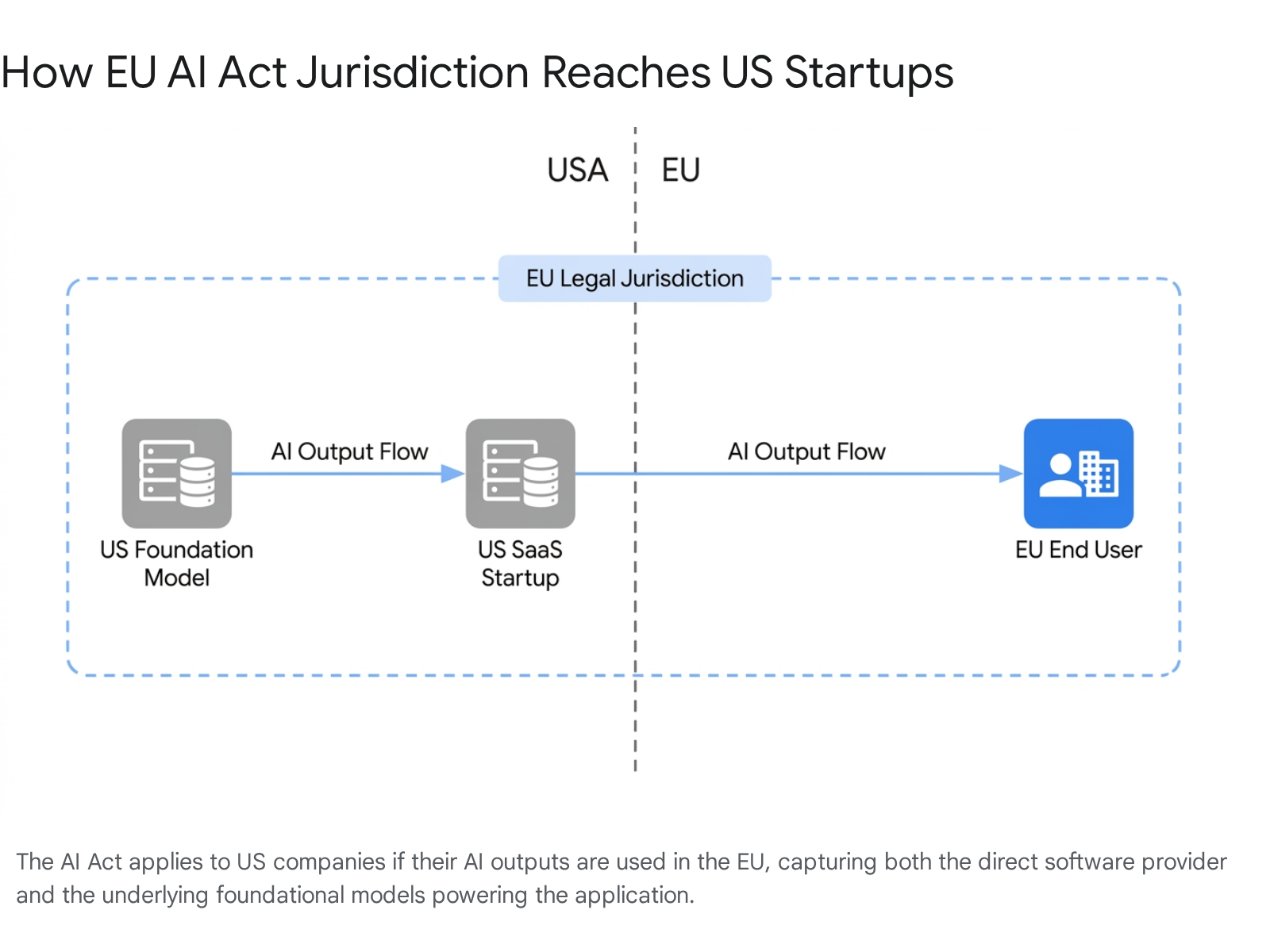
Article 2 of the AI Act defines its jurisdiction not by where a company is incorporated, where its servers reside, or where its code is written, but by where the AI system's impacts are felt 13. A US startup with no physical EU office, no European employees, and servers based entirely in California or Virginia is fully subject to the law if it meets any of several specific triggers 14.
The primary trigger applies if you place an AI system on the EU market, meaning you sell, license, or make your AI product available to EU customers, whether directly through enterprise sales or indirectly through app stores and distributors 34. The second trigger activates if you put an AI system into service within the EU, such as deploying an internal workforce management algorithm used by your own remote European employees 4. The third and most expansive trigger applies if your AI system's output - such as predictions, generated content, or automated decisions - is used within the EU to affect European residents, even if the primary software transaction occurs outside the bloc 134.
Unlike the GDPR, which requires a company to intentionally target the EU market or monitor the behavior of EU residents, the AI Act requires no such intent test 3. If an algorithm screens a job applicant in Munich, scores the credit risk of a consumer in Madrid, or generates automated clinical notes for a patient in Rome, the US company powering that algorithm is entirely in scope 134.
The API Wrapper Misconception
A pervasive misconception among US developers is the belief that utilizing foundational models built by major tech companies via an Application Programming Interface (API) shields the startup from European regulatory burdens. Many developers assume that because companies like OpenAI, Anthropic, or Google trained the underlying models, those tech giants carry the sole legal responsibility 12.
Under the EU AI Act, the creators of foundational models are indeed classified as "Providers" of General-Purpose AI (GPAI) and face their own strict set of rules regarding training data and copyright compliance 2. However, the moment a US startup integrates one of those APIs into a commercial application tailored for a specific use case, the law officially classifies that startup as a "Deployer," and in many scenarios, legally transforms the startup into a "Provider" of a new AI system 23.
You are entirely responsible for how that AI is applied in your specific software context. A startup cannot outsource its compliance obligations to an API vendor, particularly if the software is used to make high-stakes decisions affecting individuals' livelihoods or fundamental rights 12.
Navigating the Geoblocking Dilemma
Faced with the daunting prospect of European regulatory audits, substantial compliance costs, and the threat of severe financial penalties, a common strategic question among US founders is whether they can legally and practically geoblock the European Union to avoid the AI Act entirely 17.
While geographically restricting access to a consumer application is technically feasible, geoblocking is commercially dangerous for business-to-business (B2B) startups 12. The penalties for non-compliance are not merely regulatory fines levied by authorities in Brussels; they are commercial penalties enforced by the market. This phenomenon is often referred to as the enterprise vendor blacklist 2.
Large multinational corporations, whether based in the United States or Europe, are heavily audited and fiercely protective of their own global compliance postures 2. If a Fortune 500 company headquartered in New York utilizes your human resources software, and that enterprise maintains branch offices in Paris and Frankfurt, your software is actively operating within the EU. If your startup refuses to meet EU AI Act standards, that enterprise client cannot legally deploy your product for their European workforce 142. Rather than operating two entirely disparate software ecosystems, multinational enterprises will consistently choose to consolidate their procurement, replacing non-compliant vendors with competitors who have embedded global compliance into their products from day one 27.
Decoding the Risk Classification System
The core regulatory philosophy of the EU AI Act is built on a tiered, risk-based approach 810. The legislation does not apply a uniform set of stringent rules to all algorithms. Instead, it calibrates regulatory obligations according to the specific level of risk an AI system poses to human health, safety, and fundamental rights 8114. Accurately classifying an AI system is the single most critical step in a US startup's compliance journey 8. Misclassification is one of the most common organizational failures, resulting either in devastating regulatory penalties for under-compliance or massive, unnecessary financial over-investment for systems that ultimately pose minimal risk 8.
The Act divides artificial intelligence into four distinct categories. Each tier triggers fundamentally different compliance obligations, operational burdens, and market access requirements.
| Risk Tier | Definition and Regulatory Philosophy | Common Examples of AI Systems | Startup Obligations and Enforcement |
|---|---|---|---|
| Unacceptable Risk | Systems deemed fundamentally incompatible with European values, human rights, and public safety. | Government social scoring, untargeted facial recognition scraping, workplace emotion recognition, and subliminal manipulation 11514. | Completely Banned. Enforceable since February 2025. Violations carry maximum penalties up to €35 million or 7% of global turnover 8616. |
| High Risk | Systems operating in sensitive domains that significantly impact fundamental rights, health, safety, or access to essential services. | Resume screening algorithms, automated credit scoring, medical diagnostic AI, and critical infrastructure management 111417. | Heavily Regulated. Requires rigorous data audits, technical documentation, human oversight, conformity assessments, and public database registration 1114. |
| Limited Risk | Systems where the primary risk involves a lack of transparency, creating potential for user deception or confusion. | Customer service chatbots, AI-generated synthetic media, deepfakes, and supervised clinical scribe tools 1114. | Transparency Required. Must explicitly inform users they are interacting with AI; watermarking required for synthetic content 31114. |
| Minimal Risk | Systems posing little to no credible threat to citizens' fundamental rights, privacy, or physical safety. | Video game AI, spam filters, basic recommendation engines, and conventional productivity software 1114. | No Mandatory Obligations. Startups are encouraged to adopt voluntary ethical codes but face no regulatory barriers to market entry 814. |
The vast majority of bootstrapped AI startups currently building applications will find that their products sit safely in the minimal or limited-risk categories 7. For these organizations, the regulatory burden is exceptionally light, allowing innovation to proceed without significant bureaucratic interference 7. However, for startups building enterprise software tailored to specific, sensitive industries, the high-risk classification represents a profound operational shift.
Understanding Annex III and the Article 6(3) Exception
An AI system is classified as high-risk through one of two distinct legal pathways under the Act. The first pathway involves systems functioning as safety components embedded in products already covered by existing EU harmonization legislation, such as medical devices, heavy machinery, or aviation equipment, listed under Annex I 817.
The second pathway, and the one most relevant to software startups, involves standalone AI systems operating in sensitive domains explicitly listed in Annex III 8198. These domains include biometric identification, the management of critical infrastructure, education and vocational training, employment and worker management, access to essential public and private services like credit scoring, law enforcement, and the administration of justice 889.
Crucially, the Act provides a narrow filter mechanism known as the Article 6(3) exception 817. An AI system operating within an Annex III domain can escape the burdensome high-risk classification if the developer can conclusively prove and document that the system performs only a narrow procedural task and does not pose a significant risk of harm to the health, safety, or fundamental rights of individuals 817.
The overarching principle for developers is straightforward: if the AI system materially influences a decision that affects a person's career prospects, livelihood, or civil rights, it is high-risk 17. For example, an automated job matching tool that scores, ranks, or shortlists candidate resumes is definitively high-risk 17. Conversely, an interview-scheduling tool that merely coordinates calendar logistics without evaluating candidate quality or influencing the final selection outcome is likely outside the scope of high-risk obligations, eligible for the Article 6(3) exemption 17.
The May 2026 Omnibus Agreement and Shifting Timelines
Throughout the spring of 2026, the global technology sector faced widespread anxiety regarding the impending "August 2026 cliff" - the date when the AI Act's most severe rules governing high-risk AI were originally scheduled to become fully enforceable 10. Startups and major enterprises alike warned that the necessary regulatory infrastructure, harmonized technical standards, and conformity assessment bodies were simply not ready, threatening to halt innovation and force mass market withdrawals 161023.
In response to this mounting pressure, and following intense trilogue negotiations in Brussels that briefly collapsed before resuming, a provisional political agreement on the Digital Omnibus on AI was reached on May 7, 2026 5102324. This legislative simplification package provided targeted timeline relief and shifted several critical compliance deadlines, offering US companies a crucial runway to restructure their engineering pipelines.
| Milestone Phase | Original Deadline | Revised Omnibus Deadline | Regulatory Obligations Activated |
|---|---|---|---|
| Prohibited Practices | February 2, 2025 | Unchanged | Banned AI practices and core AI literacy obligations become fully enforceable 52526. |
| GPAI Governance | August 2, 2025 | Unchanged | General-Purpose AI model providers face transparency, copyright, and systemic risk rules 52526. |
| General Transparency | August 2, 2026 | Unchanged | Chatbot disclosures and general deepfake transparency rules become active 323. |
| Watermarking Grace Period | August 2, 2026 | December 2, 2026 | Existing synthetic content generators receive a four-month grace period to implement machine-readable markers 2324. |
| Standalone High-Risk | August 2, 2026 | December 2, 2027 | Annex III systems (employment, credit, biometrics) face full conformity assessment requirements 52324. |
| Embedded High-Risk | August 2, 2027 | August 2, 2028 | Annex I systems embedded in regulated products face final compliance deadlines 52324. |
Industry trade associations representing major US technology interests, such as the Information Technology Industry Council (ITI), publicly welcomed the Omnibus deal, citing the vital need to address duplicative regulations and provide necessary relief to developers 27. However, legal and compliance experts continuously warn US founders against viewing the Omnibus delay as a total pardon. The deferral of high-risk applicability dates reflects a pragmatic acknowledgment of infrastructure delays, but the fundamental architecture of the AI Act remains entirely intact 123.
Most importantly, the Omnibus delay is a trap for teams that mistakenly assume all obligations have been pushed to late 2027. August 2, 2026, remains a heavily active compliance date for the vast majority of software products on the market today 2324.
The Immediate Reality: August 2026 Transparency Mandates
While the punishing technical audits for high-risk systems have been deferred, August 2, 2026, marks the beginning of an era of mandatory algorithmic transparency 323. Providers of AI systems intended to interact directly with human beings, or systems that generate synthetic audio, image, video, or text content, are subject to uncompromising transparency obligations under Article 50 of the Act 311.
If your US startup operates an AI-powered customer support chatbot, a generative writing assistant, or a synthetic media generator, you must implement immediate user interface changes before the August deadline 23. Users must be explicitly and clearly informed that they are interacting with a non-human machine 31114. This disclosure cannot be buried in a terms-of-service agreement; it must be contextually visible during the interaction itself 211.
Furthermore, any AI-generated synthetic content must be marked in a machine-readable format to ensure it is detectable as artificially generated or manipulated 324. This technical watermarking requirement prevents the proliferation of deepfakes and ensures traceability across digital platforms 31112. Recognizing the technical difficulty of retrofitting existing software, the May 2026 Omnibus granted a narrow four-month grace period specifically for watermarking: AI systems already placed on the market before August 2, 2026, have until December 2, 2026, to fully comply with the machine-readable output mandate 232430. Systems launched after August 2 must comply immediately upon release 24.
Ongoing Rules for General-Purpose AI Models
For US companies developing foundational, generative, or large language models, the regulatory clock has already started. Rules governing providers of General-Purpose AI (GPAI) models became fully applicable on August 2, 2025 52526.
Developers releasing GPAI models must maintain deep, up-to-date technical documentation for European regulatory authorities, publish comprehensive summaries of the datasets utilized for model training, and implement strict internal policies to comply with EU copyright directives 43113.
The law introduces an additional tier of scrutiny for GPAI models deemed to pose a "systemic risk." A model is presumed to carry systemic risk if it is trained using massive computational resources exceeding 10^25 floating-point operations (FLOPs) 42633. Providers of these frontier models face highly aggressive obligations, including mandatory adversarial testing (red-teaming), ongoing incident reporting to the European AI Office, rigorous cybersecurity protections, and the continual assessment and mitigation of systemic societal harms 413.
The December 2027 High-Risk Compliance Horizon
For US startups building business-to-business software for enterprise clients in sensitive sectors, the delayed December 2, 2027 deadline is the true existential hurdle 530. When that date arrives, any standalone software system classified as high-risk under Annex III must meet a devastatingly complex set of engineering, data governance, and legal requirements before it can legally process a single piece of European data 83034.
The Stringent Demands of Article 10: Training Data Audits
Unlike previous generations of technology regulation that dealt in vague principles of fairness, Article 10 of the AI Act is highly specific, legally binding the exact daily engineering workflows used to build machine learning models 914. From late 2027, the everyday processes of building AI training datasets - annotation, labeling, cleaning, updating, and enrichment - are heavily regulated 914.
Startups must actively subject their training, validation, and testing datasets to rigorous data governance 814. The datasets must be thoroughly audited to ensure they are relevant, complete within reasonable bounds, free of systemic errors, and statistically representative of the specific geographic, behavioral, and functional environments where the AI system will ultimately operate 8914.
Crucially, engineering teams must conduct, and meticulously document, a formal examination for potential biases that could negatively impact fundamental rights or lead to discriminatory outcomes 8914. Even if the bias examination yields a clean result, that process must be permanently logged in the compliance record 9. If a US startup relies on cheap, undocumented data scraping from the internet to train models for high-risk applications, that company will inherently fail the mandatory conformity assessments 36. A compliant annotation workflow requires documented task specifications, verifiable qualifications for human annotators (e.g., ensuring clinical knowledge for medical imaging datasets), and end-to-end data lineage mapping from source collection to final model deployment 937.
Conformity Assessments, Technical Documentation, and Human Oversight
Before a high-risk AI system can be commercialized in the European Union, the provider must successfully complete a formal conformity assessment 8834. For the majority of Annex III systems, this can be conducted as an internal self-assessment under Annex VI, provided the team meticulously follows the regulatory guidelines 34. However, systems involving biometric identification require third-party assessment by an accredited European Notified Body 34.
Upon successful assessment, the startup must draw up an EU Declaration of Conformity, affix the CE marking to their product, and register the system in the public EU AI database established under Article 71 1834. This database submission requires the provider's name, system description, intended purpose, and conformity status, making non-compliance highly visible to competitors and regulators alike 34.
This entire process requires the generation of a massive technical file (Annex IV) detailing the system's underlying logic, validation methodology, demographic accuracy metrics, and known limitations 333638. Article 9 further mandates the implementation of a continuous, lifecycle risk management system to identify and mitigate reasonably foreseeable misuse scenarios 833. Finally, high-risk systems cannot operate in a fully autonomous vacuum. Article 14 requires startups to build robust "human-in-the-loop" oversight mechanisms directly into the software architecture, ensuring human operators can seamlessly intervene, override automated decisions, or shut the system down completely 41930.
Accessibility as a Hidden Safety Risk
An often-overlooked requirement emerging for high-risk systems involves digital accessibility 39. Under Article 16, providers must ensure their systems comply with accessibility requirements harmonized with existing European directives 39. This transitions accessibility from a simple user experience consideration into a mandatory product safety issue 39.
If a high-risk AI system cannot be safely or effectively operated by individuals with disabilities - or if critical AI-generated decisions and alerts are not adequately communicated to users relying on assistive technologies - this failure may give rise to foreseeable risks of harm 39. Under the modernized European product liability regime, software is recognized as a product, meaning accessibility barriers in high-risk AI could directly expose US startups to severe civil liability claims alongside regulatory fines 39.
The Open Source Exemption and Its Limitations
The European Union actively recognizes the immense value of the open-source community for driving scientific research, software innovation, and economic growth 11. Consequently, the AI Act creates specific, vital exemptions designed to protect developers releasing models into the public domain 1131.
If a US developer builds a General-Purpose AI model solely for scientific research and development, they are not legally considered a "Provider" under the Act and are entirely exempt from its commercial obligations 31. Furthermore, if a startup develops a GPAI model and releases it under a truly free and open-source license that allows broad access, modification, and distribution, they are exempt from several heavy administrative burdens, such as the requirement to maintain technical documentation for authorities or to formally appoint an EU representative 3113.
However, the open-source exemption is heavily conditional and is by no means a total free pass 1131.
First, open-source models classified as having "systemic risk" (those exceeding the 10^25 FLOPs training threshold) receive absolutely no exemptions; providers of these massive models must comply with every safety and cybersecurity obligation in the Act 1113. Second, even standard open-source GPAI developers must still implement a policy to strictly comply with EU copyright laws, and they must publish a sufficiently detailed summary of the training data used, utilizing the official template provided by the AI Office 1131.
Crucially, the exemption applies only to foundational models, not applied systems 1131. If a startup develops and releases an open-source AI application that performs a high-risk task (such as an open-source resume screener) or poses transparency risks (such as an open-source deepfake application), the exemption immediately evaporates. The startup remains fully accountable for all prohibitions, transparency rules, and safety requirements under the law 11.
Building the Compliance Infrastructure: The Authorised Representative
A critical component of EU AI Act compliance involves human infrastructure. If your startup is headquartered in the United States and has no formal legal entity established within the European Union, you are legally barred from placing a high-risk AI system or a GPAI model on the European market until you appoint an Authorised Representative (AR) 1404142.
Article 22 strictly mandates the appointment of this representative 142. Unlike other obligations that dictate how code is written or data is logged, Article 22 requires the physical hiring of a specialized firm 42. The AR acts as the official legal point of contact for European market surveillance authorities and the newly established EU AI Office 344243.
The responsibilities of the AR are extensive. They must hold your highly sensitive technical documentation and declarations of conformity in secure custody for a period of ten years after the system is placed on the market 3443. They are responsible for verifying that your EU database registrations are accurate, and they must actively cooperate with competent authorities to mitigate risks if an incident occurs 43.
US founders often mistakenly assume they can simply expand the mandate of their existing GDPR data protection representative to cover the AI Act 42. While possible, it is strategically flawed; the AI Act requires distinct technical expertise in algorithmic auditing, conformity verification, and complex market access laws, requiring a standalone written mandate 342. Furthermore, the AR must be truly independent and capable of critically assessing your compliance 41. Under the law, an AR is legally duty-bound to terminate their mandate and report you to authorities if they discover you have consistently failed to maintain compliance 4142.
The Economic Reality: Compliance Costs and Innovation Impacts
The EU AI Act is a profoundly expensive piece of legislation. It aggressively shifts the concept of compliance from an occasional legal paperwork exercise into a continuous, heavy engineering and auditing overhead 83644. Large technology conglomerates benefit from massive economies of scale, allowing them to absorb these regulatory overheads, but for software startups and micro-enterprises, the financial burden is structurally disproportionate, operating effectively as a barrier to entry 744.
Industry data indicates that organizations experience an approximate 40% increase in compliance burden when aligning complex AI systems with the Act's requirements, driven largely by the fact that high-risk systems require near-complete regulatory oversight and continuous monitoring 844. Estimates place the realistic first-year compliance cost for deploying a single high-risk AI system between €80,000 and €250,000, with enterprise deployments easily exceeding €1 million annually 3644.
| Compliance Component | Estimated Financial Cost | Strategic and Operational Resource Impact |
|---|---|---|
| Legal Scoping and Gap Analysis | €15,000 - €50,000 | Initial risk classification, mapping data governance gaps, and defining Annex III overlap 3645. |
| Technical Audits & Conformity | €10,000 - €80,000 | Producing dense Annex IV documentation, logging training data sources, and calculating demographic bias metrics 3336. External third-party audits drive costs to the higher end 36. |
| Annual Maintenance & Monitoring | €15,000 - €40,000 / year | Continuous post-market monitoring, updating documentation when models drift, incident reporting, and mandatory staff AI literacy training 3644. |
| EU Authorised Representative | €500 - €5,000 / year | Retaining an EU-based legal entity to serve as regulatory liaison, manage communications, and provide secure ten-year document custody 46. |
These staggering costs, combined with the structural ambiguity of the early regulatory rollout, are already impacting international launch timelines 1647. Surveys commissioned by industry groups reveal a widening transatlantic opportunity gap. US technology startups are actively embedding AI into their workflows faster and scaling applications more aggressively 47. In contrast, tech firms operating within the EU and UK report significant regulatory-driven delays, leading to hundreds of thousands of dollars in foregone savings and delayed revenue capture per firm annually 47. Industry advocates warn that the cumulative cost of compliance, delayed product launches, and lost global competitiveness could run into the billions, fundamentally challenging Europe's ability to retain top-tier AI talent and capital investment 161549.
However, some financial analysts note that this regulatory reckoning also creates immense opportunities 7. Startups that successfully navigate the complex compliance landscape and align their products with Europe's stringent standards can aggressively market their AI software as verifiable, trustworthy, and legally safe 750. In a global market increasingly concerned with algorithmic bias and data privacy, verifiable regulatory compliance transforms from an operational friction into a premium competitive selling point, particularly for enterprise procurement teams 7.
Global Divergence: EU Standards vs. US Fragmentation
The global market for artificial intelligence is currently evolving under two fundamentally divergent legal paradigms, shaping how global technology must be designed and governed 1051.
The European Union has enacted a comprehensive, binding, horizontal legal framework anchored heavily in product safety concepts, the protection of fundamental human rights, and the harmonization of the internal market 3051. In stark contrast, the United States continues to lack a comprehensive federal AI statute 30. US federal AI governance relies predominantly on non-binding executive orders, voluntary safety commitments from tech giants, and targeted agency guidelines that focus heavily on consumer protection and market transparency 3051.
This federal vacuum in the US has triggered a rapid, fragmented proliferation of state-level AI regulations 1050. States like Colorado and Texas have passed their own specific laws targeting automated decision-making, algorithmic discrimination, and governance requirements 3050. For multinational startups, navigating this disjointed patchwork of American rules while simultaneously addressing the EU AI Act presents a massive strategic vulnerability 10.
The most pragmatic corporate strategy is not to chase minimum compliance in fifty different jurisdictions, but rather to adopt an "EU-plus" approach 10. Because the EU AI Act represents the absolute highest global standard for AI regulation, a startup that builds its data governance, risk management, and documentation pipelines to satisfy European requirements will inherently satisfy 70% to 80% of emerging global and US state-level requirements by default 1030. Designing to the strictest standard reduces overall operational complexity and projects a unified, mature commitment to responsible AI 10.
Bottom line
The EU AI Act permanently alters the legal and engineering realities for US software startups whose AI systems interact with the European market, establishing an aggressive standard of extraterritorial liability. While the May 2026 Omnibus agreement provided critical engineering runway by delaying the devastating technical audits for high-risk B2B systems until late 2027, the era of mandatory algorithmic transparency officially arrives in August 2026. Startups that fail to accurately classify their models, implement rigorous training data governance, and secure an EU Authorised Representative will face not only catastrophic regulatory fines, but the immediate, silent commercial penalty of being blacklisted by their most lucrative global enterprise clients.