
US and EU AI Watermark and Label Rules for 2026
Starting in the summer of 2026, the era of voluntary artificial intelligence transparency ends as strict, legally binding labeling requirements take effect across the European Union and key United States jurisdictions. Organizations deploying generative AI must now navigate a highly fragmented compliance landscape, balancing legally mandated cryptographic metadata and pixel-level watermarking against the technical reality that these tracking mechanisms remain highly vulnerable to adversarial removal.
The End of the Wild West: 2026 as the Regulatory Inflection Point
For the first few years of the generative artificial intelligence boom, transparency was largely a matter of corporate goodwill. Technology companies signed voluntary pledges, published internal ethical guidelines, and experimented with beta-stage labeling tools. In 2026, that grace period is officially over. Between executive actions, state-level mandates, and the sweeping extraterritorial reach of the European Union's AI Act, businesses, advertising agencies, and independent creators are now facing hard legal deadlines 123.
The regulatory philosophy has shifted fundamentally from attempting to control the training of sophisticated models to controlling their output. Lawmakers have recognized that they cannot entirely restrict the proliferation of synthetic media generation capabilities. Instead, they are demanding that the resulting media be clearly and permanently labeled. The primary legislative goal is no longer to stop the creation of synthetic media, but to ensure that consumers, voters, and businesses can instantly verify whether the text they are reading, the audio they are hearing, or the video they are watching was generated by a machine or a human 123.
However, this aggressive legislative push is colliding with a harsh technical reality. The technology required to reliably, persistently, and universally watermark AI-generated content is fundamentally brittle. As governments mandate comprehensive labeling and provenance tracking, independent security researchers are simultaneously proving that these digital labels can be easily stripped, bypassed, or forged 45. This creates a complex environment for compliance teams, who must implement fallible technical solutions to satisfy inflexible legal mandates.
The Brussels Effect: The European Union Sets the Global Baseline
The European Union's Artificial Intelligence Act stands as the world's first comprehensive horizontal regulatory framework for artificial intelligence. Crucially, its influence extends far beyond the borders of its member states. Through a phenomenon known as the "Brussels Effect," multinational companies often find it more practical and cost-effective to adopt the European Union's strict standards globally rather than maintaining separate, less-compliant versions of their products and services for different geographic regions 6.
The Brussels Effect operates through two primary mechanisms. The de facto effect occurs when companies voluntarily adopt European standards globally because maintaining separate product versions is prohibitively expensive. For instance, major United States technology companies are currently building human oversight, documentation, and bias testing directly into their global enterprise software architecture rather than attempting to isolate their European customers. The de jure effect occurs when other governments adopt legislation modeled on the European framework. In 2026, jurisdictions ranging from Colorado to Brazil have begun adopting risk-based classification structures heavily influenced by the European precedent 6.
Article 50 Transparency Obligations
At the absolute center of the European Union's approach to synthetic media is Article 50 of the AI Act. This provision dictates that users have a fundamental right to know when they are interacting with a machine or consuming artificially generated content.
The law creates two distinct categories of responsibility within the artificial intelligence ecosystem. The first category applies to providers, which are the entities that create, train, and distribute generative systems. Companies like OpenAI, Google, and Anthropic fall into this group. Under the law, providers must ensure that their systems mark outputs in a machine-readable format, making the media persistently detectable as artificially generated or manipulated 148.
The second category applies to deployers, which encompasses any business, agency, or individual utilizing these systems in a professional context to generate public-facing text, audio, images, or video. Deployers must explicitly and visibly disclose to their audience that the content is artificial. The only exception to this visible disclosure rule for deployers is if the content is subject to rigorous human editorial review, placing ultimate responsibility back onto human actors 4910.
To guide these technical implementations, the European Commission introduced a dedicated Code of Practice on the Transparency of AI-Generated Content. The draft Code makes it explicitly clear that no single universal technical solution exists to ensure full resistance to manipulation. Consequently, the European Union mandates a multi-layered approach to watermarking and labeling. This involves embedding metadata directly into the file, weaving an imperceptible watermark into the pixel or audio data, and maintaining digital fingerprinting logs as a fallback mechanism for when other techniques inevitably fail 149.
The May 2026 Digital Omnibus and the December Extension
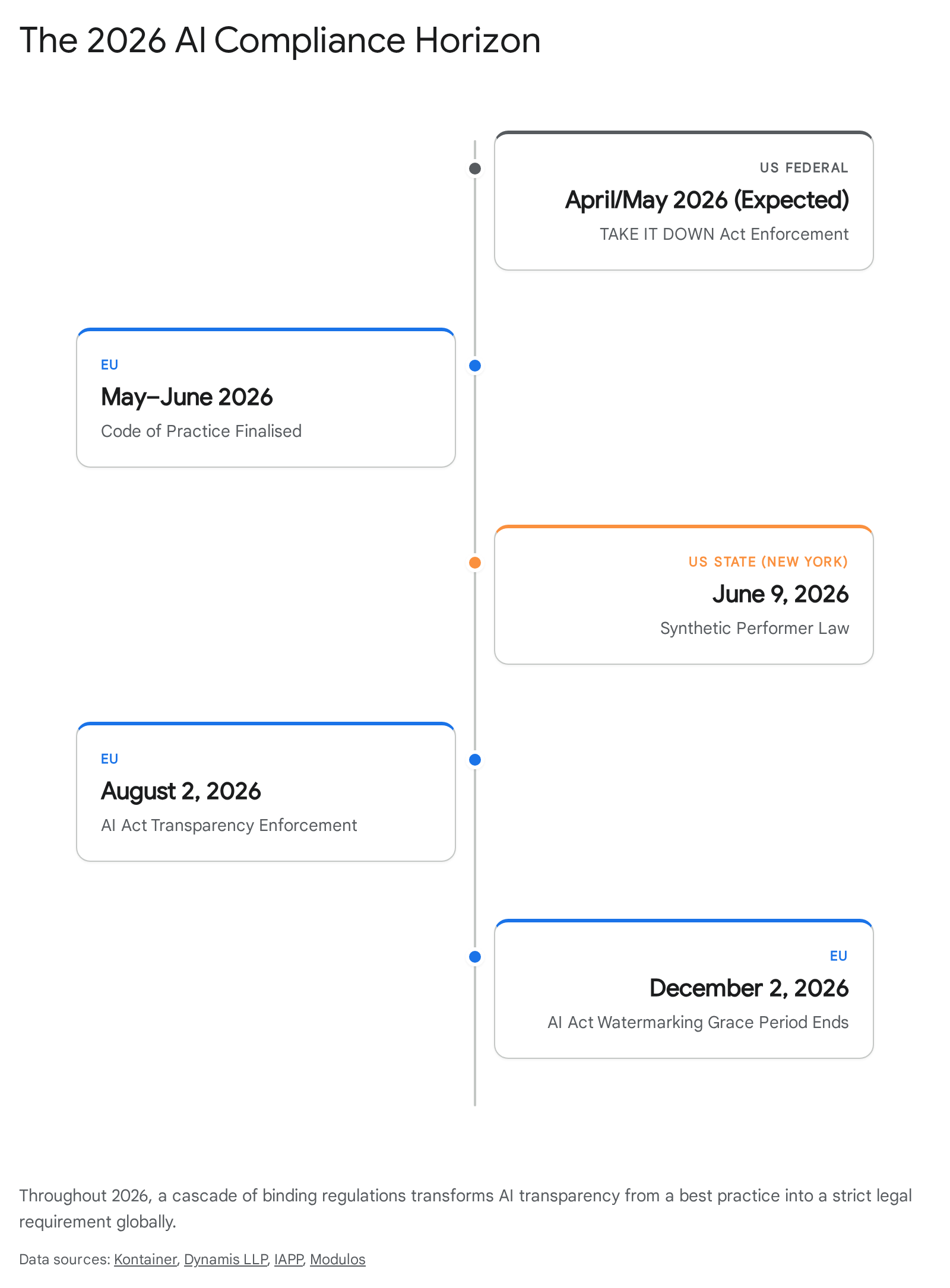
The original deadline for the sweeping transparency requirements under Article 50 was set for August 2, 2026. However, as the enforcement date approached, it became evident to regulators and industry participants that the technical infrastructure, standardized codes of practice, and verification tools required for seamless cross-platform watermarking were not fully mature 1112.
In response to these operational realities, the European Parliament and the Council of the European Union reached a provisional political agreement in early May 2026 on the "Digital Omnibus on AI." This legislative package was designed to streamline compliance and prevent widespread market disruption. While the core transparency obligations - such as visibly disclosing the use of chatbots and labeling basic artificial content - remain firmly scheduled for August 2, 2026, the Omnibus granted a brief, targeted grace period specifically for the highly technical watermarking mandate 1314.
Under this grandfathering rule, generative systems that were already placed on the market before August 2, 2026, now have until December 2, 2026, to fully comply with the machine-readable watermarking requirements under Article 50(2) 1415. Systems introduced to the market on or after August 2 must be compliant immediately upon their release.
Failure to comply with these transparency rules is not treated as a minor administrative oversight. The European Union has established severe consequences, with potential financial penalties reaching up to €15 million or 3% of a company's total annual worldwide turnover, whichever figure is higher 13.
The United States Patchwork: Federal Restraint and State-Level Aggression
Unlike the European Union, the United States has not passed a single, unifying framework to govern artificial intelligence. Instead, the domestic regulatory landscape in 2026 is characterized by targeted federal laws addressing highly specific, visceral harms, operating alongside a fragmented mosaic of aggressive, state-level legislation 165.
The Federal Stance: The TAKE IT DOWN Act
While the United States lacks an omnibus bill, the federal government has acted decisively to address the most universally recognized harm caused by generative platforms: nonconsensual intimate imagery and deepfakes. In the spring of 2026, the TAKE IT DOWN Act (S. 146) passed through Congress with overwhelming bipartisan support and was signed into law 67.
The Act introduces profound criminal and civil elements to the regulatory landscape. On the criminal side, it makes it illegal for a person to knowingly publish authentic or synthetic nonconsensual intimate images with the intent to cause harm. More significantly for the technology industry, the civil provisions require covered social media platforms and websites to completely remove flagged nonconsensual intimate imagery within 48 hours of receiving a valid request 2021.
This federal mandate fundamentally alters platform operations. To meet a 48-hour takedown window at scale, platforms are effectively forced to aggressively deploy automated deepfake detection and provenance-checking infrastructure to manage their liability and surface violative content 20.
Furthermore, federal agencies are utilizing their immense purchasing power to drive transparency standards. Under directives issued by the Office of Management and Budget, any federal agency purchasing artificial intelligence tools for enterprise-wide use must now legally require their vendors to implement watermarks and cryptographic metadata. This ensures the government can identify synthetic content, link it to specific models, and trace its origin and editing history 522. Concurrently, the National Institute of Standards and Technology is actively finalizing its guidelines and establishing standardized deepfake evaluation benchmarks to give these procurement rules technical teeth 8.
California's SB 942: Forcing Verification Infrastructure
California, serving as the headquarters for the vast majority of the world's leading artificial intelligence laboratories, has enacted the California AI Transparency Act, commonly known as SB 942, taking effect concurrently with European rules on August 2, 2026 24.
This legislation applies to any covered provider that creates or produces a generative system accessible within California that surpasses one million monthly visitors or users. This precise threshold captures major foundation-model laboratories and significant mid-market generation platforms, ensuring scale without crippling small startups 24.
The California law imposes three core technical obligations. First, providers must offer a free, publicly accessible artificial intelligence content detection tool. This tool must allow any person to upload content or provide a URL to determine if it was generated or substantially altered by that specific provider's system. Crucially, the tool must expose an application programming interface so third-party platforms can integrate the verification process 24.
Second, the law mandates latent disclosure. Every image, video, and audio file generated by the system must include a machine-readable provenance record that is extraordinarily difficult to remove 24. Third, providers must offer a manifest disclosure option, allowing end-users to easily apply a visible, permanent label to their generated content 2224.
California's approach is notable because it shifts significant enforcement responsibility directly onto the system providers rather than just the end-users. By mandating the creation of public detection interfaces, California regulators are betting that verifiable disclosure requires more than just embedding fragile metadata into a file; it requires a live, actively maintained verification infrastructure provided by the creators of the models themselves 25.
New York's Focus on Creators and Digital Replicas
New York State has taken a fundamentally different angle from California, focusing heavily on consumer warnings and the robust protection of creative likeness and performance rights.
New York Assembly Bill A3411B requires any owner, licensee, or operator of a generative system to display a clear and conspicuous notice on the user interface warning consumers that the system's outputs may be entirely inaccurate 269.
More urgently for the advertising, entertainment, and media industries, New York's Synthetic Performer Law (S. 8420) takes effect on June 9, 2026. This aggressive statute requires explicit, conspicuous disclosure whenever an advertisement features an artificially generated digital replica of a human performer. The law goes so far as to create a recognized property right in a performer's digital replica, meaning any use of a recognizable individual in synthetic content requires prior written consent and fair compensation 102930. Critically for corporate governance, the New York law introduces strict personal liability for corporate directors and officers who fail to comply, moving beyond simple entity-level fines 29.
Comparing the Major 2026 Transparency Laws
To properly understand the organizational compliance burden, it is vital to contrast how these three major regulatory frameworks approach transparency and enforcement.
| Regulatory Feature | European Union AI Act (Article 50) | California SB 942 (AI Transparency Act) | New York S.8420 (Synthetic Performers) |
|---|---|---|---|
| Effective Enforcement Date | August 2, 2026 (December 2, 2026 for legacy watermarks) | August 2, 2026 | June 9, 2026 |
| Primary Regulatory Target | Both Providers and Deployers operating within the EU market | GenAI Providers boasting >1M monthly California users | Advertisers and creators distributing ads to New York residents |
| Core Technical Requirement | Machine-readable marking paired with visible user disclosure | Mandatory latent metadata combined with the provision of public detection APIs | Conspicuous visible disclosure specifically for AI-generated human replicas |
| Enforcement and Penalty | Up to €15 million or 3% of global annual turnover | $5,000 per individual violation, accruing per day | $1,000 to $5,000 per violation; includes personal liability for directors |
| Scope of Covered Content | All synthetic text, audio, image, and video outputs | Images, audio, and video outputs (expressly excludes text) | Advertisements specifically featuring synthetic human performers |
The Technology: How Content Provenance Actually Works
Regulators across the globe demand that artificial intelligence content be reliably labeled, but achieving this technically is immensely complex. In response to these sweeping legal mandates, the technology industry has effectively split its efforts into two distinct, complementary approaches: cryptographic metadata and invisible pixel-level watermarking 11.
Content Credentials: The Rich but Fragile Wrapper
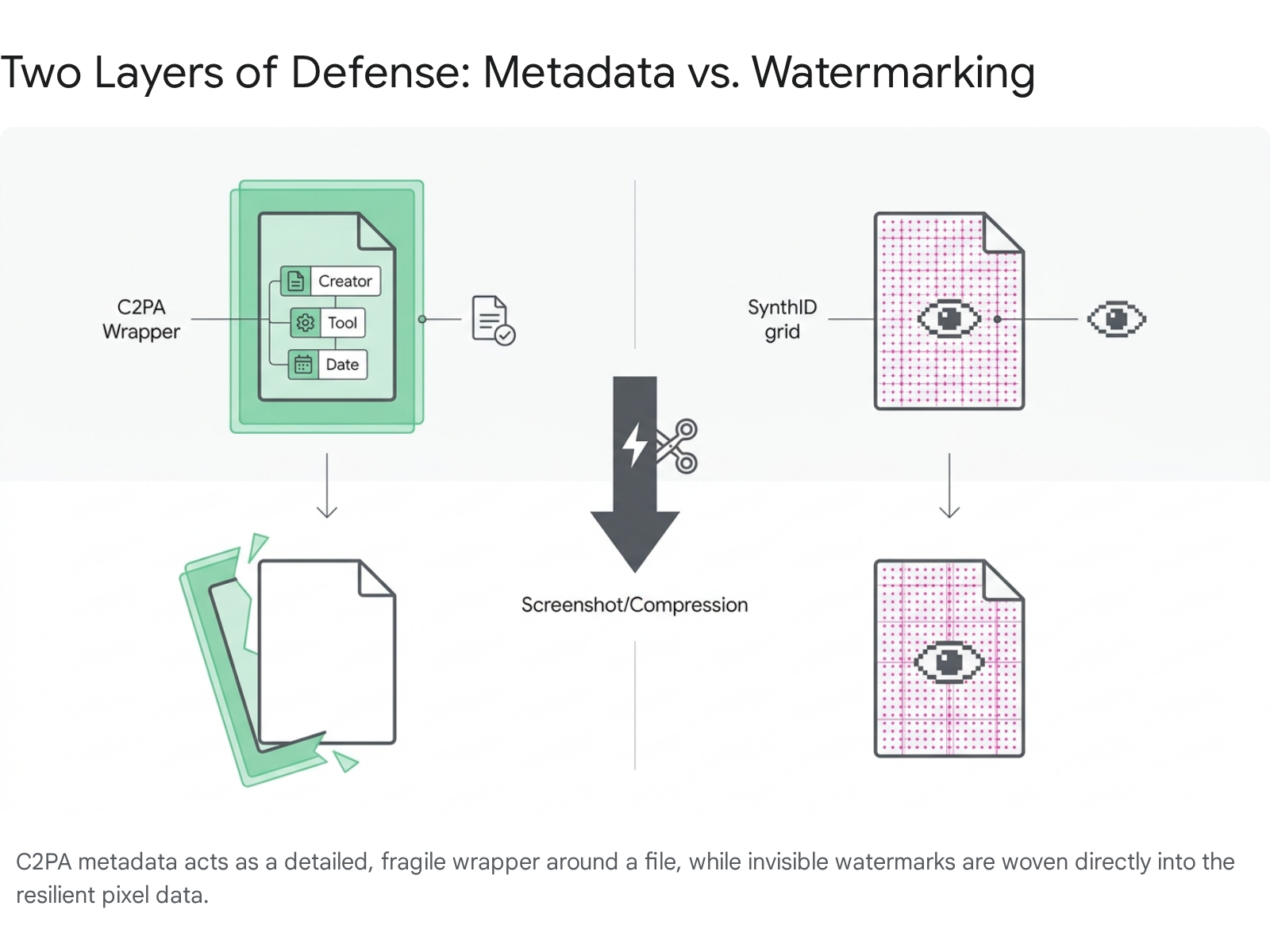
The Coalition for Content Provenance and Authenticity is an open, cross-industry standard backed by technology giants including Adobe, Microsoft, and Google. It functions by attaching a cryptographically signed metadata manifest directly to the header of an image, video, or audio file 1132.
This metadata approach is widely considered the gold standard for detailed digital provenance. It does not simply flag a piece of content as artificial; it records a highly structured narrative. The manifest details exactly which tool was used to generate the media, who the corporate issuer was, the exact date of creation, and a comprehensive, tamper-evident history of any subsequent digital edits 1132.
However, this metadata standard suffers from a fatal technical flaw in the context of the open internet: extreme fragility. Because the manifest lives entirely within the file's metadata container rather than the visual data itself, it is easily stripped, either maliciously or accidentally. If a user takes a screenshot of a signed image, saves a picture via a basic right-click, or uploads the file to a social media platform that aggressively compresses media headers to save bandwidth, the cryptographic signature is destroyed. Once the signature is broken, the provenance data is lost entirely, rendering the file untraceable by these means 113334.
Invisible Watermarking: The Persistent but Sparse Signal
To combat the inherent fragility of metadata, leading laboratories are deploying invisible watermarks, most notably Google's SynthID and Meta's open-source Video Seal. Rather than hiding text data in the file header, these sophisticated technologies embed imperceptible mathematical patterns directly into the pixels of an image, the waveform of an audio file, or the frames of a video 223312.
Because the identification signal is woven inextricably into the actual media content, invisible watermarks are highly resilient. They can typically survive severe digital degradation, including screenshots, heavy cropping, aggressive resizing, color correction, and substantial JPEG compression pipelines common in modern web infrastructure 3412.
The primary trade-off for this resilience is very low information density. A pixel-level watermark cannot carry a detailed, cryptographic history of the file. It generally only holds enough data to communicate a basic, binary signal indicating that the media originated from a specific artificial source 1112. Furthermore, unlike the open standards governing metadata, most advanced watermarking systems remain proprietary black boxes, requiring the original provider's specific, closed-ecosystem tools to verify their presence 1134.
Because both systems possess opposing strengths and weaknesses, industry consensus in 2026 strongly suggests that regulatory compliance requires a dual-layer architecture. Organizations are advised to embed metadata for deep, auditable transparency at the source, while simultaneously injecting invisible watermarks as a durable, secondary fallback for when the content inevitably travels across hostile digital environments 1133.
| Technical Mechanism | Primary Method of Embedding | Key Strengths | Critical Weaknesses |
|---|---|---|---|
| Cryptographic Metadata (e.g., C2PA) | Signed manifest in the file header | Rich data payload (tool, edits, timestamps); open standard | Extremely fragile; easily destroyed by screenshots or standard re-encoding |
| Invisible Watermarking (e.g., SynthID) | Imperceptible mathematical patterns in pixel/audio data | Highly resilient to cropping, compression, and screenshots | Very low data payload; often relies on proprietary, closed-system detection tools |
The Adversarial Arms Race: Why Technical Watermarks Fail
Despite the strict legal mandates demanding permanent, machine-readable watermarks, peer-reviewed computer science research published from 2024 through 2026 has repeatedly demonstrated that perfectly robust watermarking is currently a mathematical myth 45.
The technology industry is engaged in a perpetual, high-stakes arms race against adversarial techniques specifically designed to erase these safety signals. As quickly as companies develop new embedding techniques, researchers and bad actors develop automated tools to scrub them completely clean. The academic literature demonstrates that existing black-box watermarking techniques remain highly ineffective against determined extraction attacks due to inherent vulnerabilities in the models themselves 413.
Advanced Removal and Generative Laundering
Recent academic and security studies highlight exactly how brittle these systems remain in the face of targeted, sophisticated attacks:
- Generative Laundering and Diffusion Purification: Advanced attackers do not simply attempt to crop or blur an image to defeat a watermark. Instead, they use secondary generative models to slightly reprocess or regenerate the content. By intentionally adding noise to a watermarked image and then using a diffusion model to denoise it, attackers effectively re-synthesize the image. This process preserves the high-level visual semantics that humans recognize while entirely wiping out the delicate, high-frequency pixel adjustments that make up the invisible watermark. Controlled studies have shown this specific technique can defeat up to 92% of invisible image watermarks currently on the market 1337.
- Visual Paraphrasing: Researchers have developed automated systems that analyze a synthetic image, generate an exact, highly detailed text caption of what it depicts, and then feed that caption back into an entirely separate diffusion model to create a visual paraphrase. The resulting image looks practically identical to the human eye but is mathematically distinct from the original, thereby stripping the watermark entirely without degrading visual quality 38.
- The Fragility of Text Watermarks: Watermarking text generated by large language models has proven even less reliable than image marking. Text watermarks rely on subtly biasing the model's statistical word choices during generation. Research indicates that simple synonym substitution, or utilizing a secondary model to paraphrase the output, can remove or hopelessly obscure the watermark with an 85% success rate 13. Furthermore, current cryptographic proof generation times for text can take several minutes, limiting their scalability for massive content production pipelines 13.
- Dedicated Attack Frameworks: In 2025, researchers unveiled unified frameworks like UnMarker, which successfully erased watermarks from robust, industry-leading systems such as Google's SynthID and Meta's StableSignature. Notably, these tools function in a black-box setting, meaning they successfully erase the marks without needing any access to the proprietary source code or internal workings of the original watermarking systems 3940.
The Open-Source Loophole
Even if a theoretically perfect, un-removable watermark were invented tomorrow, the entire global regulatory framework suffers from a massive open-source loophole. Systems like SynthID and the metadata standards only function if the software generating the media actively cooperates and chooses to apply the stamp 5.
While massive corporate laboratories can force watermarking onto their proprietary cloud application programming interfaces, bad actors easily bypass these corporate guardrails by downloading and running decentralized, open-source models on their own local hardware 522. Because open-source models do not inherently embed cryptographic signatures or proprietary watermarks into their codebases, the absence of a label in 2026 provides no actual assurance that a piece of media is authentic. It simply means the file lacks a signature - whether because it is a genuine photograph, because the metadata was stripped by a screenshot, or because it was generated by an unregulated local model operated by a malicious actor 2234.
Policymakers often mistakenly assume that watermarking can simply be standardized and verified across the board, turning compliance into a box-checking exercise while ignoring the reality that bad actors operate entirely outside this verification ecosystem 422.
Platform Policies: The De Facto Global Enforcers
While the European Union AI Act and various state legislatures set the legal baselines, the actual, day-to-day enforcement of transparency is largely carried out by the major social media and digital advertising platforms. For most creators, advertising agencies, and corporate brands, the immediate consequence of failing to label synthetic content is not a distant government fine, but having a costly ad campaign instantly rejected or a vital social media account algorithmically shadow-banned 241.
TikTok's Zero-Tolerance Stance
Driven by the platform's unprecedented algorithmic velocity and its unique vulnerability to the rapid spread of misinformation, TikTok has implemented arguably the most aggressive artificial intelligence content policies in the global industry 241.
The platform's Synthetic Media Policy strictly prohibits any realistic, artificially generated content depicting real, private individuals without explicit, documented consent. While public figures can be depicted in synthetic media, the content must be explicitly labeled and cannot place them in harmful, violent, sexual, or falsely endorsing contexts. Furthermore, TikTok utilizes its own automated detection pipelines to forcibly apply labels to synthetic content as it is uploaded. Repeated violations of these disclosure rules result in swift content removal and account suspensions 241.
Meta's Stringent Advertising Mandates
Meta, managing Facebook and Instagram, relies heavily on automated metadata scanning. If its internal systems detect the specific algorithmic media tags within an uploaded image's metadata, it automatically applies an "AI-generated" or "Made with AI" label for the user 242.
In 2026, Meta aggressively updated its advertising policies to mandate strict, proactive disclosure. Any ad creative where artificial intelligence was used to generate, substantially modify, or composite visual or audio content must be explicitly disclosed via a mandatory checkbox within the Meta Ads Manager. While standard, traditional edits like basic color correction or cropping are exempt, synthetic voiceovers, artificial background generation, and digitally created product composites are heavily scrutinized. Failure by an advertiser to proactively disclose this usage triggers automated ad rejections and potential long-term account restrictions, marking a significant shift from voluntary transparency to operational necessity 4243.
The Implementation Gap
Despite these highly publicized, stringent corporate policies, independent audits reveal a massive, ongoing gap between platform promises and technical reality. A prominent cross-platform audit published by Indicator found that major platforms successfully labeled known, uploaded synthetic content only about 30% of the time 14.
The audit highlighted a critical breakdown in the transparency chain. Often, platforms possess the technical capability to successfully read the metadata internally for their own moderation and tracking purposes, but they routinely fail to render the visible label to the end-user interface 14. This inconsistency means that regulators cannot rely solely on self-regulatory platform initiatives to ensure public awareness, reinforcing the need for the strict, legally binding frameworks coming into force globally.
Practical Compliance Strategies for Organizations
The highly fragmented nature of 2026 regulations means that waiting for a single, unified global technical standard is no longer a viable corporate strategy. Businesses, advertising agencies, and independent creators must proactively adopt a workflow that satisfies the strictest requirements of the European Union, California, and platform-specific advertising policies simultaneously 2945.
For organizations deploying generative tools in 2026, achieving defensible compliance requires several immediate, structural steps:
- Conduct a Comprehensive Tech Stack Audit: Organizations must identify every tool in their operational pipeline that generates text, images, code, or video. Compliance teams must actively verify whether their chosen vendors currently support the embedding of standard cryptographic metadata and resilient invisible watermarking, as utilizing non-compliant vendors passes regulatory risk directly to the deployer 1146.
- Implement Mandatory Manifest Disclosures: Organizations cannot rely solely on latent metadata, as the research clearly demonstrates it is easily stripped by downstream platforms. For any public-facing content - particularly marketing materials, advertisements, or public interest corporate communications - publishers must integrate a visible, plain-text disclosure directly into the user interface at the point of first exposure, guaranteeing the consumer is informed before engaging with the media 3047.
- Formalize and Document Human Oversight: The European Union AI Act provides critical exemptions for transparency labeling if the generated content undergoes rigorous human editorial review, provided the human takes ultimate legal and editorial responsibility for the output. Documenting this human-in-the-loop process through detailed internal logs is absolutely crucial for proving compliance during a regulatory audit 104648.
- Prepare for Rapid Incident Response: Under the new federal TAKE IT DOWN Act, platforms must remove nonconsensual intimate imagery within 48 hours of notification. Organizations hosting any user-generated content must ensure their moderation tools are technically equipped to parse metadata and detect synthetic content rapidly to comply with these incredibly tight takedown windows, or risk severe civil penalties 620.
Bottom Line
In 2026, artificial intelligence transparency transitions from a technical experiment into a rigid, highly consequential legal mandate, driven heavily by the extraterritorial reach of the European Union and aggressive state laws in California and New York. While regulators strictly demand that synthetic media be clearly and permanently labeled to protect the public, the underlying technology remains highly imperfect; cryptographic metadata is easily stripped by routine web browsing, and invisible watermarks can be mathematically scrubbed by dedicated adversaries. Ultimately, while compliance is now legally mandatory and heavily enforced by corporate social platforms, the technological arms race to reliably track digital provenance is far from over, and absolute certainty regarding the origin of digital media remains elusive.