
Which Fall 2026 AI Conferences Are Worth It
Engineers seeking deep technical rigor should prioritize Microsoft Ignite and specialized local builder hubs, deliberately avoiding generalist events dominated by high-level vendor pitches. Conversely, founders hunting for venture capital and enterprise buyers belong at capital-dense arenas like TechCrunch Disrupt or the commercially focused AI Summit New York. The late 2026 event landscape has aggressively pivoted away from artificial intelligence hype toward concrete return on investment and autonomous agent deployments, making precise strategic alignment critical for any attendee.
The New Era of Artificial Intelligence: Why Event Strategy Must Change
The technology conference circuit in the fall of 2026 looks vastly different than it did during the initial generative artificial intelligence boom. Organizations have unequivocally moved past the sandbox and experimentation phases. Research indicates that up to 95% of early enterprise generative pilots failed to show measurable financial returns within their first six months, leading to intense pressure from boards of directors, chief executive officers, and institutional investors to deliver real-world profitability 1.
This "ROI reckoning" has fundamentally altered what makes an industry event valuable. Executives are no longer flying engineering teams across the world to watch basic chatbot demonstrations or high-level theoretical presentations. Instead, the focus has shifted entirely to agentic workflows, multi-agent orchestration, and cost-efficient inference models. Attendees now demand to see actual production code, transparent post-mortems of failed deployments, and concrete methodologies for scaling intelligent systems 234.
The Shift to Autonomous Agentic Workflows
The dominant programming theme for the fall 2026 season is the operationalization of "agents" - autonomous systems capable of completing complex, multi-step tasks independently, reasoning through obstacles, and interacting with external application programming interfaces 36. By late 2026, the technology has evolved from single-prompt human interactions to sophisticated architectures where multiple agents collaborate.
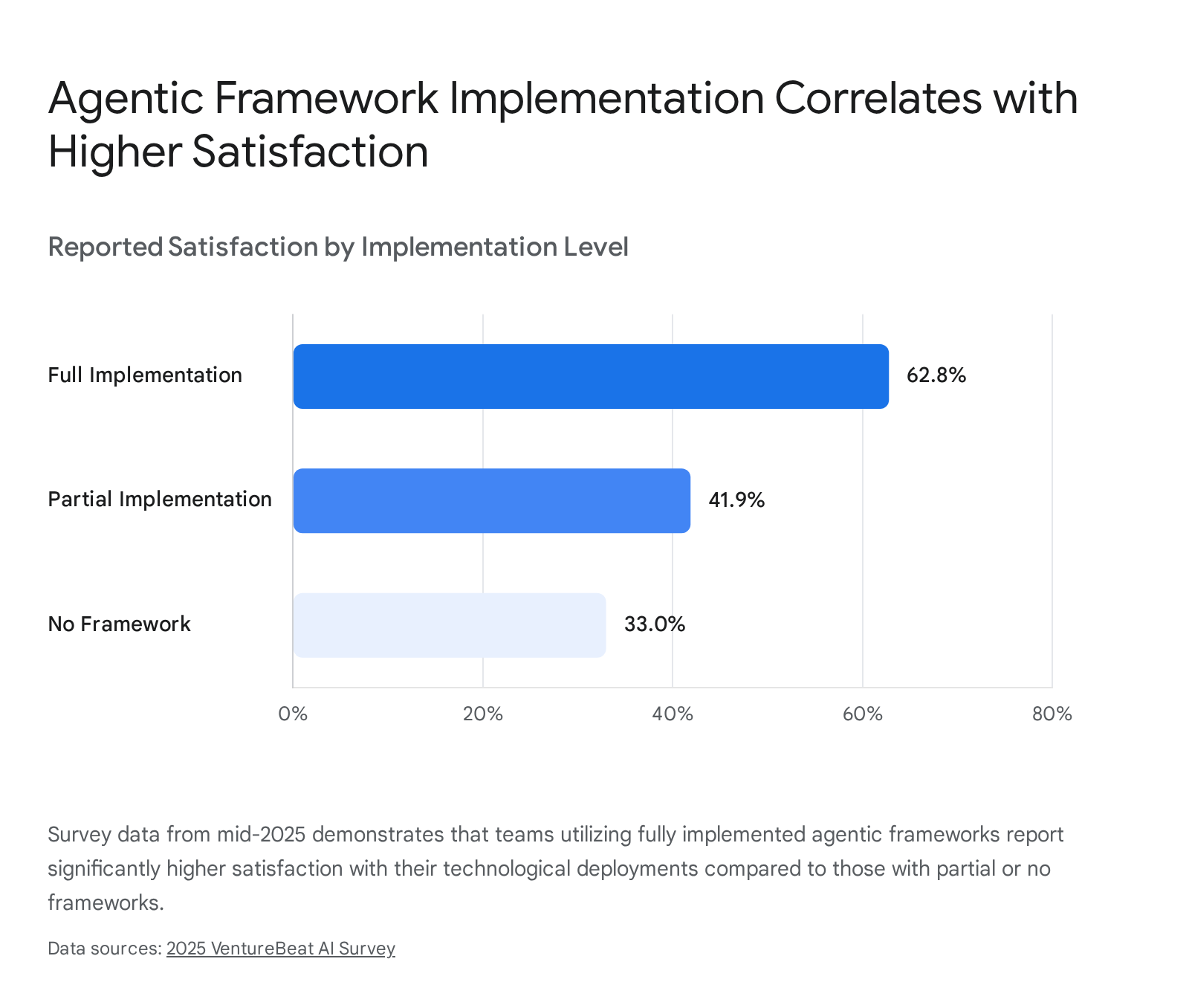
These systems cross into different enterprise environments, such as transferring context seamlessly between platforms like Salesforce, ServiceNow, and Amazon Web Services, to independently resolve business issues 2.
For prospective conference attendees, this means the most valuable sessions are those addressing the foundational infrastructure required to support these autonomous agents. Technical teams are flocking to events that solve deep architectural problems. The conversations that matter now revolve around untangling technical debt without pausing delivery roadmaps, stitching together legacy data lakes with shared metadata, and implementing lightweight orchestration layers that allow generative systems to trust the underlying corporate data 27.
The Economics of Inference and Large Reasoning Models
Another major macro-driver for fall conference attendance is the plummeting cost of inference and the rise of "inference-time scaling." The price per million tokens for top-performing large language models dropped by more than 200 times between 2023 and 2025 8. This dramatic cost reduction, coupled with hardware innovations from companies like Groq and sustained improvements by legacy providers like Nvidia, has made scalable, agentic applications far more accessible to startups and mid-market enterprises 3.
Founders are utilizing summits and expos to find cloud infrastructure partners that offer competitive pricing models in an increasingly crowded market 37. Meanwhile, developers are attending highly technical workshops to master large reasoning models (LRMs). The release of models like OpenAI's o1 and o3-mini triggered a wave of innovation where models are permitted to "think" for longer periods, reviewing their own answers before outputting a result 38. This paradigm shift requires engineers to learn entirely new methods of prompt engineering and system evaluation, driving record attendance at practitioner-focused technical tracks.
Dispelling the Misconception of the "AI Wall"
A pervasive narrative in late 2025 suggested that artificial intelligence scaling laws were hitting a hard ceiling, with prominent publications wondering if large language models had stalled 4. However, the release of next-generation models by Google DeepMind, Anthropic, and OpenAI definitively proved that performance jumps remain massive, completely invalidating the "AI wall" theory 4.
The realization that capabilities are continuing to accelerate exponentially - evidenced by massive private capital rounds such as Anthropic's $65 billion raise at a $900 billion valuation and specialized coding startups securing billion-dollar valuations - means that staying current is an existential requirement for both business leaders and technical staff 10. Organizations that wait for the ecosystem to stabilize before deploying intelligent systems risk falling irreparably behind competitors who are doing the foundational governance and integration work today 5.
Evaluating Geographic Hubs: Where the Money and Talent Live
Before selecting a specific event from a crowded calendar, professionals must understand the geographic concentration of venture capital and technical talent. Travel budgets remain highly scrutinized, making the location of a summit just as critical as its keynote agenda.
Despite rising living costs and the persistence of remote work, the San Francisco Bay Area remains the undisputed epicenter of the global technology ecosystem.
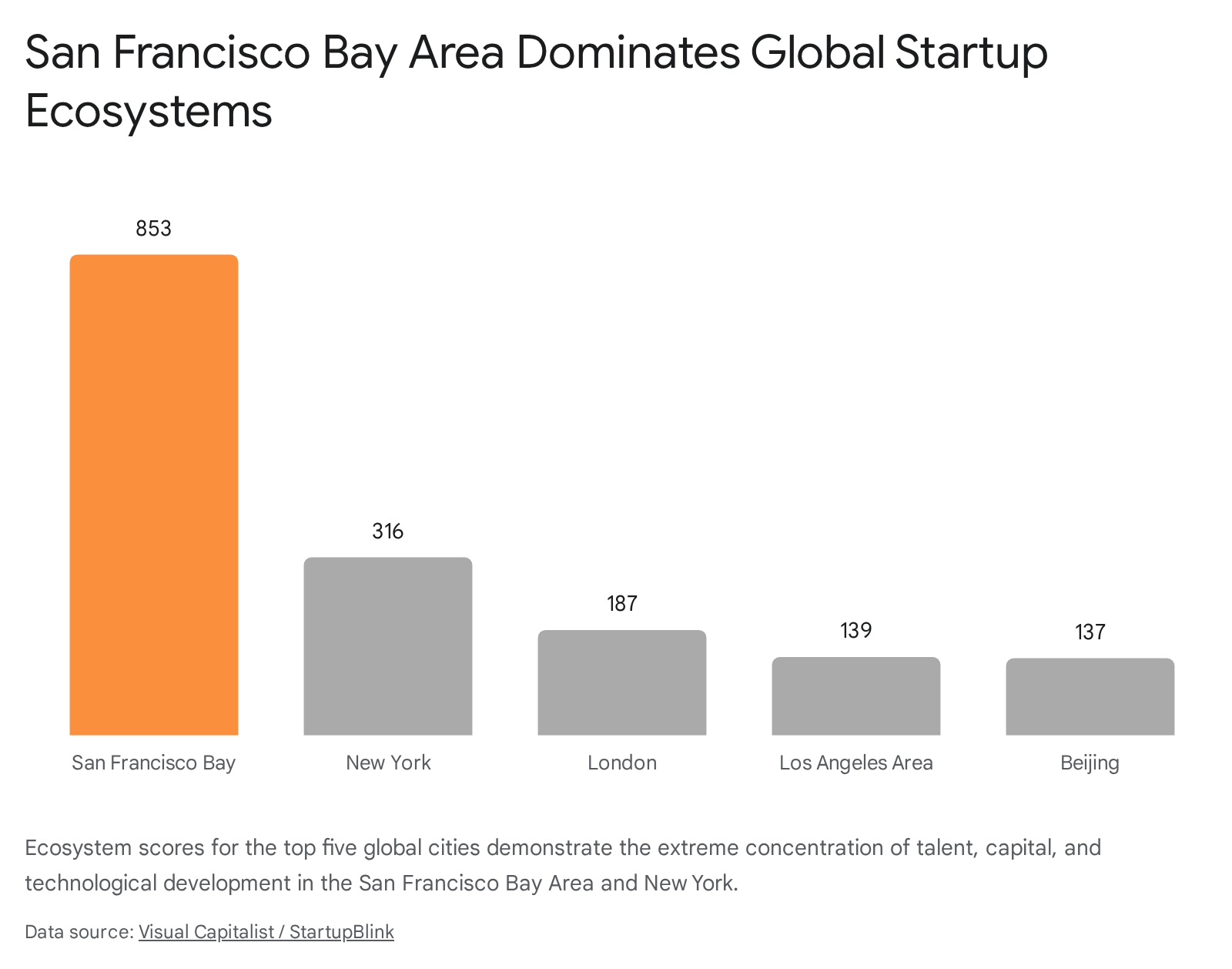
The concentration of capital has become increasingly extreme. In recent funding cycles, the top five United States metropolitan areas controlled a staggering 83.3% of all artificial intelligence venture capital, leaving the remaining 47 major metros to fight for less than 3% of the total available funding 12.
The disparity in capital distribution dictates where different professionals should spend their travel budgets. For founders seeking to raise mega-rounds or developers looking to integrate frontier models directly with top-tier research labs, San Francisco is completely unavoidable. The average funding deal size in the Bay Area exceeds $122 million, making it the primary target for heavy capitalization 12. American startups captured 53% of all global artificial intelligence deals, demonstrating deep investor conviction in domestic frontier technology 13.
New York City occupies the second tier, capturing roughly 17% of United States seed funding. It features a higher volume of deals than many other regions, but at a significantly lower average size of $46.85 million 126. New York's conferences are uniquely positioned for founders building applied enterprise software, financial technology, and media tools, rather than core infrastructure.
Internationally, London maintains its position as Europe's leading startup hub. The United Kingdom saw over £4.5 billion invested in the sector recently, hosting major successes in drug discovery and enterprise infrastructure 1315. London is a vital destination for companies navigating international governance, scaling into the European market, or working within highly regulated sectors like life sciences and banking 1316. Interestingly, while San Francisco pays significantly more per funding stage early on, London catches up or leads by Series C, indicating a mature market for growth-stage companies 17.
Seattle serves as a specialized tier. Driven by the massive corporate presence of major cloud providers like Microsoft and Amazon, Seattle remains the premier destination for data infrastructure, cloud engineering, and hands-on developer networking, boasting massive local communities of dedicated builders 1819.
| Geographic Hub | Primary Industry Focus | Capital Dynamics | Best Fit For Attendee Profile |
|---|---|---|---|
| San Francisco Bay Area | Frontier Models, Core Infrastructure, Autonomous Agents | Captures 45% of US seed funding; massive average deal sizes ($122M+). 126 | Startups seeking massive scale; engineers wanting proximity to top research labs. |
| New York City | Applied AI, FinTech, Media, Enterprise SaaS | High volume of deals, lower average size ($46.8M). Captures 17% of US seed. 126 | B2B founders selling to Fortune 500 operators; revenue-focused executives. |
| London, UK | Life Sciences, Financial Services, Global Governance | Top European hub; highly competitive at the Series C growth stage. 1317 | Growth-stage companies expanding to Europe; executives focused on ethical AI and policy. |
| Seattle, WA | Cloud Computing, Data Engineering, Developer Tools | Driven by major cloud providers; strong local community funding. 1819 | Cloud architects, data scientists, and engineers focused on scalable back-end infrastructure. |
The Best Fall 2026 Conferences for Startup Founders
For founders and chief executive officers, the primary objectives of conference attendance are securing venture capital, forming strategic corporate partnerships, and generating high-quality enterprise leads. Generalist "thought leadership" events offer poor returns for this demographic. Instead, founders must target the following events, which offer the highest density of venture capitalists, institutional investors, and enterprise buyers.
TechCrunch Disrupt 2026 (San Francisco)
Scheduled for October 13 through 15 at Moscone West in San Francisco, TechCrunch Disrupt remains the legendary capital engine of the technology world. Drawing an expected 10,000 attendees, the event is engineered almost entirely around startup discovery, networking, and venture funding 202122. The 2026 iteration places a heavy programmatic emphasis on autonomous technologies, investment mechanics, and the tactical realities of scaling an enterprise from ideation to an initial public offering 2023.
For early-stage companies, the undeniable main attraction is the Startup Battlefield 200. This highly competitive pitch arena allows startups to showcase their products to top-tier investors for a $100,000 equity-free prize and unparalleled media exposure 2224.
Beyond the main stage, the true value of Disrupt lies in its targeted, high-velocity networking. The event operates a dedicated Deal Flow Cafe specifically designed for founder-investor matchmaking 25. Founders returning from recent iterations report that the most valuable assets are surprisingly low-tech: clear brochures, bold roll-up banners, and live hands-on product demonstrations on simple laptops 26. Because attendees are flooded with heavily marketed software products, allowing investors to physically test an application is the most effective way to cut through the noise, validate product-market fit, and secure follow-up meetings 26.
The AI Summit New York (Informa Connect)
Positioned at the end of the fall season, December 9 through 10 at the Javits Center, The AI Summit New York is an applied-technology trade show ruthlessly focused on commercialization. Drawing over 2,500 visitors and heavily populated by professionals from Fortune 500 and FTSE 100 companies, this event is custom-designed for business operators responsible for revenue, growth, and organizational performance 272829.
The New York summit stands out because it explicitly avoids pure academic research and theoretical futurism in favor of practical enterprise case studies. The extensive agenda features 14 content tracks covering highly tactical topics like revenue operations, marketing automation, evaluating build-versus-buy vendor decisions, and internal governance 2728. For a business-to-business founder, this is an incredibly fertile environment. It places sellers directly in the room where enterprise procurement officers are finalizing software budgets and architecture decisions for the upcoming 2027 fiscal year. The event also includes a dedicated two-day hackathon that serves as a direct pipeline for industry scouts seeking fresh technical talent 30.
AI LIVE: The London Summit
For founders looking to scale into the European market or sell deeply integrated enterprise solutions, AI LIVE is a mandatory consideration. Scheduled for October 20 and 21 at Olympia London, this inaugural event is built under the theme "Technology + Human Purpose." Expected to host over 2,000 global leaders, the summit skips speculative innovation entirely and focuses heavily on deployment realities, risk management, digital identity, and operational efficiency 163132.
The summit floor is divided into 11 dedicated zones covering specific industrial applications such as robotics, digital health, future finance, and cybersecurity 16. This fragmented structure makes it incredibly efficient for founders to target specific industry verticals without wasting time on unrelated sectors. Unlike developer-heavy conferences, the attendee base here is heavily weighted toward C-suite executives, policy makers, and enterprise strategists who control massive purchasing budgets, making it an ideal environment for securing pilot programs 1631.
The Best Fall 2026 Conferences for Engineers and Builders
Engineers operate on a completely different frequency than corporate founders. Technical practitioners consistently express deep frustration with "vendor-heavy" events focused on high-level executive strategy. In the developer community, heavily marketed platforms that lack technical substance are derisively referred to as "AI slop" or "vibe coding" 3334.
Engineers prioritize venues where they can examine actual production code, learn how to scale distributed systems to millions of users, and speak directly with the authors of frontier research 333. They require environments that address the genuine friction of implementation, such as hallucinations, context window limits, and the realities of multi-agent deployment 35.
Microsoft Ignite 2026 (San Francisco)
Microsoft Ignite is the premier flagship technical event of the fall season. Taking place November 17 through 20 at the Moscone Center in San Francisco, this multi-day conference dictates the global roadmap for Azure cloud services, the Copilot platform, and corporate developer tooling 3637. With historic attendance frequently exceeding 30,000 in-person participants, it is a massive focal point for the global technology workforce 37.
The 2026 agenda is intensely focused on "Agentic AI," exploring how autonomous agents integrate seamlessly with enterprise productivity tools 36. For developers and systems architects, the real value lies in the "L400+" deep-dive sessions. These are not high-level marketing pitches; they are rigorous, hands-on implementation workshops covering hybrid cloud infrastructure, security posture management, zero-trust advancements, and the latest integrations within GitHub Copilot 3738. Engineers working within the Microsoft ecosystem, or those tasked with building scalable enterprise applications that require enterprise-grade security and governance, will find this the most technically satisfying mega-event of the fall.
PASS Summit West (Seattle)
While generative interfaces dominate mainstream headlines, the underlying engineering reality is that autonomous agents require flawless, strictly governed data pipelines to function safely 7. Generative applications aggressively magnify every existing flaw in an enterprise's data estate. Consequently, managing data quality, establishing clear lineage services, and securing metadata are the primary operational bottlenecks for engineering teams in 2026 7.
The PASS Summit West, scheduled for November 9 through 11 in Seattle, focuses precisely on these unglamorous but vital foundational elements 7. Engineers attend to learn highly specific skills: how to untangle decades of technical debt, how to stitch together fragmented data lakes across Snowflake and Databricks, and how to create clean, reliable signal layers that modern models can inherently trust 77. It is a highly specialized, technically rigorous environment free from the broad, generalist hype found at larger executive summits.
NeurIPS 2026 (The Winter Transition)
While technically occurring in early winter (December 2026 in Vancouver, British Columbia), no discussion of late-year technical conferences is complete without mentioning the Conference on Neural Information Processing Systems (NeurIPS). It is universally considered the most prestigious and important event in machine learning and computational neuroscience 4041.
NeurIPS is strictly peer-reviewed and academically rigorous. Engineers and researchers who need to understand the theoretical techniques that will dominate the commercial market 12 to 18 months in the future must attend 33. Recent events have highlighted critical breakthroughs in reinforcement learning, intelligent data curation, and the complex optimization of audio and multimodal models 40.
However, prospective attendees should be warned of severe logistical constraints. The conference has grown so massively popular that the physical infrastructure of host cities is struggling to cope. For example, the Vancouver Convention Centre has a maximum capacity of approximately 18,000 attendees, forcing organizers to implement a lottery system for non-author registrations as demand dramatically outpaces space 42. Furthermore, the rapid expansion of the field has led researchers to criticize the centralized conference model, pointing out that the research lifecycle now outpaces annual conference cycles. This has sparked proposals for "Community-Federated Conference" models that split peer review and networking into globally coordinated but locally organized hubs to reduce environmental impact and psychological strain on researchers 42. Securing tickets to the main NeurIPS event requires extensive advance planning.
The Rise of Local "Tinkerer" Hubs and Community Events
For engineers unable to travel or those exhausted by massive corporate expos, the rise of specialized, community-run local meetups has provided a powerful, high-signal alternative.
In regions like Seattle, the "AI Tinkerers" network has become a vital technical resource. Operating as a builder-only community, these monthly events require attendees to showcase real, functioning systems and working code, strictly banning sales decks, high-level strategy presentations, and vendor pitches 18. The Seattle chapter alone is part of a global network boasting over 109,000 members 18.
Similarly, events like the AI Engineer World's Fair in San Francisco or KubeCon are fiercely defended by practitioners as the "cool kids list" - vendor-neutral, engineer-built environments where people openly share what broke in production rather than projecting an illusion of flawless software 3. These highly concentrated, low-cost environments are frequently cited by developers as more valuable for day-to-day problem-solving and immediate upskilling than thousand-dollar executive passes to generalized summits 333.
The Boutique Alternative: Intimate Networking for Operators
A growing trend in late 2026 is the rejection of massive, multi-day trade shows in favor of hyper-curated, boutique summits. While 12,000-person events offer incredible scale, they often lack the intimacy required to forge genuine partnerships or conduct deep strategic alignment.
Events like the AI Summit NYC (distinct from the larger Informa Connect event of a similar name) represent this shift. Designed specifically for operators responsible for revenue and growth, this boutique gathering intentionally limits its audience to approximately 100 to 150 approved attendees 28. It skips the expo floor entirely, focusing instead on high-quality conversations between Chief Revenue Officers, Chief Operating Officers, and founders. The discussions center purely on execution: what tools are currently working, where companies are wasting budgets, and how to evaluate build-versus-buy decisions 28. For a senior leader who needs clear, actionable direction without the distraction of thousands of vendor booths, these smaller, highly vetted rooms offer unparalleled return on the time invested.
Making the Business Case: Conference Return on Investment (ROI)
Securing internal corporate approval to attend these events requires proving concrete financial returns. Historically, conference attendance was viewed as a nebulous networking exercise, but in 2026, the benchmark for event ROI relies on linking participation directly to operational efficiency, tangible revenue growth, or specific technical breakthroughs 43.
For enterprise buyers and operations teams, the primary justification is workflow optimization and cost reduction. Comprehensive trend analysis shows that 99% of attendees at specialized, high-quality events discover new applications to bring back to their teams, and 88% report identifying cost savings or revenue growth exceeding $100,000 44. By attending events that focus heavily on "agentic-native" architectures, finance and operations teams can drastically reduce administrative workloads. The ability to automate complex enterprise reporting or streamline customer service through validated, secure frameworks creates immediate, measurable value that heavily dwarfs the cost of a plane ticket, hotel, and delegate pass 4345.
For founders, the ROI calculation is simpler in concept but significantly higher in risk: it is entirely about capital acquisition and deal velocity. Attending a capital-dense event like TechCrunch Disrupt effectively consolidates months of dispersed investor outreach into a single, high-intensity 72-hour window 45. However, this strategy only yields a positive return if the startup arrives meticulously prepared. Success requires functional prototypes, a crystal-clear understanding of competitive differentiators, and, most importantly, pre-booked meetings utilizing the event's matchmaking applications 2645. Without intense preparation, founders risk becoming lost in the noise of the expo floor, rendering the trip a costly failure.
| ROI Metric Category | Expected Outcomes for Engineers | Expected Outcomes for Founders |
|---|---|---|
| Operational Efficiency | Discovery of new orchestration tools; resolution of architecture bottlenecks; cost-reduction via inference optimization. | Reduction in administrative overhead; discovery of cheaper cloud compute alternatives; streamlined go-to-market strategies. |
| Financial Impact | Direct reduction in monthly cloud/compute spending; faster time-to-ship for internal software projects. | Accelerated fundraising cycles; acquisition of high-value enterprise pilot contracts; access to massive venture capital pools. |
| Network Expansion | Peer-to-peer troubleshooting; direct access to frontier model researchers; recruitment of top-tier developer talent. | Matchmaking with specialized institutional investors; strategic partnerships with Fortune 500 decision-makers; vital media exposure. |
Bottom line
The Fall 2026 artificial intelligence conference circuit is strictly bifurcated, demanding that professionals ruthlessly align their travel strategy with their immediate business objectives. Founders and executives must migrate to capital-dense, commercially focused events in San Francisco and New York - such as TechCrunch Disrupt or The AI Summit - to secure necessary funding and forge enterprise contracts. Conversely, engineers and developers require the authentic technical depth found at Microsoft Ignite, peer-reviewed academic summits like NeurIPS, or local code-first community hubs to master the complexities of emerging autonomous workflows. The era of attending generalist technology conferences for casual exploration is over; success now depends entirely on matching precise organizational goals to the specific, highly curated audience of the event.