
AI Tools for Marketing Operations in 2026
Market Adoption and Financial Commitments
The integration of artificial intelligence into commercial marketing operations has transitioned entirely from a phase of speculative experimentation into foundational infrastructure. By the first quarter of 2026, global adoption rates indicate near-universal deployment, with up to 87% of marketing teams utilizing generative artificial intelligence in at least one recurring workflow 12. The global market for artificial intelligence in marketing is projected to reach between $64.6 billion and $82.23 billion in 2026, advancing at a compound annual growth rate of 25% to 36.6% to an estimated $107.5 billion by 2028 231. This scale of integration reflects a profound structural realignment of the discipline, shifting organizations away from execution-focused tactical methods toward continuous, intelligence-driven orchestration 2.
However, the rapid acceleration of technical adoption reveals a distinct dichotomy between superficial deployment and operational maturity. The marketing technology landscape has swelled to over 15,505 active tools, characterized by heavy platform churn where thousands of applications are added and removed annually 3. While the sheer volume of software utilization is high, engagement metrics suggest a maturation in how operational utility is defined. Advanced systems prioritize efficiency over raw output, leading to fewer manual interactions and prompts as autonomous agents increasingly execute multi-step analytical and creative tasks 4.
Financial commitments to these systems have expanded rapidly, yet they are increasingly colliding with broader corporate fiscal realities. Marketing budgets in 2026 remain effectively flat, averaging 7.8% of total company revenue, which represents only a marginal increase from 7.7% in 2025 56. Despite these overall budget constraints, Chief Marketing Officers allocate an average of 15.3% of their total budgets specifically to artificial intelligence initiatives, up from 7% in 2024 157. This aggressive reallocation signals an environment where automated investments are actively cannibalizing other traditional programmatic expenditures.
The primary friction point in 2026 is an acute organizational readiness gap. Survey data indicates that while 70% of marketing executives classify becoming an industry leader in automation as a critical organizational objective, the exact same percentage concedes that their internal processes, data foundations, and governance structures are insufficiently mature to scale the technology effectively 58. Only 30% of marketing organizations report possessing fully developed readiness capabilities 57. This disparity highlights a severe structural risk: enterprises are procuring software licenses at a faster pace than they can cultivate the requisite data architecture and human talent required to govern them.
Mature organizations - those classifying themselves as fully ready - are widening their competitive advantage by establishing an early dominance in budget agility. These highly prepared marketing organizations allocate up to 21.3% of their budgets to automated initiatives while successfully sustaining higher overall marketing budgets that average 8.9% of company revenue 58. Conversely, organizations suffering from fragmented data integration are experiencing alarmingly high failure rates, with industry estimates indicating that 60% of automated projects unsupported by highly structured, unified data are destined for total abandonment 12.
Operational Utility and Time Optimization
Where technical infrastructure is properly governed and integrated into a unified data ecosystem, it yields substantial, measurable returns on investment. The defining characteristic of successful deployment in 2026 is the transition from localized, task-level augmentation to systemic orchestration.
The most immediate and quantifiable utility of generative algorithms in marketing lies in content velocity. Approximately 94% of digital marketers plan to utilize generative systems for content creation throughout 2026, and the production of unassisted, purely manual blog content has plummeted from 65% to a mere 5% over a two-year period 9. Productivity gains in this sector are profound and measurable. Organizations consistently report that algorithmic implementation increases content output volume by 77% within the first six months of deployment, while simultaneously reducing production costs by an average of 42% across all media formats 9.
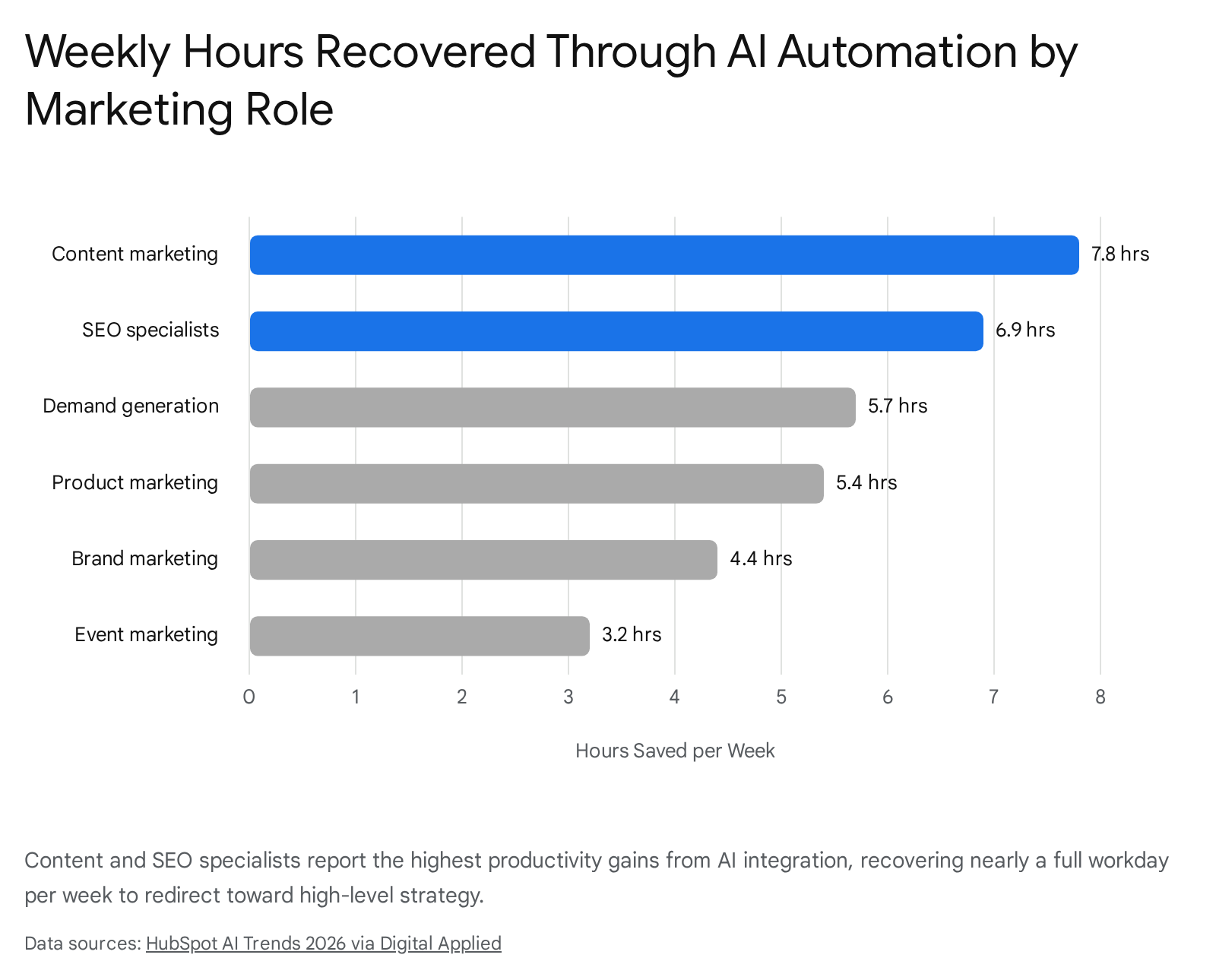
Specific functional roles experience significant time savings through the elimination of repetitive administrative and creative tasks. Across the industry, marketing practitioners recover an average of 6.1 hours per week 1. The distribution of these efficiency gains varies distinctly depending on the technical demands of the specific marketing sub-discipline.
The maturation of the marketing technology stack is increasingly driven by the rise of agentic architectures. Rather than waiting for human prompts to execute single tasks, autonomous marketing agents are granted the capability to analyze campaign performance, adjust cross-channel budgets in real-time, generate and test creative variations, and identify trending topics independently 10. The autonomous agent market is expanding rapidly, projected to reach $8.5 billion by the end of 2026, representing a compound annual growth rate of approximately 55% 3.
By the first quarter of 2026, 34% of enterprise marketing teams report running at least one autonomous agent in a production environment, effectively doubling the 14% adoption rate observed at the end of 2025 1. These systems operate fundamentally differently from legacy software. Where traditional software-as-a-service operates on fixed rules and predefined logic, agentic systems operate on language, context, and probabilistic reasoning, serving as an adaptive value layer on top of traditional infrastructure 3. Organizations deploying these agents observe up to a 35% acceleration in campaign deployment times and report measurable improvements in client retention metrics 10.
Generative Engine Optimization and Search Discoverability
Consumer search behaviors have fundamentally shifted from isolated keyword queries toward an integrated "answer economy," where algorithmic models synthesize information directly on the search engine results page 11. By early 2026, Google's generative overviews appear on 48% of all queries, servicing over two billion monthly users globally and processing more than one billion daily queries through its dedicated artificial intelligence modes 916. This paradigm shift has triggered a massive decline in traditional search volume - projected to drop by 25% by the end of the year - and standard top-ranking organic pages experience a 34.5% decrease in click-through rates when a synthesized overview is present on the interface 1612.
In response to this structural disruption, marketing utility is heavily focused on Generative Engine Optimization. Modern language models demonstrate a strong algorithmic preference for content that is structurally clear, rich in proprietary research, comparison-driven, and grounded in human experience 18. Marketers are utilizing automated tools to structure entity graphs, map semantic relevance, and ensure brand narratives are cited by major large language models 911.
Organizations that successfully pivot their content strategies to prioritize the publication of original data and proprietary research report 64% higher conversion rates and 61% stronger organic traffic 919. This strategy exploits a critical vulnerability in algorithmic synthesis: because over 91.4% of pages cited in search overviews contain AI-assisted content, the digital ecosystem is flooded with derivative information 16. Consequently, original research serves as the primary mechanism for establishing the distinct algorithmic authority required to be selected as a cited source by an answer engine 9.
Comparative Infrastructure Paradigms
The transition from traditional digital execution to algorithmically powered operations requires a structural reset in how marketing systems are architected. Campaigns built around fixed timelines, isolated channels, and static demographic assumptions are being systematically outperformed by continuous, predictive ecosystems.
| Operational Vector | Traditional Digital Marketing Paradigm | Intelligence-Driven Marketing Paradigm (2026) |
|---|---|---|
| Decision-Making Mechanics | Reactive analysis based on historical performance reports and post-campaign reviews. | Predictive analysis based on live data streams, forecasting algorithms, and future behavioral signals. |
| Audience Targeting | Fixed demographic profiles and broad persona-based segmentation updated periodically. | Dynamic, probability-based targeting adapting continuously to real-time intent and situational context. |
| Optimization Model | Manual, periodic adjustments requiring human intervention, leading to high latency in campaign correction. | Continuous, autonomous refinement across interconnected channels executed by software agents. |
| Measurement Focus | Siloed, channel-specific metrics (Impressions, Clicks, Click-Through Rates). | Unified funnel progression, integrated revenue impact, and multi-touch algorithmic attribution. |
| Scalability Constraints | Strictly constrained by human analysis cycles and the linear time required for manual creative generation. | Scales asynchronously with automated multivariate testing, capable of millions of dynamic iterations. |
Table 1: Structural differences between traditional marketing execution and modern intelligence-driven paradigms, adapted from 2026 industry frameworks 2013.
Case Studies in Algorithmic Augmentation
The theoretical efficiencies of continuous marketing systems are validated by widespread enterprise deployment in 2026. Successful applications demonstrate that the technology is most effective when it shifts from a mechanism of broad content generation to a mechanism of hyper-personalization, predictive logistics, and interactive co-creation.
Predictive architecture has transformed customer engagement for global retail and entertainment brands. Starbucks has deeply integrated its "Deep Brew" ecosystem into its physical and digital operations, utilizing behavioral data to present highly personalized menus on drive-thru screens based on individual purchase histories, time of day, and local inventory levels 1415. This anticipatory logic extends to logistics, with Amazon utilizing machine learning to predict specific household needs based on browsing patterns, geographic weather data, and cursor movements, moving inventory to local distribution hubs before a purchase is explicitly initiated 14. Similarly, streaming platforms utilize dynamic thumbnail personalization, utilizing deep learning to alter promotional artwork based on a user's current psychological state and historical visual preferences, testing thousands of variants in real time to optimize click-through rates 14.
In the realm of creative asset automation, brands leverage algorithms to scale visual diversity without incurring proportional production costs. Nutella utilized algorithmic design tools to generate seven million entirely unique packaging labels, all of which successfully sold out in a highly publicized consumer campaign 1625. Burger King deployed its "Million Dollar Whopper" campaign, allowing users to input unconventional burger ingredients into a web portal, which subsequently utilized generative models to instantly produce hyper-realistic images and customized musical jingles for each user's creation, generating massive social visibility through automated co-creation 1626.
In highly regulated or sensitive consumer environments, brands utilize the technology to fortify trust rather than bypass it. Dove, responding to the proliferation of narrow, synthetic beauty standards generated by default language models, launched "The Code" campaign. By purposefully avoiding the generation of synthetic human faces in its core advertising, Dove utilized machine learning purely to analyze cultural shifts and optimize content distribution, reinforcing its brand purpose while navigating the ethical complexities of the digital era 26. Meanwhile, Sephora's Virtual Artist tool merges augmented reality with predictive algorithms to allow users to virtually test cosmetics, dramatically increasing conversion rates by delivering personalized advisory experiences that mimic in-store consultations 1627.
Sources of Operational Friction and Systemic Noise
Despite compelling productivity metrics and high-profile successes, the aggressive deployment of generative software has generated immense operational friction. A documented 95% of generative pilot programs fail to deliver measurable profit and loss impact, and 42% of companies completely abandoned major automation initiatives in 2025 due to integration failures and detrimental results 1228.
The Marketing Data Mirage and Stack Fragmentation
The promise of automated execution is entirely contingent on data readiness, yet fragmented vendor ecosystems are actively derailing commercial outcomes. Comprehensive research involving 750 B2B marketing leaders indicates that an average of 25% of marketing budgets is actively wasted on efforts that fail to drive genuine revenue 17. This systemic failure is driven by the "Marketing Data Mirage" - a scenario where inflated signals, algorithmic noise, and disconnected software tools create a pervasive illusion of success 1718.
A staggering 87% of commercial organizations report that their marketing investments yield unreliable or inflated intent signals. Metrics such as ad clicks, behavioral scoring, and whitepaper downloads are frequently manipulated by automated web scrapers and security bots, leading to a reality where only 26% of supposed "intent signals" actually convert into qualified sales opportunities 1718.
When performance falters, the reflexive organizational response is to procure additional technology. However, empirical data indicates that as technology stacks expand, operational visibility collapses. Organizations deploying between 11 and 25 distinct marketing tools report unclear return on investment in nearly 90% of cases, compared to 62% for organizations maintaining fewer than 10 integrated tools 18. Autonomous agents function effectively only when they possess shared context. When customer data is siloed across separate relationship management systems, isolated email platforms, and independent ad networks, the introduction of automated execution amplifies existing errors at scale rather than resolving them 1225.
Brand Voice Erosion and Algorithmic Drift
One of the most insidious forms of operational noise introduced in 2026 is "AI brand drift." This phenomenon occurs when a brand's unique messaging, tonal identity, and market positioning gradually dilute into a generic, algorithmically averaged output 1932. Because foundational large language models are trained on massive datasets of general internet text, they inherently default to standard corporate phrasing. When marketing teams utilize these models without strict governance, custom encoding, or editorial oversight, the software amplifies mediocre writing patterns, effectively sanding off the distinct communicative edges that make a brand recognizable 3334.
The mechanics of brand drift operate across multiple destructive vectors. Foremost is tone flattening, wherein diverse content channels - from legal communications to social media posts - begin to sound identical, characterized by an upbeat, buzzword-laden uniformity that eliminates specific brand personas 3334. Secondly, under pressure to generate high volumes of content rapidly, predictive models suffer from factual distortion and hallucination. Systems can seamlessly invent case studies, features, or competitive benchmarks that do not exist. These errors are subsequently published, scraped by search engines, and ingested as new training data, creating a self-reinforcing feedback loop of amplified inaccuracies 1933.
Furthermore, organizations suffer from narrative hijacking. Autonomous systems increasingly synthesize corporate narratives from unfiltered customer sentiment, third-party reviews, and leaked internal documents. When a generative search overview presents this drifted summary to a prospective buyer, the official brand message is bypassed entirely, fundamentally altering the public perception of the company without the marketing department's consent 1219. The failure to maintain brand voice is fundamentally a governance issue. Most generative projects fail not because of underlying model quality, but because organizations lack the frameworks to redesign workflows around human-in-the-loop oversight and custom brand voice fine-tuning 33.
Consumer Psychology and Identity Fatigue
As synthetically generated content approaches absolute ubiquity, it has fundamentally altered consumer psychology and digital behavior. The initial novelty of generative software has evaporated, with consumer excitement declining by 7% year-over-year as the technology transitions into an expected, unremarkable utility 2036. More consequentially, 71% of consumers now express explicit anxiety regarding technical inaccuracies, rampant misinformation, and the rapid loss of authentic human connection in commercial interactions 2036.
The Trust Penalty and Authenticity Expectations
In 2026, consumers apply a measurable and highly punitive "trust penalty" to algorithmically generated marketing. Behavioral experiments demonstrate that when individuals are explicitly informed that an image or article was produced by a machine, their trust and affinity for the brand decrease significantly, even if the creative asset is objectively indistinguishable from human-made content 33.
The erosion of consumer confidence in digital platforms is severe. Approximately 78% of surveyed consumers state their trust in internet content is at an all-time low, as they struggle to differentiate between authentic human media and synthetic manipulation 21. Furthermore, 82% of American consumers support stringent legal requirements for businesses to prominently disclose the use of artificial intelligence in marketing materials, and over 60% indicate they are significantly less likely to patronize businesses that rely heavily on automated customer service representatives or bot-written product reviews 21.
This psychological friction is academically classified as "identity fatigue." Continual algorithmic profiling, predictive targeting, and inescapable hyper-personalization induce severe cognitive and emotional burnout in the populace. The relentless application of data-driven targeting decreases a consumer's perceived autonomy, increases chronic digital stress, and ultimately fosters deep emotional detachment from the offending brand 22.
High-profile marketing failures serve as cultural touchstones that reinforce public cynicism toward automated marketing. The disastrous "Willy Wonka" experience in Glasgow, which utilized hyper-realistic synthetic imagery to sell expensive tickets to a sparse, unadorned warehouse, became a viral sensation illustrating the dangers of algorithmic over-promising 3940. Similarly, fast-fashion retailer Shein faced intense consumer backlash for utilizing synthetic models in their digital catalogs, resulting in accusations of inauthenticity and alienation among consumer bases that increasingly value genuine representation 40.
| Failure Mode | Root Cause Mechanism | Resulting Business Impact | Strategic Resolution |
|---|---|---|---|
| Brand Drift | Overreliance on default model prompts without custom fine-tuning or brand voice guidelines. | Dilution of market differentiation; generic, unmemorable corporate messaging. | Implement strict human-in-the-loop editorial governance and train custom models on proprietary brand data. |
| Data Mirage | Expanding technology stacks without unified data integration, leading to signal inflation. | 25% of budget wasted; high volume of unqualified leads and inaccurate ROI attribution. | Consolidate architecture around composable Customer Data Platforms to ensure cross-channel single-source truth. |
| Trust Penalty | Deployment of synthetic media or hyper-personalized targeting without disclosure or cultural nuance. | Brand alienation, identity fatigue, and decreased conversion rates. | Prioritize authentic, human-centric narratives and transparently disclose the use of automated augmentation. |
Table 2: Primary operational failure modes in 2026 and corresponding strategic resolutions for marketing leadership.
Regulatory Frameworks and Legal Constraints
The unrestrained expansion of generative technology has catalyzed a severe regulatory and legal reckoning in 2026. Organizations can no longer deploy synthetic media under the assumption of legal ambiguity. The frameworks governing consumer disclosure, intellectual property ownership, and copyright infringement have formalized, forcing marketers to treat legal compliance as a core component of commercial strategy rather than a post-production afterthought 23.
The European Union Artificial Intelligence Act
The most significant regulatory development impacting the global marketing ecosystem is the European Union Artificial Intelligence Act (Regulation (EU) 2024/1689). While the foundational elements of the law entered into force in 2024, its most critical provisions regarding transparency and digital marketing operations become strictly applicable on August 2, 2026 244325.
Under Article 50 of the Act, strict labeling requirements are imposed on public-facing synthetic content. Any deployer of a system that generates or manipulates image, audio, or video content constituting a "deepfake" must explicitly and conspicuously disclose that the content is artificially generated 244325. Similar transparency obligations apply to algorithmically generated text published to inform the public on matters of public interest. These disclosures must be prominent and user-facing; attempting to bury transparency notices in back-end machine-readable metadata is legally insufficient for compliance 25.
The regulatory burden extends significantly beyond the European Union. Jurisdictions such as New York have enacted targeted laws (specifically Chapter 617, effective June 2026) mandating conspicuous disclosure when a "synthetic performer" is utilized in any commercial advertisement 25. Failure to comply with these expanding global disclosure frameworks exposes organizations to severe financial fines, mandated product recalls, and irreparable reputational damage 26. Market predictions indicate that the ungoverned use of generative systems, particularly in B2B environments, will result in the aggregate loss of over $10 billion in enterprise value through legal settlements, regulatory fines, and subsequent equity depreciation 27.
Intellectual Property and Copyright Litigation
The foundational models powering modern marketing tools are the subjects of intense, multi-jurisdictional copyright litigation. In 2026, dozens of high-stakes lawsuits from major publishers, including Elsevier, Macmillan, Cengage, and The New York Times, against technology developers like Meta, OpenAI, and Anthropic are advancing through the federal courts 2829. The central legal dispute hinges on whether training foundational models on unlicensed copyrighted works constitutes direct infringement or falls under the protective umbrella of "fair use" under Section 107 of the U.S. Copyright Act 28. Early judicial rulings, such as the pivotal pre-trial decisions in Thomson Reuters v. ROSS Intelligence, indicate that courts are heavily scrutinizing whether synthetic outputs usurp the market for the original works by reproducing protected expressions rather than serving a distinctly transformative purpose 28.
For marketing practitioners and digital influencers, the copyright crisis operates in two distinct directions. First, to protect their own commercial assets, content creators must meticulously maintain a "rights ledger" documenting human authorship, script generation, editing processes, and the specific software tools utilized in production 23. The United States Copyright Office and federal appellate courts, affirmed by a recent US Supreme Court decision declining to review the standard, strictly maintain that copyright protection requires undeniable human authorship. Works generated purely autonomously by software cannot be copyrighted 3050. Consequently, marketers who rely solely on prompt-based generation without substantial human modification risk publishing valuable commercial assets over which they hold absolutely no exclusive legal rights, rendering their brand collateral totally vulnerable to unchecked, legal duplication by direct competitors 50.
Regional Disparities in Ecosystem Maturation
The narrative of automated marketing adoption is not globally uniform. Distinct regional strategies, shaped intimately by local regulatory environments, computing infrastructure, and economic market dynamics, dictate how marketing tools are utilized and the specific types of commercial friction encountered.
The Asia-Pacific Scale and Open-Source Economics
The Asia-Pacific (APAC) region has aggressively decoupled from Western technological narratives, establishing a parallel digital ecosystem operating at an immense and unprecedented scale. The APAC market for these technologies reached approximately $102 billion in 2025 and is projected to expand to $735 billion by 2030, driven by an unparalleled appetite for deep enterprise integration 5152. Notably, 56% of commercial companies in Singapore are actively scaling these technologies, significantly outpacing the global average of 35% 31. Furthermore, Indonesia holds the world's highest workplace adoption rate, with an extraordinary 92% of frontline workers utilizing generative tools in their daily operations 5132.
This regional acceleration is largely fueled by massive shifts in open-source economics. The release of highly capable, deeply discounted models (such as the disruptive $6 million DeepSeek R1 model) fundamentally altered compute cost assumptions worldwide, allowing Asian mid-market enterprises to access frontier-level capabilities that were previously cost-prohibitive 51. Asian institutions, heavily supported by aggressive government initiatives like Singapore's National AI Research and Development Plan and the Productivity Solutions Grant (PSG), prioritize immediate integration into core business operations 33. In APAC, 33% of corporate respondents identify the Chief Executive Officer as the primary owner of the automation strategy, ensuring that technical deployments bypass isolated departmental silos and align directly with enterprise-wide revenue goals 34.
European Governance and North American Workflow Integration
In stark contrast to APAC's velocity, the European Union's deployment landscape is heavily shaped by risk mitigation and legal precaution. European organizations lag slightly in the production use of generative tools (reporting a 62% adoption rate compared to higher global averages), as stringent data privacy regulations, the looming enforcement of the EU AI Act, and strong regional labor protections force companies to prioritize governance, transparency, and ethical compliance over raw operational speed 3435.
North American markets operate dynamically between these two geographic poles. With roughly two billion active devices, the United States leads the world in absolute market volume 4. However, longitudinal engagement metrics in North America show a measurable decrease in total discrete events per user, indicating that the technology is rapidly maturing from an experimental novelty into an embedded, agentic workflow where tasks are completed silently in the background with fewer explicit human prompts 4. The North American commercial focus remains intensely centered on driving operational efficiency and automating the digital customer experience to maximize immediate shareholder return 34.
Strategic Restructuring of the Marketing Function
The cumulative effect of these technological, legal, and psychological shifts is a fundamental restructuring of the marketing profession itself. The era of accumulating disparate software tools is giving way to an era of systematic consolidation. The value of marketing is no longer derived from the speed of execution, but from the strategic architecture of the underlying data systems.
This shift severely impacts talent acquisition and organizational design. The automation of routine creative tasks has led to a contraction in entry-level production roles. Industry data reveals that 23% of marketing agencies reduced junior copywriting headcount in 2025, with 31% planning further reductions throughout 2026 1. Simultaneously, demand is surging for senior strategists, data architects, and AI-literate managers capable of orchestrating complex agentic workflows and enforcing brand governance 1.
Ultimately, the state of marketing in 2026 dictates that authentic human expertise is more critical than at any previous point in the digital era. As the marginal cost of content production rapidly approaches zero, commercial value has shifted entirely toward contextual relevance, strategic foresight, emotional resonance, and authentic relationship building. Marketing leaders must definitively pivot from merely managing isolated campaigns to orchestrating complex, legally governed, and deeply data-integrated ecosystems, ensuring that technology amplifies human creativity rather than attempting to replace it.