
Strategies for finding jobs in the artificial intelligence market
The Bifurcation of the Global Tech Workforce and the Entry-Level Crisis
The artificial intelligence labor market in 2026 is characterized by a stark, unprecedented bifurcation that is fundamentally rewriting the rules of technology employment. A deep structural shift is underway wherein traditional, routine knowledge-work roles - including generalist software engineering, administrative support, and junior marketing positions - are experiencing significant contractions. The deployment of increasingly capable automation systems and large language models (LLMs) has led to a collapse in entry-level hiring across traditional tech and corporate functions, which plummeted by as much as 73.4% year-over-year 1. Openings for routine, automation-prone roles fell 13% shortly after the advent of advanced conversational agents, forcing organizations to rethink how they develop future talent pipelines when the traditional entry points have been automated out of existence 2.
Conversely, the demand for specialized artificial intelligence talent has reached a state that industry insiders describe as practically infinite. Available budgets for AI integration far exceed the supply of qualified candidates, leading to a global demand-to-supply ratio of 3.2 to 1 for AI engineering and data roles, with over 1.6 million open positions chasing roughly 518,000 qualified individuals 2. In the first quarter of 2025 alone, AI-related job postings in the United States increased by 25.2% year-over-year, accounting for an increasingly dominant share of total tech sector roles despite broader macroeconomic headwinds 34. The value proposition of these professionals is reflected in their compensation; job titles containing the term "AI" have commanded an average 56% wage premium over comparable non-AI roles, with senior AI engineers frequently earning upwards of $250,000 annually, excluding equity and performance bonuses 151.
Despite this explosive growth, a profound mismatch persists between the skills job seekers are acquiring and the capabilities employers urgently require. A vast segment of the available talent pool remains focused either on highly theoretical machine learning foundations or superficial end-user tool adoption. This dynamic leaves a massive deficit in the critical "middle layer" of applied AI engineering, systems integration, and risk governance 2. To successfully navigate this landscape, professionals and organizations must move beyond generalized credentials and adopt highly targeted, role-specific strategies that emphasize demonstrable, production-ready skills, specifically grounded in the realities of generative models.
Deconstructing the PhD Misconception in AI Hiring
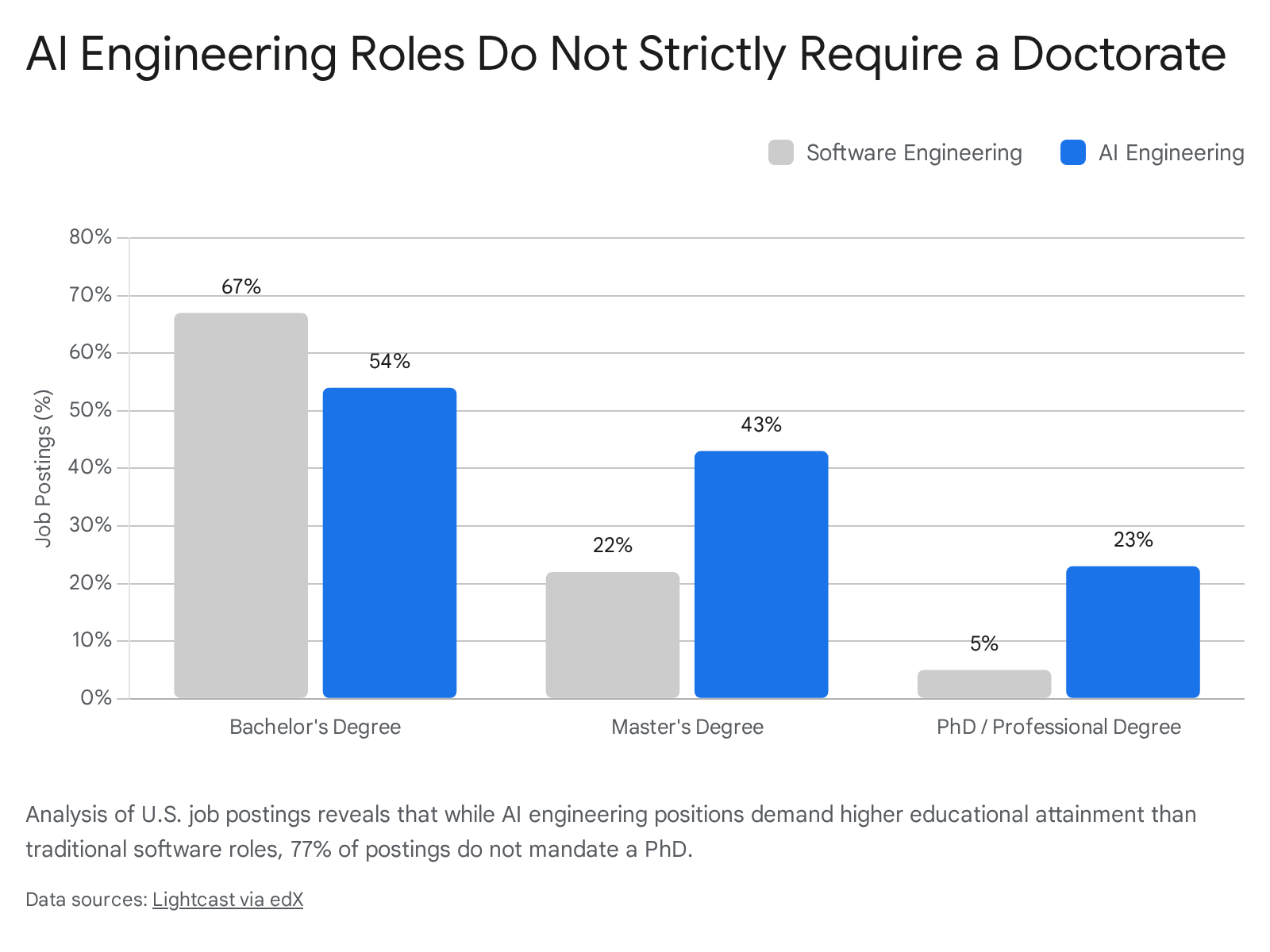
A pervasive and enduring misconception within the broader technology industry is that a doctorate is a strict prerequisite for entering the artificial intelligence field. While this assumption held merit during the algorithmic research boom of the late 2010s - a period defined by the necessity of building and training neural networks from scratch - the commoditization of foundation models has fundamentally altered the educational landscape. The contemporary AI job market prioritizes the ability to orchestrate, constrain, and deploy existing intelligence over the ability to invent novel algorithms.
Labor market analytics reveal a clear departure from traditional academic credentialism. Data covering 2024 through 2025 indicates that while traditional software engineering postings heavily favor Bachelor's degrees (67%), AI engineering roles display a distinct, yet accessible, distribution. In the AI engineering domain, 54% of job postings require a Bachelor's degree, 43% request a Master's degree, and only 23% mandate a PhD or professional equivalent 78.
This demand for applied talent has catalyzed a broader shift toward "skills-first" hiring. Mentions of university education requirements in AI job postings declined by 15% between 2018 and 2023, while over 60% of employers now indicate a preference for hands-on experience, demonstrated portfolios, or recognized micro-credentials over formal academic pedigrees 9. Organizations that have aggressively adopted skills-based hiring report a 20% reduction in time-to-hire, an essential operational advantage given that the average time to fill an open AI role spans 142 days 29. Graduates from specialized, intensive AI training programs frequently secure roles at twice the rate of candidates possessing only theoretical academic backgrounds 9.
The stringent PhD requirement remains rigid primarily in highly specialized, niche domains. For roles designated strictly as AI Research Scientists at frontier laboratories - such as Google DeepMind, OpenAI, or Anthropic - the focus is on developing novel architectures, optimizing distributed training scaling laws, or exploring foundational AI safety 101112. In these environments, a doctorate in Computer Science, Computational Neuroscience, or a related STEM field is heavily preferred and is frequently explicitly requested in early-career research postings 1011. However, for the overwhelming majority of enterprise AI roles centered on deploying, fine-tuning, and maintaining robust systems, practical engineering capability drastically outweighs academic credentials.
The Evolution of Skill Requirements: Applied Generative AI vs. Traditional ML
The most profound technical shift in AI skill requirements over the past three years has been the rapid transition from traditional, statistical machine learning and deep learning architecture toward applied generative AI and large language model orchestration 213.
Historically, machine learning practitioners spent the majority of their time on data cleaning, feature engineering, and training predictive models from scratch using frameworks like PyTorch, TensorFlow, and scikit-learn 1214. While these traditional skills remain critical for core algorithmic research and specialized predictive modeling - such as fraud detection, dynamic pricing, or high-frequency algorithmic trading - the current enterprise technology boom is driven overwhelmingly by the integration of pre-trained foundation models into scalable, user-facing applications 514.
In 2026, the modern AI developer stack is heavily indexed on retrieving, grounding, and controlling existing intelligence rather than creating it from the ground up. Key technical requirements now reflect a shift toward systemic orchestration. Retrieval-Augmented Generation (RAG) has become the industry standard for grounding LLMs, requiring engineers to build pipelines that connect generative models to proprietary vector databases like Pinecone or Milvus, thereby reducing hallucinations and providing real-time, context-aware responses 1516. The industry is also rapidly moving toward agentic workflows, transitioning from single-prompt interfaces to autonomous, multi-agent systems using frameworks like LangGraph, CrewAI, and the Model Context Protocol (MCP) 151718. These stateful systems allow AI agents to plan, utilize external tools, search the web, and recursively correct their own errors.
Furthermore, Parameter-Efficient Fine-Tuning (PEFT) techniques, such as Low-Rank Adaptation (LoRA), have become highly sought-after skills. PEFT allows engineers to adapt massive open-source models to specific domain tasks without incurring the massive compute overhead associated with full pre-training 1920. Prompt engineering has matured from casual experimentation into a rigorous discipline; prompts are now treated as deterministic software code that bounds system behavior, evaluated systematically against golden datasets 2122. Employers are no longer seeking candidates who can merely write a neural network in a localized Jupyter notebook; they require engineers who can orchestrate complex, cross-platform LLM integration patterns, optimize inference latency, and deploy functional intelligence safely 1423.
Delineating AI Sub-Fields and Role Strategies
The umbrella term "AI professional" has fragmented into highly distinct sub-disciplines. Each sub-field requires a unique technical stack, distinct evaluation metrics, and fundamentally different portfolio artifacts. Candidates who fail to tailor their approach to the specific nuances of these roles - relying instead on a generic "data enthusiast" profile - often face immediate rejection despite possessing underlying technical competence 212.
The Machine Learning (ML) Researcher
The ML Researcher resides at the theoretical frontier of artificial intelligence, typically employed by academic institutions, government laboratories, or the core research divisions of Big Tech firms 1011. This role focuses on advancing the fundamental science of AI, discovering new algorithmic architectures, pushing the boundaries of reinforcement learning, and optimizing distributed training processes 1011. The prerequisite is nearly always a PhD in a highly quantitative field, supported by a strong foundation in linear algebra, probability, and advanced calculus 10. Success in this role is measured less by immediate commercial deployment and more by academic impact, typically demonstrated through the publication of peer-reviewed papers in top-tier venues such as NeurIPS, ICML, or ICLR, alongside the release of novel open-source algorithmic implementations 1024.
The Machine Learning (ML) Engineer
The distinction between an ML Engineer and the newer AI Engineer is fundamentally a question of scope and core objective 14. The ML Engineer acts as the model builder and specialist. Their primary focus remains the core predictive model lifecycle, taking theoretical algorithms and scaling them to perform specific, high-performance predictive tasks, such as product recommendation engines or credit risk scoring 1425. The tech stack for an ML Engineer is laser-focused on frameworks like PyTorch or TensorFlow, combined with extensive experience in distributed data processing tools like Apache Spark to handle large-scale feature engineering 1214. Their objective is an accurate, reliable, and highly tuned model endpoint, requiring deep statistical intuition and rigorous hyperparameter optimization 14.
The Data Scientist
While the spotlight has shifted toward generative AI engineering, the Data Scientist remains a foundational role, acting as the critical bridge between raw data, statistical analysis, and strategic business outcomes. Data Scientists operate distinctly from AI Engineers; rather than building software applications, they focus on interpreting complex datasets to derive actionable insights, run rigorous A/B tests, and develop internal predictive models 826. Data literacy, statistical modeling, and deep expertise in SQL and Python are paramount 8. Although advanced degrees enhance competitiveness, they are not strictly required; practical experience with data manipulation and business intelligence storytelling holds equal weight 727. In 2026, data and analytics roles still constitute a massive portion of the AI job landscape (up to 36.1% of postings on major networks), emphasizing the enduring need for professionals who can extract insight before complex AI models are even applied 2.
The AI Engineer
The AI Engineer is an emerging, highly pragmatic role tasked with shipping user-facing AI features rapidly to market. Unlike the ML Engineer, the AI Engineer rarely trains models from scratch 1214. Instead, they act as sophisticated system integrators, weaving together foundation model APIs, vector databases, and retrieval systems into complete applications (such as a RAG-based customer support chatbot or an autonomous financial analysis agent) 1416. Their technical repertoire leans heavily on robust software engineering principles, Python, application deployment frameworks like FastAPI or Streamlit, and orchestration libraries like LangChain or LangGraph 1415. Their primary goal is time-to-market and the creation of a functional, intuitive product that seamlessly embeds artificial intelligence into the user experience 14.
The MLOps and ML Platform Engineer
If the ML Engineer builds the "brain," the MLOps Engineer is responsible for keeping it alive, secure, and performant in production 12. MLOps applies the rigorous principles of DevOps to the machine learning lifecycle. Despite the immense hype surrounding AI modeling, an estimated 88% of corporate ML initiatives fail to move beyond the proof-of-concept stage due to insurmountable deployment, scaling, and monitoring bottlenecks 13. Consequently, the MLOps market is expanding exponentially, projected to grow from $2.19 billion in 2024 to over $3 billion by 2025, reaching towards $16 billion by 2030 1213.
MLOps is highly accessible to self-taught software engineers transitioning into AI, as it relies on familiar systems engineering concepts: containerization (Docker), orchestration (Kubernetes), infrastructure-as-code (Terraform), and continuous integration/continuous deployment (CI/CD) pipelines 1225. The modern MLOps professional must also master emerging "LLMOps" paradigms, which involve managing prompt versioning, testing RAG pipelines, and monitoring data drift within vector databases 1229. Looking forward, the discipline is evolving towards AIOps, where machine learning is used to autonomously monitor and optimize the very IT infrastructure that hosts the models 13.
The AI Product Manager (AI PM)
The integration of non-deterministic, probabilistic models into consumer and enterprise software has rendered traditional Product Management methodologies virtually obsolete. Standard Product Requirements Documents (PRDs) were built for deterministic logic - defining exact inputs and binary, expected outputs 30. AI features break this model; the same input can yield vastly different outputs depending on temperature settings or retrieved context, and feature "correctness" exists on a fluid spectrum 30.
AI PMs in 2026 are not hired merely to design user interfaces or coordinate agile sprints; they are hired to own, measure, and constrain system behavior 31. Their core competencies involve drafting "Behavior Specifications," defining rigorous evaluation frameworks with quantitative Golden Sets, establishing hallucination risk tolerance, designing fallback behaviors for edge cases, and managing the delicate balance between data science experimentation and engineering execution 223032. Data fluency, a firm grasp of model training trade-offs (e.g., accuracy versus bias), and the ability to design closed-loop user feedback mechanisms to capture data for future fine-tuning are now fundamental requirements 222733.
The AI Policy and Ethics Researcher
As AI systems increasingly dictate critical decisions in healthcare diagnostics, financial lending, hiring, and criminal justice, the global regulatory landscape has tightened significantly, driven by mandates like the EU AI Act and the NIST AI Risk Management Framework. This pressure has birthed the AI Ethics and Policy Researcher - a role that has experienced over 200% growth in recent years 34336.
These professionals operate at the complex intersection of technology, civil law, and moral philosophy. They are tasked with operationalizing ethical principles, conducting Algorithmic Impact Assessments (AIAs), and auditing datasets for exclusion, sampling, and measurement bias 3437. A strong candidate possesses a deeply interdisciplinary background - often holding advanced degrees in Philosophy, Sociology, Law, or Computer Science - and can translate complex statistical fairness metrics (such as demographic parity or equalized odds) into actionable business policies and engineering constraints 3438. They engage with diverse stakeholders to ensure compliance with UNESCO guidelines and prevent reputational and legal risks associated with discriminatory algorithmic outcomes 440.
Table 1: AI Role Profiles Mapping
| Role | Core Technical Requirements | Non-Technical Competencies | Expected Portfolio Artifacts |
|---|---|---|---|
| ML Researcher | PyTorch, JAX, advanced calculus, linear algebra, custom neural network architecture | Academic writing, grant proposal drafting, interdisciplinary collaboration | Published papers (NeurIPS, ICML), novel algorithmic implementations |
| ML Engineer | Scikit-learn, TensorFlow, Apache Spark, feature engineering, statistical modeling | Problem framing, resource optimization, quantitative data storytelling | Jupyter notebooks showing EDA, model tuning, and accuracy metrics |
| Data Scientist | Python, SQL, R, statistical analysis, A/B testing frameworks, data visualization | Business acumen, cross-functional communication, analytical thinking | Dashboards (Tableau/PowerBI), predictive business models, A/B test reports |
| AI Engineer | Python, LangGraph, OpenAI/Anthropic APIs, Vector DBs (Pinecone, Chroma) | Rapid prototyping, user experience (UX) awareness, agile iteration | Live RAG chatbots, multi-agent workflows hosted on GitHub/Hugging Face Spaces |
| MLOps Engineer | Docker, Kubernetes, MLflow, Airflow, CI/CD pipelines, Prometheus/Grafana | Systems thinking, cross-functional communication (SRE/DevOps coordination) | End-to-end automated pipelines, data drift detection dashboards, Dockerized APIs |
| AI Product Manager | Data literacy, A/B testing statistics, understanding of LLM capabilities and limits | Strategic storytelling, ethical reasoning, stakeholder expectation management | Behavior-based PRDs, quantitative evaluation rubrics, failure analysis case studies |
| AI Ethics Researcher | Statistical fairness metrics (demographic parity), data auditing, privacy tech | Critical analysis, moral philosophy, regulatory interpretation (NIST, EU AI Act) | Algorithmic Impact Assessments (AIA), bias audit reports, governance policy whitepapers |
The Portfolio Paradigm: Demonstrating Systemic Control
In 2026, traditional resumes are secondary; the specialized portfolio is the ultimate market differentiator 23. Because access to generative AI APIs is ubiquitous, a resume listing generic skills like "Python" or "ChatGPT integration" provides zero distinguishing signal to recruiters 2. Hiring managers at top firms require empirical, demonstrable proof that a candidate can move beyond theoretical exercises or "toy projects" (like simple MNIST digit classifiers or Titanic survival datasets) and deliver robust, production-ready systems 1923.
For AI Engineers and MLOps professionals, a portfolio must meticulously demonstrate mastery over the entire deployment lifecycle. A highly competitive MLOps portfolio will feature an end-to-end continuous delivery pipeline that includes a FastAPI inference service, an Evidently AI dashboard monitoring real-time data drift, and a GitHub Actions CI/CD pipeline that automatically triggers model retraining when accuracy thresholds are breached 1941. AI Engineers should showcase complex, agentic applications - such as a LangGraph-powered financial analyst that scrapes real-time market data, grades retrieved context for accuracy, and generates structured, compliant reports without hallucinating 16. Hosting these projects on Hugging Face Spaces or as fully documented, containerized GitHub repositories is standard industry practice, proving the system can run outside the developer's local environment 19.
For AI Product Managers, traditional portfolios filled with polished UI wireframes and high-level strategy decks are actively penalized, as they signal a focus on visual presentation rather than algorithmic intelligence 31. An effective AI PM portfolio replaces the traditional PRD with a comprehensive "Behavior Specification." It must explicitly include rigorous evaluation frameworks detailing how non-deterministic outputs were scored, what constitutes an acceptable failure rate versus a catastrophic hallucination, and concrete examples of handling data drift or user edge cases 3031.
For AI Policy and Ethics Researchers, theoretical essays on the dangers of AI are insufficient for securing high-paying corporate roles. Portfolios must contain practical, operational artifacts such as structured Bias Audit Plans (demonstrating exactly how one would identify exclusion or temporal bias in a dynamic loan approval dataset), executed Algorithmic Impact Assessments outlining specific mitigation strategies, and policy briefs that successfully translate abstract regulatory requirements into concrete engineering constraints 384042.
Global Talent Hubs and the Borderless AI Workforce
The geographic distribution of AI talent in 2026 reflects a complex, dynamic interplay between established technology capitals, aggressive governmental investments in sovereign computing, and the stabilization of remote work infrastructure.
Major Global Talent Hubs
Silicon Valley and the San Francisco Bay Area remain the undisputed global epicenters of venture capital allocation and foundational model research, housing industry titans like OpenAI, Anthropic, and major Big Tech AI divisions 544. It is the premier destination for high-end research scientists and commands the highest absolute salaries, though the cost of living and competition for specialized roles are uniquely extreme 5.
Paris has aggressively and successfully positioned itself as the global capital of open-source artificial intelligence 45. Fueled by massive seed rounds and strong government backing for sovereign technology, companies like Mistral AI and the community platform Hugging Face are engaged in a fierce talent war, heavily recruiting disillusioned alumni from Meta and Google DeepMind 647. While base salaries in Paris for senior ML roles range from €55k to €130k - lower than their Silicon Valley counterparts - the mission-driven appeal of open-source development and significant equity packages are proving highly attractive to researchers seeking impact over pure monetary compensation 6.
London serves as the primary European beachhead for Big Tech, dominated historically by Google DeepMind 44. The recent influx of foreign AI giants, including Cohere and Anthropic, opening major London offices has created an exponential increase in C-suite and senior technical pay as startups and incumbents engage in bidding wars 44. To retain top talent against aggressive poaching from venture-backed startups, DeepMind has increasingly resorted to issuing multi-million dollar restricted stock packages to senior researchers 44.
Bangalore has emerged rapidly as the largest tech talent market in the Asia-Pacific region, boasting a tech workforce exceeding 1 million professionals 5. The city claims the highest concentration of AI development talent in India, placing it on par with major U.S. clusters in terms of raw talent volume. With 75.5% of its population in the working-age bracket and rapid digitalization across telecom and fintech, Bangalore is scaling massive global capability centers focused heavily on machine learning, data engineering, and enterprise AI implementation 548.
Toronto, benefiting from Canada's progressive technology visa policies and deep academic roots in deep learning pioneers at the University of Toronto, holds the third-largest AI talent pool in North America with nearly 24,000 specialized workers 7. The Canadian market overall saw significantly faster tech talent growth (+5.9%) compared to the U.S. (+1.1%) in recent years, driven heavily by AI specialty hiring and the widespread adoption of AI technologies across the financial and healthcare sectors 487.
The Role of Remote Hiring and Distributed Teams
While post-pandemic return-to-office mandates at major corporations dominated headlines, data from 2025 and 2026 indicates that remote work has stabilized, consistently constituting roughly 7% of total global job postings 5051. However, within the highly specialized AI sector, remote hiring is not just a perk but a strategic necessity. The global demand-to-supply ratio for AI talent means that companies simply cannot afford to restrict their hiring solely to local geographies if they intend to scale rapidly 2.
International, borderless hiring has become a mainstream strategy, facilitated by the widespread adoption of Employer of Record (EOR) services like Remote.com. These platforms allow increasingly lean HR teams to legally employ, payroll, and provide benefits to talent across multiple jurisdictions without the prohibitive cost of setting up local corporate entities 528. Startups and scale-ups are actively utilizing distributed teams to access specialized engineering skills in secondary hubs - such as Poland, Germany, or emerging Latin American markets like Mexico City - leveraging highly competitive compensation structures to build world-class AI products around the clock 57.
Navigating the Sourcing Ecosystem: Talent Intelligence and Niche Networks
The massive influx of applicants leveraging generative AI to rapidly generate cover letters and mass-apply to thousands of jobs has severely degraded the signal-to-noise ratio on traditional recruitment platforms 54. As a direct result, companies are fundamentally altering how they source, filter, and engage AI talent.
Generalist platforms like Indeed, Jooble, and ZipRecruiter remain highly efficient for aggregating listings globally, but they suffer from high volumes of unqualified applicants, "ghost" postings, and outdated job descriptions 5455. LinkedIn remains universally essential due to its unparalleled passive sourcing capabilities; recruiters heavily rely on LinkedIn Recruiter to poach employed talent by analyzing skill endorsements and career trajectories 2156. However, for a job seeker, applying directly through the platform's public portal often places their application in a pool numbering in the hundreds or thousands, dramatically reducing visibility 57.
To bypass this overwhelming noise, elite AI talent is increasingly sourced through specialized networks, venture capital talent pools, and hyper-niche professional communities. Venture Capital (VC) talent networks - such as those operated by Andreessen Horowitz (a16z), Sequoia Capital, Khosla Ventures, and Y Combinator - aggregate open roles strictly across their highly funded portfolio companies 58599. These platforms offer candidates a direct, vetted pipeline to well-capitalized startups actively building frontier technologies 5961.
Simultaneously, open-source communities have evolved into de facto recruitment networks. Hugging Face, while fundamentally a collaborative platform for hosting models and datasets, is heavily monitored by technical recruiters. Organizations actively scout and recruit researchers and engineers who publish highly downloaded models, curate clean datasets, or build innovative applications (Spaces) on the platform, allowing demonstrable proof-of-work to completely bypass traditional resume screening 6210.
Furthermore, the rise of AI-native "Talent Intelligence Platforms" - such as Wrangle, Eightfold AI, and Findem - means recruiters are no longer relying on simple keyword searches. These advanced systems build relational "talent graphs" that analyze a candidate's GitHub commits, open-source contributions, patent filings, and career trajectory to infer their actual, applied capabilities 64. They utilize intent signals and predictive analytics to automatically match passive candidates to highly specialized roles before a formal job description is ever posted to the public web 6465.
Table 2: General Tech Job Boards vs. Specialized AI Talent Networks
| Platform Type | Key Platforms | Primary Audience & Strengths | Signal-to-Noise Ratio for AI Roles |
|---|---|---|---|
| General Aggregators | LinkedIn, Indeed, ZipRecruiter | Massive global reach, unparalleled for passive networking and headhunting (LinkedIn). Good for general tech but overcrowded. | Low Signal / High Noise: Public job postings frequently receive hundreds of generic, AI-generated applications. |
| AI-Specific Job Boards | AIJobs.com, AIJobs.net, AAAI Career Center | Highly targeted filtering for machine learning, data science, and MLOps roles. Candidates are self-selected for AI interest. | Medium-High Signal: Filters out fundamentally non-technical applicants, though popular roles still face heavy competition. |
| Startup / Ecosystem Networks | Wellfound (AngelList), Y Combinator Jobs | Direct access to founders and hiring managers. Transparent equity and salary data. Ideal for agile, early-stage engineering roles. | High Signal: Emphasizes direct communication, product velocity, and cultural fit over corporate credentialism. |
| VC Talent Pools | a16z Talent Network, Sequoia, Khosla Ventures | Curated talent pools exclusively for portfolio companies. Access to highly capitalized, stealth, or rapidly scaling frontier startups. | Very High Signal: Often vetted internally; places candidates directly in front of aggressively hiring, cash-rich startups. |
| Open Source / Community | Hugging Face, GitHub, Discord (e.g., EleutherAI), HackerNews | Proving grounds for applied engineering skills. Recruiters actively scout top contributors to repositories and models. | Maximum Signal: Verifiable, public proof-of-work that entirely bypasses the traditional, biased resume screening process. |
Conclusion
The artificial intelligence labor market of 2026 presents a landscape of extraordinary opportunity, counterbalanced by rigorous, highly specific demands. The era of the generalized software engineer or the purely theoretical data scientist coasting on academic credentials is rapidly giving way to a highly specialized, applied ecosystem. As global organizations shift their strategic focus away from the mere novelty of foundation models toward the rigorous, scalable operationalization of AI systems, the talent imperative has fundamentally evolved.
To secure roles in this highly competitive environment, candidates must deliberately align themselves with the distinct technical requirements and cultural expectations of their chosen sub-field - whether that involves mastering MLOps infrastructure and CI/CD pipelines, orchestrating complex RAG agents, authoring probabilistic evaluation frameworks as an AI Product Manager, or conducting meticulous algorithmic impact assessments as an AI Ethics Researcher. By eschewing overcrowded generalist job boards in favor of specialized venture capital talent networks and open-source communities, and by replacing traditional, bulleted resumes with production-grade, interactive portfolios, professionals can successfully navigate the noise and capitalize on the unprecedented demand within the global AI economy.