
When Will We Reach Human-Level AI
Most leading artificial intelligence executives and forecasters predict we will achieve Artificial General Intelligence (AGI) between 2027 and 2032, driven by massive investments in compute scaling and breakthroughs in algorithmic reasoning. However, skeptical researchers warn that fundamental physical constraints - such as data exhaustion, memory bandwidth limits, and immense power requirements - could push true AGI decades into the future. The ultimate timeline depends heavily on whether the industry can invent fundamentally new, efficient computing architectures before it exhausts viable hardware and high-quality public training data.
For years, the arrival of Artificial General Intelligence was treated as a thought experiment reserved for science fiction writers and academic philosophers. Today, it operates as the organizing principle of the global technology industry and a primary driver of geopolitical strategy.
As of mid-2026, frontier AI systems are no longer merely generating text and images; they are acting as autonomous agents capable of writing complex code, booking flights, and executing multi-step corporate workflows. The rapid capability jumps seen in models like OpenAI's o3 and GPT-5 class, Anthropic's Claude 4.6, and Google's Gemini 3.1 Pro have forced policymakers, executives, and the general public to confront a startling possibility 12. The threshold where machines match or exceed human cognitive capabilities across all domains may be just a few years away.
Beneath the staggering valuations and aggressive product launch schedules lies a fierce, highly technical debate. While optimists point to predictable mathematical scaling laws that suggest AGI is imminent, a growing coalition of hardware engineers and foundational researchers warn that the AI industry is barreling toward invisible physical and logistical walls. To understand when - and if - we will reach AGI, we must look past the boardroom hype and examine the raw physics of modern computing, the limits of global data, and the shifting goalposts of how we measure machine intelligence.
Defining the Goalposts: What Actually Is AGI?
The term Artificial General Intelligence is notoriously slippery. Historically, it was defined simply in contrast to Artificial Narrow Intelligence (ANI). Narrow AI successfully beats humans at chess, diagnoses cancer from X-rays, or translates languages, but it operates under a strict set of constraints and cannot transfer its knowledge to unrelated tasks 1426. AGI, by contrast, is a hypothetical system that matches or surpasses human capabilities across virtually all cognitive tasks, demonstrating the ability to generalize knowledge, adapt to novel situations, and solve problems without task-specific reprogramming 1234.
If an AGI were to vastly exceed human cognitive performance in every domain, it would cross the threshold into Artificial Superintelligence (ASI) 39. Some researchers argue that AGI and ASI are practically synonymous; the moment an AI can do everything a human can do, its inherent advantages in processing speed and memory recall will instantly render it superhuman 9.
However, treating AGI as a sudden, binary switch is increasingly viewed as unhelpful. To provide a clearer roadmap, researchers at Google DeepMind recently proposed a widely adopted framework that breaks the path to AGI into five distinct levels of capability 310.
| Level | Classification | Definition | Real-World Examples (as of 2026) |
|---|---|---|---|
| Level 0 | No AI | Narrowly coded software with no learning capability. | Traditional calculators, basic algorithms. |
| Level 1 | Emerging AGI | Equal to or somewhat better than an unskilled human across a wide range of tasks. | Early foundation models (GPT-4, Llama 2). |
| Level 2 | Competent AGI | Reaches the 50th percentile of skilled human adults across generalized tasks. | Frontier agentic models operating in 2025 - 2026. |
| Level 3 | Expert AGI | Reaches the 90th percentile of skilled adults. | None generalized. (Narrow examples: Grammarly). |
| Level 4 | Virtuoso AGI | Reaches the 99th percentile of skilled adults. | None generalized. (Narrow examples: Deep Blue). |
| Level 5 | Superhuman AGI | Outperforms 100% of humans across all cognitive tasks (ASI). | None generalized. (Narrow examples: AlphaFold). |
Under this framework, the industry has currently achieved Level 1 and is aggressively pushing into Level 2. The debate over timelines is fundamentally a debate over how long it will take to move from Level 2 to Level 5.
The Regulatory Definition Problem
The ambiguity of AGI is not just an academic problem; it has become a regulatory crisis. In 2026, the world is operating under a patchwork of new governance frameworks designed to contain AI risks. The European Union's Artificial Intelligence Act (EU AI Act), the U.S. National Institute of Standards and Technology's AI Risk Management Framework (NIST AI RMF 1.0), and the international standard ISO/IEC 22989 all attempt to define and regulate artificial intelligence 512131415.
However, these frameworks were largely drafted with predictive and generative AI in mind - systems that assist human decision-making. The EU AI Act, which began widespread enforcement in August 2026, explicitly defines AI systems around concepts of generating outputs like predictions or recommendations 5166. Similarly, the NIST AI RMF and ISO/IEC 42001 focus heavily on program-level risk management and organizational transparency 61819.
These frameworks struggle to elegantly categorize autonomous, "agentic" AI systems that take complex actions in the real world without a human in the loop 216. Because a true AGI would, by definition, be highly autonomous and capable of generating its own internal goals, current risk taxonomies - which label risk based on specific use cases like HR screening or medical devices - may prove entirely inadequate for a general-purpose superintelligence.
| Regulatory Framework | Enforcement Style | Core Definition Focus | Major 2026 Challenge |
|---|---|---|---|
| EU AI Act | Binding Law (fines applied) | Risk-based product compliance (Provider vs Deployer obligations). | Regulating autonomous agents acting outside predefined high-risk categories. |
| NIST AI RMF 1.0 | Voluntary (de facto US standard) | Program-level risk management (Govern, Map, Measure, Manage). | Adapting the Generative AI profile to autonomous multi-step actions. |
| ISO/IEC 42001 | Voluntary Certification | Management system audits (processes and structures). | Ensuring agile compliance as models are updated daily. |
The "Already Here" Theory
Amid the race to the future, a controversial theory has gained traction: What if AGI is already here, and we are simply refusing to acknowledge it?
Prominent technologists, including Peter Norvig and Blaise Agüera y Arcas, argue that frontier language models have already achieved the most important components of general intelligence 37. They suggest that our reluctance to label current systems as AGI stems from "human exceptionalism" - a psychological need to keep moving the goalposts whenever a machine masters a traditionally human skill 37.
Critics of this view argue that the term AGI has been co-opted into a myth or a quasi-religious belief system by tech executives to justify multi-billion-dollar fundraising rounds 822. By defining AGI as an omnipotent, god-like entity that will either bring about a utopia of infinite abundance or destroy humanity, corporations can deflect attention from the immediate, tangible harms of current AI - such as labor displacement, copyright infringement, and algorithmic bias 822. If AGI is treated as a mystical future event, the incremental reality of today's deeply flawed but highly capable automation is easily ignored.
The Forecasts: When Do Experts Expect AGI?
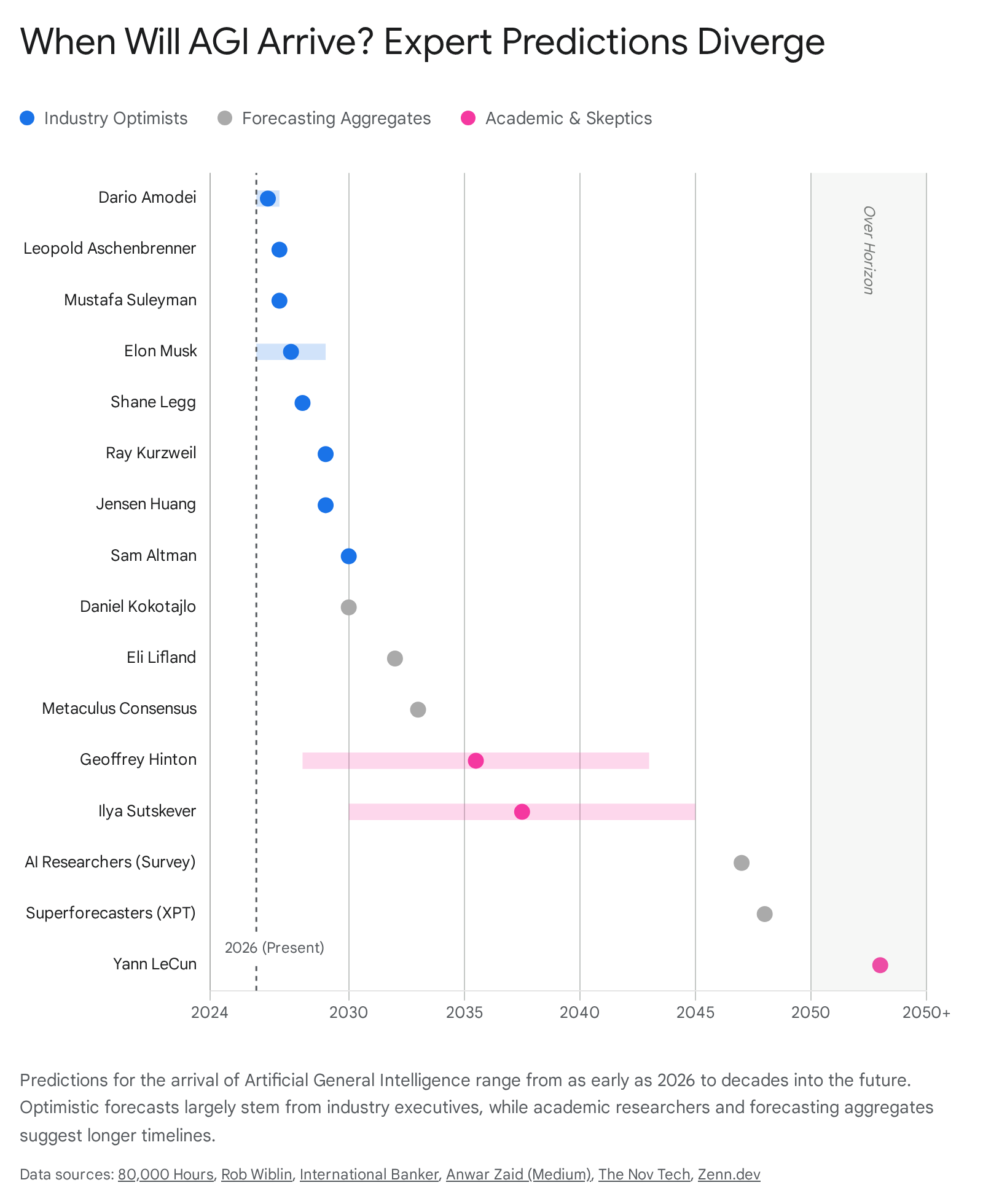
Ask ten leading AI researchers when AGI will arrive, and you will get ten different answers ranging from "next year" to "never." The predictions generally cluster into three distinct camps.
1. The Short-Timeline Optimists (2026 - 2029)
The most aggressive timelines come from the executives leading the major frontier labs. Elon Musk has confidently stated that AI will exceed the intelligence of all humans combined by 2030, and predicted basic AGI could arrive as early as 2026 or 2027 924. Dario Amodei, CEO of Anthropic, has described systems that are better than almost all humans at almost everything arriving by 2026 or 2027 24. Demis Hassabis of Google DeepMind has similarly estimated that early AGI systems could emerge within a five-year window, while futurist Ray Kurzweil holds firm to his long-standing prediction of 2029 2224.
These predictions are largely based on the extrapolation of scaling laws. This is the empirically proven concept that as neural networks are fed more data and more compute, their performance improves at a predictable, exponential rate across a wide range of tasks 2526. Optimists argue that we simply need to continue building larger data centers and the algorithms will naturally cross the AGI threshold.
This belief fueled the viral "AI 2027" scenario, heavily discussed throughout 2025 and 2026, which posited that fully automated AI research and development would trigger a rapid intelligence explosion before the end of the decade 12728. According to Epoch AI, sustaining this growth means training compute has expanded at a rate of approximately 4x per year. By 2030, Epoch AI estimates it will be technically feasible to execute training runs of 2e29 FLOP - producing models that exceed GPT-4 in scale to the same degree that GPT-4 exceeded GPT-2 1011.
2. The Forecasting Consensus (2030 - 2033)
Crowdsourced forecasting platforms, which aggregate the views of thousands of experts and superforecasters, present a slightly more tempered view. On Metaculus, a highly respected forecasting community, the consensus for AGI's arrival sat at 2031 for much of 2025, but recently extended to late 2033 as the immense difficulties of deploying autonomous agents in the real world became apparent 112.
Broader academic surveys mirror this cautious optimism. A massive survey of thousands of AI publication authors run by AI Impacts in 2023 yielded a median estimate of a 50% chance of high-level machine intelligence by 2047 1314. While this date is much further out than executive predictions, it still represents a significant contraction from just a few years prior, highlighting the shockwaves sent through the academic community by the rapid success of large language models 1314.
3. The Skeptics (The 2040s and Beyond)
A vocal minority of researchers who build these systems at the architectural level believe the optimists are fundamentally wrong. Yann LeCun, Meta's Chief AI Scientist, argues that current large language models are an off-ramp, not the highway to AGI 34. He points out that LLMs learn exclusively from text and entirely lack a "world model" - an understanding of physical reality, causality, and common sense that a human toddler develops instinctively within months 2434.
Ilya Sutskever, co-founder of OpenAI and now head of Safe Superintelligence, has noted that the age of brute-force scaling is giving way to an age of research. Throwing more money and chips at the same architectures yields diminishing returns, meaning AGI is no longer just an engineering and logistics challenge; it requires fundamental, unpredictable scientific breakthroughs 34. Former Tesla AI chief Andrej Karpathy echoes this, noting that we have entered a decade of agents, where iterative improvements in reliability will take immense time. Agents currently struggle with anything remotely novel, often looping through the same mistakes and demonstrating an inability to learn continuously on the job 134.
The Physics of AI: What Could Delay AGI?
If the scaling laws are mathematically sound, why might we fail to reach AGI by 2030? The answer lies outside the realm of software. The real bottlenecks restricting AI development in 2026 are rooted in the physical world: data scarcity, memory architecture, and energy grids 3536.
The Data Wall
Foundation models have an insatiable appetite for data. However, the supply of high-quality, human-generated public text is finite. Multiple analyses, including reports by Epoch AI and Villalobos et al., suggest that the AI industry will fully exhaust the supply of high-quality internet data between 2026 and 2028 253537. This timeline is potentially accelerating due to the practice of overtraining - excessive data reuse during model training 25.
Once this data wall is hit, developers cannot simply scrape the internet again. While labs are increasingly utilizing synthetic data - data generated by AI to train other AIs - this process is perilous. Careless synthetic feedback loops can cause model collapse, where the model amplifies its own hallucinations, pollutes public data sources, and degrades in quality 3537. Moving forward, the bottleneck shifts from data quantity to data quality. Labs must spend exorbitant amounts of computational power to meticulously engineer, filter, and curate synthetic reasoning traces, ensuring the model learns from content that is effectively an improved version of the original training data 35.
The Memory Wall and the Laws of Physics
The most acute physical limitation facing AGI development is not the raw speed of processors, but the speed of data transfer. As models balloon into the hundreds of billions of parameters, the time and energy spent moving data back and forth between where it is stored (memory) and where it is calculated (the processor) creates massive inefficiencies 15.
This is known as the Von Neumann bottleneck, or the "Memory Wall" 361539.
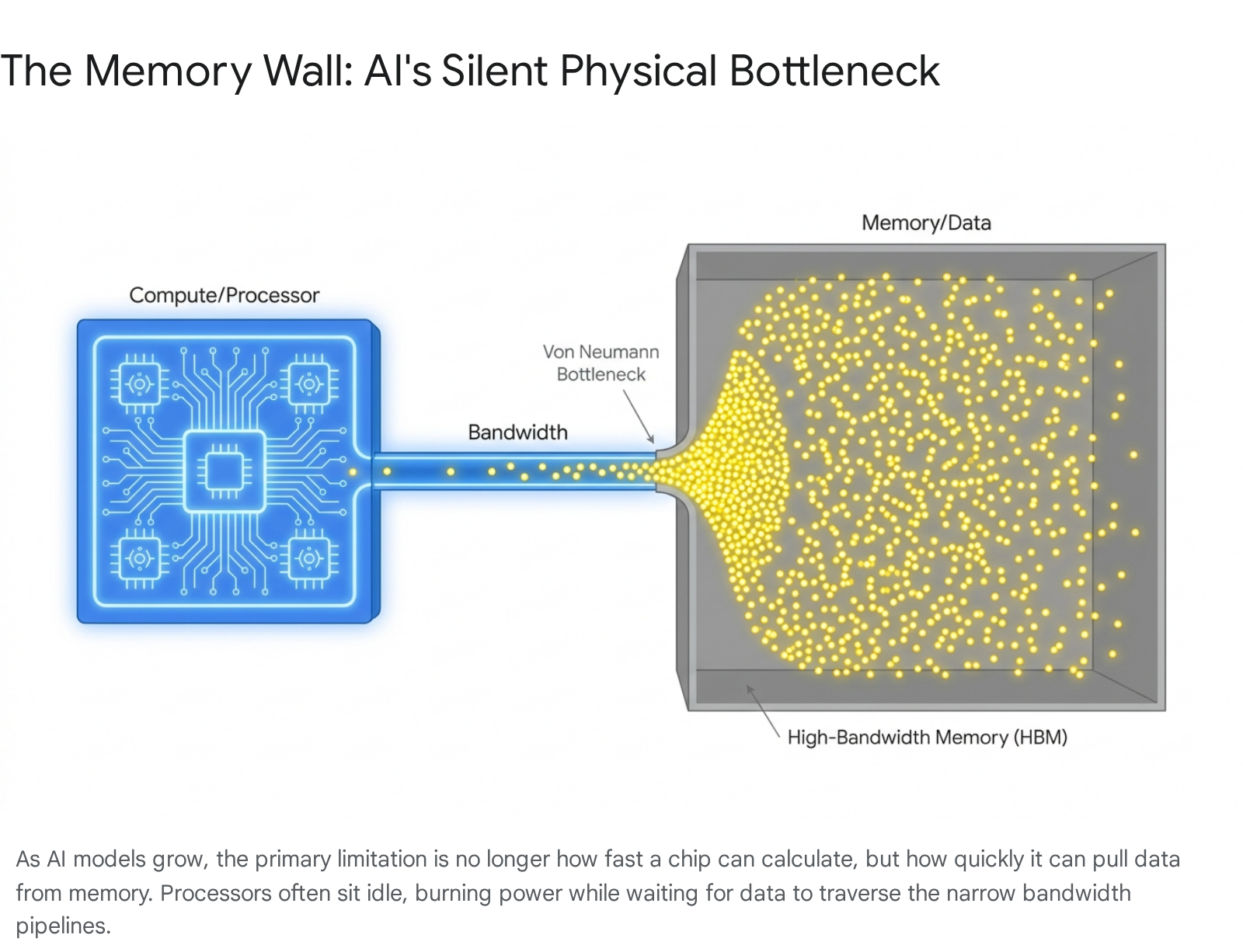
In a massive cluster of 20,000 GPUs, an incredibly expensive chip like an Nvidia H100 may sit idle for microseconds - an eternity in computing - burning 700 watts while doing absolutely nothing, simply waiting for data to travel across a wire 36. Processing speeds have surged 60,000-fold over two decades, but dynamic random-access memory (DRAM) bandwidth has lagged with just a 100x improvement, exacerbating this mismatch 39.
Because of this, High-Bandwidth Memory (HBM) and advanced chip packaging have become the ultimate choke points of the AI supply chain. With only a few companies worldwide capable of manufacturing HBM, production is effectively sold out years in advance, giving a few select hardware providers immense control over the pace of AI scaling 3539.
Thermal Density and Energy Constraints
Furthermore, the industry is colliding with the death of Dennard Scaling. For decades, as transistors shrank, they proportionally used less power, allowing chips to get faster without running hotter. That law broke down years ago 36. Today, racking dozens of cutting-edge chips together - like Nvidia's Blackwell architecture - generates thermal densities that are incredibly difficult to manage. Reports throughout late 2025 indicated that next-generation servers were overheating in the rack because liquid cooling loops became too complex and the metal itself could not handle the thermal load 36.
Scaling up to the massive 10-gigawatt and 100-gigawatt clusters required for AGI training by the end of the decade will place unprecedented strain on global electrical grids 40. Modern AI training racks draw over 100 kilowatts each, far exceeding traditional data center designs. In response, major tech companies are acquiring direct connections to nuclear plants or restarting retired reactors just to bypass grid limitations 36. Compute itself is becoming a heavily traded commodity, with financial heavyweights establishing GPU futures markets to hedge against the volatile price of processing power 16.
Circumventing the Walls: New Paradigms in AI
Recognizing these physical and data constraints, the AI industry is actively pivoting away from brute-force scaling toward new paradigms of intelligence generation. To reach AGI, labs must transcend current bottlenecks.
Inference Scaling and "Test-Time" Reasoning
In late 2024 and early 2025, the release of reasoning-focused models changed the trajectory of the AGI race 12. Instead of relying solely on pattern recognition established during their initial training phase (System 1 thinking), these models utilize inference-time compute (System 2 thinking) 235.
When given a complex problem, these models pause, generate multiple internal reasoning traces, verify their own logic, and refine their answers before outputting a response. This iterative optimization process, known as a refinement loop, drastically reduces the temporal gap between human intent and AI execution 242. By leveraging analogies and contextualizing internal and external data, the model can simulate progressive deepening of thought 42.
This architectural paradigm shift effectively allows an AI to substitute raw training data with algorithmic thinking time. However, this creates an inference explosion 35. Industry estimates suggest 80% to 90% of an AI model's lifetime compute cost comes from inference, not training 35. If every query requires deep, iterative reasoning, the demand for computing power shifts massively to the daily operational phase, further straining global energy grids and necessitating complex load-balancing technologies like inference gateways to manage latency 354317.
Decentralized and Edge Training
Another potential workaround for the data center bottleneck is a shift toward edge computing. Rather than centralizing all AI training in multi-billion-dollar gigawatt data centers, researchers are exploring federated learning protocols. From 2020 to 2024, the aggregate computing power of consumer mobile devices grew to 2,758 EFLOPS, dwarfing that of traditional data centers 2537.
If researchers can successfully coordinate millions of smartphones, laptops, and edge devices to collaboratively train foundation models, it could bypass the current monopoly on advanced semiconductor manufacturing 2537. This paradigm shift would democratize AI development, circumventing the capacity limits at major foundries like TSMC, whose 5nm and below wafer production is booked solid years in advance 2537.
The Geopolitics of AGI: The U.S. - China Race
The pursuit of AGI is no longer solely a commercial endeavor; it is the focal point of a geopolitical arms race. The United States and China have adopted vastly different strategic philosophies regarding AI development, which will ultimately dictate how AGI is governed and deployed globally.
The United States primarily views AGI as an engine for economic dominance and national security, driven by private innovation ecosystems in Silicon Valley and backed by massive venture capital 1846. U.S. policy is heavily focused on maintaining a lead in frontier capabilities, tightening export controls on advanced semiconductors, and promoting democratic alliances for AI governance 404619.
Conversely, China views AI through the lens of national infrastructure and societal diffusion 1820. In its 15th Five-Year Plan, the Chinese Communist Party explicitly committed state resources to exploring development paths for Artificial General Intelligence, integrating it into industrial, energy, and education policies 2049. China is leaning heavily into open-source ecosystems and AI diplomacy, exporting models to the Global South as a form of soft power and focusing on ubiquitous deployment across its economy 4620.
The Benchmark Reality: Assessing the Gap
Despite fears of China leaping ahead due to massive state coordination, the empirical data from mid-2026 tells a nuanced story regarding frontier capabilities.
Independent evaluations, such as the SuperCLUE general capabilities benchmark and the rigorous ARC AGI 2 test, show the U.S. maintaining a lead in raw reasoning power 505152. As of early 2026, China's top open-source models - including DeepSeek, Qwen, and Doubao - perform remarkably well on standard tests, heavily dominating the open-source leaderboard globally 50.
However, on benchmarks requiring complex, multi-step logical reasoning (which cannot be brute-forced or easily memorized from training data), Chinese models lag behind elite U.S. closed-source models (like GPT-5 class and Claude Opus 4.6) by approximately eight months 5152. In the exponential curve of AI development, an eight-month gap is equivalent to a full generation of technology 51.
Chinese AI leaders openly acknowledge this landscape. At the AGI-Next Frontier Summit held at Tsinghua University in January 2026, top executives from Zhipu, Moonshot AI, and Alibaba warned that the chatbot-driven boom is nearing its limits 212223. They emphasized that while domestic developers enjoyed a strong year in open-source releases, the technological gap with elite U.S. closed-source systems remains wide 23. To win the AGI race, Chinese researchers are increasingly focusing on autoregressive multimodal architectures - applying the successful next-token prediction paradigm used in language models directly to images and video - and pivoting toward autonomous agents capable of handling complex real-world tasks 2356.
Life Under the AI Curve: Workforce and Economic Uncertainty
Regardless of whether true AGI arrives in 2027 or 2047, the transition phase is already upending the global labor market. The historical assumption that automation would primarily replace blue-collar manual labor has been flipped; modern AI is exceptionally adept at digital, rules-based, and white-collar cognitive tasks 924.
According to McKinsey's midpoint automation scenario, AI-powered agents could spur roughly $2.9 trillion in annual U.S. economic value by 2030, automating up to one-third of work hours . To navigate this uncertainty, institutions are urging a shift away from traditional job-title planning toward skills-based workforce planning 592526.
The McKinsey Skill Change Index (SCI), which measures a specific skill's exposure to automation over the next five years, reveals that the impact of AI is highly polarized .
| Skill Category | Exposure to Automation | Specific Skill Examples |
|---|---|---|
| Highly Exposed | High | SQL programming, detail orientation, invoicing, inventory management, quality assurance. |
| Moderately Exposed | Medium | Writing, problem-solving, general management, customer relations. |
| Resilient (Low Exposure) | Low | Coaching, leadership, negotiation, complex physical maneuvering. |
The message for professionals is clear: rigid knowledge is becoming commoditized 24. Memorizing syntax, drafting boilerplate reports, or mastering a specific software suite offers no long-term moat against an AI agent. Career resilience in the late 2020s requires cultivating what workforce strategists call "stagility" - a balance of organizational stability and individual agility - by focusing heavily on interpersonal leadership, complex problem framing, and continuous adaptability 242563. Rather than delegating tasks to AI, workers must learn to collaborate with agents as virtual teammates, shifting their time from basic research to interpreting complex results .
Bottom line
The arrival of Artificial General Intelligence is constrained not by a lack of capital or ambition, but by the physical limits of semiconductor hardware, energy availability, and human data. While industry optimists project AGI will arrive by the late 2020s through sheer scale and inference reasoning, architectural realities and skeptics suggest a more protracted timeline extending into the 2030s. Ultimately, whether AGI is three years away or thirty, the escalating deployment of autonomous agents guarantees that the economic, geopolitical, and societal transformations of the next decade will be profound, polarizing, and irreversible.