
5 Ways Humanoid Robots Could Shape the Economy by 2035
By 2035, humanoid robots will transition from experimental prototypes to foundational economic infrastructure, driven by collapsing hardware costs, breakthroughs in physical artificial intelligence, and next-generation solid-state batteries. They are projected to heavily penetrate five core areas of the global economy: industrial manufacturing, retail and front-line service, healthcare and eldercare, domestic household assistance, and broader macroeconomic supply chain management. While industrial and logistics adoption is already proving economically viable due to severe labor shortages, consumer and domestic use will ultimately depend on overcoming critical safety hurdles and the unpredictable nature of human environments.
The Technological Foundation: Why 2035 Is the Tipping Point
To comprehend what humanoid robots will achieve in the global economy by 2035, it is essential to first examine the specific technological bottlenecks that are currently being cleared. Historically, humanoid robots failed commercialization tests because they were too expensive, too fragile, overly clumsy, and lacked the battery life to complete a full working shift without constant tethering or recharging 11. The narrative that humanoid robots were perpetually a decade away from reality has been upended by a sudden convergence of advancements across battery chemistry, materials science, and artificial intelligence. Three core breakthroughs are fundamentally changing this trajectory and making the 2035 projections a reality.
The Solid-State Battery Revolution
The human bipedal form factor is notoriously inefficient for machines. Balancing on two legs while lifting heavy payloads and navigating dynamic environments requires immense, continuous bursts of energy. Current liquid lithium-ion batteries restrict high-end humanoid robots, such as the Tesla Optimus Gen 2 or the Unitree H1, to roughly two to four hours of dynamic, untethered operation 25. For logistics companies and manufacturers looking to replace an eight-hour human shift, a two-hour runtime represents a critical operational failure that necessitates complex, expensive "hot-swapping" battery workarounds 5.
However, the late 2020s are expected to see the massive commercialization of solid-state batteries tailored specifically for robotics. Battery manufacturers like Farasis Energy, EVE Energy, and GAC are successfully validating sulfide-based all-solid-state batteries that achieve remarkable energy densities ranging from 400 to 600 Wh/kg 67. These advanced batteries are projected to extend continuous operational runtimes to 8 to 12 hours, effectively covering a standard human work shift with a single charge .
Because humanoid robots represent a smaller volume of total battery demand compared to electric vehicles (EVs), and because robotics companies can more easily absorb the premium cost of high-density, highly safe cells, industry analysts expect humanoids to be the first major commercial beneficiaries of solid-state technology . Data indicates an exponential surge in demand: the capacity needed for solid-state batteries driven by humanoid robots is projected to hit 74.2 GWh by 2035, representing a staggering 1,500-fold increase from a mere 0.05 GWh in 2025 25. This transition from two-hour runtimes to twelve-hour runtimes serves as the primary hardware catalyst for making humanoids economically viable.
Omnidirectional Dexterity and Proprioception
While industrial robots have mastered the simple, repetitive "grip" for decades, true economic utility across diverse sectors requires fine motor skills and proprioception - the internal sense of where fingers and limbs are positioned in physical space. Historically, robotic hands have suffered from severe "coupling problems," meaning they struggle to flex and move sideways simultaneously without losing stability or grip strength 9. This lack of dexterity left a vast gap between basic robotic grasping and true, human-like manipulation.
Recent advances in material science and embodied artificial intelligence are revolutionizing the design of multi-fingered dexterous hands. Researchers and commercial hardware developers are combining flexible, soft-sensing polymers with rigid-soft hybrid hand designs equipped with omnidirectional bending sensors 910. These advanced hands frequently feature 18 or more degrees of freedom and successfully decouple pitch and yaw movements 9. This allows the robot to "feel" its posture in real-time, enabling delicate, human-like tasks such as operating a computer mouse, handling fragile retail items, using scissors, or assisting in medical procedures. The ability to perform fine-grained grasping and compliant manipulation vastly expands the total addressable market for humanoids beyond simple warehouse box-moving into advanced manufacturing and daily life assistance 10.
The Economics of Vision-Language-Action AI
The traditional approach to robotics required highly specialized human engineers to painstakingly hand-code every movement and account for every potential environmental variable. This made robots incredibly brittle; if an object was moved one inch to the left, the robot would fail. The rise of Vision-Language-Action (VLA) models has entirely inverted this paradigm. Powered by large-scale neural networks, robots can now be trained via teleoperation and simulation, learning directly from human demonstrations and applying those learned behaviors autonomously to entirely novel situations 121314.
Crucially, the underlying economics of acquiring this training data have collapsed, accelerating the pace of development. The average cost of capturing high-quality teleoperation data - captured, labeled, and packaged into standardized formats - fell precipitously from approximately $340 per hour in early 2024 to roughly $118 per hour by the end of 2025 14. This 60% reduction in data collection costs puts a $50,000 to $150,000 pilot data budget within reach for most enterprise companies, sparking a massive wave of bespoke AI training across different industrial sectors 14.
Collapsing Hardware Costs and the Path to Commercialization
Simultaneously, the manufacturing bill of materials for humanoid hardware has dropped dramatically. Between 2023 and 2024, manufacturing costs dropped by an estimated 40% year-over-year 3164. While early state-of-the-art prototypes cost between $50,000 and $250,000 to produce, new commercial models entering the market - driven heavily by competitive Chinese manufacturing and the reuse of mature, scaled electric vehicle component supply chains - now range from $13,500 to $30,000 35.
Because the technology is evolving so rapidly, major financial and research institutions offer differing projections for the 2035 macroeconomic landscape. The variance in these forecasts highlights the inherent uncertainty of global hardware scaling, supply chain stability, and emerging regulatory frameworks.
| Forecasting Institution | Estimated Market Size (By ~2035) | Estimated Unit Shipments | Key Growth Drivers Highlighted |
|---|---|---|---|
| Goldman Sachs | $38 Billion (Baseline) to $154 Billion (Blue-Sky) | 1.4 Million units | Declining BOM costs, VLA AI models, and manufacturing labor shortages. 36 |
| Acumen Research | $21.6 Billion | Expanding tenfold | Breakthroughs in AI, logistics integration, and European ethical robotics focus. 20 |
| Interact Analysis | $15 Billion | 700,000 units | Heavy reliance on Chinese state subsidies, US capital markets, and R&D. 1 |
| Roland Berger | $300B - $750 Billion | Ecosystem-wide scale | Convergence of AI, hardware advancements, and structural labor gaps across the value chain. 7 |
Despite differences in absolute dollar figures, there is universal agreement across market intelligence firms that commercial adoption will firmly cross the chasm from pilot purgatory to mass deployment by the early 2030s. Based on current pilot programs, deployment timelines, and immense macroeconomic pressures, the following five scenarios outline the realities of the humanoid economy in 2035.
Scenario 1: The Manufacturing and Logistics Takeover
The earliest, most aggressive, and most certain scenario for humanoid robots is their deep integration into highly structured industrial environments. By 2035, humanoids will serve as the primary connective tissue in factories, logistics hubs, and warehouses, fully taking over the repetitive, physically taxing tasks that human workers increasingly refuse to perform 228.
The adoption curve in the manufacturing and logistics sector is driven almost entirely by the stark mathematics of Return on Investment (ROI). In the United States, a fully loaded manufacturing worker - accounting for base wages, health insurance, retirement benefits, paid time off, and management overhead - costs a facility approximately $160,000 annually, which breaks down to roughly $30 per hour 524.
In sharp contrast, the operating costs for humanoid robots are falling rapidly. Early estimates place humanoid operating costs between $2 and $12 per hour, factoring in maintenance, energy, software licensing, and downtime 2425. When a company purchases a modern industrial humanoid outright at a price point of $20,000 to $30,000, the payback period for replacing a highly paid, multi-shift human role can be as short as 1.9 months for single-shift operations, and essentially one month for multi-shift continuous operations 524.
Furthermore, capital expenditure barriers are being eliminated through the rise of Robot-as-a-Service (RaaS) business models. Logistics giants like GXO Logistics have already deployed humanoids, such as Agility Robotics' Digit, in massive Spanx warehouses on a subscription basis 24. This shifts the financial burden from a massive upfront capital expenditure to a predictable monthly operational expense. As RaaS pricing competition drives monthly costs down and providers absorb the maintenance risks, the financial justification for human labor in structured lifting and sorting environments essentially vanishes 2526.
By 2035, factory floors will not be entirely devoid of human presence, but the nature of the environment will be transformed into "fenceless operations" 9. Historically, heavy industrial robots were kept behind steel cages to prevent them from accidentally crushing human operators. Humanoids, equipped with advanced spatial perception and soft-tissue collision detection, will work safely alongside human technicians. They will autonomously transport totes, load assembly lines, and palletize goods in spaces explicitly designed for human ergonomics, saving companies the massive capital expense of retrofitting older, legacy factories with automated conveyor belts 29. Removing the limitations of human fatigue, mandatory breaks, and shift changes allows these facilities to edge much closer to continuous 24-hour operation, dramatically increasing total global throughput and redefining industrial productivity 2510.
Scenario 2: Retail and Frontline Service Integration
While factories are highly structured environments with predictable lighting and flooring, the retail and service sectors introduce a chaotic new layer of complexity: unpredictable human customers. By 2035, humanoid robots will be a standard fixture in grocery stores, big-box retailers, and hospitality venues, serving a highly visible hybrid role of inventory manager and customer concierge 11.
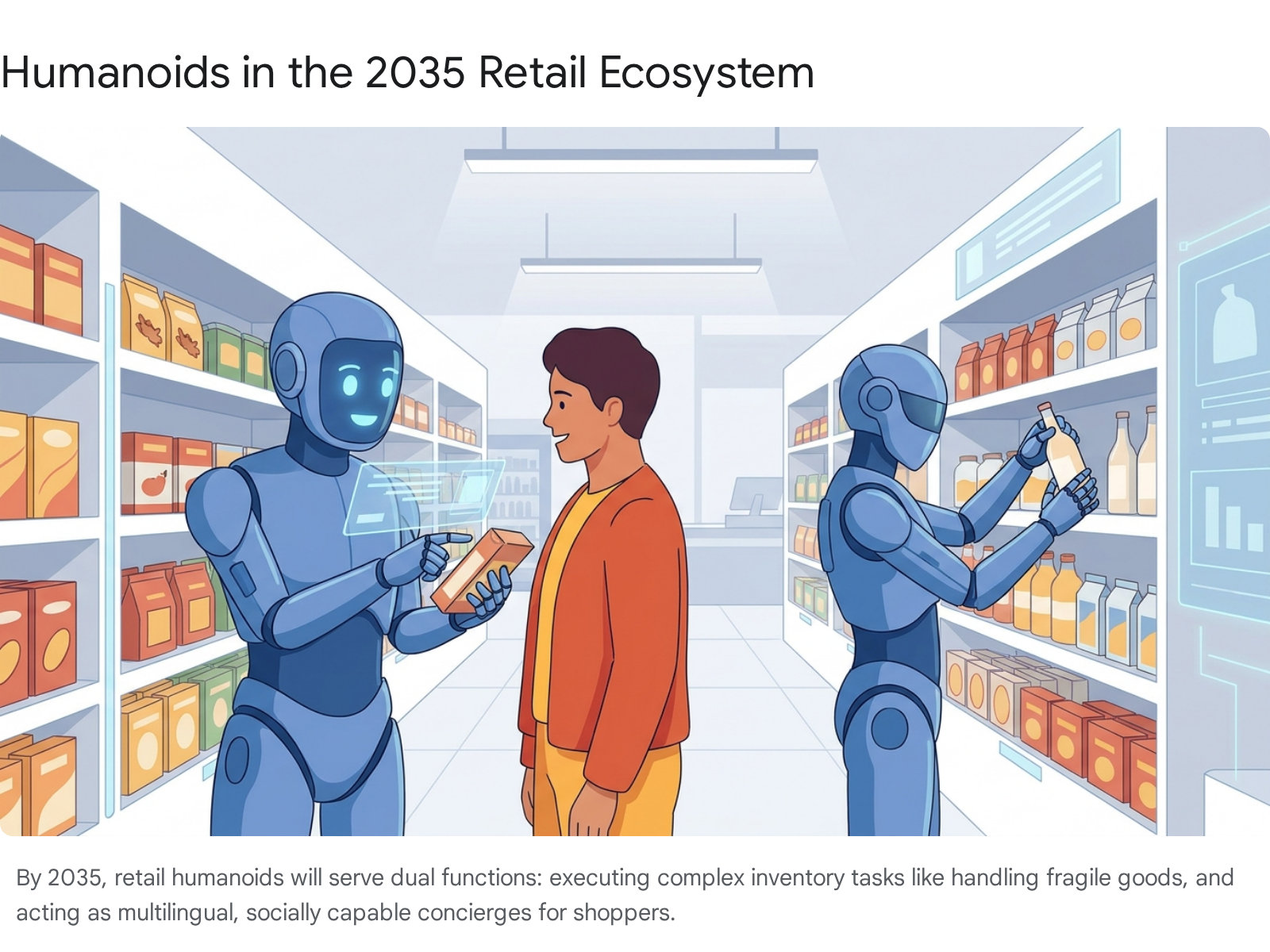
The challenge of inventory management and shelf stocking is surprisingly complex for a robot. Handling diverse packaging types without causing damage requires immense tactile sensitivity. However, commercial pilot programs are already proving successful. In Denmark, the supermarket chain Føtex has partnered with technology startups to deploy Unitree G1 humanoids to autonomously stock grocery shelves 16. Engineers specifically trained these robots on items like bags of potato chips and boxes of pasta because chips crush easily and pasta boxes are awkward to grip. Achieving success with these items serves as a benchmark indicating that the robot possesses the fine motor control necessary to handle almost any item in a supermarket 16.
By 2035, major global grocery chains will rely heavily on fleets of humanoids working overnight shifts or operating discreetly alongside daytime shoppers. They will navigate complex, crowded aisles to detect out-of-stock items, identify pricing errors, manage inventory with near-perfect accuracy, and seamlessly restock shelves without human intervention 1611.
Beyond logistics, customer-facing service is where humanoid form-factors truly justify their anthropomorphic design. Unlike static self-checkout kiosks or mobile applications, humanoids offer a physical presence that commands attention and engagement. Armed with advanced Large Language Models, these robots will interpret nuanced customer queries, provide fluent multilingual support, demonstrate how products work in real-time, and guide shoppers through vast store layouts using natural gestures and sustained eye contact 1112.
The speed of this retail integration scenario, however, depends heavily on broader public acceptance. Retailers must carefully navigate the "uncanny valley" - the psychological phenomenon where highly realistic but imperfect human replicas evoke feelings of unease or revulsion in observers 1334. Research published in retail journals indicates that social capability, meaning the robot's ability to mimic empathy, make small talk, and utilize appropriate social cues, is the strongest predictor of positive consumer attitudes, even more so than the robot's mechanical efficiency 11. Therefore, by 2035, the most successful retail robots will likely feature friendly, slightly abstracted, and clearly mechanical designs rather than hyper-realistic, skin-covered human faces 35.
Scenario 3: The Demographic Lifeline in Healthcare and Eldercare
In many advanced economies, the most urgent and heavily funded driver for humanoid robotics is not corporate profit margins, but looming demographic collapse. By 2035, nations such as Japan, South Korea, and much of Western Europe will be deeply entrenched in "super-aged" society status, facing severe, systemic shortages of working-age caregivers and medical professionals 1437.
The International Labour Organization and global health ministries are already sounding the alarm over the immense physical and mental toll exacted on human nurses and care workers. Moving bedridden patients, repeatedly lifting the elderly, and performing strenuous physical care tasks carry remarkably high occupational safety and health risks 8.
By the mid-2030s, humanoid robots will be deeply integrated into the daily operations of hospitals, rehabilitation centers, and assisted living facilities. Their substantial mechanical strength, combined with the delicate touch afforded by multi-fingered sensor dexterity, will allow them to safely transfer patients from beds to wheelchairs, assist in exhausting physical rehabilitation exercises, and autonomously deliver medical supplies across sprawling hospital campuses 3738. Projections from Goldman Sachs estimate that intelligent robotics could fill roughly 2% of the total global elderly care demand by 2035, and potentially up to 53% in a highly optimistic, long-term scenario where technological hurdles are rapidly cleared 16.
Recognizing the existential economic threat of an aging, shrinking workforce, global governments are increasingly treating humanoid development as a matter of critical national infrastructure and security. * South Korea: Facing one of the world's most dramatic demographic shifts, where an estimated 30% of the population will be over the age of 65 by 2035, the government has launched aggressive state initiatives 15. Through the "K-Humanoid Alliance" and the broader "Manufacturing AX" initiative, a consortium of major conglomerates including Samsung, LG, and Hyundai aims to achieve mass production of general-purpose humanoids by 2029 404142. South Korea is even actively exploring the deployment of humanoid robots in frontline military operations to offset severe troop shortages 43. * Japan: As the first nation to enter super-aged status, Japan has positioned robotics at the center of its national strategy. Through its "New Robot Strategy" and the highly funded "Moonshot Research and Development Program," Japan is subsidizing "AgeTech," systematically deploying AI-based robots into nursing facilities to provide both grueling physical labor and baseline cognitive companionship for dementia patients 101416.
Despite this necessary integration, the introduction of robots into intimate caregiving settings raises profound ethical and psychological concerns. Sociologists and medical experts warn against a complete over-reliance on artificial intelligence in care environments, noting that while a humanoid can flawlessly lift a patient or monitor vital signs, it cannot provide the genuine empathy, psychological support, and organic social bonding that are fundamentally necessary for human well-being and dignity 1417.
Scenario 4: The Domestic Household Assistant
The ultimate, yet most highly contested and difficult scenario for 2035 is the widespread, ubiquitous adoption of humanoid robots in private consumer homes. While popular culture envisions a future where an automated robotic maid seamlessly cooks meals, cleans floors, and folds laundry, the engineering reality of deploying a massive, powerful machine into an unstructured home environment is fraught with immense safety challenges 18.
Factories, warehouses, and even retail stores can be standardized; human homes cannot. Homes contain narrow staircases, dropped children's toys, unpredictable pets, varied lighting conditions, and rapidly moving toddlers 3518. While an industrial robot currently relies on highly structured, predictable workflows, a domestic robot must navigate absolute, unscripted chaos. Furthermore, the stakes for failure are exponentially higher. A robot losing power and falling over in a factory simply halts a production line and damages company property; a heavy, metal robot falling over in a living room could severely injure a small child or a pet 18.
Because of these extreme risks, leading roboticists and researchers caution against aggressive hype, suggesting that true, general-purpose household autonomy may not firmly arrive until well into the 2030s 35. It is widely acknowledged within the industry that many of the viral promotional videos showcasing humanoid robots effortlessly folding laundry or brewing coffee are still heavily reliant on remote human teleoperation, rather than true, on-board autonomy 341819.
Despite this deep technical skepticism, ambitious robotics companies are aggressively targeting the lucrative consumer market. Startups like 1X Technologies are already taking preorders for their "NEO" robot, which is designed specifically from the ground up for the home environment. To mitigate the inherent safety risks of a heavy machine in a living room, NEO is built with a soft, machine-washable knitted suit, weighs only 30 kilograms (dramatically lighter than industrial robots that often weigh up to 89 kilograms), and features specially designed pinch-proof joints to protect human fingers 13.
By 2035, it is highly probable that wealthy early adopters and tech enthusiasts will have domestic humanoids operating in their homes. However, rather than acting as flawless, autonomous, all-knowing butlers, they will likely operate in a constrained, hybrid capacity. They will handle specific, heavily trained chores such as loading dishwashers, sorting laundry, or fetching items, and will be programmed to immediately revert to safe, frozen modes or request remote human assistance when confused by novel or dangerous scenarios 3520. Financial analysts project that as mass manufacturing scales globally, consumer humanoid prices could plummet from $35,000 today to roughly $13,000 to $17,000 by 2030, making them financially accessible to upper-middle-class households by 2035 165.
Scenario 5: Macroeconomic Reconfiguration and the "Physical AI" Labor Market
The deployment of millions of humanoid robots across manufacturing, retail, and domestic sectors will inevitably trigger a massive, structural reconfiguration of the global labor market. The International Monetary Fund estimates that nearly 40% of global jobs could be automated, displaced, or significantly altered by the rise of AI and physical robotics 17.
While mainstream headlines tend to focus exclusively on catastrophic job losses, historical economic data and current projections suggest a more nuanced reality characterized by intense labor transformation rather than pure elimination. Organizations like the International Labour Organization and the World Economic Forum point out that while repetitive physical roles, basic assembly, and simple security patrols will undoubtedly be displaced, the integration of complex humanoid ecosystems will spawn entirely new, highly specialized job categories 82122.
By 2035, the global labor market will see an unprecedented surge in demand for emerging technical roles: * Robot Maintenance and Repair Technicians: Hardware inevitably degrades, delicate actuators fail under stress, and sensors break. A massive, globally distributed workforce of technicians will be required to physically maintain, repair, and upgrade massive commercial robotic fleets 21. * AI Oversight and Quality Control Specialists: Humans will be required to monitor complex algorithmic decisions, validate the outputs of AI vision systems, and manage unpredictable edge-case scenarios where autonomous robots fail or become confused 821. * Fleet Managers and Automation Engineers: Highly skilled professionals will be needed to design, optimize, and orchestrate the complex daily workflows and physical interactions between human workers and autonomous robotic systems on factory floors 21.
Furthermore, as routine physical labor is increasingly automated, the economic premium placed on uniquely human skills - creativity, deep emotional intelligence, strategic judgment, and complex, unscripted problem-solving - will rise dramatically across all sectors 1723.
However, the speed and scale at which this macroeconomic shift occurs is tightly constrained by a highly vulnerable and concentrated physical supply chain. Analysis from McKinsey highlights that the dawn of the humanoid era is entirely dependent on hardware components that are currently not manufactured at the necessary global scales 24.
| Critical Humanoid Component | Function & Constraint | Geopolitical and Market Risk |
|---|---|---|
| Actuators (Motors & Gears) | Provide all joint movement. Constitute 40 - 60% of the total unit cost. | High demand from the massive automotive and EV sectors creates intense competition for limited global manufacturing capacity. |
| Planetary Roller Screws | Enable high-load, high-precision linear motion (crucial for bipedal legs and heavy lifting). | Extremely narrow supplier base, exceptionally long lead times, and almost zero viable substitution options. Represents a severe supply bottleneck. |
| Neodymium (NdFeB) Magnets | Absolutely essential for creating high-torque, efficient actuators. | China currently controls approximately 69% of global rare-earth mining and a staggering 90% of advanced magnet processing capacity. |
| Sensors & Perception Systems | Provide vision, tactile feedback, and spatial awareness. Constitute 10 - 20% of the total cost. | Requires access to advanced semiconductor chips, making it highly vulnerable to ongoing US-China technological trade restrictions and embargoes. |
By 2035, geopolitical dominance in the robotics sector will largely hinge on which nations control these critical physical supply chains. Currently, China's vast manufacturing base, aggressive state subsidies, and overwhelming dominance in the processing of rare-earth metals give its domestic robotics companies a profound, structural cost advantage over Western competitors 24. Market intelligence firm Interact Analysis projects that, due to these dynamics, China and the United States will collectively account for over 85% of total humanoid robot demand and production by 2035, essentially establishing a superpower duopoly over the future of physical artificial intelligence 1.
Bottom line
By 2035, humanoid robots will transition from experimental novelties into essential economic infrastructure, fundamentally altering the landscapes of industrial manufacturing, retail service, and eldercare. While the economic return on investment for industrial use is already proving viable due to severe labor shortages, widespread integration into unstructured domestic homes remains highly uncertain and contingent on clearing significant safety and AI reliability hurdles. Ultimately, the pace of this robotic revolution will not be dictated solely by software intelligence, but by the physical realities of battery chemistry, mechanical supply chains, and intense global geopolitical competition over hardware manufacturing.