
How Brain-Computer Interfaces Could Go Mainstream
The mass-market adoption of brain-computer interfaces (BCIs) is projected to unfold in two distinct phases: critical medical integrations scaling over the next five years, followed by a much slower consumer rollout stretching beyond 2035. While non-invasive headsets will soon gain traction in gaming and corporate wellness, true mainstream ubiquity depends on overcoming the physical limits of human skulls, navigating an incoming wave of global "neurorights" legislation, and proving these devices offer practical utility that justifies their high costs and privacy risks.
The Reality Check: Where the Science Actually Stands
If you follow corporate announcements, glossy venture capital presentations, and social media speculation, you might assume that seamless, telepathic communication with our digital devices is just a minor software update away. The reality inside global neuroscience laboratories is far more grounded and significantly more complex. Current brain-computer interfaces are primarily experimental medical devices designed to restore lost physical functions, not frictionless consumer electronics meant to permanently replace your smartphone keyboard or computer mouse 11.
The industry is currently battling profound technical limitations surrounding signal drift, electrode displacement, and the brain's natural biological immune response. For example, high-resolution implanted arrays, such as the widely utilized Utah array, are prone to long-term degradation. These devices can lose signal capture capability from over 60% of their electrodes within a single year as the brain naturally encapsulates the foreign objects in protective scar tissue 1. While newer flexible threads aim to mitigate this, the human body remains a hostile environment for permanent electronic hardware.
Furthermore, the science-fiction concept of "high-bandwidth mind reading" relies on a fundamental misunderstanding of human biology and neurophysics. Human psychophysics experiments reveal that our behavioral output - even something as complex as human speech - operates at a remarkably low data transfer rate of approximately 40 bits per second (bps) 3. We do not necessarily need alien-level gigabit bandwidth to operate a computer with our minds; we simply need a system capable of accurately capturing, filtering, and decoding that very narrow stream of localized neural intent 3.
Decoding "Inner Speech" and the Speed of Thought
One of the most significant recent leaps toward practical, mainstream utility occurred in August 2025, when researchers at Stanford University successfully demonstrated the ability to decode "inner speech" using a brain-computer interface 234.
Previously, most speech-restoration BCIs relied on what researchers call "attempted speech." This involves asking a paralyzed patient to actively try to move their lips, jaw, and tongue. The BCI would read the electrical signals sent from the brain to the motor cortex and translate those specific muscular intentions into text on a screen 25. However, attempting to physically speak can be intensely exhausting and frustrating for patients suffering from severe neurodegenerative diseases like amyotrophic lateral sclerosis (ALS) or those recovering from brainstem strokes 23.
The Stanford team proved that BCIs can bypass the physical attempt entirely and decode purely silent, unuttered thoughts. When a user simply imagines speaking - the phenomenon of the internal monologue or self-talk - the motor cortex activates in a pattern remarkably similar to attempted speech, albeit with a significantly weaker signal magnitude 23. By hooking implanted microelectrodes to an advanced artificial intelligence machine learning model, the researchers were able to decode imagined sentences from a staggering 125,000-word vocabulary with a 74% accuracy rate in real-time 256.
Crucially, the researchers also addressed the dystopian fear of "accidental thought leakage," a primary concern for any future mainstream consumer. If a BCI can read internal monologues, how does it differentiate between a text message the user wants to send and a fleeting, private thought? To prevent the BCI from broadcasting private, wandering thoughts, the researchers engineered a cognitive password system. The decoding system would only activate and begin translating inner speech after the user vividly imagined a specific, uncommon trigger phrase - in this trial, the phrase "chitty chitty bang bang" or "Orange you glad I didn't say banana" 2357. The system recognized these mental passwords with over 98% accuracy, establishing a foundational privacy safeguard for future consumer devices 25.
The Hardware Gap: Invasive vs. Non-Invasive Technologies
The timeline for BCI mainstreaming is entirely dependent on which of the two primary hardware tracks you examine: invasive surgical implants or non-invasive wearables. The BCI market is fundamentally bifurcated by these two approaches, each with wildly different clinical outcomes, regulatory hurdles, and target demographics.
Invasive devices, pursued by highly capitalized companies like Neuralink, Synchron, Paradromics, and Blackrock Neurotech, offer pristine single-neuron resolution but require neurosurgery and carry profound medical risks 8119. Non-invasive devices, championed by consumer-facing brands like Emotiv, Muse, and Neurable, sit on the scalp and read electrical activity through the skull, prioritizing accessibility and scale over data fidelity 813.
| Feature | Invasive BCIs (Implants & Stentrodes) | Non-Invasive BCIs (EEG, fNIRS) |
|---|---|---|
| Spatial Resolution | < 100 micrometers (single-neuron level) up to 1-2 cm 8. | 5 to 9 centimeters (broad cortical regions) 8. |
| Signal Accuracy | 85 - 95% accuracy in complex motor control tasks 1415. | 65 - 75% accuracy in similar complex applications 14. |
| Primary End-Users | Severe paralysis, ALS, spinal cord injuries, stroke recovery 816. | Gaming, VR/AR, cognitive wellness, enterprise productivity 813. |
| Safety & Risks | Surgical risks, infection, tissue scarring, device migration 151718. | Safe, no surgical risk. Susceptible to motion artifacts and poor contact 1719. |
| Regulatory Path | Strict FDA medical device regulation (IDE, clinical trials) 815. | General wellness exemptions (unless making medical diagnostic claims) 8. |
| Market Share (2025) | ~15% of current BCI revenue, but highest long-term valuation TAM 816. | ~85% of current BCI revenue, driving early consumer adoption 810. |
The "Stadium Noise" Problem: Decoding the Brain's Signals
To truly understand why the BCI market is so starkly divided, and why a non-invasive consumer device cannot yet compete with an implant, one must understand the physics of the human skull.
Neuroscience experts frequently rely on the "stadium noise" analogy to explain the vast difference in signal quality between device types 21111213. Imagine you want to know exactly what the quarterback is saying in the huddle during a professional football game. Using a non-invasive BCI, such as an electroencephalography (EEG) headset, is the equivalent of standing in the parking lot outside the stadium, listening to the roar of 80,000 fans. You can tell if something broadly exciting happened due to a sudden spike in overall volume, or if the game is paused due to a lull in the noise, but the thick concrete walls of the stadium - analogous to the human skull, tissue, and hair - muffle the specifics.
This biological obstruction is why surface EEGs suffer from exceedingly low spatial resolution, generally tracking broad areas of 5 to 9 centimeters, and why they display high susceptibility to motion artifacts from blinking or clenching a jaw 81719. It requires immense artificial intelligence processing power to separate the true neural signal from the ambient biological noise 819.
Conversely, an invasive BCI is the equivalent of sneaking onto the field and taping a highly sensitive microphone directly to the quarterback's helmet 191325. By physically bypassing the skull, intracranial arrays capture the pristine, high-fidelity electrical firing of individual neurons, allowing for a spatial resolution of less than 100 micrometers 8.
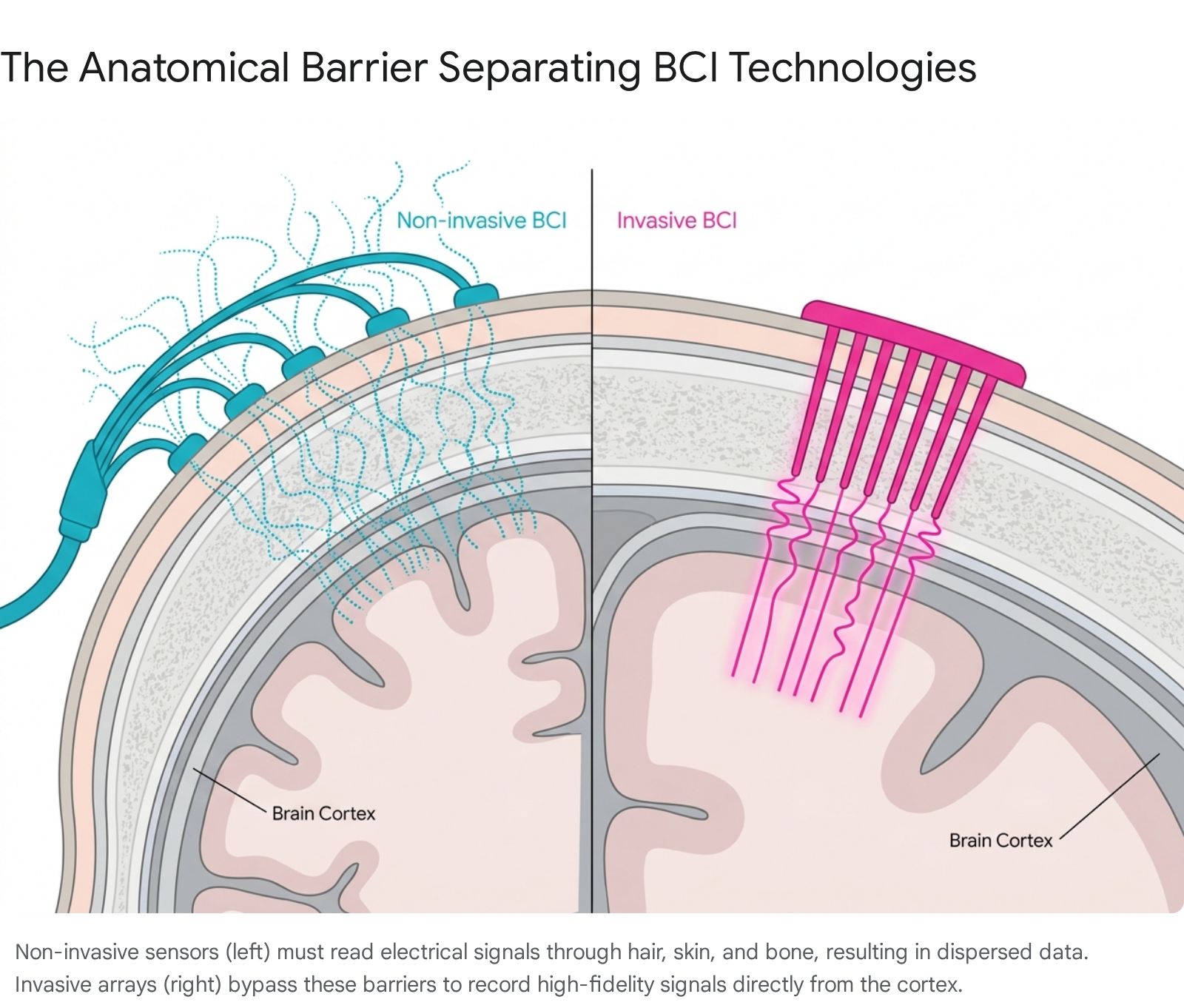
Electrocorticography (ECoG), which places electrodes beneath the skull but on the surface of the brain, offers an intermediate compromise with excellent signal clarity without penetrating deep brain tissue, though it still requires highly invasive surgical intervention 17.
This physical reality means that until external sensors undergo a generational leap, high-precision tasks like rapid typing, complex robotic arm manipulation, and fluent inner-speech decoding will remain the exclusive domain of surgical implants.
Timeline to Mass Adoption: The 2026 - 2045 Horizon
If you are waiting for a consumer BCI that allows you to seamlessly dictate emails flawlessly while walking down the street, or natively control your smart home without speaking, you will likely be waiting a couple of decades.
According to comprehensive market projections by Morgan Stanley and other financial analysts, the Total Addressable Market (TAM) for BCIs in the United States alone is estimated at a staggering $400 billion 9. However, the timeline to scale this technology is remarkably slow compared to traditional consumer electronics like smartphones or virtual reality headsets.
Forecasts suggest that heavy commercial activity - defined as product launches backed by established medical reimbursement codes - will establish a strong foothold over the next five years. However, market penetration is expected to reach only 1% roughly a decade from now. Even by the year 2045, long-term economic models suggest BCI market penetration will sit at just 2.8% 9. The coveted "hockey stick" growth curve of exponential consumer adoption is likely twenty years away, meaning the immediate future of the technology is entirely medical and specialized 9.
Early Medical Rollouts (Now to 2030)
The immediate future of the technology belongs definitively to the healthcare sector, which accounted for over 57% of the total BCI market share as of 2025 816.
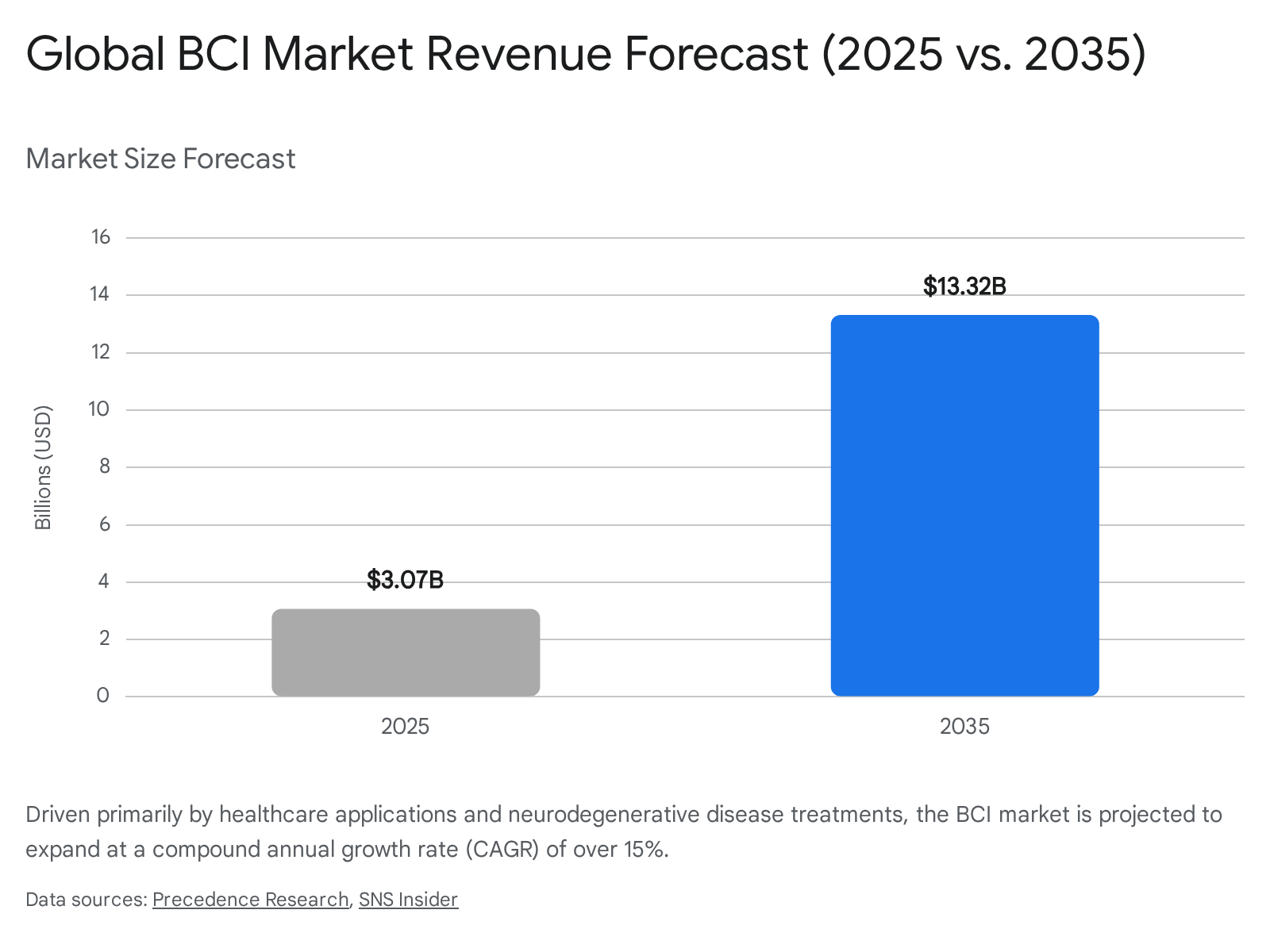
Morgan Stanley segments this market into an "Early TAM" valued at $80.8 billion, targeting roughly 2.8 million US patients with critical upper limb impairments, severe epilepsy, and treatment-resistant depression 9. This will eventually give way to an "Intermediate TAM" valued at $320 billion, targeting a broader base of 6.8 million patients with moderate limb impairment once the technology is fully de-risked 9.
Recent clinical trials validate this medical trajectory. Neuralink's highly publicized PRIME study, which secured FDA Investigational Device Exemption (IDE) approval in 2023 and initiated human implants in January 2024, has demonstrated an impressive 85% to 95% success rate in decoding motor intent. Furthermore, serious adverse events have occurred in less than 5% of cases 1514. However, the trials also highlighted technical fragility, with early human trials reporting a 10% to 15% channel loss caused by micromotion artifacts, and a thread retraction rate of 2% to 5% as the brain shifted inside the skull 15.
Similarly, Synchron has taken a drastically different approach to hardware that is yielding promising results. Instead of performing open brain surgery, Synchron utilizes a minimally invasive endovascular approach. Their "Stentrode" device is fed through the jugular vein and deployed directly into the blood vessels resting over the motor cortex. By avoiding drilling into the skull, Synchron boasts an incredibly low surgical failure rate of less than 5%. As of late 2023, their trials for ALS patients demonstrated a decoding accuracy of 70% to 85% for speech intent, proving that safer, semi-invasive methods are commercially viable 1815.
The primary barrier for these medical BCIs in the near term is proving long-term durability to insurance payers. Healthcare systems require solid, multi-year proof of patient benefit, encompassing gains in communication and independence, before supporting broader coverage and reimbursement policies 910.
The Consumer Breakthrough (2030 and Beyond)
Outside of the medical sphere, consumer adoption is currently constrained by the inherent limitations of non-invasive EEG headsets. While devices from companies like Emotiv, Muse, and Neurable are already available on the market for a few hundred to a few thousand dollars, they are largely utilized for highly niche applications. Current consumer uses revolve around meditation tracking, cognitive load monitoring, sleep quality improvement, and rudimentary neuro-adaptive gaming 81327.
For example, in 2025 and 2026, several companies launched virtual reality (VR) and augmented reality (AR) games that utilize non-invasive BCI technology to allow users to control avatars or game elements through focused thought 15. However, these are neuro-adaptive experiences rather than precise, one-to-one control mechanisms. The headset might alter the game's difficulty based on your detected stress levels, or change an environment based on your focus, but it cannot reliably act as a precise mouse or keyboard replacement for competitive inputs 11529.
For consumer BCIs to break out of the novelty phase and achieve mainstream scale, they must transition seamlessly into daily life. This means integrating invisible sensors into existing wearables - like ear buds, headphones, or smart glasses - where they can passively monitor focus, stress, and fatigue to optimize workplace productivity without requiring the user to wear a bulky gel-node cap or undergo calibration 132730.
Technological Triggers for a Mainstream Shift
Two major technological developments currently underway in the research and development sector are poised to accelerate the transition from clinical labs to consumer living rooms.
Microneedle Sensors and Dry Electrodes
The greatest physical hurdle for non-invasive consumer BCIs is human hair, which acts as an incredibly effective barrier to electrical signals 16. Traditional medical EEGs require rigorous skin preparation and the application of wet conductive gels to lower impedance and achieve clear signals 16. This process is entirely impractical for daily consumer use, as the gel dries out over time and leaves a mess 16.
To bridge the gap between invasive surgery and noisy surface sensors, researchers and device manufacturers are rapidly industrializing microneedle biosensors 3217. These microscopic needle arrays can slip seamlessly between hair follicles and penetrate the outermost layer of dead skin just enough to access interstitial fluid 321718. By doing so, they achieve much clearer electrical signals without triggering pain receptors or requiring surgical intervention 3217.
The engineering challenge now lies in material science. Manufacturers are utilizing silicon, metal, and advanced polymers to scale production, while applying zwitterionic polymer coatings to prevent biofouling - a process where the body's proteins gunk up the sensor over time 3217. As manufacturing scales up, these microneedle patches could offer near-clinical signal fidelity in a comfortable, consumer-friendly format 132.
AI-Driven Signal Translation and Interoperability
Because non-invasive sensors will always capture a certain degree of "stadium noise," the industry is relying heavily on Artificial Intelligence to act as an aggressive noise-canceling filter. Advanced machine learning algorithms are increasingly capable of stripping away biological artifacts - such as the massive electrical noise caused by simply blinking an eye or clenching a jaw - to isolate the underlying, subtle neural intent 829. As these AI decoding models improve, the effective signal-quality gap between invasive and non-invasive approaches narrows, allowing cheaper external devices to perform complex tasks 818.
However, the industry faces a massive interoperability bottleneck. Currently, devices from various manufacturers utilize proprietary protocols, hardware, and software APIs, limiting compatibility across systems 2735. Hospitals and consumers face severe usability challenges when attempting to combine multiple devices or software applications. Until industry-wide middleware standards and universal data translation frameworks are established, the lack of seamless communication between devices will constrain broader market scalability 2735.
The Coming Clash Over "Neurorights" and Brain Data Ownership
As BCIs inch closer to mainstream viability, a massive legal, ethical, and societal vacuum has become apparent. The fundamental question of the 2030s will undoubtedly be: Who owns your brain data?
Neural data is uniquely intimate. Even when completely anonymized, the raw electrical patterns of a brain can reveal underlying mental health conditions, emotional states, cognitive decline, and subconscious reactions to visual stimuli 3637. Despite this profound sensitivity, current consumer privacy protections are woefully inadequate. A 2024 audit by the Neurorights Foundation analyzed 30 consumer neurotechnology companies and found that 96.7% reserved the right to transfer users' brain data to third parties. Furthermore, fewer than 20% even mentioned encryption in their policies, and only 10% adopted core safety measures 3619.
This creates the potential for a "Cambridge Analytica of the mind," where workplace monitoring devices could log an employee's fatigue, or consumer wearables could harvest subconscious emotional reactions for hyper-targeted neuromarketing 371939.
US Legislation: The MIND Act and State-Level Protections
In the United States, there is currently no comprehensive federal privacy law explicitly protecting neural data 2041. To fill this dangerous void, individual states have begun acting independently. In 2024 and 2025, Colorado and California became the first U.S. states to amend their privacy laws, officially classifying neural data as "sensitive personal information" that requires explicit, informed consent for collection and strictly limits its commercial sale 36212244.
At the federal level, the issue finally gained urgent traction in late 2025 when Senators Chuck Schumer, Maria Cantwell, and Ed Markey introduced the Management of Individuals' Neural Data (MIND) Act of 2025 303745. If passed, the MIND Act will allocate $10 million to the Federal Trade Commission (FTC) to conduct a comprehensive, year-long study on the collection, monetization, and potential exploitation of neural data by foreign actors and corporations 374546.
Notably, the proposed MIND Act adopts an incredibly broad definition of neurotechnology. It applies not just to invasive brain implants, but to any wearable that accesses the central or peripheral nervous system. This means that smart watches tracking heart rate variability, smart glasses utilizing eye movement, and even voice analysis tools that infer psychological states could fall under stringent new federal oversight 30374145.
Global Frameworks: From Chile to the European Union
Globally, the push to establish sweeping new human rights - specifically dubbed "neurorights" - is advancing much faster than in the United States. Proposed by neuroethicists, these rights include mental privacy (protection against unconsented decoding), mental identity (protection against personality alteration), and cognitive liberty (the right to free will without subliminal algorithmic manipulation) 232425.
| Jurisdiction | Key Legislative / Regulatory Action | Status & Global Impact |
|---|---|---|
| Chile | Constitutional Amendment & Supreme Court Ruling | Active. In 2021, Chile became the first nation to constitutionally protect mental privacy. In 2023, its Supreme Court ordered consumer BCI firm Emotiv to delete a user's neural data, establishing historic global legal precedent 193926. |
| European Union | The AI Act & Medical Device Regulation (MDR) | Active / Phased Rollout. The AI Act strictly prohibits AI systems that use subliminal techniques to alter human behavior. Simultaneously, updated MDR rules mandate that non-medical consumer BCIs that "write" or stimulate the brain must now comply with strict medical safety standards 512728. |
| Spain | Charter of Digital Rights | Active. Adopted a framework explicitly guaranteeing citizens' neurorights, guiding future national policies, and establishing Spain as a regulatory leader in technological humanism 2956. |
| United States | MIND Act of 2025 (Federal) | Proposed. Directs the FTC to study neural data exploitation and draft regulatory frameworks. Currently relies on state-level actions (CO, CA) for enforcement 374145. |
| China | Ethics Guidelines for BCI Research | Active. Issued in 2024 by the Ministry of Science and Technology, requiring strict anonymization of brain data and explicitly prioritizing non-invasive approaches over surgical implants 3031. |
The European Union has taken a particularly aggressive and comprehensive stance to curtail potential abuses. The EU's newly minted Artificial Intelligence Act, which is taking effect in phases through 2027, directly impacts BCIs by broadly prohibiting AI systems that deploy subliminal techniques to manipulate behavior or bypass rational control 2728.
Furthermore, European regulators recently closed a massive loophole in the Medical Device Regulation (MDR). Previously, companies could market neuro-enhancement devices that mildly stimulated the brain as mere "lifestyle tools" to avoid strict medical oversight 51. Under the updated regulations, consumer BCIs that physically stimulate or "write" into the brain - even if marketed purely for wellness, meditation, or gaming - must now undergo the same rigorous safety compliance and clinical validation as traditional medical implants 51.
Bottom line
The timeline for brain-computer interfaces to reach true mainstream, mass-market adoption spans well past 2035, fundamentally hindered by the physical limits of reading clean electrical signals through the human skull. While the next five years will see remarkable, life-altering medical breakthroughs for patients with severe paralysis, ALS, and neurological disorders, the consumer market will be largely restricted to rudimentary wellness wearables and neuro-adaptive gaming headsets. Ultimately, widespread adoption will depend not just on technological leaps like microneedle sensors and AI decoding algorithms, but on whether governments can enact robust "neurorights" legislation before the deeply private thoughts of consumers are commodified by the technology industry.