
What TikTok Gets Wrong About Cortisol Face and Belly Fat
"Cortisol face" is a viral social media myth; while severe, medically diagnosed hypercortisolism can redistribute fat to the face and abdomen, everyday psychological stress does not raise cortisol levels high enough to cause these dramatic clinical changes. True morning facial puffiness is almost always the result of fluid retention, poor sleep, or dietary sodium, whereas stubborn visceral belly fat is driven by a complex interplay of localized enzymes and insulin resistance.
The Viral Obsession with the Stress Hormone
Over the past year, social media platforms have been flooded with influencers attributing everything from jawline puffiness to stubborn abdominal fat to a single hormonal culprit: cortisol. Content creators peddle "adrenal cocktails," specialized workout routines, and supplements promising to cure "cortisol face" and melt away "stress belly." The narrative is undeniably compelling because it offers a simple biological scapegoat for complex, often frustrating bodily changes.
However, the medical reality of cortisol is far more nuanced than a short video can convey. Cortisol is an essential steroid hormone produced by the adrenal glands, responsible for regulating the body's stress response, controlling metabolism, suppressing inflammation, and maintaining the sleep-wake cycle 12. While it is true that chronic stress can have detrimental effects on health and body composition, the magnitude of hormonal dysfunction required to visibly alter facial structure is immense.
The conversation around facial swelling gained mainstream traction when comedian Amy Schumer revealed her diagnosis of Cushing's syndrome - a rare condition of severe cortisol excess - after receiving widespread internet commentary about her "puffy" appearance 2. Schumer explained that her condition was induced by high-dose steroid injections prescribed for endometriosis 2. This legitimate medical scenario was quickly co-opted by wellness influencers, who began convincing millions of chronically stressed people that their mundane facial bloating was also a dangerous cortisol crisis 346.
To understand where the internet gets it right - and where it goes wildly wrong - we must examine the biological mechanisms of stress, the strict clinical thresholds for diagnosing hormonal disorders, and the cultural forces driving our obsession with pathologizing normal bodily functions.
The Biology of Stress: Fire Alarms and Thermostats
When you encounter a perceived threat, your body initiates a carefully orchestrated cascade of physiological responses. This survival mechanism begins in the amygdala, an area of the brain responsible for emotional processing. The amygdala acts as the body's "smoke detector" or fire alarm 569.
If the amygdala perceives danger, it instantly sends a distress signal to the hypothalamus, activating the sympathetic nervous system 6. This immediate "fight-or-flight" response is driven by epinephrine (adrenaline) and norepinephrine, which increase your heart rate, dilate your airways, and mobilize blood sugar for instant energy 567.
As the initial adrenaline surge subsides, the hypothalamus activates the second component of the stress response: the hypothalamic-pituitary-adrenal (HPA) axis 26. The hypothalamus secretes corticotropin-releasing hormone (CRH), which signals the pituitary gland to release adrenocorticotropic hormone (ACTH). ACTH then travels through the bloodstream to the adrenal glands, prompting them to release cortisol 711.
Cortisol as the Body's Thermostat
If the amygdala is the fire alarm, cortisol acts more like the body's thermostat 813. A thermostat maintains a steady state (homeostasis) but can also adjust its baseline setting to adapt to changing environmental demands - a process known as allostasis 8910.
In a healthy system, cortisol levels naturally rise and fall in a diurnal rhythm. They peak in the early morning - known as the cortisol awakening response (CAR) - to help you wake up and gradually decline throughout the day, reaching their lowest point around midnight 111112. During an acute stressor, cortisol floods the system to repair tissues, heighten alertness, and replenish the energy stores depleted by the initial adrenaline rush 613. Once the threat passes, the parasympathetic nervous system acts as a brake, allowing the body to "rest and digest," and cortisol levels return to baseline 6.
However, when psychological or environmental stress is constant, the thermostat breaks. The HPA axis remains perpetually activated, leading to chronically elevated cortisol 7. It is this chronic elevation that social media correctly identifies as a problem, but drastically misrepresents in its physical manifestations.
The Myth of "Cortisol Face"
The term "cortisol face" is used online to describe a round, swollen, or puffy facial appearance supposedly caused by the stress of modern life 12. Influencers frequently post "before and after" photos, claiming that lowering their stress levels instantly de-puffed their cheeks and sharpened their jawlines.
Endocrinologists and dermatologists are clear: "cortisol face" is not a recognized medical condition, and everyday stress alone cannot cause it 124.
While cortisol can influence the skin - for example, by increasing oil gland production and triggering acne - the dramatic facial swelling depicted online is biologically implausible for the average stressed person 12. According to experts, a person cannot experience twenty-four-hour high cortisol of a magnitude sufficient to cause clinical disease simply from daily psychological stress 3.
The Reality of Facial Puffiness
If stress is not causing a puffy face, the underlying cause is usually far more mundane. Medical professionals note that the vast majority of people self-diagnosing with "cortisol face" are actually experiencing generalized fluid retention or mild edema due to basic lifestyle factors 4.
The most common actual culprits for facial puffiness include dietary sodium, sleep deprivation, and alcohol consumption. Eating salty foods, especially late at night, causes the body to retain water, which frequently settles in the facial tissues 26. Sleep deprivation can lead to blood vessel dilation and fluid pooling, causing under-eye bags and a swollen appearance 16. Furthermore, alcohol causes systemic dehydration, prompting the body to fiercely hold onto whatever water it has left, leading to bloating 6. In some cases, undiagnosed seasonal allergies or an underactive thyroid (hypothyroidism) can cause distinct facial swelling that mimics weight gain 46.
When is a Round Face a Medical Concern?
The visual inspiration for the "cortisol face" trend is a very real, very severe medical symptom known as "moon facies" or moon face 22. Moon face is characterized by a buildup of fat on the sides of the face, resulting in a distinctly round appearance.
However, moon face is indicative of a severe disorder of hypercortisolism, such as Cushing's syndrome, or is a side effect of prolonged, high-dose exogenous steroid use 224. In these clinical scenarios, the cortisol levels are exponentially higher than anything a person could generate from a stressful job or a bad breakup 34.
Does Cortisol Actually Cause Belly Fat?
While social media exaggerates cortisol's effect on the face, its claims about the stomach hold far more scientific weight. There is a well-documented, evidence-based link between chronic cortisol elevation and the accumulation of abdominal fat.
When the body is under chronic stress, elevated cortisol alters metabolism to ensure a steady supply of energy. It stimulates gluconeogenesis - the production of glucose in the liver - and breaks down muscle protein 19. Crucially, cortisol also stimulates the release of insulin. Because the body isn't actually fighting a physical threat or running away, this excess circulating glucose isn't burned for fuel. Instead, the resulting hyperinsulinemia prompts the body to store the extra calories as fat 201422.
The Danger of Visceral Adipose Tissue (VAT)
Cortisol does not distribute fat evenly. It preferentially directs the storage of fat deep within the abdominal cavity, surrounding the internal organs. This is known as visceral adipose tissue (VAT), as opposed to subcutaneous fat, which sits just beneath the skin 11191516.
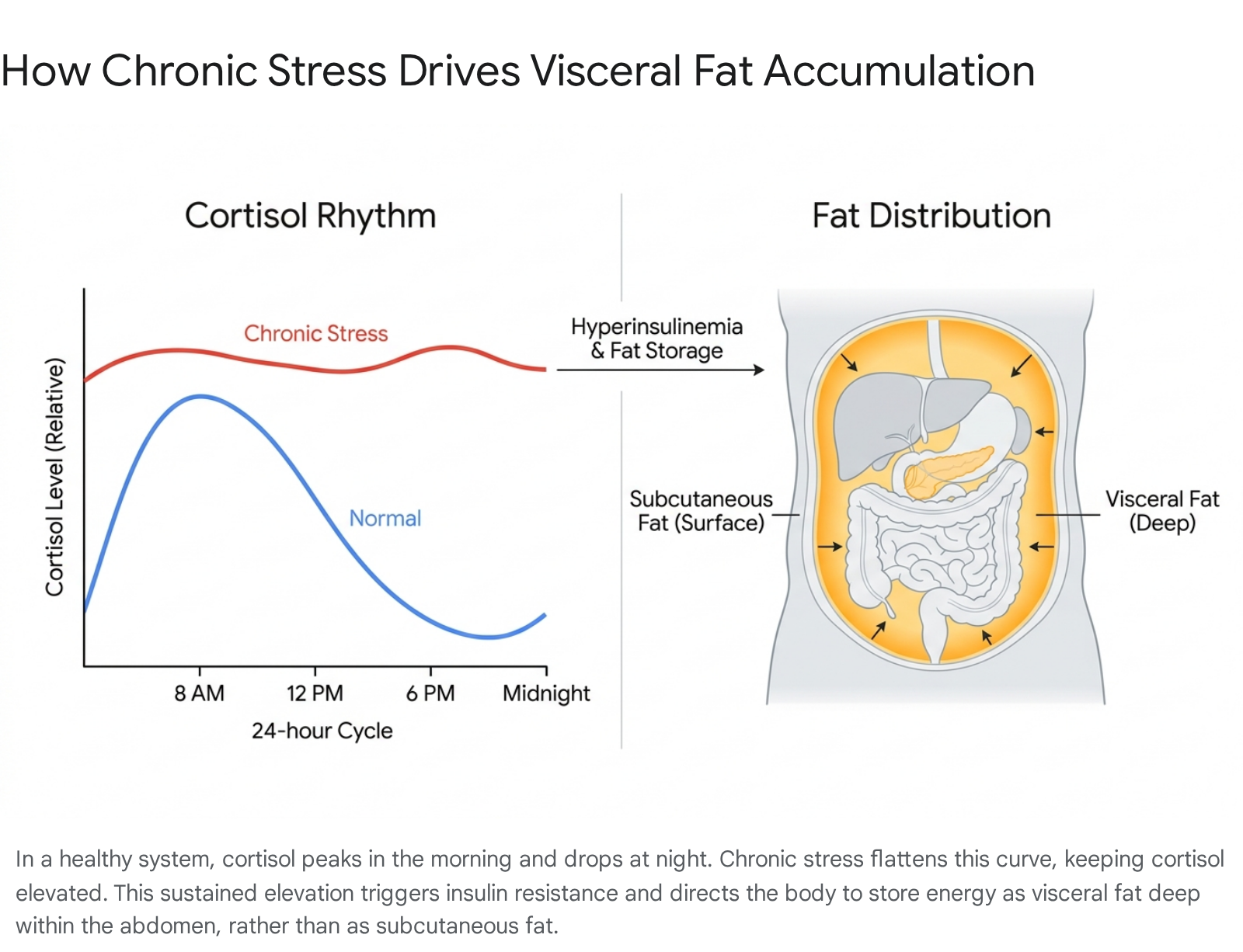
Visceral fat is highly metabolically active and functions almost like an endocrine organ itself. It secretes adipokines - hormones and inflammatory cytokines that disrupt metabolic function, leading to insulin resistance, increased cardiovascular risk, and a systemic state of low-grade, chronic inflammation 1915.
Studies have shown that individuals with a higher cortisol awakening response (CAR) and heightened cortisol reactivity to laboratory stressors are significantly more likely to have a higher waist-to-hip ratio and greater visceral fat deposition, even if their overall Body Mass Index (BMI) falls within a normal range 1117. Animal models and human clinical data alike demonstrate that chronic exposure to excess glucocorticoids causes persistent visceral adiposity that outlasts the initial stressor, making this fat particularly difficult to lose 1518.
Local vs. Systemic Cortisol: The 11β-HSD1 Enzyme
Interestingly, measuring systemic (circulating) cortisol in individuals with obesity often yields paradoxical results. Several studies have found that obese individuals actually have lower baseline total and salivary cortisol levels than lean individuals, alongside a blunted response to stress 1920.
This apparent contradiction is explained by how cortisol is metabolized at the tissue level. Adipose tissue expresses an enzyme called 11β-hydroxysteroid dehydrogenase type 1 (11β-HSD1). This enzyme acts as a local amplifier, regenerating active cortisol from inactive cortisone directly within the fat cells 182122.
In idiopathic (standard) obesity, there is an increased clearance of cortisol from the blood, but highly increased regeneration of cortisol inside the fat tissue via 11β-HSD1 2022. Therefore, a blood test might show normal or low systemic cortisol, while the visceral fat cells are simultaneously swimming in a localized cortisol surplus, driving further abdominal fat accumulation 1920.
True Cushing's vs. Pseudo-Cushing's: The Clinical Reality
When a patient presents to an endocrinologist with severe central weight gain, facial rounding, easy bruising, and purple stretch marks, doctors must differentiate between true Cushing's syndrome and pseudo-Cushing's states.
Cushing's syndrome is a rare, life-threatening condition caused by prolonged exposure to high levels of glucocorticoids. Most commonly, it is iatrogenic, meaning it is caused by prescription steroid medications 72324. Endogenous Cushing's - where the body makes too much of its own cortisol - is incredibly rare, affecting roughly 0.2 to 5 per million people annually 24. It is usually caused by a benign ACTH-secreting pituitary tumor (known specifically as Cushing's disease) or an adrenal tumor 232526.
How Doctors Test for True Hypercortisolism
Because cortisol naturally fluctuates, a single random blood draw is useless for diagnosing Cushing's 924. Before ordering any biochemical test, physicians must obtain a comprehensive medication history to rule out all sources of exogenous glucocorticoids - including oral tablets, inhaled asthma agents, topical creams, and joint injections - as failure to exclude iatrogenic exposure is the most common diagnostic pitfall 232728.
If external steroids are ruled out, endocrinologists rely on a rigorous, step-wise approach utilizing three first-line screening tests. Current guidelines from the Endocrine Society, as well as East Asian consensus statements, require positive results on at least two of these tests to proceed with a diagnosis 26272930:
| Diagnostic Test | What It Measures | Clinical Threshold for Abnormality | Key Pitfalls & Limitations |
|---|---|---|---|
| Late-Night Salivary Cortisol (LNSC) | Loss of normal circadian rhythm. Cortisol should be near zero at midnight. | > 3.6 nmol/L (or > 0.1 μg/dL) | Cannot be used in shift workers; highly sensitive to contamination from topical hydrocortisone 27. |
| Overnight 1-mg Dexamethasone Suppression Test (ODST) | Negative feedback loop. Dexamethasone should suppress morning cortisol. | > 1.8 μg/dL (or > 50 nmol/L) measured at 8:00 AM | False positives occur with estrogen use (pregnancy, birth control) or rapid drug metabolism 2730. |
| 24-Hour Urinary Free Cortisol (UFC) | Total integrated volume of cortisol secreted over a full day. | > 193 nmol/24h (or > 100 μg/24h) | Unreliable in patients with renal impairment; incomplete urine collection voids the result 2728. |
The Conundrum of Pseudo-Cushing's
The diagnostic waters are frequently muddied by "pseudo-Cushing's syndrome," now clinically termed non-neoplastic hypercortisolism 26313233.
Pseudo-Cushing's occurs when severe physiological or psychological stress causes the HPA axis to over-activate, resulting in mild hypercortisolemia and physical symptoms that heavily mimic true Cushing's 28314234. It is not caused by a tumor, but rather by underlying systemic conditions. The most common drivers of pseudo-Cushing's include chronic, severe alcoholism, major depressive disorder, uncontrolled diabetes, polycystic ovary syndrome (PCOS), and severe malnutrition or anorexia nervosa 2631324235.
To differentiate between a pituitary tumor and pseudo-Cushing's, specialists often use a Dexamethasone-CRH (Dex-CRH) test. In this test, after two days of dexamethasone suppression, a CRH-stimulated cortisol level greater than 87 nmol/l at the 15-minute mark correctly predicts true Cushing's disease with a 100% positive predictive value 3336. True Cushing's patients will still respond to CRH stimulation despite being suppressed by dexamethasone, whereas pseudo-Cushing's patients will not 24263346.
The "Adrenal Cocktail" and Social Media Cures
With the rise of cortisol anxiety comes a wave of influencer-promoted remedies, the most prominent being the "adrenal cocktail."
Typically composed of orange juice, coconut water, and a heavy pinch of sea salt - and sometimes elevated with cream of tartar or coconut milk - this drink is aggressively marketed as a cure for "adrenal fatigue" 474837. Proponents claim the specific combination of Vitamin C, potassium, and sodium replenishes the body's overworked adrenal glands and balances hormones naturally 473738.
Endocrinologists are quick to point out two major flaws with this trend. First, adrenal fatigue is a myth. The concept that the adrenal glands become "exhausted" from producing too much cortisol and simply stop working is not a recognized medical diagnosis 3738. True adrenal insufficiency, known as Addison's disease, is a serious autoimmune condition requiring immediate medical intervention, not dietary fruit juice 2.
Second, the adrenal cocktail is merely an electrolyte drink. While there is nothing inherently dangerous about an adrenal cocktail for a healthy person, there is zero clinical evidence that it heals the adrenal glands or lowers cortisol 3738. It provides rapid hydration, a quick hit of carbohydrates (sugar) for energy, and necessary electrolytes like sodium 4748. If someone feels significantly better after drinking it, it is likely because they were previously dehydrated or experiencing low blood sugar, not because they successfully hacked their endocrine system 4837.
The Cultural Psychology of Body Image
The popularity of the "cortisol face" and "stress belly" trends cannot be understood purely through biology; it requires a deep examination of global psychology and cultural body image standards. Body image dissatisfaction (BID) is a pervasive global health crisis, heavily driven by digital media and the internalization of rigid, often unattainable aesthetic ideals 394041.
When people feel they are failing to meet these standards, they experience profound psychological discomfort 4042. By labeling normal facial puffiness or natural abdominal fat as "cortisol face" or "stress belly," Western wellness culture effectively medicalizes normal human variation. It gives people a pseudo-scientific excuse for why their bodies do not look like filtered social media posts, turning natural physiological responses into a pathology that must be "cured" with consumer products.
Global Manifestations of Body Dissatisfaction
Research highlights how specific cultural contexts shape our anxieties about appearance. In Brazil, for example, a recent large-scale community-based study of adults aged 20 - 59 found that a staggering 87.1% of participants experienced body image dissatisfaction 3943. The vast majority of this dissatisfaction (75.1%) was related to perceived excess weight, particularly among women, while dissatisfaction related to thinness affected mostly men 3943.
Crucially, while this dissatisfaction in Brazil was associated with a more than fourfold increase in the odds of clinical depression and anxiety (OR = 4.24 and 4.54, respectively), researchers found no statistically significant association between body image dissatisfaction and stress itself 3943. This highlights a vital clinical paradox: while we constantly blame external stress for our changing bodies, it is the dissatisfaction with our bodies that is actively generating clinical mental health burdens.
Cultural Differences in Emotion Regulation
Furthermore, how different cultures cope with these body image threats heavily influences their mental health outcomes. Studies comparing European Western populations with East Asian populations reveal distinct regulatory strategies 4244. Western cultures often view emotions as emerging from a stable, internal self. When faced with a body image threat, Westerners are more likely to ruminate, internalize the failure, and attempt "Appearance Fixing" strategies to regain control 424445.
Conversely, East Asian cultures tend to view emotions as transient and context-dependent, highly valuing social harmony and interdependent social orientations 4245. Research indicates East Asian individuals are significantly more likely to utilize "Positive Rational Acceptance" - adjusting themselves to accommodate situational needs and accepting the transient nature of the threat rather than obsessively focusing on appearance fixing 4244. This acceptance serves as a protective buffer against the eating disorders, depression, and social anxiety that typically follow appearance fixing 42.
Evidence-Based Strategies for Managing Cortisol and Fat
If adrenal cocktails and TikTok hacks are not the answer, how can you effectively manage stress and mitigate the actual accumulation of visceral fat? The scientific literature overwhelmingly points to foundational lifestyle interventions rather than quick fixes.
1. Optimize Nutrition for Blood Sugar Stability
Diet plays a crucial role in regulating the HPA axis. High-glycemic diets filled with processed sugars cause rapid spikes and crashes in blood sugar, which the body interprets as an emergency, triggering cortisol release to mobilize energy 205859.
Adopting a Mediterranean-style diet rich in whole foods, lean proteins, and healthy fats helps stabilize blood sugar and lower systemic inflammation 5960. Key nutrients have been clinically shown to support stress resilience; for instance, foods high in Omega-3 fatty acids (salmon, walnuts) and magnesium (spinach, dark chocolate) help regulate the stress response 19586061. Additionally, some research suggests that adaptogenic herbs like ashwagandha and rhodiola may help moderate the HPA axis during times of high stress, though they are not a replacement for a balanced diet 65860.
For those targeting visceral fat, recent meta-analyses on intermittent fasting (IF) offer compelling data. A 2024 review of 24 trials involving 2,032 participants found that long-term intermittent fasting significantly reduced body weight, visceral fat, and waist circumference compared to standard control diets 46. However, when compared directly to continuous energy restriction (standard calorie counting), IF and continuous restriction are comparably effective, meaning the best diet is the one a patient can adhere to consistently 4647.
2. Prioritize Low-Intensity Steady-State (LISS) Exercise
While exercise is excellent for health, severe high-intensity interval training (HIIT) or over-exercising without adequate recovery acts as a massive physical stressor, keeping cortisol levels chronically elevated 191448.
Research shows that 150 - 200 minutes per week of low-to-moderate intensity exercise - such as brisk walking, cycling, or light jogging - effectively reduces cortisol levels and specifically targets visceral belly fat without overwhelming the central nervous system 19596148. Mind-body movements like Yoga, Tai Chi, and Pilates are particularly effective, as they combine physical exertion with breathwork, which has been shown to lower cortisol levels by up to 31% while improving insulin sensitivity 192261.
3. Implement Strict Sleep Hygiene
Sleep is the critical window when the body repairs the HPA axis and resets its hormonal baseline. Lack of sleep directly disrupts the natural diurnal rhythm, leading to higher cortisol levels upon waking and throughout the day 205861. To regulate this, experts recommend aiming for 7 to 9 hours of consistent sleep, going to bed and waking up at the exact same time daily 206061. Avoiding blue light from screens and limiting caffeine intake in the hours leading up to bed is essential, as both interfere with melatonin production and artificially stimulate the stress response 586148.
4. Practice Active Stress Management
You cannot eliminate stress, but you can change how your amygdala responds to it. Mindfulness meditation, deep breathing exercises, and cognitive reframing effectively dial down the sensitivity of the brain's fire alarm 58596165. Engaging in these practices for just 10 to 15 minutes a day has been shown to enhance emotional regulation and blunt the cortisol spikes associated with daily frustrations, directly mitigating the hormonal drive to store visceral fat 5859.
Bottom line
The viral concept of "cortisol face" is largely a myth; everyday psychological stress cannot drive cortisol high enough to cause the clinical facial fat redistribution seen in medical conditions like Cushing's syndrome. However, chronic stress can severely disrupt your metabolism, driving the accumulation of dangerous visceral belly fat through hyperinsulinemia and local tissue-level enzyme activity. Ultimately, attempting to cure these aesthetic concerns with unproven supplements or adrenal cocktails is ineffective; true hormonal balance requires a commitment to unglamorous, evidence-based habits like consistent sleep hygiene, moderate exercise, and foundational stress management.