
How a Normal Workday Affects Your Stress Hormones
During a normal workday, your primary stress hormone, cortisol, naturally spikes in the morning to provide energy and focus, gradually tapering off as evening approaches to allow for restful sleep. When workplace stress becomes chronic and unmanageable, this natural diurnal rhythm flattens out, leaving you exhausted during the day and wired at night. Over time, this constant hormonal dysregulation causes cumulative wear and tear on your bodily systems, driving burnout, cognitive decline, and metabolic dysfunction.
The Biology of a Healthy Workday
Stress in the workplace is almost universally categorized as a negative force. However, human biology requires a certain level of stress to function, adapt, and succeed. The physiological systems that manage stress are elegantly designed to help us navigate daily challenges, provided they are given the opportunity to reset.
The Cortisol Awakening Response
A healthy stress response begins the moment you wake up. Cortisol is a glucocorticoid hormone produced by the adrenal glands, which sit atop your kidneys. Within the first 30 to 45 minutes of rising, your brain signals the adrenal glands to release a massive surge of cortisol 121. This surge, known as the Cortisol Awakening Response (CAR), typically increases your circulating cortisol levels by 50% to 75% 22.
Cortisol is widely misunderstood as just a panic hormone, but it is actually a vital steroid hormone responsible for mobilizing glucose for energy, slightly raising blood pressure to increase blood flow, managing inflammation, and sharpening mental focus 2134. A robust Cortisol Awakening Response is a strong indicator of a resilient hypothalamic-pituitary-adrenal (HPA) axis, which is the body's central stress response system 2.
Exposure to bright morning sunlight within the first few hours of waking has been shown to enhance this natural cortisol rise. Research indicates that exposure to bright light (between 2,500 and 10,000 lux) can increase the cortisol awakening peak by 20% to 40% 56. This photic information travels from the retina to the suprachiasmatic nucleus, the brain's master clock, helping to synchronize your circadian rhythm, suppress sleep-inducing melatonin, and optimize stress hormone function for the rest of the day 78119.
Eustress and the Dual Stress Axes
As you begin your workday, you encounter various demands, ranging from deadlines to complex problem-solving tasks. When you perceive these challenges as manageable, your body experiences "eustress" - a positive, motivating form of stress 131015.
During eustress, two primary systems work in tandem to optimize your performance: the sympathetic-adrenomedullary (SAM) system and the HPA axis 1112. The SAM system reacts instantly to immediate stimuli by releasing catecholamines like adrenaline and noradrenaline into the bloodstream 1013. This creates the classic "fight-or-flight" response, instantly elevating your heart rate, dilating blood vessels, and sharpening your immediate attention 310. Cortisol follows shortly after to sustain this energy by ensuring the brain has a steady supply of glucose 3. Under moderate, manageable stress, these hormones increase motivation, enhance cognitive performance, and foster a state of deep focus 41519.
Cortisol vs. Alpha-Amylase
To measure how workers react to daily stressors, researchers often evaluate two distinct salivary biomarkers: cortisol and salivary alpha-amylase (sAA). While cortisol reflects the slower, more sustained activation of the HPA axis, sAA acts as a highly sensitive surrogate marker for the rapid, sympathetic nervous system 112014.
Studies on office workers show that alpha-amylase spikes rapidly during acute psychosocial stressors, such as public speaking or meeting a sudden deadline, and recovers quickly once the stressor is removed 15. Cortisol, by contrast, takes about 20 minutes to reach its peak concentration after a stressor is introduced 1315. Interestingly, these two markers affect cognitive performance differently. Research demonstrates that acute sympathetic activation (marked by an sAA spike) improves working memory and immediate recall. However, sharp spikes in cortisol are associated with a temporary decrease in long-term memory retrieval, as glucocorticoids bind to receptors in the hippocampus and alter neural processing 13.
| Phase of Day | Healthy Cortisol Range (ng/mL) | Physiological Function | Signs of Dysregulation |
|---|---|---|---|
| Morning (Waking + 30m) | 13 - 24 ng/mL | Triggers wakefulness, mobilizes glucose, sharpens cognition. | Difficulty waking, deep fatigue, brain fog. |
| Afternoon | 5 - 10 ng/mL | Sustains energy for daily tasks; begins gradual decline. | Mid-day energy crashes, reliance on stimulants. |
| Night (Bedtime) | 1 - 4 ng/mL | Allows melatonin production to initiate restorative sleep. | "Tired but wired" feeling, insomnia, restlessness. |
Table 1: The standard diurnal cortisol rhythm in a healthy adult. Disruptions to this curve are primary indicators of chronic stress and burnout 2. Note that individual baseline levels may vary slightly.
When Workplace Stress Becomes Chronic
When workplace stress transforms from episodic, manageable challenges into relentless pressure, the body's recovery mechanisms fail. The HPA axis remains locked in an "on" position, leading to a cascade of physiological breakdowns that extend far beyond feeling simply tired 19.
Allostatic Load and HPA Axis Dysregulation
The cumulative physiological toll of chronic stress is known in psychosomatic medicine as "allostatic load" 162425. Allostasis is the process by which the body adapts to stress to regain internal balance, or homeostasis 25. However, adaptation requires immense biological energy. When an employee faces unyielding deadlines, interpersonal conflict, or job insecurity, the repeated activation of the stress response causes profound wear and tear on the cardiovascular, metabolic, and immune systems 31325.
Over time, this chronic exposure fundamentally alters the body's cortisol rhythm. Instead of a steep morning spike and a low nighttime trough, chronic stress often produces a "flattened" diurnal cortisol curve 212. A massive meta-analysis of past studies found a clear, significant link between flatter diurnal cortisol slopes and poorer mental and physical health, particularly in relation to systemic inflammation and immune disorders 12.
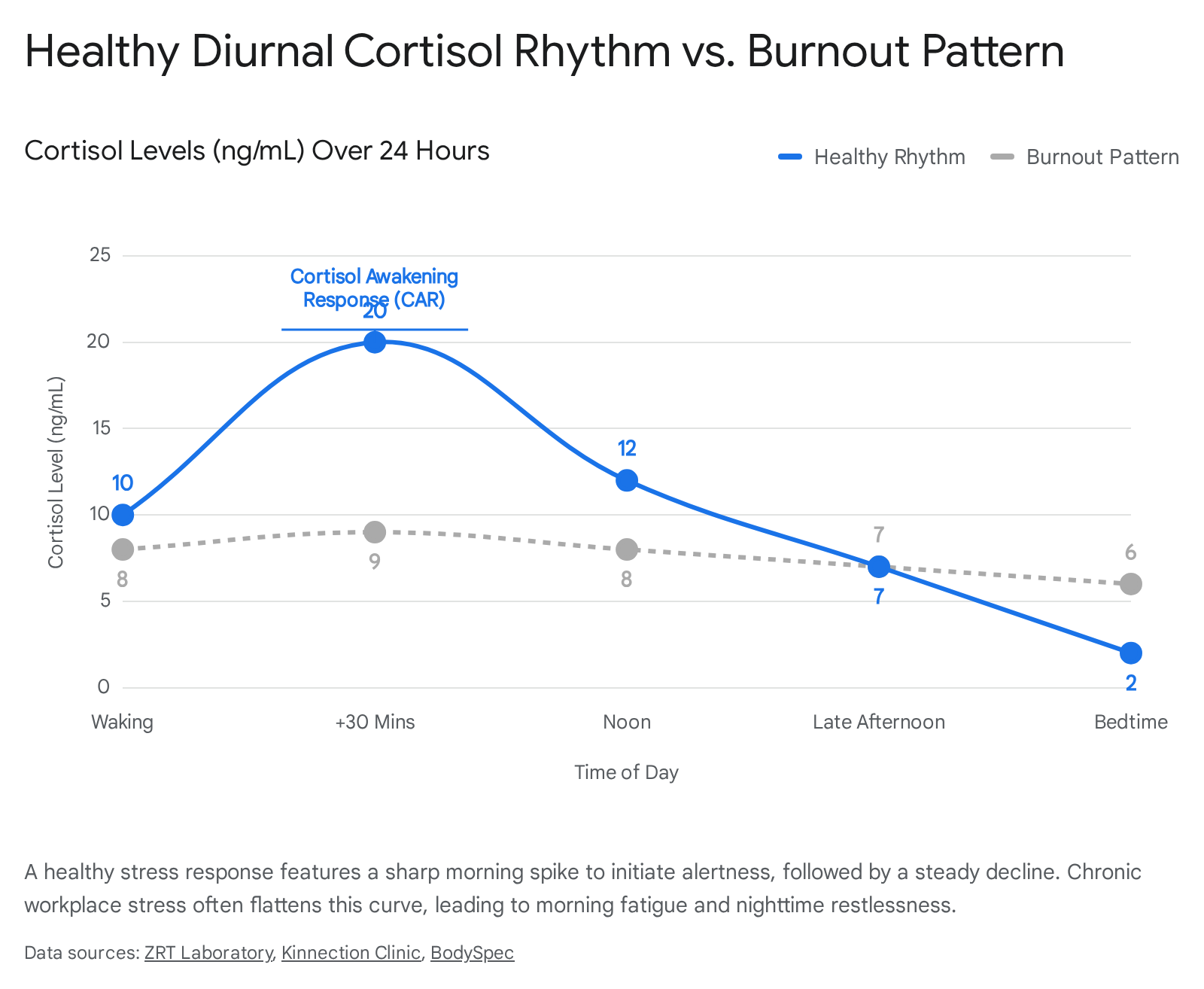
This flattened curve can manifest in two distinct physiological states depending on the duration and severity of the stress: 1. Hypercortisolism (Elevated Baseline): In the earlier stages of chronic stress, cortisol remains persistently high throughout the day and into the night. This elevated evening cortisol suppresses melatonin production, disrupts sleep architecture, and prevents cellular repair 1317. Chronic hypercortisolism is linked to insulin resistance, loss of bone density, high blood pressure, and a weakened immune response 327. 2. Hypocortisolism (Blunted Response): After prolonged periods of unremitting stress, the HPA axis may fundamentally downregulate, resulting in an abnormally low morning Cortisol Awakening Response and depressed cortisol levels throughout the day 181920. This state is heavily correlated with clinical burnout, profound daytime exhaustion, food cravings, and emotional cynicism 111820.
The Systemic Impact of Burnout
The consequences of unmanaged allostatic load are profound. Burnout is no longer viewed merely as a psychological state of being overwhelmed; it is increasingly recognized as a systemic and chronobiological disorder 19. High levels of cortisol and systemic inflammation impair neurochemical balance in the brain, increasing the release of inflammatory cytokines 27. This inflammation interferes with the body's normal healing responses, slowing wound repair and increasing susceptibility to infections, which ultimately leads to higher rates of absenteeism 27.
Furthermore, chronic stress affects reproductive health and sex drives. Consistent HPA axis activation can suppress testosterone production and affect the biochemical functioning of the reproductive system, leading to a noticeable decline in libido 3. The continuous activation of the cardiovascular system also dramatically increases the long-term risk for hypertension, heart attacks, and strokes 3.
The Global Epidemic of Workplace Burnout
The physiological toll of modern work is visible on a massive global scale. Recent organizational data indicates that workplace burnout has reached unprecedented levels, affecting nearly every demographic and region.
According to a 2024 report by DHR Global surveying white-collar knowledge workers across North America, Europe, and Asia, an alarming 82% of employees reported experiencing some degree of burnout 3121. Similarly, a comprehensive global study by the Boston Consulting Group (BCG) found that nearly half (48%) of all workers are currently grappling with burnout, a state characterized by exhaustion, disenchantment, and a sense of professional inefficiency 22.
Interestingly, burnout does not necessarily mean employees are "checking out." The DHR Global survey revealed a confounding overlap: despite 82% of workers feeling burned out, 88% still reported being "highly engaged" with their work 3121. This suggests a dangerous "locked-in" effect where employees are trapped by tight job markets or internal pressures, continuing to output high effort while their biological systems deteriorate 31.
The financial cost of this biological crisis is staggering. Gallup's State of the Global Workplace report estimates that the productivity losses caused by disengagement and burnout equal $48 billion in lost productivity globally, with low engagement costing the world economy nearly 9% of global GDP 343536. An estimated 12 billion working days are lost every year to depression and anxiety, translating to a US $1 trillion annual cost to the global economy 37.
| Metric | Global Statistic | Implication for Workplaces |
|---|---|---|
| Global Burnout Rate | 48% to 82% | Between half and four-fifths of the global workforce is experiencing symptoms of burnout, indicating systemic work design failures 212236. |
| Daily Stress Levels | 41% to 43% | Over four in ten employees experience significant stress on a daily basis, driving chronic HPA axis activation 3438. |
| Global Engagement | 21% | Global employee engagement has fallen to levels not seen since the COVID-19 pandemic, costing the economy trillions 3435. |
| Turnover Intent | 50% to 52% | Workers experiencing burnout are twice as likely to actively seek new employment, severely impacting retention 3536. |
Table 2: Key statistics highlighting the scale of the global workplace stress and burnout crisis in 2024 and 2025.
Demographically, younger workers are bearing the brunt of this crisis. The DHR Global survey found that 87% of Generation Z workers and 85% of Millennials reported feeling burned out, compared to 76% of Generation X and 57% of Baby Boomers 21. Furthermore, marginalized groups, including women, members of the LGBTQ+ community, and people with disabilities, experience up to 26% higher rates of burnout, underscoring how lack of inclusion acts as a chronic psychosocial stressor 22.
How Modern Work Designs Disrupt Hormones
The way modern work is structured heavily dictates our physiological stress responses. Changes in where and when we work have introduced novel stressors that directly impact hormone regulation.
The "Always-On" Culture of Hybrid Work
While hybrid and remote work models have offered unprecedented flexibility, they have also fundamentally blurred the boundaries between professional and personal life. Without the physical transition of commuting to an office, remote workers frequently struggle to log off at the end of the day 4041.
This leads to a phenomenon known as "soft overtime" - unpaid, unrecorded work performed during evenings and weekends simply because digital devices keep employees reachable at all hours 40. This "always-on" culture keeps the HPA axis engaged well beyond normal working hours. Constantly checking emails, responding to instant messages, or participating in continuous video conferencing ("Zoom fatigue") prevents the parasympathetic nervous system from initiating the recovery phase 4023. As a result, evening cortisol levels remain inappropriately elevated, compromising sleep quality and accelerating allostatic load 402343.
Paradoxically, while hybrid models can increase raw productivity and self-reported work-life balance for some, fully remote work carries hidden psychological costs 4123. Gallup reports that 25% of fully remote workers experience daily loneliness, compared to 16% of on-site workers 3438. Social isolation is a well-documented chronic psychosocial stressor that can elevate baseline cortisol levels and increase the risk of anxiety and depression 142343.
The Physiological Disruption of Shift Work
If standard office stress bends the diurnal cortisol curve, shift work actively breaks it. Between 15% and 25% of the global industrialized workforce engages in shift work, a practice inherently at odds with human evolutionary biology 2425.
The body's central circadian pacemaker is heavily reliant on the external light-dark cycle 724. When nurses, emergency responders, or logistics workers work through the night, they face profound circadian desynchronization. Working under artificial light suppresses the nocturnal release of melatonin, while attempting to sleep during the day conflicts with the body's natural drive to produce cortisol 71724.
Clinical evaluations of night-shift workers reveal severely blunted diurnal cortisol variations, flattened curves, and irregular melatonin secretion 71719. This internal misalignment between the circadian network and peripheral organs leads to higher incidences of metabolic syndrome, glucose intolerance, cardiovascular disease, and systemic inflammation 17192627.
Furthermore, the specific design of the shift matters. Studies indicate that irregular, rapidly rotating shifts - such as a "PAN" pattern where nurses move from afternoon to morning to night shifts within a 40-hour window - drastically reduce waking cortisol levels 28. This deprives workers of the biological energy needed to start their day, leading to severe sleep inertia and cognitive deficits that increase the risk of workplace accidents 2528. Biological adaptation to night shifts is notoriously difficult; field studies show that the circadian system is highly resistant to shifting from a day-oriented to a night-oriented schedule, leaving workers in a perpetual state of biological jet lag 26.
Global Work Cultures and Stress
The threshold for when stress becomes harmful is deeply influenced by cultural expectations regarding labor and productivity.
In East Asia, the historic pursuit of rapid macroeconomic growth has fostered extreme corporate cultures. In Japan, the cultural concept of enduring suffering with dignity (gaman) has historically normalized excessive overtime, leading to the legally recognized phenomenon of Karoshi - literal death from overwork, often manifesting as stress-induced heart attacks or strokes 4950. South Korea faces similar systemic pressures, boasting some of the longest working hours in the OECD, driven by a "hurry-hurry" (ppali-ppali) culture that views extreme overtime as a baseline marker of diligence rather than an exception 495029. In China's tech sector, the grueling "996" schedule (working 9:00 a.m. to 9:00 p.m., six days a week) keeps the body in a state of perpetual cognitive and physical activation, driving massive allostatic load 49.
Research indicates that in these highly rigid, hierarchical environments, employees often engage in "reading the air" - hyper-analyzing social dynamics to avoid contradicting superiors, which acts as an ongoing psychological stressor that suppresses creative problem-solving and replaces it with anxiety 49. Furthermore, studies note that workers in East Asia report working the longest hours globally, yet they are culturally less likely to discuss work-related stress with peers or management, compounding feelings of isolation 30.
By contrast, Western corporate environments increasingly emphasize wellness initiatives, mental health days, and flexible work arrangements 4930. Yet, they still face massive burnout crises. In North America and Europe, workplace stress is often driven by psychological factors - such as digital overload, interpersonal conflict, performance pressure, and job insecurity - rather than the sheer physical exhaustion of mandated 70-hour weeks 312153. Europe, for example, reports the highest percentage of unengaged employees globally at 73% 35. Regardless of the cultural origin, the biological endpoint of chronic stress is identical across the globe: hypercortisolism followed by HPA axis exhaustion.
Debunking Viral Stress Myths
As burnout has become a dominant cultural conversation, social media has filled the void with oversimplified biological explanations. Several pervasive myths regarding stress hormones require scientific correction to prevent individuals from pursuing ineffective or harmful treatments.
Debunking "Adrenal Fatigue"
A highly common claim in alternative wellness circles is that chronic stress causes the adrenal glands to "burn out" or run out of the ability to produce cortisol - a condition commonly dubbed "adrenal fatigue" 5431.
The global endocrinology community has unequivocally rejected this diagnosis. The Endocrine Society, representing thousands of medical specialists, states clearly that there is no scientific basis to suggest that mental or physical stress drains the adrenal glands of their capacity to function 543156. While the symptoms of burnout - profound exhaustion, brain fog, and reliance on caffeine - are very real, they are caused by disruptions in the communication between the brain (the hypothalamus and pituitary gland) and the adrenal glands, not by the physical failure of the glands themselves 563233.
If you are chronically stressed, your adrenal glands will continue to synthesize and release cortisol. Feeling exhausted is a result of brain receptor downregulation, circadian disruption, and systemic inflammation, not "tired" organs 3132. Attempting to treat "adrenal fatigue" with unregulated glandular supplements or cortisol replacements is not only ineffective but can be actively dangerous, potentially suppressing natural hormone production and increasing the risk of osteoporosis or diabetes 5633.
Is "Cortisol Face" Real?
Recently, social media platforms have been flooded with claims that everyday stress causes "Cortisol Face" - a dramatically bloated, round, and puffy facial appearance, leading influencers to sell various remedies to "lower cortisol and slim the jawline" 346061.
In medicine, a truly round, swollen face caused by fat accumulation is a recognized clinical sign known as "moon facies" 6135. However, moon facies is a symptom of Cushing's syndrome, a rare endocrine disorder caused by pituitary or adrenal tumors, or by prolonged use of high-dose corticosteroid medications 346164. These conditions result in a massive, pathological overproduction of cortisol 3565.
Everyday workplace stress does not elevate cortisol to the extreme levels required to structurally redistribute facial fat into a clinical "moon face" 34606466. While chronic stress can affect your appearance, it does so through different mechanisms. Cortisol degrades collagen proteins, leading to thinning skin and earlier wrinkle formation, and it triggers increased sebum (oil) production, leading to stress-related acne breakouts 676869. Elevated cortisol also decreases epidermal lipids, leading to increased transepidermal water loss and a compromised skin barrier, which makes the skin look dull and dry 3671. However, sudden and severe facial puffiness is much more likely caused by fluid retention from a high-sodium diet, alcohol consumption, lack of sleep, or allergies - not by stress alone 346437.
Does Delaying Caffeine Actually Help?
Another highly popular productivity trend dictates that you must delay your first cup of coffee for 90 to 120 minutes after waking. Proponents claim that drinking caffeine immediately spikes your already high morning cortisol (the CAR) leading to overstimulation, and that delaying coffee allows the sleep-inducing chemical adenosine to naturally clear from the brain, preventing afternoon energy crashes 387475.
While timing caffeine intake can be a useful personal preference, the strict physiological reasoning often cited is scientifically flawed. Clinical research shows that while caffeine does trigger a cortisol release in naive users, habitual coffee drinkers (which includes most working adults) quickly build a tolerance. For people who consume caffeine daily, the cortisol response to a morning coffee is virtually abolished 7677.
Furthermore, the sensation of waking up is driven by the clearance of adenosine during sleep. Adenosine does not continue to steadily decline in the 90 minutes after waking; in fact, the moment you wake up, adenosine begins slowly building again 7677. Caffeine works best when it can bind to adenosine receptors immediately post-sleep to reduce sleep inertia 76. Delaying caffeine may help highly anxious individuals avoid compounding their natural morning arousal with a stimulant, but it does not biologically "protect" your natural cortisol rhythm or magically prevent afternoon crashes, which are more often linked to meal timing and hydration 7677.
| Viral Phenomenon | The Social Media Claim | The Clinical Medical Reality |
|---|---|---|
| Adrenal Fatigue | Chronic stress exhausts the adrenal glands until they physically cannot produce cortisol. | The adrenals do not fail from stress. Exhaustion is caused by brain-level HPA axis dysregulation and systemic inflammation 545632. |
| Cortisol Face | Everyday work stress directly causes a bloated, dramatically round "moon face." | True moon face requires clinical pathology (Cushing's syndrome). Stress-related puffiness is usually minor water retention from diet or poor sleep 346064. |
| Caffeine Timing | You must delay coffee 90 mins to protect your natural cortisol spike and clear adenosine. | Habitual caffeine users do not experience a cortisol spike from morning coffee anyway. Adenosine clears during sleep, not after waking 7677. |
Table 3: Comparing popular stress hormone myths with clinical endocrinology consensus.
The Science of Stress Recovery
Recovering from workplace stress is not a passive process; it is an active biological requirement. Because hormones like cortisol take time to clear from the bloodstream, the body requires deliberate interventions to signal safety to the brain and initiate the parasympathetic "rest and digest" response.
How Long Does It Take to Recover?
Following an acute stressor - such as a tense meeting with a manager or a suddenly accelerated deadline - it takes the body roughly 20 to 60 minutes for cortisol levels to naturally decline back to baseline, provided the stressor is completely removed 1339.
However, if an employee immediately moves to another stressful task, or if they continue to ruminate on the stressful event, the HPA axis remains active, and cortisol levels stay elevated. Recovering from chronic stress and allostatic load is a much longer and more complex process. It can take weeks or even months of sustained behavioral changes, improved sleep hygiene, and reduced workloads to fully restore a healthy, steep diurnal cortisol curve 139.
The Power of Detachment and Micro-breaks
To facilitate daily recovery and prevent stress from accumulating, organizational psychologists and physiologists emphasize the necessity of "psychological detachment" - the ability to completely cognitively disconnect from work-related thoughts 79. This is increasingly difficult in an era of smartphones and hybrid work, but establishing strict boundaries (such as silencing work notifications after hours) is proven to lower evening cortisol levels and improve next-day engagement 4079.
Throughout the workday, implementing "micro-breaks" is a highly effective, evidence-based strategy. Just 10 to 15 minutes spent stepping away from a screen to engage in deep breathing, light stretching, or positive social interaction can interrupt the continuous activation of the sympathetic nervous system 79. These brief pauses prevent the slow, cumulative build-up of cortisol, allowing the body to reset its stress baseline before the next challenge arises.
Bottom line
Your stress hormones, particularly cortisol, are not inherent enemies; they provide the essential biological energy required to navigate a normal workday, mobilize resources, and meet challenges with sharp focus. However, when work environments demand constant, unyielding vigilance - through excessive workloads, blurred digital boundaries, or biologically disruptive shift work - the body's central stress response breaks down, replacing a healthy daily rhythm with a flattened, chronic state of alert. Protecting yourself against burnout requires actively managing recovery, honoring your circadian rhythms, and recognizing that human biology is simply not built for endless, uninterrupted output.