
What Startups Need to Know About EU AI Act Sandboxes
By August 2026, every European Union Member State must operate an artificial intelligence regulatory sandbox, offering startups a structured, supervised environment to test high-risk AI systems before facing full market compliance. While these sandboxes provide small businesses with priority access, fee waivers, and vital exit reports to accelerate market entry, they do not grant blanket immunity from overarching laws like the GDPR. Startups must act immediately to secure spots in early pilot programs, as institutional readiness currently varies drastically across the continent.
The New Regulatory Reality for Artificial Intelligence
The European Union Artificial Intelligence Act (Regulation (EU) 2024/1689), which officially entered into force in August 2024, represents the world's first comprehensive, binding legal framework for artificial intelligence 12. For the global technology sector, it is a paradigm-shifting piece of legislation. It shifts the oversight of software from a reactive, post-market enforcement model to a proactive, product-safety framework 3.
While the overarching aim is positive - ensuring that AI is safe, transparent, and aligned with fundamental human rights - the complexity of the legislation has generated a massive wave of anxiety, fear, and misinformation within the European startup ecosystem 1. Much like the panic that preceded the enforcement of the General Data Protection Regulation (GDPR) in 2018, some founders have questioned whether they need to leave the EU entirely to continue innovating 1.
However, regulatory experts argue that the AI Act will not kill innovation; rather, it will shape it to be more accountable 1. The law is not a blanket ban on artificial intelligence 1. Instead, it introduces a tiered, risk-based classification system that dictates the severity of a company's compliance obligations 15.
Understanding the Risk Tiers
To understand whether a startup actually needs to utilize a regulatory sandbox, founders must first accurately classify their technology. The vast majority of bootstrapped AI startups in Europe build products that sit in the minimal or limited risk categories, carrying very light compliance burdens 5.
The AI Act categorizes systems into four distinct tiers:
| Risk Tier | Examples of AI Systems | Startup Obligations | Sandbox Utility |
|---|---|---|---|
| Unacceptable Risk | Social scoring, manipulative AI, real-time biometric surveillance. | Banned outright as of February 2025 15. | None. These systems cannot be legally developed or tested for the market. |
| High Risk | AI in hiring, credit scoring, healthcare, education, law enforcement, critical infrastructure 11. | Full compliance: mandatory CE marking, technical documentation, third-party audits, human oversight 5. | Maximum Utility. Sandboxes are explicitly designed to help these companies navigate complex compliance before launch. |
| Limited Risk | Chatbots, customer service AI, non-harmful deepfakes, marketing automation 1. | Transparency only: Users must be clearly informed they are interacting with AI 15. | Minimal. Compliance is straightforward and does not require supervised testing. |
| Minimal Risk | Spam filters, AI in video games, basic analytics 15. | None. Encouraged to adopt voluntary codes of conduct 15. | None. |
For startups building high-risk systems, the compliance burden is heavy and the cost of failure is existential. Recognizing that strict regulations often disproportionately harm small businesses that lack massive legal departments, the European Commission integrated specific measures to support innovation 27. The cornerstone of this innovation support is the AI regulatory sandbox.
What Exactly Is an AI Regulatory Sandbox?
A regulatory sandbox in the tech industry typically conjures images of a digital testing environment or an API playground. Under the EU AI Act, however, a regulatory sandbox is a legally defined supervisory mechanism, not an industry-led innovation lab 39.
According to Article 57 of the AI Act, an AI regulatory sandbox provides a "controlled environment that fosters innovation and facilitates the development, training, testing and validation of innovative AI systems for a limited time before their being placed on the market or put into service" 10.
These environments are set up and monitored by a national competent authority 4. The fundamental goal is to connect innovators and regulators directly. This allows businesses to explore and experiment with new products under a regulator's supervision, providing innovators with incentives to test their algorithms in a controlled environment while allowing regulators to better understand emerging technologies 56.
The Four Core Purposes of the Sandbox
For startups, entering a sandbox means shifting from a mindset of unchecked disruption to one of structured experimentation. Under Articles 57 and 58 of the AI Act, sandboxes serve four primary operational purposes 9:
- Development and Testing: Startups can train and validate their AI systems in highly controlled conditions, and in certain authorized cases, in supervised real-world conditions 97.
- Regulatory Learning: Founders can understand exact legal requirements by receiving direct, actionable feedback from the authorities who will eventually regulate them 9.
- Risk Identification: Participants work hand-in-hand with supervisors to actively identify and mitigate risks to fundamental rights, health, and safety 97.
- Market Preparation: Startups can build robust compliance readiness, including risk management systems and technical documentation, before the full weight of the market obligations applies 915.
Debunking the Immunity Myth
One of the most dangerous misconceptions circulating among founders is that the sandbox acts as a temporary suspension of all existing laws, particularly the GDPR 18. This is definitively false.
The sandbox is not a zone of legal immunity. For example, France's data protection authority (CNIL), which operates a sandbox for AI in public services, explicitly notes that the environment "does not allow the removal of legal constraints, even temporarily, because personal data law does not allow it" 8. If an AI system relies on processing the personal data of EU residents, the startup must maintain full GDPR compliance, conduct Data Protection Impact Assessments (DPIAs), and respect user privacy rights 89.
What the sandbox does offer is a safe space to test how an AI system complies with both the AI Act and the GDPR simultaneously, with regulators providing guidance on how to lawfully implement concepts like data minimization and pseudonymization in complex algorithmic training 810.
The Startup Advantage: Concessions and Cost Savings
The European Union views small and medium-sized enterprises (SMEs), including startups, as the engine of its digital economy 711. The term "SME" appears almost 40 times in the AI Act, indicating a clear legislative intent to shield smaller innovators from the crushing compliance costs that usually favor massive legacy tech monopolies 11.
Priority Access and Free Entry
Article 62 of the AI Act mandates that Member States must provide EU-registered SMEs and startups with "priority access" to their national AI regulatory sandboxes 1120. Furthermore, under Article 58, participation in these sandboxes must be provided free of charge to SMEs and startups 98.
However, there is a financial caveat: national competent authorities reserve the right to recover "fair and proportionate exceptional costs" 28. While the baseline regulatory guidance, application processing, and routine supervisory check-ins are free, startups should clarify what qualifies as an exceptional cost before signing an agreement. Exceptional costs may include highly specialized third-party technical audits, specific high-performance computing resources required for the test, or external sector-specific expert consultations 812.
The "Inverse Fine Cap" Protection
Perhaps the most significant financial protection granted to startups is how the AI Act treats regulatory penalties. The AI Act is famous for its massive fines, but the penalty structure was carefully engineered to avoid bankrupting small businesses over accidental infractions.
Under standard rules, the AI Act sets fines as the higher of a fixed monetary amount or a percentage of the company's global annual turnover 20. For large corporations, a severe violation (such as deploying a prohibited AI practice under Article 5) triggers a fine of up to €35,000,000 or 7% of global turnover, whichever hits harder 20.
However, Article 99(6) of the AI Act establishes a vital "inverse fine cap" specifically for SMEs and startups 20. For these entities, the fine is calculated as the lower of the two figures 20.
| Company Profile | Annual Global Turnover | Violation Type | AI Act Fine Calculation Rule | Maximum Financial Exposure |
|---|---|---|---|---|
| Enterprise AI Provider | €2 Billion | Prohibited Practice (Article 5) | Higher of €35M or 7% of turnover | €140,000,000 (7% of €2B) 20 |
| High-Growth Startup | €10 Million | Prohibited Practice (Article 5) | Lower of €35M or 7% of turnover | €700,000 (7% of €10M) 20 |
| Early-Stage SME | €1 Million | Prohibited Practice (Article 5) | Lower of €35M or 7% of turnover | €70,000 (7% of €1M) 20 |
This inverse fine cap guarantees that a startup will never face an apocalyptic €35 million fine simply because their turnover is low 20. Additionally, startups benefit from reduced conformity assessment fees, which competent authorities must scale proportionally to the company's size and market share 1120.
The Sandbox Liability Shield
A major hesitation for founders entering a regulatory sandbox is the fear of inadvertently admitting to a compliance failure in front of the regulator. The AI Act addresses this through a conditional liability shield 7.
If a startup participates in a sandbox, follows the specific testing plan, and adheres in good faith to the guidance given by the national competent authority, the authorities will impose no administrative fines for infringements of the AI Act that occur within the sandbox 78. This allows developers to test volatile or unpredictable AI models without the looming threat of regulatory action.
However, this shield only protects against state-imposed administrative fines. Providers remain fully liable under applicable Union and national liability laws for any actual damage inflicted on third parties (e.g., consumers, patients, or other businesses) as a result of the experimentation taking place in the sandbox 711.
Navigating the Sandbox Lifecycle
The journey through an AI regulatory sandbox is a highly structured, sequential process.
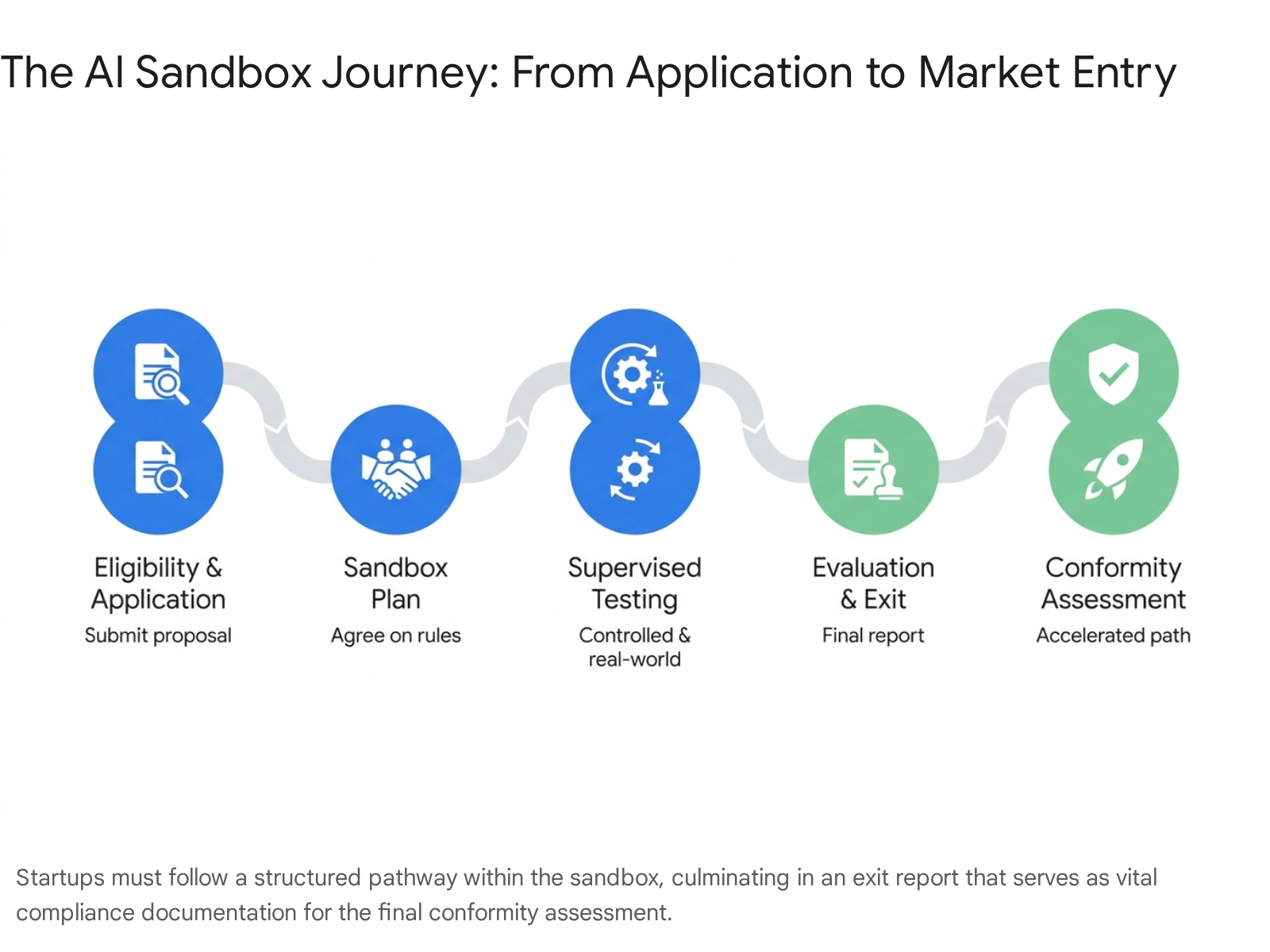
It requires rigorous preparation, deep collaboration with government officials, and a commitment to radical transparency regarding how an AI model is built, trained, and deployed.
Phase 1: Application and the Sandbox Plan
To enter, a startup must submit a comprehensive application to the relevant national competent authority. If accepted, the startup and the regulator co-draft a "sandbox plan" 107. This legally binding document outlines the scope of the experimentation, the specific regulatory uncertainties being tested, the timeline, and the safeguards put in place to protect fundamental rights and health 713.
If the testing is to occur in "real-world conditions" outside of a closed laboratory setting, the national authority must explicitly authorize this and agree on enhanced safeguards to protect any end-users or citizens who may interact with the system 713.
Phase 2: Active Supervision and Iteration
During the testing phase, the startup implements the requirements of the AI Act in real time. This includes establishing risk management systems, executing data governance frameworks, drafting technical documentation, and proving that human oversight mechanisms actually function 8.
This is an iterative process. If significant risks to health, safety, or fundamental rights are identified during testing, the startup must implement immediate mitigation strategies 7. If effective mitigation proves impossible, the national competent authority has the legal power to temporarily or permanently suspend the testing process and eject the startup from the sandbox 7.
Phase 3: The Exit Report and Conformity Acceleration
The most valuable asset a startup acquires from the sandbox is not simply advice, but formal legal documentation. According to Article 57(7), upon the successful completion of the sandbox plan, the competent authority must provide the provider with "written proof" of the activities carried out 7.
More importantly, the authority generates a detailed "exit report" outlining the results, risk mitigation strategies, and learning outcomes 7. This exit report is a highly coveted asset. Startups use this documentation to demonstrate their compliance during the mandatory, formal conformity assessment process required to launch a high-risk AI system on the European market 7.
The AI Act dictates that market surveillance authorities and notified bodies must take these exit reports "positively into account" 7. By presenting a regulator-approved exit report, startups can drastically accelerate their final conformity assessment, reducing time-to-market and saving significant capital that would otherwise be spent arguing compliance with external auditors 7.
The Intellectual Property and Trade Secret Dilemma
A profound point of friction for many startups considering the sandbox is the fear of exposing their core intellectual property. Machine learning algorithms, proprietary training datasets, and unique source codes are the lifeblood of an AI startup. The prospect of opening the hood for government regulators naturally causes hesitation.
Article 78 and the Boundaries of Confidentiality
The AI Act attempts to strike a balance between transparency and proprietary protection. Article 78 explicitly states that all authorities involved in applying the regulation - including those running the sandboxes - must respect the confidentiality of information and data obtained during their supervisory tasks 14. This specifically mandates the protection of "intellectual property rights and confidential business information or trade secrets," explicitly including source code 14.
Regulators are strictly instructed to request only the data that is absolutely necessary to assess the risks posed by the AI system 14. They are legally obligated to deploy adequate cybersecurity measures to protect this information and must delete all collected data as soon as the sandbox assessment is complete 14. Furthermore, the valuable exit report generated at the end of the sandbox will only be published to the wider public if both the startup and the competent authority explicitly agree to do so 724.
The CJEU Reality Check
However, legal analysts warn that startups should not view Article 78 as an impenetrable shield. The text requires authorities to protect confidentiality but adds a crucial caveat: such protection "must not prevent or hinder effective enforcement" 15.
Recent rulings by the Court of Justice of the European Union (CJEU) in related digital rights cases have made it clear that trade secret claims cannot serve as a categorical, unilateral block against regulatory oversight 15. The CJEU maintains that only competent supervisory authorities or courts can determine whether information is lawfully protected from disclosure 15. Therefore, startups entering the sandbox must be prepared to transparently share deep technical details with regulators, relying entirely on the state's legal duty to keep that data secure 1415.
Generative AI and the Copyright Conflict
For startups building General Purpose AI Models (GPAIMs) or generative AI systems, the IP dilemma is even more acute. Under the AI Act, providers of general-purpose models must implement a policy to comply with Union copyright law 2616. Crucially, they must publicly disclose a detailed summary of the content and datasets used to train their models 2616.
The regulation grants no exceptions for open-source models, nor does it allow companies to bypass the rules via geographic arbitrage 2616. Even if a model is trained on servers entirely outside of the EU, if it is placed on the EU market, the provider must comply with Union copyright law - including identifying and respecting copyright opt-outs from text and data mining (TDM) 2616. Inside the sandbox, startups building generative AI should expect rigorous auditing of their data scraping methodologies to ensure they meet these new, globally enforceable copyright transparency standards 2617.
The Fragmented Map of European Readiness
While the EU AI Act provides a unified legal text, its real-world implementation is heavily fragmented. Article 57 mandates that every Member State establish at least one operational AI regulatory sandbox by August 2, 2026 107. However, execution relies entirely on national governments, leading to a stark "readiness gap."
An April 2026 analysis published by the European Parliament's Research Service (EPRS) painted a sobering picture: only 8 of the 27 EU Member States are currently on track to establish operational sandboxes before the hard deadline 418. Five countries are actively implementing their frameworks, while 14 Member States have communicated no concrete plans whatsoever 18.
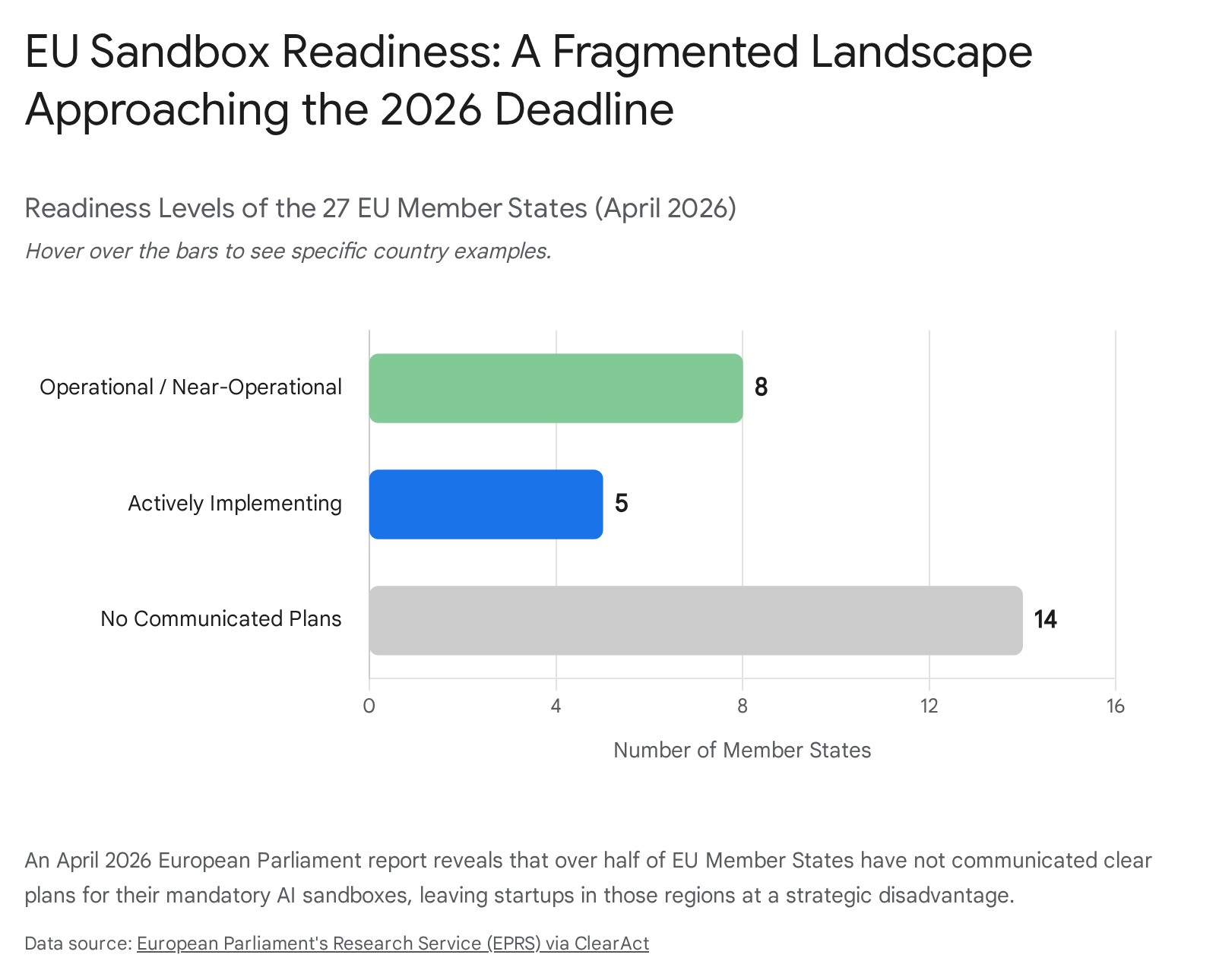
This fragmentation threatens the concept of the digital single market. A startup headquartered in an unprepared Member State faces a distinct strategic disadvantage, lacking the supervised testing and exit reports that competitors in proactive countries are currently gathering. Startups must therefore strategically evaluate where they base their regulatory operations.
Key Member State Strategies Compared
European nations are adopting vastly different institutional architectures to manage their sandboxes. Some are creating brand new AI agencies, others are decentralizing power among existing regulators, and some are relying heavily on their established data protection authorities 8.
| Member State | Sandbox Operational Status | Designated Lead Authority | Regulatory Architecture & Focus |
|---|---|---|---|
| Spain | Operational since 2025 18 | AESIA (Agencia Española de Supervisión de la IA) 1519 | Centralized "Think & Do" model. The pioneer of the EU sandbox effort. |
| Ireland | Actively Implementing 1831 | Distributed (15 authorities) via the National AI Office 20 | Decentralized approach utilizing existing bodies like the DPC. Strong GDPR overlap 3120. |
| Germany | Near-Operational 18 | Bundesnetzagentur (Federal Network Agency) 318 | Integrates AI rules into existing market surveillance structures. Focuses on minimizing SME administrative burdens 1833. |
| Estonia | Pilot Phase 12 | Ministry of Economic Affairs & Communications 8 | Cross-sectoral "Testbed" offering technical resources (HPC, data environments) alongside legal advice 812. |
| Denmark | Operational 8 | Datatilsynet & Agency for Digital Government 8 | Jointly operated. Initially hyper-focused on GDPR compliance, slowly expanding scope to include full AI Act metrics 8. |
| France | Near-Operational 18 | Sectoral (coordination via DGE/CNIL) 38 | Highly decentralized. CNIL manages a privacy-focused sandbox for public service AI, adapting it for the broader AI Act 38. |
Spain: The "Think & Do" Laboratory of Europe
Spain stands as the undisputed pioneer of AI governance in the European Union 21. It was the first Member State to establish a dedicated national AI authority: the Spanish Agency for the Supervision of Artificial Intelligence (AESIA) 1935. Backed by an initial €4.3 million budget from EU Recovery and Resilience Funds, Spain launched the first EU AI sandbox pilot in late 2022 622.
Operating under a "Think & Do" model - meaning it investigates solutions rather than merely acting as a punitive sanctioning body - AESIA hosted 12 high-risk AI systems in its initial cohort 2324. These startups operated in critical sectors including biometrics, machinery, healthcare, and employment 24.
The data extracted from this pilot has been transformative. In early 2026, AESIA published a comprehensive set of 16 practical guidelines to help companies comply with the AI Act 1524. These included technical manuals on risk management, data governance, and cybersecurity, accompanied by practical checklist tools 24. While technically non-binding, these documents are the first structured interpretative criteria issued by a public authority in Europe 21. They essentially serve as the blueprint that the European Commission itself will likely use to draft its official harmonized standards 1523. For a startup, securing a spot in Spain's mature, well-resourced sandbox provides unparalleled legal certainty 23.
Ireland: The Transatlantic Enforcer
Ireland's strategy is globally consequential because Dublin serves as the European headquarters for nearly all major US technology corporations 25. Given the intense scrutiny Ireland has faced regarding its enforcement of the GDPR and the Digital Services Act (DSA) - with agencies like Coimisiún na Meán (CnaM) facing multi-million euro legal battles with Big Tech - the Irish government is taking a highly structured, strict approach to AI regulation 925.
Instead of a single AI regulator, Ireland has designated 15 different National Competent Authorities, coordinated by a newly established National AI Office 20. Ireland is currently moving to embed its regulatory sandbox directly into primary national legislation via the Regulation of Artificial Intelligence Bill 2026 31.
Startups operating in Ireland should prepare for a rigorous, "GDPR-scale" enforcement environment 31. The Irish scheme makes it clear that regulators will have the power to conduct unannounced inspections, demand deep technical documentation, access training datasets, and challenge a startup's self-assessed risk classification 31. If an Irish authority disagrees with a startup's claim that its AI is "limited risk," it can forcibly impose the full high-risk compliance burden 31. Testing within the Irish sandbox, therefore, requires intense preparation, as the DPC and CnaM will be closely monitoring any personal data processing or content generation 931.
Estonia and Finland: The Cross-Border Innovators
Estonia, globally recognized for its digital-first government, is launching a highly comprehensive "Artificial Intelligence Testbed" in the second half of 2026 12. What differentiates Estonia's approach is the blending of legal and technical support. While most sandboxes only offer compliance advice, the Estonian Testbed will provide participating startups with access to AI testing and validation tools, secure data environments, and state-backed high-performance computing (HPC) resources 12.
Furthermore, Estonia and Finland have recognized that small nations cannot dictate market terms alone. In early 2026, the two governments agreed to jointly develop their AI regulatory sandboxes 26. This cross-border cooperation allows them to pool technical infrastructure and share compliance costs 26. The partnership is particularly focused on testing "Agentic AI" - systems capable of pursuing goals with a high degree of autonomy, particularly those that could perform administrative government functions 26. For startups building autonomous agents, the Helsinki-Tallinn corridor represents a highly progressive testing ground.
The EUSAiR Initiative: Bridging the Transnational Gap
To mitigate the massive disparity in Member State readiness, the European Union is funding a supranational initiative: the EU Regulatory Sandboxes for AI (EUSAiR) 27. Backed by the Digital Europe program, EUSAiR is a two-year coordination project designed to build standardized, cross-border frameworks that all Member States can eventually adopt 27.
Running from October 2025 through March 2026, the EUSAiR pilot program is accepting up to 90 AI use cases from providers across the continent 927. The goal is to test a common EU framework for AI regulatory sandboxes (AIRS) to ensure that a risk assessment conducted in Sweden translates seamlessly to the market in Italy 27.
The Funnel: European Digital Innovation Hubs (EDIHs)
The AI Act explicitly mandates that startups should be directed toward pre-deployment services and "value-adding services" to help them prepare for the sandbox 13. To facilitate this, the EUSAiR project heavily utilizes the vast network of European Digital Innovation Hubs (EDIHs) 28.
EDIHs act as the regional "front door" for the European digital ecosystem 28. For a startup that lacks dedicated legal counsel, walking into an EDIH is the most efficient first step. EDIHs are equipped to conduct Digital Maturity Assessments, evaluate a startup's technical and legal readiness, and act as a triaging agent 28. They help founders clearly formulate the specific regulatory challenges they want to test before formally applying to a national sandbox 28.
Why You Still Need Legal Counsel
Given that sandboxes offer priority access and direct guidance from state regulators, some founders mistakenly assume that sandbox participation eliminates the need for external legal counsel 529. This is a dangerous oversimplification that can lead to catastrophic market delays.
Legal experts continually warn that sandbox participation facilitates compliance, but it does not automatically guarantee it 30. Sandboxes are narrow in scope; they are designed specifically to test compliance with the AI Act 30. They do not resolve the immense complexity of multi-regulatory overlap 30.
A startup building an AI system for the financial or healthcare sector must satisfy the AI Act, while simultaneously complying with the GDPR, strict anti-money laundering (AML) regulations, Medical Device Directives, and general consumer protection laws 30. A national AI authority overseeing a sandbox cannot grant waivers for financial regulations or data protection breaches 830.
Furthermore, completing a test in one jurisdiction does not grant blanket immunity across the EU 30. While the exit report is highly valuable, regulators in different Member States may interpret data residency rules or cross-border transfer requirements differently 30. Therefore, startups should utilize legal counsel to carefully map their systems across all intersecting frameworks, define the precise scope of their sandbox application, and strategically treat the sandbox as an "evidence generator" rather than a final stamp of approval 2930.
Bottom line
By August 2026, the EU AI Act will strictly regulate high-risk systems, shifting the tech landscape from post-market correction to pre-market product safety. Early participation in national regulatory sandboxes is not an optional luxury for high-risk startups; it is a strategic necessity that offers vital compliance clarity, reduced financial liabilities through inverse fine caps, and exit documentation that significantly accelerates market access. However, because Member State readiness is vastly unequal and sandboxes do not override overarching frameworks like the GDPR or sectoral laws, founders must proactively secure their spots in operational pilots today, leaning on expert counsel to navigate the lingering jurisdictional complexities.