
What Science Says About the Purpose of Dreams
Dreams are not random neural noise, but rather a sophisticated biological mechanism designed to process emotional memories, simulate social threats, and consolidate complex learning. While modern neuroscience firmly rejects the idea of universal "dream dictionaries," empirical research reveals that dreaming actively reshapes our waking experiences, acting as a form of nocturnal therapy that buffers mental health and regulates our emotional responses to the world.
The Neurobiology of Dreaming: Beyond Random Noise
For millennia, human beings have sought to understand the vivid, hallucinatory narratives that unfold during sleep. In the late nineteenth and early twentieth centuries, the study of dreams was dominated by psychoanalytic theories. Sigmund Freud famously posited that dreams were manifestations of suppressed, unconscious desires, heavily cloaked in symbolism to protect the dreamer from their own taboo wishes 1. Concurrently, pioneers like Mary Calkins began conducting early empirical sleep studies, noting that dreams were inextricably linked to recent waking life rather than distant, hidden childhood traumas .
However, as neuroimaging and electroencephalography (EEG) advanced in the latter half of the twentieth century, the scientific consensus shifted dramatically. In the 1970s, the "activation-synthesis hypothesis" proposed that dreams were simply the brain's attempt to make sense of random neural firings originating in the brainstem during Rapid Eye Movement (REM) sleep 12. Under this model, dreaming was viewed as a meaningless biological byproduct - static on a television screen that the cortex hastily synthesized into a disjointed story 123.
Today, cognitive neuroscience has largely moved beyond the activation-synthesis model. Massive scale studies utilizing natural language processing (NLP) to analyze thousands of dream reports have demonstrated that dreams are highly structured, deeply interconnected narratives 345. Rather than being random noise, dreaming is now understood to be an intensified form of mind-wandering driven by the brain's Default Mode Network (DMN) - the same network responsible for daydreaming and spontaneous thought during waking hours . During sleep, the DMN synthesizes memories, emotions, and future anticipations into immersive virtual realities 358.
The Architecture of the Sleeping Brain
To understand why we dream, it is crucial to understand the neurochemical and structural changes that occur when we sleep. The brain does not simply power down; it shifts into different modes of highly active processing.
During REM sleep, where the most vivid and narrative-driven dreaming occurs, brain activity closely mirrors wakefulness 16. The visual cortex and the limbic system (which processes emotions) become highly active, creating the immersive and intensely emotional environments we experience in dreams 11. Conversely, the dorsolateral prefrontal cortex - the region responsible for logical reasoning, impulse control, and reality testing - is almost entirely suppressed 167. This unique neurological configuration explains why dreams can be entirely illogical or bizarre, yet we rarely question their reality while we are in them 7.
The progression of dreams throughout the night is also heavily modulated by neurohormones, particularly cortisol 8. Cortisol levels naturally escalate over the course of the night. Researchers hypothesize that high levels of cortisol during late-night REM sleep disrupt communication between the hippocampus (where short-term memories are stored) and the neocortex (where long-term memories are stored) 8. This disruption fragments episodic memories, explaining why late-night dreams are often bizarre and disjointed, as the brain struggles to access coherent biographical data and instead relies on procedural memories and raw emotion 8.
"Overnight Therapy": Processing Emotion and Memory
Perhaps the most robust scientific explanation for the purpose of dreaming is its role in emotional regulation and psychological healing.
The Noradrenaline Void
During REM sleep, the brain enters a unique neurochemical state: it is completely depleted of noradrenaline (norepinephrine), a neurotransmitter that triggers the body's physiological stress response 910. This is the only time during a 24-hour cycle that the brain is entirely free of this anxiety-inducing molecule 10.
This creates a neurochemical "safe environment" 9. The brain's emotional centers can replay and process emotionally charged or traumatic memories from the day without triggering the visceral, heart-pounding stress response originally attached to them 910. In essence, the dreaming brain strips the emotional sting from stressful events while retaining the core informational memory. Sleep researcher Dr. Matthew Walker refers to this phenomenon as "overnight therapy" or "emotional first aid" 91011.
Empirical Evidence of Emotional Buffering
Recent empirical data strongly supports this therapeutic mechanism. A novel 2024 study conducted by the University of California, Irvine, Sleep and Cognition Lab investigated how dream recall impacts next-day emotional reactivity 12. Researchers had participants view a series of highly emotional and neutral images before sleep. By tracking the participants through a single night, the study found a distinct biological trade-off: the dreaming brain actively prioritized the processing of emotionally charged, negative memories over mundane ones 12.
Crucially, participants who recalled dreaming about the negative stimuli demonstrated better memory recall of the event the next day, but significantly reduced emotional reactivity to it 12. In contrast, participants who did not dream remained highly reactive to the negative images 12. This provides hard empirical evidence that dreams actively transform our psychological responses, rather than passively reflecting them 1213. Furthermore, longitudinal studies have shown that individuals navigating difficult life transitions, such as divorce, who dream about their ex-spouses exhibit fewer depressive symptoms a year later compared to those who do not, highlighting the long-term mental health benefits of this nocturnal processing .
Problem Solving and Threat Simulation
Because the logical, inhibitory centers of the brain are deactivated during sleep, the dreaming mind can form bizarre, novel connections between unrelated concepts. This lack of inhibition fosters profound creativity and cognitive flexibility, which has led scientists to investigate dreaming as a mechanism for complex problem solving 1014.
Targeted Memory Reactivation
A groundbreaking 2026 study from neuroscientists at Northwestern University demonstrated that dreams can be actively nudged to solve waking problems 14. Researchers utilized a technique called Targeted Memory Reactivation (TMR). While participants were awake, they struggled with unsolved brain teasers paired with specific, subtle sound cues 14. When the participants entered REM sleep, the researchers quietly played those same sound cues 14.
The results were remarkable: 75% of the participants reported that the unsolved puzzles infiltrated their dreams, and those who dreamed about the puzzles successfully solved them at a significantly higher rate the next morning 14. This confirms that the fluid, hyper-associative state of REM sleep allows the brain to bypass logical roadblocks that hinder waking cognition, synthesizing solutions that the waking mind cannot reach 10.
The Threat Simulation Theory
From an evolutionary perspective, researchers also view dreaming as a crucial survival mechanism. The Threat Simulation Theory posits that dreams serve as a biological virtual reality simulator, allowing humans to rehearse responses to physical and social dangers in a safe, low-risk environment 1. By confronting predators, social rejection, or environmental hazards in our sleep, our neural pathways become primed to handle complex, high-stakes interactions when we are awake 115.
Recent analyses of dream content confirm that themes of status, self-protection, and interpersonal conflict are overwhelmingly common across all demographics, supporting the idea that dreams function as a "multimotive simulation space" for humanity's most pressing evolutionary challenges 15.
The Timeline of Dreams: Day-Residue and Dream-Lag
The Continuity Hypothesis dictates that the content of our dreams is deeply intertwined with our waking lives 161718. However, waking events do not simply echo into a single night's sleep and disappear forever. When scientists track how and when waking events appear in dreams, they observe a distinct, non-linear timeline composed of two specific phenomena.
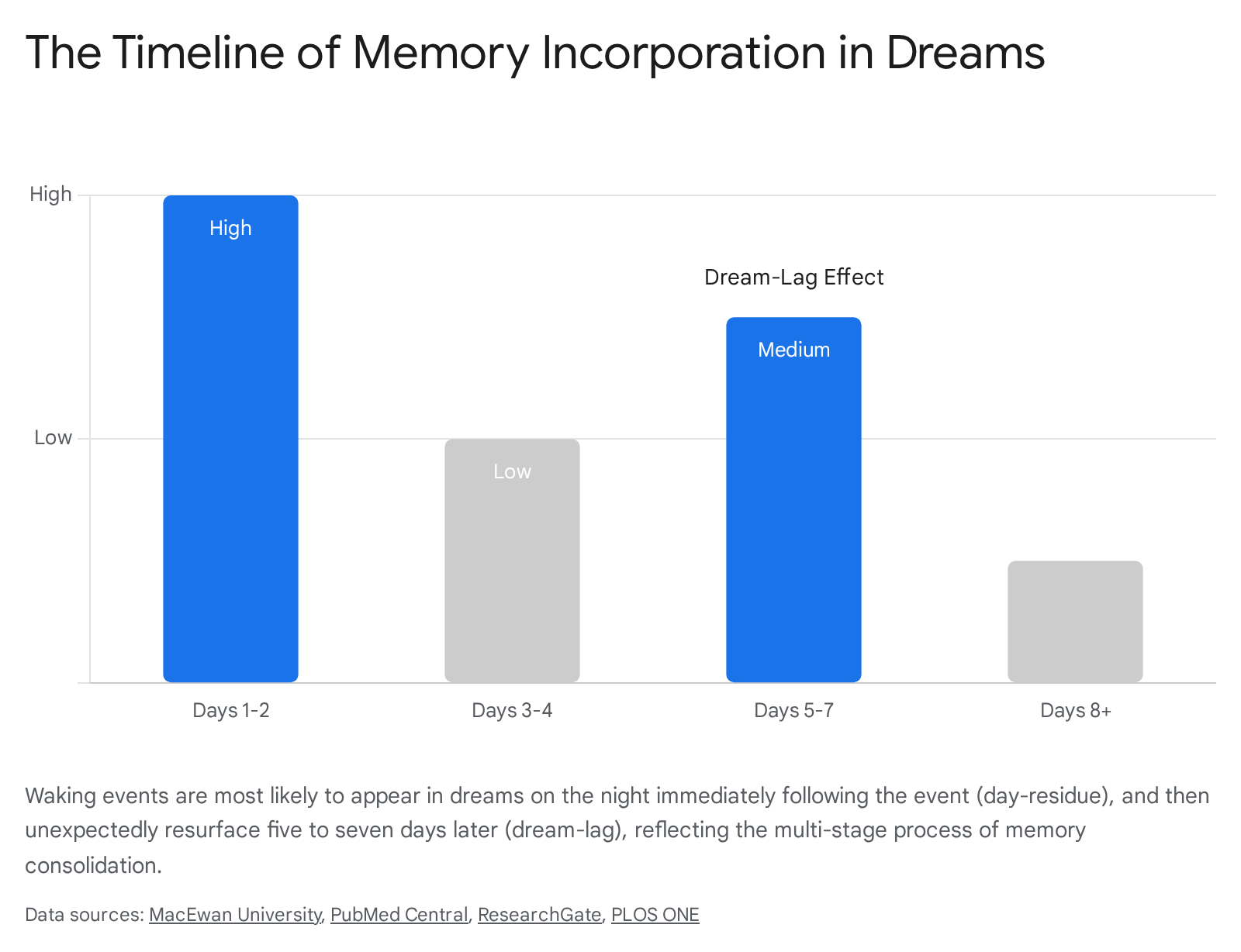
The day-residue effect refers to the immediate incorporation of material from the preceding day. Studies show that up to 70% of dream reports contain fragments of recent waking experiences 1622. However, these events often vanish from dreams for several days, only to reliably resurface five to seven nights later - a phenomenon known as the dream-lag effect 1920.
Researchers propose that this temporal gap reflects the underlying biological process of long-term memory consolidation 2021. Over the course of a week, memories are gradually transferred from the brain's short-term storage networks to permanent storage in the neocortex 821. The dream-lag effect appears to be a visible byproduct of this slow data transfer. Notably, while the day-residue effect can include mundane daily activities, the delayed dream-lag effect is heavily biased toward processing personally significant and emotionally dense events 1921.
| Feature | Day-Residue Effect | Dream-Lag Effect |
|---|---|---|
| Timeline | 1 to 2 nights after the waking event. | 5 to 7 nights after the waking event. |
| Prevalence | Very common (found in ~65 - 70% of dream reports). | Less frequent, but highly consistent in specific individuals. |
| Type of Content | Both routine daily activities and significant events. | Primarily restricted to personally significant or highly emotional events. |
| Neurological Function | Immediate emotional buffering and short-term memory sorting. | Deep integration of new memories into long-term neocortical networks. |
Nightmares: When the System Fails
While normal dreaming serves to alleviate emotional stress, the system can become overloaded, resulting in clinical nightmares. Occasional bad dreams are normal, but frequent, highly distressing nightmares - categorized as Nightmare Disorder - affect an estimated 2% to 5% of the general adult population 22. However, this prevalence skyrockets to nearly 30% among individuals with psychiatric diagnoses, and up to 70% in individuals suffering from Post-Traumatic Stress Disorder (PTSD) 22.
The Mechanics of Traumatic Dreams
PTSD-related nightmares are neurologically distinct from standard bad dreams. While ordinary dreams mostly occur in REM sleep and rely on metaphorical or symbolic structures, PTSD nightmares can intrude across all stages of the sleep cycle 22. Furthermore, they are often literal, unedited replays of traumatic events rather than fragmented narratives 22.
In these instances, the brain's "overnight therapy" mechanism fails. Because the brain is unable to suppress the release of noradrenaline during sleep, the individual experiences the full physiological panic of the original trauma, causing the stress response to flood the sleeping brain and jolt the individual awake 1022.
The psychological toll of chronic nightmares is severe. They are robustly linked to impaired daytime functioning, severe emotional dysregulation, and a drastically increased risk of suicidal ideation and suicide attempts 22. In one study of veterans with a history of suicide attempts, trauma-related nightmares were a direct predictor of future suicide attempts 22.
Interestingly, susceptibility to non-traumatic nightmares seems linked to specific cognitive traits. Research indicates that individuals prone to "concretization" - the cognitive habit of turning abstract, vague anxieties into concrete, physical threats to make sense of them - are significantly more likely to experience frequent nightmares 22. For these individuals, the brain actively invents physical monsters to justify abstract daytime stress.
The Wake-Sleep Continuum: Blurring the Lines
Historically, sleep and wakefulness were viewed as two mutually exclusive physiological states. You were either awake, or you were asleep and dreaming. However, modern neuroimaging and massive new datasets are proving that the boundary between these states is an illusion.
A 2025 analysis of the newly established DREAM database - an international consortium compiling over 2,500 EEG recordings and dream reports from 37 scientific institutions - confirmed that subjective conscious experiences occur throughout all sleep stages 232425. While dreams are most vivid during REM, they frequently occur during the deeper, slower non-REM (NREM) phases 2325. During these NREM dreams, AI algorithms detected that the brain exhibits electrical activity more closely resembling wakefulness, functioning in a "hybrid state" where the brain is partially awake while the body sleeps 2325.
Furthermore, researchers analyzing the transition from wakefulness to sleep have identified that "dream-like" mental states can occur even while a person is wide awake 26. Using an experimental setup inspired by Thomas Edison, researchers found that when the visual regions of the brain temporarily disconnect from the frontal reasoning regions, individuals can experience vivid, bizarre "dream narratives" regardless of their actual stage of vigilance 26.
This fluidity explains phenomena such as "paradoxical insomnia," where clinical patients report being awake all night, despite EEG monitors confirming they were in deep sleep 2728. Studies suggest that highly immersive, vivid dreaming can reshape how the sleeper perceives their own sleep depth, sometimes causing them to feel completely conscious while biologically asleep 2728.
Cross-Cultural Differences in Dreaming
While the neurobiological machinery of sleep is a universal human trait, the actual content, structure, and emotional function of dreams are heavily sculpted by an individual's socio-cultural environment 2930.
Western vs. Forager Communities
A landmark 2023 study published in Scientific Reports analyzed the dream logs of two African forager communities - the BaYaka in the Democratic Republic of Congo and the Hadza in Tanzania - and compared them to those of Western populations in Europe and North America 293031. The findings revealed stark differences in how the dreaming brain processes threats based on societal structure.
Western dreams frequently revolve around individualistic anxieties: failing an exam, losing a loved one, or professional incompetence 3031. Crucially, these dreams often lack emotional resolution, leaving the dreamer with lingering stress and anxiety upon waking 2930.
In contrast, the dreams of the BaYaka and Hadza frequently featured severe physical threats, such as animal attacks or falling down a well 3031. However, because these communities live in highly egalitarian societies that rely on face-to-face cooperation for survival, their dreams almost always ended with a cathartic resolution involving social support, such as being rescued by a community member 293031. This suggests that the brain utilizes the cultural tools available to it - in this case, strong communal bonds - as emotional instruments to resolve nocturnal threats 29.
| Dream Characteristic | Western Societies (Europe, North America) | Forager Communities (BaYaka, Hadza) |
|---|---|---|
| Primary Themes | Individual stress, psychological anxiety, personal failure. | Physical threats, environmental hazards, community survival. |
| Emotional Resolution | Often lacking; dreams end unresolved with lingering anxiety. | Highly cathartic; threats are resolved before waking. |
| Role of Others | Others are often passive, absent, or a source of judgment. | Strong presence of social support; community members act as rescuers. |
Intra-Asian Differences and Self-Construal
Cultural variances are not limited to the divide between industrialized and hunter-gatherer societies; significant intra-regional differences exist based on social values. A 2025 study comparing dream structures between the United States, Japan, and China found that American dreams feature strong individual agency and clear mobility 32. Conversely, Japanese and Chinese dreams reflect interdependent self-construals, characterized by vaguer dream-egos and a much greater presence of external social actors 32.
Interestingly, the study noted nuanced differences within East Asia itself. In Japan, interdependent self-construal correlated with higher levels of anthropophobia (fear of people) in dreams, whereas in China, independent and interdependent self-construals coexisted positively without predicting social anxiety, reflecting deep cultural variations in how human relationships dictate subconscious narratives 32.
Indigenous Australian "Dreaming" and Relational Knowledge
In discussions of cultural perspectives on sleep, the Indigenous Australian concept of "The Dreaming" (or Songlines) occupies a profound and distinct space. It is crucial to note that "The Dreaming" is not synonymous with the neurobiological act of REM sleep 3334. Rather, it is a complex, atemporal epistemological framework that encompasses the creation of the world, ancestral spirits, law, and relational knowledge 3334.
For Aboriginal and Torres Strait Islander peoples, memory is not merely stored in the brain; it is fundamentally encoded in the landscape, songs, and communal relationships 3335. The Dreaming operates without a demarcation between past, present, and future, linking the individual to the "more-than-human" sensuous world 3334. This holistic worldview is inextricably linked to psychological health. Research into Social and Emotional Wellbeing (SEWB) confirms that integrating this culturally specific spiritual connection to "Country" is a highly effective, evidence-based pathway to resilience, mental health, and trauma recovery in Indigenous populations, contrasting sharply with isolated, Western medical models 3436.
Artificial Intelligence and the Future of Dream Decoding
For decades, dream research was fundamentally limited by its reliance on subjective, self-reported journals recorded upon waking. Memory degrades rapidly, and language often fails to capture the bizarre geometry of dreams. Today, the convergence of functional magnetic resonance imaging (fMRI) and Artificial Intelligence is allowing scientists to objectively decode the dreaming mind.
Reconstructing Visuals with fMRI
Groundbreaking research led by Professor Yukiyasu Kamitani at the ATR Computational Neuroscience Laboratory in Japan has demonstrated that it is possible to "read" visual imagery directly from the sleeping brain 3738. The process utilizes fMRI to monitor the Blood Oxygenation Level-Dependent (BOLD) signal, mapping exact patterns of blood flow in the visual cortex 37.
The process of AI dream decoding follows a clear cyclical sequence. First, during a waking training phase, participants view real images while an fMRI records their brain's Blood Oxygenation Level-Dependent (BOLD) signals. Second, during the sleeping phase, fMRI data is collected while the subject is in REM sleep. Third, a sophisticated Deep Neural Network (DNN) analyzes these sleeping brain patterns, correlating them with the waking training data. Finally, a Generative AI model outputs a reconstructed, albeit fuzzy, visual approximation of the dream 374339.
Recent iterations of this technology, such as the DreamConnect and DREAM models (published in 2024 and 2025), have dramatically improved this process. These models utilize dual-stream frameworks - specifically reversing the pathways of the human visual system - to isolate semantics, depth, and color cues directly from the fMRI data 43394046. While the visual outputs are currently symbolic approximations rather than high-definition video recordings, the AI algorithms can successfully predict the visual category of a dream (e.g., differentiating a "face" from a "building") with 60% to 70% accuracy 37.
Semantic Analysis using Large Language Models
Beyond visual decoding, researchers are deploying Large Language Models (LLMs) to analyze the semantic structure of thousands of written dream reports 41. Historically, because dreams feel bizarre, they were assumed to be linguistically chaotic.
However, AI semantic analysis reveals the exact opposite. When LLMs encode dream reports, they return remarkably low "perplexity" scores 41. In machine learning, perplexity measures how "surprising" or unpredictable a text sequence is. The low perplexity of dream reports indicates that they are highly structured, predictable, and follow definitive narrative rules - often more so than standard, structured text like Wikipedia articles 41. This computational evidence firmly concludes that dreaming is a highly organized cognitive function governed by distinct biological rules, heavily shaped by personality traits like mind-wandering and real-world global events 3441.
Do Dream Dictionaries Actually Work?
A quick internet search will yield thousands of "dream dictionaries" confidently claiming that dreaming of snakes signifies betrayal, water represents emotion, or losing teeth indicates a fear of aging. However, there is absolute consensus among neuroscientists and sleep clinicians that these universal dream symbols have no basis in empirical science 14243.
The concept of fixed, universal symbols is largely a remnant of early psychoanalysis. Modern dream science explicitly rejects this approach because the brain constructs dreams using the dreamer's highly personal memories, daily anxieties, and cultural context 14243. The exact same visual stimulus - such as an airplane - will carry a fundamentally different emotional and neurological meaning for a commercial pilot than it will for someone with a severe phobia of flying 43. Institutions like the American Academy of Sleep Medicine and the Cleveland Clinic caution against relying on external dictionaries, emphasizing that dream interpretation is entirely subjective, and external meaning should not be applied to personal neural processing 4244.
The Real Benefits of Dream Journaling
While pulling rigid definitions from dream dictionaries lacks scientific validity, the act of tracking and writing down your dreams - dream journaling - offers empirically proven psychological benefits 444546.
Clinical research demonstrates that regular journaling, including dream tracking, serves as a powerful form of emotional catharsis. By writing down unsettling or bizarre narratives, individuals can externalize subconscious anxieties, effectively distancing themselves from intense feelings and shifting the brain into a calm, reflective state 4446. Meta-analyses of therapeutic writing practices show that consistent journaling can reduce symptoms of anxiety and depression by 20% to 45% 53. Furthermore, keeping a dream journal improves general mindfulness, aids in recognizing waking emotional patterns, and serves as a highly effective tool when paired with structured psychotherapy, helping patients draw connections between their nocturnal stress simulations and daytime triggers 4447.
Bottom line
Dreams are an essential biological function, serving as a nocturnal laboratory where the brain consolidates memories, diffuses emotional trauma, and rehearses responses to real-world threats. While the specific imagery we experience is uniquely sculpted by our personal waking lives and cultural environments, the underlying neurological machinery is universal. Though advances in AI and fMRI are bringing us closer to objectively mapping the subconscious mind, the true meaning of any dream ultimately resides in the highly personal, emotional context of the dreamer.