
What Neuroscience Actually Knows About Why We Dream
Dreams are the conscious manifestation of the sleeping brain actively processing memories, regulating emotions, and simulating survival scenarios. Rather than being mystical visions or random noise, advanced neuroimaging reveals that dreaming is a highly orchestrated biological mechanism. It is essential for optimizing our neural circuitry, clearing metabolic waste, and maintaining our waking sanity.
For millennia, humans have sought meaning in the bizarre, fragmented narratives that play out in our minds while we sleep. Ancient civilizations viewed them as messages from the divine, while early psychoanalysts framed them as a gateway to the unconscious, filled with hidden symbols of suppressed urges 123. Today, the study of dreaming - oneirology - has largely moved out of the psychoanalyst's armchair and into the functional magnetic resonance imaging (fMRI) machine.
Equipped with high-density electroencephalography (EEG) and advanced machine learning algorithms, neuroscientists are finally mapping the exact circuitry responsible for our nightly hallucinations. The emerging scientific consensus suggests that dreaming is not merely a random byproduct of sleep, but an evolved neurobiological mechanism essential for memory retention, emotional regulation, and survival 456.
The Sleeping Body and the Waking Brain
To understand why we dream, we must first understand what happens to the physical brain when we cross the threshold of sleep. Sleep is not a uniform state of unconsciousness; it is a dynamic cycle defined by distinct neurological phases.
Recent research from the University of Oxford has even pinpointed the biological trigger that forces the brain into this state. Researchers discovered that sleep arises from a buildup of electrical stress in mitochondria - the energy producers inside cells 7. In specific sleep-regulating neurons, an oversupply of energy causes mitochondria to leak electrons, creating reactive oxygen species. When this leak reaches a critical threshold, these neurons act like circuit breakers, tripping the brain into sleep to prevent cellular damage 7.
Once asleep, an adult human cycles through various stages every 90 to 120 minutes, broadly categorized into non-rapid eye movement (NREM) and rapid eye movement (REM) sleep 89.
The End of the REM Monopoly
Historically, scientists believed that dreaming was an exclusive property of REM sleep 1011. REM is characterized by darting eyes, temporary paralysis of the skeletal muscles (atonia) to prevent us from acting out our dreams, and fast-wave EEG patterns that closely resemble a waking, alert brain 8.
However, massive collaborative research efforts - such as the creation of the DREAM database compiling global brain activity and dream reports - have unequivocally proven that dreaming occurs throughout the entire night, spanning both REM and NREM sleep 1012. While dreaming happens in all stages, the quality, texture, and structure of those dreams vary drastically depending on the brain's neurochemical state.
When researchers use directed word-graph theory to analyze the structural connectedness of dream reports, they find that dreams occurring during REM sleep are significantly longer, more vivid, highly emotional, and feature complex, movie-like narrative arcs 913. In contrast, dreams reported from NREM sleep (particularly the lighter N1 and N2 stages) tend to be shorter, less intense, highly conceptual, and more akin to fleeting thoughts or static images 91013.
The "Posterior Hot Zone"
If dreams happen in both REM and NREM sleep, researchers needed a unified neural signature to identify when someone is dreaming. Recent high-density EEG studies have identified exactly that: a "posterior hot zone" in the parieto-occipital region of the cerebral cortex 11.
A distinct drop in low-frequency EEG activity in this specific zone is a reliable neural correlate of conscious dream experiences, regardless of the sleep stage 1114. When this posterior region is active with high-frequency waves, subjects awakened by researchers report that they were dreaming. When it is quiet, they report dreamless sleep. This discovery shifted the paradigm, proving that dreaming is a specific localized state of consciousness, not merely a global byproduct of REM sleep 11.
The "Defragmentation" of the Mind: Memory and Synapses
If dreaming is an active, measurable neurological state, what biological purpose does it serve? One of the most strongly supported frameworks in modern sleep neuroscience combines the Memory Consolidation Theory with the Synaptic Homeostasis Hypothesis (SHY) 151617.
During waking hours, human brains are constantly bombarded with sensory information. Learning new concepts and forming short-term memories requires the strengthening of synapses (synaptic potentiation) between neurons 517. However, maintaining these constantly strengthened neural connections demands vast amounts of cellular energy and physical space. If synapses only ever grew stronger, the brain's circuits would quickly become saturated with noise, impeding new learning and exhausting cellular resources 1617.
Synaptic Homeostasis and Downscaling
The Synaptic Homeostasis Hypothesis, proposed by Giulio Tononi and Chiara Cirelli, posits that sleep is the biological price we pay for brain plasticity 1617. While we sleep, the brain essentially undergoes a system-wide "defragmentation." During deep NREM slow-wave sleep, the brain selectively downscales or prunes the excessive, weak neural connections formed during the day 51516.
This global downscaling restores the brain to a baseline energy state, weeding out unnecessary data and increasing the signal-to-noise ratio for the memories that truly matter 16.
Systems Consolidation and Memory Replay
Simultaneously, the most critical memory traces are reactivated and transferred from short-term storage in the hippocampus to long-term storage in the neocortex - a process known as systems consolidation 51816. Oxford University's Sleep and Brain Plasticity labs utilize simultaneous EEG-fMRI and targeted memory reactivation to map how slow oscillations, thalamocortical spindles, and hippocampal ripples coordinate this massive data transfer 517.
In animal models, neural firing patterns recorded while a rat learns a physical maze are visibly replayed by the brain during subsequent slow-wave sleep 16. For humans, dreaming is believed to be the subjective, conscious byproduct of this memory replay and integration process 1521. As the sleeping brain sifts through recent memories, prunes weak synapses, and links new data to older, established knowledge networks, we experience this rapid cross-referencing as the associative, often bizarre narratives we call dreams.
Overnight Therapy: Processing Emotion and Trauma
Beyond organizing facts and physical skills, dreaming plays a vital role in human emotional regulation. During REM sleep, the brain regions associated with emotion - specifically the amygdala and limbic system - are highly active, sometimes operating at levels exceeding normal waking consciousness 1819. At the exact same time, the brain strictly suppresses the release of noradrenaline, a primary stress-inducing neurotransmitter 20.
This unique neurochemical environment allows the brain to process highly charged, traumatic, or upsetting memories in a calm, stress-free biological state. By replaying emotional events within the safe "virtual reality" of a dream, the brain strips away the visceral emotional arousal attached to the memory . Clinical sleep studies demonstrate that individuals who dream about emotionally difficult events experience a steeper decline in depressive symptoms over time compared to those who do not, acting as a form of biological "overnight therapy" .
Trauma, Nightmares, and REM Fragmentation
The mechanisms of dreaming can easily become maladaptive, particularly in the wake of severe psychological trauma. While standard dreams help strip the emotional sting from difficult memories, individuals with Post-Traumatic Stress Disorder (PTSD) often suffer from chronic nightmare disorder 212223.
In a healthy brain, nightmares generally occur during REM sleep and serve to process fear. However, PTSD-related nightmares frequently bleed into all stages of sleep, presenting as hyper-realistic, unfragmented replays of the original trauma rather than symbolic narratives 2224. From a neurobiological perspective, trauma results in the overactivation of the hypothalamic-pituitary-adrenal (HPA) axis, causing sustained cortisol release and disrupting the delicate balance of serotonin and dopamine required for healthy REM sleep 20.
Patients with PTSD often exhibit highly fragmented REM sleep, meaning their dream cycles are constantly interrupted by micro-awakenings 21. This REM fragmentation impairs the brain's ability to successfully consolidate and defuse the emotional memory. This leads to a self-perpetuating loop: trauma triggers nightmares, the nightmares cause sleep fragmentation, and the resulting poor REM sleep exacerbates daytime emotional dysregulation and cognitive impairment 202124.
The REM Rebound Effect
The brain's physical demand for REM sleep is so powerful that it operates on a strict homeostatic drive. When humans or animals are deprived of REM sleep - due to severe stress, sleep apnea, alcohol withdrawal, or REM-suppressing medications like certain antidepressants - the brain accumulates a "REM debt" 825.
Once the individual is finally allowed to sleep normally without the suppressing factor, they experience the "REM rebound effect." During a REM rebound, the frequency, depth, and intensity of REM sleep are vastly amplified as the brain rushes to compensate for the deprivation 2526. This biological overcompensation frequently results in highly vivid, intense, and bizarre dreams, sometimes causing disorientation or headaches upon waking 25.
Evolutionary Simulators: Why Dreams Are So Stressful
While memory consolidation explains how the brain processes data during sleep, evolutionary psychologists have proposed theories explaining why dream content is so heavily biased toward social interaction, anxiety, and danger. If dreams are merely random memory filing, why do they so frequently involve running away, falling, or fighting?
The Threat Simulation Theory (TST)
Proposed by cognitive neuroscientist Antti Revonsuo, the Threat Simulation Theory argues that dreaming is an ancient biological defense mechanism 272829. During human evolution, our ancestors faced constant physical and environmental perils. TST suggests that the brain utilizes the REM sleep state to run a virtual-reality simulator, repeatedly placing the dreamer in threatening scenarios to practice threat perception and evasion without real-world consequences 192728.
Empirical dream content analysis provides compelling evidence for TST. Up to 66 percent of recurrent dreams contain one or more physical threats, often targeted directly at the dreamer, who usually takes reasonable defensive actions within the dream 2830. Furthermore, the threat simulation system is highly responsive to real-world environments. Studies comparing the dream journals of severely traumatized Kurdish children in war zones to those of non-traumatized Finnish children found that the traumatized children experienced significantly more frequent, severe, and realistic threat-based dreams 192729.
Similar cross-cultural studies involving the BaYaka foragers in the Republic of Congo demonstrate that populations facing routine ecological risks (like predation or infectious disease) have highly active threat-simulation dreams, supporting the theory that dreams help rehearse survival tactics 31.
However, the theory is not without contention. A 2008 study comparing populations in a high-crime area of South Africa with a low-crime area in Wales found that the South African cohort actually reported fewer threat dreams, despite higher real-world danger exposure 1928. This suggests the simulation mechanism may be more complex than a direct one-to-one reflection of daily environmental risk.
The Social Simulation Theory (SST)
A complementary evolutionary framework is the Social Simulation Theory. Because human survival has historically relied on complex group cooperation, natural selection heavily favored individuals with advanced social cognition 38.
SST posits that dreams function to process and update cognitive schemas of social interaction. Content analyses reveal that human dreams are overwhelmingly social; 95 percent of dream reports feature the dreamer interacting with two to four other characters 32. Rather than just practicing how to run from predators, these simulations allow the brain to safely rehearse social perception, bonding, conflict resolution, and the maintenance of attachment networks 33.
Comparing the Major Theories of Dreaming
To understand the competing and complementary perspectives in modern neuroscience, the following table summarizes the dominant hypotheses regarding the biological function of dreaming:
| Theory | Core Mechanism | Proposed Function of Dreaming | Evidence Base |
|---|---|---|---|
| Synaptic Homeostasis (SHY) | Global downscaling of synaptic strength during NREM sleep. | Prevents neural overload, saves cellular energy, and increases the signal-to-noise ratio for memories. | Animal models showing synaptic pruning; EEG data linking slow-wave sleep to metabolic recovery 151617. |
| Memory Consolidation | Reactivation of waking neural patterns (Hippocampus to Neocortex). | Transfers short-term memories to long-term storage, integrating new data with past experiences. | Neural replay observed in animal models; targeted memory reactivation studies 1621. |
| Threat Simulation (TST) | Activation of the amygdala and fear-conditioning systems during REM. | Provides a safe, virtual environment to rehearse threat-avoidance behaviors for waking survival. | Cross-cultural dream content analysis showing high prevalence of threat rehearsal 2729. |
| Social Simulation (SST) | Activation of social cognition networks. | Simulates and rehearses complex interpersonal scenarios to strengthen group cooperation. | Content analysis showing 95% of dreams involve multi-character social interactions 3233. |
| Activation-Synthesis | Brainstem generates random signals; cortex synthesizes them. | Dreaming has no inherent evolutionary function; it is a byproduct of the brain attempting to make sense of random neural noise. | fMRI data showing visual cortex activation driven by lower-brainstem impulses 33435. |
Freud vs. fMRI: Debunking Hidden Symbols
For much of the 20th century, Sigmund Freud's psychoanalytic theory dominated both clinical psychology and the cultural understanding of dreams. Freud famously declared dreams the "royal road to the unconscious," proposing they were censored expressions of repressed, socially unacceptable desires 34.
He argued that a psychological "censor" disguised these forbidden wishes using "dream-work" - mechanisms like condensation and displacement. This process theoretically transformed the true meaning (the latent content) into bizarre, symbolic imagery (the manifest content) to prevent the sleeper from waking up in distress 23.
Modern cognitive neuroscience has largely dismantled the strict Freudian model. Researchers point out that there is no empirical neurobiological evidence for a neural "censor" or the premise that dreams are inherently designed to hide secrets 235.
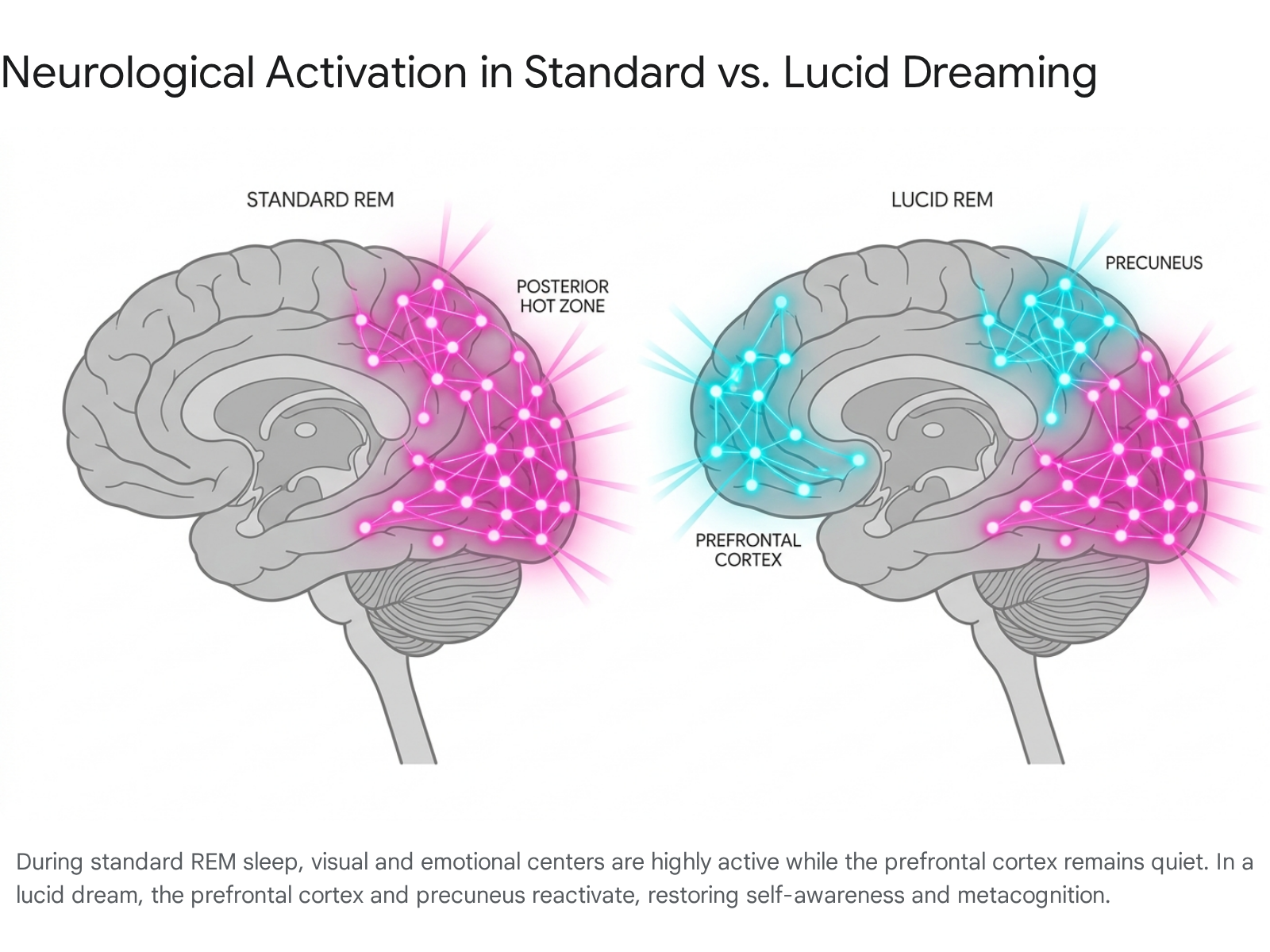
Instead, the bizarre nature of dreams is now understood as a feature of brain network dynamics. During REM sleep, the brain's executive control center - the dorsolateral prefrontal cortex, responsible for logic, self-reflection, and impulse control - is largely deactivated 3637. Concurrently, the visual and emotional centers are firing rapidly. Without the prefrontal cortex to impose logic, linear time, or reality-testing, the brain accepts shifting, impossible, and highly associative imagery as reality 3637. The "meaning" in dreams is not deliberately encrypted; it is simply the raw, unfiltered associative language of a brain communicating with itself without the strictures of waking logic.
Conscious in the Subconscious: The Science of Lucid Dreaming
One of the most fascinating intersections of neuroscience and consciousness studies is lucid dreaming - a rare hybrid state of sleep where the individual becomes consciously aware that they are dreaming and can often exert volitional control over the dream narrative 363839.
For decades, lucid dreaming was dismissed by mainstream science as a myth or merely a micro-awakening. However, advanced neuroimaging has proven it to be a distinct, objectively measurable state of consciousness that differs significantly from both standard REM sleep and wakefulness 3639.
The Awakening of the Prefrontal Cortex
The neurological hallmark of lucid dreaming is the reactivation of brain regions that are normally suppressed during REM sleep. A landmark fMRI case study of actively lucid dreamers revealed sharp increases in the Blood Oxygenation Level Dependent (BOLD) signal within the bilateral anterior prefrontal cortex (aPFC), the precuneus, and the inferior parietal lobules 143647.
The precuneus is deeply involved in self-referential processing and the first-person perspective. Its activation explains how the dreamer suddenly regains a sense of "I" within the simulation 47. Additionally, EEG recordings during lucid dreams show a marked increase in high-frequency gamma and beta wave oscillations - brain waves typically associated with intense waking concentration, spatial awareness, and problem-solving 3839.
Resting-state connectivity studies also show that individuals who frequently experience lucid dreams have a higher baseline connectivity between the aPFC and parietal structures, suggesting an inherently higher capacity for metacognition and cognitive control 1440.
Therapeutic Potential of Lucidity
Because lucid dreaming bridges the gap between unconscious exposure and conscious control, it is being aggressively studied as a clinical intervention. Lucid Dreaming Therapy (LDT) trains patients suffering from chronic nightmares or PTSD to realize they are in a dream state. Once aware, they can actively "re-signify" or alter the threatening scenario, effectively neutralizing the fear response from the inside out 638. While evidence is still preliminary, small pilot studies show significant nightmare reduction and lower anxiety scores following LDT 38.
Methodological Challenges in Dream Research
Despite rapid advancements, observing the dreaming brain remains exceptionally difficult. Neuroscientists primarily rely on two tools, each with significant limitations when applied to sleeping subjects 4142.
| Neuroimaging Tool | Advantages in Dream Research | Current Limitations |
|---|---|---|
| Electroencephalography (EEG) | Excellent temporal resolution (captures brain waves in milliseconds). Can identify exact sleep stages and sleep spindles. | Poor spatial resolution. Difficult to pinpoint exactly which deep brain structures are generating the signals 4143. |
| Functional MRI (fMRI) | Excellent spatial resolution. Can pinpoint exact blood flow changes in specific deep-brain structures (like the amygdala). | Poor temporal resolution (delayed by seconds). Highly susceptible to movement artifacts. The scanner is incredibly loud and claustrophobic, making it exceptionally difficult to induce natural sleep 4142. |
To overcome these hurdles, major research institutions are heavily investing in specialized infrastructure. The University of Bern's "Decoding Sleep" initiative, backed by 13 million Swiss francs, recently constructed novel physical structures like a hydraulic platform bed designed to gently rock patients to induce deeper sleep while attached to sensitive neuroimaging equipment 444546. Simultaneous EEG-fMRI setups are also becoming standard, using advanced algorithms to cancel out the magnetic artifacts the MRI machine creates on the EEG sensors 4243.
Decoding Dreams with Artificial Intelligence
If dreams are fundamentally electrical and chemical signals, is it possible to extract and view them from the outside? Recent advancements in artificial intelligence are moving this premise from science fiction into laboratory reality.
Pioneering work out of the ATR Computational Neuroscience Laboratories in Kyoto, Japan, led by Professor Yukiyasu Kamitani, has successfully demonstrated the ability to decode and reconstruct the visual contents of a dream using fMRI and machine learning 55474849.
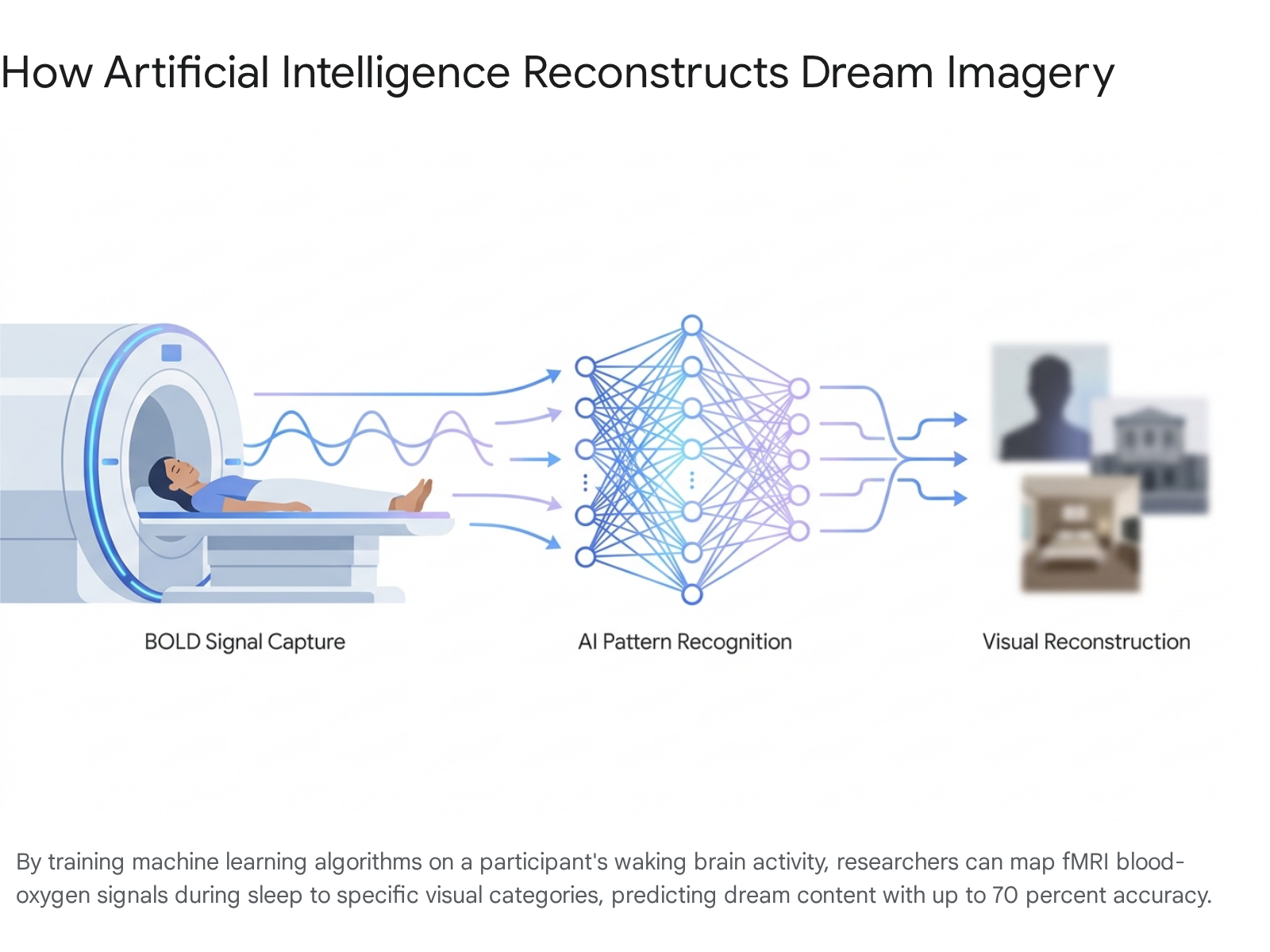
The methodology relies on the biological fact that the visual cortex represents imagery similarly whether a person is awake and looking at an object, or asleep and dreaming of it 5051. Kamitani's team first records participants' fMRI brain activity while they are awake and viewing thousands of specific images (e.g., a car, a man, furniture). A deep neural network (DNN) learns to associate specific patterns of localized blood flow with these specific visual categories 4748.
When the participants fall asleep inside the fMRI scanner, the AI monitors their brain activity in real-time. By comparing the sleep data against the waking baseline, the algorithm can predict what the sleeper is visualizing. When awakened, participants' self-reported dreams align with the algorithm's predictions with an accuracy of roughly 60 to 70 percent 49. While current reconstructions look like highly blurred, symbolic blobs rather than high-definition video, the technology serves as absolute proof that dreams are not ethereal, untrackable phenomena - they possess a distinct, readable physical signature 4849.
Bottom line
Dreaming is far from a passive, accidental occurrence of sleep; it is a highly orchestrated state of neurobiological maintenance. Through global synaptic downscaling, the brain prevents cognitive overload, while memory replay and emotional decoupling help us synthesize the chaotic events of our waking lives into stable, long-term learning. While technical limitations in neuroimaging still prevent us from capturing the exact molecular triggers of every dream in high definition, it is abundantly clear that the strange, virtual simulations we experience each night are fundamental to our waking sanity, emotional resilience, and evolutionary survival.