
How Your Brain Consolidates Memories While You Sleep
During sleep, your brain actively reorganizes and strengthens the fragile information you learned during the day, transferring it from short-term storage into permanent long-term memory. This process, known as memory consolidation, relies on synchronized brain waves to replay daily experiences, link them to existing knowledge, and clear out metabolic waste. Without adequate sleep, the brain's ability to encode new facts, process complex emotions, and refine physical skills is significantly impaired.
The Active Nighttime Brain
For centuries, sleep was largely viewed as a passive state of rest - a biological necessity to simply power down the body and mind. However, modern neuroscience has revealed that the sleeping brain is anything but dormant. It is a highly active, dynamic environment where some of the most critical cognitive work of our lives takes place.
Every day, humans are bombarded with an overwhelming amount of sensory information, facts, conversations, and physical tasks. If the brain attempted to store every single detail permanently, its neural networks would quickly become saturated with noise 12. Instead, the brain uses wakefulness primarily to encode new information and uses sleep to process, filter, and consolidate it 33.
Memory consolidation is the biological mechanism through which new, unstable information is transformed into durable, long-term memories 5. Research over the past two decades has established that this process is not merely the absence of forgetting. It is an active reconstruction. During sleep, the brain replays the day's events, strengthens vital synaptic connections, prunes irrelevant details, and integrates new knowledge with past experiences 34. Understanding how this happens requires a look at the brain's architectural memory systems and the electrical symphonies that orchestrate them.
The Biological "RAM" and "Hard Drive"
To understand how memories are stored and transferred, it is helpful to use a computing analogy, though with a few important biological caveats. The brain does not have discrete, localized hardware components like a desktop computer, but functionally, it operates with temporary and permanent storage systems 78.
When you are actively learning something new - such as holding a phone number in your mind, following a recipe, or navigating a new building - you are using working memory. This acts as the brain's Random Access Memory (RAM). It is incredibly fast but highly limited in its capacity. Information in working memory is processed primarily by the prefrontal cortex and the hippocampus, a seahorse-shaped structure deep within the medial temporal lobe 75.
The hippocampus is exceptional at rapidly encoding new experiences. It binds together the sights, sounds, and emotions of an event into a cohesive, temporary memory trace, known as an engram. However, this hippocampal storage is fleeting and easily overwritten by new incoming data 2810. If your attention is elsewhere, the process falters at this very first step, and the memory is never effectively created - explaining why we often feel we have "forgotten" something that was never actually encoded 8.
For a memory to endure, it must be moved out of the temporary hippocampal RAM and into the brain's long-term storage "hard drive" - the neocortex. The neocortex is the wrinkled outer layer of the brain responsible for higher-order functioning. Here, memories are not stored as single, isolated files in one location. Instead, they are distributed across vast, overlapping networks of neurons 78.
The mechanism by which information moves from the hippocampus to the neocortex is explained by the Active Systems Consolidation model.
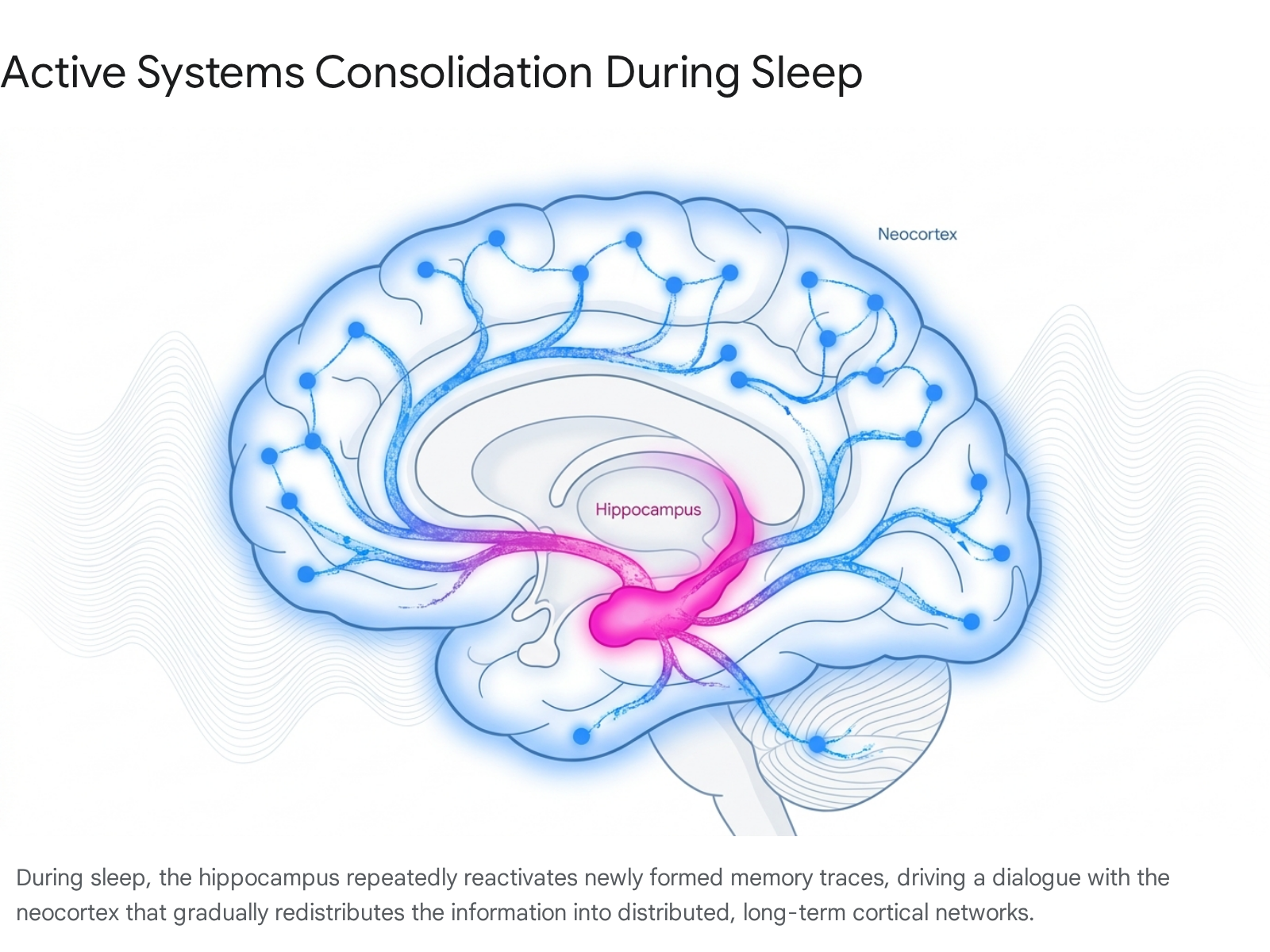
This theory posits that during sleep, the hippocampus repeatedly reactivates the memory traces it formed during the day. Through this repetitive "playback," the hippocampus acts as a physiological instructor, training the slower-learning neocortex to form permanent connections between its own neurons 256.
Eventually, the memory becomes independent of the hippocampus entirely. You can recall your childhood phone number or the lyrics to your favorite song effortlessly because that information is deeply embedded in your neocortical networks, requiring no heavy lifting from the hippocampus 210. While the Active Systems Consolidation model assumes that this nighttime transfer frees up hippocampal resources for the next day's learning, some recent neurological reviews note that the exact relationship between overnight consolidation and next-day learning capacity remains an area of active debate, with some evidence suggesting overlapping rather than strictly causal mechanisms 67.
The Architecture of Sleep: Stages and Memory Types
Sleep is not a uniform state of unconsciousness. Over the course of a typical night, your brain cycles through distinct phases roughly every 90 to 110 minutes. These cycles are broadly divided into Non-Rapid Eye Movement (NREM) sleep and Rapid Eye Movement (REM) sleep. Each stage plays a unique and complementary role in memory consolidation, tackling different types of information 13148.
To understand how the brain divides its nighttime labor, the following table summarizes the key stages of sleep and their specific contributions to memory consolidation 13816.
| Sleep Stage | Brain Wave Signature | Primary Memory Type | Key Function in Consolidation |
|---|---|---|---|
| Light Sleep (NREM 1 & 2) | Alpha and Theta waves | Declarative & Motor | Early processing; prepares the brain for deep sleep; minor consolidation of simple motor skills. |
| Deep Sleep (NREM 3 / SWS) | Delta waves (0.5 to 4 Hz) | Declarative (Facts, Events) | Major transfer of information from hippocampus to neocortex; stabilizes and expands memory traces. |
| REM Sleep | Beta and Desynchronous waves | Procedural & Emotional | Integrates new memories with old; emotional regulation; synaptic pruning; pattern recognition. |
NREM Sleep: The Heavy Lifter for Facts
NREM sleep is divided into three stages, with the deepest being NREM-3, commonly referred to as slow-wave sleep (SWS). Slow-wave sleep dominates the first half of the night. It is characterized by slow, high-amplitude delta brain waves 1617.
SWS is widely considered the most critical phase for stabilizing and transferring declarative memories - the explicit, fact-based memories such as names, dates, vocabulary, prose, and spatial navigation 8189. During deep sleep, the brain is highly disconnected from sensory input, creating an optimal, interference-free environment for the hippocampus to communicate with the neocortex 1620. In addition to facts, emerging research indicates that NREM sleep also supports procedural memory, helping to solidify the sequence of physical skills 821.
REM Sleep: The Emotional and Procedural Refiner
As the night progresses, the sleep cycles shift, and REM sleep becomes more dominant. During REM sleep, the brain becomes highly active, closely resembling the electrical patterns of wakefulness. Your eyes dart rapidly beneath your eyelids, and your voluntary muscles undergo a temporary paralysis (atonia) to prevent you from acting out your vivid dreams 1610.
While NREM sleep stabilizes memories, REM sleep is believed to integrate, reorganize, and refine them. REM sleep is particularly important for non-declarative memories, such as complex procedural skills and emotional memories 81618. During this phase, the brain prunes weaker synaptic connections and links new information to existing cognitive frameworks, which often results in creative problem-solving and emotional regulation 38.
The Electrical Symphony: How Brain Waves Transfer Memories
The physical transfer of memories is driven by a highly coordinated electrical dance between different regions of the brain. Memory consolidation during sleep relies on the precise synchronization of three distinct brain wave rhythms: sharp-wave ripples, slow oscillations, and sleep spindles 112412.
Sharp-Wave Ripples (SWRs)
Sharp-wave ripples (SWRs) are brief, incredibly fast bursts of electrical activity (ranging from 80 to 150 Hz in humans) originating in the hippocampus. SWRs are the neurophysiological signature of memory replay 31126.
When you learn a new route to work, a specific sequence of neurons fires in your hippocampus. During SWRs in deep sleep, that exact same sequence of neurons fires again, but at a highly accelerated speed - sometimes fast-forwarded or even replayed in reverse 324. This high-speed replay is the hippocampus packaging the memory and broadcasting it out to the rest of the brain.
For many years, SWRs were primarily studied in rodents. However, recent breakthroughs utilizing human epilepsy patients with intracranial electrodes have confirmed that these ripples occur robustly in humans. Furthermore, they are spatially distinct from the pathological electrical discharges associated with epilepsy 2613. SWRs are so fundamental to cognition that researchers have recently detected them occurring not just in sleep, but during brief moments of wakeful rest and fluctuating attention, suggesting they help guide ongoing decision-making and schema-based learning even while we are awake 28293031.
Sleep Spindles and Slow Oscillations
If SWRs are the packages of information, slow oscillations and sleep spindles are the delivery mechanisms.
Slow oscillations originate in the frontal cortex. These slow waves (0.5 to 4 Hz) sweep across the brain, providing a temporal framework that sets the rhythm for the entire consolidation process 171124. Meanwhile, sleep spindles are sudden bursts of rhythmic activity (7 to 15 Hz) generated in the thalamus. Spindles act as gatekeepers, opening a window of plasticity in the neocortex so that it is primed and ready to receive the memory package from the hippocampus 112414.
When a sharp-wave ripple from the hippocampus perfectly aligns with a sleep spindle and the upward phase of a slow oscillation, the memory trace is successfully transferred and permanently etched into the cortex 2412. Recent studies reveal that these spindles are particularly crucial for consolidating complex, multi-layered associations, allowing us to reconstruct whole memories from a single cue 15.
Resetting the Neural Canvas
A persistent question in neuroscience has been: if we continually learn and strengthen connections, why doesn't the brain run out of storage space or become overloaded with neural noise?
A groundbreaking 2024 study published in Science provided a crucial piece of the puzzle. Researchers discovered that while specific regions of the hippocampus (CA1 and CA3) actively replay memories during deep sleep, another region (CA2) briefly goes completely silent. This localized silencing acts as a "reset" button. By temporarily shutting down certain circuits, the brain allows these neurons to clear their short-term configurations, freeing up resources so you can wake up the next day with a blank canvas ready to encode new information 16.
Beyond Preservation: How Sleep Transforms Memories
For decades, the consensus was that sleep simply protected memories from decay - shielding them from the interference of waking life. However, recent evidence shows that sleep actively transforms and edits our memories, deciding what to keep and what to discard 34.
A 2025 study published in Nature Human Behaviour demonstrated this transformative power using a real-world scenario. Researchers took participants on a 20-minute audio-guided art tour and tested their memories up to 15 months later. They found a striking divergence in how the brain handled different types of memory over time 1718.
Without sleep, memory for both the specific visual details of the art (features) and the order in which the art was viewed (sequence) decayed steadily. However, for participants who slept normally after the tour, their memory for the sequence of events was actually enhanced and preserved, even a year later. Sleep selectively bolstered the structural narrative of the experience - the chronological order - while allowing superficial perceptual details to fade 171920. This "anti-forgetting" effect proves that sleep organizes our memories into coherent, generalized schemas that help us navigate the world, rather than acting as a simple, objective video recorder 431.
The Glymphatic System: Taking Out the Neural Trash
Memory consolidation isn't the only vital task occurring during deep sleep. Sleep is also a period of intense biological housekeeping. In 2012, researchers discovered the glymphatic system, the brain's unique waste clearance pathway.
During normal wakefulness, cellular metabolism produces toxic byproducts, including amyloid-beta and tau proteins. If left to accumulate, these proteins form plaques and tangles that destroy neurons and synaptic connections, heavily impairing memory 3940.
During slow-wave sleep, the brain's glial cells actually shrink, expanding the perivascular spaces around blood vessels by up to 60%. This allows cerebrospinal fluid (CSF) to wash through the brain tissue at a highly accelerated rate, flushing out amyloid-beta and tau into the lymphatic system 1721. The powerful delta waves of deep sleep physically drive this fluid exchange.
Human studies conducted in 2025 demonstrated a direct correlation between high EEG delta power during non-REM sleep and elevated morning plasma levels of amyloid-beta and tau, confirming that the brain actively pumps these toxins out during deep rest 39. Conversely, just one night of sleep deprivation significantly stalls this clearance process. Over years, chronic impairment of the glymphatic system - often measured by an imaging biomarker known as DTI-ALPS - is strongly linked to the onset of vascular dementia and Alzheimer's disease 4022.
The Cognitive Cost of Sleep Deprivation
When you deprive the brain of sleep, the intricate mechanisms of memory consolidation and waste clearance collapse, resulting in immediate and long-term cognitive deficits.
Temporary Amnesia from Sleep Loss (TASL)
Sleep deprivation degrades the brain's capacity to encode new information. Trying to learn after a sleepless night is like trying to save a file to a hard drive that has been unplugged. Neuroimaging shows that sleep loss severely decreases activation in the hippocampus and severs its functional connectivity with the prefrontal cortex, temporal lobes, and parietal lobes 2344.
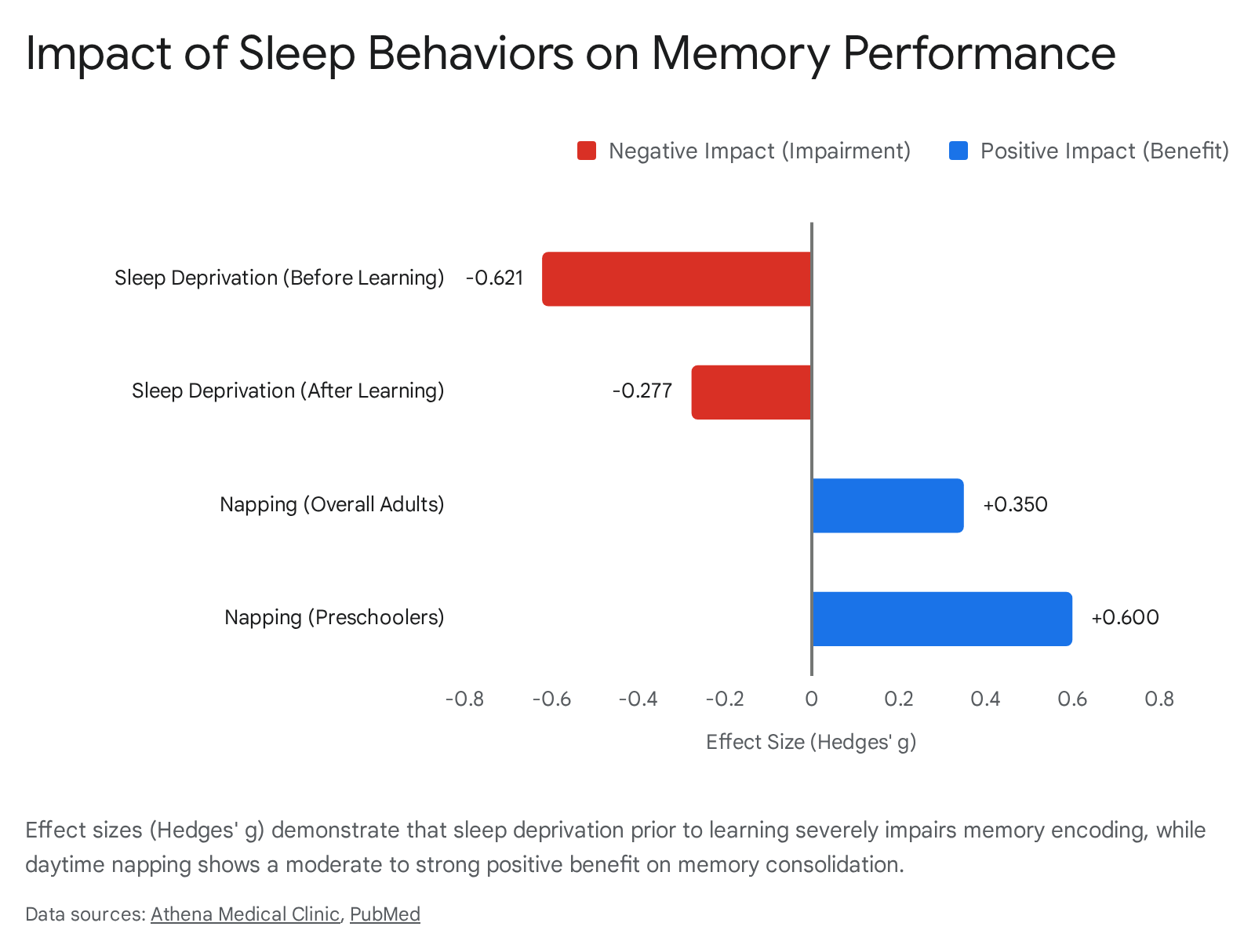
Researchers sometimes refer to this state as "temporary amnesia from sleep loss" (TASL). It affects not only the ability to memorize facts but also impairs working memory, attention, and executive functions like decision-making 2324. Meta-analytic data confirms that sleep deprivation before learning has a massive negative effect on encoding capacity, while sleep deprivation after learning disrupts the consolidation of whatever fragile memories were formed during the day 4424.
Emotional Dysregulation and Brain Aging
Without the emotional refining process of REM sleep, the brain struggles to contextualize negative experiences. Sleep deprivation impairs prefrontal control over the amygdala, the brain's fear center. A 2024 study demonstrated that healthy participants deprived of sleep lost their ability to suppress unwanted, intrusive memories 2425. This failure of inhibitory memory control sheds light on why chronic sleep disturbances are heavily co-morbid with mental health conditions like post-traumatic stress disorder (PTSD) and severe anxiety 25.
Over the long term, poor sleep does physical damage to the brain. A massive 2025 study tracking older adults found that those with chronic insomnia experienced accelerated brain aging equivalent to 3.5 additional years . They exhibited structural changes in the brain and were significantly more likely to develop mild cognitive impairment or dementia, likely due to the prolonged failure of the glymphatic system to clear metabolic waste 26.
Sleep Hacking: Myths vs. Science
Because sleep takes up roughly a third of our lives, humans have long searched for ways to "hack" it to increase productivity. However, science paints a nuanced picture of what is actually possible.
Debunking the Sleep-Learning Myth (Hypnopaedia)
In the 1920s, inventors sold devices that played audio tapes to sleeping individuals, promising they could learn a new language or memorize facts by morning. This concept, known as hypnopaedia, has been thoroughly debunked. When EEG technology was invented in the 1950s, scientists realized that any learning occurring from these tapes only happened because the audio was physically waking the participants up 27.
Modern research confirms that while the sleeping brain can process basic acoustic patterns and recognize specific tones, it cannot group sequences of sounds into complex meaning. The high-order brain structures required to learn a new language from scratch are deactivated during slow-wave sleep. You cannot learn Spanish or memorize a textbook simply by playing a tape while you snooze 505152.
The Reality of Targeted Memory Reactivation (TMR)
While you cannot learn new complex information during sleep, you can manipulate sleep to dramatically strengthen things you already learned during the day. This is achieved through a technique called Targeted Memory Reactivation (TMR).
If an individual learns a spatial task or a vocabulary list while a specific background sound or scent is present, re-playing that exact sound or releasing that scent during their deep sleep triggers the hippocampus to selectively replay those specific memory traces. Studies consistently show that TMR can significantly enhance memory retention and spatial recall the next day, provided the auditory cues are low-intensity and do not cause micro-arousals 202728.
The efficacy of TMR is currently a major focus of clinical research. In 2024, researchers successfully used TMR combined with imagery rescripting to reduce the vividness and emotional distress of negative autobiographical memories, suggesting massive potential for treating trauma 29. The technique has also shown promise in utilizing personalized stimulation frequencies to help individuals master difficult learning tasks 30. However, TMR appears to be less effective in older adults, likely due to age-related degradations in the natural slow-wave sleep features required for consolidation 31.
Actionable Strategies for Better Memory
For students, professionals, and anyone looking to optimize their cognitive health, the science of memory consolidation offers several actionable, evidence-based takeaways.
The Power of the Daytime Nap
You do not need a full eight hours to trigger memory consolidation. Extensive meta-analyses have shown that daytime napping yields moderate to large benefits for declarative memory, physical performance, and emotional regulation across all age groups 5758.
A nap of just 30 to 60 minutes contains enough Stage 2 and early slow-wave sleep to facilitate the transfer of memories and clear out synaptic buildup. Researchers have found that motor tasks - like typing sequences or sports drills - show noticeable performance gains after a daytime nap. These improvements directly correlate with bursts of sleep spindle activity in the motor cortex during the nap 5832.
Timing Your Sleep for Optimal Learning
Research indicates that the timing of sleep relative to learning matters immensely. Studies tracking college students using wearable fitness trackers have found that inconsistent sleep schedules (such as sleeping very little on weekdays and binge sleeping on weekends) strongly correlate with lower academic performance. A 2023 MIT study found that nearly 25% of the variance in a student's grade could be attributed to the quality, duration, and consistency of their sleep 6033.
Furthermore, pulling an "all-nighter" before an exam is entirely counterproductive. Sleep lost immediately following a period of intense learning generally cannot be fully "recovered" on subsequent nights, meaning the memories will not be properly consolidated 603334. To maximize recall, reviewing the most critical material shortly before going to sleep helps tag that information for priority processing. By doing so, you are essentially signaling to the hippocampus which memory traces should be heavily replayed and consolidated during your slow-wave sleep 3435.
Bottom line
Memory consolidation during sleep is a highly active, complex biological process where the hippocampus replays daily experiences, allowing the neocortex to integrate them into permanent long-term storage. This process relies on the precise synchronization of deep brain waves, which not only strengthen factual and procedural memories but also physically cleanse the brain of toxic metabolic waste. While you cannot passively learn a new language in your sleep, consistently getting high-quality, uninterrupted rest - or taking strategically timed daytime naps - remains the most effective, scientifically proven method for protecting your cognitive health and optimizing your ability to learn.