
What Quiet Quitting Means and What the Data Shows
Quiet quitting is the conscious decision by employees to fulfill only their formal job duties while withdrawing all discretionary effort and emotional investment from their workplace. Recent global workplace data reveals that nearly 60 percent of the worldwide workforce currently falls into this category, driven largely by persistent burnout, broken trust, and ineffective management. This widespread disengagement is a profound macroeconomic issue, currently costing the global economy an estimated $8.9 trillion annually in lost productivity.
The Origins of a Global Disengagement Movement
The concept of quiet quitting exploded into mainstream public consciousness during the summer of 2022. It gained immense viral traction on the social media platform TikTok after a career coach named Bryan Creely, and subsequently an engineer named Zaid Khan, posted short videos describing a rejection of "hustle culture" 123. Khan's video defined the concept not as outright resigning, but as quitting the expectation of going above and beyond one's job description 24. The sentiment resonated instantly with a global workforce exhausted by pandemic-era disruptions, blurring work-life boundaries, and mounting economic uncertainty 15.
However, while the English term was coined and popularized on Western social media, the underlying behavioral shift actually originated much earlier in East Asia. As early as April 2021, young workers in China began embracing a lifestyle and social movement known as tang ping, which translates to "lying flat" 4678. Tang ping emerged as a direct cultural rejection of China's grueling "996" work culture - a system demanding that employees work from 9:00 a.m. to 9:00 p.m., six days a week 8. The lying flat movement advocated for a lifestyle stripped of intense career ambitions, consumerist pressures, and relentless economic productivity 69. A related, slightly more pessimistic concept known as bai lan ("let it rot") further captured a sense of fatalism among youth facing high urban unemployment and fierce competition for white-collar jobs 4.
While tang ping often represents a broader, holistic lifestyle choice, quiet quitting is specifically an occupational behavior exhibited while still maintaining employment 78. From a historical perspective, organizational researchers note that the behavior itself is not entirely unprecedented. It serves as a modern, white-collar adaptation of the 1970s labor union tactic known as "work-to-rule," where employees perform exactly what is required by their union contracts - and absolutely nothing more - as a form of silent protest against management 510. Similarly, previous generations have expressed forms of disengagement, such as the "slackers" of Generation X in the 1990s or the "cyberloafing" trends of the early remote work era, but the modern iteration is distinct in its deliberate boundary-setting 11.
The Ecosystem of "Quiet" Workplace Trends
To fully understand the scope of the problem, researchers and human resources experts differentiate quiet quitting from other forms of workplace disengagement. The term itself is somewhat of a misnomer; quiet quitting does not mean an employee is lazy, careless, or abandoning their post 31213. Employees who quiet quit still perform their required duties, meet their deadlines, and follow workplace rules 3. What they withdraw is their emotional investment, their willingness to perform unpaid tasks, and their availability outside of strict business hours 35.
As the conversation around modern labor dynamics has evolved, a complex ecosystem of related terminology has emerged to describe the varying states of friction between employees and employers.
| Workplace Phenomenon | Definition and Characteristics | Primary Drivers | Organizational Impact |
|---|---|---|---|
| Quiet Quitting | Strictly doing the bare minimum required by the job description; intentionally withdrawing all discretionary effort. | Burnout, desire for work-life balance, perceived lack of fair compensation 1415. | Stagnant innovation, reduced team collaboration, lower overall productivity 31514. |
| Loud Quitting (Active Disengagement) | Openly expressing dissatisfaction; actively undermining organizational goals and spreading negativity while remaining employed. | Deep resentment, consistently unmet psychological needs, highly toxic management 151617. | High toxicity, severe disruption of team morale, potential reputational damage 1720. |
| Quiet Firing | Managers subtly making a role unbearable (withholding feedback, isolating, denying raises) to force an employee to resign. | Poor leadership, avoidance of formal termination processes, evasion of severance or unemployment costs 31822. | Total erosion of trust, silent attrition, significant legal and ethical risks 31822. |
| Resenteeism | Remaining in a role due to a perceived lack of outside options or economic fear, but harboring deep, growing resentment. | Economic insecurity, feeling trapped in an unfulfilling role, high inflation 3. | Highly contagious negative morale, diminished team cohesion, passive-aggressive behaviors 3. |
| Quiet Cracking | A persistent state of hidden workplace unhappiness that gradually corrodes motivation without the worker making a deliberate choice to disengage. | Ongoing uncertainty, broken promises, long-term corporate instability 2319. | A slower, more insidious decline in performance; estimated to cost billions in unseen productivity loss 2319. |
| Quiet Vacationing | Employees taking advantage of remote work autonomy to travel or take time off without formally notifying their managers, while still delivering expected results. | Blurred boundaries of remote work, a desire for total autonomy, strict outcome-based performance rather than time-based tracking 2526. | Challenges to traditional management oversight; forces a shift from micromanagement to trust-based leadership 26. |
The Hard Data on Global Disengagement
The data behind quiet quitting reveals a staggering deficit in global workforce motivation. According to Gallup's comprehensive "State of the Global Workplace" reports - which survey over 128,000 employees across more than 160 countries annually - the vast majority of the world's workers are psychologically detached from their jobs 2720.
In 2023, Gallup's metrics classified 59 percent of the global workforce as "not engaged," which serves as the statistical equivalent of the quiet quitting profile 1529. Another 15 to 18 percent were classified as "actively disengaged," or loud quitters 152122. By 2024 and heading into 2025, global engagement remained largely stagnant, with only 21 to 23 percent of employees reporting that they were actively engaged, thriving, and emotionally invested in their daily work 19212223. This means that for every single engaged worker, there are nearly four who are either going through the motions to collect a paycheck or actively working against their employer's interests 19.
The Trillion-Dollar Economic Toll of Lost Discretionary Effort
The financial implications of this mass withdrawal of labor are profound. Discretionary effort - the willingness of an employee to voluntarily take on a new project, mentor a junior colleague, suggest an innovative idea, or catch a critical error outside their strict purview - is what separates merely functional organizations from highly competitive, high-performing ones 23.
When roughly 60 percent of a workforce ceases to provide this effort, the macroeconomic impact is severe. Research estimates that low employee engagement costs the global economy approximately $8.8 trillion to $8.9 trillion annually 2019212333. To put this in perspective, this figure represents roughly 9 percent of global GDP 202333. Furthermore, the subtler phenomenon of "quiet cracking" - where workers slowly deteriorate under the weight of dissatisfaction rather than making a deliberate choice to withdraw - adds an estimated $438 billion in supplementary productivity losses 1923.
This loss of productivity is not merely theoretical; it is visible in national economic metrics. A working paper from the National Bureau of Economic Research (NBER), authored by economists at Washington University in St. Louis, utilized U.S. Bureau of Labor Statistics data to examine a noticeable 3 percent decline in total U.S. hours worked between 2019 and 2022 23. The researchers found that, historically, changes in total hours worked were driven almost exclusively by people entering or leaving the labor force entirely 23. However, the post-pandemic era marked the first time a significant share of the decline - more than half - came from employed workers voluntarily reducing their individual hours 23.
This reduction was heavily concentrated among a specific demographic: the top quarter of workers by hours worked, primarily married, college-educated men who historically logged over 50 hours per week 23. This cohort saw their annual hours drop significantly, equating to an average reduction of 11 hours per year across the per capita aggregate 23. For the highest earners, this represented more than a full week of lost work per year as they voluntarily traded economic output for increased social activity and leisure time 23.
Regional Realities: How Geography Influences Quiet Quitting
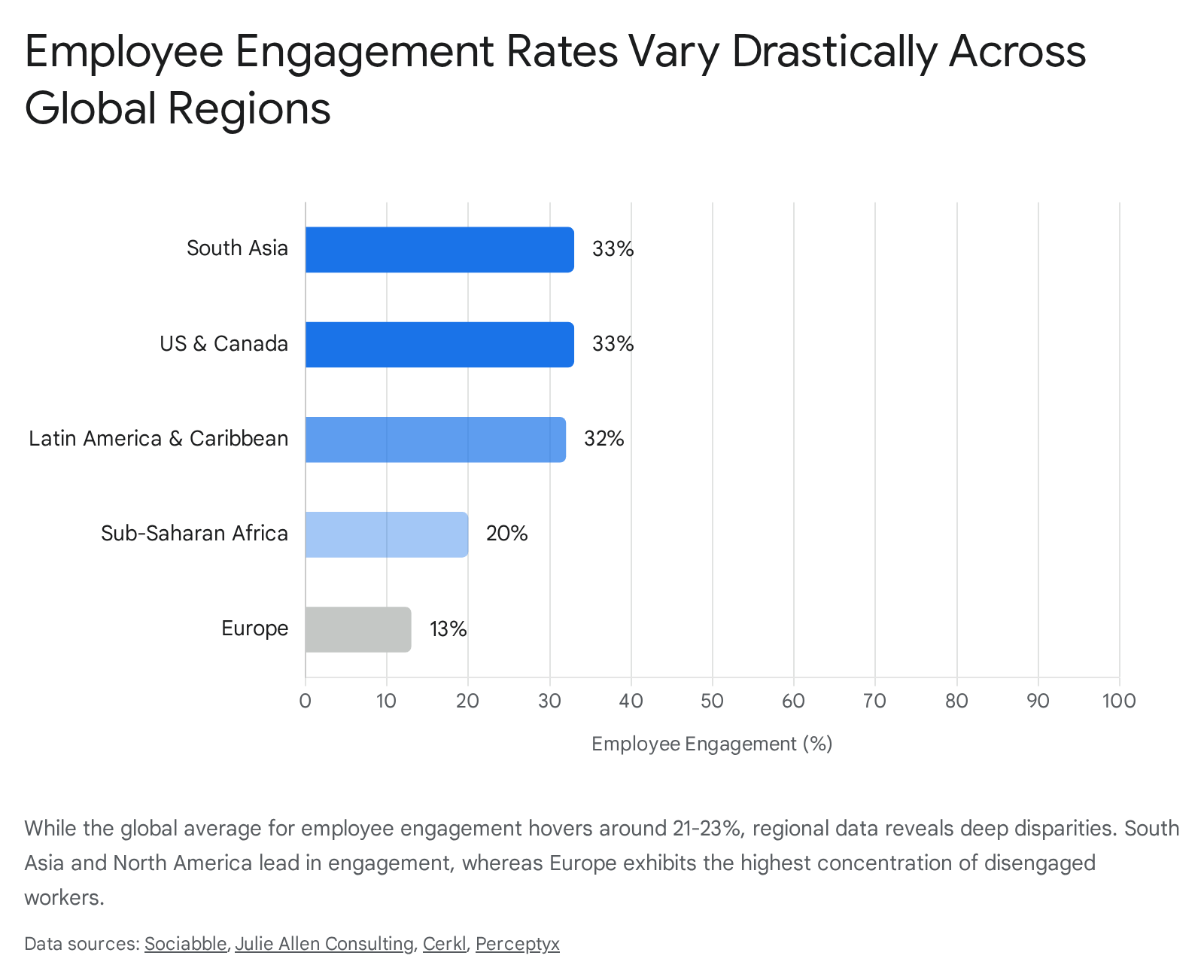
The global data indicates that quiet quitting manifests quite differently depending on regional economic conditions, local labor laws, and deep-seated cultural norms regarding work-life balance.
| Region | Engagement Rate | Key Drivers and Cultural Context |
|---|---|---|
| North America | ~31% - 33% | High engagement relative to the global average, but accompanied by extremely high daily stress. The U.S. workforce has seen engagement hit a 10-year low recently, with at least 50% of the workforce fitting the quiet quitting profile 11721222324. |
| Europe | ~13% | The lowest engagement rates globally, yet European workers report the highest levels of life evaluation. This reflects a strong, systemic cultural rejection of "hustle culture" and a preference for legislative protections over corporate loyalty 427212224. |
| Latin America | ~32% | High engagement driven by cultural norms that heavily prioritize group cohesion, relationships, and hierarchical respect. Volatile job markets and high unemployment also make workers more appreciative of job security, sustaining engagement 2224. |
| Sub-Saharan Africa | ~20% | Stagnant engagement plagued by intense financial pressure. Workers report high stress (48%) and loneliness (28%), with 75% actively looking for new jobs, indicating that quiet quitting here is often a holding pattern before actual resignation 2225. |
| South Asia | ~33% | Leads the world in the percentage of thriving employees. However, within specific major economies like India, engagement among knowledge workers has reportedly plummeted in recent years due to poor leadership communication and burnout 3152224. |
Europe's Legislative Backlash Against Hustle Culture
Europe reports the lowest employee engagement rates in the world, hovering around a mere 13 percent 272122. However, organizational psychologists point out that this low engagement does not necessarily correlate with misery or poor well-being. In fact, European workers consistently rank among the highest globally in overall life evaluation, with 47 percent reporting that they are thriving in their daily lives 4.
The data suggests a strong, institutionalized cultural backlash against American-style "hustle culture." A 2025 poll of employees across the United Kingdom, France, Germany, Italy, and Spain found that 86 percent believe U.S. corporate culture is increasingly influencing their workplaces, bringing with it an overemphasis on long hours, aggressive productivity tracking, and job insecurity 26. Furthermore, 34 percent of surveyed European employees explicitly stated they would resign if their current workplace adopted these aggressive trends 26.
In response to digital overwork, European countries rely heavily on labor protections rather than expecting employees to set boundaries individually. For example, France has instituted a "Right to Disconnect" law, mandating that companies with 50 or more employees establish clear collective agreements ensuring workers are not penalized for ignoring after-hours emails or calls 26. Similarly, Germany's "Bridging Part-time Work" law allows employees to temporarily reduce their working hours for one to five years to manage burnout or family obligations, with a guaranteed right to return to full-time status 26.
Latin America's Shifting Labor Landscape
Latin America and the Caribbean present a contrasting picture, with engagement rates sitting relatively high at roughly 32 percent 2224. The resilience of engagement in South America is partially attributed to cultural norms that place a high value on interpersonal relationships, group harmony, and communication, leading to more positive workplace interactions 24. Furthermore, because job markets in the region can be volatile and unemployment high, workers often display a "social desirability bias" in surveys, reporting higher gratitude and engagement simply for having formal employment 24.
However, the region is also undergoing significant legislative shifts to institutionalize work-life balance, preventing the need for quiet quitting. For instance, Chile is executing a gradual reduction of its legal workweek from 45 hours down to 40 hours by 2028, alongside new laws guaranteeing telework rights for parents 37. Colombia is similarly phasing down its maximum working week to 42 hours by 2026, while also implementing strict new laws regarding workplace harassment 37. These legislative moves signal that Latin American governments are proactively addressing the burnout that fuels quiet quitting.
Africa's Disengagement and Retention Crisis
In Sub-Saharan Africa, the workplace data paints a deeply concerning picture. Employee engagement has barely improved over recent years, stagnating at 20 percent 2225. This disengagement is heavily compounded by severe economic pressures, rising living costs, and inadequate infrastructure.
The 2025 Gallup data reveals that 48 percent of African employees experience significant daily stress - 7 percentage points above the global average - and 28 percent report feeling lonely for a large portion of their day 25. Most alarming for employers is the retention crisis: a staggering 75 percent of the workforce is actively watching for or seeking new job opportunities 25. This indicates that in regions with high economic instability, quiet quitting is rarely a permanent lifestyle choice; rather, it is a temporary holding pattern. Employees withdraw their discretionary effort to conserve energy while actively hunting for a better opportunity, treating their current role merely as a necessary income stream 151425. While optimism remains relatively high - 85 percent of workers in surveyed African nations believe their current jobs provide security - the lack of enthusiasm for traditional work models is profound, particularly among the youth 27.
Demographic Divides: Why Youth Lead the Trend
While the temptation to coast at work affects all age groups, the data indicates a pronounced generational divide. A 2024 HubSpot study found that while 35 percent of Generation X workers admit to quiet quitting, the sentiment is overwhelmingly driven by younger cohorts, with massive social media resonance among Generation Z and Millennials 318. Studies show that an estimated 47 percent of Gen Z employees openly admit to "coasting" through their daily work 319.
Gallup's longitudinal data highlights how rapidly this shift occurred. Between 2019 and 2022, the percentage of engaged employees under the age of 35 dropped by 4 to 6 percentage points, accompanied by a simultaneous spike in active disengagement 21723. Young workers reported sharp declines in specific engagement metrics, particularly agreeing that someone at work cared about them, encouraged their development, or provided opportunities to learn and grow 1723.
The psychological drivers behind this generational divide are deeply rooted in macroeconomics. Generation Z and younger Millennials entered the workforce during a period of rolling crises: the aftermath of the 2008 financial crash, a global pandemic, runaway inflation, and soaring housing costs 11. According to Deloitte's 2025 Gen Z and Millennial Survey, roughly half of these demographics do not feel financially secure, contributing heavily to stress and emotional fatigue 3.
As a result, the implicit promise of the traditional corporate "hustle" - that boundless loyalty and excessive hours will inevitably lead to homeownership, generous pensions, and financial stability - appears irreparably broken to many 11. Consequently, younger workers are placing a premium on mental health and strict boundaries. They view quiet quitting not as laziness, but as a rational economic recalibration to protect their well-being in an unpredictable, often unforgiving economy 1339.
The Psychology of Disengagement: What the Academic Research Shows
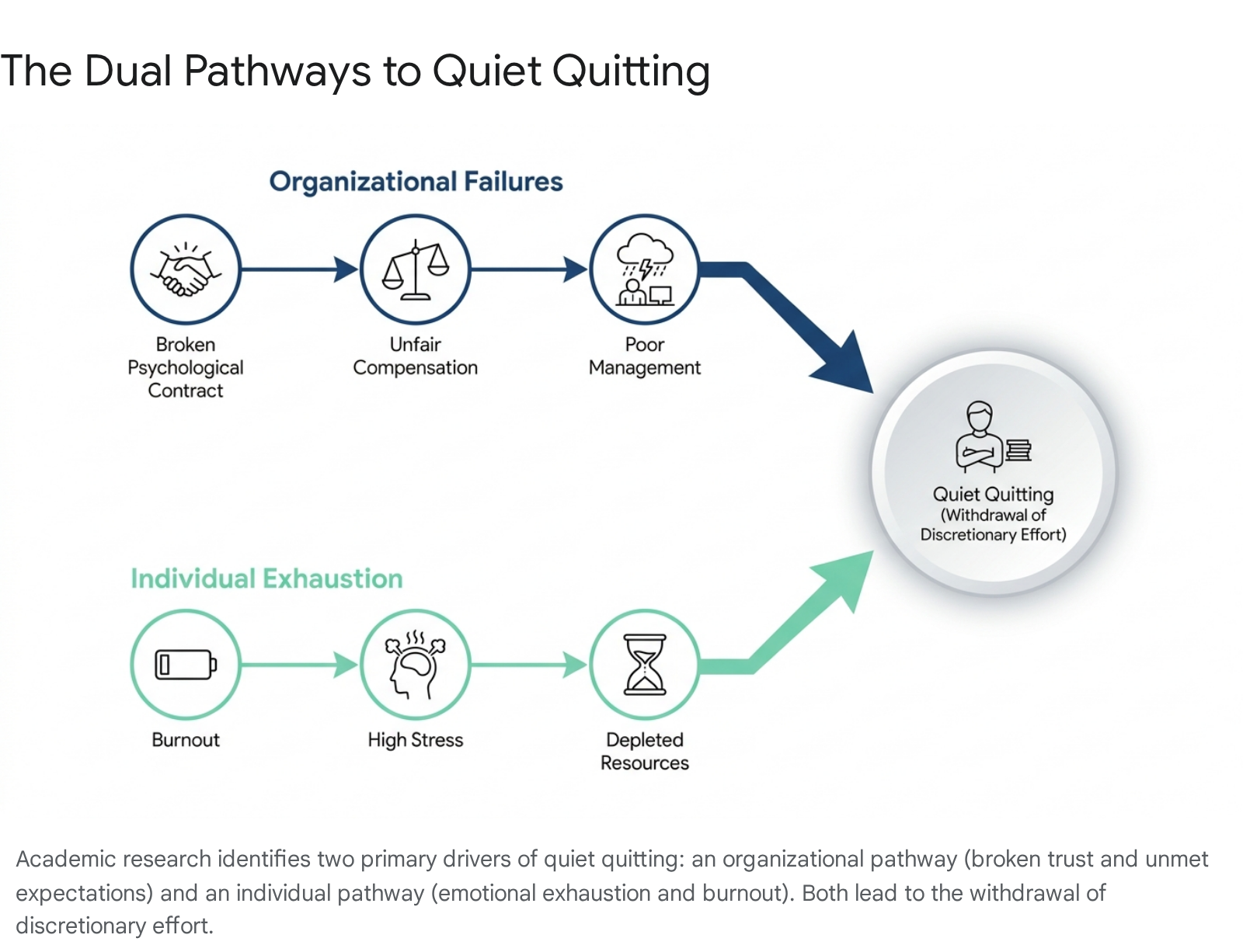
While social media frequently frames quiet quitting as a trendy lifestyle aesthetic, academic researchers and organizational psychologists view it through the lens of established behavioral science. Peer-reviewed literature spanning 2023 to 2025 has systematically analyzed the root causes of the phenomenon, moving beyond the buzzwords to identify severe structural workplace failures.
The Breach of the Psychological Contract
The primary academic framework utilized to explain quiet quitting is Psychological Contract Theory 28. The psychological contract represents the unwritten, implicit expectations, beliefs, and obligations that exist between an employee and an employer . It encompasses fundamental ideas about fairness, career advancement trajectories, psychological safety, and mutual respect.
When organizations underwent mass layoffs, froze wages despite record-high inflation, or demanded perpetual digital availability during the global shift to remote work, employees perceived a severe, unilateral breach of this contract 710. Research clearly indicates that psychological contract fulfillment negatively correlates with quiet quitting; conversely, when the contract is violated, employees react by psychologically withdrawing to recalibrate the relationship back to what they view as equitable 2943. If the employer is only providing the bare minimum in terms of compensation, recognition, and security, the employee mirrors this by providing only the bare minimum in labor - a concept popularized colloquially as "acting your wage" 1144.
The Withdrawal of Organizational Citizenship Behavior (OCB)
In organizational psychology, the act of "going above and beyond" is formally defined as Organizational Citizenship Behavior (OCB) 28. OCB includes all the discretionary, extra-role actions that keep a company running smoothly but are rarely written into a contract: helping an overwhelmed colleague, attending non-mandatory team-building meetings, innovating new processes, or answering emails on weekends 30.
Quiet quitting is fundamentally defined in the academic literature as the intentional, calculated withdrawal of OCB 29. A systematic review of the literature reveals that the withdrawal of OCB is largely driven by a mismatch between personal values and organizational goals, alongside a distinct lack of career advancement 4647. Studies demonstrate that employees who perceive limited advancement opportunities are nearly three times more likely to reduce their discretionary effort over a two-year period 4647. When workers realize that performing OCB does not lead to tangible rewards, promotions, or increased job security, the motivation to engage in these extra-role behaviors collapses completely 4647.
Burnout and the Conservation of Resources
Quiet quitting is also closely linked to the Conservation of Resources (COR) theory and the Job Demands-Resources model 2848. After years of elevated stress - global worker stress reached a historic high of 44 percent in 2022 and has remained stubbornly elevated - employees are emotionally exhausted 152029.
From this theoretical perspective, quiet quitting is not a malicious act of defiance or inherent laziness, but a necessary biological and psychological coping mechanism 153048. When job demands continuously outstrip the resources provided to the employee, individuals deliberately scale back their effort to protect their remaining mental and emotional energy, effectively building a defensive boundary against total occupational burnout 4849.
Measuring the Unseen: The Quiet Quitting Scale (QQS)
Because quiet quitting is a psychological withdrawal rather than a formal human resources event (like handing in a resignation letter), it is notoriously difficult for organizations to measure. To address this empirical gap, a team of researchers led by Petros Galanis developed and rigorously validated the Quiet Quitting Scale (QQS) in 2023 313233.
The QQS is a nine-item psychometric instrument that breaks the phenomenon down into three distinct, measurable domains 3132:
| QQS Dimension | Description | Number of Scale Items |
|---|---|---|
| Detachment | The degree of emotional disinterest, psychological withdrawal, and reduced mental attachment to professional responsibilities. | 4 items |
| Lack of Initiative | The conscious refusal to volunteer for tasks, participate in non-mandatory activities, or take on additional responsibilities beyond strict formal obligations. | 3 items |
| Lack of Motivation | The distinct absence of intrinsic and extrinsic drive to achieve organizational goals or seek career advancement within the company. | 2 items |
The validation of the QQS proves that quiet quitting is a quantifiable, distinct psychological state that operates independently from standard, generalized job satisfaction metrics 32. In initial studies applying the QQS to the high-stress healthcare sector, the results were highly alarming. Applying the scale's proposed cut-off point of 2.06, researchers found that 68.2 percent of surveyed clinical nurses were officially classified as quiet quitters 3134. The research also found that individuals working in understaffed departments, working rotating shifts, and possessing fewer years of clinical experience were significantly more likely to utilize quiet quitting as a protective mechanism 31.
The Tangible Impact on Organizational Culture
While quiet quitting may protect the individual employee from short-term burnout, its cumulative effect on an organization is highly destructive. Human resources research points to several critical areas where quiet quitting degrades corporate performance:
- Decreased Efficiency and Productivity: When a significant portion of the staff limits their effort, workflows slow down, and the quality of output drops to merely "acceptable" levels 1514.
- Innovation Stagnation: Innovation requires risk-taking, brainstorming, and passionate debate - all forms of discretionary effort. Disengaged employees rarely contribute new ideas or improvements, stifling the institution's ability to adapt to changing markets 15.
- Knowledge Drain: In knowledge-intensive industries, quiet quitters mentally distance themselves and often withhold vital expertise or neglect to document processes. When they eventually leave the company, they take critical institutional knowledge with them 14.
- Toxic Resentment Spillovers: A culture where half the team is coasting inevitably places a heavier burden on the remaining engaged employees. This dynamic breeds severe resentment, quickly transforming high performers into either loud quitters or quiet quitters themselves 31514.
It is also worth noting that quiet quitting carries long-term risks for the employee. While it provides immediate relief from overwork, choosing to "act your wage" can hamper career trajectories. Employees who consistently perform the bare minimum are the least likely to receive promotions, wage increases, or bonuses, and may be the first considered for layoffs during economic downturns 1144.
How Organizations Are Fixing the Problem
The overwhelming consensus among workplace researchers, economists, and organizational psychologists is that quiet quitting is a direct symptom of poor management 2151720. Gallup's data reveals a striking, foundational metric: managers account for a massive 70 percent of the variance in team engagement 212354.
When employees are managed poorly, they are nearly 60 percent more likely to experience high daily stress than those working under good, supportive management 1627. In fact, the data reveals a shocking reality regarding well-being: experiencing frequent daily stress, anger, and loneliness is reported approximately 30 percent more often by actively disengaged employees working under bad management than by people who are entirely unemployed 162023.
To combat the quiet quitting epidemic, organizational data points to several highly effective interventions that companies must adopt:
- Frequent, Meaningful Communication: The single most effective habit for successful managers is conducting one meaningful, 15-to-30-minute conversation with each team member every single week. These conversations should focus on their individual goals, life situations, and removing roadblocks to their success 217.
- Realigning Compensation and Expectations: Data shows that quiet quitters know exactly what would bring them back. When asked what they would change about their workplace to make it great, 85 percent of self-identified quiet quitters cited engagement/culture, pay, and overall wellbeing 2033. Furthermore, 90 percent of quiet quitters indicated they could be actively incentivized to work harder if working conditions and compensation structures improved 23.
- Supporting the Managers: Companies cannot expect managers to fix employee engagement if the managers themselves are drowning. In 2024, roughly 25 percent of leaders reported feeling burned out often or always, and two-thirds felt it at least sometimes 1627. Organizations must invest heavily in training and supporting middle management, transitioning them from simple taskmasters into empathetic coaches who can foster psychological safety 1754.
Bottom line
The data is unequivocal: quiet quitting is not a fleeting, superficial social media trend, but a systemic, global recalibration of the fundamental relationship between labor and management. With roughly six in ten workers psychologically detached from their jobs, the global economy is shedding trillions of dollars annually in lost discretionary effort and productivity. While the long-term permanence of this shift remains uncertain and highly dependent on future macroeconomic conditions and labor markets, the immediate solution is clear. Organizations cannot demand "above and beyond" effort without reciprocal investment; they must address the root causes of burnout, repair broken psychological contracts, and invest heavily in empathetic, highly trained management.