Workplace disengagement and global labor recalibration
The modern global workplace is currently undergoing a structural recalibration of the psychological contract between employers and employees. Historically, organizational success has relied heavily on discretionary effort - the willingness of employees to perform tasks and expend energy beyond the strict boundaries of their formal job descriptions. In organizational psychology, this is known as Organizational Citizenship Behavior (OCB), which involves going beyond the call of duty and has traditionally been rewarded with career advancement, job security, and wage growth 1. However, a widespread withdrawal of this discretionary effort has emerged, popularized in contemporary discourse as "quiet quitting."
Rather than a transient social media trend, empirical data and socio-economic analyses suggest that quiet quitting is a complex, multi-faceted response to systemic organizational dysfunction, prolonged economic uncertainty, and the erosion of traditional work-reward paradigms. Employees who engage in this behavior are not formally resigning, nor are they committing job abandonment; they are strictly adhering to their contractual obligations while refusing to participate in the "hustle culture" that demands continuous overachievement 234. To understand this phenomenon requires distinguishing it from other forms of workplace withdrawal, analyzing its parallel manifestations across different global cultures, assessing the macroeconomic costs, and evaluating the legal and human resource frameworks attempting to address it.
Taxonomy of Workplace Disengagement Behaviors
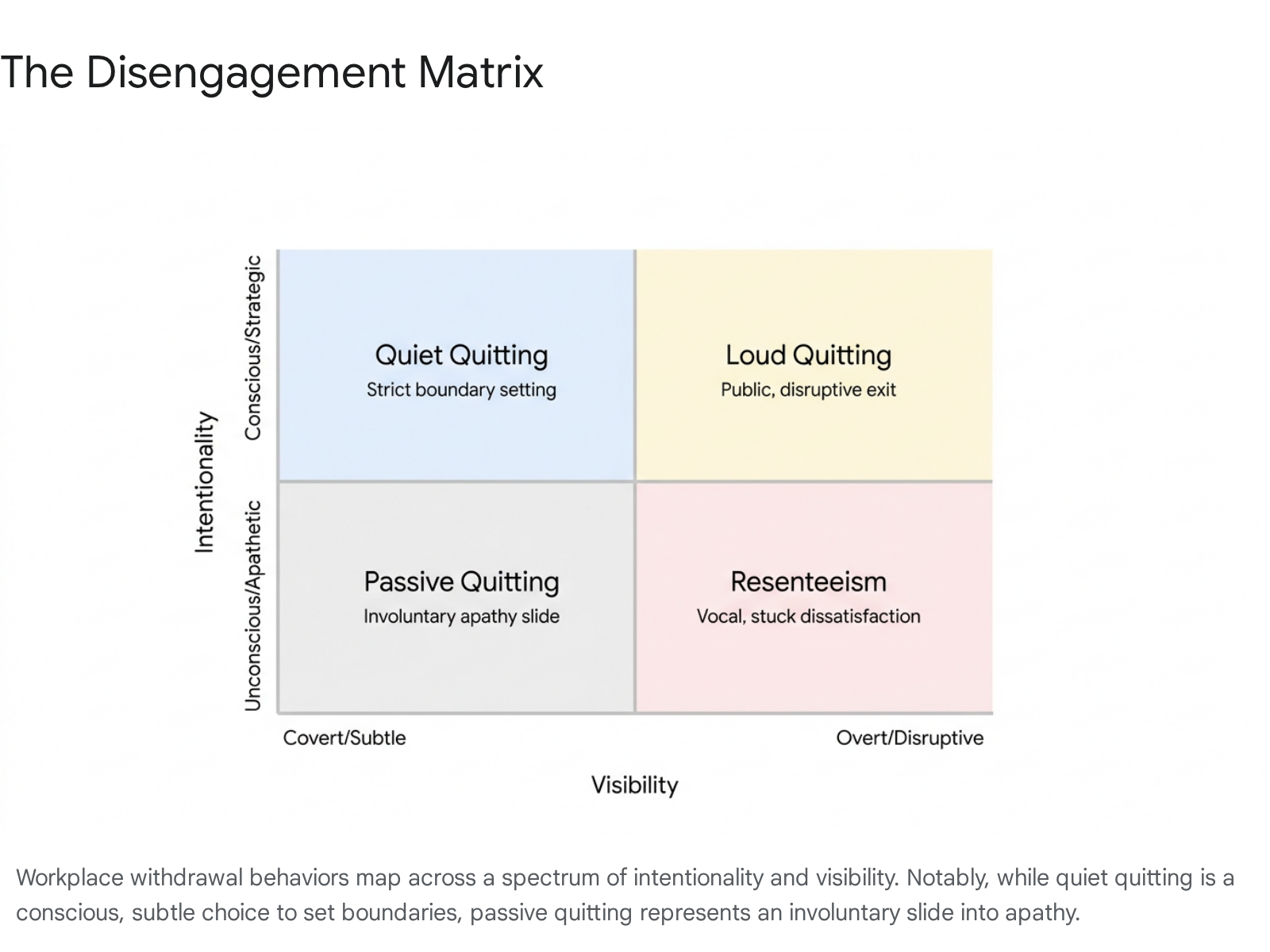
The popularization of the term "quiet quitting" - largely catalyzed by a viral 2022 social media video by a New York software engineer - has necessitated a more rigorous academic and practical taxonomy of workplace withdrawal behaviors 456. Disengagement is not a monolithic concept; it manifests across a spectrum of intentionality and visibility. Recognizing the nuances between different types of withdrawal is critical for organizational leaders seeking to address the root causes of productivity decline.
The Deliberate Boundary Setting of Quiet Quitting
At its core, quiet quitting is an active, conscious recalibration of effort. It involves fulfilling the precise requirements of a job description but actively withdrawing from citizenship behaviors, such as staying late, answering correspondence outside of working hours, or volunteering for additional uncompensated projects 1247. Organizational psychologists assert that labeling this behavior as "laziness" represents a fundamental misreading of the situation. Instead, it is frequently a self-protective mechanism deployed against toxic work cultures, stagnant compensation, and a lack of upward mobility. By strictly defining their contribution, employees attempt to preserve their mental health and reclaim their work-life balance in an era where the lines between home and office have been severely blurred 288.
The Unintentionality of Passive Quitting
Recent organizational psychology research has introduced the concept of "passive quitting" to distinguish deliberate boundary-setting from apathetic withdrawal. According to a 2026 structural equation modeling (SEM) study by Nowak, passive quitting is an unintentional, unconscious decline in engagement stemming from severe exhaustion, fatigue, and a profound loss of meaning at work 91112.
The distinction between the two is empirically significant. The Nowak study, utilizing a Computer-Assisted Web Interview (CAWI) sample of 1,040 employees in Poland, demonstrated that passive quitting is a strong and significant predictor of occupational burnout (β = 0.475, p < 0.001) 910. Conversely, quiet quitting showed virtually no relationship to burnout risk (β = 0.0012) when passive quitting was controlled for 910. The study utilized validated measurement scales, noting a Content Validity Index (CVI) for content relevance of 0.929 and high internal consistency (Cronbach's alpha exceeding 0.910 for both constructs) 1112. This robust statistical evidence suggests that quiet quitting may function as an effective coping mechanism that protects the employee from burnout, whereas passive quitting is an indicator of an employee who has already been depleted by organizational demands.
Institutional Failures and Quiet Cracking
A related concept identified in 2025 workforce analytics is "quiet cracking." This refers to a systemic institutional breakdown rather than an individual choice 1115. Quiet cracking occurs when organizations push employees past their psychological breaking points - often through structural overreach, understaffing, and the integration of new technologies (like generative AI) without adjusted performance metrics - while simultaneously removing growth opportunities 15. Employees experiencing quiet cracking do not consciously choose to step back; they simply deteriorate under the weight of unsustainable expectations, resulting in a state of persistent workplace unhappiness that corrodes performance 16. In the United States alone, 54% of employees report experiencing some level of quiet cracking, with many remaining in their roles solely due to financial pressure and job insecurity 11.
Manifestations of Loud Quitting and Resenteeism
On the more visible end of the withdrawal spectrum lie "loud quitting" and "resenteeism." Loud quitting refers to the overt, sometimes dramatic departure of an employee who broadcasts their grievances to the broader organization or the public, often utilizing social media to expose toxic workplace practices 1718. This behavior actively damages employer branding and team morale, creating immediate operational voids.
Resenteeism represents a scenario where employees remain in their roles due to financial insecurity or a lack of alternative options, but do so with open hostility and cynicism 122021. Unlike quiet quitters who subtly disengage to protect their peace, those experiencing resenteeism actively express their frustration, foster toxicity, and disrupt team dynamics. The fundamental difference lies in the visibility of the discontent; resenteeism is vocal and contagious, making it an immediate threat to organizational culture 2022.
To synthesize these variations, the following table outlines the distinct characteristics of modern workplace withdrawal mechanisms.
| Disengagement Construct | Intentionality Level | Organizational Visibility | Primary Psychological Driver | Consequence to Organization |
|---|---|---|---|---|
| Quiet Quitting | High (Conscious boundary setting) | Low (Subtle withdrawal) | Self-protection, work-life balance | Loss of discretionary effort, stalled innovation |
| Passive Quitting | Low (Unconscious apathy) | Low to Medium | Exhaustion, loss of meaning | Decline in baseline productivity and quality |
| Resenteeism | High (Conscious hostility) | High (Overt complaining) | Feeling trapped, lack of recognition | Toxic culture contagion, team disruption |
| Loud Quitting | High (Conscious exit) | Very High (Public broadcast) | Severe grievance, perceived injustice | Reputational damage, sudden knowledge loss |
| Quiet Cracking | Low (Systemic failure) | Medium (Gradual decline) | Institutional overreach, lack of support | Systemic performance deterioration, elevated turnover |
Cultural Contexts and East Asian Precursors
While the English phrase "quiet quitting" gained sudden virality in Western labor markets in the summer of 2022, the underlying sentiment of rejecting hyper-competitive labor markets and withdrawing discretionary effort has deep roots globally. Particularly in East Asia, prolonged economic pressures, severe housing unaffordability, and intense academic and professional competition have birthed distinct, culturally specific movements that mirror, predate, and in some aspects exceed the Western concept of quiet quitting.
Chinese Labor Dynamics and the Rejection of Involution
In the People's Republic of China, rapid economic growth over the past four decades established a grueling expectation of labor, epitomized by the "996" work schedule - working from 9:00 AM to 9:00 PM, six days a week . However, as macroeconomic growth began to decelerate and youth unemployment climbed to a record high of nearly 20% by mid-2022, a sense of "involution" (nèijuǎn) set in among the populace 51314. Involution describes an environment of intense, zero-sum competition for ever-scarcer resources, where increased individual effort and extreme educational investments no longer yield proportional economic rewards or upward mobility 1516.
In response to this hyper-competitive environment, several distinct behavioral trends emerged among Chinese youth. The most direct parallel to western quiet quitting is the concept of hùnong xué, roughly translated as "slacking off" or "bluffing it." Arising online around 2020, this involves utilizing methods that appear serious to fulfill mandatory obligations with the absolute minimum actual effort, effectively maintaining a facade of compliance while radically scaling back personal exertion 16.
A more philosophical rejection of the system emerged in 2021 with the Tang ping ("lying flat") movement. Tang ping represents a passive-aggressive grassroots rebellion against societal expectations to overwork, marry, and consume 1517. It advocates for a low-desire lifestyle, encouraging individuals to step off the treadmill of continuous competition to maintain baseline survival while preserving mental peace 131418.
However, as economic prospects continued to stagnate, a darker evolution of Tang ping surfaced in 2022: Bai lan, which translates to "let it rot" 1315. Originating from esports and NBA basketball terminology - meaning to deliberately tank a game to secure better future draft picks - Bai lan represents a complete surrender to a deteriorating situation 131417. Unlike quiet quitters or those "lying flat" who actively manage their boundaries to protect their well-being, those who embrace Bai lan feel such profound despondency regarding social mobility, affordable housing, and career prospects that they actively embrace failure rather than attempting to redress the balance 1314. Sociology and public policy experts warn that while Tang ping is a universal desire for balance, Bai lan carries severe risks of creating a disenfranchised demographic that could eventually disrupt broader social and economic stability .
South Korea and the N-po Generation
South Korea's rapid transformation from an impoverished nation in the 1960s to a highly advanced global economy was built on a punishing work ethic and rigid corporate hierarchies 1931. Today, however, young South Koreans face one of the most competitive academic systems in the world, coupled with an uneven playing field and skyrocketing housing costs in Seoul, where the cost of an apartment escalated to 18 years of median household income 1920. The country's labor market is characterized by incredibly long hours; a 2025 OECD survey placed South Korea as the fifth-highest for working hours, averaging 1,900 hours per year per person 21.
The resulting disillusionment birthed the satirical term "Hell Joseon" around 2015, likening modern South Korea to the rigid, feudal class system of the Joseon dynasty, implying that hard work cannot overcome entrenched socio-economic inequality 192022. This despair is quantified in the demographic phenomenon of the "N-po generation." Originally termed the Sampo generation (representing the giving up of three things: courtship, marriage, and childbirth), the term expanded to Opo (adding the abandonment of homeownership and personal relationships), Chilpo (abandoning hopes and careers), and ultimately to the N-po or Sippo generation, signifying a cohort giving up on an indefinite number of societal milestones due to immense economic pressure 23.
Within the corporate sphere, this translates directly to a rejection of the yageun (overtime) and hoesik (mandatory after-hours drinking and dining) culture. Younger South Korean workers - frequently referred to as the MZ generation - are increasingly setting strict boundaries and questioning legacy practices. They are earning the derogatory label of wolgeup rupang ("salary lupin" or salary thief) from older management for doing only what they are paid to do 2124. The parallels to quiet quitting are exact: a refusal to prioritize corporate loyalty over personal survival in an economy that no longer guarantees a prosperous future in exchange for total dedication 312425.
The following table summarizes the diverse cross-cultural terminology that maps to the global phenomenon of workplace withdrawal.
| Region / Culture | Terminology | Literal Translation | Conceptual Meaning |
|---|---|---|---|
| Western / Global | Quiet Quitting | N/A | Fulfilling minimum job requirements without exceeding them. |
| China | Hùnong xué | Bluffing / Slacking off | Maintaining a facade of effort while delivering the bare minimum. |
| China | Tang ping | Lying flat | Rejecting hustle culture for a low-desire, stress-free life. |
| China | Bai lan | Let it rot | Complete surrender to a deteriorating economic situation. |
| South Korea | Wolgeup rupang | Salary lupin (thief) | Earning a paycheck without providing proportional effort. |
| South Korea | N-po Generation | N-giving-up | A demographic abandoning standard life milestones due to cost. |
Macroeconomic and Statistical Realities
The macroeconomic impact of workplace disengagement is profound. The behavioral shifts observed anecdotally and sociologically are clearly visible in large-scale workforce data collected over the past several years. Quiet quitting represents an aggregate productivity loss that poses a structural threat to the global economy.
The Stagnation of Global Engagement
According to the comprehensive State of the Global Workplace reports generated by Gallup spanning 2024 to 2026, the global labor market is facing an unprecedented engagement crisis. Global employee engagement, which had seen steady but slow growth peaking at 23% in 2022, declined to 21% in 2024, and fell further to a decade-low of 20% in the 2025/2026 reporting cycle 392627. This metric indicates that approximately 80% of the global workforce is currently either "not engaged" (62%, correlating with quiet quitting) or "actively disengaged" (17%, correlating with resenteeism or loud quitting) 16.
The financial toll of this lost discretionary effort is staggering. Gallup estimates that low engagement and quiet quitting cost the global economy $8.8 trillion in 2024 (roughly 9% of global GDP) 39. By 2026, the estimated cost of this lost productivity escalated to approximately $10 trillion annually 2627. Furthermore, the emergent phenomenon of "quiet cracking" was estimated to cost companies an additional $438 billion in productivity losses in 2025 alone 16. To contextualize this massive shortfall, analysts project that if global engagement were raised to the 70% level consistently seen in best-practice organizations, the global economy could see a nearly $9.6 trillion to $10 trillion economic expansion 394228.
Performance metrics at the organizational level corroborate the macroeconomic data. Research indicates that disengaged employees exhibit 37% higher absenteeism and operate with 18% lower productivity compared to engaged peers. Conversely, companies maintaining highly engaged workforces report 23% higher profitability, 17% higher productivity, and 59% less voluntary turnover 1644.
Regional Variations in Workplace Sentiment
Engagement levels and the desire to withdraw from work are highly regionalized, reflecting variations in labor laws, economic climates, and cultural expectations.
| Global Region | Employee Engagement (2025) | Job Market Confidence | Daily Stress Levels |
|---|---|---|---|
| United States & Canada | 31% | 47% | 50% (Highest globally) |
| Post-Soviet Eurasia | 25% | 57% | 21% (Lowest globally) |
| Global Average | 20% | 52% | 41% |
| Middle East & North Africa | 14% | 36% | High (Specifics vary) |
| Europe | 12% | Lower than average | Lower than average |
As of the 2025/2026 data, the United States and Canada maintained the highest regional engagement rate at 31% to 32%, though this represents a notable drop from a peak of 36% in 2020 293031. In the U.S. specifically, only 30% of workers reported being highly satisfied with their pay, and fundamental engagement metrics experienced sharp drops: clarity of expectations fell 10 points to 46%, and the feeling that an employer cares about their development dropped to 30% 2948.
Conversely, Europe consistently ranks as the region with the lowest engagement, stagnating at 12% to 13%, with the United Kingdom recording an exceptionally low 10% engagement rate 4230. However, it must be noted that European workers consistently report higher levels of life evaluation, well-being, and lower daily stress compared to their North American counterparts 5. This dichotomy suggests that European labor markets, supported by robust social safety nets and strictly regulated working hours, may structurally require less intense psychological engagement to maintain baseline economic functionality, allowing employees to disengage from work without catastrophic personal consequences 530.
The Collapse of the Managerial Premium
The most alarming structural finding in recent data is the collapse of the "managerial engagement premium." Historically, managers have exhibited significantly higher engagement levels than individual contributors, acting as the connective tissue that translates corporate strategy into team motivation.
Longitudinal data spanning 2022 to 2025 reveals a structural convergence in engagement levels. In 2022, managers exhibited a pronounced engagement premium, reporting engagement levels of 31% compared to 20% for individual contributors. However, by 2025, manager engagement plummeted to 22%, while individual contributor engagement saw a minimal shift to 19%, effectively erasing the historical managerial advantage 2627. Because an estimated 70% of the variance in team engagement is directly attributable to the manager, the burnout and disengagement of the managerial class serves as a critical leading indicator for broader organizational decline 39422832. Young managers (under 35) and female managers experienced the steepest drops in engagement and well-being, falling five and seven percentage points respectively 394228.
Generational Stratification in the Labor Market
The quiet quitting phenomenon is heavily stratified by age and generation, exposing fundamentally different expectations regarding the role of work in human life. The modern workforce currently spans up to five generations, but the friction is most pronounced between the digitally native Generation Z (born 1997 - 2012) and Millennials (born 1981 - 1996) on one side, and Generation X and Baby Boomers on the other 50.
Data consistently indicates that younger workers are leading the disengagement trend. In the U.S., Gen Z engagement dropped five percentage points in a single year (2023 to 2024), with severe declines in fundamental metrics such as clarity of expectations and receiving recognition 29. In India, a 2025 ADP Research report highlighted that 47% of Gen Z employees actively identified as "coasting" through work 51. Generational research reveals profound differences in career mindsets across several axes.
First, younger workers emphasize purpose over hierarchy. Approximately 75% of Gen Z employees state that working for an organization with clear social responsibility and aligned values is critical to their retention 52. This contrasts with older generations who often prioritize hierarchy, legacy, and job security 50. When corporate values do not align with personal ethics, younger workers are highly prone to disengagement.
Second, flexibility has transitioned from a permissible perk to an absolute prerequisite. While Millennials and older cohorts often view remote work and flexibility as a benefit, Gen Z views it as a fundamental structural requirement. Over 70% of Gen Z workers refuse to apply for roles lacking flexibility, viewing the rigid 9-to-5 office structure as an outdated mechanism of control rather than a driver of productivity 52. Furthermore, 22% of younger workers expect a wage increase if required to give up hybrid or remote options, viewing flexibility and compensation as intrinsically linked 48.
Third, younger generations possess a highly transactional view of employment. Having witnessed Millennials endure the Great Recession, and having entered the workforce during the pandemic and subsequent inflation spikes, Gen Z possesses little faith in the concept of corporate loyalty 2152. They view their labor as a strict economic exchange; if extra effort is not immediately compensated with financial reward or rapid career advancement, it is strategically withheld 1852.
Older generations and entrenched management often interpret this lack of discretionary effort as laziness or entitlement, creating cross-generational friction 224. However, younger workers frame their actions as calibrated contributing and rational boundary-setting. They reject the premise that their self-worth is intrinsically tied to their economic output, viewing the establishment of hard boundaries between professional and personal life as an essential mental health practice 123.
Root Causes: Burnout and the Psychological Contract
To categorize quiet quitting merely as a generational quirk or a digital trend is to ignore the deep structural realities of the post-pandemic economy. Disengagement is the trailing indicator of a broken "psychological contract" between employer and employee 3334.
The psychological contract consists of the unwritten expectations and obligations that operate alongside formal employment contracts. Employees traditionally offered loyalty, overtime, and emotional investment in exchange for job security, fair wage progression, and continuous career advancement 3334. When these reciprocal benefits disappear, the contract is voided, leading to a direct reduction in discretionary effort.
Several intersecting macroeconomic and sociological factors have driven this breakdown. Foremost is economic uncoupling. Despite rising corporate profits in many sectors, wage growth has frequently failed to outpace global inflation, and housing has become deeply unaffordable in major urban centers across the world 1931. When employees realize that going "above and beyond" will not result in wealth accumulation, homeownership, or long-term financial security, the incentive for exceptional performance vanishes. Research confirms that only 30% of U.S. workers report being highly satisfied with their pay, directly correlating with high turnover risk and widespread disengagement 48.
Chronic burnout serves as another primary catalyst. The blurring of work and home life caused by the sudden, mass shift to remote work during the pandemic led to an insidious "always-on" culture. With 41% of global employees reporting significant daily stress and high rates of burnout (up to 82% among knowledge workers according to 2024 data), quiet quitting acts as an emergency brake 6483235. It is a necessary retreat utilized by workers to prevent total physical and psychological collapse.
Finally, widespread managerial and leadership failures exacerbate the issue. Disengagement does not happen in a vacuum; it is deeply tied to leadership failing to follow through on commitments, lacking recognition systems, and failing to provide clear career paths 213336. Poor leadership is cited by 57% of quiet quitters as the primary factor directly impacting their work ethic, with micromanagement and inconsistent standards breeding deep resentment 36.
Legal, Policy, and Human Resource Responses
As the quiet quitting phenomenon entrenches itself into the baseline of modern labor, governments, legal systems, and human resource departments are being forced to adapt. The response to this withdrawal of labor varies heavily depending on the jurisdiction's overarching labor philosophy.
The European "Right to Disconnect"
In the European Union, the cultural shift toward setting boundaries is increasingly being codified into statutory law, essentially institutionalizing the core tenet of quiet quitting. The "Right to Disconnect" aims to legally protect employees from work-related communications outside of standard working hours, actively dismantling the "always-on" culture.
France pioneered this legislative approach in 2017, requiring companies with 50 or more employees to negotiate specific terms allowing workers to ignore digital communications after hours without fear of reprisal 3738. Belgium followed with a similar law in 2022, applying a broader scope to companies with 20 or more employees 3739.
The momentum behind these laws has accelerated significantly. By 2024 and 2025, Spain, Ireland, and Australia had implemented variations of the right to disconnect. In Australia, the law enacted in August 2024 allows employees to disengage from work communications after hours unless their refusal to respond is deemed strictly unreasonable (e.g., in emergencies) 37. Furthermore, the European Commission engaged in advanced talks throughout 2025 to establish minimum telework and disconnection standards across the entire EU 4041.
| Country | Implementation Year | Threshold / Scope | Enforcement Mechanism / Format |
|---|---|---|---|
| France | 2017 | > 50 employees | Mandatory negotiation; fines for non-compliance. |
| Belgium | 2022 | > 20 employees | Mandatory guidelines established with works council. |
| Ireland | 2021 | All employees | Formal Code of Practice (no penalties for refusal to engage). |
| Australia | 2024 / 2025 | Tiered by business size | Legal right to refuse unreasonable after-hours contact. |
| Spain | 2018 | All workers | Implemented through collective bargaining. |
The effectiveness of these laws is heavily dependent on the underlying industrial relations system and the strength of trade unions. Where implemented effectively, these policies mandate that employers respect the temporal boundaries of their workforce, thereby reducing the need for employees to silently disengage as a form of self-defense 41.
U.S. Employment Law and the Risks of Constructive Discharge
In jurisdictions dominated by "at-will" employment, such as the United States, the legal landscape surrounding quiet quitting is precarious for both employers and employees. Technically, in at-will states, an employer can terminate an employee for any legal reason, including a perceived lack of initiative or poor performance if an employee is observed doing the bare minimum 4263.
However, terminating an employee solely for quiet quitting carries significant legal risks. If an employee is adequately fulfilling the strict, documented requirements of their job description, firing them for a lack of discretionary effort can invite intense legal scrutiny. If the employee belongs to a protected class, or if they recently engaged in protected activities such as complaining about unfair wages, safety concerns, or harassment, the termination can easily be challenged in court as discriminatory or retaliatory 434466. An employer must have meticulously documented evidence of actual performance deficiencies to defend against such claims 4266.
Furthermore, some organizations respond to quiet quitting with "quiet firing" - deliberately making the work environment hostile, withholding promotions, or stripping away responsibilities in an attempt to force the underperforming employee to resign voluntarily 67. This tactic is highly actionable in employment law. Courts recognize this behavior as "constructive discharge"; if an employer creates working conditions so intolerable that a reasonable person feels compelled to resign, the legal system treats the resignation as an involuntary, wrongful termination 66.
The Evolution of Human Resource Strategy
From an organizational management perspective, Human Resources (HR) departments in 2025 and 2026 are realizing that attempting to punish quiet quitters is both legally risky and practically ineffective. Instead, progressive organizations are redesigning their management frameworks to address the root causes of disengagement.
A primary intervention is the redefinition of performance metrics. HR leaders are actively moving away from visibility and "time-in-seat" metrics toward strictly outcome-based evaluations. If an employee accomplishes their required outcomes within their allotted hours without working overtime, they are increasingly recognized as highly efficient and high-performing, rather than disengaged 6768. This requires cutting organizational clutter, reducing redundant reporting, and ensuring jobs are not merely checklists but roles tied to actual impact 68.
Additionally, because manager disengagement is the primary driver of team disengagement, organizations are investing heavily in upskilling management. Training managers to recognize burnout, establish psychological safety, and engage in transparent coaching conversations has been shown to reduce disengagement rates by half 422836.
Finally, organizations are being forced to rebuild recognition and compensation systems. HR strategies are emphasizing the need to fairly compensate discretionary effort. If an organization requires an employee to consistently operate beyond their original job description, the job description - and the corresponding salary - must be formally adjusted to match reality, thereby restoring equity to the psychological contract 36444546.
Conclusion
The discourse surrounding "quiet quitting" has matured far beyond its origins as a viral internet complaint. It represents a highly rational, widespread response to the erosion of the psychological contract in the modern, post-pandemic workplace. Whether it manifests as Tang ping and Bai lan in China, the N-po generation in South Korea, or the formalized legislative Right to Disconnect in the European Union, the underlying reality remains consistent: the global workforce is actively rejecting the premise that infinite, uncompensated discretionary effort is a standard condition of employment.
The macroeconomic implications of this shift are severe, with an estimated $10 trillion in global productivity lost annually to apathy, exhaustion, and institutional overreach. Organizations that continue to view quiet quitting solely as an issue of individual laziness or generational entitlement will likely face accelerating attrition, potential legal vulnerabilities regarding constructive discharge, and systemic quiet cracking. Conversely, organizations that interpret quiet quitting as a diagnostic signal - an urgent demand for transparent expectations, equitable compensation, robust boundary management, and outcome-focused leadership - will be uniquely positioned to recapture the engagement and innovation of the future workforce.