Global trends in overwork and labor engagement in 2026
The paradigm of continuous, boundaryless labor - historically normalized under the cultural framework of "hustle culture" - is undergoing a structural contraction across the global economy. By 2026, labor market data, psychological health indicators, and legislative actions indicate a systemic rejection of chronic overwork as an aspirational standard. However, assertions that overwork is entirely obsolete require significant calibration. While ideological support for unpaid overtime and relentless careerism has deteriorated, severe macroeconomic pressures, including a prolonged cost-of-living crisis and persistent inflation, have forced millions of workers into secondary and informal employment. Consequently, the global labor landscape is defined by a deep dichotomy: a widespread psychological and cultural demand for work-life boundary enforcement, juxtaposed against the economic necessity of extended labor hours.
Macroeconomic Indicators of Labor Productivity
The shift in attitudes toward work is occurring against a backdrop of complex and often contradictory macroeconomic trends. Post-pandemic economic stabilization has yielded high baseline employment in advanced economies, but traditional productivity growth has stagnated.
Global Productivity and Output Measures
In 2023 and 2024, global labor productivity - measured as gross domestic product (GDP) per hour worked - registered subdued growth, expanding by an average of only 0.6% across countries in the Organisation for Economic Co-operation and Development (OECD) 1. This aggregate figure obscures significant regional divergence. The euro area experienced a 0.9% contraction in labor productivity, marking its steepest decline since 2009, while the United States recorded a 1.6% increase 1. By 2025, U.S. nonfarm business sector labor productivity demonstrated robust localized growth, reaching 4.9% in the third quarter of that year as output rose 5.4% against a mere 0.5% increase in hours worked 2. First-quarter data for 2026 indicated an ongoing expansion, with a 0.8% increase in nonfarm labor productivity and a 3.6% increase specifically within the manufacturing sector 2.
However, broader efficiency metrics indicate underlying vulnerabilities. Multifactor productivity (MFP), which evaluates the efficiency with which economies convert combined labor and capital inputs into output, largely stagnated or turned negative across most OECD nations 1. The International Labour Organization (ILO) projects that global labor productivity will continue to grow at a moderate but highly uneven pace throughout 2026, with productivity gains remaining exceptionally weak in low-income economies, thereby inhibiting income convergence and job quality improvements 34.
Labor Force Participation and Demographic Shifts
Despite sluggish productivity growth, baseline employment and labor force participation rates in advanced economies have reached historical apexes. In the second quarter of 2025, the overall OECD employment rate achieved a record 70.3%, while the labor force participation rate reached 74.1% 5.
| OECD Member State / Region | Labor Force Participation Rate (Q2 2025) | Employment Rate (Q2 2025) | Labor Market Characteristics |
|---|---|---|---|
| Iceland | 87.7% | Data Unavailable | Highest overall participation rate within the OECD 5. |
| Netherlands | Data Unavailable | 82.3% | Highest aggregate employment rate within the OECD 5. |
| Euro Area | Data Unavailable | Increased by 0.4% YoY | Employment growth primarily driven by rising participation rates 5. |
| Turkey | 60.2% | Data Unavailable | Lowest labor force participation rate among OECD members 5. |
| United States | Declining trajectory | 4.4% Unemployment (Est. 2027) | Participation rate constrained by aging population and baby boomer retirements 67. |
The resilience of these headline figures masks emerging demographic challenges. The OECD projects that by 2060, the working-age population will decline by 8% across member nations, generating significant labor shortages and fiscal pressures 8. In the United States, the Congressional Budget Office (CBO) projects a continuous decline in the labor force participation rate through 2035, driven predominantly by the rising average age of the population, despite temporary offsets from net immigration flows 67.
The Contraction of Employee Engagement and the Burnout Syndrome
The most pronounced indicator of the shift away from hustle culture is the severe and sustained contraction of employee engagement. The psychological attachment workers feel toward their organizations has deteriorated globally, generating immense financial friction for enterprises.
The Macroeconomic Cost of Disengagement
According to Gallup's State of the Global Workplace report, global employee engagement fell to 20% in 2025, marking the lowest level recorded since 2020 and the second consecutive year of decline 91011. This indicates that 80% of the global workforce is currently either passively disengaged - performing only contractual minimums - or actively disengaged and working against organizational interests 1012. The financial ramifications of this detachment are staggering; low engagement is estimated to have cost the world economy approximately $10 trillion in lost productivity, equivalent to 9% of global GDP 911.
While global employee wellbeing metrics saw a marginal one-point improvement to 34% of workers categorized as "thriving," psychosocial distress remains historically elevated 10. Forty percent of global employees reported experiencing significant stress a lot of the previous day, and 23% reported persistent daily sadness 10. In the United States and Canada, 50% of employees reported experiencing high daily stress, representing the highest regional rate globally, with workers under 35 reporting even higher stress incidence at 59% 12.
Managerial Exhaustion and Organizational Restructuring
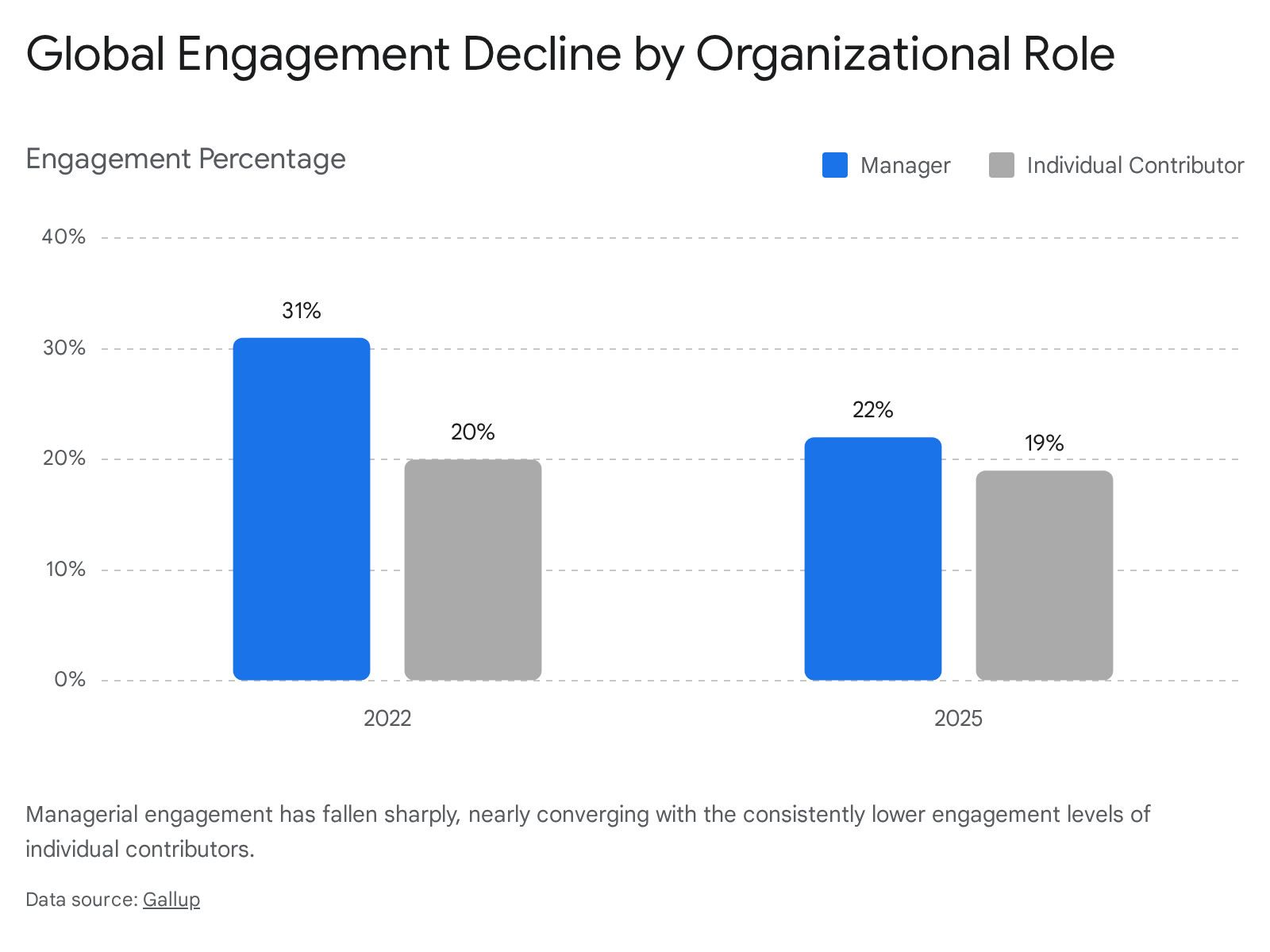
A primary mechanism driving the global engagement crisis is the collapse of managerial stability. Historically, organizational managers enjoyed an "engagement premium," exhibiting consistently higher psychological attachment to their work than individual contributors 911.
The rapid erosion of managerial engagement has severe downstream effects, as managers account for roughly 70% of the variance in team-level engagement 13. This crisis is exacerbated by systemic undertraining; data from 2026 indicates that only 44% of global managers have received formal management training, leaving the majority of middle management unprepared to support employees navigating chronic occupational stress 13.
The friction surrounding managerial layers has fueled intense debate regarding organizational design, culminating in the discourse around "Founder Mode" versus "Manager Mode" 151614. Popularized in late 2024 and hotly debated through 2026, Founder Mode advocates for executives bypassing traditional, bureaucratic managerial hierarchies to maintain direct, cross-functional engagement with product development and personnel 1516. Proponents argue that standard Manager Mode relies heavily on rigid delegation, which introduces blind spots, slows agility, and distances leadership from the reality of operations 1614. Conversely, critics caution that while Founder Mode is highly effective for early-stage startups and agile pivots, scaling this highly centralized approach in large enterprises risks severe executive burnout and toxic micromanagement 1415.
The Clinical and Financial Reality of Burnout
Burnout is recognized by the World Health Organization as an occupational syndrome resulting from chronic workplace stress that has not been successfully managed 13. It is characterized by emotional exhaustion, increased depersonalization, and reduced professional efficacy 1617.
The clinical impacts of maintaining a continuous hustle culture are severe. Working over 55 hours weekly has been shown to increase the risk of stroke by 35% and drastically reduce marginal productivity, establishing that extended working hours do not scale linearly with output 16. Overwork is linked to a heightened risk of depression, with individuals working excessive hours demonstrating nearly seven times greater risk of experiencing depressive symptoms 16. Furthermore, 76% of workers steeped in hustle culture report diminished self-esteem, and 81% experience severe anxiety disorders 18.
Financially, burnout operates as a massive hidden tax on enterprise performance. The cost of burnout ranges from $3,999 to $20,683 per employee annually 13. Crucially, 89% of these costs arise from presenteeism - where employees are physically or digitally present but operating at severely compromised cognitive capacity - rather than direct absenteeism 13. Employees experiencing burnout are 13% less confident in their performance, highly susceptible to errors, and 63% more likely to utilize sick days, ultimately driving massive productivity leakage 13.
Demographic and Sectoral Disparities in Job Satisfaction
The rejection of overwork norms is not uniformly distributed across the labor market. Sentiments vary significantly based on generational cohorts, industry sectors, and regional economic stability.
Generational Divides and Anti-Overwork Sentiments
Younger workers, particularly Generation Z, report the highest levels of acute occupational stress. By 2026, Gen Z had surpassed Millennials as the most burned-out generation, with 74% reporting moderate to severe burnout compared to 66% of Millennials 19. Alarmingly, Gen Z workers reach peak burnout at age 25, a full 17 years earlier than the historical average for American workers 13.
This demographic reality has catalyzed highly visible, social-media-driven labor movements that explicitly reject the expectation of uncompensated discretionary effort. Following the initial wave of "quiet quitting" (the strict adherence to contractual duties without taking on extra, unpaid responsibilities), newer frameworks such as "loud laboring" (vocalizing dissatisfaction regarding policies like return-to-office mandates) and "lazy girl jobs" have gained prominence 202122. Despite the provocative nomenclature, analysts note that these movements do not signify inherent laziness. Rather, they represent a conscious prioritization of mental health and a deliberate search for roles that pay a living wage while strictly enforcing work-life boundaries, allowing workers to detach completely at the end of the standard workday 2122. Over 64% of Gen Z workers report valuing mental health over financial growth, and 58% are willing to accept lower baseline compensation in exchange for guaranteed work-life balance 16.
A parallel ideological shift has occurred in China, driven by extreme competitive pressures and youth unemployment that peaked at a record 21.3% in mid-2023 2324. The grueling "996" work schedule (9 AM to 9 PM, six days a week) spawned the "Tang Ping" (lying flat) and "Bai Lan" (let it rot) movements among Chinese youth 2324. These movements advocate for a voluntary retreat from the relentless pursuit of homeownership and high-stress corporate advancement, embracing instead a low-desire lifestyle 2324. Recognizing the threat to macroeconomic stability and demographic growth, the Chinese government has responded with campaigns promoting traditional ambition, alongside pilot programs exploring staggered paid leave and potential school breaks to stimulate domestic leisure and ease societal pressure 2325.
Blue-Collar Sector Dissatisfaction and Unionization Resurgence
While knowledge workers debate the boundaries of digital availability, the blue-collar workforce faces distinct challenges centered on compensation and structural respect. Pew Research data from 2025 indicates that blue-collar workers report markedly lower job satisfaction than their peers; only 43% feel extremely or very satisfied with their jobs, compared to 53% of other workers 26. The primary driver of this dissatisfaction is inadequate compensation relative to physical effort, with 77% of dissatisfied blue-collar workers citing low pay as a major factor, and 64% reporting they do not earn enough to pay basic bills 26.
This structural dissatisfaction has fueled a resurgence in organized labor activity. According to the Economic Policy Institute (EPI), the number of workers represented by a union in the United States increased by 463,000 to reach 16.5 million in 2025 - the highest absolute level recorded in 16 years 27. Union density stabilized at 11.2% of the wage and salary workforce 27. Notably, this growth disrupted traditional geographical patterns, with the American South accounting for nearly half (46%) of all net union gains nationwide 27. Furthermore, survey data reveals an massive unmet demand for collective bargaining; 43% of nonunion workers (equating to roughly 50 million individuals) indicated they would vote to unionize if provided the opportunity, a substantial increase from historical norms 27.
Economic Necessity and the Rise of Multiple Jobholding
The cultural narrative surrounding the "death of hustle culture" is heavily complicated by global macroeconomic constraints. While workers philosophically desire balanced lives, the protracted cost-of-living crisis has forced millions into secondary employment to secure basic financial resilience.
Cost-of-Living Pressures in Advanced Economies
In advanced economies, inflation and housing costs have eroded real wage gains, pushing workers to adopt multiple jobs out of strict economic necessity rather than entrepreneurial ambition. In the United Kingdom, data from the Office for National Statistics (ONS) and payroll analyses reveal a systemic underreporting of multiple jobholding in standard surveys 2829. The necessity of juggling jobs is highly gendered and falls disproportionately on young workers.
| UK Demographic Cohort | Multiple Jobholding Rate (2022-2023) | Multiple Jobholding Rate (2023-2024) | Impact and Contract Security |
|---|---|---|---|
| Young Women (16-29) | 7.0% | 10.6% | 36% hold temporary contracts in their primary job, signaling high precarity 29. |
| Older Women (30-64) | 7.3% | 8.7% | Higher baseline rate than men, driven by insufficient hours in primary roles 29. |
| Young Men (16-29) | 5.5% | 6.8% | Modest increase; lower overall incidence compared to female peers 29. |
| Older Men (30-64) | 4.6% | 5.0% | Lowest rate of multiple jobholding among all measured cohorts 29. |
The data indicates that over one in ten young women in the UK currently holds multiple jobs simultaneously, with 36% of this cohort relying on temporary contracts in their primary roles 29. This reliance on fragmented employment restricts access to training, limits pension contributions, and severely undermines long-term financial stability 2829. Similar trends are evident in the United States, where Federal Reserve data reported that the number of multiple jobholders reached a record high of 9.1 million in March 2025, stabilizing at roughly 8.8 million persons into 2026 30.
The Informal Economy and Precarious Labor in the Global South
In the Global South, the concept of opting out of "hustle culture" is largely irrelevant, as labor markets are dominated by the informal economy, where extensive working hours are a basic prerequisite for survival.
In Kenya, labor force data from 2025 highlights the stark division between formal and informal employment. While the economy generated approximately 716,800 new jobs, the vast majority were concentrated in the informal "jua kali" sector, which grew to encompass 18.1 million workers 31. By contrast, modern formal wage employment grew at a slower pace, accounting for only 3.3 million jobs 3132. With 80% of its 57 million citizens under the age of 35, Kenya faces acute pressure to generate formal employment; currently, 14.7% of youth aged 15 - 34 are classified as Not in Education, Employment, or Training (NEET) 32.
Across the African continent, demographic shifts demand the creation of 15 million new jobs annually to absorb new labor market entrants 33. Urbanization and sectoral transitions are rapidly altering where this labor occurs. While agriculture employed 47% of African youth in 2025, the services sector is projected to overtake agriculture as the primary employer by 2033 33. Despite this transition, high employment rates in the region do not equate to job quality; the ILO projects that 2.1 billion workers globally will hold informal jobs by 2026, leaving them highly exposed to poverty, lack of social protection, and zero regulatory limits on working hours 34.
Technological Integration and Workforce Anxiety
The proliferation of advanced digital tools, most notably generative Artificial Intelligence (AI) and enterprise collaboration platforms, has fundamentally altered the pace and nature of work. Rather than strictly reducing workloads, these technologies have introduced new vectors of psychosocial stress.
Artificial Intelligence Integration and Productivity Measurement
By 2026, AI has transitioned from an experimental capability to a foundational operational layer across global enterprises. Adoption is pervasive; a 2025 global workforce survey by ADP found that 50% of workers utilize AI at least multiple times a week, and 20% utilize it nearly every day 35.
However, the widespread deployment of AI has generated a distinct "productivity paradox." While individual workers acknowledge the utility of these tools (with 65% reporting a positive impact on personal efficiency), macroeconomic and organizational productivity gains remain highly elusive 3637. Strikingly, 89% of leaders report no measurable impact on aggregate labor productivity resulting from AI adoption over the past three years 36.
At the individual level, heavy AI utilization is correlating with heightened anxiety rather than relief. ADP data reveals that daily AI users are four times more likely to report feeling less productive than they believe they could be, compared to non-users 35. This anxiety stems from the failure of organizations to redesign workflows; when AI automates routine tasks, the remaining workload consists entirely of high-density, complex problem-solving, dramatically increasing cognitive fatigue 41. Furthermore, 20% of employees report encountering errors or "hallucinations" in AI outputs that require manual correction, disrupting workflows and creating new administrative burdens 37.
The lack of transparent communication regarding how AI will impact long-term career trajectories further exacerbates stress. In the first quarter of 2026, 18% of U.S. workers believed it was likely their job would be eliminated by AI within five years 11. In organizations where AI had already been formally implemented, this fear rose to 23%, underscoring the urgent need for clear reskilling pathways and transparent change management 1137.
Remote Work Dynamics and Return-to-Office Mandates
The debate over physical work locations remains one of the most contentious issues in modern labor relations. As of early 2026, approximately 22.6% of U.S. employees continue to work remotely at least partially, indicating that flexible arrangements have permanently altered the labor landscape 3843.
Despite overwhelming employee preference for flexibility, 2025 and 2026 saw a surge in aggressive Return-to-Office (RTO) mandates from major corporations (including Amazon, JPMorgan Chase, and Dell) and the U.S. Federal Government 4339. Executive justifications for these mandates center on perceived deficits in collaboration, spontaneous innovation, and operational discipline 4041. By late 2024, 75% of U.S. workers faced some form of office attendance requirement 39.
However, workforce analytics strongly suggest that RTO mandates fail to resolve core productivity bottlenecks. Issues such as calendar fragmentation, meeting overload (with 30% of meetings occurring outside standard hours), and "tool sprawl" (workers switching contexts roughly 1,200 times daily, losing four hours weekly to reorientation) persist regardless of whether an employee is sitting in a corporate office or at home 40. Furthermore, strict mandates trigger severe talent attrition. Metaintro data from 2026 indicates that IT workers facing RTO mandates are two to three times more likely to seek new employment, and filling in-person roles takes 40% to 50% longer than filling equivalent remote positions 41. With 92% of professionals stating they would leave their current role for one offering better flexibility, rigid RTO policies function as a significant risk to organizational human capital 42.
Legislative Reforms and Evolving Working Hour Standards
In response to the clinical and economic fallout of chronic overwork, regulatory bodies and corporate governance frameworks are implementing structural interventions to mandate work-life boundaries and ensure fair compensation.
Statutory Reductions in Working Hours
Governments across Latin America, a region historically characterized by some of the longest annual working hours globally, are aggressively rolling back standard maximum workweeks. These reforms represent a massive shift in labor policy, forcing enterprises to optimize productivity through process improvement rather than raw labor extraction.
| Jurisdiction | Previous Standard | Target Standard | Implementation Timeline | Strategic Implications |
|---|---|---|---|---|
| Chile | 45 hours | 40 hours | Phased through April 2028 | Mandates sophisticated digital time-tracking; strictly prohibits any reduction in base remuneration; restricts managerial exemptions 434445. |
| Colombia | 48 hours | 42 hours | Phased through July 2026 | Requires employers to unilaterally adjust internal Working Regulations to remain compliant with phased hour drops 44. |
| Mexico | 48 hours | 40 hours | Proposed Reform | Constitutional reform highly debated due to concerns over stagnant output-per-worker rates 444647. |
| Brazil | 6-day week | 5-day week | Proposed Reform | Aimed at boosting mental health and leisure consumption; complements efforts to expand statutory paternity leave 4648. |
Beyond Latin America, other regions are pursuing similar objectives. The European Union has advanced the "Right to Disconnect" directive. Designed to counteract the "always-on" culture fueled by telework, this initiative seeks to guarantee employees the right to disengage from work-related communications outside of contracted hours without facing professional retaliation 384950. In late 2025, the European Commission initiated second-stage talks with social partners to formalize this at the EU level, though industry bodies like the World Employment Confederation-Europe (WEC-Europe) have argued against overly prescriptive statutory rules, favoring decentralized collective bargaining 384957. Several member states, including France, Belgium, Spain, and Portugal, have already integrated the right to disconnect into national law, demonstrating a clear legislative trajectory toward boundary enforcement 3851.
Corporate Governance and ESG Social Metrics
Concurrently, the mechanisms used to evaluate corporate responsibility are shifting. Environmental, Social, and Governance (ESG) reporting is transitioning from voluntary marketing to mandatory financial disclosure. In the European Union, the Corporate Sustainability Reporting Directive (CSRD) took broad effect in 2026, requiring thousands of companies to provide structured, third-party-verified data regarding their labor practices 525354.
Under the "Social" pillar of ESG, organizations are now expected to track and disclose specific human capital metrics that serve as proxies for corporate well-being. These include absenteeism rates, employee turnover percentages, gender representation across management, and comprehensive health risk indicators 545556. Advanced organizations are deploying validated psychosocial instruments, such as the Maslach Burnout Inventory, to quantify burnout risk before it manifests as operational failure 55.
The integration of these well-being metrics is driven by compelling financial incentives rather than mere compliance. Studies indicate that companies successfully integrating well-being initiatives report up to 20% higher productivity and a 25% reduction in healthcare expenditures 19. Furthermore, businesses with strong overall ESG performance generate average annual returns of 12.9%, compared to just 8.6% for lower-rated peers, proving that sustainable labor practices directly correlate with superior financial resilience 53.
As the global labor market navigates the remainder of the decade, the data is unequivocal: the ideological era of hustle culture is effectively over, rejected by workers demanding psychological safety and boundaries. However, achieving true work-life balance remains heavily contingent on an individual's economic position and geographical location. For the global workforce to fully escape the hazards of overwork, organizations and governments must continue bridging the gap between progressive labor legislation, technological workflow design, and the alleviation of the economic pressures that force precarious labor.