
What the Data Says About Return-to-Office Mandates
Where Does the Return-to-Office Mandate Stand Today?
As of 2026, the global labor market has largely settled into a structured hybrid equilibrium, though the landscape remains heavily polarized by aggressive, high-profile return-to-office (RTO) mandates. In direct terms, the era of fully remote work as a default pandemic-era necessity has ended, but the corporate attempt to force a wholesale return to the five-day in-office workweek has simultaneously failed. Despite the prevailing corporate narrative that full-time physical attendance is required to salvage collaboration and productivity, empirical data from 2024 through 2026 paints a remarkably different picture. Research from institutions such as Stanford University, the National Bureau of Economic Research (NBER), Microsoft, and Gallup definitively shows that flexible, hybrid models yield equal or superior objective productivity, significantly reduce overhead, and drastically lower employee attrition 122.
The highly publicized five-day office mandates enforced by legacy technology firms are increasingly recognized by economists and labor analysts not as genuine productivity strategies, but rather as financially engineered "stealth layoffs" designed to trim headcount without incurring the costs of formal severance 45. Global data tracking college-educated workers indicates that work-from-home levels stabilized after 2023 at an average of roughly 1 to 1.27 days per week globally, with English-speaking advanced economies supporting significantly higher rates of flexibility 26. Ultimately, the data indicates that businesses prioritizing outcome-driven flexibility - particularly what Microsoft terms "Frontier Firms" that integrate artificial intelligence and asynchronous workflows - are vastly outperforming those relying on presence-based management 13.
How Much Does the Commute Really Cost the Modern Worker?
To understand the intense friction surrounding RTO mandates, one must first examine the everyday reality that anchors the employee experience: the commute and the wallet. The financial and temporal burdens of traveling to a physical office are rarely tracked explicitly on corporate balance sheets, but they represent a massive, uncompensated tax on the modern workforce.
In 2024 and 2025, the cost of commuting surged significantly due to fluctuating fuel prices, increased tolls, and rising urban parking rates. According to financial models and Clever Real Estate analyses, the average U.S. commuter spends approximately $8,466 annually on their commute, consuming nearly 19% of their annual income 8. Focusing strictly on fuel, Empower data from 2024 highlights that the average commuter spends $2,400 annually just on gas, whilst sitting in traffic for an average of 43 hours per year 9. A detailed breakdown of these hidden economics reveals that the true cost of office work extends far beyond direct transit expenses. The average office worker incurs an additional $7,000 to $33,500 in annual expenses when factoring in $2,500 to $6,000 for work lunches and coffee, $1,000 to $3,000 for professional wardrobes and dry cleaning, and up to $15,000 for before-and-after childcare necessary to cover commuting hours 10.

Beyond direct financial expenditures, the opportunity cost of time is staggering. The average commute of 27 minutes each way results in 225 hours of lost productivity and personal time annually 10. When extrapolated over a standard work year, the time opportunity cost equates to roughly $14,062 for a worker earning $38 an hour 11. The National Bureau of Economic Research (NBER) corroborates this, noting that remote workers save an average of 72 minutes daily on commuting 12. Remote workers do not simply absorb this time for leisure; tracking data demonstrates they redirect 40% of that reclaimed time back into their primary work tasks, 11% into caregiving, and 34% into relaxation and personal well-being 12.
Furthermore, the environmental and macroeconomic impacts of this mass transit are undeniable. Global Workplace Analytics estimates that if just 39% of the workforce worked from home half the time, greenhouse gas emissions would be reduced by 54 million tons annually, saving 119 billion miles of commuting and $20 billion in fuel 12. Accident costs would decrease by $10 million, sparing tens of thousands from road-related injuries 12. When companies issue blanket RTO mandates, they are effectively demanding a massive transfer of wealth, time, and carbon expenditure from the employee and the public back to the employer, providing a clear economic foundation for the profound structural resistance currently observed in the labor market.
What is "Productivity Paranoia" and Is It Justified?
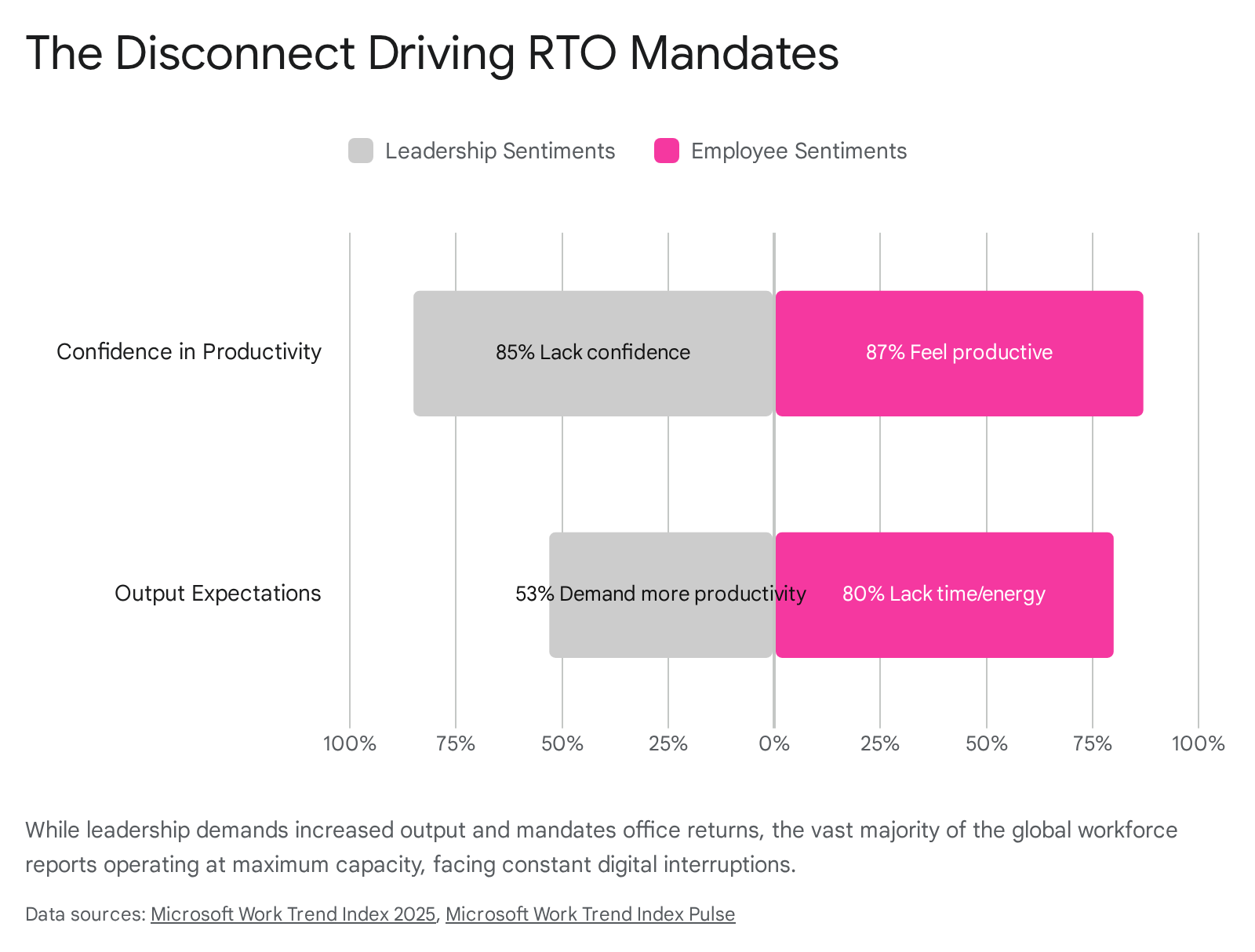
As organizations navigated the post-pandemic era, a phenomenon defined by Microsoft as "productivity paranoia" began to dictate corporate policy. Despite extensive data showing that employees were working longer and producing more, managerial trust fractured. In Microsoft's initial Work Trend Index Pulse report, 85% of leaders admitted that the shift to hybrid work made it difficult to have confidence that employees were being productive 4. This paranoia risks making flexible work unsustainable, as it drives companies to mandate physical attendance or deploy invasive digital surveillance technologies rather than evaluating actual output, creating a toxic environment of digital presenteeism 414.
The paranoia is fundamentally a crisis of measurement and management capacity, exacerbated by a rapidly evolving technological landscape. The 2025 Microsoft Work Trend Index Annual Report revealed a startling disparity regarding enterprise capacity: 53% of leaders stated that organizational productivity must increase, yet 80% of the global workforce reported lacking the time or energy to do their current jobs effectively 13. Furthermore, the average knowledge worker is now interrupted by a meeting, email, or chat ping 275 times per day - roughly once every two minutes 13.
This operational disconnect is further highlighted by the Slack Future Forum Pulse data gathered throughout 2025 and 2026. The data demonstrates that non-executive employees are nearly twice as likely as executives to be working from the office five days a week, and they report twice as much work-related stress and anxiety as their executive counterparts 5. Full-time office workers showed a decline in work-life balance that was twice as steep as flexible workers, alongside 1.5 times worse scores for work-related anxiety 6.
Survey data from Scalable in 2025 emphasizes the depth of the trust dilemma. Half (50%) of knowledge workers explicitly report that their employer suffers from productivity paranoia over remote work, and 35% deeply resent being dictated a set number of mandatory in-office days 14. The insistence on RTO mandates under the guise of "productivity" often belies a failure of leadership to transition from synchronous, visually monitored management to asynchronous, outcome-based leadership 14. When managers can no longer look across an open-plan office to see who is sitting at a desk, the lack of robust, metric-driven evaluation systems creates a vacuum of trust, which executives attempt to fill by forcing bodies back into seats.
What Does the Data Actually Say About Objective vs. Self-Reported Productivity?
The debate over remote work productivity is frequently clouded by subjective opinions, executive anecdotes, and flawed surveys that rely entirely on self-reported feelings of efficiency. However, robust objective data from 2024 to 2026 provides a clear distinction between how productive workers feel and what tracking systems prove they are actually producing. The consensus reveals a fascinating dynamic: remote work simultaneously drives massive increases in deep-focus productivity while creating coordination challenges for highly synchronous, legacy-structured teams 17.
A landmark 2024 analysis by the U.S. Bureau of Labor Statistics (BLS) across 61 industries found a clear, positive association between remote work adoption and total factor productivity (TFP) growth. Specifically, a one-percentage-point increase in remote work correlated with a 0.08 to 0.09 percentage-point increase in TFP, a relationship that held even when controlling for pre-pandemic economic trends 18. Similarly, economists at the San Francisco Federal Reserve noted in mid-2026 that despite near-zero employment growth over the prior three years, the U.S. economy expanded at a steady 2.5% annually. This suggests that the tools enabling remote and asynchronous work - paired with heavy investments in AI - are driving fundamental, long-term efficiency gains that allow companies to produce significantly more output without comparable increases in labor input 78.
To provide a granular view, the following comparative table synthesizes the latest peer-reviewed research and workforce analytics regarding objective versus self-reported productivity:
Comparative Analysis of Remote and Hybrid Productivity Metrics (2024-2026)
| Productivity Metric | Self-Reported / Perceptual Measure | Objective / Tracked Measure | Source & Context |
|---|---|---|---|
| Deep Focus Time | 87.9% of tech workers rate their focus as "high" when given location flexibility. | Remote workers spend 59.48% of their week in focused work vs. 48.5% for office workers (an extra 4.15 hours of deep work/week). | Hubstaff (2025) analysis of tracking data 2. |
| Task Completion & Output | 64% report getting more done in less time while working from home. | Remote workers demonstrate a 12-15% higher task completion rate compared to in-office peers, boosting revenue per employee. | EssayPro Productivity Study (2025) 21. |
| Work Interruptions | Office workers feel constantly disrupted by ambient noise and impromptu meetings. | Remote workers experience 18% fewer disruptions (723 vs 884 interruptions annually), saving roughly 62 hours of context-switching time a year. | Hubstaff (2025) 2. |
| Hours Worked vs. Total Output | Remote workers feel they work harder to prove themselves to skeptical managers. | Remote workers actually work ~1 hour less per day than in 2019, yet macro-level output increased, indicating massive efficiency gains and better labor market matching. | BLS / Gallup (2025) 18. |
| Employee Engagement | Fully remote workers self-report the highest peak engagement levels. | Fully remote: 31% engaged. Hybrid: 23% engaged. On-site: 19% engaged. | Gallup State of the Global Workplace (2026) 179. |
| Performance & Promotions | Hybrid workers fear being overlooked due to executive "proximity bias." | Hybrid workers show zero statistical difference in performance reviews or promotion rates compared to full-time office staff. | Stanford University / NBER (2024) 2. |
The data points overwhelmingly to a "Hybrid Sweet Spot." Stanford economist Nicholas Bloom's randomized control trial involving 1,600 employees at Trip.com revealed that hybrid workers perform identically to in-office workers on objective output metrics, but the hybrid models reduced employee resignations by a staggering 33% 2. The cost savings from reduced attrition - calculated at roughly $20,000 per retained employee for recruitment and training - make structured hybrid arrangements the most economically viable model for modern enterprises, saving millions on the bottom line 2.
However, Gallup's 2026 State of the Global Workplace report identifies a critical "Remote Work Paradox." While fully remote workers are the most engaged and objectively productive, they also report significantly lower overall well-being and higher rates of stress, anger, and loneliness due to a lack of social infrastructure 179. Furthermore, extended isolation leads to measurable drops in creativity and job satisfaction, particularly for single employees living alone, who are 38% more likely to experience symptoms of depression 2. Thus, the overarching conclusion of the 2026 data is that productivity thrives in remote settings, but long-term emotional well-being and organic collaboration require intentional, high-quality in-person touchpoints.
Why Are Tech Giants Like Amazon, Dell, and Zoom Mandating a Return to the Office?
If the macroeconomic data and objective tracking metrics overwhelmingly support hybrid and remote work, why have corporate behemoths like Amazon, Dell, and even Zoom - a company whose entire business model relies on remote infrastructure - enforced strict RTO mandates in 2025 and 2026?
The case of Zoom serves as a particularly ironic focal point for labor analysts. In late 2023 and continuing into 2024, the video conferencing darling that powered the remote work revolution mandated that employees living within 50 miles of an office must return at least two days a week 1011. The company claimed that a structured hybrid approach was necessary to effectively use their own technologies and support global customers 10. However, the mandate sparked severe internal backlash. The hypocrisy of the policy was laid bare when it was revealed that Zoom's Chief People Officer was permitted to remain fully remote, highlighting the inherent hierarchical inequities of geographically enforced policies and sending a "deal with it, peons" message to the broader workforce 25.
Dell took a similarly hardline stance, declaring that workers must be in the office five days a week as of March 2025 26. Yet, it is Amazon's approach that has been the most aggressive and consequential. CEO Andy Jassy issued a sweeping memo stating that starting in January 2025, employees must return to the office five days a week, effectively ending the hybrid era for the retail and cloud computing giant 1127. Jassy cited the need to strengthen company culture, increase the speed of moving fast, and invigorate a sense of ownership 12.
The fallout at Amazon was immediate and severe. Internal surveys and data from the Strategic Organizing Center (SOC) revealed that 68% of Amazon's corporate employees were likely to leave within the year, and 84% expressed a total loss of trust in leadership to follow through on promises 29. Furthermore, Phase 2 of Amazon's RTO plan required all employees, regardless of level, to relocate to primary or secondary corporate hubs (such as Seattle, Arlington, or Austin) by January 2026, or face "voluntary resignation" 30. By late 2025, reports surfaced that Amazon's strict RTO enforcement was acting as a catalyst for up to 30,000 corporate job cuts - roughly 10% of their white-collar workforce - focusing on human resources, devices, and operations 31.
This brings us to the most critical, third-order insight of the 2026 labor market: The Stealth Layoff Hypothesis.
Labor economists, HR analysts, and the workforce at large increasingly view 2025 and 2026 RTO mandates not as genuine cultural initiatives, but as financially engineered workforce reduction tools. A comprehensive 2026 study by Enhancv revealed that an overwhelming 72% of the workforce views RTO mandates as "stealth layoffs" designed deliberately to force resignations 413.
The severance math driving this strategy is compelling for Chief Financial Officers facing pressure to increase margins. Consider the financial differential: a formal layoff of 200 software engineers might cost a company $12 million to $24 million in severance pay, trigger costly WARN Act legal compliance, drastically increase unemployment insurance premiums, and inflict severe damage on the employer's brand 5. Conversely, an RTO mandate that causes 15% to 20% voluntary attrition costs exactly $0 in direct severance, avoids legal triggers entirely, and allows the executive suite to publicly frame the event to shareholders as a proactive measure for "bringing teams together" 5. Data from BambooHR corroborates this cynical engineering, showing that 25% of executives and 18% of HR professionals explicitly hoped their RTO policies would trigger voluntary departures 533.
Furthermore, corporate real estate portfolios play a massive underlying role. Companies locked into long-term, expensive commercial office leases signed between 2019 and 2021 are utilizing RTO mandates to justify these massive sunk costs to their boards of directors 5. By mandating physical attendance, executives achieve targeted headcount reduction while simultaneously avoiding the embarrassment of empty corporate real estate on quarterly earnings calls.
What Are the Real Rates of Turnover and Attrition Driven by These Mandates?
Corporate reliance on RTO as a mechanism for voluntary attrition is a high-risk strategy that frequently results in adverse selection. Put simply, the employees who leave are usually the high-leverage talent the company desperately wants to keep, while those who stay become disengaged.
U.S. voluntary turnover climbed to 23.4% in early 2026, representing millions of separations across the economy 34. A survey from Unispace found that 42% of employers that mandated a return to the office experienced higher-than-normal turnover, and 29% had a demonstrably harder time recruiting new talent 14. High-performing employees - those who possess the most leverage and options in the labor market - are 16% more likely to express a low intent to stay when faced with strict RTO mandates 26. Studies from the University of Michigan and the University of Chicago found that major tech companies implementing strict RTO policies experienced substantially increased attrition specifically among their most senior and experienced personnel 12. Overall, 80% of companies report losing talent explicitly due to their return-to-office policies, proving the severe retention cost of inflexibility 26.
When employees cannot afford to quit due to macroeconomic cooling or personal financial constraints, a new phenomenon emerges: tactical resistance.
The Rise of "Coffee Badging" and Quiet Quitting
Because the "quit threat" collapsed slightly in 2025 as the labor market tightened, many employees have resorted to malicious compliance 5. Nearly half (46%) of workers admit to "coffee badging" - the practice of swiping their ID card at the office to register attendance in the company's surveillance system, having a coffee with a colleague, and then immediately returning home to do their actual deep-focus work 413.

Furthermore, the Enhancv study noted that 36% of workers are using their mandated office time to apply for new jobs directly from their corporate desks, and 32% admitted to intentionally reducing their daily output as a form of quiet protest 415. When employee trust scores drop to a dismal 50 out of 100 due to strict badge-tracking, the office ceases to be a hub of innovation; it becomes a purely performative space and a staging ground for the "Great Exit" 413. Companies that engineered RTO to shed 15% of their workforce are increasingly finding themselves stuck with high compliance from a deeply resentful, disengaged talent pool that refuses to provide discretionary effort 5.
How Do Return-to-Office Trends Vary Across European and Asian Markets?
The tension between geographic flexibility and office mandates is not a uniquely American phenomenon, but the regulatory responses and cultural integrations vary drastically across global regions. The Global Remote Work Readiness Index for 2026 highlights that European nations - specifically Estonia, Finland, and the Netherlands - are the best prepared for remote work, blending high-speed infrastructure with progressive labor policies 37.
Europe: Legislating the Right to Disconnect
In Europe, the RTO debate is heavily mediated by legislative action and formal social dialogue, rather than pure corporate diktat. European governments are actively embedding remote work protections into national labor laws, most notably through the "Right to Disconnect." Initiated by France in 2017 and subsequently adopted in various forms by Belgium, Spain, Italy, and Portugal, these laws protect employees from employer communications outside of established working hours 3816.
By late 2025, the European Commission launched second-stage talks with social partners to establish a legally binding EU-wide directive on telework and the right to disconnect, aiming to set minimum standards for remote work and protect employees from victimization 1617. These legislative frameworks acknowledge that remote work inherently blurs the lines between professional and personal life, seeking to combat the "always-on" digital culture that leads to severe burnout 38. Because European labor markets structurally prioritize work-life balance - which, according to JLL's 2025 Barometer, now outranks salary as the leading factor for retention globally (65% of workers) - RTO mandates in the EU are generally softer 41. European markets lean heavily toward durable hybrid models rather than the punitive five-day mandates seen in the U.S., with Great Britain seeing hybrid work stabilize as a mainstream norm for 28% of its workforce 6.
Asia-Pacific (APAC): Bimodal Realities and Extreme Burnout
The Asian market presents a stark contrast, displaying a heavily bimodal approach to remote work adoption. According to the 2025 Global Remote Work Index and JLL's Workforce Preference Barometer, English-speaking APAC nations like Australia and New Zealand maintain high levels of work-from-home adoption, hovering around 33% to 36% 42. Singapore has also emerged as a progressive regulatory leader, implementing the Tripartite Guidelines on Flexible Work Arrangement Requests in late 2024, prompting an impressive 72.7% of firms to formally offer flexible arrangements 642.
Conversely, traditional economic powerhouses like Japan and South Korea have reverted heavily to strict office-centric models. In Japan, the telework implementation rate has fallen below 20%, with actual work-from-home representing roughly 7% of total labor input 42. Executives in these regions cite the necessity for rapid, face-to-face problem solving and agile responses amidst fierce technological and AI competition 18.
The human cost of this aggressive reversion to the office has been severe. The 2025 DHR Global Workforce Trends Report highlights that 22% of APAC respondents feel extremely burnt out - nearly double the rate of their North American (10%) and European (13%) counterparts 19. In Singapore, anxiety over job loss peaked at a staggering 85%, reflecting broader regional volatility and changing labor expectations 20. While 70% of APAC employees face some form of RTO mandate, their acceptance of these policies is highly contingent on the quality of the workplace experience; substandard offices immediately trigger negative sentiment, non-compliance, and severe retention risks 21.
How Can Employees Successfully Negotiate Hybrid Work in 2026?
Despite the headlines dominated by absolute mandates from Fortune 100 companies, hybrid work remains highly negotiable for high-value knowledge workers. Data indicates that nearly 28% of employees have successfully negotiated personal exceptions to their company's RTO rules, creating what some analysts call a "two-tier workforce" 13. For professionals looking to secure flexible arrangements in 2026, negotiation requires a strategic, evidence-based approach rather than an emotional appeal to personal convenience.
Securing flexibility requires understanding the employer's underlying anxieties - primarily productivity paranoia and communication breakdown - and systematically dismantling them with data and proactive solutions. The following strategic framework outlines how employees align their negotiation tactics with core employer concerns.
Strategic Framework for Negotiating Hybrid Work
| Employer Concern / Resistance Point | Employee Negotiation Strategy & Actionable Tactic | Context & Efficacy |
|---|---|---|
| Fear of Lost Productivity | Showcase Objective Results: Shift the focus from hours logged to metrics achieved. Present a portfolio of completed projects, efficiency gains, or global client acquisition achieved during remote periods. | According to Nexthink, framing requests around tangible metrics (e.g., 15% higher task completion) neutralizes the primary argument against remote work 214748. |
| Loss of Team Culture & Trust | Employ Purposeful Priming: Proactively build trust before making the request. Consistently deliver high-visibility results, over-communicate indirectly (Slack, Loom), and volunteer for cross-functional initiatives. | Harvard Business Review emphasizes that demonstrating reliability and inclusivity calms managerial fears about remote workers becoming isolated 22. |
| Communication Bottlenecks | Propose Asynchronous Solutions: Offer a structured communication plan. Suggest shared decision logs, defined async response norms, and specific tools to maintain visibility without requiring synchronous meetings. | Addressing the "how" of communication proves to managers that remote work will not stall team momentum or decision-making 1750. |
| Rigid Corporate Policy | Leverage Market Research & Trial Periods: Research the company's true stance via platforms like Jobgether. If met with resistance, propose a low-risk 30-day trial period (e.g., 3 days remote) with defined success metrics. | Many companies list jobs as hybrid but are open to full remote after successful onboarding. Trial periods lower the perceived risk of permanent policy changes 50. |
| Real Estate Sunk Costs | Align with Financial Realities: If a company is consolidating offices or hiring globally to reduce costs, position the remote request as aligned with overhead reduction or accessing global time zones. | International hiring is a strategic pivot to lower costs; employees can position their flexibility as part of this broader modernization effort 55152. |
Employees must enter these negotiations recognizing that "he who has the gold makes the rules," meaning employers ultimately possess the right to dictate labor terms 53. However, by presenting a well-structured, logical schedule that directly addresses the business's operational goals, employees transform a request for personal flexibility into a mutually beneficial business proposition 4722.
The Bottom Line
The pervasive corporate narrative that a mandatory return to the physical office is a strict prerequisite for productivity is fundamentally contradicted by the economic, behavioral, and objective tracking data of 2026. While high-profile, five-day mandates from industry titans like Amazon, Dell, and Zoom capture the headlines and create an illusion of a broad return to pre-pandemic norms, these moves are largely driven by a combination of managerial "productivity paranoia," the financial imperative to justify sunk real estate costs, and strategic engineering aimed at inducing "stealth layoffs" without paying massive severance packages.
For the global workforce, the true cost of the office commute - measured in thousands of dollars, significant environmental impact, and hundreds of lost personal hours annually - is no longer an acceptable trade-off for performative presence. The objective data clearly indicates that structured, well-managed hybrid environments offer the optimal macroeconomic balance: they capture the deep-focus productivity and efficiency gains of remote work while providing the necessary social infrastructure to prevent the isolation and burnout inherent in fully remote models. Organizations that refuse to adapt to this reality, relying instead on badge-tracking, strict surveillance, and rigid mandates, will continue to suffer from targeted attrition of their best talent, widespread "coffee badging," and the quiet but devastating erosion of their corporate culture. In the modern knowledge economy, geographic and temporal flexibility is not merely a perk to be clawed back by management; it is a foundational driver of sustainable economic output and enterprise resilience.