
How Attitudes Toward Overwork Are Changing in 2026
Hustle culture is not dying, but it is actively fracturing along generational, regional, and socioeconomic lines in 2026. While millions of employees are rejecting unpaid overwork in favor of strict boundaries, legal "right to disconnect" protections, and sustainable creator models, systemic economic pressures and relentless digital connectivity keep the "always-on" reality firmly entrenched for many. Ultimately, the global pursuit of endless productivity has morphed into a widespread burnout epidemic, forcing companies and governments to treat work-life balance not as a perk, but as an operational necessity to prevent systemic workforce collapse.
The Evolution of the Grind
For much of the 2010s, "hustle culture" dominated the professional zeitgeist. Propagated by Silicon Valley startups, high-profile entrepreneurs, and social media influencers, the philosophy was simple: outwork the competition, monetize your hobbies, sleep less, and grind harder to achieve exponential career growth and financial security. Working 80-hour weeks was treated as a badge of honor, and "rise and grind" became a cultural mantra.
By 2026, the data indicates that a vast segment of the global workforce no longer believes this social contract is valid. The shift away from hustle culture is not a sudden phenomenon born of laziness, but rather a calculated recalibration by workers who realized that the promised rewards of constant labor rarely materialized. Inflation, soaring housing costs, and stagnant wages have decoupled extreme effort from economic mobility. In the wake of the global pandemic and subsequent economic recalibrations, employees have recognized that tying their self-worth exclusively to professional output leaves them physically exhausted and emotionally hollowed out.
Today, the dialogue around work has shifted from maximizing productivity to optimizing sustainability. From new European labor laws to the restructuring of the digital creator economy, the modern workforce is actively searching for an antidote to the "always-on" era.
The Macroeconomic Reality: Why the Hustle Failed
To understand why hustle culture is facing such intense backlash, one must look at the macro-level data on what work actually delivers to the global population in 2026. The International Labour Organization (ILO) Employment and Social Trends 2026 report paints a sobering picture of a fragile global labor market 1.
While the headline global unemployment rate appears stable at 4.9% (representing roughly 186 million people), this metric masks a profound lack of quality jobs 12. The broader "jobs gap" - a metric capturing people who want paid work but cannot access it - is projected to reach a staggering 408 million in 2026 13. Even more telling is that improvements in job quality have largely stalled globally. Nearly 300 million workers are living in extreme working poverty, earning less than $3 a day, and an estimated 2.1 billion workers remain trapped in informal employment ecosystems lacking basic rights, social protection, or job security 145.
For the majority of the world, "hustling" does not lead to a corner office; it is merely a requirement for basic survival. In higher-income economies, population aging and slower labor force growth have stabilized unemployment, but workers still feel the squeeze of high living costs 1. When hard work no longer guarantees a house, a stable retirement, or a comfortable lifestyle, the ideological foundation of hustle culture crumbles. Workers are increasingly asking what they are grinding for, prompting a worldwide re-evaluation of the relationship between employer and employee.
The Global Engagement Slump: A Trillion-Dollar Crisis
The psychological withdrawal from the "grind" is clearly visible in global corporate data. According to Gallup's 2026 State of the Global Workplace report, global employee engagement fell to 20% in 2025, continuing a downward trajectory from a peak of 23% in 2022 66. This three-point drop is not an abstract statistical blip; it represents tens of millions of workers who have psychologically checked out of their jobs.
This mass disengagement has catastrophic financial implications. Gallup estimates that the ongoing engagement slump cost the world economy an estimated $10 trillion in lost productivity in a single year, equating to roughly 9% of global GDP 6.
The Collapse of the "Manager Premium"
Perhaps the most alarming internal corporate trend in the 2026 data is the crisis among middle management. Historically, managers reported significantly higher engagement levels than individual contributors - a phenomenon researchers referred to as the "engagement premium" 66. Managers generally enjoyed higher pay, more autonomy, and greater access to organizational strategy, which insulated them from the worst elements of burnout.
Today, that premium has effectively vanished. Between 2024 and 2025, manager engagement plummeted from 27% to 22% globally 66. Young managers under the age of 35 and female managers have been hit particularly hard by this decline 68. The root cause is a structural vice: managers are squeezed from the top by executives demanding higher output and leaner operations, and from the bottom by direct reports demanding empathy, mental health support, flexible scheduling, and clear boundaries 9107.
Because managers account for up to 70% of the variance in team engagement, a burned-out, disengaged management layer creates a cascading effect downstream 812. When leaders stop caring, their teams quickly follow suit.
Regional Disparities: The Paradox of High Engagement and High Stress
The emotional toll of modern work varies wildly depending on the region, but stress remains a nearly universal constant. The 2026 Gallup data reveals a fascinating paradox regarding the United States and Canada. This region maintains an engagement rate of 31%, keeping it among the highest in the world 68. However, this high engagement comes at an enormous psychological cost: 50% of North American employees report experiencing significant daily stress, the highest rate globally 8.
In contrast, Europe continues to report the lowest engagement of any region worldwide at just 12% 8. Yet, European workers report significantly lower daily stress (39%) and anger (15%) than their North American counterparts 8. This divergence highlights the impact of contrasting cultural norms and legislative environments. Europe's robust social safety nets, guaranteed vacation time, and stronger labor laws allow workers to disengage from corporate devotion without plunging into financial ruin or high-stress panic.
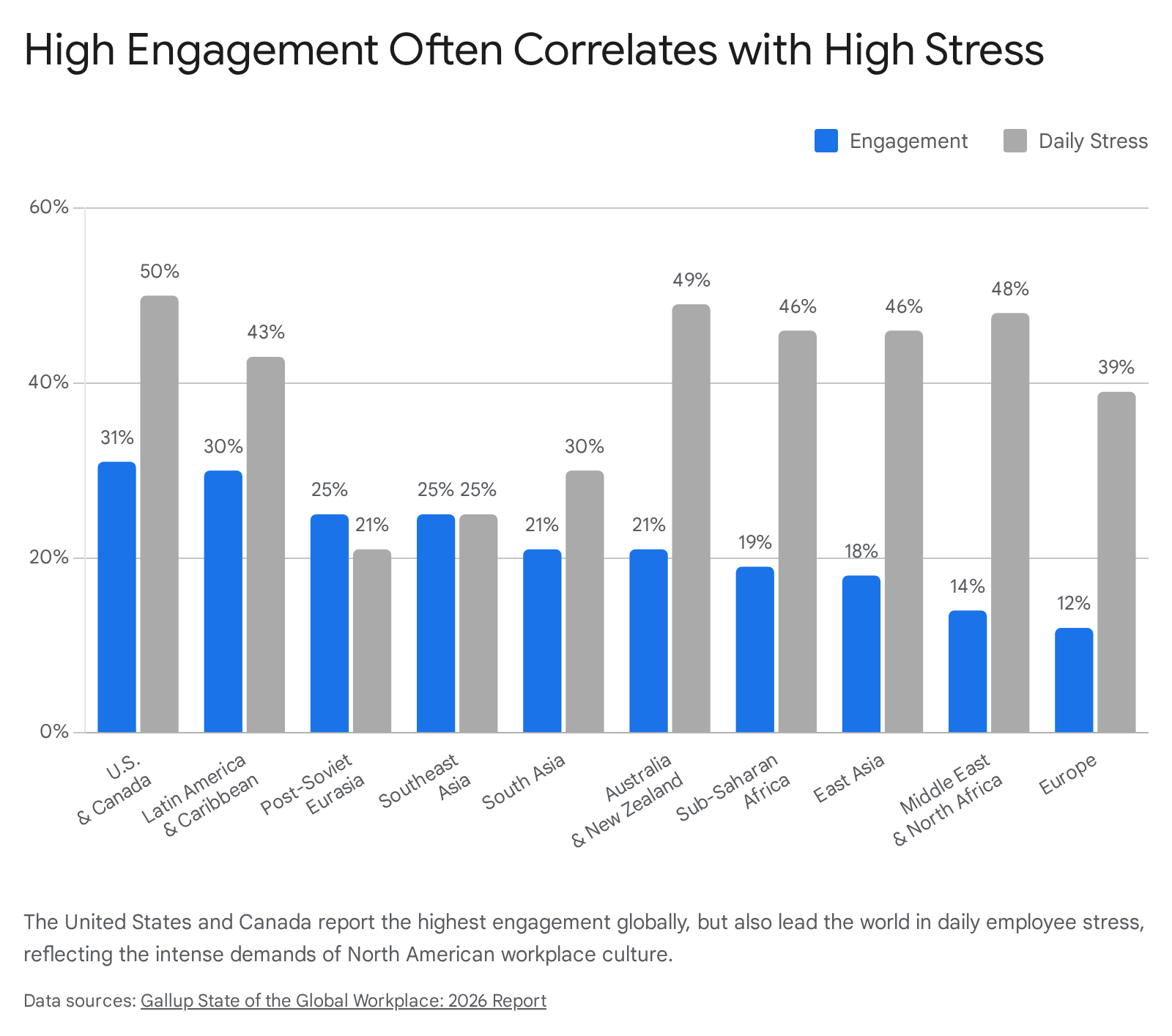
To further understand how the global workforce is feeling, we can look at the specific emotional markers across key territories.
| Region | Employee Engagement | Daily Stress | Daily Sadness | Daily Anger |
|---|---|---|---|---|
| US & Canada | 31% | 50% | 22% | 18% |
| Latin America & Caribbean | 30% | 43% | 18% | 14% |
| Southeast Asia | 25% | 25% | 21% | 19% |
| Australia & New Zealand | 21% | 49% | 21% | 14% |
| South Asia | 21% | 30% | 36% | 31% |
| Middle East & North Africa | 14% | 48% | 26% | 30% |
| Europe | 12% | 39% | 17% | 15% |
Data derived from the Gallup State of the Global Workplace: 2026 Report. Percentages represent the share of the workforce identifying with each metric 8.
The Burnout Epidemic: Sickness in the System
As hustle culture peaked, it normalized chronic exhaustion. The World Health Organization (WHO) now explicitly classifies burnout as an "occupational phenomenon" resulting from chronic, unmanaged workplace stress characterized by energy depletion, mental distancing from one's job, and reduced professional efficacy 910. In 2026, experts no longer view burnout as an individual failing, a lack of resilience, or poor time management. It is widely recognized as a profound failure of workplace design 89.
Recent global data reveals that 43% of employees worldwide report feeling burned out at work - a measurable increase from 38% just a few years prior 9. In the United States, surveys indicate that up to 76% or 77% of workers have experienced burnout at their current jobs at some point 89. The physical and psychological impacts of this chronic exhaustion are devastating. Medical studies confirm that working over 55 hours weekly increases the risk of stroke by 35% and actually pushes productivity to near zero during those excess hours, proving the core tenet of hustle culture - that more hours inherently equal more output - to be biologically false 16.
The costs to businesses are equally staggering. Burnout drains productivity, with global corporate losses estimated at over $322 billion annually directly tied to absenteeism and healthcare expenditures 10917. Burned-out employees are roughly 2.6 to 3 times more likely to actively job-search, which drastically inflates turnover and onboarding costs for companies 1011. Furthermore, "presenteeism" - a scenario where employees show up to work while mentally exhausted and detached - severely degrades decision-making quality, leading to a 60% increase in quality errors and a 41% drop in innovation output among teams 1012.
Sector-Specific Exhaustion
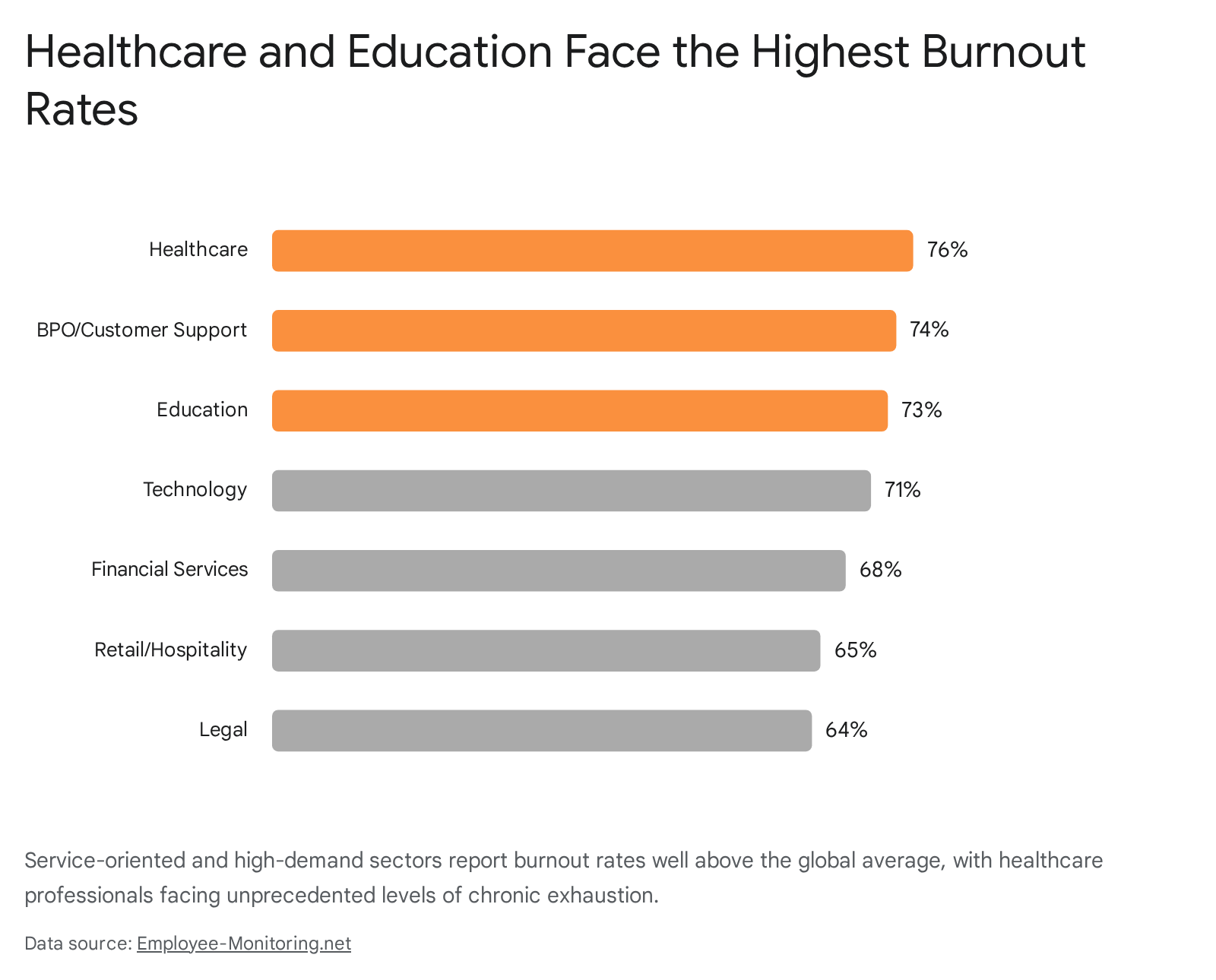
Burnout is not distributed evenly across the economy. Frontline, caregiving, and high-intensity knowledge sectors are bearing the brunt of the crisis. Healthcare maintains the highest burnout rate of any sector at 76%, driven by chronic understaffing, administrative burdens, and the emotional toll of patient care 10. Within healthcare, nursing staff report an alarming 82% burnout prevalence 10.
Education follows closely behind at 73%, with K-12 teachers reporting 78% burnout rates due to expanding non-instructional duties and behavioral challenges in classrooms 10. Technology and software engineering also see elevated risk (71%), fueled by constant on-call expectations, sprint-based development cycles, and fears of AI displacement 10.
How Employees Are Pushing Back: From "Quiet Quitting" to "Lying Flat"
The resistance against hustle culture is not a monolithic movement; it manifests quite differently based on cultural, geographic, and economic realities. However, the core sentiment across the globe is identical: a refusal to sacrifice physical and mental health for diminishing economic returns.
The Western Response: "Quiet Quitting" and the "Soft Life"
In North America and Europe, the pushback against overwork initially gained mainstream media attention under the moniker "quiet quitting." The term, popularized by Gen Z on platforms like TikTok, does not actually mean quitting one's job. Instead, it involves doing exactly what is in one's job description during established business hours and refusing to take on unpaid, out-of-hours responsibilities 1620. In 2026, this concept has matured into broader lifestyle philosophies, such as the "soft life" trend and "slow living," which champion emotional well-being and boundaries over professional prestige 16.
Gen Z and younger millennials are driving this cultural reset. Having watched older generations endure severe burnout and mass corporate layoffs despite their loyalty to their employers, younger workers are redefining success as sustainability rather than sheer output 1314. Research indicates that 64% of Gen Z workers value mental health over financial growth, and nearly 58% state they would gladly accept lower pay in exchange for a better work-life balance 16.
In fact, 2025 survey data reveals that 28% of all employees now rank work-life balance as the single most important factor they look for in a job, slightly edging out compensation (27%) 23. For Gen Z, this preference is even more pronounced, with 32% placing work-life balance at the top of their priority list 23. For these generations, declining an out-of-hours Slack message or taking an unrequested mental health break - a phenomenon sometimes dubbed "quiet vacationing" - is not viewed as laziness. It is viewed as a necessary defensive strategy for long-term career survival 1323.
The Eastern Response: Rejecting "996"
In China, the rebellion against hustle culture has taken on profound macroeconomic implications. For years, the country's rapid technological and economic boom was fueled by the infamous "996" work schedule - working from 9:00 a.m. to 9:00 p.m., six days a week 1525. High-profile tech executives famously championed this 72-hour workweek as a "blessing" and a competitive necessity for young workers looking to make their mark on the world 2516.
However, severe economic pressures, a slowing growth rate, skyrocketing housing costs, and record youth unemployment - which peaked at a staggering 21.3% in mid-2023 - have radically altered the mindset of young Chinese workers 2717. Facing a stalled social mobility ladder where hard work no longer guarantees prosperity, millions of young people have adopted the philosophies of Tang Ping ("lying flat") or Bai Lan ("let it rot") 2717.
These slang terms describe a voluntary psychological retreat from the relentless rat race. Individuals choosing to "lie flat" opt for a low-desire lifestyle, earning just enough to meet their basic needs rather than burning out in pursuit of increasingly elusive societal milestones like homeownership or corporate leadership 2717. The government has expressed deep concern over these movements, occasionally censoring the terms online to encourage youth to keep striving for the national economic dream 27.
Despite official pushback, the unsustainability of 996 is forcing change. Although Chinese labor law explicitly caps the workweek at 44 hours, official data from early 2025 indicated that the average Chinese employee was still working 48.5 hours per week 1529. Nevertheless, faced with shifting worker attitudes and an impending demographic crisis as the working-age population shrinks, major firms are slowly adapting. Companies like home appliance manufacturer Midea and drone giant DJI have begun establishing internal curfews, ordering employees out of the office by 9:00 p.m. or reducing formalistic weekend overtime 1518. To compensate for the reduction in human hours, Chinese industries are leaning heavily into automation and robotics to sustain productivity levels 29.
Structural Reforms: The Four-Day Workweek
Because organic cultural shifts are slow and individual boundary-setting can result in punitive action from management, many organizations and governments are experimenting with systemic structural changes to work design. The most prominent and widely researched of these interventions is the four-day workweek.
The prevailing model for the four-day week is the "100-80-100" principle: employees receive 100% of their standard pay for working 80% of their normal hours, provided they maintain 100% of their previous productivity 1920.
What the Trial Data Reveals
The results of large-scale, coordinated trials conducted over the last few years have been remarkably consistent, dispelling early skepticism from traditional managers. A major study published in Nature Human Behaviour in July 2025 tracked nearly 2,900 employees across 141 companies in six countries (including the US, UK, Australia, and Canada). The researchers found that workers reported significantly lower stress, reduced burnout, higher job satisfaction, and improved sleep quality 2122.
Crucially, compressing the workweek did not result in an intensification of stress - a primary concern for executives who feared employees would simply panic while trying to do the same amount of work in less time. Following the trial, roughly 90% of participating companies chose to continue the four-day model permanently 21.
In the UK trial, which involved 61 companies, the business case held up remarkably well. Company revenue rose slightly (1.4% on average) during the six-month trial period, while staff turnover plummeted by a massive 57% 21. Employee intent to stay increased by 10 to 15 percentage points across multiple global pilots, demonstrating that time-based flexibility is currently one of the most powerful retention and recruitment tools available to HR leaders 19.
Similar results were found in Iceland's massive public sector trials involving over 2,500 workers. In roles heavily dependent on knowledge coordination, the reduced hours forced sharper prioritization and the elimination of low-value meetings, ultimately keeping productivity neutral or positive while vastly improving employee well-being 19.
Why Some Experiments Fail
Despite the overwhelmingly positive headlines, the four-day workweek is not a universal cure, and experiments do fail when implemented poorly. Research from MIT Sloan and other institutions indicates that failures stem largely from leadership mindsets and structural deficits, rather than a lack of employee desire 21.
- Failure to Redesign Workflows: Companies that simply drop a Friday without fundamentally auditing their meeting culture or communication workflows end up failing. Teams are forced to cram 40 hours of synchronous obligations into 32 hours, which increases daily fatigue and eventually leads to worse outcomes than a standard five-day week 21.
- Industry Incompatibility: The four-day model faces severe friction in continuous-service industries like shift-based manufacturing, hospitality, retail, and frontline healthcare. In these sectors, output is strictly tied to operational hours. Cutting working hours means a retail store must either close for a day or hire additional staff to cover the gap. For low-margin businesses, increasing headcount to cover a 20% reduction in working hours can inflate labor costs by up to 25%, making the model economically unsustainable 192123.
- Internal Inequity: When a four-day week is offered exclusively to corporate office-based knowledge workers but denied to warehouse, retail, or customer-service staff within the same company, it breeds deep internal resentment. In these cases, the policy signals that work-life balance is a white-collar perk rather than a universal company value 21.
Comparing Four-Day Workweek Implementation Strategies
| Implementation Approach | Core Characteristics | Common Business Outcomes |
|---|---|---|
| Systemic Redesign | Pre-trial workflow audits, elimination of low-value meetings, shift to asynchronous communication. | Neutral to positive revenue, massive drop in voluntary turnover, significantly higher job satisfaction 1921. |
| Compressed Scheduling | 40 hours crammed into 4 days (e.g., four 10-hour shifts) with no change to the volume of meetings. | Increased daily fatigue, higher short-term stress, marginal impact on long-term burnout reduction 21. |
| Operational Mismatch | Reduced hours applied to continuous service roles (nursing/retail) without hiring adequate backfill staff. | Customer service delays, revenue drops, increased frontline stress, eventual abandonment of the pilot 1923. |
The Legislative Antidote: The "Right to Disconnect"
If the four-day workweek aims to compress the raw number of working hours, "Right to Disconnect" laws aim to build an impenetrable legal wall between work and personal life. As remote and hybrid work environments successfully blurred the physical boundaries of the office, digital communication tools allowed managers and clients to reach employees at all hours, pouring gasoline on the "always-on" culture 36.
European Leadership and Enforcement
The European Union has consistently led the global charge on codifying the right to disconnect. France pioneered the concept in 2017, requiring companies with over 50 employees to negotiate collective terms allowing staff to ignore after-hours digital communications without fear of reprisal 37. Belgium followed suit, passing a law in 2022 that extended this right to civil servants and subsequently initiated plans to expand it to the private sector 3724.
By 2026, the map of European right-to-disconnect laws has hardened around national statutes in countries like Spain, Italy, Portugal, Ireland, and Slovakia 2540. More importantly, the era of gentle guidelines is ending as enforcement mechanisms grow teeth. As of July 2026, Luxembourg's labor inspectorate is actively issuing administrative fines ranging from €251 to €25,000 for employers who fail to put a right-to-disconnect regime in place 25.
Outside of Europe, Australia enacted a sweeping Right to Disconnect law in August 2024 for larger businesses (expanding to smaller businesses in 2025). The Australian framework is notably robust, protecting workers from unreasonable after-hours contact not just from their own managers, but also from third-party clients, suppliers, and members of the public 37.
The Stalled American Landscape
In North America, legislative progress remains heavily fragmented and culturally contested. There is no federal mandate in the United States, and attempts to pass state-level legislation have faced stiff opposition from business lobbies concerned with operational flexibility across multiple time zones 3741.
In 2024, California lawmakers introduced Assembly Bill 2751, a landmark proposal that would have required employers to establish written policies granting workers the right to ignore communications during defined nonworking hours 4126. A similar bill was floated in New Jersey shortly after 4126. Both bills included reasonable exemptions for genuine emergencies and last-minute scheduling changes 26. However, both bills ultimately stalled in legislative committees, underscoring the deep resistance to regulating knowledge-worker hours within the highly competitive U.S. economy 4126.
Despite the lack of statutory rights, employment lawyers are advising U.S. corporations to act as if these laws exist. Continuous after-hours messaging creates severe hidden liability risks under existing frameworks 41. Non-exempt employees answering texts or emails off-the-clock can trigger massive wage-and-hour lawsuits under the Fair Labor Standards Act (FLSA) 4127. Furthermore, expectations of constant connectivity can exacerbate mental health conditions, potentially triggering employer obligations under the Americans with Disabilities Act (ADA) 41.
Global Right to Disconnect Legislative Status (2026)
| Region / Country | Legislative Status | Key Enforcement Mechanisms or Scope |
|---|---|---|
| France | Enacted (2017) | Mandatory negotiations for companies >50 employees 3725. |
| Luxembourg | Enacted / Enforced | Administrative fines up to €25,000 active as of July 2026 25. |
| Australia | Enacted (2024/2025) | Includes protection from third-party/client contact. Financial penalties apply 37. |
| Belgium | Enacted | Covers civil servants; expanding to private sector 3724. |
| United Kingdom | Proposed | Moving toward bespoke policy collaborations under the Labour government 37. |
| United States | Stalled (State Level) | Bills in California and NJ stalled; no federal action 3726. |
The Creator Economy: Hustling on Your Own Terms?
A common modern narrative suggests that escaping the corporate 9-to-5 hierarchy by becoming a digital creator, freelancer, or solopreneur is the ultimate cure for hustle culture. The 2026 data shatters this illusion entirely. The creator economy has rapidly evolved into a high-pressure digital sweatshop where the algorithm serves as a far more demanding and unpredictable boss than any corporate manager.
According to a 2026 study by the Creator Economy Research Institute, an alarming 62% to 63% of full-time content creators reported experiencing severe burnout symptoms over the previous year 4428. Nearly half had considered quitting the industry entirely within a six-month window 28. Creators essentially operate as one-person media empires - handling creative strategy, scripting, filming, video editing, accounting, brand pitching, and community management - often without the administrative infrastructure, health benefits, or boundaries of a traditional job 294748.
The pressure is highly platform-dependent but universally exhausting. Creators on TikTok report burning out roughly 40% faster than those on YouTube, largely due to the intense daily content velocity required to stay relevant in short-form video feeds 4428. Furthermore, platform policy changes, shifting monetization thresholds, and unpredictable algorithm updates induce constant financial anxiety, making true downtime feel like a devastating risk to their income 442847.
To survive in 2026, professional creators are pivoting their rhetoric away from the "grind" and toward "sustainable growth." This involves actively diversifying revenue streams (e.g., paid newsletters, owned digital communities, digital products) rather than relying solely on fluctuating social media ad revenue 4448. Creators are also investing in operational systems, standard operating procedures (SOPs), and openly communicating scheduled hiatuses to their audiences to protect their mental health without fear of algorithmic punishment 4830.
Artificial Intelligence: Boundary Setter or Stress Multiplier?
The integration of Generative AI into daily workflows introduces a massive wild card into the debate over work hours and burnout. In theory, AI tools should drastically reduce administrative burdens, eliminate repetitive tasks, and free up human capital for creative and strategic thinking, essentially solving the time-scarcity problem at the heart of hustle culture. In practice, the impact of AI is highly polarized.
AI for Defending Time and Well-being
A new suite of AI productivity tools is empowering remote and hybrid workers to enforce their own boundaries. Applications like Reclaim AI, Motion, and Clockwise use artificial intelligence to automatically block out "deep work" time on employee calendars, dynamically adjusting schedules to defend focus periods against the relentless creep of ad-hoc meeting invites 315132. By automating complex task scheduling and taking over meeting transcriptions via tools like Otter.ai, remote workers are successfully clawing back hours of lost administrative time each week 3151.
In the realm of corporate wellness, AI is shifting from a reactive tool to a predictive one. Rather than relying on lagging indicators like annual engagement surveys, advanced wellness platforms are utilizing anonymized behavioral data - such as shifts in digital communication patterns, sleep consistency reports, or calendar density - to detect the early warning signs of team burnout before it results in mass turnover 5333. In progressive organizations, AI wellness coaches act as a confidential first point of contact for overwhelmed employees, providing nudges to take a walk or schedule a mental health day when systemic strain is detected 733.
The Threat of "AI Intensification"
However, there is a dark side to this technological leap: the risk of "AI intensification." If an AI assistant allows a knowledge worker to draft a comprehensive report in one hour instead of four, employers rarely return those three saved hours to the employee as earned leisure time. Instead, management expectations simply rise, forcing workers to produce four times as much output within the same standard eight-hour workday 2334.
The ILO explicitly warns that AI threatens to destabilize job security, particularly for educated youth seeking entry-level knowledge work, as the bottom rung of the corporate ladder becomes automated 15. This dynamic helps explain why, despite the tens of billions of dollars invested in AI adoption by 2025, global productivity gains remain highly uneven, and workforce exhaustion continues to climb 19. The technology is currently advancing much faster than management's ability to redesign workloads in a way that respects human cognitive limits 97.
Corporate Wellness in 2026: From Perks to Purpose
As the true cost of burnout becomes undeniable, organizations are fundamentally restructuring their approach to employee health. In the past, corporate wellness programs were largely performative, relying on surface-level perks like discounted gym memberships, free office snacks, or one-off meditation webinars 3356. These initiatives placed the burden of stress management entirely on the individual, ignoring the structural realities of heavy workloads and toxic management.
In 2026, forward-thinking employers recognize that yoga classes cannot fix a broken culture. Wellness is transitioning from an HR perk to core enterprise infrastructure 3456. Companies are embedding well-being metrics directly into leadership performance evaluations, training managers to identify psychological strain, and utilizing continuous data to adjust workflows 34. As industry research increasingly proves that purpose-led, structurally integrated wellness strategies can yield up to 20% higher productivity and dramatically reduce healthcare costs, preventing burnout is no longer viewed as a soft benefit, but as a hard business imperative 3456.
Bottom line
Hustle culture is not dying, but it is facing an unprecedented and organized resistance from a global workforce that is exhausted, disengaged, and highly aware of the physical costs of chronic overwork. While phenomena like "quiet quitting" and China's "Tang Ping" highlight a grassroots psychological rejection of the endless grind, the most effective pushbacks are proving to be structural: Right to Disconnect laws and meticulously planned four-day workweeks. Moving forward, the true test for organizations will be whether they utilize advancements like Artificial Intelligence to genuinely ease the cognitive burden on their workers, or if they simply use it to extract more value from an already depleted labor pool.