Remote work productivity and executive perceptions
The rapid global transition to remote work, initially catalyzed by the COVID-19 pandemic, has initiated an unprecedented structural shift in international labor markets. Years after the acute phase of the pandemic, remote and hybrid work arrangements have stabilized into a persistent macroeconomic phenomenon. However, a stark divergence has emerged between empirically measured productivity outcomes and the subjective perceptions of corporate leadership. This tension has driven sweeping return-to-office mandates across major corporate sectors throughout 2024 and 2025, triggering significant debates regarding human capital management, organizational innovation, and the sunk costs of commercial real estate.
Understanding the true efficacy of remote work requires separating rigorous economic data from managerial intuition. Extensive research - spanning national labor statistics, randomized controlled trials, and organizational network analyses - reveals that the productivity of remote work is not a monolith. Rather, it is highly dependent on the specific structural model employed, the nature of the tasks being performed, and the demographic and geographic contexts of the workforce.
Methodological Challenges in Productivity Measurement
The relationship between remote work and productivity is complex and highly stratified. Efforts to measure output often struggle with the inherent difficulty of quantifying knowledge work, where deliverables are frequently non-linear, collaborative, and resistant to traditional industrial measurement frameworks 123. Prior to the pandemic, productivity was frequently measured by proxy, using physical presence and hours logged at a desk as baseline indicators of effort 4. The shift to distributed environments forced organizations to reevaluate these metrics.
Traditional time-based productivity metrics frequently fail to capture the nuances of distributed knowledge work. Organizations that attempt to compare remote and office productivity using simple output metrics frequently overlook critical confounding variables, including collaboration requirements, leadership visibility, meeting effectiveness, and employee well-being 13. Consequently, modern workplace analytics increasingly rely on total factor productivity metrics, randomized controlled trials, and organizational network analyses that track digital exhaust - such as communication density, document collaboration, and uninterrupted focus time - to isolate the true effects of varied work arrangements 123.
| Measurement Approach | Traditional Office Environment | Remote and Hybrid Environments | Primary Limitations |
|---|---|---|---|
| Input-Based Metrics | Physical presence, hours at desk, visible activity. | Keyboard activity tracking, mouse movement, login duration. | Incentivizes "productivity theater" rather than actual output; fails to measure quality 45. |
| Output-Based Metrics | Subjective managerial performance reviews. | Task completion rates, code commits, ticket resolution. | Difficult to quantify abstract knowledge work, strategy, or relationship building 12. |
| Network Analytics | Meeting attendance, physical proximity to leadership. | Communication density, cross-functional email traffic, calendar analysis. | Can conflate high communication volume with high productivity; risks ignoring deep focus work 15. |
Macroeconomic and Sector-Specific Productivity Trends
At a macroeconomic level, data from the U.S. Bureau of Labor Statistics indicates a statistically significant positive relationship between the adoption of remote work and industry-level total factor productivity growth. Analyzing data across 61 industries from 2019 through 2022, the Bureau of Labor Statistics found that a one percentage-point increase in remote workers was associated with a 0.09 percentage-point increase in total factor productivity growth 6. This association was notably stronger than the link with unit labor costs, demonstrating a consistent pattern wherein larger increases in remote work correlated with larger decreases in the growth of unit capital, energy, material, and service costs across industries 6.
However, labor economists caution against interpreting this correlation as absolute proof of universal individual productivity gains. The observed macroeconomic productivity increases are heavily concentrated in specific sectors - namely technology, finance, and information services - that drove much of the overall numerical gain 8. To attain a granular understanding of human capital output, productivity must be segmented by the specific remote work model deployed and the specific nature of the tasks being executed.
Fully Remote Work Outcomes
The empirical consensus indicates that fully remote work - where an employee operates entirely off-site - carries distinct productivity tradeoffs. Aggregated research suggests that fully remote arrangements are associated with a generalized productivity decline of roughly 10% to 20% compared to fully in-person baselines across the broader economy 78. This decline is largely attributed to increased communication friction, barriers to informal mentoring for junior staff, and challenges in sustaining organizational culture 7. A highly cited study published in the Journal of Political Economy Microeconomics examining IT professionals in Asia who shifted to fully remote work documented an 8% to 19% drop in productivity, driven heavily by a 30% increase in total hours worked needed to achieve the same output 87.
Conversely, in highly structured, task-based roles, fully remote work routinely yields profound positive productivity gains. A 2025 working paper analyzing a large Turkish call center found that a shift to fully remote work increased workforce productivity by 10.5%, reflecting significantly shorter call durations facilitated by a quieter home environment that eliminated ambient office noise 9. Furthermore, this arrangement allowed the firm to increase its share of graduate employees by 14% without raising wages, as the remote model expanded the accessible labor pool to include rural residents and demographics with traditionally lower labor-force participation 9. An earlier foundational randomized controlled trial by Stanford economists involving call center workers at Ctrip demonstrated a similar 13% performance increase for fully remote workers, largely due to reduced attrition, fewer breaks, and a quieter environment 89.
Independent Execution Versus Network Innovation
A critical distinction in remote work productivity lies between independent task execution and collaborative innovation. Fully remote work excels in facilitating "deep work." Objective workforce data analysis indicates that remote workers spend approximately 59.5% of their week engaged in focused work, compared to just 48.5% for office workers 10. Remote workers experience an average of 2.78 interruptions per focused work session, compared to 3.40 for office staff. By reducing context switching - which requires an average of 23 minutes for refocusing - remote workers reclaim over 60 hours of productive time annually 10.
However, while remote work supports independent task execution, extensive research indicates it poses distinct risks to cross-functional innovation. A landmark study published in Nature Human Behaviour analyzing the communication patterns of over 61,000 Microsoft employees found that company-wide remote work caused organizational networks to become significantly more siloed 513. Workers spent roughly 25% less time collaborating with colleagues across different business groups, instead forming tighter but highly insular connections within their immediate teams 511. The shift to remote work also prompted a heavy reliance on asynchronous communication over synchronous, rich-media conversations, which hindered the transfer of complex knowledge 511.
Further empirical research tracking innovation metrics across an Indian IT firm demonstrated that while the quantity of new ideas generated did not decrease during remote work phases, the quality of those ideas suffered significantly due to the absence of spontaneous, informal interactions that historically drive the cross-pollination of concepts 1213. During the firm's in-office phase, it took an employee approximately 111 months to generate a measurable innovative idea; under a decentralized model, this stretched to 143 months, representing a 22% drop in idea generation efficiency 12.
Hybrid Work Equilibriums
Hybrid work - typically involving two to three days in the office and the remainder remote - has emerged as the optimal balance for maximizing both output and employee retention. Research consistently demonstrates that hybrid arrangements yield a flat or slightly positive impact on raw productivity compared to full-time office work 7.
The most significant organizational benefit of hybrid work lies in human capital retention and job satisfaction. In a multi-year randomized controlled trial at Trip.com, hybrid workers demonstrated zero difference in performance reviews, promotion rates, or raw output compared to fully in-office peers; however, the hybrid group saw a 33% reduction in employee resignations 10. By reducing attrition, hybrid models save organizations millions in recruitment and onboarding costs, generating massive secondary financial benefits 10. Employees benefit from the reduction in commuting time - saving an average of 72 minutes globally per remote day - which is frequently reallocated into both additional working time and personal well-being 171415.
| Work Arrangement Model | Average Productivity Impact | Impact on Employee Retention | Primary Operational Advantages | Primary Operational Vulnerabilities |
|---|---|---|---|---|
| Fully In-Office | Baseline | Baseline | Rapid synchronous communication, informal mentoring, high visibility. | High overhead real estate costs, geographic talent constraints, commuter fatigue. |
| Fully Remote | -10% to -20% (varies sharply by role) | Moderately Positive | Deep focus time, massive real estate savings, access to global talent pools. | Network siloing, weakened social ties, onboarding challenges for junior staff. |
| Hybrid (2-3 days remote) | Neutral to +5% | Highly Positive (-33% turnover) | Optimizes focused work with in-person collaboration, high job satisfaction. | Requires complex scheduling logistics, risk of proximity bias against remote days. |
The Perception Gap Between Executives and Employees
Despite empirical evidence supporting the efficacy of hybrid models and the nuanced benefits of remote work, a severe perceptual divide has formed between organizational leadership and the broader workforce. This phenomenon has deeply influenced corporate policy throughout 2024 and 2025, fueling aggressive initiatives to return staff to physical offices.
Productivity Paranoia and Input Bias
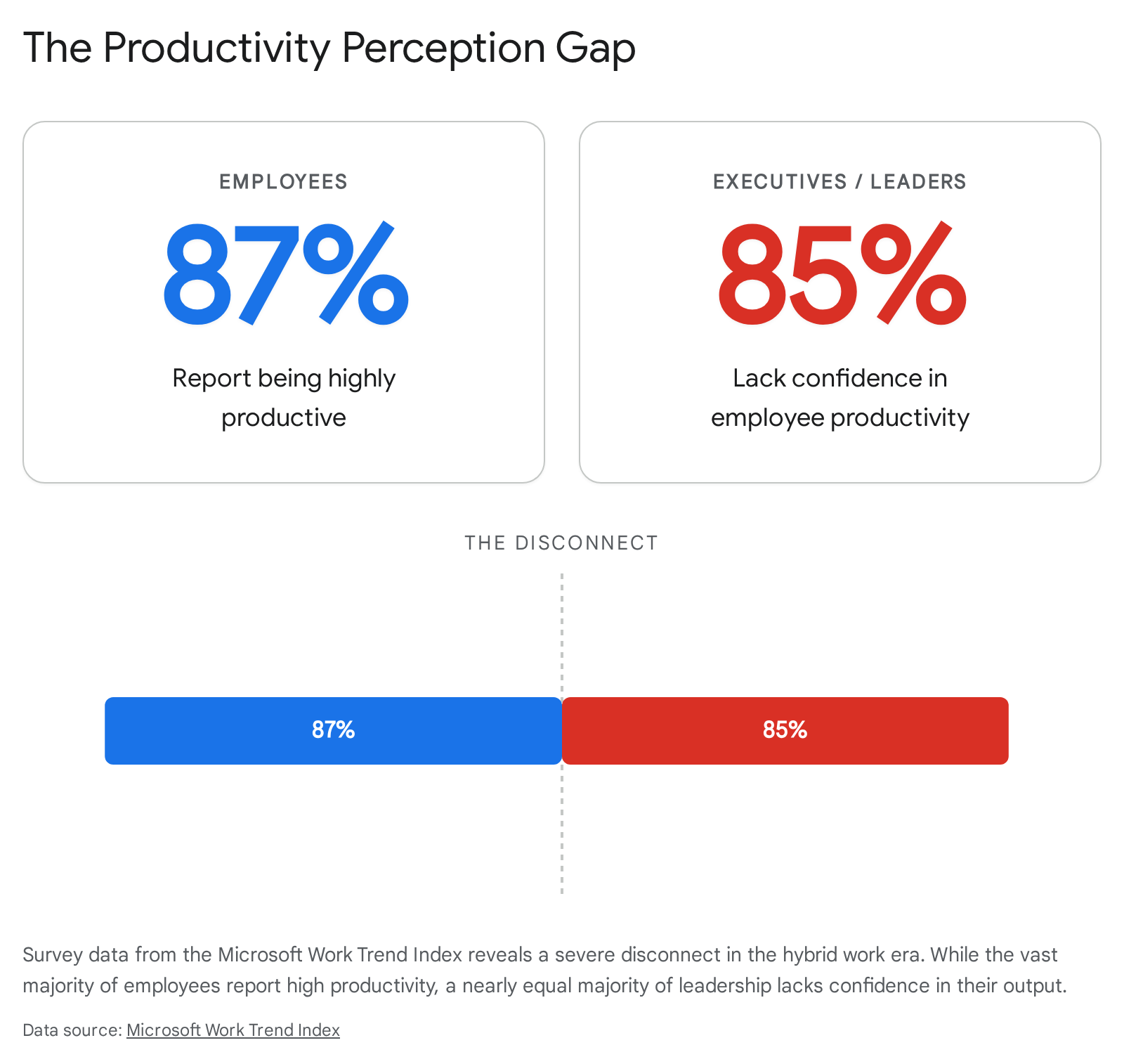
Corporate executives and their employees are operating in fundamentally different perceptual realities regarding workplace output. In comprehensive global surveys conducted by Microsoft for its Work Trend Index, 87% of information workers reported that they are highly productive under remote or hybrid conditions 4161718. Conversely, 85% of corporate leaders reported that the shift to hybrid work has made it profoundly challenging to have confidence that their employees are actually being productive 4161718.
This systemic management distrust has been formally termed "productivity paranoia" 4161819. It occurs when leaders fear that remote workers are neglecting their duties, despite internal organizational metrics - such as hours logged, overlapping meeting volumes, and digital output - remaining stable or even increasing beyond the point of employee exhaustion 41819.
Organizational psychologists attribute this pervasive disconnect to "input bias" - a cognitive heuristic where managers equate the visible, physical exertion of effort with the quality of the end result 4. In traditional office environments, physical cues such as late hours at a desk or the sound of rapid typing serve as proxies for dedication. Without the traditional visual and aural cues of a centralized office, managers lacking rigorous outcome-based evaluation frameworks struggle to evaluate performance, defaulting to a presumption of idleness 4.
The Rise of Productivity Theater
Driven by an acute awareness of management's distrust, remote employees have increasingly engaged in defensive "productivity theater." Studies indicate that 88% of remote workers feel intense pressure to artificially prove their productivity to management 520. This manifests in performative digital availability; for instance, 64% of remote workers admit to actively keeping their enterprise chat statuses green even when engaged in offline focus work or taking brief restorative breaks 520.
When managers lack the sophisticated analytical frameworks to evaluate workers based on tangible deliverables, they revert to measuring digital presence. This culture of surveillance directly undermines the autonomy that makes flexible work attractive, leading to heightened anxiety, severe cognitive load, and eventual burnout among remote staff 52025. Ultimately, the fixation on visibility over value creation creates a zero-sum environment where employees prioritize the appearance of labor over the execution of meaningful work.
The Economics of Return-to-Office Mandates
Influenced by productivity paranoia and complex macroeconomic pressures, 2024 and 2025 witnessed a massive surge in coordinated Return-to-Office (RTO) mandates. By 2025, 55% of Fortune 100 companies required five-day in-office attendance, a drastic escalation from just 5% two years prior 2122. These mandates have been highly contentious, sparking deep friction between labor and corporate boards, and yielding highly mixed operational results.
Commercial Real Estate Pressures and Sunk Costs
While executives publicly justify RTO mandates by citing the need to rebuild corporate culture, accelerate spontaneous innovation, and enhance mentorship, underlying economic analyses suggest that sunk costs in commercial real estate play a pivotal role in these decisions.
Throughout 2024 and early 2025, commercial office vacancy rates hit historic highs, reaching 20.4% nationally in the United States, with premium global markets like Toronto and San Francisco experiencing similar or worse distress 232430. Organizations locked into multi-year, long-term lease agreements face immense fiduciary pressure from boards and shareholders to justify these fixed costs 3025. In a 2025 survey of over 1,300 global executives, a significant portion acknowledged that their preference for in-office mandates was heavily influenced by financial obligations tied to existing real estate footprints 32.
Urban economics frameworks, such as the DiPasquale-Wheaton four-quadrant model, suggest this represents a classic market adjustment challenge 30. Firms are attempting to artificially sustain legacy asset valuations and justify capital expenditures by forcing geographic agglomeration, even when distributed models might be more operationally efficient. The benefits of urban agglomeration - the productivity gains from the physical clustering of economic activity - are actively being weighed against the new models of distributed work that modern cloud infrastructure has enabled 30.
Human Capital Attrition and Brain Drain
The enforcement of strict RTO policies has triggered severe, empirically measurable human capital losses. Rather than universally improving corporate performance, rigid mandates frequently destroy value through elevated attrition. Research tracking S&P 500 firms implementing RTO mandates between 2023 and 2025 reveals that these companies experienced an average 13% to 14% increase in abnormal employee turnover following the announcements 2026. Turnover rates at organizations with strict mandates frequently hit 169%, compared to 149% at firms maintaining flexible arrangements 20.
Critically, this turnover is not evenly distributed across the organizational hierarchy. Mandates cause a disproportionate "brain drain" of high-performing, highly tenured, and diverse talent 202526. High-performing employees possess the market mobility and leverage to reject unfavorable conditions and easily transition to competitors offering flexible arrangements 2025. Furthermore, empirical evaluations of stock market data show that rigid RTO policies fail to generate corresponding improvements in firm valuation or financial performance. This indicates that firms are absorbing the massive costs of recruitment, onboarding, and lost institutional knowledge without reaping the promised productivity dividends 27.
The Amazon 2025 Case Study
The most prominent corporate example of RTO fallout occurred following Amazon's implementation of a rigid five-day in-office mandate effective January 2025 1521. Leadership positioned the move as a necessary strategic step to restore a collaborative "Day One" culture and accelerate decision-making 21.
The internal workforce response was catastrophic. Leaked internal surveys revealed an employee satisfaction rating of 1.4 out of 5, with 91% of respondents expressing deep dissatisfaction 152122. By early 2025, 48% of surveyed corporate employees reported actively applying for jobs elsewhere, and 87% stated the policy would actively reduce their productivity due to hostile work environments and punishing commutes 213536. Survey data highlighted the logistical absurdity of the mandate for a globalized workforce: 60% of workers reported living further than 45 minutes from their assigned office, and 45% reported that they were not even assigned to the same physical office building as their direct managers 35. The Amazon mandate serves as a macro-level case study regarding the volatile costs of implementing sweeping physical requirements without securing employee buy-in or conducting thorough spatial analyses.
Global Adoption Rates and Cultural Determinants
The academic and corporate discourse surrounding remote productivity is often heavily skewed toward North American and Western European norms. However, globally harmonized data from 2024 and 2025 reveals that the adoption, success, and perception of remote work are deeply influenced by regional, cultural, and infrastructural factors.
Geographic Disparities in Remote Work
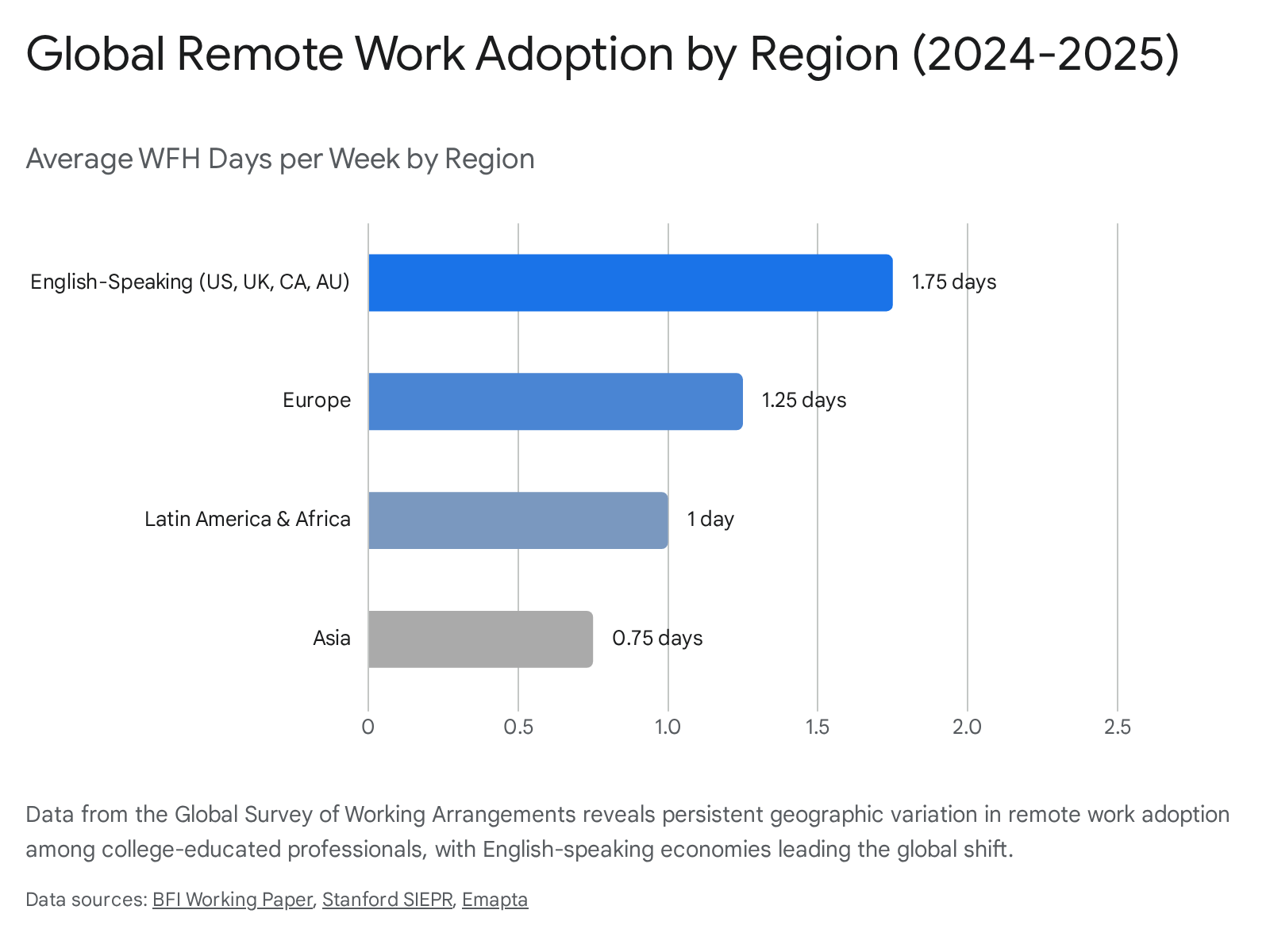
Based on the Global Survey of Working Arrangements (G-SWA) - which tracked over 16,000 college-educated workers across 40 countries - global remote work rates stabilized at an average of 1.27 days per week by early 2025 142829. This represents a durable structural shift where roughly 25% of all paid workdays for educated professionals are completed at home globally 28.
However, adoption remains highly polarized by geography:
- English-Speaking Economies: The United States, Canada, the United Kingdom, and Australia exhibit the highest remote work integration, averaging 1.5 to 2.0 remote days per week 142829.
- Europe and Latin America: Nations in these regions reflect moderate adoption, averaging between 1.0 and 1.5 remote days per week 142829.
- Asia: East Asian countries demonstrate the lowest adoption rates, typically averaging between 0.5 and 1.0 remote days per week 142829.
The Impact of Cultural Individualism and Urban Infrastructure
The vast disparities between the West and Asia are not driven merely by industrial composition or technological feasibility, but heavily by cultural norms and urban realities. Economists utilizing the G-SWA data determined that cultural "individualism" accounts for nearly 29% of the cross-country variation in remote work rates - making it the strongest single predictor of national adoption levels 3031. Countries scoring high on cultural individualism (such as the U.S. and U.K.) readily embrace the autonomy of remote work, whereas collective cultures emphasize visible participation and physical solidarity 3031.
Furthermore, "face-time culture" remains deeply entrenched in Asian corporate environments. In Japan and South Korea, hierarchical structures and the emotional bonding associated with physical presence (known as jeongse in Korea) heavily incentivize in-office attendance 3233. Despite reports showing a 9% productivity bump for remote Korean workers, hierarchical corporate structures strongly resist decentralization 33. In China, the pervasive "996" work culture (9 a.m. to 9 p.m., six days a week) practically demands physical presence for managerial oversight 34.
Beyond cultural attitudes, structural housing density severely limits remote work feasibility in certain regions. In dense urban centers like Hong Kong and Tokyo, cramped multi-generational living spaces lack the quiet environments and dedicated home offices necessary to achieve the focus-driven productivity gains observed in Western nations, making the physical office a more practical environment for sustained output 313234.
Evolving Legal Frameworks and Labor Rights
As the permanence of remote and hybrid work is cemented globally, governments are rapidly constructing regulatory frameworks to protect workers from the boundary-blurring effects of digital labor. The most significant legislative trend shaping knowledge work in 2024 and 2025 is the expansion of the "Right to Disconnect," intended to combat the performative overwork and burnout endemic to distributed teams.
Legislative Developments in Europe and Australia
Europe remains the vanguard of digital labor rights, building upon precedent set by France in 2017 4435. As of 2025, numerous European nations, including Belgium and Austria, have codified requirements that companies negotiate specific terms allowing employees to ignore digital communications outside of contracted hours without fear of reprisal 4446. Austria's new Telework Act, effective January 2025, explicitly mandates that employees have a right to disconnect for a minimum of 12 consecutive hours within a 24-hour period, even under flexible scheduling arrangements 46. In Germany and the U.K., updated labor laws are expanding rights to request flexible working arrangements while simultaneously introducing robust penalties for non-compliance regarding working hour transparency 4447.
Australia enacted sweeping Right to Disconnect legislation that took effect in August 2024 for large companies, extending to small businesses in August 2025 444636. The Australian framework specifically empowers employees to refuse after-hours contact from employers or third parties (including clients and suppliers) unless the refusal is deemed "unreasonable" due to specific emergencies or legal requirements 4436. Violations can trigger civil penalties of up to AUD 16,500, marking a major shift in holding employers financially accountable for respecting off-hours in a globally connected, always-on economy 46.
Labor Law Modernization in Latin America
Latin America has rapidly modernized its telework laws, positioning the region as a highly regulated but highly attractive hub for remote talent. By 2023, over 80% of Latin American companies supported hybrid or remote policies, driving massive growth in the regional outsourcing market and contributing to a projected 10.1% compound annual growth rate for Latin American outsourcing services through 2030 37. To manage this influx of digital labor, regional governments have instituted aggressive employee protections.
Colombia enacted strict legislation (Law 2191) guaranteeing digital disconnection across both public and private sectors, ensuring personal time and vacations are entirely free from digital interruption 3839. In Mexico, a 2026 Senate proposal aims to amend Articles 3 Ter and 132 of the Federal Labor Law to expand the right to digital disconnection - previously reserved under Article 330-E only for teleworkers - to encompass all employees regardless of their physical work location 404154. This legislation is a direct response to the psychological burnout caused by Mexico maintaining some of the highest average working hours in the OECD 54. Similarly, Brazil has moved to expand existing telework protections to temporary and platform workers, ensuring that remote labor is fully integrated into the broader employment safety net 363840.
| Region | Key Legislative Actions (2024-2026) | Primary Focus of Labor Reforms |
|---|---|---|
| Europe | Austria Telework Act (2025); U.K. Right to Disconnect proposals. | Standardizing remote contracts, mandating 12-hour disconnect windows, employer equipment provisions 4446. |
| Australia | Right to Disconnect Law (August 2024 / 2025). | Empowering workers to refuse third-party and employer contact out-of-hours; strict civil penalties 4446. |
| Latin America | Mexico Senate Reform (2026); Colombia Law 2191. | Expanding telework protections to all employees, combating OECD-high working hours, formalizing digital boundaries 384054. |
Conclusion
The discourse surrounding remote work productivity is heavily clouded by a persistent conflict between objective empirical data and subjective managerial perception. Rigorous research confirms that while fully remote work can mildly inhibit cross-functional innovation and complex organizational coordination, it provides demonstrably superior environments for deep, focused knowledge execution. Hybrid work models offer an optimal synthesis, preserving the collaborative advantages of the physical office while harnessing the massive retention and autonomy benefits of remote flexibility.
However, executive decision-making remains heavily influenced by "productivity paranoia," input bias, and the immense financial pressures of sustaining commercial real estate portfolios. By prioritizing physical presence and visibility over measured outcomes, organizations implementing rigid return-to-office mandates in 2024 and 2025 have absorbed severe human capital costs, systematically driving away their most talented, mobile, and diverse employees without achieving the desired improvements in raw productivity or firm valuation.
As remote work stabilizes into a permanent fixture of the global economy - shaped profoundly by cultural individualism and regional legislation designed to protect employees' right to disconnect - the long-term competitive advantage will belong to organizations that manage by output rather than observation. Companies that successfully implement structured hybrid environments, invest in intentional asynchronous collaboration frameworks, and establish cultures of trust will systematically outperform those attempting to force decentralized digital workflows back into localized physical constraints.