
How to Prepare for a College Admissions Interview
A college admissions interview is a strategic opportunity to personalize an application, articulate intellectual curiosities, and demonstrate genuine interest in an institution beyond the metrics of transcripts and test scores. To prepare effectively, applicants must conduct deep institutional research, formulate narrative responses using behavioral frameworks like the STAR method, and adapt to the specific evaluative metrics of the college in question. While an interview rarely serves as the sole deciding factor in an admissions decision, a highly articulate and authentic conversation can provide a crucial competitive advantage in a crowded applicant pool.
The Strategic Role of the Interview in Holistic Admissions
As the college admissions landscape becomes increasingly saturated and acceptance rates at highly selective institutions plummet into the single digits, students and parents frequently obsess over every variable. The college interview often looms large in the public imagination, depicted in popular culture as a high-stakes interrogation that determines a student's academic fate. The reality, according to admissions data and professionals, is far more nuanced, placing the interview within a broader ecosystem of holistic application review.
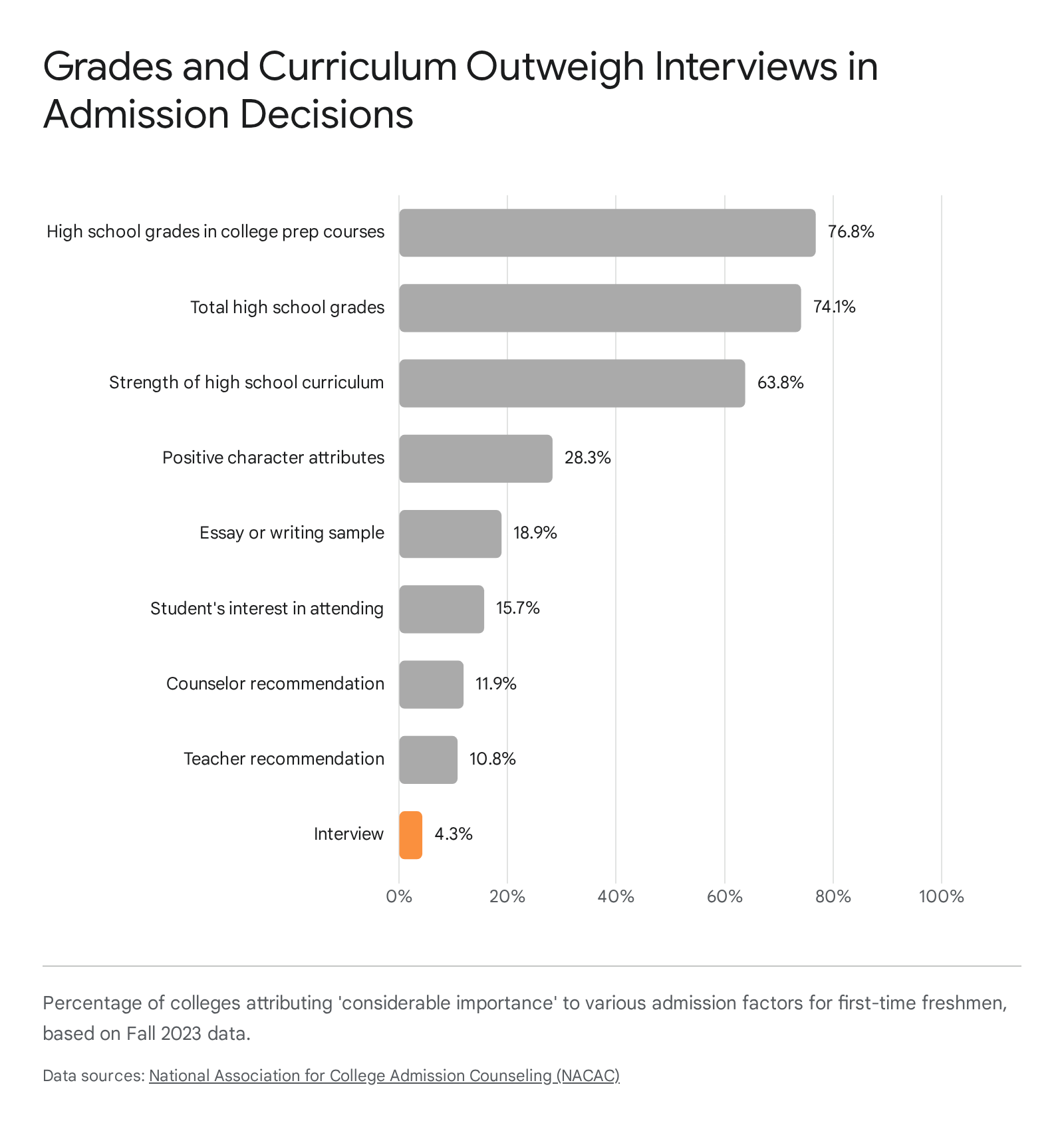
According to the National Association for College Admission Counseling (NACAC) "State of College Admission" report for the Fall 2023 cycle, the empirical weight of the interview is relatively small compared to academic performance. Across all four-year colleges surveyed, high school grades and the strength of the high school curriculum are uniformly rated as the most critical factors. Specifically, 76.8% of colleges place "considerable importance" on high school grades in college preparatory courses, and 63.8% heavily weigh the overall strength of a student's curriculum 122. Other factors that heavily outrank the interview include total high school grades (74.1%), positive character attributes (28.3%), the application essay or writing sample (18.9%), demonstrated interest (15.7%), and counselor recommendations (11.9%) 12. By contrast, only 4.3% of colleges attribute considerable importance to the interview itself 12.
This broad statistical average, however, requires precise contextualization. While massive public universities rarely offer interviews due to the logistical impossibility of interviewing tens of thousands of applicants, highly selective private institutions continue to view the interview as a vital mechanism for differentiation 354. At institutions where the vast majority of applicants boast impeccable academic credentials, the interview provides a distinctly human element. It allows the admissions committee to gauge an applicant's communication skills, intellectual vitality, and overall cultural fit 75. Furthermore, even when an interview is officially categorized as "optional," independent educational consultants and admissions counselors universally advise students to accept the opportunity 910116. Declining an interview can inadvertently signal a lack of genuine interest, potentially harming a candidate at institutions that heavily weigh "demonstrated interest" to protect their enrollment yields 137.
Categorizing the Interview Experience
When initiating the preparation process, it is critical for applicants to understand the primary function of the interview they are about to undertake. Institutions generally deploy two distinct typologies of interviews: evaluative and informational 3415.
| Feature | Evaluative Interview | Informational Interview |
|---|---|---|
| Primary Objective | To assess the student as a viable candidate and contribute qualitative data to the final admission decision 3615. | To answer the applicant's questions, provide institutional context, and facilitate mutual discovery 3615. |
| Typical Interviewer Profile | Admissions officers, highly trained alumni volunteers, or senior student admission fellows 354. | Regional alumni volunteers, faculty members, or current undergraduate students 354. |
| Institutional Documentation | The interviewer submits a formal summary report and candidate rating that becomes a permanent part of the applicant's file 346. | May involve a brief confirmation to the admissions office logging attendance, but rarely includes a strict grading rubric 313. |
| Weight in Admissions Decision | "Considered" or "Important." At schools like MIT, the evaluative report carries weight comparable to other major application components 16. | Very low direct impact on the admission decision, serving primarily to satisfy the "demonstrated interest" metric 138. |
It is essential to recognize that the boundary between evaluative and informational is frequently permeable. An informational interview is never entirely off the record; if a student behaves unprofessionally, expresses disinterest, or uses inappropriate language, the interviewer maintains a mechanism to alert the admissions office 138. Conversely, highly evaluative interviews are structured as two-way conversations, actively reserving time for the applicant to pose thoughtful questions and learn more about the academic environment 511. Therefore, applicants must approach every interaction with the exact same level of professionalism and preparation, regardless of its official designation.
The Interviewer Profiles
The specific identity and professional background of the interviewer fundamentally alter the conversational dynamic. Understanding these distinct profiles enables the applicant to tailor their narrative approach appropriately.
Alumni interviewers constitute the largest demographic of interviewers for elite, highly selective universities. Because professional admissions staffs lack the bandwidth to interview every applicant, universities like Harvard, Princeton, and Yale rely on massive networks of thousands of alumni volunteers positioned globally 16818. Alumni interviews are intentionally conversational, relaxed, and less rigidly structured than corporate interviews 59. Crucially, alumni interviewers operate "blind." They generally possess no access to the applicant's essays, transcripts, standardized test scores, or extracurricular lists; they are provided only with the student's name, high school, and basic contact information 51610. This lack of prior context represents a massive strategic advantage for the applicant, providing a blank slate upon which to present an unfiltered, highly curated version of their narrative 16. Furthermore, these interviews serve a dual institutional purpose: beyond evaluating candidates, they exist to keep alumni emotionally and philanthropically connected to their alma mater 138.
Interviews conducted directly by admissions officers represent a much more formal and increasingly rare encounter 54. Because an admissions officer evaluates applications full-time and holds direct voting power in committee, the stakes of these conversations are elevated. Admissions officers have usually reviewed the entirety of the student's application file prior to the meeting 5. Consequently, they will ask highly specific, probing questions regarding academic inconsistencies, specific essay topics, or precise career trajectories 5. Applicants must be prepared to defend their intellectual choices and elaborate deeply on the materials they submitted.
Student interviewers, frequently referred to as Senior Fellows or Admissions Ambassadors, are highly utilized by liberal arts colleges 6. While these interviews are formally evaluative and result in a written report submitted to the admissions committee, the tone is inherently peer-to-peer 616. Current students are primarily assessing cultural and social fit. They are internally asking whether the applicant would be a stimulating classmate in a small seminar, an engaged roommate, or an active contributor to campus clubs 611. Conversations with student interviewers often pivot toward campus traditions, dining hall culture, and the realities of the daily undergraduate workload.
Macro Trends Redefining the Interview Ecosystem (2024 - 2026)
To fully comprehend the contemporary role of the college interview, one must understand the massive systemic shifts that have disrupted higher education between 2024 and 2026. The interview does not exist in a vacuum; its importance fluctuates inversely with the availability of other quantitative data points.
The Test-Optional Paradigm and the Return to Standardized Testing
The sudden onset of the COVID-19 pandemic catalyzed an unprecedented shift in college admissions, forcing thousands of institutions to adopt "test-optional" policies due to the widespread cancellation of SAT and ACT testing administrations 1223. In this temporary test-optional environment, subjective and qualitative factors - such as application essays, teacher recommendations, and college interviews - gained outsized prominence. Admissions officers, lacking the standard quantitative baseline of test scores, leaned heavily on these qualitative narratives to differentiate between thousands of students presenting identical 4.0 GPAs 24. During this era, the interview served as a critical proxy for academic preparedness and intellectual agility.
However, moving into the 2024, 2025, and 2026 admissions cycles, a sweeping reversal occurred across the elite tier of American higher education. Institutions including Dartmouth College, Yale University, Brown University, Harvard University, the University of Pennsylvania, and the Massachusetts Institute of Technology reinstated mandatory standardized testing requirements 121314. This reversal was largely driven by internal institutional research and external economic studies - most notably from researchers at Dartmouth and Harvard's Opportunity Insights - which concluded that standardized test scores remained the most highly predictive metric of undergraduate academic success 1314. Furthermore, these studies suggested that test-optional policies inadvertently harmed high-achieving students from lower-income backgrounds, who often withheld strong scores out of fear they were not "high enough," whereas test mandates forced admissions offices to view scores contextually 13.
As the SAT and ACT reclaim their status as the dominant quantitative gatekeepers, the college interview is returning to its traditional, specialized function. It is no longer tasked with serving as a proxy for academic capability; instead, it is purely an assessment of character, extracurricular passion, and institutional fit 614.
The Ramifications of the Supreme Court Affirmative Action Ruling
The 2023 Supreme Court decision in Students for Fair Admissions v. Harvard, which effectively struck down race-conscious admissions policies (affirmative action), has triggered a profound shift in how universities instruct their interviewing staff. The legal fallout from this decision directly impacts what can and cannot be recorded during a college interview, fundamentally altering the applicant's communication strategy.
In late 2025, Harvard University issued highly restrictive new guidelines to its vast network of alumni interviewers, explicitly banning them from referencing an applicant's race, ethnicity, or national origin in their written evaluation reports 15. During training sessions, interviewers were further instructed to avoid mentioning an applicant's religious affiliations, the languages spoken in their home, or their involvement in specific racial or cultural organizations 15. Alumni were directed to sanitize their language, utilizing broad umbrella terms like "affinity groups" or "faith events," and were warned that their reports would be discarded by the admissions office if they failed to comply 15.
This policy shift immediately drew severe condemnation from civil rights organizations, including the NAACP Legal Defense and Educational Fund, which argued that the policy forces the disproportionate censorship of students of color and immigrants 15. The NAACP pointed out that a student might spend their entire interview recounting a profound personal experience shaped by racial discrimination, completely unaware that the interviewer is institutionally barred from passing that vital context onto the admissions committee 15.
For applicants navigating this new landscape, the strategic takeaway is critical. Students cannot rely on the interview to convey demographic context, personal hardship related to identity, or the cultural significance of their extracurricular activities. If a student's racial, ethnic, or cultural background is central to their identity and life trajectory, they must explicitly articulate that narrative within their primary written essays, ensuring the information reaches the admissions committee directly, bypassing the legally restricted interviewer entirely.
Institutional Frameworks: Ivy League vs. Liberal Arts Colleges
The evaluative weight and stylistic approach to the college interview vary dramatically depending on the structural nature of the institution. A pervasive misconception among applicants is that the admissions philosophy at a massive research university is identical to that of a small liberal arts college. In reality, their differing educational models dictate entirely different interview paradigms.
| Metric | Elite Research Universities (e.g., Ivy League) | Top Liberal Arts Colleges (e.g., "Little Ivies") |
|---|---|---|
| Undergraduate Population | Large (Typically 6,000 to 15,000+ undergraduates) 161718. | Small (Typically 1,500 to 3,000 undergraduates) 161718. |
| Educational Philosophy | Emphasis on cutting-edge faculty research, graduate programs, and specialized professional schools 171819. | Exclusive focus on undergraduate education, small discussion-based seminars, and close faculty mentorship 181920. |
| Primary Interview Modality | Off-campus or virtual interviews conducted almost exclusively by regional alumni volunteers 41618. | High availability of on-campus interviews conducted directly by admissions staff or senior student fellows 618. |
| Interview Importance | Generally considered a supplementary or secondary factor used to differentiate statistically identical candidates 818. | Often highly evaluative; considered a crucial metric for determining collaborative potential and community fit 61518. |
The massive applicant pools and global reach of Ivy League institutions mean they rely entirely on the scalability of alumni networks 1618. For example, Harvard coordinates roughly 10,000 alumni volunteers to conduct its interviews 16. Because these alumni are far removed from the daily operations of the admissions office, their reports are utilized as general character assessments rather than rigid academic evaluations 168.
Conversely, liberal arts colleges operate on an intimate scale. The pedagogical model of a liberal arts college relies heavily on the Socratic method, requiring students to actively participate in small, 12-person seminars rather than passively absorbing information in 300-person lecture halls 171920. Therefore, admissions officers at these institutions must evaluate an applicant's conversational agility, intellectual curiosity, and willingness to engage with opposing viewpoints. An interview is the most effective tool to measure these traits 1518. At liberal arts colleges, the interview is not merely a formality; it is an active audition for a seat at a highly collaborative seminar table.
The Comprehensive Preparation Timeline
Effective preparation for a college interview cannot be achieved through last-minute cramming. A successful candidate builds their narrative architecture over several weeks, methodically refining their delivery, mastering behavioral frameworks, and researching institutional specifics.
Three Months Prior: Institutional Immersion and Narrative Building
The foundational layer of interview preparation is deep, specific institutional research. Colleges are highly adept at identifying applicants who view their institution merely as a prestigious brand name versus those who genuinely understand its academic offerings 71121. General platitudes regarding a "beautiful campus" or a "great location" are detrimental. Applicants must scour the university's website, looking past the marketing materials to identify specific academic departments, interdisciplinary centers, unique study-abroad programs, and professors whose research aligns with their own interests 212235.
Simultaneously, the applicant must audit their own background. By reviewing their transcripts, resumes, and extracurricular lists, the student should identify their core strengths and values. The goal during this phase is to outline five to ten adaptable anecdotes that highlight leadership, resilience, intellectual curiosity, and community impact 2337. These anecdotes will serve as the raw material for answering unpredictable behavioral questions.
One Month Prior: Mock Interviews and Behavioral Strategy
Practice is the mechanism that transforms raw anecdotes into polished, compelling narratives. Scheduling a formal mock interview with a high school guidance counselor, a teacher, or a trusted professional mentor is essential 353824. The mock interview should strictly simulate the real environment, matching the anticipated dress code and utilizing the exact software platform if the interview is virtual 3540. Recording the session allows the applicant to objectively review their performance, identifying distracting nonverbal habits, assessing their speaking pace, and eliminating filler words 233740.
During this practice phase, applicants must master the STAR Method to structure their responses to behavioral questions. Behavioral questions - which ask for specific examples of past behavior - are the standard in modern interviewing, operating on the premise that past performance is the most accurate predictor of future behavior 3525. The STAR framework ensures responses are highly organized, detailed, and impact-driven: * Situation: The applicant establishes the context and sets the scene, providing the necessary background information without rambling (e.g., "During my junior year, the debate team's budget was unexpectedly slashed by the district..."). * Task: The specific challenge, problem, or responsibility the applicant was faced with ("...and as the club treasurer, it became my responsibility to raise $3,000 in six weeks to ensure we could travel to the state championship."). * Action: The core of the answer, detailing the specific, concrete steps the applicant took to resolve the issue. This must focus on the individual's actions, using "I" rather than "we" to highlight personal leadership ("I conceptualized and organized a community trivia night, securing donated venue space from a local business and aggressively marketing the event through social media campaigns."). * Result: The positive outcome, the quantifiable impact, and the underlying lesson learned ("The event raised $3,500, securing our travel funds, and the experience taught me the critical importance of adaptable project management and community networking.") 352526.
The Week Prior: Environmental Control and Logistics
As the interview approaches, preparation shifts from narrative strategy to logistical control. The applicant must select their wardrobe, ensuring it aligns with the expected level of professionalism. The universal standard for college interviews is "business casual," which signals maturity without appearing excessively rigid 2227. For male applicants, this generally involves dress trousers or khakis paired with a collared button-down shirt; a blazer is often appreciated but rarely mandated, while ties are optional 222744. Female applicants typically opt for knee-length skirts, tailored dress pants, and a conservative blouse or sweater 27. Across all demographics, candidates must strictly avoid overly casual garments such as t-shirts, athletic wear, or baseball caps, as well as highly distracting elements like excessive jewelry or heavy perfumes 222627. In virtual environments, color selection is also a strategic factor; solid shades of blue, green, or purple tend to display beautifully on web cameras, whereas complex patterns can create visual distortion 21.
If the interview is virtual, technology must be rigorously tested. Applicants must verify their internet bandwidth, update the necessary software (Zoom, Skype, Teams), and check their audio inputs 94027. Utilizing a headset or earphones with a dedicated microphone drastically improves audio clarity compared to a laptop's default internal microphone 927. The physical environment must be curated: the background should be tidy, professional, and free of clutter, and the applicant must secure a quiet space immune from household interruptions 2138. Lighting is critical; sitting with a window behind the applicant will result in a dark, silhouetted face. Lighting sources should be positioned in front of the applicant, illuminating the face clearly 2138.
Crucially, applicants must position their camera to simulate genuine eye contact. In a virtual setting, looking at the interviewer's face on the screen means the applicant is looking slightly downward. To project confidence and direct engagement, the applicant must train themselves to look directly into the webcam lens while speaking 2240. Elevating the laptop on books so the camera sits at eye level, and dragging the video window to the top center of the screen near the webcam, can naturally facilitate this eye contact 40.
The Day of the Interview and Post-Interview Protocol
On the day of the interview, whether navigating to a local coffee shop or logging into a digital portal, punctuality is absolute. Arriving or logging in 10 to 15 minutes early provides a necessary buffer for unforeseen traffic or software updates, while also allowing the applicant a moment to breathe, review their notes, and center their mindset 212744.
During the conversation, applicants must avoid the temptation to recite heavily memorized scripts. Delivering an answer with robotic perfection destroys the illusion of organic conversation and frequently makes the applicant appear inauthentic 11945. It is entirely acceptable, and often viewed as a sign of intellectual maturity, to pause for a few seconds to formulate a thoughtful response to a complex question 1137.
The evaluation does not conclude when the meeting ends. Within 24 hours of the interview's completion, the applicant must send a professional, personalized thank-you email to the interviewer 242627. This correspondence should be brief, expressing gratitude for the interviewer's time, and must reference a specific topic discussed during the meeting (e.g., "I deeply appreciated your insights regarding the undergraduate research culture in the chemistry department") 2427. This specific reference proves the applicant was actively listening and cements a positive final impression 727.
Deconstructing Common Interview Questions
While the exact phrasing will vary, the vast majority of college interview questions revolve around a predictable set of themes designed to probe an applicant's self-awareness, academic passions, and resilience.
| Question Category | Common Phrasing | Core Competency Assessed |
|---|---|---|
| The Personal Overview | "Tell me about yourself." 72428 | Assesses concise communication and self-awareness. The interviewer is looking for a structured "elevator pitch" highlighting academic interests, a core passion, and future goals, rather than a chronological regurgitation of a resume 744. |
| Institutional Fit | "Why do you want to attend this college?" 71140 | Assesses the depth of institutional research and genuine interest. General answers are detrimental; applicants must cite specific academic programs, unique pedagogical approaches, or faculty research that aligns with their background 71121. |
| Resilience & Adaptability | "Tell me about a time you failed or faced a significant challenge." 252829 | Assesses emotional maturity and the capacity for growth. Admissions committees are highly averse to fragility; they seek students who view setbacks as learning opportunities and can articulate how they pivoted strategies to overcome obstacles 252930. |
| Academic Vitality | "What is your favorite book, or what have you read lately outside of school?" 72144 | Assesses genuine, self-directed intellectual curiosity. It separates students who read merely to pass AP exams from those who actively seek out knowledge and complex ideas in their free time 721. |
When confronted with a question to which the applicant genuinely does not know the answer, they must never attempt to fabricate a response. Feigning knowledge is easily detected and severely damages credibility 1129. It is highly professional to admit the limits of one's knowledge, state that the question presents an interesting perspective, and express a desire to research the topic further 29.
Formulating Questions for the Interviewer
The conclusion of every interview features a reversal of roles, where the interviewer asks the applicant if they have any questions. Declining this opportunity is a severe strategic error, signaling a lack of intellectual curiosity or a superficial interest in the institution 92122. Applicants must prepare a list of four to six thoughtful questions in advance 92427.
Crucially, applicants must never ask logistical questions that can be answered by a cursory glance at the university's homepage, such as "Do you offer a psychology major?" or "What are the application deadlines?" 2122. Instead, the most effective questions are subjective, requiring the interviewer to reflect on their own experiences or provide qualitative opinions 2227. Because individuals generally enjoy speaking about their own lives, soliciting the interviewer's personal story builds a strong rapport 827. Excellent inquiries include: * "In your experience, what makes the campus culture here distinct from similar universities?" 21 * "If you could offer one piece of advice to an incoming freshman trying to maximize their experience here, what would it be?" 21 * "How accessible did you find the faculty when seeking mentorship or research opportunities outside of scheduled class time?" 9 * "Can you describe a specific campus tradition that significantly shaped your undergraduate experience?"
Specialized Strategies for International Applicants
For international students, the college interview carries an added layer of evaluative weight and complexity. Beyond serving as a metric for personality and institutional fit, the interview functions as a live, unscripted audit of the applicant's English language proficiency and their capacity to adapt to a Western academic environment 911.
Admissions officers operate with the understanding that application essays can be heavily polished by educational consultants, and standardized metrics like the TOEFL do not always accurately predict conversational fluency in a fast-paced seminar setting 113150. The interview proves that the student possesses the linguistic agility to participate in rigorous academic debates and integrate seamlessly into residential campus life 11. Importantly, international students should not harbor anxiety regarding their accents; interviewers are explicitly trained to assess clarity of thought, confidence, and the ability to express complex conceptual ideas, not to demand flawless grammatical perfection 911.
Navigating Third-Party Interview Platforms
The sheer volume of international applications - particularly from dense educational markets like China and India - presents an insurmountable logistical challenge for U.S. admissions offices, which lack the staffing to conduct interviews on a global scale. Furthermore, the rise of sophisticated credential fraud, ghostwritten essays, and most recently, the explosion of generative AI tools like ChatGPT, has forced universities to seek robust verification methods 315051. Consequently, hundreds of elite U.S. institutions have partnered with third-party verification services to conduct and record international student interviews 4531.
The two dominant platforms in this space are InitialView and Vericant 453150. These services facilitate recorded video interviews accompanied by proctored writing samples, which are subsequently distributed directly to the universities selected by the applicant 1131.
| Feature | InitialView | Vericant |
|---|---|---|
| Core Format | A 12-to-15-minute unscripted video interview paired with a 20-minute digital writing component 4551. | A structured video interview, writing sample, and a Spoken English Evaluation (SEE) 2350. |
| Interviewer Profile | Native English-speaking professionals, exclusively comprising former U.S. admissions officers and high school counselors 4550. | Highly trained professional interviewers specialized in language assessment 45. |
| Evaluation Methodology | Unscored. InitialView acts strictly as a neutral conduit, sending the raw, unedited video directly to colleges so admissions officers can form their own unbiased opinions 50. | Scored. Vericant utilizes linguistic experts to evaluate the applicant's Spoken English Evaluation across five precise metrics: range, accuracy, fluency, interaction, and coherence 50. |
| Applicant Agency and Repeat Policy | Applicants are permitted to review their recorded interview and may request a redo within a strict 15-day window if they are dissatisfied, prior to sending it to universities 50. | Applicants may pay for unlimited repeat interviews, reviewing all attempts and selecting only the highest-quality recording to distribute to their college list 4550. |
The utility of these platforms has expanded alongside the capabilities of artificial intelligence. InitialView, for example, heavily markets its platform as "the answer to ChatGPT," highlighting its VIVA program which requires students to upload their academic work and respond on camera to unscripted questions about their own writing, thereby proving academic integrity and authentic student voice 51. For international applicants, investing in a high-quality third-party interview is highly recommended, as it allows a single excellent performance to be broadcast to an unlimited number of prospective colleges, saving immense time and reducing repetitive stress 114550.
Mastering Cross-Cultural Interview Nuances
International applicants must also consciously navigate American cultural norms, which frequently contradict the social conditioning of their home countries.
A primary friction point is the concept of self-promotion. In many East Asian cultures, for example, humility is paramount, and speaking boastfully about one's individual achievements is considered distasteful or arrogant 3132. The American interview process, however, operates on the explicit expectation of self-promotion. Employers and admissions officers expect candidates to confidently articulate their accomplishments, leadership capabilities, and unique value propositions 323334. International students must override their cultural hesitation and utilize specific examples to highlight their individual contributions to team successes, explicitly stating how their skills will benefit the American campus 3334.
Nonverbal communication also requires cultural recalibration. Direct, sustained eye contact is interpreted in the United States as a sign of honesty, engagement, and confidence; in other cultures, maintaining unbroken eye contact with an authority figure may be viewed as deeply disrespectful 3234. Similarly, the firm handshake is the standard professional greeting in the U.S. While international students should expect to offer and receive handshakes, they should also be aware that they can politely decline a handshake based on specific religious or cultural boundaries - for instance, by placing a hand over the heart and respectfully explaining the religious restriction - without suffering any professional penalty 323334. Furthermore, Americans generally require a larger radius of personal space compared to residents of more densely populated nations, typically expecting two to three feet of distance during in-person interactions 34.
Finally, international students should proactively address the unique strengths inherent in their global background. Rather than viewing their status as a liability, they should emphasize their cross-cultural communication skills, deep cultural awareness, adaptability in navigating unfamiliar systems, and bilingual proficiencies as distinct assets that will enrich the diversity of thought on an American campus 2633. While discussing student visa or work authorization status is occasionally necessary, it is generally advised to focus initially on academic and personal merits, reserving detailed logistical visa discussions for a later stage unless directly prompted by the interviewer 333435.
Debunking Pervasive Admissions Myths
The immense pressure surrounding the college application process breeds a vast ecosystem of misinformation, anxiety, and urban legends. Separating empirical admissions realities from pervasive myths is essential for an applicant's mental health and strategic focus.
A foundational myth is that the alumni interviewer holds the final, dictatorial say over a student's admission. In reality, alumni volunteers possess zero executive decision-making power. Their role is strictly advisory; they facilitate a conversation, assess the applicant's enthusiasm, and submit a brief, often character-limited summary of their impressions 5856. Professional admissions officers - who analyze the applicant within the broader context of institutional priorities, historical high school data, and demographic needs - make the ultimate, binding decisions 856. The alumni report is merely one data point among dozens.
Another pervasive misconception is that a phenomenal, highly charismatic interview can salvage a poor academic record. College is, inherently, an academic institution. No amount of conversational charm, extracurricular volume, or interviewing prowess can overcome a transcript indicating that a student lacks the foundational skills to survive the academic rigor of the university 62436. The interview is a supplementary, differentiating factor utilized after academic viability has been established, never a substitute for a high GPA or rigorous coursework.
Similarly, students often operate under the false assumption that because an interview is labeled "informational," it carries no consequences and requires no preparation. "Informational" does not equate to "invisible." If an applicant arrives at an informational interview demonstrating profound apathy, lacking basic research about the institution, or behaving unprofessionally, the representative will log that negative interaction in the student's file, severely damaging their "demonstrated interest" rating 31315. Conversely, treating an informational interview with rigorous professionalism allows the applicant to extract highly specific, granular details about the college, which can then be weaponized to write vastly superior "Why Us?" supplemental essays.
Finally, a common myth deeply ingrained in applicants is that they must possess a tragic, cinematic life story to impress an admissions committee. Students erroneously believe they need to have cured a rare disease, survived a disaster, or launched a multi-national nonprofit to stand out. In reality, admissions officers are not seeking Hollywood screenplays; they are searching for authenticity, emotional maturity, and self-awareness 101129. Speaking passionately and with profound insight about a seemingly mundane part-time job, demonstrating deep commitment to an obscure hobby, or articulating the complex interpersonal dynamics of mediating a conflict within a high school club is often highly effective. These grounded narratives reveal far more about a student's daily character and resilience than an exaggerated tale of triumph 10.
Bottom line
The college admissions interview serves as a critical mechanism for personalizing an application, allowing candidates to transform from a static collection of metrics into dynamic, multi-dimensional individuals. While academic rigor remains the undisputed primary driver of admission, a highly articulate and authentic interview can provide a definitive competitive advantage, particularly at liberal arts colleges and highly selective universities. Success hinges on rigorous institutional research, the mastery of behavioral storytelling frameworks like the STAR method, and an acute awareness of the specific cultural and evaluative expectations of the institution. Ultimately, the interview is not merely a test of worthiness, but a mutual exploration of fit, ensuring that the student and the university are optimally aligned for future success.