
How to Write a Standout College Application Essay
To write a college application essay that truly differentiates an applicant from the broader pool, the narrative must prioritize an authentic, reflective voice over forced vocabulary or sensationalized trauma. The most memorable essays operate as a "business casual" conversation with the admissions committee - utilizing vivid, highly specific details to demonstrate character and growth, while actively avoiding the generic, over-edited prose frequently produced by generative AI tools and heavy-handed consultants.
The Evolving Weight of the College Essay
Before analyzing the mechanics of narrative structure or the selection of an optimal topic, applicants must understand the precise weight the personal statement carries within the broader admissions ecosystem. The college admissions process is a highly structured, data-driven endeavor that ultimately relies on human judgment to shape a freshman class. The essay is a critical component, but it operates within a firm hierarchy of academic metrics.
According to the National Association for College Admission Counseling (NACAC) survey for the Fall 2023 admission cycle, the essay is highly influential, though it is not the primary driver of college acceptances 12.
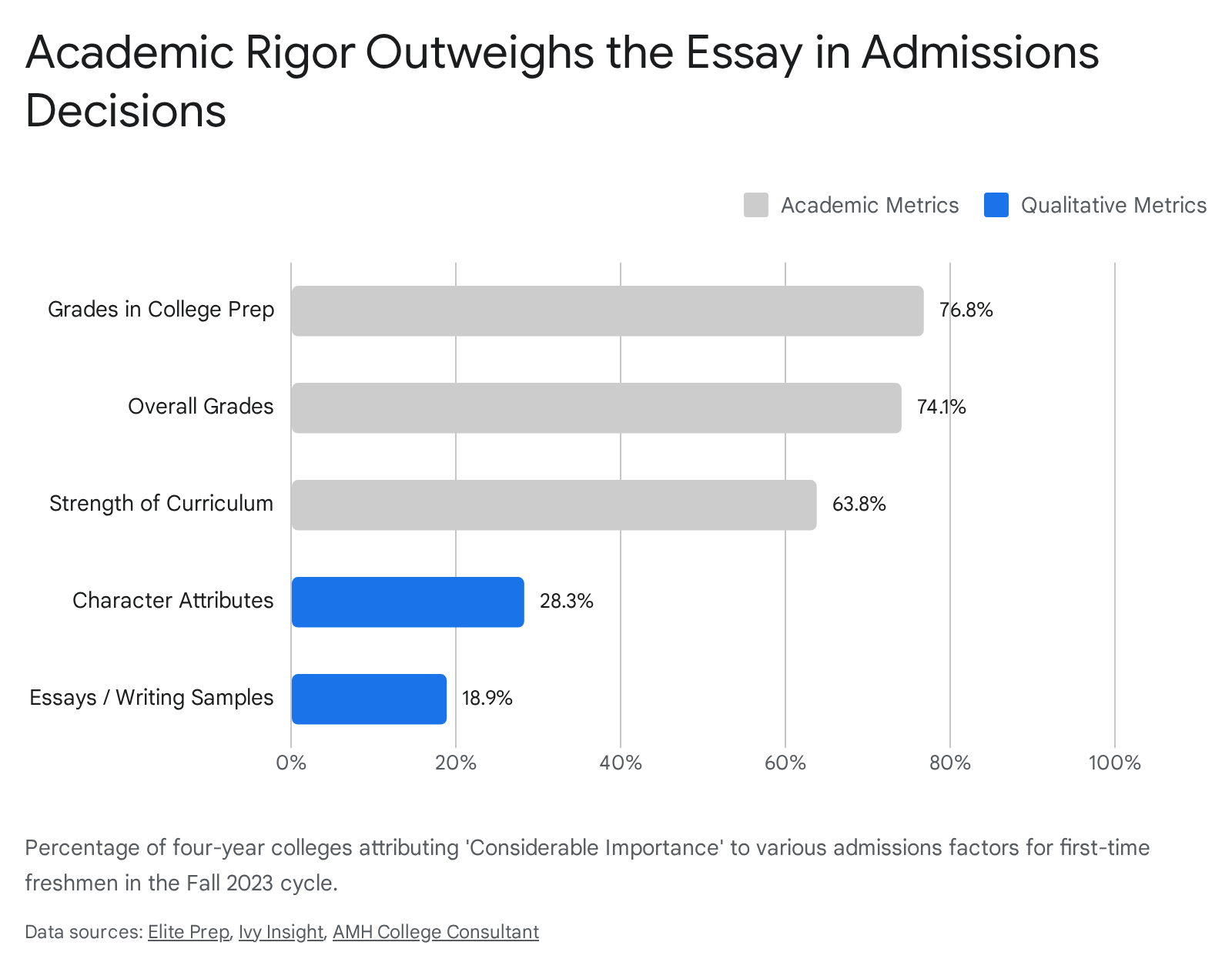
The most critical factors remain deeply grounded in sustained academic performance over the course of an applicant's high school career.
When admissions officers evaluate the factors that carry "considerable importance," the data reveals a clear preference for quantitative academic rigor. However, as the academic profiles of applicants at highly selective institutions become increasingly indistinguishable - with thousands of students presenting perfect or near-perfect grade point averages - qualitative elements like the essay and positive character attributes serve as the ultimate tiebreakers 23.
| Admissions Factor | Percentage of Colleges Rating it "Considerable Importance" | Percentage Rating it "Moderate Importance" | Combined Importance (Considerable + Moderate) |
|---|---|---|---|
| Grades in College Prep Courses | 76.8% | 15.1% | 91.9% |
| Overall High School Grades (All Courses) | 74.1% | 18.9% | 93.0% |
| Strength of High School Curriculum | 63.8% | (Varies by institution) | (Varies, but consistently high) |
| Positive Character Attributes | 28.3% | (Varies by institution) | 65.8% |
| Essays or Writing Samples | 18.9% | (Varies by institution) | Over 65.0% |
| Demonstrated Interest | 16.0% | (Varies by institution) | (Varies heavily by public/private status) |
| Standardized Test Scores (SAT/ACT) | 5.0% - 25.0% (Context dependent) | (Varies by institution) | (Fluctuates based on post-COVID test policies) |
The importance of test scores has fluctuated significantly depending on whether a school maintains test-optional or test-blind policies in the post-pandemic landscape, though some major universities are currently reversing these policies 134. Consequently, for institutions that de-emphasize standardized testing, the personal essay assumes an even greater burden in differentiating applicants.
The Post-Affirmative Action Landscape
While the essay ranks lower than overall academic performance globally, its importance has surged at highly selective private institutions, particularly in the wake of recent legal shifts. In June 2023, the U.S. Supreme Court ruled in Students for Fair Admissions v. Harvard that race-based affirmative action in college admissions was unconstitutional 345. This landmark decision effectively ended the explicit consideration of race as a standalone factor in college admissions, overturning decades of precedent and sending ripples through the higher education sector 89.
However, the Court explicitly noted a critical carve-out: universities may still consider an applicant's discussion of how race or background affected their life, whether through discrimination, inspiration, or otherwise, provided the student is evaluated as an individual 49.
Consequently, the personal statement and supplemental essays have become the primary mechanisms for students to share their lived experiences and contextualize their backgrounds 59. A text analysis of the top 25 U.S. college admissions websites conducted shortly after the ruling found a 63% increase in the usage of the exact phrase "lived experience" 9. In an era where legacy admissions and athletic recruitment still play heavy roles, and where a vast number of applicants boast perfect or near-perfect academic records, the essay has transitioned from a mere supplement to the central stage for personal differentiation 9. Elite institutions are increasingly stating that they seek students who will contribute to their community not merely because of who they are, but because of the specific, articulated experiences that have shaped their worldview 9.
The Core Objective: Finding an Authentic Voice
One of the most persistent complaints from admissions officers is that college essays frequently do not sound like teenagers wrote them. They often read like the musings of a middle-aged corporate executive or a dry academic journal, stripped of all humanity by over-editing and thesaurus abuse 611.
The primary goal of the personal statement is to allow the admissions committee to gauge whether an applicant is a strong cultural and intellectual fit for their specific community 11. As one former admissions officer noted, highly selective colleges are not simply collecting academic markers; they have far more than enough qualified applicants to fill a class 6. Instead, they are attempting to build a multifaceted village 6. An applicant's unique writing voice helps the committee envision exactly how they will fit into the dynamic of that village.
Decoding the Concept of "Voice"
In the context of writing, "voice" is essentially the fraternal twin of an individual's spoken word 6. It encompasses unique syntax, rhythm, vocabulary choices, tone, and perspective. When an admissions officer reads an essay, they should ideally be able to "hear" the applicant speaking, sensing the energy and personality behind the prose 6.
A common trap applicants fall into is attempting to write what they assume an admissions committee wants to read 12. This assumption inevitably results in generic, highly polished essays centered around lofty, abstract themes. True voice, conversely, is characterized by unabashed authenticity. If a student is naturally quirky or deeply sarcastic, that disposition should subtly bleed into the prose. If they are intensely analytical, their structural logic should reflect that precision 1112. Admissions officers want to hear from the real student, complete with all their natural flaws and complexities, rather than a rehearsed, cookie-cutter narrative 12.
The "Business Casual" Rule
Admissions officers do not expect literary perfection, but they do expect respect for the format. A highly effective framework for understanding tone is to treat the essay like a "business casual" interaction 6. Applicants should remove their "verbal pajamas" - meaning they should eliminate overly casual text-speak, heavy slang, and grammatical carelessness. They should put on a nice pair of pants, sip some water, and enunciate clearly. However, they should not show up wearing a tuxedo 6.
To achieve this balanced tone, applicants should consider several practical strategies:
First, writers must minimize their reliance on the thesaurus. If a student naturally describes a situation as "predictable," they should use that word. They should not swap it for "prognosticative" simply to sound intelligent 6. Hyper-steroidal, polysyllabic word parades actively hurt an applicant's chances because they scream inauthenticity and disrupt the natural flow of reading 6. A simpler word is frequently the best word for the job.
Second, the "Read Aloud" test remains the single best mechanism to check for authentic voice. The writer should read the draft out loud to themselves or a trusted peer. If the student stumbles over a sentence, or if they would feel embarrassed or pretentious saying the sentence out loud to a friend over coffee, it is not their natural voice and should be rewritten 1113.
Third, contrary to what some high school English rubrics demand for formal academic papers, using contractions is completely acceptable and highly encouraged in personal statements. Utilizing words like "can't," "shouldn't," and "I'm" makes the writing feel conversational, approachable, and human 14.
Finally, applicants should strive to replace vague adjectives with concrete details. Instead of broadly stating a passion for reading, an applicant might explain that growing up with a single parent who worked the graveyard shift meant that books became their primary source of companionship 15. The latter statement conveys the same passion but grounds it in a deeply personal reality.
Mastering the "Show, Don't Tell" Principle
If there is one piece of advice universally echoed by college counselors, writing teachers, and university admissions blogs across the country, it is the creative writing maxim: Show, don't tell.
The renowned playwright Anton Chekhov famously summarized this principle: "Don't tell me the moon is shining; show me the glint of light on broken glass" 1617. Whether a student is applying to an undergraduate program, a master's degree, or a competitive fellowship, this concept serves as the foundational pillar of compelling narrative writing 16.
The Cognitive Mechanics of Showing
"Telling" gives the reader bare information, functioning much like a brief newspaper report or a resume summary. "Showing," on the other hand, transports the reader into an experience by utilizing sensory details, dialogue, and specific physical actions to create a mental movie 187.
Admissions officers process thousands of essays per cycle. By the end of a long day of reading, an admissions officer has likely encountered the phrases "I am a natural leader" or "I am highly determined" countless times 168. Abstract nouns such as passion, excellence, dedication, and leadership are explicit "telling" words. They state a conclusion about the applicant without providing the necessary evidence to support the claim.
To force a tired reader to lean in and engage with the text, the writer must bypass the abstract and focus on the granular 188. If the goal is to demonstrate determination, the applicant should avoid the word "determined." Instead, the narrative should show the applicant standing in the freezing rain at dawn, failing for the twelfth consecutive time to calibrate a surveying drone, and stubbornly refusing to pack up the equipment.
The distinction between the two approaches is stark when viewed side-by-side. If a student simply states they are entrepreneurial, the reader registers a fact. If the student describes how, in eleventh grade, they built a website, hired two friends, and launched a tutoring service that helped twenty classmates improve their grades, the reader witnesses the entrepreneurship in action 16. Similarly, rather than telling the reader about pre-competition nerves, the writer can describe trembling hands, a racing heart, and blurring thoughts just before taking the stage 12. When discussing empathy learned through volunteering, the narrative should not simply state that the experience taught compassion. It should describe sitting beside a client at a shelter, watching them repeatedly erase the same sentence on a housing form because their hand was shaking too violently to write clearly 16.
Advanced Narrative Techniques
Applicants can utilize several advanced creative writing techniques to elevate their prose from a simple recounting of facts to an immersive story:
The "Rule of Three" is a well-documented psychological heuristic that makes writing inherently more memorable. The human brain requires a minimum of three examples to recognize a pattern. When providing examples to build narrative momentum, applicants should structure their sentences to provide three specific instances that scale in emotional or logical weight, culminating in the most powerful example 21.
Incorporating dialogue is another highly effective tool. Instead of summarizing a conflict by stating that two lab partners argued over a methodology, the writer can drop the reader directly into the conversation using exact quotes. This technique not only speeds up the pacing of the story but also breaks up dense visual blocks of text on the page, providing relief for the reader's eyes 21.
Furthermore, applicants should approach their essays with cinematic pacing. They should think like a film director, zooming in tightly on the micro-details of a scene - the texture of a specific prop, the exact shade of a color, the sound of a closing door - before panning out to explain the broader context and significance of the moment 21.
The Necessary Caveat: The Importance of "Telling"
While "Show, Don't Tell" remains the golden rule, the unique constraints and specific goals of the college essay require a slight modification to the mandate: applicants must mostly show, but they must also occasionally tell 822.
A purely descriptive, highly literary essay that paints a beautiful scene but fails to explicitly connect that scene to the applicant's core values will ultimately leave the admissions officer confused about the point of the narrative 822. College essays must decisively pass the "So What?" test. After successfully showing a vivid scene, the applicant must step back and "tell" the reader why this specific moment matters.
The reflection must address what the student learned, how the experience fundamentally altered their worldview, and how those lessons will translate to their presence on a college campus 623. The most successful personal statements master the rhythm of oscillating between immersive, sensory "showing" (the narrative action) and explicit, clear "telling" (the analytical reflection).
Navigating Hardship and the "Trauma Dump" Phenomenon
One of the most complex and contentious topics in modern college admissions is the increasing prevalence of the "trauma essay." Driven by application prompts that explicitly ask students to recount a time they faced a challenge, setback, or failure, many teenagers feel an immense, sometimes toxic pressure to "sell their pain" to admissions committees 24.
The statistical reality behind this trend is sobering: research indicates that 85% of college students have experienced at least one traumatic event in their lifetime, and over two-thirds of children sustain some kind of trauma before reaching the age of sixteen 9. Consequently, the volume of essays detailing severe mental health struggles, grief, systemic abuse, and profound hardship has skyrocketed in recent admissions cycles.
Critics, high school counselors, and students themselves have pointed out that the college essay process frequently commodifies teenage pain. This dynamic creates an unhealthy environment where applicants feel they are competing in an "Overcoming Obstacles Olympics," racing to the bottom to prove they have suffered enough to truly deserve admission 2426. Furthermore, writing about raw, unprocessed trauma can trigger panic attacks and reopen deep emotional wounds, which is a psychologically dangerous exercise for an unproctored seventeen-year-old trying to meet a midnight deadline 2410.
The Admissions Perspective on Hardship
Do colleges actually want to read about an applicant's trauma? The consensus among admissions professionals is highly nuanced.
Admissions officers readily recognize that traumatic experiences are often deeply life-shaping, and they genuinely want to understand the authentic context of an applicant's life 26. As one admissions expert noted, ruling out trauma topics entirely is unfair and restrictive, as the struggle to adapt, survive, and move forward after a traumatic experience may be the most meaningful thing an applicant has ever accomplished 26. Furthermore, a blanket ban on "sad stories" ignores the reality that for many marginalized students, navigating systemic hardship is inextricably linked to their daily lived experience.
However, admissions officers are not looking for a "sob story" designed purely to elicit pity, nor are they qualified therapists equipped to process raw trauma 1028. When an essay focuses entirely on the horrific details of a traumatic event without demonstrating subsequent growth, resilience, or self-awareness, it fails its primary purpose as a college application essay 1028.
Strategic Frameworks for Discussing Hardship
If a student determines that discussing a significant setback or trauma is essential to their narrative, they must approach the topic strategically and carefully:
First, the narrative must focus on the aftermath, not just the event. A common and fatal mistake applicants make is spending the vast majority of their word count describing the problem in harrowing detail, leaving only a few rushed sentences at the end to discuss their personal growth 29. The trauma itself is not what earns a student admission; the response to the trauma is what demonstrates character. Applicants should keep the description of the hardship brief and clear, devoting the majority of the essay space to the actions taken afterward.
Second, the essay should highlight action over emotion. While it is perfectly acceptable and necessary to describe the emotional toll of an event, feelings alone do not demonstrate college readiness or resilience. The essay must show the specific choices made during or after the hardship. Seeking help, changing a toxic habit, or working to reform a broken system demonstrates strength and maturity far more effectively than purely emotional descriptors 29.
Third, effective writing about trauma requires distance and processing. If the trauma is still incredibly raw and the student has not yet begun to heal, it is usually a highly ineffective essay topic. A strong essay requires the writer to have enough psychological distance from the event to look back with self-awareness, objectivity, and maturity 11.
Finally, applicants should remember that the personal statement is not the only place to explain a hardship. If a student has faced a severe obstacle - such as an illness or family crisis that caused a temporary dip in their grades - but prefers not to make it the central narrative of their main essay, they should utilize the "Additional Information" section of the Common Application. Alternatively, they can ask their high school guidance counselor to explain the necessary context in their official letter of recommendation 28.
The Editing Spectrum: Self, Peers, and Professionals
No exceptional essay is written in a single draft. The revision process is the crucible where a decent concept is forged into a standout essay. However, applicants face a myriad of choices regarding who should help them edit their work, and each approach carries distinct advantages and risks.
| Editing Strategy | Advantages | Potential Drawbacks | Ideal Use Case |
|---|---|---|---|
| Self-Editing | Preserves 100% of the student's authentic voice; builds independent critical thinking and revision skills 31. | Writer blindness (the inability to see one's own logical gaps, repetitive phrasing, or structural flaws after staring at a draft for hours) 32. | The first few rough drafts; identifying core themes; staged grammar checks. |
| Peer / Teacher Review | Provides free, objective external feedback; easily highlights confusing phrasing or dropped narratives 3132. | Peers may lack specific admissions expertise; traditional English teachers may inadvertently push for a rigid "five-paragraph academic essay" format 1833. | Checking for basic clarity; ensuring the essay accurately sounds like the student. |
| Paid Essay Consultants | Offers deep understanding of current admissions strategy; provides objective pacing and structural advice 3334. | Extremely expensive (frequently exceeding $200/hr); high risk of over-editing, sanitizing, and erasing the student's authentic voice 35. | High-stakes applications for highly selective institutions; students with no access to public school counselors. |
The Academic Reality of Editing Efficacy
Interestingly, academic research suggests that highly formalized review processes do not automatically yield superior essays. A study published by Semantics Scholar involving 61 college students compared groups receiving Formal Peer Review, Formal Self-Review, and No Formal Review 1213.
The study found no significant difference in the final writing quality across the three instructional approaches. However, it noted that students in the "No Formal Review" group - who were simply instructed to revise their own drafts to improve clarity and completeness - actually made more revisions from their first to final drafts, at both the summary and sentence levels. Furthermore, these students maintained a more positive attitude toward the instruction they received 1213. The empirical lesson for applicants is that while feedback is necessary, over-structuring the feedback process or relying too heavily on rigid external critiques can stifle a student's natural revision instincts.
The Danger of the Paid Consultant Industry
While ethical admissions consultants act as coaches who use Socratic questioning to pull the authentic story out of a student, the consulting industry is largely unregulated. Some consultants heavily rewrite essays, crossing a distinct ethical line 34.
Admissions officers are highly trained professionals who read thousands of files and are adept at spotting inconsistencies. If an applicant's high school English grades and standardized reading scores reflect average proficiency, but their personal statement reads like a Pulitzer-winning memoir crafted by a seasoned professional, significant red flags will be raised regarding the application's integrity 38.
Furthermore, if a consultant strips away a student's natural, teenage phrasing in favor of hyper-polished, risk-averse corporate speak, the essay loses the exact human element it was designed to showcase 3335. A consultant might ensure the grammar is flawless, but in doing so, they often extinguish the specific spark that makes an essay memorable.
The golden rule for parents, teachers, and consultants alike is to edit with a profoundly light hand 39. Suggesting structural shifts, pointing out confusing sentences, or asking probing questions to elicit more detail are all helpful interventions; actively rewriting a teenager's sentence to sound "more sophisticated" is ultimately sabotage 3940.
Generative AI and the College Essay (2025/2026 Landscape)
The rapid proliferation of generative artificial intelligence tools - such as ChatGPT, Claude, and Gemini - has fundamentally disrupted the college application landscape. As of 2025, surveys indicate that an estimated 86% to 92% of students report using generative AI in some capacity during their studies 14. The technology is now easily capable of producing a grammatically flawless, highly structured 650-word personal statement in a matter of seconds 15.
The Official Rules: Institutional Policy Variations
Because the technology is evolving at a breakneck pace, there is no single, universal rule for AI use in college admissions across the United States. However, applicants must navigate a complex minefield of institutional policies that range from strict prohibition to cautious integration.
| Institution / Platform | Stated Generative AI Policy (2025-2026) | Stance on Enforcement |
|---|---|---|
| The Common Application | AI-generated text violates the official fraud policy, which mandates that all work must be "truthful, complete, and the original work of the applicant" 43. | Violation is considered fraud; can result in rejection or rescinded admission 43. |
| Harvard University | Prohibits the use of AI-generated essays or external tools that produce work not reflective of the student's own abilities without explicit disclosure 4445. | Violations of the Honor Code are treated as academic misconduct 45. |
| Yale University | Views unacknowledged AI-generated text as academic dishonesty. Students must attribute/cite any AI material used in assignments 44. | Instructors govern course policy; admissions strictly monitors for unoriginal work 44. |
| University of California (Berkeley) | Allows generative AI tools for brainstorming or grammar when permitted, but forbids generating assignments or inputting confidential data into public AI models 44. | Emphasizes privacy and appropriate use guidelines 44. |
Ethical Use versus Academic Dishonesty
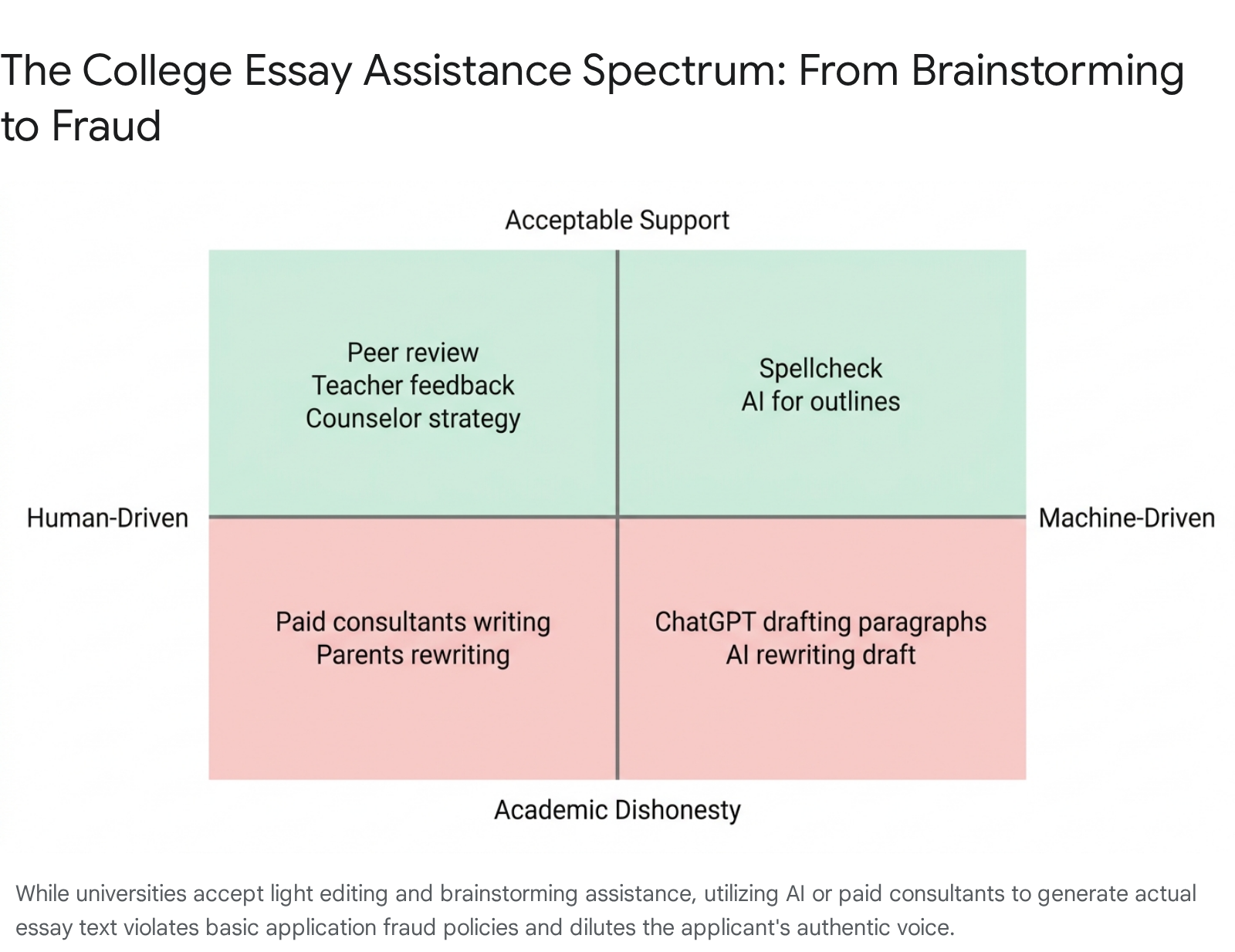
While commanding ChatGPT to write a personal statement from scratch is universally condemned by admissions offices, many higher education guidelines acknowledge that AI can be utilized ethically as a supplementary tool, functioning similarly to a calculator in a mathematics course or a spellchecker in a word processor.
Permitted uses generally include utilizing AI to brainstorm topics, generate idea lists, or help outline a structural flow to overcome initial writer's block 4346. Additionally, using AI tools strictly for grammar, spelling, and basic syntax checks (similar to the function of Grammarly) is widely accepted 43.
Conversely, prohibited uses involve instructing AI to write full paragraphs or complete drafts. Furthermore, relying on AI to heavily rewrite or "polish" a student's rough draft to the point where the phrasing, vocabulary, and syntax are no longer the student's own constitutes a breach of academic integrity 4345.
The Qualitative Failure of AI Essays
Even if a student decides to ignore the ethical implications and institutional bans, relying on generative AI to write a college essay is a remarkably poor strategic choice. Generative AI large language models are fundamentally trained to predict the most statistically probable sequence of words based on vast datasets 15.
Consequently, AI-generated essays represent the exact definition of statistical average. They are structurally sound, grammatically perfect, and entirely devoid of human soul 47. The Chronicle of Higher Education has pointed out that AI-generated essays actively obscure the real person behind the application 47. Because the models lack lived experience, they rely heavily on the exact clichés and abstract nouns - such as "passion," "determination," and "multifaceted" - that admissions officers actively despise.
An AI cannot capture the highly idiosyncratic, sensory details of a student's life. It cannot authentically describe the specific smell of a grandmother's kitchen, the exact self-deprecating thought a student had when they failed a driving test, or the precise tension in a room during a difficult conversation. In a holistic admissions process explicitly designed to identify unique human beings, outsourcing a personal voice to a machine guarantees that the applicant will sound indistinguishable from the masses.
In response to the difficulty of verifying authentic prose in the AI era, some institutions are altering their evaluation metrics. For instance, in 2024, Duke University's dean of undergraduate admissions announced that the school would stop assigning numerical ratings to essays, largely because the prose could no longer be assumed to reflect the applicant's own writing ability amidst the interference of AI and paid consultants. While the essays are still read carefully for content and context, they are no longer scored strictly for prose quality 48.
Common Clichés and Pitfalls to Avoid
Beyond the complexities of trauma narratives and the ethical pitfalls of artificial intelligence, applicants must actively dodge a series of structural and thematic clichés that reliably induce eye-rolls in admissions offices.
The Non-Profit and "Savior" Traps
Many highly ambitious students operate under the false assumption that starting a non-profit organization is a required golden ticket to elite admissions. Consequently, they rush to launch half-baked Instagram pages or highly localized charities in the fall of their senior year, purely to generate material for their essays 49.
Admissions officers see right through this tactic. Starting a non-profit solely to boost a resume reads as highly disingenuous, and the timing of a senior-year launch immediately raises suspicion 49. Furthermore, writing about short-term volunteer trips abroad frequently devolves into "saviorism" - where a student writes a patronizing, cliché-ridden essay about how helping the less fortunate made them realize how lucky they are to live in the United States 49.
Instead of relying on generic community service tropes, students are much better served writing about authentic, sustained, long-term commitments. A narrative about the pragmatic responsibilities learned while working a mundane part-time job or consistently babysitting younger siblings often reveals far more genuine character than a fabricated leadership role 49.
The Generic "Why Us" Supplement
Many colleges require a supplemental essay asking variants of the question: Why do you want to attend our university?
When answering these prompts, applicants must rigorously avoid generic flattery. Writing broad statements such as "Yale is a prestigious university with great professors and a beautiful campus" wastes valuable word count, as the exact same sentence could apply to dozens of competing institutions 50.
A strong supplemental essay requires deep, targeted research. Applicants should name specific professors they wish to study under, reference niche undergraduate research opportunities or specific laboratories, and explicitly connect the college's unique resources to their own demonstrated academic trajectory 505116.
Forcing Humor and Using Cliché Quotes
Humor is a highly subjective and volatile tool in writing. If a student is naturally funny in their daily life, they should feel free to let that humor surface in their short answers and essays 53. However, if an applicant is not naturally humorous, the college application is not the time to start experimenting with stand-up comedy.
Additionally, applicants should avoid opening their essays with famous quotes, particularly those that sound like they belong on a motivational poster. Cheesy truisms like "Life is what you make of it" or "Always follow your dreams" take up valuable space that should be used for the student's own original thoughts 53.
Finalizing the Narrative: A Step-by-Step Draft Checklist
Before finalizing the application and hitting the submit button, applicants should rigorously evaluate their final drafts against a checklist grounded in expert admissions guidance 231718:
- The "Nameless Floor" Test: If the essay was dropped on the floor of the applicant's high school without a name attached, would their friends immediately recognize who wrote it based purely on the tone and specific anecdotes? If not, the essay lacks specificity and an authentic voice 14.
- Word Count Adherence: Most primary personal statements, such as those on the Common Application, have a strict maximum limit of 650 words. Applicants should aim to be within 10% of the upper limit to fully utilize the allotted space without over-explaining. The editing phase should aggressively target unnecessary filler words, redundant adjectives, and excessive adverbs 2318.
- The Reflection Ratio: Ensure that at least 30% to 40% of the essay is dedicated to explicit reflection. A beautifully written narrative is useless if it does not eventually step back to explain how the events shaped the applicant's character, core values, and future outlook 23.
- Grammar and Syntax Precision: While the voice should be natural and conversational, glaring grammatical errors signal carelessness to the reader. The final review must check for correct verb tense consistency, appropriate punctuation, and the elimination of common homophone errors (such as their/there/they're) 17.
- The Prompt Alignment Check: Did the narrative actually answer the prompt? While many Common App prompts are broad enough to accommodate various stories, the applicant must ensure their narrative explicitly addresses the core question being asked, particularly in highly specific supplemental essays 17.
Bottom line
The college application essay occupies a highly specific and challenging genre of writing: it must be deeply personal yet professionally calibrated, highly narrative yet explicitly analytical. While an exceptional essay cannot salvage an uncompetitive academic transcript, it serves as the vital, humanizing tiebreaker in the holistic admissions process - a role that has only grown in importance following the end of affirmative action. Students optimize their chances by mining their authentic lived experiences using vivid "show, don't tell" techniques, rather than relying on the statistical mediocrity of generative AI, the sanitized prose of expensive consultants, or the sensationalism of trauma narratives. Ultimately, admissions officers are not seeking flawless literary masterpieces; they are searching for curious, self-aware, and authentic teenagers who will actively enrich their campus community.