
What Is Vacuum Decay and Could It Destroy the Universe
Vacuum decay is a theoretical cosmic event in which the underlying quantum fabric of our universe transitions to a lower, more stable energy state, initiating an expanding bubble of new physics that would fundamentally alter the laws of nature. If such a phase transition were to occur, this bubble would expand outward at the speed of light, instantly destroying all atoms, chemistry, and biological life caught in its path. However, while precise particle measurements suggest our universe is technically vulnerable to this phenomenon, calculations indicate the event is unfathomably rare and is not expected to happen for at least $10^{790}$ years.
The Meaning of "Nothing" in Quantum Physics
To understand how the universe could spontaneously self-destruct, one must first dismantle the classical understanding of "nothing." In everyday conversation, a vacuum is simply an empty space. If you were to take a theoretical box and remove all the matter, gas, dust, and light, you would seemingly be left with a perfect void. However, modern quantum field theory reveals that space is never truly empty 123.
Instead, the universe is permeated by a variety of quantum fields, each corresponding to different fundamental particles and forces 24. The vacuum of space is merely the lowest possible energy state of these interconnected fields 25. Because of Heisenberg's uncertainty principle - a foundational rule of quantum mechanics stating that you can never know both the exact energy and the exact duration of a system simultaneously - these fields are in a state of constant, microscopic fluctuation 26.
This relentless quantum activity means that "empty" space is actually humming with temporary, virtual particles that spontaneously pop in and out of existence 17. Consequently, the baseline energy of the vacuum is not absolute zero. It possesses a positive, inherent energy value known as zero-point energy 478. For the universe to remain stable, this baseline energy must remain perfectly constant. If the zero-point energy of a foundational quantum field were to suddenly drop, the fundamental structure of reality would change with it 4.
The Higgs Field and the Origin of Mass
Of all the quantum fields that fill the universe, the Brout-Englert-Higgs field (commonly referred to as the Higgs field) is the most critical to the concept of vacuum decay 5110. The Higgs field is an invisible energy matrix that gives mass to the universe's fundamental particles, such as the electrons and quarks that make up atoms, as well as the W and Z bosons that carry the weak nuclear force 12313.
Unlike every other known quantum field in the Standard Model of particle physics, the Higgs field is entirely unique because its default resting value is greater than zero 214. In the earliest, hottest fractions of a second following the Big Bang, all fields were highly energetic, and the fundamental forces were unified 1315. As the universe rapidly expanded and cooled, it underwent a series of phase transitions. During this cooling process, the Higgs field "froze" into a non-zero state - a phenomenon rooted in the groundbreaking theory of spontaneous symmetry breaking pioneered by Japanese physicist Yoichiro Nambu 1516.
Because the Higgs field settled at a non-zero value, it acts somewhat like a cosmic molasses. As elementary particles travel through space, they interact with the Higgs field's background energy (known as its vacuum expectation value, or VEV, which is approximately 246 GeV) and acquire mass through this interaction 51417.
If the Higgs field's setting were truly zero, the fundamental particles interacting with it would be entirely massless 214. Without mass, electrons would never bind to nuclei, atoms could not form, and particles would simply zip through the cosmos at the speed of light 21415. The existence of chemistry, planets, and biological life is entirely dependent on the Higgs field remaining exactly at its current value 118.
The Danger of a Temporary Resting Place
The existential threat of vacuum decay hinges on a single, terrifying question: Is the current 246 GeV setting of the Higgs field its final, absolute lowest energy state, or is it merely stuck in a temporary resting place?
When physicists discovered the physical manifestation of the Higgs field - the Higgs boson - at CERN's Large Hadron Collider (LHC) in 2012, it allowed them to finally measure the specific properties of the field 42021. By plugging the mass of the Higgs boson into the equations of the Standard Model, researchers began mapping the potential energy landscape of the universe. To their surprise, the math suggested that the current state of the Higgs field might not be the true bottom of the energy well 512.
If a deeper, lower-energy state exists, the laws of thermodynamics dictate that the universe will eventually try to reach it. Everything in nature prefers to exist in its lowest possible energy configuration 11022. The transition from our current state to that deeper state is what physicists call vacuum decay.
The False Vacuum vs. The True Vacuum
To communicate the precarious position of our universe, physicists frequently utilize the analogy of a ball rolling down a hilly landscape 131.
Imagine a heavy ball rolling down the side of a steep mountain. Halfway down the slope, the ball falls into a crater and gets stuck. From the perspective of the ball, its position is entirely stable. If a gentle breeze nudges the ball, it rolls slightly up the side of the crater, but gravity immediately pulls it back down to the center 371. In classical physics, as long as the ball does not receive a massive, concentrated kick of kinetic energy to push it up and over the crater's rim, it will stay in that exact spot forever.
However, despite this apparent stability, the ball has not actually reached the absolute bottom of the mountain 131. In mathematical physics, the crater is known as a local minimum of potential energy, whereas the valley floor at the very bottom of the mountain is the global minimum.
Applied to cosmology, the ball represents the energy state of the Higgs field 3110.
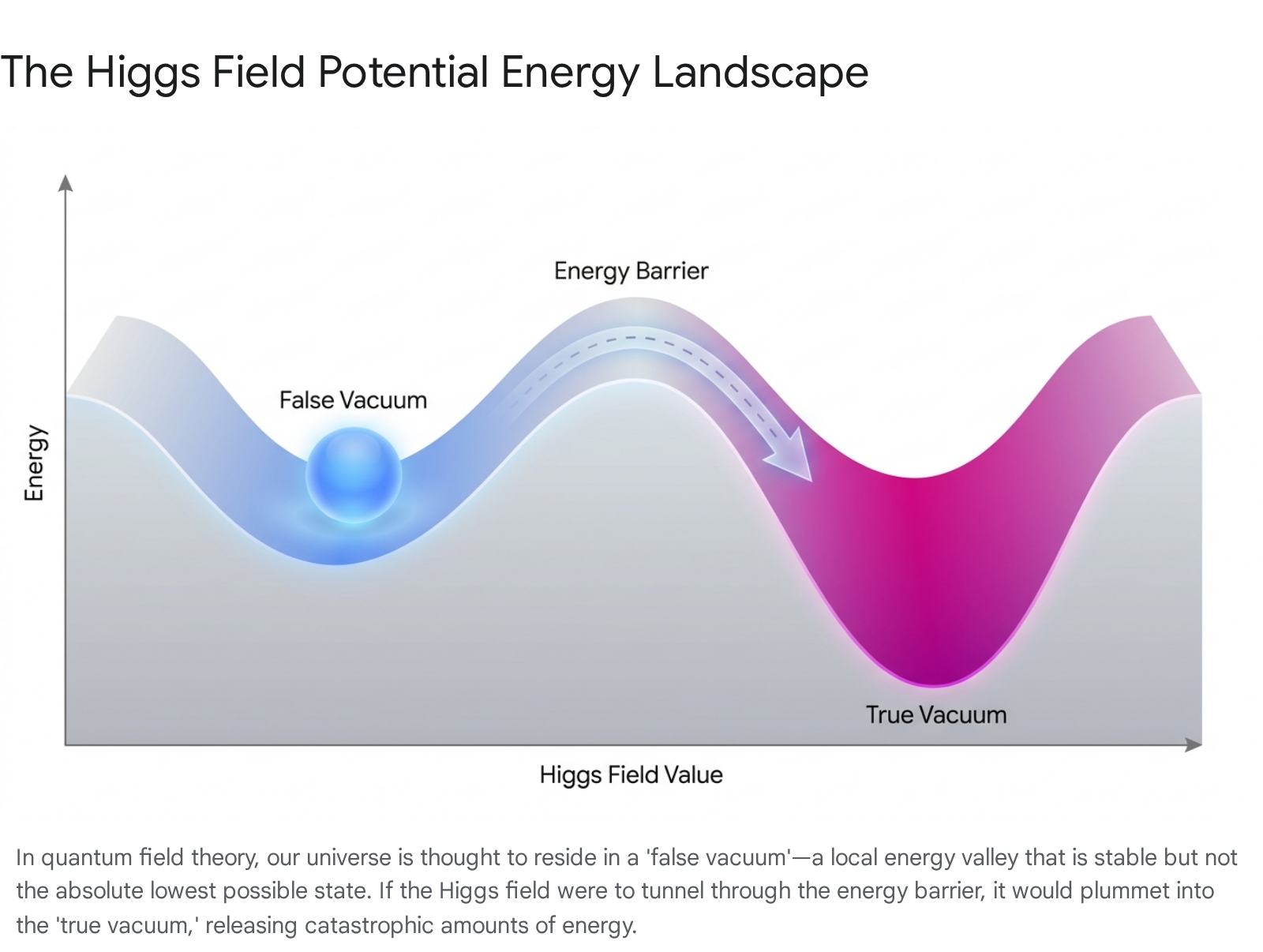
- True Vacuum: If the Higgs field is resting at the absolute global minimum of its potential energy curve, the universe is considered to be in a "true vacuum." This is a perfectly stable, final configuration that will never change, as there is nowhere lower for the energy to fall 41723.
- False Vacuum: If the Higgs field is resting in a local minimum - like the ball trapped in the crater - the universe is in a "false vacuum." It appears perfectly stable and has successfully supported cosmic structures for nearly 13.8 billion years, but a deeper, more stable reality mathematically exists 411723. This precarious condition is known as being metastable 12324.
Current experimental evidence, derived from the precise measurements of fundamental particles at the LHC, strongly implies that our universe is currently sitting in a false vacuum 351.
Comparing Vacuum States
The differences between our current state and a potential true vacuum are absolute. A transition from one to the other would not merely alter the contents of the universe; it would comprehensively rewrite the fundamental physical laws that govern it.
| Cosmic Characteristic | False Vacuum (Our Current Universe) | True Vacuum (Hypothetical End State) |
|---|---|---|
| Energy Level | Local minimum; contains a specific, non-zero baseline energy (zero-point energy). 723 | Global minimum; the absolute lowest possible energy state for the quantum fields. 1723 |
| Stability Status | Metastable. Appears stable over billions of years, but vulnerable to quantum tunneling or high-energy triggers. 7123 | Absolutely stable. The final mathematical state of the field; no further decay is possible. 417 |
| Higgs Field Effect | Provides standard mass to fundamental particles (electrons, quarks) allowing for atoms, chemistry, and life. 1214 | Radically altered Higgs value. Elementary particles would become immensely heavier or behave entirely differently. 218 |
| Cosmic Structure | Supports complex baryonic structures: stars, galaxies, planets, and biological organisms. 118 | Incompatible with standard matter. Atoms would instantly collapse under altered gravitational and electromagnetic balances. 223 |
The Cosmic Tug-of-War: The Higgs vs. The Top Quark
For physicists to know definitively whether we are living in a false vacuum or a true vacuum, they must map the precise shape of the Higgs field's potential energy curve (often described visually as a "Mexican hat" potential) 52. The curvature, depth, and overall stability of this mathematical landscape are strictly determined by the masses of the universe's fundamental particles 525.
Specifically, the stability of the electroweak vacuum is locked in a quantum tug-of-war between the Higgs boson itself and the top quark, which is the heaviest known elementary particle in the Standard Model 525.
The quantum interactions between these two particles dictate the shape of the energy barrier holding our universe together. The Higgs boson's self-interaction effectively pushes the brim of the energy potential "upward," promoting absolute cosmic stability. Conversely, the top quark, because of its immense mass, exerts a downward mathematical pressure on the potential energy curve, dragging the universe toward instability 5.
If the top quark were relatively light, the vacuum would be absolutely stable. If the top quark were exceedingly heavy, the vacuum would be violently unstable, and the universe would have collapsed immediately after the Big Bang. However, if the masses sit in a highly specific, narrow middle ground, the vacuum is metastable - a false vacuum with an incredibly long, but finite, lifespan 523.
Precision Measurements at the Large Hadron Collider
Over the past decade, the ATLAS and CMS experiments at CERN have dedicated immense resources to refining the measurements of both particles 53420. Through the collision of protons at 13.6 to 14 tera-electron volts, physicists have collected vast datasets to narrow down the exact physical constants 32026.
Recent combinations of ATLAS and CMS data show that the mass of the Higgs boson is approximately $125.11 \pm 0.11$ GeV 427. Meanwhile, comprehensive measurements of the top quark place its mass at roughly $172.52$ GeV 528.
When theoretical physicists plug these highly specific, updated numbers into Standard Model equations, the result lands the universe squarely on the boundary line between stability and metastability, leaning strongly toward the metastable (false vacuum) side 172329. This delicate mathematical balance suggests that a deeper, true vacuum state almost certainly exists at much higher energy scales, separated from our reality by a finite energy barrier 228.
What Triggers Vacuum Decay?
If the universe is indeed trapped in a false vacuum, how could it ever transition to a true vacuum? The energy barrier - the metaphorical "crater wall" holding the Higgs field in its current state - is immensely high 11030.
To push the field over this barrier in a classical sense, an unimaginable amount of energy would need to be concentrated into an infinitesimally small volume of space 131. Calculations suggest no known natural astrophysical process, not even the most violent supernovae or supermassive black hole mergers, can generate this localized energy density 13031.
However, the Higgs field is governed by the laws of quantum mechanics, not classical physics 117.
The Threat of Quantum Tunneling
In the quantum realm, a particle (or a fundamental field) does not necessarily need the required kinetic energy to physically climb over an energy barrier. Due to the inherent probabilistic nature of quantum mechanics, a system can spontaneously "tunnel" right through the barrier to a lower energy state 1217.
If the Higgs field were to undergo quantum tunneling, a microscopic point in space would suddenly drop through the energy barrier into the true vacuum state 11718. This event is entirely probabilistic and acausal. It does not require a physical trigger or a localized energy spike; it is a random quantum fluctuation that can occur at any point in spacetime, akin to the unpredictable radioactive decay of a single atom 732.
Primordial Black Holes as Theoretical Catalysts
While spontaneous quantum tunneling is the baseline threat, some astrophysicists theorize that specific, extreme cosmic environments could act as catalysts to speed up the process. Theoretical calculations indicate that a primordial black hole - a hypothetical type of microscopic black hole forged in the dense, chaotic moments immediately following the Big Bang - could locally amplify quantum fluctuations 232933.
The intense gravitational gradients and Hawking radiation near the event horizon of a microscopic black hole could dramatically lower the energy barrier, acting as a "seed" to nucleate a vacuum decay event 22333. By depositing energy at localized spots in the thermal plasma, these black holes could create hot spots that act as the foundation for false vacuum decay 2.
However, the fact that the universe has survived for 13.8 billion years places a severe constraint on this theory. If primordial black holes routinely triggered vacuum decay, the universe would have already destroyed itself long before stars and galaxies could form 33.
The Mechanics of Bubble Nucleation
If a quantum tunneling event does occur, it initiates a process known in phase-transition physics as bubble nucleation 171823.
To conceptualize this, think of a pot of boiling water. When water reaches a critical temperature, it undergoes a phase transition from liquid to gas. This transition doesn't happen everywhere in the pot all at once; it starts with tiny, localized bubbles of water vapor forming at the bottom, which then expand upward into their surroundings 1824.
Vacuum decay would operate on a similar mechanical principle. If a microscopic point in space drops into the true vacuum, it creates a "bubble" of the new energy state 171824. Because the true vacuum is at a much lower, more energetically favorable state than the surrounding false vacuum, the interior of the bubble asserts a tremendous pressure outward against the false vacuum 1823.
The Speed-of-Light Expansion
Once nucleated, the bubble wall will accelerate outward, driven by the vast difference in potential energy between the true and false vacuums 2334. Within microscopic fractions of a second, the bubble's expansion will approach the speed of light 21723.
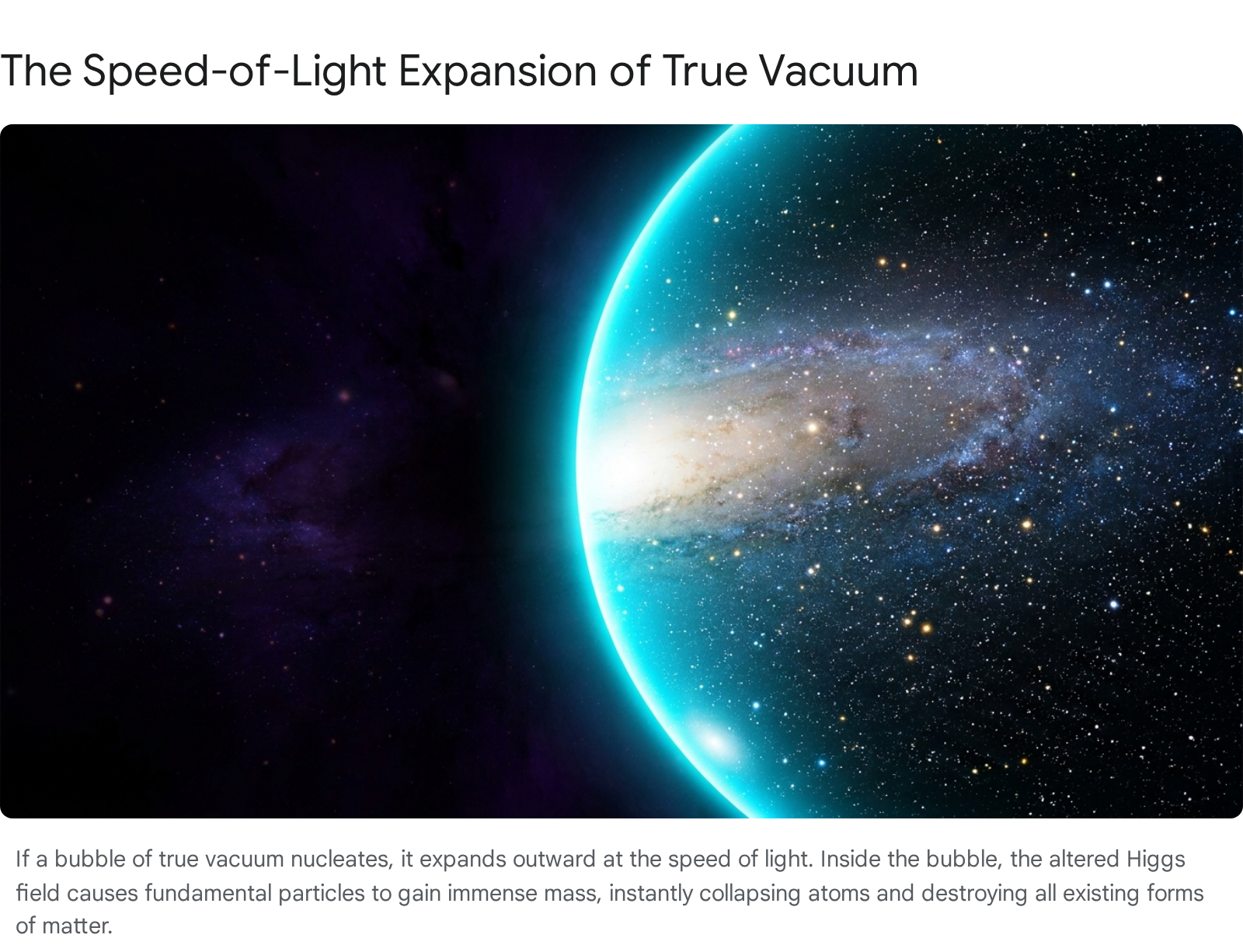
Because the bubble expands at light speed, there can be no advance warning of its approach. No signal, no flash of light, and no gravitational wave can outrun the bubble's perimeter to alert observers 17. For an observer situated in the path of a vacuum decay bubble, the very first indication that the event has occurred would be the exact moment of their obliteration 117.
What Happens Inside the True Vacuum?
The destruction caused by vacuum decay is not an explosion in the traditional sense; it is an ontological erasure of reality as we know it. As the boundary of the bubble sweeps through a solar system or a galaxy, the immense latent energy released by the decaying Higgs field acts like a wall of incineration, bathing the interior in a super-heated plasma of particles 18. But the thermal destruction is arguably the least of the universe's problems.
Inside the bubble, the foundational rules of physics change instantly 118. The vacuum expectation value of the Higgs field would drop to a new depth, fundamentally altering how it interacts with other fields and particles.
Based on current models, if the Higgs field fell to a lower energy state, fundamental particles like electrons and quarks would become vastly heavier 218.
The Collapse of Chemistry and Structure
This sudden shift in particle mass would have immediate and catastrophic consequences for all organized matter:
- The collapse of atoms: In standard physics, the radius of an electron's orbit around an atomic nucleus is inversely proportional to its mass 14. If electrons suddenly become immensely heavy, their orbits would shrink drastically, spiraling tightly into the nucleus.
- The end of chemistry: The delicate balance of electromagnetic forces that allow atoms to bond into molecules would be utterly shattered 123. DNA, proteins, water, and stellar plasma would instantly disintegrate into disjointed subatomic particles.
- Gravitational dominion: With fundamental particles becoming drastically heavier, they would be drawn together by gravity far more strongly than the other fundamental forces could hold them apart 2.
The resulting universe inside the bubble would be a bizarre, unrecognizable realm. Some mathematical models suggest the resulting gravitational imbalance could cause the universe inside the bubble to almost immediately undergo complete gravitational collapse, folding back on itself in a microscopic fraction of a second 23. In any scenario, life, biology, chemistry, and even stars as we know them would be physically impossible 123.
Timeline: When Will the Universe Decay?
If the universe is indeed metastable, the immediate question is: when will it decay?
Because the energy barrier holding the false vacuum in place is so astronomically large, the probability of quantum tunneling occurring in any given volume of space is vanishingly small 1135. The universe's sheer vastness gives it a long lease on life.
Historically, the estimated timeline for vacuum decay was generally cited as an unfathomable $10^{100}$ to $10^{139}$ years in the future 16. However, the precision of these calculations relies heavily on cutting-edge theoretical physics, and they are frequently updated as physicists refine their understanding of quantum field interactions.
The 2024 Calculation Update
In recent years, physicists attempted the most direct calculations yet regarding the rate of quantum tunneling required to trigger a bubble nucleation 2. Previous consensus held that a cubic gigaparsec of space would experience a spontaneous vacuum decay event once every $10^{794}$ years 237.
In 2024, a team of theoretical physicists published a slight correction to this math, carefully adjusting the contribution of gauge fields to the tunneling rate 232. This 7% mathematical correction to the gauge fields effectively reduced the estimated lifespan of the false vacuum by a factor of 10,000, bringing the new estimate down to $10^{790}$ years 237.
To put this number into perspective, our universe has existed for roughly 13.8 billion years, or about $1.38 \times 10^{10}$ years 230. The time required for vacuum decay to occur is so astronomically far into the future that all the stars will have burned out, all galaxies will have drifted apart, and even supermassive black holes will have evaporated via Hawking radiation long before a bubble nucleates.
As the authors of the 2024 paper cheekily noted in their conclusion, "The SM [Standard Model] vacuum lifetime remains longer than the current age of the universe, and there is no occasion for anxiety" 326.
Dark Energy: The Universe's Built-In Defense Mechanism
Even if the impossibly rare event of a vacuum decay bubble nucleating were to happen somewhere in the distant cosmos tomorrow, humanity would likely remain perfectly safe due to a different cosmological phenomenon: dark energy 1038.
The universe is not static; it is expanding, and the rate of that expansion is accelerating due to dark energy 838. Because of this metric expansion of space, vast regions of the cosmos are receding from each other at speeds faster than the speed of light 1038.
If a vacuum decay bubble were to nucleate in a region of the universe that is already receding from us faster than light, the bubble could never physically reach us. Even though the bubble wall expands at the speed of light, the space between our galaxy and the bubble is stretching faster than the bubble can traverse it 1038. Therefore, the destructive wave would be permanently isolated beyond our cosmic event horizon, unable to catch up to our local galactic neighborhood 38.
Could Human Technology Trigger the Apocalypse?
Whenever new, powerful particle accelerators are built, public anxiety flares regarding the possibility that scientists might accidentally trigger an apocalyptic event 2339. The concern is that by smashing protons together at unprecedented energies inside machines like the Large Hadron Collider (LHC), physicists might inadvertently concentrate enough energy into a microscopic point to kick the Higgs field over its energy barrier and initiate vacuum decay artificially 293039.
This fear is entirely unfounded, largely due to a simple reality check provided by the cosmos itself 839.
While the LHC achieves collision energies of roughly 13.6 to 14 tera-electron volts ($14 \times 10^{12}$ eV), nature has been conducting far more violent experiments for billions of years 202326. Ultra-high-energy cosmic rays - heavy atomic nuclei expelled by supermassive black holes and supernovae - strike the Earth's atmosphere constantly 2939. We have observed cosmic ray collisions at and beyond energies of $5 \times 10^{19}$ eV, which is millions of times more powerful than anything the LHC can produce, easily surpassing the theoretical Greisen - Zatsepin - Kuzmin limit 82330.
Given the vastness of space and the density of the early universe, an incalculable number of these natural high-energy collisions have occurred over the last 13.8 billion years. If smashing particles together at these energies could induce vacuum decay, the universe would have ended billions of years ago 82930. To artificially trigger vacuum decay, physicists estimate that humanity would need to construct a particle accelerator roughly the size of our entire galaxy 30.
The 2025 Expert Consensus on Artificial Induction
To gauge the scientific consensus on this existential risk, a 2025 survey queried 20 leading physicists specializing in quantum field theory and cosmology 3135. The survey sought to determine whether an arbitrarily advanced, futuristic technological civilization (possessing galactic-scale resources) could intentionally induce vacuum decay. The results highlighted both the theoretical uncertainties and the practical impossibilities of artificial vacuum decay:
- The experts estimated an average probability of 45.6% that the universe's vacuum is indeed metastable 3135.
- When asked if an advanced technological civilization could artificially induce vacuum decay, 55% of the experts answered with a 0% probability 3135.
The experts reasoned that if vacuum decay could be technologically induced, the sheer statistical probability of advanced alien civilizations existing over cosmic history implies someone would have already done it by now (a cosmological extension of the Fermi Paradox) 3133. Furthermore, many experts argued that the energy scale required to destabilize the Higgs vacuum is simply prohibited by the fundamental laws of quantum field theory, meaning experiments can only act locally and cannot unravel the global field 3135.
Bringing Vacuum Decay into the Laboratory
While we cannot - and should not want to - test vacuum decay on a cosmological scale, experimental physicists have recently begun simulating the mechanics of false vacuum decay using terrestrial analogues. These experiments do not involve the Higgs field and pose zero threat to reality; instead, they use specialized materials to mimic the complex mathematics of bubble nucleation in phase transitions 633.
In 2024, an international team including researchers from Newcastle University and Italy provided the first experimental evidence of vacuum decay dynamics 624. They utilized a supercooled vapor of magnetic atoms, chilled to less than a microkelvin (one millionth of a degree) above absolute zero 624. At this extreme temperature, the gas entered a metastable state. The researchers observed that thermal and quantum fluctuations caused tiny "bubbles" of a lower-energy magnetic state to nucleate and expand through the gas, perfectly mirroring the theoretical models of cosmological false vacuum decay 62433.
Similarly, in 2026, a team of Chinese physicists successfully used a highly controllable quantum simulator to model the event 40. By arranging a ring of mutually repulsive Rydberg atoms and illuminating them with site-selective laser beams, the researchers engineered a custom energy landscape containing distinct "true" and "false" vacuum states 40. This setup allowed them to watch the quantum tunneling process unfold in real-time, observing how stronger symmetry-breaking lasers accelerated the decay rate 40.
These analogue experiments are highly valuable to theoretical physics. By confirming that bubble nucleation behaves exactly as predicted in isolated quantum systems, physicists gain crucial confidence in the mathematical models they use to study the Big Bang, cosmic inflation, and the ultimate fate of the universe 624.
Vacuum Decay in Popular Culture
Because of its apocalyptic, inescapable nature, vacuum decay has captured the imagination of science fiction writers, serving as the ultimate cosmic threat. The most prominent example is the hard science fiction novel Schild's Ladder by Australian author Greg Egan 414243.
Published in 2002, the novel imagines a future where humanity has seemingly solved physics and routinely runs experiments in perfectly isolated vacuum environments 4344. During an experiment to test quantum graph theory, a researcher inadvertently triggers a vacuum decay event, creating a stable "novovacuum" that expands at half the speed of light, swallowing star systems and erasing known physics 424445. The novel explores the philosophical and physical implications of humanity fleeing a threat that fundamentally rewrites reality 4245. While fiction takes creative liberties with the expansion speed (halving the speed of light to allow for a narrative escape), it accurately reflects the profound existential horror and scientific fascination that vacuum decay inspires 4345.
Bottom Line
Vacuum decay is a mathematically sound hypothesis rooted in quantum field theory, suggesting that the energy fields defining our universe are resting in a temporary, "false" state of stability. If the Higgs field were to undergo a random quantum tunneling event, it would drop to a "true" vacuum, triggering an expanding bubble of new physics that would annihilate atoms, chemistry, and life as we know it at the speed of light. However, humanity has no cause for alarm. Current measurements of particle masses place the universe's lifespan at an incomprehensible $10^{790}$ years, and human technology is fundamentally incapable of generating the energies required to accidentally trigger such an event.