
Casimir effect and quantum vacuum fluctuations
The Casimir effect represents a macroscopic mechanical manifestation of quantum field theory, serving as primary evidence for the physical reality of zero-point energy and vacuum fluctuations. First proposed by Dutch physicist Hendrik Casimir in 1948, the effect describes an attractive force that arises between two uncharged, perfectly conducting parallel plates placed in a vacuum 1. While classical electrodynamics predicts an absence of electromagnetic forces between neutral boundaries, the quantization of the electromagnetic field dictates that a vacuum is never truly empty. Instead, space is permeated by a turbulent spectrum of virtual particles and fluctuating fields 12.
By imposing boundary conditions on these fields, physical objects alter the local energy density of the vacuum 1. This alteration generates measurable radiation pressure differentials, pushing objects together or pulling them apart depending on their geometry and dielectric properties 33. Over the ensuing decades, research has expanded the classical parallel-plate paradigm to encompass atom-surface interactions, lateral forces on corrugated surfaces, rotational torques in birefringent media, and the conversion of vacuum fluctuations into real photons via the dynamical Casimir effect 1456. Today, the phenomenon intersects applied physics, micro-engineering, and theoretical cosmology, posing critical challenges to the stability of nanomechanical devices while offering a laboratory to test deviations from Newtonian gravity and probe the nature of dark energy 789.
Quantum Vacuum and Zero-Point Energy
Quantization of the Electromagnetic Field
The theoretical foundation of the Casimir effect lies in the quantization of the electromagnetic field. In quantum field theory, a field is not a continuous, classical entity but a system mathematically equivalent to an infinite collection of harmonic oscillators 1. Each oscillator corresponds to a specific mode or wavelength of the electromagnetic field. According to the Heisenberg uncertainty principle, a quantum harmonic oscillator cannot remain perfectly at rest at the bottom of its potential well; it must possess a minimum, non-zero ground state energy 1.
This minimum energy is defined as $\frac{1}{2}\hbar\omega$, where $\hbar$ is the reduced Planck constant and $\omega$ is the angular frequency of the specific mode 1. Integrating this zero-point energy across all possible frequencies in an unbounded vacuum yields an infinite total energy density. However, because observable physical effects depend solely on changes or differences in energy rather than absolute infinite values, this background energy can be theoretically renormalized. The physical vacuum is thus understood not as an empty void, but as a dynamic medium characterized by continuous, spontaneous fluctuations of electromagnetic waves 111.
Cavity Mode Restriction and Pressure Differentials
When macroscopic material interfaces - such as ideal metallic plates - are introduced into this fluctuating vacuum, they act as boundaries that constrain the behavior of the electromagnetic field. The presence of these conductors forces the transverse component of the electric field to vanish at the boundary surfaces 1011. Consequently, the field between the plates cannot sustain arbitrary wavelengths. It can only support standing wave modes where an integer multiple of half a wavelength precisely matches the separation distance between the boundaries 12.
A visual conceptualization of this phenomenon reveals the space outside the plates as filled with a full, continuous spectrum of electromagnetic sine waves, representing unconstrained vacuum fluctuations. In stark contrast, the narrow space between the parallel plates contains only specific standing waves - those whose wavelengths precisely fit within the boundaries of the cavity. This spatial constraint excludes a significant portion of the fluctuation spectrum, creating a pressure differential that manifests as a net inward force, physically driving the plates together 33. The vacuum expectation value of the energy of the second-quantized electromagnetic field is directly altered by the shapes and positions of these macroscopic boundaries 1.
Derivation of the Macroscopic Force
Hendrik Casimir's original 1948 calculation provided a precise analytical formula for the attractive force per unit area (pressure) between two perfectly conducting, infinitely large parallel plates at zero temperature 13. The Casimir pressure $P_c$ is entirely independent of the fundamental charge or mass of particles; it relies exclusively on the separation distance $d$, the speed of light $c$, and the Planck constant $h$ (or $\hbar$):
$P_c = -\frac{\pi^2 \hbar c}{240 d^4}$
The negative sign indicates that the force is attractive 1314. The magnitude of this force scales aggressively, increasing inversely with the fourth power of the separation distance 3. Because of the $1/d^4$ scaling, the force is virtually imperceptible at macroscopic distances. However, at submicron scales, it becomes a dominant mechanical interaction. At a separation of 10 nanometers, the Casimir force exerts a pressure of approximately 1 atmosphere (101.3 kPa) 8.
Lifshitz Theory and Dispersion Forces
Retardation and the Transition from van der Waals Forces
The interaction between neutral bodies is broadly categorized under dispersion forces, which arise from quantum fluctuations of charge distribution. At extremely short ranges (typically a few angstroms to a few nanometers), the interaction is governed by the London-van der Waals force 115. This force relies on instantaneous dipole-dipole interactions, where a spontaneous fluctuation in the electron cloud of one atom induces a corresponding polarization in a neighboring atom, creating an attractive potential that scales as $1/d^3$ for atom-surface geometries 15.
However, when the separation distance increases, the finite speed of light becomes a critical factor. By the time the electromagnetic field generated by a fluctuating dipole traverses the gap to a second atom or macroscopic boundary and returns, the original dipole has changed its orientation 12. This retardation effect weakens the correlation between the dipoles. Casimir, working with Dirk Polder, mathematically demonstrated that accounting for this retardation shifts the scaling law of the force. The non-retarded van der Waals interaction transitions smoothly into the fully retarded Casimir-Polder force, scaling as $1/d^4$ at distances roughly beyond 5 to 100 nanometers 11315.
Lifshitz Unification and Dielectric Permittivities
In 1956, Evgeny Lifshitz formalized a generalized theory that unified the van der Waals, Casimir, and Casimir-Polder forces into a single theoretical framework 1619. Unlike Casimir's idealized model involving perfect conductors at absolute zero, Lifshitz theory models the macroscopic bodies and the intervening medium based on their complex, frequency-dependent dielectric permittivities and magnetic permeabilities 316.
The Lifshitz equation relies on integrating the reflection coefficients of the transverse electric (TE) and transverse magnetic (TM) modes over imaginary frequencies (Matsubara frequencies) 1617. This approach accounts for the exact optical properties of real materials, acknowledging that physical metals are not perfect reflectors but possess finite conductivity and become transparent at frequencies exceeding their plasma frequency 1318. The theory accommodates the presence of any fluid or dielectric medium between the plates, allowing for the accurate prediction of force magnitudes in experimental setups far more complex than a perfect vacuum 2223.
| Force Variant | Interaction Geometry | Fundamental Distance Scaling | Dominant Physical Mechanism |
|---|---|---|---|
| van der Waals Force | Atom-Atom / Atom-Plate | $1/d^3$ | Non-retarded, instantaneous dipole fluctuation coupling |
| Casimir-Polder Force | Atom-Macroscopic Plate | $1/d^4$ | Retarded dipole fluctuation coupling |
| Casimir Force | Plate-Plate (Macroscopic) | $1/d^4$ | Global restriction of electromagnetic vacuum modes |
| Lateral Casimir Force | Corrugated Grating Surfaces | Phase-dependent | Broken transverse translational symmetry |
The Role of Thermal Fluctuations
At non-zero temperatures, thermal fluctuations of the electromagnetic field coexist alongside quantum zero-point fluctuations. While zero-point fluctuations dominate the total force at very small separation distances, the thermal component becomes the primary driver of the Casimir interaction at larger separations, typically on the order of micrometers 19.
The characteristic thermal wavelength $\lambda_T = \hbar c / k_B T$ dictates this transition. When the separation $d$ between boundaries substantially exceeds $\lambda_T$, the influence of the zero-point vacuum modes diminishes relative to the background blackbody radiation spectrum 1219. This results in an enhancement of the radiation pressure. For example, theoretical models indicate that the Casimir force between two plane mirrors separated by 7 $\mu$m is roughly twice as strong at room temperature as it would be at absolute zero 12. Accounting for these thermodynamic contributions is necessary for establishing rigorous agreement between theory and precision metrology at micrometer scales 7.
Experimental Metrology of Static Forces
Historical Measurements and Metrological Challenges
The exact measurement of the Casimir force presents immense technical challenges. A configuration of two flat, parallel macroscopic plates requires perfect angular alignment; any slight tilt (on the order of microradians) introduces systematic errors that dwarf the actual force due to the extreme $1/d^4$ scaling 1220. For decades, experiments yielded only qualitative confirmation of the phenomenon 312.
To bypass the parallelism constraint, researchers frequently substitute one flat plate with a macroscopic sphere or spherical lens. Provided the radius of the sphere is much larger than the separation distance, the proximity force approximation (PFA) can be applied to map the theoretical parallel-plate equations to the sphere-plate geometry 1012.
In 1997, Steven K. Lamoreaux achieved a critical milestone by directly measuring the Casimir force between a spherical lens and a flat plate using a highly sensitive torsion balance 1. Lamoreaux quantified the force to within 5% of theoretical predictions 1. Soon after, Umar Mohideen and colleagues, as well as teams led by Ricardo Decca and Ho Bun Chan, utilized atomic force microscopy (AFM) and micromechanical torsional oscillators to further refine these measurements 1318. Decca's utilization of a microelectromechanical torsional oscillator achieved absolute errors of less than 0.6 mPa, reducing the total experimental uncertainty to 0.2% at a separation of 160 nanometers 1821.
Systematic Errors and the Conductivity Controversy
As experimental precision improved, subtle discrepancies between measured data and theoretical models emerged, highlighting the complexity of real-world materials. Corrections must be applied for surface roughness, which significantly alters the boundary profiles at sub-100 nm separations, and finite skin depth, which accounts for the penetration of high-frequency field modes into the metal 131822.
A significant controversy within Casimir physics concerns the theoretical treatment of the low-frequency dielectric response (dc conductivity) of materials, particularly dielectrics and real metals at non-zero temperatures 116. Utilizing the Drude model - which accounts for the relaxation of conduction electrons - often leads to predictions that conflict with experimental data at larger separations 1618. Conversely, utilizing a plasma model - which ignores electron relaxation at low frequencies - appears to fit experimental measurements better but violates certain thermodynamic principles, such as the Nernst heat theorem 1621. This inconsistency, often referred to as the Casimir conundrum, indicates that the macroscopic models of dielectric permittivity utilized in Lifshitz theory may be incomplete or misapplied when calculating the thermal contributions of the transverse electric (TE) zero-frequency modes 16.
Ultracold Atoms and Bose-Einstein Condensates
Atom-Surface Interaction Regimes
The measurement of the Casimir-Polder force - the interaction between a neutral atom and a macroscopic boundary - offers an alternative pathway to explore dispersion forces while avoiding the complexities of patch potentials and bulk material alignment 715. Early experiments utilized thermal atomic beams deflected by micromachined cavities to measure these forces at submicron distances 2122. However, the advent of laser-cooled atoms and Bose-Einstein condensates (BECs) revolutionized the precision and range of these experiments 1522.
A BEC provides a macroscopic quantum ensemble of atoms occupying the same ground state, characterized by extreme sensitivity to external potentials 7. By observing the mechanical behavior of a trapped condensate in close proximity to a surface, physicists can map the spatial variations in the vacuum field's energy density with extraordinary resolution 719.
Out-of-Equilibrium Thermal Measurements at JILA
A definitive measurement of the thermal Casimir-Polder force was conducted by Eric Cornell's research group at JILA. The team generated a nearly pure BEC consisting of approximately 250,000 magnetically trapped $^{87}$Rb atoms 715. The condensate was positioned a few micrometers away from a fused silica dielectric substrate 715.
The experimental technique involved exciting the dipole oscillation (center-of-mass motion) of the condensate perpendicular to the surface. As the atoms oscillated, the spatial gradient of the Casimir-Polder potential altered the trap's effective stiffness, inducing a measurable shift in the oscillation frequency 715. Because the JILA team could position the atoms at distances ranging from 5 to 15 $\mu$m, they operated in a regime where thermal fluctuations eclipse purely quantum zero-point fluctuations 15.
Crucially, the experiment was designed to operate in thermal nonequilibrium. The researchers heated the fused silica substrate to varied temperatures up to 605 K, while maintaining the surrounding vacuum environment near room temperature (310 K) 719. The measurement demonstrated that the attractive Casimir-Polder force generated by a 605 K substrate was nearly three times larger than that generated by a 310 K substrate 7. The precise measurement of this fractional frequency shift provided the first empirical confirmation of the out-of-equilibrium thermal corrections to Lifshitz theory 1923.
Furthermore, the $^{87}$Rb BEC data provided a stringent test for the competing dielectric response models. The experimental force values matched theoretical calculations that explicitly disregarded the dc conductivity of the fused silica substrate, allowing researchers to exclude the conductivity-inclusive models with high statistical confidence 1621. The precision of these frequency shift measurements also served to place strict upper limits on the existence of hypothetical short-range non-Newtonian gravitational forces 15.
Repulsion and Levitation Dynamics
Refractive Index Manipulation in Fluids
In idealized vacuum environments featuring perfect conductors, the static Casimir force is strictly attractive 13. However, the Lifshitz framework predicts that interactions can become repulsive when an intermediate dielectric medium separates the boundaries, provided specific permittivity criteria are met 2223.
For repulsion to manifest, the dielectric response functions ($\epsilon$) of the interacting objects (Material 1 and Material 2) and the intervening medium (Medium 3) must satisfy the condition $\epsilon_1 < \epsilon_3 < \epsilon_2$ over a broad and dominant range of electromagnetic frequencies 2223. Because the reflection coefficients at the boundaries exhibit opposite signs when this condition is satisfied, the zero-point energy of the system increases as the boundaries approach, yielding a net repulsive force 817.
In 2009, Jeremy N. Munday, Federico Capasso, and V. Adrian Parsegian provided the first direct experimental verification of this long-range Casimir-Lifshitz repulsion 22. Employing an atomic force microscope, they measured the interaction between a gold sphere and a silica plate immersed in liquid bromobenzene 22. The refractive index of bromobenzene is higher than that of silica but lower than that of gold across a critical spectrum of frequencies 1023. The resulting measurement demonstrated a definitive repulsive force at distances ranging from 20 nm to over 100 nm 22.
While the magnitude of the repulsive force is notably weaker than the attractive force measured between two gold surfaces in the same fluid, it increases steadily as the separation distance decreases 22.
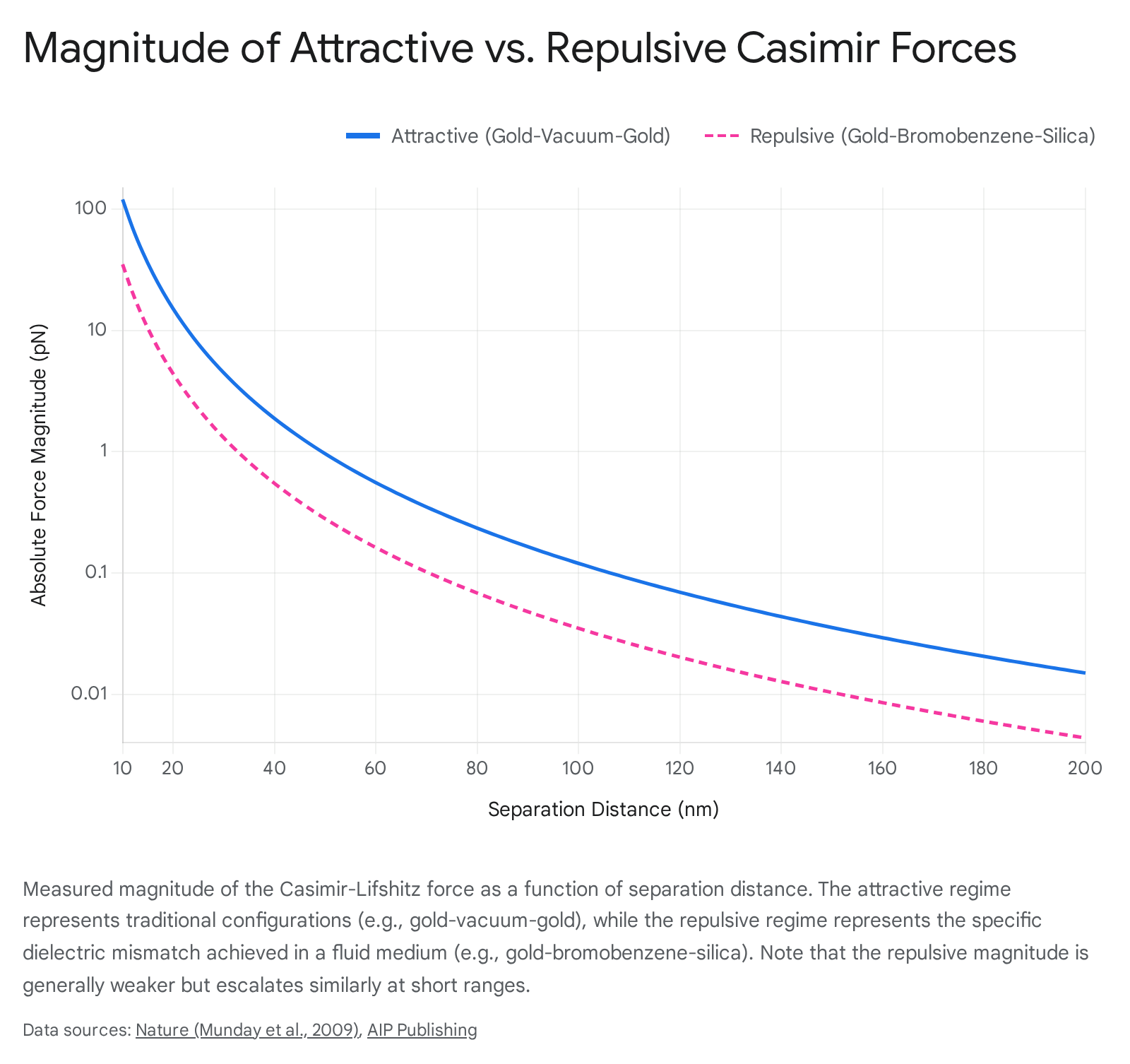
This capability to engineer the sign of the quantum vacuum interaction opens pathways for quantum levitation, where repulsive Casimir forces balance against gravitational or electrostatic forces to suspend nanomechanical components without friction 82224.
Active Tuning via Ferrofluids
Recent advancements have demonstrated that the sign of the Casimir force can be actively modulated without altering the physical components of the system. In 2024, researchers from the Chinese Academy of Sciences reported the dynamic tuning of the Casimir force utilizing a magnetic field 2531.
The experimental framework utilized a ferrofluid - a colloidal suspension of nanoscale magnetic particles - as the intermediate medium between a gold sphere and a silicon dioxide substrate 2531. The application of an external magnetic field altered the orientation and density of the magnetic nanoparticles, dynamically modulating the macroscopic dielectric permittivity and magnetic permeability of the ferrofluid 2531. The research demonstrated a reversible, in-situ transition from Casimir attraction to Casimir repulsion 25. This breakthrough establishes a mechanism for the active control of vacuum forces, highly relevant for the operation of adaptive micro-switches and sensors.
Geometry and Broken Symmetry
Lateral Forces on Corrugated Surfaces
When the boundaries constraining the electromagnetic vacuum are perfectly flat and parallel, the Casimir force acts strictly normal (perpendicular) to the surfaces 26. However, introducing topological asymmetry to the boundaries alters the spatial distribution of the zero-point energy, resulting in lateral forces parallel to the surface planes 19.
This phenomenon was empirically demonstrated by aligning two surfaces - a sphere and a flat plate - imprinted with periodic nanoscale sinusoidal corrugations 627. As the corrugations are displaced relative to one another in the transverse direction, the local separation distance fluctuates, inducing a phase-dependent lateral Casimir force 6. Advanced iterations of this experiment utilized on-chip detection platforms to measure the lateral forces between interpenetrating rectangular silicon gratings 26. As the gratings interpenetrate, the measured force deviates radically from estimates based on the proximity force approximation (PFA), necessitating the use of exact Rayleigh scattering theories to account for the complex boundary conditions 626.
Casimir Torque in Birefringent Materials
Symmetry breaking extends beyond physical geometry into the realm of optical properties. In optically anisotropic (birefringent) materials, the refractive index varies depending on the polarization of light 34. If two parallel birefringent plates are separated by a vacuum, the quantum fluctuations of the electromagnetic field depend on the relative orientation of their respective optical axes 34.
To minimize the overall free energy of the confined vacuum, the Casimir effect induces a mechanical torque that seeks to align the principal optical axes of the two materials 434. Although predicted mathematically in the 1970s, the magnitude of this torque - often constrained to a few piconewtons per square meter - rendered it undetectable for decades 3428.
In 2018, researchers successfully measured the Casimir torque by replacing one of the solid plates with a nematic liquid crystal (5CB) separated from a birefringent solid crystal (such as calcite or lithium niobate) by an ultra-thin aluminum oxide spacer 3429. The quantum torque exerted on the boundary layer of the liquid crystal forced its molecular director to twist, an effect that propagated through the bulk liquid and was optically quantified via polarization analysis 429. The experimental data confirmed that the torque amplitude exhibits a $\sin(2\theta)$ dependence relative to the rotation angle, validating the existence of rotational vacuum interactions 434.
| Interaction Vector | Phenomenon | Geometrical/Material Requirement | Experimental Validation |
|---|---|---|---|
| Normal Force (Attractive) | Static Casimir Effect | Parallel plates, homogeneous conductors | Lamoreaux (1997) 1 |
| Normal Force (Repulsive) | Repulsive Casimir Effect | Dielectric fluid medium ($\epsilon_1 < \epsilon_3 < \epsilon_2$) | Munday/Capasso (2009) 22 |
| Transverse Force | Lateral Casimir Effect | Periodic sinusoidal or rectangular corrugations | Chen/Mohideen (2002) 13 |
| Rotational Torque | Casimir Torque | Optically anisotropic (birefringent) media | Somers/Munday (2018) 34 |
The Dynamical Casimir Effect
Kinetic Conversion of Virtual to Real Photons
The static Casimir effect involves boundary conditions that are fixed in time, modifying the spatial distribution of virtual particles 337. However, if the boundary conditions change nonadiabatically - specifically, if a mirror undergoes physical acceleration at relativistic speeds - the vacuum modes cannot instantly adapt to the new boundary configurations 25.
This temporal mismatch violently disrupts the quantum vacuum, providing enough energy to separate virtual particle pairs before they can annihilate. The result is the parametric amplification of vacuum fluctuations, wherein virtual photons are promoted into real, observable photons 25. Predicted by Gerald Moore in 1970, this phenomenon is known as the Dynamical Casimir Effect (DCE) 3031. It represents the direct conversion of mechanical energy into electromagnetic radiation via interaction with the zero-point field, sharing deep theoretical analogies with Hawking radiation from black holes and Unruh radiation 232.
Observation in Superconducting Circuits
Because generating a detectable photon flux requires physical mirrors to oscillate at gigahertz frequencies (approaching a fraction of the speed of light), mechanical observation of the DCE remains experimentally impossible 3733. However, in 2011, an international team led by Christopher M. Wilson at Chalmers University of Technology successfully simulated and observed the effect using superconducting quantum circuits 423435.
The experimental apparatus consisted of a superconducting coplanar waveguide terminated by a Superconducting Quantum Interference Device (SQUID) 333. The SQUID acted as a tunable boundary condition. By driving the SQUID with a rapidly oscillating magnetic flux, the researchers modulated its Josephson energy, effectively changing the electrical length of the microwave cavity 535.
This electrical modulation perfectly simulated the action of a physical mirror vibrating at approximately 25% of the speed of light 3335. When driven at a frequency of roughly 10 GHz, the circuit emitted a continuous flux of correlated microwave photon pairs from the vacuum state 35. The measured power, spectral distribution, and twin-photon correlations precisely matched theoretical predictions for the DCE, providing the first conclusive evidence that dynamic boundary perturbations can extract real radiation from empty space 51435.
Advancements in Optomechanics and Time-Varying Media
Following the Wilson experiment, theoretical physics has expanded the study of dynamical vacuum effects into diverse media 30. Researchers are investigating the DCE in time-varying dispersive materials, where rapid modulation of the medium's permittivity and permeability generates photon pairs analogously to moving boundaries 3045. Furthermore, advancements in optomechanics suggest that the conversion of pure mechanical phonon energy into photon energy might soon be observable in highly refined nanoresonators, where the mechanical oscillation frequency approaches the fundamental optical mode of the cavity 37.
Technological and Cosmological Implications
Nanoscale Engineering and Stiction Mitigation
As integrated circuits and mechanical systems breach the sub-micron threshold, the Casimir effect transitions from an academic curiosity to an engineering constraint. In microelectromechanical systems (MEMS) and nanoelectromechanical systems (NEMS), the attractive Casimir force induces a primary failure mechanism known as stiction 846. If actuators, cantilevers, or micro-gears approach within tens of nanometers, the intense vacuum pressure can permanently weld the components together, rendering the device inoperable 824.
Engineers utilize insights from Casimir physics to mitigate these failures. By engineering surface geometries (utilizing highly corrugated surfaces to reduce the effective interaction area) or employing specific fluid environments to induce Casimir repulsion, designers can develop frictionless bearings, non-contact gears, and highly reliable MEMS switches 82226.
Zeptometer Metrology
The extreme sensitivity of the Casimir force to changes in distance makes it an ideal mechanism for ultra-precise sensing. Researchers have developed zeptometer-scale metrology techniques by coupling a mass to a MEMS parametric amplifier driven by Casimir interactions 46.
By maintaining a sensor near the pull-in instability threshold, minute DC displacements are converted into massive AC oscillations. Theoretical frameworks demonstrate that this quantum gain can amplify signals by factors exceeding 80,000, projecting positional resolutions on the order of $10^{-17}$ meters 46. Such devices represent a fusion of quantum metrology and classical engineering, promising revolutionary sensitivity for accelerometers, gradiometers, and seismometers 4636.
Bounding Exotic Physics and the Cosmological Constant
At the macroscopic extreme, the physics governing the Casimir effect informs the largest open questions in cosmology 1237. The baseline energy density of the vacuum calculated by quantum field theory is exceptionally large, yet astrophysical observations of the universe's accelerating expansion suggest a dark energy density of merely $10^{-13}$ Joules/cm$^3$ 9. This catastrophic discrepancy - often termed the cosmological constant problem - requires a reconciliation of vacuum energy physics with general relativity 9.
Furthermore, modern string theory and unified field theories postulate the existence of large extra dimensions and new sub-atomic particles (such as axions), which would manifest as non-Newtonian gravitational forces or fifth forces acting at sub-millimeter ranges 122338. By conducting precision measurements of the Casimir and Casimir-Polder forces using torsion pendulums and Bose-Einstein condensates, physicists constrain these hypothetical forces 1518. Because no anomalous deviations have been definitively observed beyond the standard uncertainty of the quantum vacuum fluctuations, the Casimir effect serves to rule out extensive modifications to Newtonian gravity at the micrometer scale 71523.
The Casimir effect thus operates as a profound theoretical and practical bridge. It demonstrates that the vacuum is an active, structured medium capable of gripping atoms, snapping micro-machines, and illuminating the foundational physics that govern the architecture of the cosmos.