
Unitarity and equivalence principle conflicts in black holes
Quantum Mechanics and General Relativity in Conflict
The black hole firewall paradox represents one of the most severe conceptual crises in modern theoretical physics. First formalized in 2012 by theoretical physicists Ahmed Almheiri, Donald Marolf, Joseph Polchinski, and James Sully (collectively known by the acronym AMPS), the paradox demonstrates a fundamental incompatibility between the foundational pillars of physics: the unitarity of quantum mechanics, the equivalence principle of general relativity, and the locality of quantum field theory 122.
Classical general relativity, constrained by Einstein's equivalence principle, establishes that the event horizon of a black hole is a global causal boundary, not a locally detectable physical barrier. An observer freely falling through the event horizon should experience an empty, smooth region of space - a condition often summarized in the literature as "no drama" 346. However, the AMPS argument posits that if the evaporation of a black hole preserves quantum information, the event horizon cannot remain an empty, smooth region of spacetime. Instead, infalling observers must encounter a highly energetic boundary - a "firewall" - that incinerates any matter crossing it 75.
The emergence of this paradox reinvigorated the long-standing black hole information problem, shifting theoretical attention from the asymptotic fate of information to the localized structure of spacetime at the event horizon. Resolving the firewall paradox requires a fundamental modification to our understanding of spacetime geometry, the locality of quantum interactions, or the strict monogamy of quantum entanglement.
Theoretical Foundations of Black Hole Evaporation
To fully understand the mechanics of the firewall paradox, it is necessary to examine the physical processes that govern black hole evaporation and the original information paradox introduced by Stephen Hawking.
Semiclassical Gravity and Hawking Radiation
In 1974, Stephen Hawking applied quantum field theory in curved spacetime to demonstrate that black holes are not perfectly black. The vacuum of spacetime is populated by quantum fluctuations - virtual particle-antiparticle pairs that continuously form and annihilate. When such a pair forms in the extreme gravitational gradient near the event horizon of a black hole, the tidal forces can separate them. One particle, falling into a negative energy state relative to an asymptotic observer, crosses the horizon, while its partner escapes to infinity as Hawking radiation 67.
Because the escaping particles possess a purely thermal spectrum dependent solely on the black hole's mass, charge, and angular momentum, the radiation appears to carry no detailed information about the specific matter that originally collapsed to form the black hole 78. If the black hole completely evaporates into this thermal bath, the initial pure quantum state of the collapsing matter evolves into a highly mixed thermal state. This irreversible transition violates unitarity, a foundational axiom of quantum mechanics which dictates that information must be conserved and that the time evolution of quantum states must be reversible 127.
Information Conservation and Unitarity
Unitarity requires that for an isolated quantum system, the probabilities of all possible outcomes must always sum to one, and the mapping of initial states to final states must be a unitary mathematical transformation. In the context of black holes, this implies that the final state of the Hawking radiation must retain a subtle, highly scrambled record of the initial state of the infalling matter.
For decades, theoretical physicists assumed that subtle quantum correlations within the Hawking radiation could eventually reveal the lost information. A prevailing early resolution to the problem was "black hole complementarity," championed by Leonard Susskind, Larus Thorlacius, and John Uglum in 1993. Complementarity argued that there is no contradiction because no single observer can simultaneously measure the information both inside and outside the black hole. An observer remaining outside sees the information absorbed and eventually re-emitted via a hot "stretched horizon," while an infalling observer experiences smooth spacetime and carries the information into the interior 612. Complementarity relied on the assumption that comparing data between these two distinct causal patches is impossible, thus masking any apparent violations of quantum mechanics such as the quantum no-cloning theorem.
Entanglement Entropy and the Page Curve
To trace the flow of information during evaporation, physicist Don Page developed a framework utilizing entanglement entropy. The entanglement entropy measures the degree to which a subsystem is quantum mechanically correlated with the rest of the universe.
| Entropy Type | Physical Definition | Role in Black Hole Physics |
|---|---|---|
| Thermodynamic (Bekenstein-Hawking) Entropy | Proportional to the surface area of the event horizon ($S = A/4G$). | Measures the total number of accessible quantum microstates of the black hole. Decreases as the black hole evaporates 910. |
| Entanglement (von Neumann) Entropy | Measures the lack of information about the total system when observing only a specific subsystem. | Tracks the information hidden in the correlations between the black hole and the emitted Hawking radiation 91112. |
Page argued that if evaporation is unitary, the entanglement entropy of the radiation must follow a specific trajectory, now known as the Page curve. Initially, the entanglement entropy of the radiation rises as the black hole emits entangled particles. However, at a critical juncture known as the "Page time" - the point at which the black hole has radiated away approximately half of its initial Bekenstein-Hawking entropy - the entanglement entropy of the radiation must begin to decrease 71213.
This decrease is mandatory for unitarity. It implies that the late Hawking radiation emitted after the Page time is highly entangled with the early Hawking radiation emitted before the Page time. As more late radiation is collected by an external observer, it purifies the early radiation, eventually driving the total entanglement entropy back to zero when the black hole vanishes 6.
The AMPS Firewall Paradox
The AMPS paper demonstrated that the postulates of black hole complementarity and the requirements of the Page curve are mutually inconsistent when analyzed through the strict rules of quantum entanglement 18. The paradox arises from the limitations governing how quantum systems can share entanglement across different spacetime regions.
Tripartite Quantum Subsystems
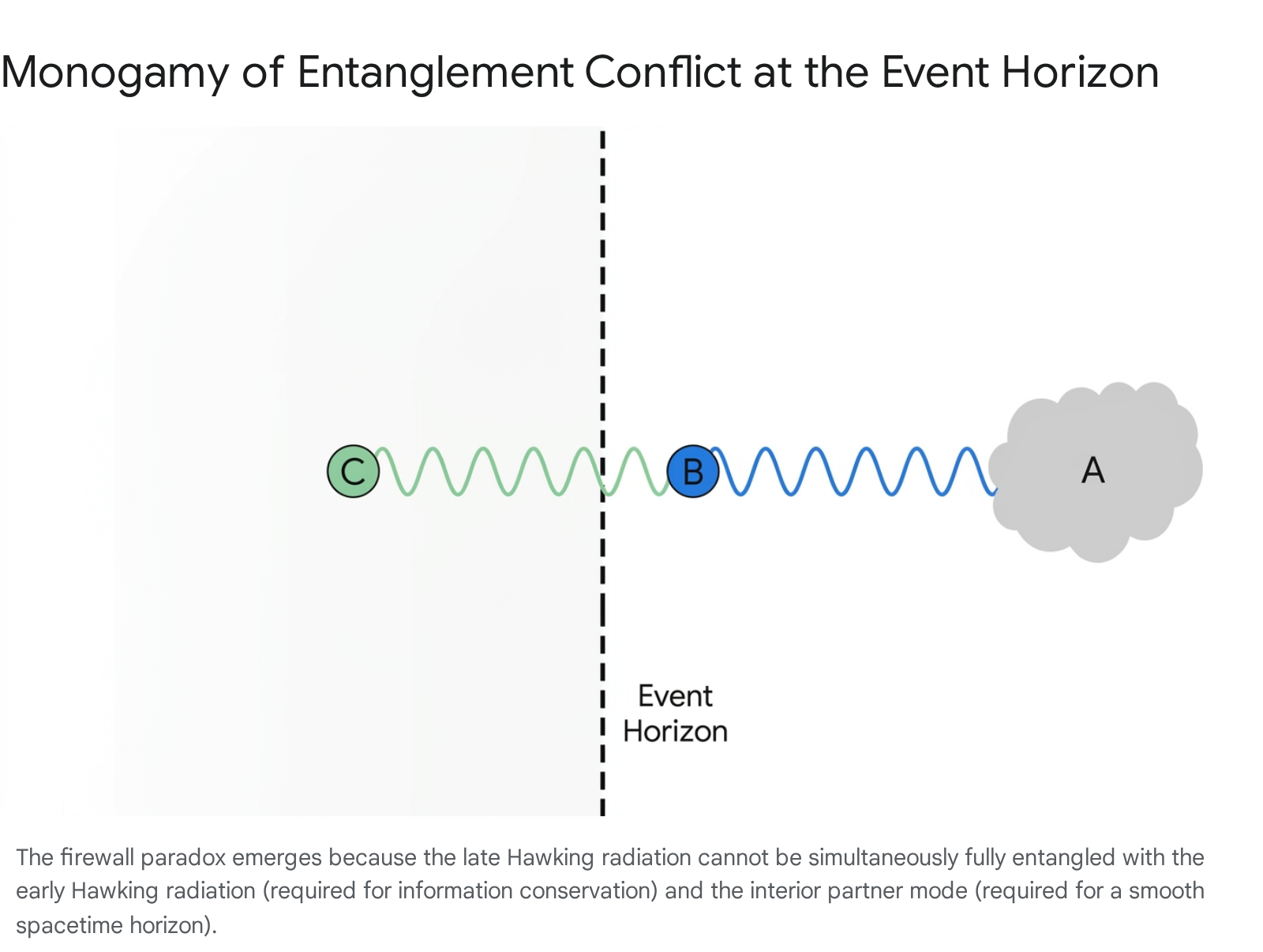
To formalize the AMPS paradox, physicists evaluate an "old" black hole that has evaporated past its Page time. The quantum degrees of freedom involved in the emission of a single new particle can be partitioned into three distinct subsystems 111814.
| Subsystem Identifier | Location | Quantum State Role |
|---|---|---|
| System A | Asymptotic Infinity | The accumulated "early" Hawking radiation emitted prior to the Page time. |
| System B | Just outside the Event Horizon | A newly emitted quantum of "late" Hawking radiation escaping the black hole. |
| System C | Just inside the Event Horizon | The infalling interior partner mode corresponding to System B. |
The Monogamy of Entanglement Constraint
In quantum mechanics, entanglement cannot be freely shared among arbitrary numbers of parties. This principle is mathematically formalized by constraints such as the Coffman-Kundu-Wootters (CKW) inequality, which dictates that if two qubits are maximally entangled with each other, they cannot be entangled with any third qubit 111815. Furthermore, strong subadditivity of quantum entropy establishes rigorous bounds on the mutual information shared between multiple systems 1617.
For the black hole evaporation process to be unitary, the total state of the radiation must eventually become pure. Because the black hole is past its Page time, the newly emitted late radiation (System B) must be highly entangled with the early radiation (System A) that preceded it 656. This quantum correlation ensures that the information initially trapped in the black hole is carried away into the external universe.
Concurrently, the equivalence principle demands that the spacetime at the horizon appears as a smooth vacuum to an infalling observer. According to quantum field theory in curved spacetime, the vacuum state across an event horizon is a highly entangled state. To prevent infinite energy densities at the horizon, the modes just outside the horizon (System B) must be maximally entangled with their localized partner modes just inside the horizon (System C) 61317.
The contradiction is fundamental: System B must be highly entangled with System A to preserve unitarity, and System B must be highly entangled with System C to preserve the equivalence principle. The monogamy of entanglement explicitly forbids System B from being simultaneously fully entangled with both independent systems 5723.
Mathur's Small Correction Theorem
Prior to the AMPS formulation, physicists assumed that tiny, localized quantum gravity corrections could subtly alter the Hawking radiation process without radically destroying the horizon structure. However, Samir Mathur published the "small correction theorem" in 2009, which proved mathematically that small corrections to the leading-order Hawking emission process are insufficient to restore unitarity .
Mathur demonstrated that unless the correction to the state is of order unity - meaning a total deviation from the semiclassical approximation at the horizon - the entanglement entropy will monotonically increase, leading inexorably to information loss. The AMPS paradox built upon Mathur's foundational proof, utilizing the monogamy of entanglement to show that preserving information requires severe, order-unity structural changes exactly at the event horizon .
The Breakdown of the Equivalence Principle
Faced with this quantum constraint, the AMPS authors evaluated the options for resolving the paradox and argued that the most conservative sacrifice is Einstein's equivalence principle 175. If quantum mechanics is sacrosanct, System B must remain entangled with System A to preserve unitarity. Consequently, the entanglement between System B and System C must be severed.
Breaking the entanglement across the event horizon fundamentally alters the local vacuum state. The severance of these quantum bonds generates a divergent energy-momentum tensor at the boundary. This releases massive amounts of energy, effectively transforming the smooth horizon into a curtain of high-energy particles - a firewall 237. Any observer or physical information falling into the black hole would be incinerated upon reaching the horizon. By replacing the interior geometry with a singularity precisely at the horizon, the firewall prevents the observer from verifying the duplication of information, but it does so by introducing a catastrophic violation of general relativity at a location where spacetime curvature is expected to be relatively mild 58.
Proposed Theoretical Resolutions
The introduction of the firewall paradox triggered an exhaustive search for theoretical mechanisms that could reconcile unitarity and the equivalence principle without resulting in a horizon-destroying firewall. These proposals generally require sacrificing or modifying other foundational assumptions of quantum field theory and general relativity.
The Fuzzball Paradigm and Microstate Geometries
Originating from string theory, the fuzzball conjecture - developed extensively by Samir Mathur - addresses the information paradox by entirely discarding the classical notion of a central singularity surrounded by an empty vacuum horizon 426.
In string theory, the fundamental constituents of matter are one-dimensional strings and higher-dimensional branes. When matter collapses to form a black hole, the pressure of the gravitational collapse causes these strings to expand into a highly complex, tangled sphere of string states. The physical size of this stringy configuration extends precisely to the radius of the expected classical event horizon 26.
Under the fuzzball paradigm, the black hole possesses a physical, textured surface. Because there is no empty vacuum extending infinitely across a boundary, the requirement for entanglement between interior and exterior vacuum modes (Systems B and C) is nullified. The Hawking radiation is emitted directly from the hot, stringy surface of the fuzzball, explicitly encoding the information of the microstates into the outgoing radiation . While proponents argue that fuzzballs negate the need for a firewall by removing the event horizon entirely, critics - including the AMPS authors - have suggested that a macroscopic observer impacting the hot, dense surface of a fuzzball would experience violent destruction operationally indistinguishable from a firewall 4.
The ER=EPR Conjecture and Spacetime Topology
In 2013, Juan Maldacena and Leonard Susskind proposed a radical geometric resolution to the paradox, known as the ER=EPR conjecture. The acronym equates Einstein-Rosen (ER) bridges, the technical term for non-traversable wormholes, with Einstein-Podolsky-Rosen (EPR) quantum entanglement 2718.
Maldacena and Susskind hypothesized that quantum entanglement and spacetime geometry are intrinsically linked; any two entangled quantum particles are physically connected by a microscopic wormhole 2919. When applied to the black hole firewall paradox, this conjecture fundamentally alters the spatial relationship between the tripartite subsystems.
The early Hawking radiation (System A), despite having traveled vast astronomical distances, remains entangled with the black hole. According to ER=EPR, this entanglement implies that the particles of System A are connected to the interior via microscopic wormholes. Consequently, System A and System C (the interior partner mode) are not independent, distinct degrees of freedom. The late Hawking radiation (System B) does not violate the monogamy of entanglement by being entangled with two separate systems; rather, it is entangled with a single, highly complex, non-locally distributed system 519. By redefining the topology of spacetime to include non-local wormhole connections, ER=EPR preserves both the unitarity of the radiation and the smoothness of the horizon, sacrificing exact spatial locality.
State-Dependent Operators in AdS/CFT
Another approach, developed by Kyriakos Papadodimas and Suvrat Raju, operates within the framework of the Anti-de Sitter/Conformal Field Theory (AdS/CFT) correspondence. Their proposal addresses the paradox by fundamentally modifying how mathematical operators inside the black hole are constructed from the boundary theory 51620.
In standard quantum mechanics, the operators that represent physical observables are linear and independent of the specific quantum state of the system. However, Papadodimas and Raju demonstrated that to reconstruct the black hole interior without encountering a firewall, the local operators describing the interior must be "state-dependent" 3221. This means the mathematical mapping that defines the inside of the black hole changes depending on the specific, complex microstate of the boundary CFT.
By implementing state-dependent operators, the researchers showed that the interior degrees of freedom can be identified with a subset of the early Hawking radiation. This identification effectively collapses Systems A and C into the same Hilbert space, resolving the strong subadditivity paradox 1622. An infalling observer would interact with these state-dependent operators and experience a smooth horizon, maintaining the equivalence principle. While mathematically successful in the AdS/CFT context, the sacrifice of exact operator state-independence introduces highly non-standard non-linearities into quantum mechanics 2336.
Computational Complexity and Decoding Constraints
Theoretical computer scientists Daniel Harlow and Patrick Hayden approached the firewall paradox from an operational perspective, utilizing computational complexity theory. They analyzed the physical requirements necessary to prove a violation of the monogamy of entanglement. An external observer (Alice) must collect the early Hawking radiation, decode it to isolate the specific mode entangled with the late radiation, and then physically jump into the black hole to verify its entanglement with the interior partner 824.
Harlow and Hayden demonstrated that decoding the highly scrambled early Hawking radiation is a computational problem of extraordinary difficulty, classified well beyond standard polynomial time (effectively exponential). Using quantum circuit analysis, they showed that the time required to process the early radiation and extract the necessary entanglement information scales exponentially with the black hole's degrees of freedom 2425.
Consequently, the decoding process would take vastly longer than the entire evaporation time of the black hole. By the time Alice decodes the radiation to verify the paradox, the black hole has already evaporated, and the event horizon no longer exists. While this does not provide a microscopic resolution to the underlying geometry, it suggests a form of "computational censorship" that protects the operational consistency of the universe, rendering the firewall paradox unobservable in practice 2724.
Non-Violent Nonlocality and Quantum Atmospheres
Physicist Steve Giddings proposed a mechanism termed "non-violent nonlocality" or "strong quantum effects." Giddings argued that the assumption of strict locality in quantum field theory on curved spacetime must be relaxed to save unitarity, but not in a way that produces an extreme firewall 139.
In this framework, the quantum information inside the black hole is transferred to the exterior Hawking radiation via non-local interactions that span a region significantly larger than the event horizon - a "quantum atmosphere" or "zone" that extends into the surrounding spacetime. This non-local transfer of information involves low-energy (soft) modes rather than high-energy (hard) modes 3926. Because the transfer occurs gradually and smoothly across a broad region, an infalling observer would not encounter a sudden, incinerating wall of energy. Recent theoretical work has even suggested that this non-violent nonlocality could be tested observationally, as the extended quantum atmosphere might produce random phase deviations or "echoes" in the gravitational waves emitted during black hole mergers 26.
The Replica Wormhole Paradigm and the Island Formula
Between 2019 and 2024, a major paradigm shift occurred in the study of black hole information, driven by advanced semiclassical calculations utilizing the Euclidean path integral approach to quantum gravity. These developments provided a rigorous mathematical derivation of the Page curve and offered a novel resolution to the firewall paradox without relying on ad hoc structural additions.
Quantum Extremal Surfaces
To calculate the fine-grained entanglement entropy of Hawking radiation, researchers - including Penington, Almheiri, Engelhardt, Marolf, and Maxfield - employed a technique known as the "replica trick." By evaluating the gravitational path integral for multiple copies (replicas) of the black hole system, they discovered that new topological saddle points emerge. These saddle points are known as "replica wormholes," which connect the interiors of the replicated black holes 71227.
The inclusion of replica wormholes radically alters the calculation of the entanglement entropy. It leads to the "island formula," a generalized entropy equation utilizing Quantum Extremal Surfaces (QES). According to the island formula, the region of spacetime that encodes the information of the Hawking radiation changes dynamically. Prior to the Page time, the entropy of the radiation is calculated using the standard Hawking method, yielding an increasing curve. However, after the Page time, the replica wormhole topology becomes the dominant saddle point. A new QES emerges inside the black hole, defining an "entanglement island." The spacetime region behind this surface becomes mathematically identified as part of the radiation's entanglement wedge 4243.
Macroscopic Superpositions of Spacetime
The island formula provides a mechanism by which the late Hawking radiation is purified, successfully reproducing the downward slope of the Page curve and bolstering the case for unitarity 1245. Crucially, the replica wormhole mechanism reveals that the Hawking radiation density matrix is an entangled macroscopic superposition of different spacetimes.
According to recent reviews of this literature, this macroscopic entanglement fundamentally invalidates the underlying premises of the AMPS firewall argument 422847. In the replica wormhole framework, radiation modes can encode the interior information while remaining independent degrees of freedom. The system bypasses the monogamy of entanglement conflict because the AMPS assumption of a single, fixed semiclassical spacetime background breaks down. The purification of the radiation state occurs across multiple branches of a macroscopic superposition, rendering the standard localized entanglement mapping inapplicable 4729.
Regularization of the Firewall Force
Furthermore, researchers analyzing the dynamics of infalling particles within the replica wormhole topology found that the topology does introduce a gravitational anomaly at the horizon. Specifically, the replica wormhole geometry generates a Dirac delta term in the Ricci scalar, which manifests as a "firewall force" experienced by radially infalling particles 12.
However, unlike the infinite, paradox-inducing energy wall of the AMPS formulation, this firewall force is mathematically proportional to the square of the particle's total energy and requires specific quantum regularization to yield physically meaningful results. By scaling the force to the Planck mass and applying logarithmic regularization, theorists have demonstrated that the replica wormhole topology provides a unified framework that simultaneously addresses both the information loss paradox and the monogamy constraints without requiring a catastrophic breakdown of spacetime 12.
Cosmological Limitations and Asymptotically Flat Spacetimes
Despite the immense success of the island formula in recovering the Page curve, the exact microscopic, real-time mechanism of information escape remains debated. The replica wormhole calculations rely heavily on low-energy effective theories and Euclidean spacetime techniques, leaving questions about the real-time Lorentzian experience of an infalling observer 4749.
Moreover, physicists have noted severe limitations regarding the applicability of the island formula outside of string theory constructs. While the formula works seamlessly in Anti-de Sitter (AdS) space, extending these findings to asymptotically flat spacetimes or cosmological de Sitter spacetimes - which more accurately model the observable universe - presents significant theoretical hurdles 453031. Recent attempts to apply the island formula to closed geometries yielded paradoxical results, such as predicting a universe with only a single quantum state, highlighting the ongoing tensions in extending these holographic principles 30.
Comparative Analysis of Proposed Resolutions
To resolve the irreconcilable triad of unitarity, the equivalence principle, and locality, each major theoretical framework fundamentally alters at least one widely accepted physics postulate.
| Proposed Resolution | Primary Theoretical Framework | Core Mechanism | Principle Sacrificed / Modified |
|---|---|---|---|
| AMPS Firewall | Quantum Field Theory | Entanglement between interior and exterior is severed, producing a high-energy boundary. | Equivalence Principle (Smooth horizon / "No Drama") 5 |
| Fuzzballs | String Theory | Black hole is a dense tangle of string states extending to the horizon radius; no vacuum exists. | Classical Horizon Geometry (No-Hair Theorem) 26 |
| ER=EPR | Quantum Geometry / AdS-CFT | Entangled particles are physically connected by non-traversable wormholes. | Exact Spatial Locality 19 |
| State-Dependence | AdS/CFT Correspondence | Interior bulk operators depend mathematically on the specific microstate of the external CFT. | State-Independence of Quantum Operators 1621 |
| Replica Wormholes | Gravitational Path Integral | Macroscopic superposition of spacetimes and entanglement islands purify the radiation. | Fixed Semiclassical Spacetime Background 4729 |
| Non-Violent Nonlocality | Modified QFT | Information transfers gently from the interior to soft modes in an extended "quantum atmosphere." | Exact Spatial Locality 3926 |
The black hole firewall paradox serves as a profound stress test for modern theoretical physics, forcing theorists to confront the limits of general relativity and quantum field theory. The AMPS argument successfully exposed a critical contradiction: the strict monogamy of entanglement prevents a black hole from simultaneously preserving quantum information and maintaining a smooth, featureless event horizon under standard semiclassical assumptions.
Over the last decade, the scientific response to this paradox has driven remarkable theoretical innovations. From the geometric entanglement of the ER=EPR conjecture to the macroscopic superpositions identified by replica wormhole calculations, resolving the firewall paradox requires rethinking the fundamental structure of space and time. While a definitive, experimentally verifiable theory of quantum gravity remains elusive, the rigorous analysis provoked by the AMPS firewall paradox continues to accelerate the unification of quantum information theory and gravitational physics.