
The Hubble tension and the standard model of the universe
The Standard Cosmological Model
The Lambda Cold Dark Matter ($\Lambda$CDM) model is the prevailing mathematical and physical framework of Big Bang cosmology. It is a highly parameterized model that provides an exceptionally accurate description of the universe's evolution, large-scale structure, and compositional geometry 11. The model operates under the assumption that general relativity is the correct theory of gravity on cosmological scales and posits that the universe is comprised of three primary components: a cosmological constant ($\Lambda$) associated with dark energy, cold dark matter (CDM), and ordinary baryonic matter 1.
In this theoretical framework, dark energy accounts for approximately 68% of the universe's total energy density and is responsible for the accelerating expansion of the universe observed at late cosmic times 2. Cold dark matter, making up roughly 27% of the energy density, is a non-luminous, slow-moving mass component that interacts primarily through gravitational forces, providing the fundamental scaffolding required for galaxy formation 12. Ordinary matter - the protons, neutrons, and electrons that make up stars, planets, and interstellar gas - constitutes the remaining 5% 2.
The $\Lambda$CDM model has achieved remarkable predictive successes over the past three decades. It successfully explains the existence and highly uniform temperature of the Cosmic Microwave Background (CMB), the large-scale spatial distribution of galaxies across cosmic filaments and voids, and the primordial abundances of light elements such as hydrogen, deuterium, helium, and lithium produced during Big Bang nucleosynthesis 13. By inputting high-precision observational data into the $\Lambda$CDM framework, cosmologists can extrapolate the universe's entire expansion history from a dense, primordial state roughly 13.8 billion years ago to its current accelerating phase.
From the core six parameters of the $\Lambda$CDM model, several vital secondary cosmological values are derived, including the physical baryon density, the spatial curvature, and the Hubble constant ($H_0$) 15. The Hubble constant quantifies the present-day rate of cosmic expansion, defining the exact relationship between the physical distance of a celestial object and the velocity at which it is receding from the observer. The Hubble constant is also directly connected to estimates of the age of the universe via the relation $A=1/H_0$, meaning any shift in the expansion rate directly alters calculations regarding the timeline of cosmic history 36. However, the precise value of this fundamental constant has become the epicenter of a severe and deepening crisis in modern astrophysics.
Definition of the Cosmological Discrepancy
The phenomenon known as the Hubble tension refers to a statistically significant and persistently widening discrepancy between two independent, highly refined methodologies used to measure the Hubble constant 64.
One approach, generally referred to as "late-universe" or "local" measurements, constructs a cosmic distance ladder composed of observable astronomical objects to empirically calculate the current expansion rate 45. These localized observational methods typically yield an $H_0$ value in the range of 73 to 74 kilometers per second per megaparsec (km/s/Mpc) 46. In contrast, the "early-universe" approach infers the present-day expansion rate by measuring the initial thermodynamic conditions of the cosmos - specifically the fluctuations within the CMB radiation - and extrapolating forward in time using the physical equations dictated by the $\Lambda$CDM model 47. This theoretical projection consistently yields a significantly lower value clustered around 67.4 km/s/Mpc 68.
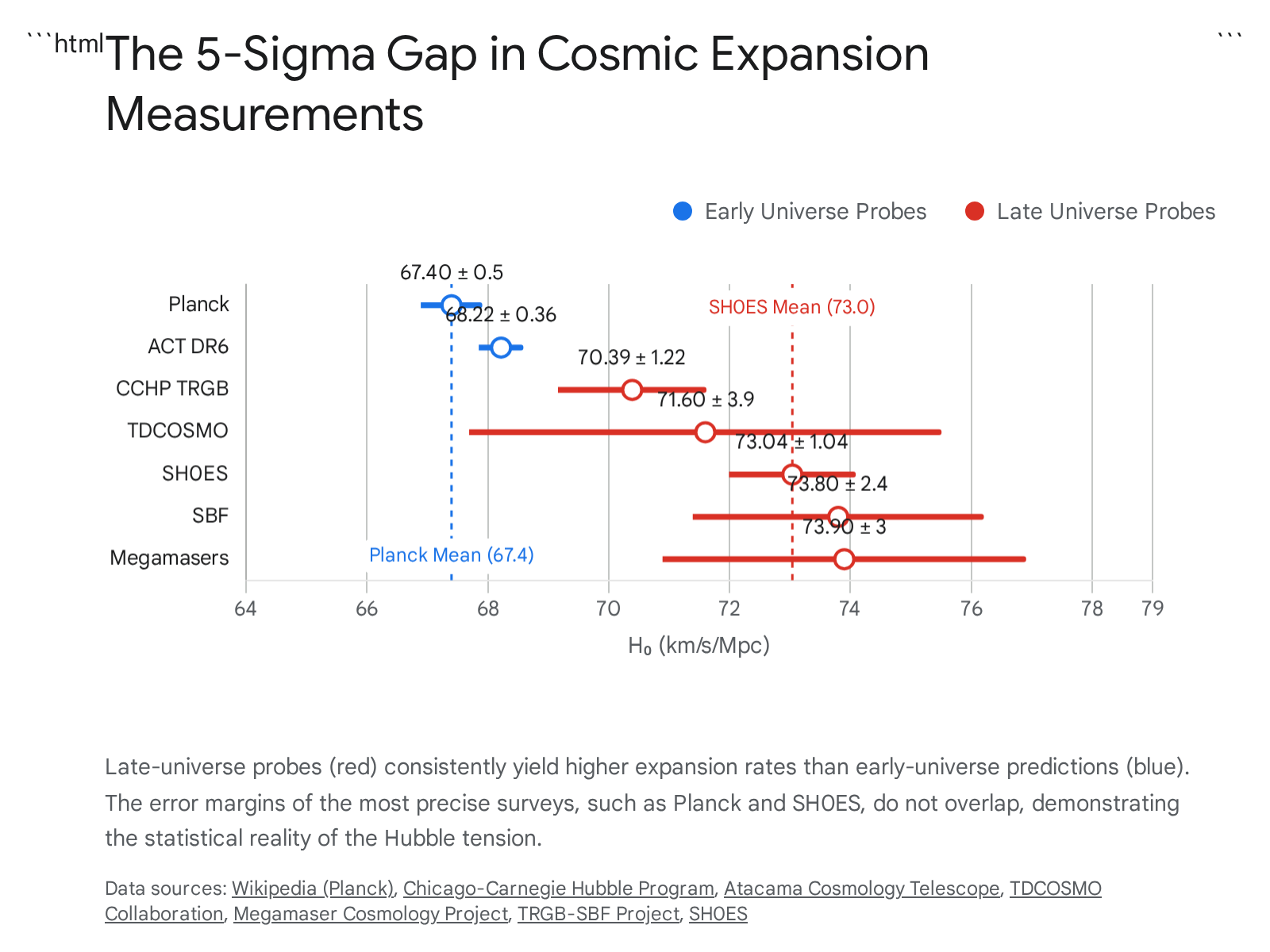
While a difference of 5 to 6 km/s/Mpc might appear minor on a vast cosmological scale, the error margins for these modern astronomical measurements have shrunk dramatically - often to less than 1.5% 79. Consequently, the discrepancy between the two approaches has reached a statistical significance exceeding 5-sigma ($>5\sigma$) 46. In physics, a 5-sigma deviation implies that the probability of this mismatch occurring due to random chance or statistical fluctuation is virtually zero 1011. The tension indicates a systematic divergence that cannot be bridged by adjusting error bars.
The implications of this gap are profound. If local measurement techniques are flawed, decades of astronomical calibration regarding standard candles and stellar physics must be fundamentally re-evaluated. However, observational cross-checks have continually validated local measurements 912. Therefore, if both the early and late measurements are fundamentally accurate, the discrepancy indicates that the standard $\Lambda$CDM model is incomplete 54. A real cosmological tension implies the existence of new, undiscovered physics - such as novel particles, undetected fields, or modifications to general relativity - that altered the universe's expansion history at some point between the emission of the CMB and the present epoch 1314.
Late-Universe Empirical Measurements
Late-universe measurements of the Hubble constant rely on direct observations of luminous objects within the local and intermediate cosmos. Because astronomers cannot directly measure both the recession velocity and the absolute physical distance of a single object spanning billions of light-years without intermediate calibration steps, they construct a methodology known as the cosmic distance ladder 45.
The distance ladder is a sequential, highly interdependent method where each "rung" provides the calibration for the next, allowing astronomers to measure progressively greater spans of space 515.
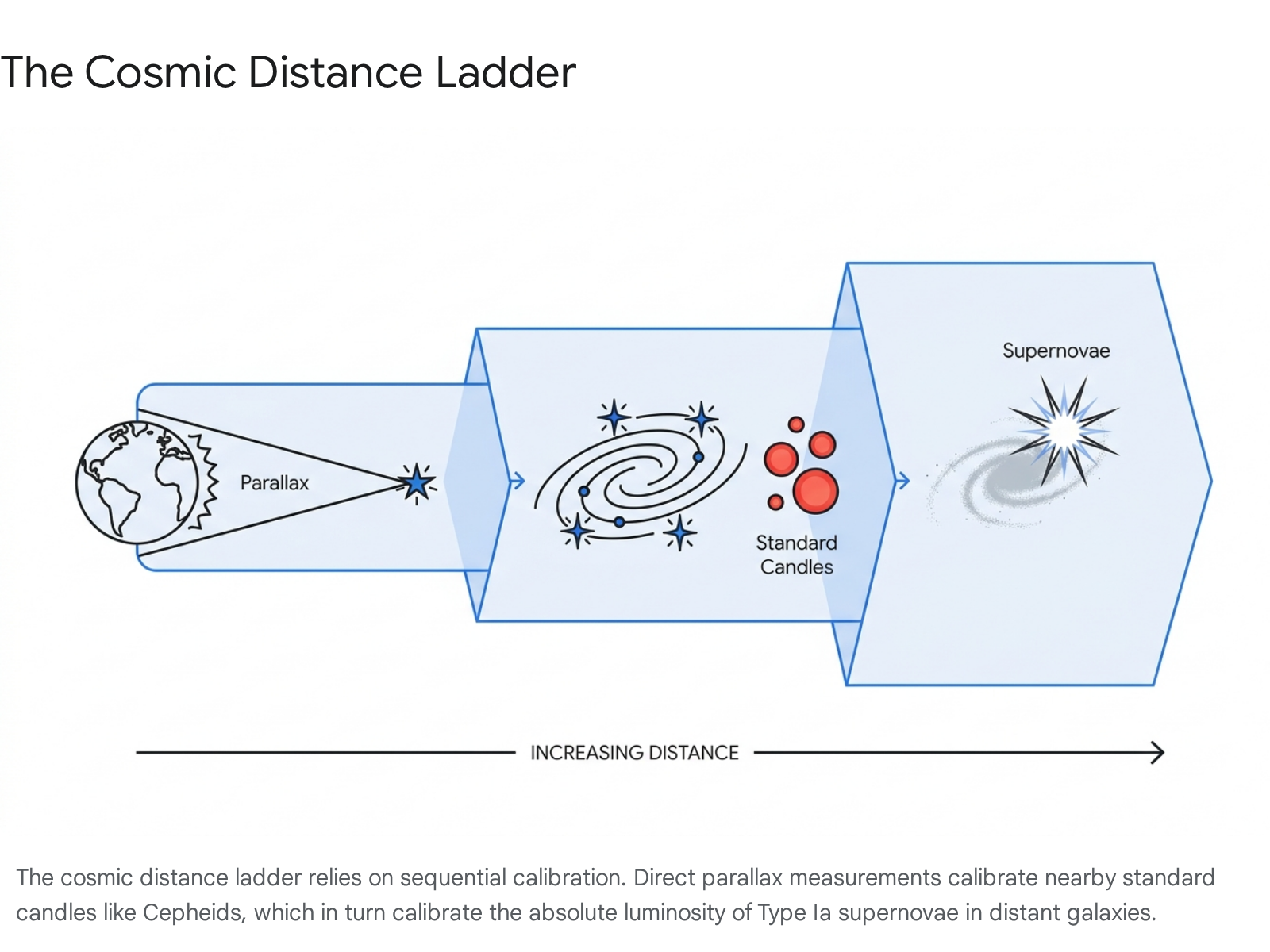
The foundational rung relies on stellar parallax, which remains the only direct, purely geometric method for measuring distance outside our Solar System. As the Earth orbits the Sun, relatively nearby stars appear to shift slightly in position against the background of much more distant stars. By measuring this microscopic angular shift over a six-month period, astronomers can calculate the exact geometric distance to these nearby stars using basic trigonometry 1516. Space observatories such as the Gaia mission have pushed parallax measurements to unprecedented levels of precision, cataloging accurate distances for millions of stars within the Milky Way and expanding the foundation of the ladder 56.
The second rung utilizes objects known as "standard candles" - astronomical entities with a known, intrinsic absolute luminosity. The most historically prominent and extensively utilized standard candles are Cepheid variable stars. Cepheids are young, massive stars that pulsate in brightness at highly predictable rates. A strict mathematical relationship exists between a Cepheid's pulsation period and its absolute intrinsic luminosity 1320. By comparing a Cepheid's known absolute brightness (inferred from its pulse rate) to its apparent faintness as observed from Earth, astronomers can calculate its exact physical distance using the inverse-square law of light 2017. Direct parallax measurements of local Milky Way Cepheids are used to calibrate the period-luminosity relationship, which is then applied to measure the distances to Cepheids located in nearby galaxies 518.
The third rung of the ladder extends deep into the cosmos using Type Ia supernovae. These exploding white dwarf stars serve as incredibly luminous standard candles, visible billions of light-years away in the "Hubble flow" - the vast region of space where the universe's global expansion dictates galactic movement far more than localized gravitational interactions 420. By identifying galaxies that host both measurable Cepheid variables and recent Type Ia supernovae, astronomers can use the Cepheid distances to precisely calibrate the peak absolute brightness of the supernovae. Once this calibration is secured, the apparent brightness of Type Ia supernovae observed in extreme deep space can be used to measure distances to the far reaches of the observable universe 418.
The SH0ES (Supernova, H0, for the Equation of State of Dark Energy) collaboration has been the primary proponent of the Cepheid-Supernova distance ladder architecture. Over decades of systematic refinement utilizing the Hubble Space Telescope (HST), SH0ES has produced a highly constrained $H_0$ measurement of $73.04 \pm 1.04$ km/s/Mpc 24.
Alternative Stellar Calibrators
Because the cosmic distance ladder relies on compounding calibrations, systematic errors originating on one rung can propagate and amplify on the next 15. For years, critics suggested that the high $H_0$ values generated by the SH0ES team might be an artifact of photometric blending. Because HST's resolution has physical limits at extreme distances, the light from a target Cepheid variable could blur together with nearby stars in crowded, dusty galactic disks, artificially inflating its perceived brightness and distorting the subsequent distance calculation 2319. To circumvent potential Cepheid-specific biases, astrophysicists have developed and deployed independent stellar calibrators for the second rung of the ladder.
The Tip of the Red Giant Branch (TRGB) method is a leading alternative. This technique relies on the evolutionary lifecycle of low-mass stars. As an aging star exhausts its hydrogen core, it begins to burn helium in a sudden, highly luminous event known as a "helium flash." Because this thermonuclear flash occurs at a strictly consistent core mass and temperature, the peak absolute brightness of stars at the tip of the red giant branch is virtually identical across different galaxy types and metallicities 220. By measuring the apparent brightness of TRGB stars in the halos of nearby galaxies, astronomers can determine cosmic distances entirely independent of Cepheid variables 2026.
Similarly, the J-Region Asymptotic Giant Branch (JAGB) method utilizes carbon-rich giant stars as standard candles. These stars are highly luminous in the near-infrared spectrum and possess a surprisingly consistent absolute magnitude 2026. A major advantage of both TRGB and JAGB stars is their location. Unlike Cepheids, which are primarily found in dense, active galactic disks where their light is subject to blending and dust obscuration, TRGB and JAGB stars are frequently located in the sparse outskirts and older halos of galaxies, drastically reducing the risk of photometric crowding errors 1920.
The Surface Brightness Fluctuations (SBF) method provides yet another independent metric. This approach assesses the statistical variance in the blended light of older elliptical galaxies. Since galaxies are composed of discrete stars rather than a continuous fluid of light, the surface brightness appears "bumpy" or granular when observed closely. In old elliptical galaxies, this surface brightness is dominated by red giant stars. The amplitude of these statistical fluctuations is inversely proportional to the galaxy's distance 821.
Independent Geometric Probes
To bypass the multi-rung distance ladder entirely, astrophysicists also utilize geometric and gravitational phenomena that allow for single-step, direct distance inferences. These methods are structurally distinct from standard candles.
Time-Delay Cosmography (TDCOSMO) leverages the phenomenon of strong gravitational lensing. When a massive foreground galaxy or cluster sits directly between Earth and a distant, fluctuating light source, the foreground mass warps the fabric of spacetime, acting as a massive cosmic lens 814. This lensing effect splits the background quasar's light into multiple, distinct visible images. Because the light forming each separated image takes a slightly different physical path through the warped spacetime, there is a measurable time delay - often spanning days or weeks - between the observed brightness fluctuations in the distinct images 822. The precise length of this time delay, combined with a detailed mass model of the lensing galaxy, is inversely proportional to the Hubble constant 1122.
The Megamaser Cosmology Project seeks absolute geometric distances by observing water megamasers - dense clouds of water vapor orbiting supermassive black holes in the accretion disks of active galaxies. By utilizing Very Long Baseline Interferometry (VLBI) via arrays of radio telescopes, astronomers can track the Keplerian orbital velocity of individual water molecule clusters as they orbit the central black hole. By measuring the centripetal acceleration and the proper motion of these masers, astronomers can compare the angular size of the disk with its physical velocity. This purely geometric approach yields a direct distance measurement entirely independent of standard candles, metallicity corrections, or the cosmic distance ladder 2923.
Early-Universe Theoretical Predictions
Unlike late-universe empirical probes that measure expansion directly through recession velocities and apparent magnitudes, early-universe probes observe the primordial thermodynamic state of the cosmos and use general relativity to mathematically predict what the expansion rate should be today 67.
The Cosmic Microwave Background
The Cosmic Microwave Background (CMB) is the relic thermal radiation from the Big Bang. Approximately 380,000 years after the universe began, the extreme temperature cooled enough for protons and electrons to combine into neutral hydrogen - a phase transition known as recombination 424. Prior to this epoch, the universe was an opaque, dense plasma where photons were constantly scattered by free electrons. Once neutral atoms formed, the universe became transparent, and the first light decoupled from matter to travel freely through space 2425.
This ubiquitous relic radiation is highly uniform but contains microscopic temperature and polarization fluctuations. These variations map the primordial density waves - baryon acoustic oscillations - that rippled through the early plasma, driven by the competing forces of gravitational collapse and radiation pressure 426. The physical size of these sound waves at the exact moment of recombination is known as the "sound horizon." The sound horizon acts as a primordial "standard ruler" permanently imprinted on the CMB 2627.
By analyzing the angular power spectrum of these acoustic peaks on the sky, cosmologists can derive a multitude of parameters regarding the universe's total composition, dark matter density, and spatial geometry 127. The European Space Agency's Planck satellite mapped the CMB with unparalleled precision across the entire sky. Feeding the Planck temperature and polarization data into the standard $\Lambda$CDM model yields a highly constrained predicted modern $H_0$ of $67.4 \pm 0.5$ km/s/Mpc 617.
Ground-Based High-Resolution CMB Verification
While Planck operated in space to capture a full-sky map, ground-based observatories complement its data by achieving higher resolution over smaller, specific patches of the sky. The Atacama Cosmology Telescope (ACT), a six-meter telescope situated in the Chilean Andes, captured CMB data with roughly three times the sensitivity and five times the resolution of Planck 2428.
The sixth and final data release from ACT (DR6), published in 2025, provided a critical, independent test of the Planck results 2428. If the Hubble tension were caused by an undetected systematic error or calibration drift in the Planck satellite's instruments, ACT DR6 would likely reveal a different $H_0$ trajectory. However, the ACT DR6 data proved to be in excellent agreement with the Planck data and the $\Lambda$CDM model. The ACT DR6 polarization data, which is signal-dominated up to a high multipole of $\ell=1500$, demonstrated extreme sensitivity at small angular scales 3637. When combined with baryon acoustic oscillation data, ACT DR6 yielded an $H_0$ of $68.22 \pm 0.36$ km/s/Mpc 3638. This independent verification cemented the validity of early-universe measurements, proving conclusively that the $H_0$ tension is not a product of satellite instrument failure 2829.
Baryon Acoustic Oscillations
The primordial sound waves that imprinted themselves on the CMB did not vanish after recombination; they also influenced the spatial distribution of regular matter as the universe expanded. Today, this manifests as Baryon Acoustic Oscillations (BAO) - a subtle periodic clustering of galaxies across the universe, separated by typical distances dictated by the size of the original sound horizon 2630. By mapping the precise distances between millions of galaxies, observatories like the Dark Energy Spectroscopic Instrument (DESI) can track the expansion history of the universe over the last 11 billion years 3132. BAO measurements effectively bridge the gap between the CMB and the local universe, providing strict constraints on the properties of dark energy and matter density across deep time 3133.
Recent Observational Updates and Dataset Clashes
As telescope technology advances, cosmologists have systematically eliminated potential sources of observational error. Between 2024 and 2026, major data releases clarified the structural nature of the tension while simultaneously introducing new, confounding variables.
The James Webb Space Telescope Confirmations
In 2024, the James Webb Space Telescope (JWST) was utilized to test the pervasive theory that photometric blending was artificially inflating the SH0ES Cepheid measurements 934. JWST's near-infrared capabilities and superior optical resolution allowed it to pierce through cosmic dust and distinctly resolve individual Cepheids that had previously been blurred together in HST data 919.
Adam Riess and the SH0ES team observed over 1,000 Cepheids in distant supernova-hosting galaxies using JWST. The resulting data confirmed that the prior HST measurements were highly accurate, ruling out blending errors at an 8.2-sigma significance 919. The combined JWST and HST Cepheid data yielded an updated $H_0$ of $72.6 \pm 2.0$ km/s/Mpc 12.
Simultaneously, Wendy Freedman and the Carnegie-Chicago Hubble Program (CCHP) released their JWST analysis of the alternative TRGB and JAGB standard candles. The CCHP data showed a slightly lower late-universe $H_0$ value averaging $69.96$ km/s/Mpc, with the TRGB-specific measurement landing at $70.39 \pm 1.22$ km/s/Mpc 1726. Because the CCHP results sit somewhat closer to the Planck CMB predictions, some researchers argued that the Hubble tension might still be an artifact of Cepheid-specific systematics or differing sample sizes between the groups 1720. The SH0ES group maintains that the discrepancy between the two teams stems from differing statistical treatments of supernova samples 23.
Crucially, however, other JWST-calibrated metrics continue to support a high expansion rate. For instance, the Surface Brightness Fluctuations (SBF) distance scale, completely recalibrated using JWST TRGB data to avoid Cepheid dependencies entirely, resulted in a definitive $H_0$ value of $73.8 \pm 0.7$ (statistical) $\pm 2.3$ (systematic) km/s/Mpc 2135. The 2025 TDCOSMO results from strongly lensed quasars yielded $71.6^{+3.9}{-3.3}$ km/s/Mpc, and the profile likelihood analysis of the Megamaser Cosmology Project settled at $73.5^{+3.0}{-2.9}$ km/s/Mpc 363748. Thus, the vast majority of independent late-universe probes remain deeply in tension with the CMB predictions.
| Methodology | Primary Calibrator / Mechanism | Recent $H_0$ Value (km/s/Mpc) | Reference |
|---|---|---|---|
| Distance Ladder (SH0ES) | Cepheids + Type Ia SNe (JWST/HST) | $72.6 \pm 2.0$ | 12 |
| Distance Ladder (CCHP) | TRGB + JAGB (JWST) | $70.39 \pm 1.22$ | 26 |
| Surface Brightness (SBF) | TRGB (JWST Calibrated) | $73.8 \pm 2.4$ | 2135 |
| Strong Lensing (TDCOSMO) | Gravitational Time-Delay | $71.6^{+3.9}_{-3.3}$ | 1436 |
| Megamasers | Geometric Disk Kinematics | $73.5^{+3.0}_{-2.9}$ | 3748 |
| CMB (Planck) | Cosmic Microwave Background | $67.4 \pm 0.5$ | 6 |
| CMB (ACT DR6) | Cosmic Microwave Background | $68.22 \pm 0.36$ | 3638 |
DESI DR2 and the Evolving Dark Energy Hypothesis
In early 2025, the DESI collaboration released its Data Release 2 (DR2), mapping over 14 million galaxies and quasars across the sky 3132. While the traditional $\Lambda$CDM model assumed dark energy is a strict cosmological constant ($\Lambda$) - meaning its energy density remains perfectly static over cosmic time with an equation of state defined as $w = -1$ - the high-precision DESI BAO data hinted at dynamic, temporal evolution 3850.
To mathematically test this evolution, cosmologists utilize the $w_0-w_a$ parametrization, where $w_0$ represents the current equation of state of dark energy, and $w_a$ describes the derivative of how it changes with respect to the scale factor of the expanding universe 5051. The combined DESI DR2, CMB, and supernova data demonstrated an increasing statistical preference - surpassing $3\sigma$ in some data combinations - for $w_0 > -1$ and $w_a < 0$ 3051. This suggests a scenario known as a "phantom crossing," indicating that the repulsive force of dark energy may be weakening over cosmic time, with a crossing point near a redshift of $z \approx 0.45$ 303338.
If dark energy is genuinely evolving, the standard $\Lambda$CDM model requires a fundamental overhaul 39. However, allowing dark energy to vary dynamically at late times does not fully resolve the Hubble tension; in fact, fitting a complex evolving dark energy model to the combined local and CMB data can sometimes exacerbate secondary cosmological tensions, such as the $S_8$ discrepancy regarding the clustering amplitude of matter 3351.
Early-Universe Theoretical Solutions
Given that the ACT DR6 and JWST observations have largely exonerated the respective instruments from major systematic failures, the cosmological consensus increasingly leans toward the necessity of new physics 928. Broadly, theoretical solutions are divided into "early-universe" modifications, which alter physics prior to recombination, and "late-universe" modifications, which alter physics during the epoch of large-scale structure formation 2640. Because late-universe interventions are heavily constrained by stringent BAO and supernova data, early-universe modifications are generally considered the most mathematically viable pathway to resolving the crisis 26.
By injecting new physics into the pre-recombination era, theorists aim to reduce the absolute physical size of the sound horizon. A smaller sound horizon mathematically requires a faster modern expansion rate ($H_0$) to produce the exact angular acoustic peaks observed in the CMB sky maps 2627.
Early Dark Energy (EDE)
Early Dark Energy (EDE) is currently the most prominent and heavily scrutinized theoretical resolution. EDE posits the existence of an exotic scalar field - behaving as a sort of anti-gravitational force - that became active approximately 100,000 years after the Big Bang, temporarily accelerating the cosmic expansion rate 274142. Crucially, to avoid destroying the successful $\Lambda$CDM predictions for the late universe, this EDE field must have decayed or diluted away faster than radiation shortly after the epoch of recombination 2756.
By increasing the early expansion rate, EDE reduces the sound horizon at decoupling, allowing the CMB data to mathematically align with a local $H_0$ of approximately 71 to 73 km/s/Mpc 5643. Furthermore, astrophysical research conducted in 2024 demonstrated that the inclusion of an EDE framework in cosmological models naturally accelerates the early clustering of dark matter halos 41. This conceptually elegantly solves a secondary mystery: JWST's unexpected observational discovery of massive, highly luminous galaxies existing within the first 500 million years of the universe, an anomaly that is highly difficult to reproduce under standard $\Lambda$CDM structure formation assumptions 4142.
While earlier Planck data analyses severely constrained EDE models, the 2025 ACT DR6 release shifted the landscape. Despite ACT DR6 showing no baseline statistical preference for EDE over $\Lambda$CDM on its own, its specific polarization data allowed for a significantly larger maximum fractional contribution of Early Dark Energy ($f_{EDE}$) in the pre-recombination era 5658. When a profile likelihood analysis combined ACT DR6 with the DESI DR2 BAO data and the SH0ES local distance measurements, the EDE model provided a highly improved fit over $\Lambda$CDM, generating an $H_0 = 71.0 \pm 1.1$ km/s/Mpc and raising the theoretical preference for the EDE framework well above $5\sigma$ 56.
Dark Radiation and Interacting Sectors
Another established theoretical mechanism to reduce the sound horizon involves adding relativistic degrees of freedom to the early primordial plasma, commonly referred to as "dark radiation" 4445. This phenomenon is mathematically parametrized as $N_{eff}$, the effective number of relativistic species. In the standard model, $N_{eff}$ is precisely 3.044, corresponding to the three known neutrino flavors 36. Increasing $N_{eff}$ by introducing a fourth "sterile" neutrino, a majoron, or a self-interacting dark sector artificially boosts the early expansion rate 263661.
Recent, highly refined iterations of this theory propose models in which a subcomponent of dark matter is tightly coupled to dark radiation via thermal equilibrium in the very early universe, before decoupling near the time of matter-radiation equality 6246. While simple, pure dark radiation models are increasingly constrained by the high-$\ell$ CMB polarization data from ACT DR6, these complex "interacting dark radiation" frameworks show promise. By carefully tuning the rate at which the dark matter decouples from the dark radiation, these models can successfully raise $H_0$ to roughly 72.5 km/s/Mpc, reducing the tension to under $3\sigma$ without violating the stringent CMB power spectrum boundaries 6246.
Late-Universe and Compositional Solutions
While early-universe solutions dominate the theoretical discourse, late-universe modifications and alterations to the fundamental nature of dark matter and gravity remain areas of active research.
Decaying Dark Matter Models
Decaying Dark Matter (DDM) models posit that a specific fractional percentage of cold dark matter is unstable. On vast cosmological timescales, this heavier dark matter particle slowly decays into a lighter particle and massless dark radiation (such as an invisible neutrino or a dark photon) 4547.
If this decay occurs primarily around the epoch of matter-radiation equality, it modifies the universe's effective equation of state precisely when the sound horizon is being established, altering the expansion rate through the Friedmann equations 4765. Furthermore, DDM directly addresses a secondary, growing crisis in cosmology: the $S_8$ tension. Weak lensing surveys, such as the Dark Energy Survey (DES), consistently observe a slightly smoother distribution of matter at late times than the Planck CMB data predicts 4849. The decay of a portion of dark matter into relativistic radiation suppresses the gravitational growth of cosmic structures at late times, neatly explaining this clustering discrepancy 4549. While achieving a complete solution to the Hubble tension via DDM requires complex parameter tuning to avoid violating bounds on invisible decay pathways, it remains one of the few theoretical frameworks capable of alleviating both the $H_0$ and $S_8$ crises simultaneously 6249.
Modified Gravity Frameworks
Rather than introducing exotic dark fluids, fields, or decaying particles, modified gravity theories argue that Einstein's theory of general relativity itself must be mathematically adjusted on vast cosmological scales 5051.
One prominent approach is $f(R)$ gravity, which modifies the foundational Einstein-Hilbert action by substituting the standard Ricci scalar ($R$) with an arbitrary, more complex function 5152. In these scalar-tensor theories, gravity is effectively weakened over specific, massive length scales, simulating the repulsive, accelerating effect of dark energy without requiring a cosmological constant. To ensure that these sweeping modifications do not violate the highly tested, extraordinarily precise laws of gravity within our own Solar System, modified gravity requires the implementation of "screening mechanisms" 5051. The Vainshtein mechanism, for instance, theoretically hides or suppresses the gravitational modifications in regions of high matter density (like stars and galaxies) while allowing them to act freely in the vast, empty intergalactic voids 5051.
Alternatively, conformally coupled modified gravity (CCMG) models suggest that the gravitational constant ($G$) is not static but evolves over cosmic time due to the coupling of a scalar field directly to the Ricci scalar 53. If this coupling mechanism becomes dynamically active near the epoch of matter-radiation equality, it fundamentally alters the background expansion of the universe. While CCMG models can mathematically push the CMB-inferred $H_0$ up to $69.6 \pm 1.6$ km/s/Mpc, observational evidence from full-shape galaxy power spectrums currently shows no strong preference for it over the standard $\Lambda$CDM model, limiting its current viability as a definitive solution 53.
| Theoretical Framework | Primary Mechanism | Impact on $H_0$ Tension | Secondary Cosmological Impacts |
|---|---|---|---|
| Early Dark Energy (EDE) | Scalar field accelerates expansion prior to recombination, drastically reducing the sound horizon. | Strong alleviation (pushes $H_0$ to $\sim$71-73 km/s/Mpc). | Can explain JWST early bright galaxies; may slightly exacerbate the $S_8$ tension. |
| Dark Radiation ($N_{eff}$) | Introduces extra relativistic species to boost the early expansion rate. | Moderate alleviation. | Strongly constrained by high-$\ell$ CMB polarization data from ACT DR6. |
| Decaying Dark Matter | CDM fraction decays into dark radiation, altering the equation of state. | Mild to moderate alleviation. | Simultaneously reduces the $S_8$ (matter clustering) tension. |
| Evolving Dark Energy | The dark energy equation of state changes over time ($w_0 > -1$, $w_a < 0$). | Mild alleviation. | Strongly supported by DESI DR2 BAO data; indicates phantom crossing. |
| Modified Gravity | Alters General Relativity ($f(R)$, Vainshtein screening) on cosmic scales. | Mild alleviation. | Mathematically complex; difficult to observationally differentiate from $\Lambda$CDM. |
Future Observational Trajectories
The Hubble tension represents the most stubborn, mathematically rigorous crisis in modern cosmology. Between 2024 and 2026, the influx of high-fidelity data from JWST, ACT DR6, and DESI DR2 has permanently reshaped the scientific landscape. The tension is no longer readily dismissible as an artifact of photometric blending, crowded stellar fields, or singular satellite miscalibration; it is a persistent, multi-faceted phenomenon corroborated by entirely independent physical metrics, from geometric water megamasers to early-universe baryon acoustic oscillations 344856.
While $\Lambda$CDM remains an overwhelmingly successful descriptor of cosmic history, its inability to seamlessly link the universe's primordial sound horizon to the modern local expansion rate indicates an incomplete theoretical foundation 348. Solutions like Early Dark Energy show immense promise, gracefully tying the Hubble tension to the anomalous abundance of early galaxies 4142. Meanwhile, DESI's hints of an evolving dark energy equation of state suggest that the vacuum energy of the universe may be far more dynamic than a simple cosmological constant allows 3133.
In the coming years, the launch of the Nancy Grace Roman Space Telescope, the continued high-resolution operations of the Simons Observatory, and the accumulation of deeper, wider DESI and JWST catalogs will likely break the remaining statistical degeneracies between these competing theoretical models 2438. Until the data converges, the Hubble tension stands as a clear signal that a paradigm shift in the fundamental laws of astrophysics is rapidly approaching.