
The Quantum Zeno Effect
Historical Context and Theoretical Formalization
In the framework of classical mechanics, observation is a passive act. A measuring apparatus records the state of a physical system without fundamentally altering its intrinsic evolution. However, in the realm of quantum mechanics, measurement constitutes an active, irreversible physical intervention. The act of probing a quantum system couples it to a macroscopic environment or measuring device, collapsing its superposition of states and irrevocably altering its future trajectory. One of the most profound consequences of this measurement-induced disturbance is the quantum Zeno effect (QZE), a phenomenon wherein the continuous or highly frequent observation of an unstable quantum system inhibits its evolution, effectively freezing it in its initial state 1232.
The phenomenon derives its name from the ancient Greek philosopher Zeno of Elea, who famously formulated a series of paradoxes designed to demonstrate that motion is an illusion. In his arrow paradox, Zeno posited that an arrow in flight, when observed at any single durationless instant, occupies a defined space and is therefore motionless. Since time is composed of an infinite series of these static instants, the arrow cannot mathematically move 253. While classical physics and calculus resolve Zeno's original paradox, the quantum analog shifts the paradox from philosophical abstraction to empirical physical reality.
The foundational concepts underlying the quantum Zeno effect were initially hinted at by scientific pioneers such as Alan Turing in a 1954 correspondence, where it was referred to as Turing's paradox, and by John von Neumann in his early treatises on the mathematical foundations of quantum measurement 148. However, the phenomenon was formally articulated and rigorously quantified in 1977 by physicists Baidyanath Misra and E. C. George Sudarshan in their seminal paper "The Zeno's paradox in quantum theory" 1456. They demonstrated theoretically that, under the standard projection postulates of quantum mechanics, an unstable particle continuously monitored to check whether it has decayed will never decay 47.
Since its theoretical formalization, the quantum Zeno effect has transitioned from a foundational curiosity to an essential mechanism in quantum engineering. It has been observed across a vast array of physical platforms, including trapped ions, superconducting flux qubits, and neutral atoms in optical cavities 15. Furthermore, expanding theoretical frameworks and subsequent physical experiments revealed a counter-intuitive corollary: under certain specific measurement intervals and environmental coupling parameters, repeated measurements can actively accelerate the decay of a quantum system. This phenomenon, known as the quantum anti-Zeno effect (QAZE), highlights that measurement acts as a highly dynamic parameter capable of either suppressing or enhancing quantum transitions depending on the frequency of observation 6789.
Mathematical Mechanics of Decay Inhibition
To understand why observation possesses the capacity to freeze quantum evolution, it is necessary to examine the fundamental dynamics of unstable states at extremely short time scales. In classical physics and standard macroscopic nuclear decay, an ensemble of unstable particles obeys the exponential decay law. If $N(t_0)$ represents the initial number of particles, the population at a later time $t$ is defined by $N(t) = N(t_0)e^{-\lambda(t-t_0)}$, where $\lambda$ is a constant decay rate 5. However, universal principles of quantum mechanics dictate that exponential decay cannot be exact at the shortest time scales immediately following state preparation 5610.
The Quadratic Deviation and Zeno Time
Consider a quantum system prepared in an initial unstable state $|\psi_0\rangle$ at time $t = 0$. The time evolution of this closed system is governed by the unitary operator $U(t) = e^{-iHt/\hbar}$, where $H$ is the system's Hamiltonian and $\hbar$ is the reduced Planck constant 5. The survival probability $P(t)$ - defined as the probability that the system is still found in the exact initial state $|\psi_0\rangle$ at a later time $t$ - is given by the squared modulus of the survival amplitude 511:
$P(t) = |\langle\psi_0|e^{-iHt/\hbar}|\psi_0\rangle|^2$
For sufficiently short times, one can perform a Taylor expansion of the time evolution operator. Because probability must be an even function of time near $t=0$ to ensure time-reversal symmetry, the odd terms vanish, and the survival probability can be approximated as 5511:
$P(t) \approx 1 - \frac{t^2}{\hbar^2} (\langle\psi_0|H^2|\psi_0\rangle - \langle\psi_0|H|\psi_0\rangle^2)$
The expression enclosed in the parentheses represents the variance of the energy of the initial state, often denoted as $(\Delta H)^2$. By defining the characteristic "Zeno time" $\tau_Z$ as $\tau_Z = \hbar / \Delta H$, the short-time survival probability reduces to a purely quadratic relationship 511:
$P(t) \approx 1 - \left(\frac{t}{\tau_Z}\right)^2$
This quadratic dependence at short times acts as the mechanical engine of the quantum Zeno effect. It stands in stark contrast to the linear short-time approximation of classical exponential decay ($e^{-\lambda t} \approx 1 - \lambda t$). Because the quantum decay curve is flat at $t=0$, the system initially transitions away from its pure state very slowly before the curve steepens into exponential decay 5.
The Projection Postulate and Continuous Measurement
The quantum Zeno effect emerges when the system's slow initial unitary evolution is repeatedly interrupted by projective measurements. Suppose a measurement is performed to check whether the system has survived in $|\psi_0\rangle$ after a short time interval $\tau = T/N$, where $T$ is the total elapsed time and $N$ is the number of equally spaced measurements. According to the von Neumann projection postulate, a positive measurement outcome collapses the system's wavefunction back to the exact initial pure state $|\psi_0\rangle$, effectively resetting the temporal clock on its unitary evolution back to $t=0$ 6711.
The total probability of the system surviving in the initial state after $N$ sequential measurements over the total time $T$ is the product of the probabilities of surviving each individual short interval $\tau$ 511:
$P_N(T) = [P(\tau)]^N \approx \left[1 - \left(\frac{T}{N \tau_Z}\right)^2\right]^N$
Taking the mathematical limit as the frequency of measurements approaches infinity (i.e., continuous observation, $N \to \infty$), the survival probability behaves as:
$\lim_{N \to \infty} P_N(T) = 1$
Mathematically, the system is permanently locked in its initial state 5711. The continuous collapse prevents the quadratic decay from ever accumulating, yielding the paradox that an unstable particle, if watched continuously, will never decay 7.
Spectral Bounds and Universal Features
The strict requirement for this quadratic short-time behavior - and thus the theoretical existence of the Zeno effect - rests on a fundamental property of physical systems: the energy spectrum of the Hamiltonian must be bounded from below. If the energy spectrum of a system extended to negative infinity, the system would not possess a stable ground state, and the physical universe would collapse 8.
In complex analysis, this lower bound in the continuous energy spectrum introduces a branch point in the complex energy plane. The existence of this branch point fundamentally prevents a strictly exponential decay law as $t \to 0$, enforcing the initial quadratic flatness. Because this lower energy bound is a universal requirement for physical stability, the short-time quadratic deviation, and consequently the potential for the quantum Zeno effect, is considered a universal feature of all unstable quantum states regardless of the specific interaction potential 68.
The Quantum Anti-Zeno Effect
While the suppression of decay via high-frequency measurement initially appeared to be a ubiquitous rule governing quantum observation, subsequent theoretical and experimental work revealed that measurement could also accelerate decay. This opposing phenomenon, termed the quantum anti-Zeno effect (QAZE) or inverse quantum Zeno effect, occurs when the interval between measurements is carefully tuned to interact with the system's environmental coupling dynamics, pushing the system into transitions faster than its unperturbed state 6789.
Mechanisms of Decay Acceleration
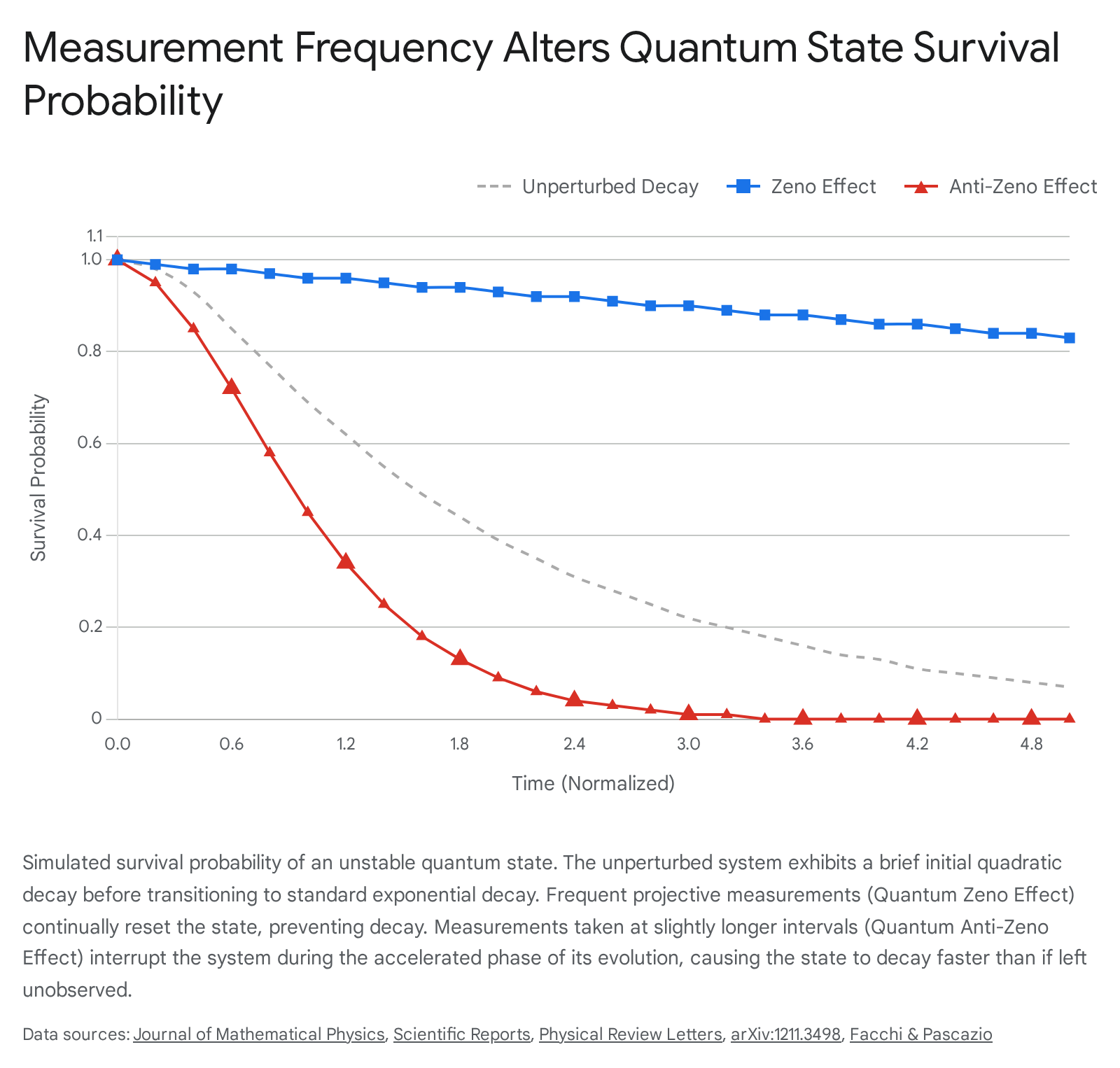
If an unstable system is left entirely unperturbed, the initial slow quadratic decay phase eventually develops an inflection point and transitions into standard exponential decay. This transition represents the threshold at which the system begins to irreversibly leak probability amplitude into a continuum of available environmental states.
The quantum anti-Zeno effect manifests when measurements are performed at intervals $\tau$ that are significantly longer than the Zeno time ($\tau_Z$) but still within the timeframe where the decay rate is accelerating toward its terminal exponential rate. By repeatedly interrupting the system at this specific intermediate interval, the measurement process essentially resets the system not to the flat top of the quadratic curve, but into a regime where the transition rate is maximized. This forces the system to repeatedly undergo the phase of fastest transition 816.
Unlike the Zeno effect, which relies on the universal lower bound of the Hamiltonian, the anti-Zeno effect is highly non-universal and model-dependent. It relies on the specific physical interaction between the system and its environment, specifically deriving from the interference of multiple complex poles in the lower half of the energy plane on a larger time scale 8. Analytically, the anti-Zeno effect depends on the overlap between the environment's spectral density - which describes the distribution of environmental modes available for the system to decay into - and a measurement-induced "filter function" 91213.
According to time-dependent perturbation theory and energy-time uncertainty, when measurements become more frequent, the energy width of the decaying state broadens. If the surrounding environment possesses a broad spectrum of modes at these newly accessible energy widths, the broadened state can couple to more decay channels. Consequently, the disruptive act of checking the system actively increases the number of pathways through which it can decay, resulting in a significantly enhanced overall decay rate 916.
Coupling Strength and System Regimes
The exact occurrence of a Zeno versus an anti-Zeno regime is further modulated by the strength of the coupling between the quantum system and its thermal or radiative bath. In standard weakly coupled systems, increasing the measurement rate $\gamma$ generally results in a predictable crossover from an anti-Zeno regime (at slower measurement rates) to a Zeno regime (at high measurement rates) 912.
However, studies investigating strongly interacting regimes - such as a single two-level system strongly coupled to a collection of harmonic oscillators via a polaron transformation - reveal distinct qualitative differences. In strongly coupled systems, the effective decay rate does not depend linearly on the spectral density of the environment. Furthermore, depending on the exact state being repeatedly prepared (for instance, an excited state versus a uniform superposition of ground and excited states), increasing the system-environment coupling strength can either invert the expected decay rate behaviors or trap the system deeper into an anti-Zeno acceleration phase 914.
Comparison of QZE and QAZE Characteristics
The specific conditions, mathematical requirements, and observational outcomes of the two regimes vary significantly based on timing and environmental variables.
| Characteristic | Quantum Zeno Effect (QZE) | Quantum Anti-Zeno Effect (QAZE) |
|---|---|---|
| Impact on Evolution | Inhibits or completely freezes unitary time evolution. | Accelerates or enhances the rate of state transitions and decay. |
| Measurement Interval ($\tau$) | Extremely short ($\tau < \tau_Z$); near continuous observation limits. | Intermediate ($\tau > \tau_Z$ but prior to purely exponential decay phases). |
| Decay Rate Dependency | Effective decay rate strictly decreases as the interval $\tau \to 0$. | Effective decay rate increases as $\tau$ decreases within specific resonant bounds. |
| Theoretical Foundation | Universal; derives from the branch point and strict lower energy bound of the Hamiltonian. | Model-dependent; arises from the interference of complex poles and spectral density overlap. |
| Environmental Coupling | Effectively decouples the system from its decohering environment. | Broadens state energy, forcing the opening of additional decay channels into the environment. |
Experimental Verifications
While Turing, von Neumann, and Sudarshan laid the theoretical groundwork, physical confirmation required decades of advancement in precision quantum optics and atomic isolation. The theoretical predictions of both the Zeno and anti-Zeno effects were definitively confirmed in physical systems beginning in the 1990s.
In 1990, a team led by Itano et al. successfully demonstrated the quantum Zeno effect using an oscillating system of beryllium ions. The researchers confined the ions in a trap and utilized an applied radio-frequency field to drive the system from a ground state to an excited state. By simultaneously applying short optical laser pulses to repeatedly measure whether the ions had made the transition, they successfully inhibited the induced transition between energy levels. The high-frequency measurements caused the state to freeze, directly verifying the suppression of unitary evolution 4511.
A decade later, in 2001, Mark G. Raizen and his research group at the University of Texas at Austin achieved a landmark result: the first simultaneous observation of both the Zeno and anti-Zeno effects in a genuinely unstable system. They trapped ultracold sodium atoms in an accelerating optical lattice where the atoms could continuously escape via quantum tunneling. By varying the frequency of measurements that interrupted the tunneling process, the researchers were able to cleanly map the crossover between the two effects. High-frequency interruptions suppressed the tunneling loss, confirming the QZE, while lower-frequency interruptions significantly enhanced the tunneling loss, confirming the QAZE, matching theoretical predictions without adjustable parameters 610.
Typologies of Quantum Measurement
The term "measurement" in the context of the quantum Zeno effect is highly nuanced and often misunderstood. It does not strictly require a conscious human observer or a macroscopic laboratory apparatus; rather, it refers to any physical interaction that correlates the state of the quantum system with an external environment, effectively extracting information and interrupting unitary evolution 267. Research distinguishes between several specific measurement typologies that influence the manifestation of the Zeno effect.
Projective Measurement (Selective vs. Non-Selective)
The classical formulation of the Zeno effect relies on von Neumann projective measurements. In this paradigm, an external macroscopic device instantaneously interacts with the system at discrete intervals, forcing the wavefunction to collapse precisely into an eigenstate of the measured observable 6711.
Projective measurements can be mathematically subdivided into selective and non-selective measurements. In selective projective measurements, the result is read out, and the observer discards any statistical trials where the system is found to have decayed (a process known as post-selection). In non-selective measurements, the physical interaction occurs, and the wavefunction collapses, but the specific outcome is ignored by the observer. Theoretical models indicate that the quantum Zeno effect persists even under non-selective measurements, freezing the evolution of the density matrix. However, the exact transition dynamics and crossover points between the QZE and QAZE can differ very significantly from the selective case, particularly when analyzing models outside the weak system-environment coupling regime 20.
Continuous Environmental Monitoring
The necessity of discrete, instantaneous measurement pulses has been challenged by formulations involving continuous measurement. According to modern decoherence theory, an "ideal" quantum Zeno effect corresponds to a mathematical limit where a quantum system is continuously coupled to an infinitely large source of thermal randomness, such as a thermal bath 6.
If a system interacts strongly and continuously with its environment, the environment continuously "measures" the system by becoming entangled with it. This process, governed by non-Hermitian Hamiltonians, extracts information about the system's state and distributes it redundantly into the bath - a mechanism deeply related to the paradigm of quantum Darwinism 1516. If this continuous coupling is strong enough, it restricts the system's evolution precisely like discrete projective pulses. The resulting states are confined to specific "Zeno subspaces." Within these protected subspaces, the system can evolve unitarily, but transitions between different subspaces are strongly hindered by the continuous environmental observation, a phenomenon sometimes referred to as the watchdog effect 261724.
Weak Measurements
In contrast to strong projective measurements, weak measurements involve coupling the primary quantum system to a measurement probe so loosely that the system's state is barely disturbed. Weak measurements yield very little information per single interaction and do not cause an instantaneous, complete collapse of the wavefunction 132526.
Rather than projecting the system strictly into a definite state, weak measurements cause a gradual collapse or a diffusion of the quantum state over a finite measurement time $\tau_{meas}$, often analyzed using Bayesian formalisms 18. A continuous sequence of weak measurements can eventually sum to the informational equivalent of a strong projective measurement. Advanced research indicates that a Zeno-like stabilization effect can still occur under weak measurements, where accumulated measurement errors introduce fluctuations in on-site energies, actively dephasing the system and ultimately slowing down its transition rates 619.
Thermodynamic Costs of the Zeno Effect
The physical act of extracting information from a quantum system is fundamentally bound by the rigid laws of thermodynamics. The quantum Zeno effect, therefore, is not merely a kinematic quirk of Hilbert space; it exacts a strict thermodynamic toll that governs its physical implementation 82031.
The Energetics of Measurement and Landauer's Principle
A complete quantum measurement involves creating physical correlations between the target system and the measurement apparatus, followed by an irreversible transition to a statistical mixture of definite outcomes (decoherence), and finally, the resetting or erasure of the apparatus's memory 1520.
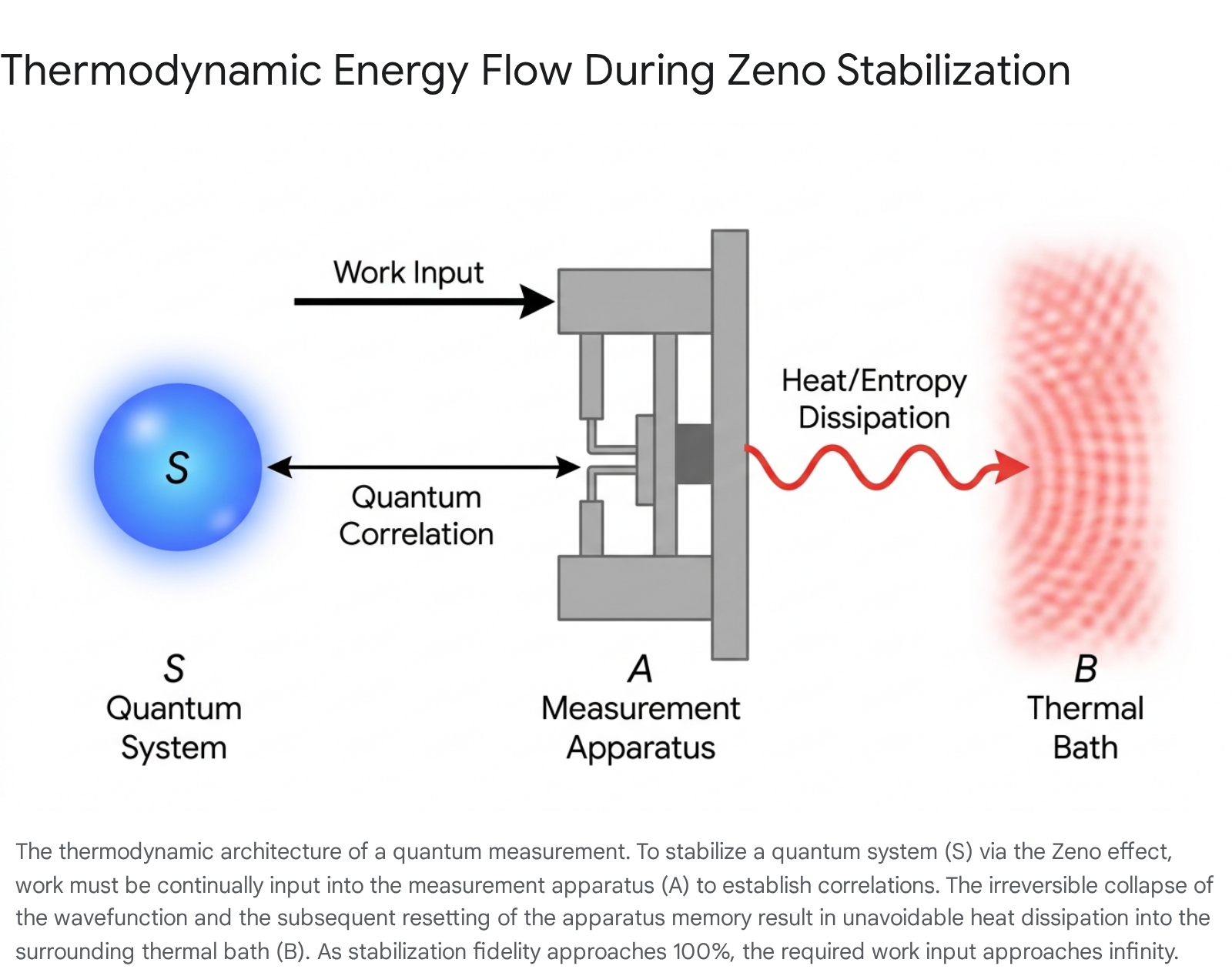
Following Landauer's principle, the erasure of information - or the compression of the apparatus's phase space to reset it for the next measurement pulse - requires an unavoidable dissipation of heat to a thermal bath, consuming a minimum amount of work equivalent to $\ln 2(k_B T)$ per bit of resolved state 831.
When utilizing the quantum Zeno effect to stabilize an unstable state, this energetic cost scales linearly with the number of measurements. If a pure state $|0\rangle$ is continuously rotated by a perturbing Hamiltonian $H$, stabilizing it requires $N$ sequential measurements over a given time $T$. The minimal work required depends directly on the system's energy variation and information-theoretic quantities defining the efficiency and completeness of the measurement interaction 1520.
The Energy-Precision Trade-off and Entropy
Recent thermodynamic analyses have established exact mathematical scaling laws for the absolute energy cost of Zeno stabilization. To achieve a target stabilization fidelity $F$ (representing precision) over a time $t$, the required number of measurements $N$ must increase drastically. Consequently, the total thermodynamic energy $E_{Zeno}$ required scales logarithmically with the desired precision 32.
The total energy cost behaves approximately as: $\beta E_{Zeno} \simeq \frac{1}{2} \left( \frac{Et}{\hbar} \right)^2 \ln \frac{4.5}{1-F}$ where $\beta$ is the inverse temperature of the environment and $E$ is the energy scale of the perturbing Hamiltonian 32.
This equation reveals a profound fundamental physical limit: achieving perfect stabilization ($F \to 1$) demands an infinite amount of energy 32. Thus, the limit of mathematically continuous measurement ($N \to \infty$) required for an "ideal" quantum Zeno effect is physically impossible, as it would explicitly violate the first and second laws of thermodynamics. Any real-world implementation of Zeno stabilization faces an absolute ceiling dictated by the available thermodynamic work 83132. Furthermore, reducing the measurement duration to near zero (infinite measurement velocity) induces massive rising entropy production, highlighting a strict fundamental trade-off between the velocity of a measurement sequence and its underlying work cost 1520.
Despite these costs, researchers are exploring how to leverage Zeno dynamics to power quantum engines. By replacing standard quantum adiabatic transformations with "Zeno strokes" - where frequent measurements selectively lock the external state of the system to avoid transitions - engineers can theoretically deliver almost ideal isentropic transformations. Implementations of quantum Zeno heat pumps using quantum harmonic oscillators demonstrate that optimal thermodynamic performance can sometimes be achieved faster using measurement protocols than with traditional shortcuts-to-adiabaticity techniques 2033.
Applications in Quantum Engineering
Far from remaining an abstract philosophical paradox or a pure thermodynamics problem, the dual phenomena of the Zeno and anti-Zeno effects have become central operational mechanisms in the engineering of advanced quantum technologies, specifically in the realms of decoherence control and fault-tolerant computing architectures 221.
Qubit Readout and the Anti-Zeno Penalty
In contemporary quantum computing architectures, particularly those utilizing superconducting qubits, the terminal readout process poses a significant vulnerability. It has been extensively documented that the lifespans of superconducting qubits can degrade severely during dispersive readout, leading to destructive non-quantum nondemolition (non-QND) errors that wipe out computational data 2223.
Recent research demonstrates that this specific readout degradation is fundamentally driven by the quantum anti-Zeno effect. The physical act of reading the qubit induces measurement-based dephasing, which broadens the energy width of the qubit state. This broadening causes the qubit's frequency to overlap with "hot spots" of strong dissipation within the local radiative bath, primarily caused by parasitic two-level systems (TLS) or defects in the surrounding physical material 2223. Consequently, the act of attempting to measure the qubit inadvertently opens new energetic decay channels, accelerating its relaxation and actively destroying the state it was meant to record 23.
By understanding this mechanism, quantum engineers can use flux-tunable controls to navigate away from these spectral overlaps. When calibrated correctly, measurement sequences can avoid anti-Zeno acceleration entirely and instead utilize Zeno suppression, actively extending the lifetime of the qubit during readout. Alternatively, engineers can execute fast, targeted resets of the qubit state by intentionally steering the system into anti-Zeno transitions when wiping the qubit memory is desired 162223.
Zeno Subspaces and Zeno Dragging
Beyond discrete qubit readout, continuous Zeno dynamics offer a sophisticated methodology for protective quantum control. When a multi-level quantum system is subjected to strong continuous measurement, the total available Hilbert space is partitioned into isolated "Zeno subspaces." Transitions between these subspaces are strictly forbidden by the measurement backaction, but the system remains free to undergo coherent, unitary evolution within the confines of a single protected subspace 172424.
This property enables an advanced technique known as "Zeno dragging." By slowly varying the monitored observable over time, the eigenvectors of the measurement operator change. The system, pinned to the Zeno subspace by continuous measurement, is forcibly dragged along the defined trajectory with high fidelity 24. This measurement-driven control mimics standard adiabatic evolution but utilizes engineered dissipation rather than purely coherent Hamiltonians. Theoretical methods, such as 'shortcut to Zeno' (STZ) and the Chantasri-Dressel-Jordan stochastic action models, are currently used to optimize these dragging schedules, opening new pathways for dissipatively stabilized quantum logic gates 24. Additionally, researchers have demonstrated that controlling multi-level qutrits via an ancilla monitoring qubit can leverage the Zeno regime to effectively shelve states, delay spontaneous emission, and perform complex operations like dense coding and teleportation 25.
Quantum Error Correction and Fault Tolerance
The most critical application of the quantum Zeno effect lies at the frontier of large-scale fault-tolerant quantum error correction (QEC). The ultimate goal of QEC is to reach the "break-even" point, a threshold where the lifetime of an encoded logical qubit heavily surpasses the natural lifetime of its constituent physical parts 2627. Early milestones, such as those achieved by Yale researchers in 2016, demonstrated a break-even point by suppressing energy loss in a superconducting resonator, extending logical lifetimes to 320 microseconds using real-time feedback and correction protocols 2627.
Prominent QEC architectures, such as the surface code famously advanced by Google Quantum AI and others, rely on two-dimensional grids of physical data qubits interspersed with auxiliary measure qubits 2282930. The system continuously performs parity checks (stabilizer measurements) on the data qubits. These measurements extract localized entropy and identify errors without collapsing the globally entangled encoded logical state 2629.
This continuous, high-frequency syndrome measurement is the quantum Zeno effect utilized at an industrial engineering scale 2. The frequent measurements effectively freeze the propagation of local physical errors, preventing them from evolving into catastrophic, uncorrectable logical errors. Recent 2024 demonstrations by Google Quantum AI showed that a distance-5 surface code logical qubit modestly outperformed an ensemble of distance-3 logical qubits, lowering the average logical error per cycle. When the Zeno effect acting on the error syndromes outpaces the underlying physical decoherence rate, the system crosses the theoretical threshold into practical, scalable fault tolerance 22829.
Epistemological and Macroscopic Implications
The highly counter-intuitive nature of the quantum Zeno effect has historically attracted significant philosophical speculation, leading to persistent public misconceptions regarding its scope and its relationship to the macroscopic world.
The Breakdown of Classical Comparisons
A common theoretical inquiry involves asking why classical macroscopic objects - which are seemingly observed continuously by ambient light or physical interaction - do not freeze in place due to the Zeno effect 44. The answer lies in the stringent mathematical requirements of quantum measurement and uncertainty.
First, the quantum Zeno effect strictly requires distinguishable, quantized states (e.g., discrete atomic energy levels). Macroscopic objects operate in a continuous spatial continuum where the Heisenberg uncertainty principle dominates. A measurement of a classical particle's physical position possesses an inherent uncertainty in both spatial resolution ($\Delta x$) and temporal precision ($\Delta t$). Because the measurement lacks infinite precision, it does not project the system into an identical, pure eigenstate repeatedly. Furthermore, measuring position continuously acts as a strong measurement that disrupts momentum. Instead of freezing the object's position, repeated imprecise measurements violently disturb its momentum, ultimately increasing the system's kinetic energy and causing it to diffuse or move erratically rather than locking it in place 4445.
The Role of the Observer and Consciousness
Another prominent misconception - championed by certain minority interpretations of quantum mechanics and often popularized in non-technical literature - posits that the Zeno effect requires a conscious observer, suggesting that the human mind physically holds reality in place by generating rapid quantum measurements through attention 346.
Modern decoherence theory and the thermodynamic analysis of measurements explicitly refute this framework. The "measurement" responsible for the quantum Zeno effect is entirely objective, mechanistic, and physical. It is a thermodynamic coupling between a quantum state and an external environment (whether that is a thermal bath, an ambient electromagnetic field, or a supercooled silicon readout resonator). The environment automatically entangles with the system and carries away information, functioning flawlessly as the measuring apparatus. Wavefunction collapse, entropy generation, and the subsequent Zeno freezing occur deterministically based on the Hamiltonian and coupling strengths, regardless of whether the extracted information is ever registered by a biological consciousness 6715.
The quantum Zeno effect demonstrates that observation in the quantum realm is an intrinsically physical act. By repeatedly collapsing a wavefunction, measurement intercepts the slow initial phase of quantum decay, effectively resetting the evolutionary clock. Moving forward, the strategic application of these measurement-induced dynamics will remain a foundational pillar in the pursuit of scalable quantum computation.