
What Is the Hubble Tension
The Hubble tension is a persistent, mathematically verified discrepancy between two different methods used to measure the expansion rate of the universe. Calculations based on the physics of the early universe consistently yield a significantly slower expansion rate than direct physical measurements of the modern, local universe. Because advanced observations have comprehensively ruled out simple instrument errors, this mismatch strongly suggests that our current standard model of cosmology is incomplete and requires novel fundamental physics.
The Foundations of an Expanding Universe
To understand the Hubble tension, one must first understand the concept of cosmic expansion. For most of human history, the cosmos was assumed to be an eternal, static expanse. That perception was permanently shattered in the late 1920s when astronomer Edwin Hubble - building on theoretical foundations laid by Georges Lemaître and Alexander Friedmann - demonstrated that distant galaxies are moving away from Earth 113. More importantly, the farther a galaxy is located from our own Milky Way, the faster it appears to be receding 32.
This relationship between distance and recessional velocity is captured by a single, critical number known as the Hubble constant, commonly denoted as H0 23. The Hubble constant describes the present-day rate of cosmic expansion and is measured in units of kilometers per second per megaparsec (km/s/Mpc) 12. A megaparsec is equivalent to approximately 3.26 million light-years. Therefore, if the Hubble constant is exactly 70 km/s/Mpc, it means that for every 3.26 million light-years of distance separating two galaxies, the expansion of the universe pushes them apart by an additional 70 kilometers every single second 45.
Determining the exact value of the Hubble constant is arguably the most important quest in modern astrophysics. It unlocks the answers to fundamental questions regarding the cosmos, including its precise age, its observable size, and its ultimate fate 267. An older, slower-expanding universe has vastly different implications for the nature of physics than a younger, faster-expanding one 1011.
Correcting Common Misconceptions About Cosmic Expansion
When discussing the expansion of the universe, it is easy to rely on flawed intuitive models. A frequent and deeply ingrained misconception is that the universe is expanding "into" something - a pre-existing empty void that exists beyond an imaginary edge 1213. Related to this is the assumption that galaxies are flying apart through space like shrapnel propelled by a localized explosion 31214.
In the framework of general relativity, neither of these concepts is true. The universe is not expanding into space; rather, space itself is expanding 13148. The metric distance between any two unstressed points in the universe is continually increasing 1617. A more accurate, commonly used analogy is that of a rising loaf of raisin bread. As the dough bakes and swells, every raisin moves away from every other raisin. No single raisin sits at the true "center" of the expansion, and the raisins are not moving through the dough. The dough between them is simply expanding 179.
Furthermore, this expansion does not override strong local forces. Gravitationally bound systems - such as our solar system, the Milky Way galaxy, and even local clusters of galaxies - do not expand 16. The force of gravity on these local scales vastly overwhelms the gentle stretching of space 1619. The expansion of the universe is a phenomenon that only dominates in the vast, empty voids between distant galaxy clusters.
The Stakes: Age, Structure, and the Fate of the Cosmos
The exact value of the Hubble constant acts as a linchpin for the standard model of cosmology, known as Lambda-CDM (ΛCDM) 1820. In this acronym, "Lambda" represents dark energy, the mysterious force causing the universe's expansion to accelerate, and "CDM" stands for Cold Dark Matter, the invisible scaffolding that gives galaxies their structure 819.
If astronomers can measure the current expansion rate with absolute precision, they can run the cosmic clock backward to determine the exact moment of the Big Bang. Before high-precision space telescopes were launched, estimates for the age of the universe varied wildly, ranging anywhere from 9.7 billion to 19.5 billion years 2. Refinements of the Hubble constant eventually pinned this number down to roughly 13.8 billion years 2. However, if the Hubble tension proves that the expansion rate is significantly faster than theoretical models predict, the universe could be hundreds of millions of years younger than previously believed 1021.
Furthermore, the expansion rate dictates the ultimate fate of the universe. In cosmology, there is a constant tug-of-war between the gravitational pull of all the matter in the universe trying to pull everything together, and the repulsive force of dark energy pushing space apart 1722. If expansion dominates entirely, the universe will ultimately suffer a "Big Freeze" or "Heat Death," where galaxies become totally isolated, stars burn out, and the cosmos grows eternally dark and cold 22. If gravity were to eventually win, the expansion would reverse, leading to a "Big Crunch" 22. Pinning down H0 is the key to knowing which fate awaits.
Measuring Cosmic Expansion: Two Incompatible Frameworks
The Hubble tension exists because the universe offers astronomers two completely distinct methodologies for measuring how fast it is expanding. One method requires looking as far back in time as possible, observing the radiation left over from the infancy of the universe. The second method requires observing the modern, local universe as it exists today. In theory, if the standard model of cosmology is correct, both methods should yield the exact same number. In reality, they do not 123.
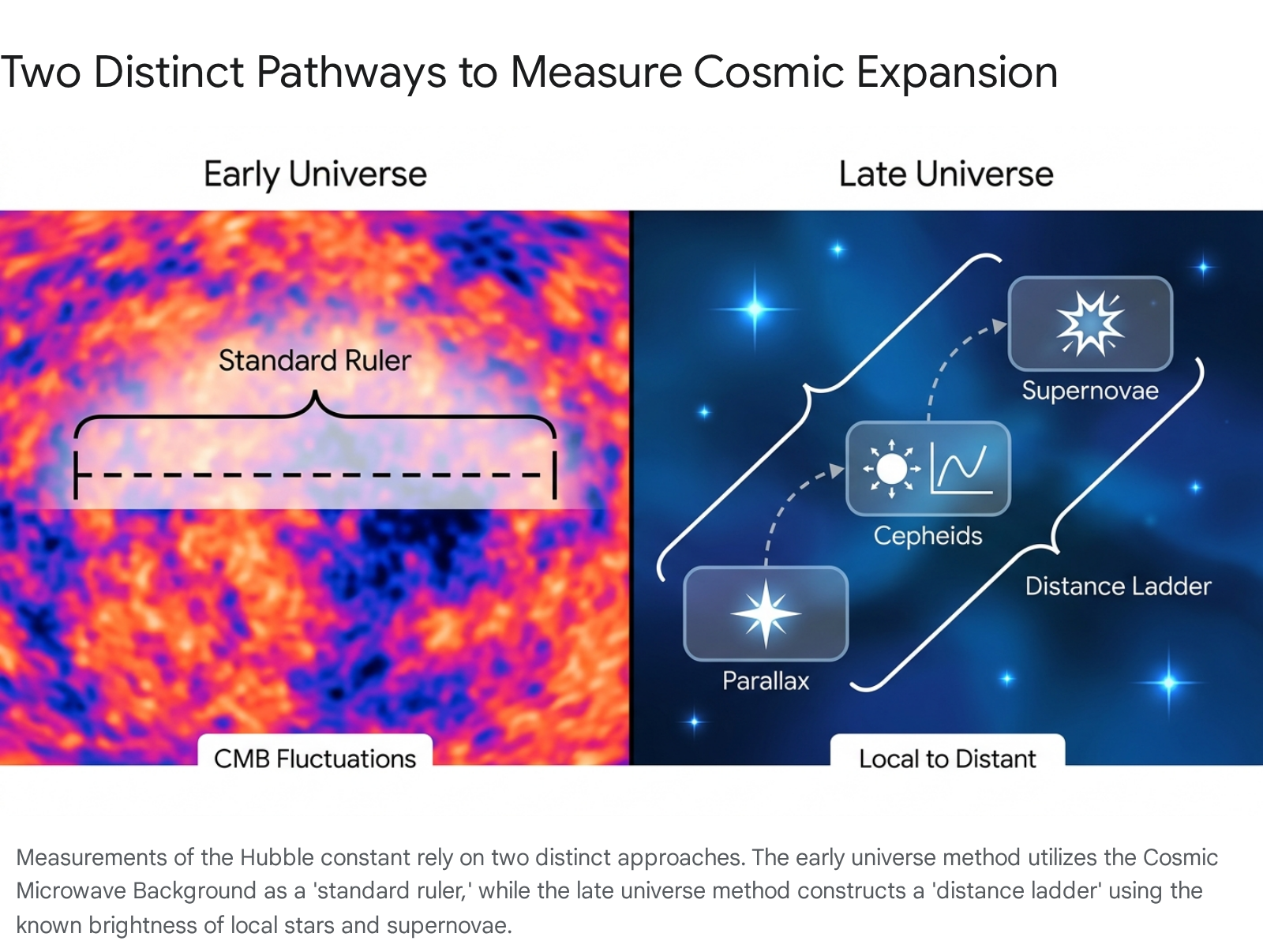
The Early Universe Method: The Standard Ruler
The first approach relies on the physics of the early universe. Roughly 380,000 years after the Big Bang, the universe was a dense, searing-hot plasma of interacting particles and radiation 102526. Within this primordial soup, a massive cosmic tug-of-war took place. The gravity of dark matter pulled ordinary baryonic matter inward, while intense radiation pressure pushed it outward 19. This dynamic created colossal sound waves - known as baryon acoustic oscillations (BAO) - that rippled continuously through the cosmic fluid 819.
Eventually, the expanding universe cooled just enough for protons and electrons to combine into the first neutral atoms. At this exact moment, radiation was finally free to travel through space unhindered 2526. This flash of first light is visible to us today as the Cosmic Microwave Background (CMB), a faint glow of microwave radiation permeating the entire sky 1027. When the universe became transparent, those massive sound waves were suddenly frozen in place, leaving a pattern of slight temperature and density variations imprinted on the CMB 828.
The physical size of these frozen ripples is called the "sound horizon" 828. Because the plasma physics of the early universe is thoroughly understood, astrophysicists can calculate the precise physical size of this sound horizon at the moment it froze 2829. By observing how large these ripples appear in the sky today, researchers can use the sound horizon as a cosmic "standard ruler" 8.
By taking this standard ruler and applying the mathematics of the standard ΛCDM cosmological model, scientists can extrapolate forward across 13.8 billion years of cosmic history to predict exactly how fast the universe should be expanding today 1823. Data from the European Space Agency's Planck satellite, which mapped the CMB with extraordinary precision, yields a predicted Hubble constant of 67.4 ± 0.5 km/s/Mpc 4828.
The Late Universe Method: The Cosmic Distance Ladder
The second approach measures the expansion rate empirically by observing the universe as it behaves today (the late, or local, universe) 13. This requires measuring two distinct variables for thousands of different galaxies: how fast they are moving away from us, and exactly how far away they are 7827.
Measuring a galaxy's recessional velocity is relatively straightforward using spectroscopy; as an object moves away, its light is stretched into longer, redder wavelengths, a phenomenon known as cosmological redshift 15. Measuring the exact physical distance to that galaxy, however, is notoriously difficult 827. To solve this, astronomers construct a "cosmic distance ladder," calibrating increasingly distant cosmic objects through a sequence of interlocking steps 11112.
The distance ladder relies on "standard candles" - astronomical objects that have a known, consistent intrinsic brightness 2811. If an observer knows exactly how bright an object actually is, they can calculate its exact distance by measuring how dim it appears from Earth. This relies on the inverse-square law of light, much like judging the distance to an approaching car on a dark highway by calculating how faint its headlights appear 27.
The traditional cosmic distance ladder uses a multi-rung approach: 1. Parallax: Using the Earth's orbit around the sun to geometrically measure the distance to nearby stars within the Milky Way 810. 2. Cepheid Variable Stars: These are massive, pulsating stars whose pulse rate is directly correlated to their absolute luminosity. By measuring the pulse rate of a Cepheid, astronomers know its true brightness, making it a reliable standard candle 28. 3. Type Ia Supernovae: These are exploding white dwarf stars. Because they detonate at a highly specific mass threshold, their explosions result in a consistent, brilliant peak luminosity 1211. They are bright enough to be seen in distant galaxies where individual Cepheid stars are invisible, extending the distance ladder deep into the cosmos 12.
Over the last two decades, teams such as the SH0ES (Supernova H0 for the Equation of State of Dark Energy) collaboration, led by Nobel laureate Adam Riess, have used the Hubble Space Telescope to painstakingly build this ladder. Their direct observations of the local universe consistently yield a Hubble constant of approximately 73.0 to 73.5 km/s/Mpc 583233.
The Origin of the Tension and the Crisis in Cosmology
For decades, cosmological measurements possessed large enough error margins that the early universe predictions and the late universe observations effectively overlapped. Before the launch of modern space telescopes, the Hubble constant was broadly estimated to be somewhere between 50 and 100 km/s/Mpc 213.
However, as astrophysics entered the "precision era," detectors improved, mathematical models became highly sophisticated, and massive surveys cataloged billions of stars 11010. The error bars on the data sets began to shrink dramatically. Eventually, it became mathematically impossible to ignore that the numbers were converging on two entirely different values.
| Measurement Approach | Data Source | Implied Hubble Constant (H0) | Characteristics |
|---|---|---|---|
| Early Universe Prediction | Planck Satellite (CMB) | 67.4 ± 0.5 km/s/Mpc | Relies heavily on ΛCDM modeling; very small statistical uncertainty 4833. |
| Late Universe Observation | SH0ES Collaboration (Cepheids) | ~73.0 ± 1.0 km/s/Mpc | Model-independent; relies on direct astronomical distance ladders 13314. |
The gap between 67.4 and 73.0 km/s/Mpc may seem negligible, representing a difference of only about 8-9% 913. However, the precision of modern instruments means this discrepancy is massive in statistical terms 915. The tension has grown to a statistical significance of 5 to 7 standard deviations (sigma) 37383940. In physics, a 5-sigma discrepancy is considered the gold standard for a definitive discovery, indicating that the odds of this mismatch being a random statistical fluctuation are less than one in a million 21.
The inability to reconcile these figures has led to widespread acknowledgment of a "crisis in cosmology" 2516. To address this, over 500 researchers collaborated to produce the 400-page CosmoVerse white paper in 2025, detailing the severe discordances between theoretical predictions and empirical observations 424344. The scientific community was forced to confront a binary reality: either there were massive, unrecognized systematic errors in how telescopes were measuring the local universe, or the standard model of cosmology was fundamentally broken.
The James Webb Space Telescope Era (2024 - 2025)
For a long time, the easiest hypothesis to swallow was that human error was to blame 123. Since the CMB measurements from the Planck satellite were considered exquisitely precise, skepticism frequently fell upon the local distance ladder, specifically the reliance on Cepheid variable stars 381746.
Astrophysicists hypothesized that "stellar crowding" could be artificially skewing the distance ladder 1747. The Hubble Space Telescope operates primarily in visible light. When peering at distant galaxies to identify Cepheids, the light from a target star could easily blend with the light of neighboring stars in crowded galactic fields, making the Cepheid appear brighter than it actually is. Furthermore, intervening cosmic dust could obscure the light in unpredictable ways 1747.
The launch of the James Webb Space Telescope (JWST) offered a direct, high-powered way to test this hypothesis. JWST's near-infrared capabilities allow it to peer clearly through cosmic dust, and its vast resolution allows it to easily separate individual stars in densely packed galaxies 274748.
Validating the Cepheids
In 2024 and 2025, the SH0ES team utilized JWST to re-examine the exact same Cepheid variables previously measured by the Hubble Space Telescope 321718. The results were definitive: JWST's crisp infrared observations perfectly matched the previous Hubble data 6321718. The earlier measurements were correct; stellar crowding and dust were not significantly impacting the calculations, and any lingering doubts about the fidelity of Hubble's data were erased 91718. The SH0ES team maintained their finding of an expansion rate near 73 km/s/Mpc, reinforcing the tension 932.
Alternative Standard Candles: The CCHP Results
However, another prominent research group, the Chicago-Carnegie Hubble Program (CCHP) led by Wendy Freedman, took a different approach with the JWST data. Recognizing that relying exclusively on Cepheids introduced systemic risk, the CCHP team utilized entirely different standard candles to build alternative distance ladders: 1. Tip of the Red Giant Branch (TRGB) stars: Aging stars that undergo a sudden, brilliant helium flash in their cores. This flash occurs at a highly predictable peak brightness, making them excellent standard candles 1319. 2. J-Region Asymptotic Giant Branch (JAGB) stars: Carbon-rich stars typically found in the outer, less crowded halos of galaxies, reducing the risk of stellar blending 131951.
In late 2024 and 2025, the CCHP team published results indicating a Hubble constant of 70.39 ± 1.22 km/s/Mpc 45152. This value sat uncomfortably in the middle of the tension 52. Because the CCHP value's error margins slightly overlapped with both the early universe predictions and the SH0ES local measurements, some researchers initially suggested that the Hubble tension might be an illusion caused by over-reliance on a single type of star 7134852. The CCHP argued that when multiple methods were averaged, the tension all but disappeared, seemingly saving the standard cosmological model 71353.
The 2026 Turning Point: The Local Distance Network
The debate between the SH0ES findings (using Cepheids) and the CCHP findings (using TRGB and JAGB stars) threatened to stall cosmological progress in a tug-of-war over specific stellar calibrations 452. A traditional cosmic distance ladder is inherently fragile; it is only as strong as its weakest rung. If a single calibration step is flawed, the error cascades outward along the entire chain 3954.
To definitively settle the true value of the local expansion rate, a massive international collaboration convened at the International Space Science Institute (ISSI) in Bern, Switzerland, in March 2025 251554. The result of this summit was the formation of the H0 Distance Network (H0DN) collaboration, which published a landmark, consensus-driven report in April 2026 155455.
The H0DN collaboration abandoned the linear "ladder" concept entirely. Instead, they built a "Local Distance Network" - a highly complex mathematical framework that simultaneously linked multiple, overlapping distance indicators 395420. This network integrated data from Cepheids, the Tip of the Red Giant Branch, carbon-rich asymptotic giant branch stars, supernovae (both Type Ia and Type II), surface brightness fluctuations, and several other geometric anchors across a census of nearly 100 nearby galaxies 39545521.
By utilizing a statistical technique known as covariance weighting, the network explicitly accounted for shared uncertainties across different methods, ensuring that no single flawed measurement path could skew the final result 395558.
A Definitive Gap is Established
The exhaustive Local Distance Network analysis produced a robust and unyielding answer. Even when researchers subjected the network to extreme stress tests by systematically removing entire categories of data - such as stripping out all Cepheid data, or completely removing all TRGB data - the final result remained functionally unchanged 552159.
A comparison of the competing historical data points demonstrates the severity of the finalized gap:
| Methodology / Source | Reported Hubble Constant (H0) | Implied Category | Status as of 2026 |
|---|---|---|---|
| Planck Satellite (CMB) | 67.4 ± 0.5 km/s/Mpc 4828 | Early Universe Prediction | Baseline theoretical expectation 60 |
| CCHP JWST (TRGB/JAGB) | 70.39 ± 1.22 km/s/Mpc 45152 | Late Universe Observation | Outlier suggesting a middle ground 52 |
| SH0ES (Cepheids/SNe Ia) | 73.04 ± 1.04 km/s/Mpc 331461 | Late Universe Observation | Re-validated by JWST data 3218 |
| Local Distance Network | 73.50 ± 0.81 km/s/Mpc 155455 | Late Universe Consensus | Definitive local measurement 3955 |
The H0DN collaboration established the local Hubble constant at 73.50 ± 0.81 km/s/Mpc, achieving an unprecedented precision of just over 1% 155455.
This 2026 consensus effectively ended the debate over measurement errors. The result sits at a staggering 7.1 sigma deviation from the early-universe predictions of the ΛCDM model (67.24 ± 0.35 km/s/Mpc when combining early-universe variables) 405522. As the ISSI Bern researchers concluded, explanations that rely on overlooked errors in local distance measurements are no longer mathematically sustainable 155459. If the tension is real, astrophysics must look beyond the standard cosmological model to explain it.
Theoretical Solutions: Rewriting Cosmic History
Confirming the reality of the Hubble tension forces astrophysics into a profound paradigm shift. If the universe is expanding at 73.5 km/s/Mpc today, but the physics of the early universe dictates it should only be expanding at 67.4 km/s/Mpc, then something unpredicted must have occurred between the Big Bang and the present day to fundamentally alter the cosmic expansion rate 1020. Theoretical physicists classify potential solutions into two broad categories: early-universe modifications and late-universe modifications 20.
Modifying the Early Universe: Early Dark Energy (EDE)
Currently, the most favored theoretical solution involves injecting new physics into the cosmos in the brief, highly energetic window before the cosmic microwave background was formed 2838636465.
This framework hypothesizes a phenomenon called Early Dark Energy (EDE). Standard dark energy is the invisible force driving the accelerating expansion of the universe today, dominating the late-stage cosmos 1822. Early Dark Energy postulates that a different, exotic scalar-field form of dark energy existed shortly after the Big Bang 28296623. This EDE would have acted like a cosmological constant, accounting for roughly 7% to 10% of the total energy density of the universe around 50,000 years after the Big Bang, temporarily injecting an extra burst of expansion into the primordial plasma 296623.
Crucially, this early burst of expansion would have altered the physics of the primordial plasma, forcing the massive baryon acoustic sound waves to travel shorter physical distances before the universe cooled and the plasma froze 2866. This mechanism effectively shrinks the cosmic "sound horizon" 286523.
Because CMB measurements rely on the sound horizon acting as a standard ruler, shrinking that ruler changes the math. If the true physical size of the sound horizon is smaller than the standard ΛCDM model assumes, then calibrating our measurements against it naturally yields a higher predicted Hubble constant for the modern universe, smoothly bringing the theoretical prediction up to match the 73.5 km/s/Mpc local measurements 6523.
For this theory to remain consistent with all other observed data, the Early Dark Energy must have decayed away faster than radiation shortly after the universe became transparent, essentially vanishing from the cosmic stage before it could warp other astronomical structures 296623. While EDE is highly compelling mathematically, it faces theoretical challenges, such as the "cosmic coincidence" problem - why this energy appeared and disappeared at exactly the right moments - and potential conflicts with the observed clustering of galaxies (known as the S8 tension) 4023.
Late Universe Alterations and Evolving Dark Energy
Other theoretical pathways seek to modify the laws of physics at vast cosmic scales closer to the present day 1020.
Evolving Dark Energy: The standard ΛCDM model assumes that dark energy is a cosmological constant - meaning its energy density remains perfectly static as the universe expands 31922. However, recent data releases from the Dark Energy Spectroscopic Instrument (DESI) have hinted that this might be an incorrect assumption. DESI's mapping of baryon acoustic oscillations across millions of galaxies suggests that the dark energy equation of state (denoted as w) may be dynamic, evolving and changing in strength over billions of years 19202268. If dark energy's strength fluctuates, any mathematical extrapolation from the early universe directly to the present day using a constant value will inevitably be incorrect, resulting in a false tension 20.
Interacting Dark Energy: The standard model assumes that dark matter and dark energy are entirely separate components that do not speak to one another 69. Novel models of Interacting Dark Energy (IDE) propose that dark energy might interact with and transfer momentum to dark matter. This interaction would alter the density of normal baryonic matter required by the equations to fit the data, gradually pulling the predicted expansion rate closer to the observed values 69.
Modified Gravity: Some physicists suggest that Einstein's theory of general relativity may not perfectly describe gravity on the largest scales of the universe 1020. Certain modified gravity models (such as f(R) gravity) introduce scalar fields that dynamically alter the expansion history of the universe at low redshifts. These models naturally speed up the local expansion rate to accommodate supernova data without breaking the early universe framework established by the CMB 70247273.
Bottom line
The Hubble tension is the mathematically verified discrepancy between the universe's expansion rate predicted by early-cosmic physics (~67.4 km/s/Mpc) and the rate measured directly in the modern universe (~73.5 km/s/Mpc). Exhaustive 2026 analyses utilizing the Local Distance Network have decisively ruled out measurement errors or telescope flaws as the source of the disagreement, cementing the gap at a severe 7.1-sigma statistical significance. Readers should understand that this tension represents a genuine crisis in cosmology, proving that the standard model of physics is fundamentally incomplete. What remains deeply uncertain is the exact nature of the missing physics - whether the universe requires a brief, ancient phase of "Early Dark Energy," a modification of Einstein's laws of gravity, or a dark energy force that dynamically evolves over time.