
What Is Neuroplasticity and Can Adults Change Their Brains
Adults can absolutely rewire their brains throughout their lifespans, but doing so requires deliberate effort, novelty, and focused attention to overcome the brain's natural stabilizing mechanisms. While the passive, sponge-like learning of childhood eventually shuts down to protect our established memories and skills, specific lifestyle interventions - like aerobic exercise, deep sleep, and targeted cognitive speed training - can force the mature brain to build new neural pathways and actively stave off cognitive decline.
The Fall of the Ten Percent Myth and the Fixed Brain Dogma
For most of the 20th century, the prevailing scientific consensus and popular cultural understanding held that the adult human brain was a static, rigidly fixed organ. Scientists largely believed that humans were born with a set number of neurons and neural pathways that developed rapidly during childhood, solidified by early adulthood, and could only degrade or die off as a person aged 11.
Accompanying this bleak neurological outlook was a pervasive cultural myth: the idea that humans only use ten percent of their brain capacity. The origins of this specific fabrication are complex. It likely stems from a misinterpretation of the "reserve energy" theories proposed in the 1890s by Harvard psychologists William James and Boris Sidis, who posited that humans rarely meet a fraction of their full mental potential 24. In 1908, James wrote that humans make use of only a small part of their possible mental and physical resources, a philosophical statement that was later misquoted as a biological statistic 43.
The myth gained immense traction in the 1920s self-help movement, eventually cementing itself in popular consciousness when broadcaster Lowell Thomas repeated it in the preface to Dale Carnegie's bestselling book How to Win Friends and Influence People 24. Early neurological experiments inadvertently fueled the fire. In the 1920s and 1930s, psychologist Karl Lashley removed large sections of the cerebral cortex in rats and found they could still relearn specific tasks, leading to misunderstandings about "spare" brain capacity 5. Similarly, neurosurgeon Wilder Penfield discovered areas of the brain he termed the "silent cortex," which produced no immediate observable muscle twitches or sensory responses when stimulated with electricity 44.
Today, advanced neuroimaging techniques like functional magnetic resonance imaging (fMRI) and positron emission tomography (PET) scans have thoroughly debunked the ten-percent myth. The human brain accounts for roughly 2% of the body's total weight but greedily consumes 20% of its resting energy 43. Imaging reveals that virtually every part of the brain is highly active over the course of a day, even during sleep, and that damage to even microscopic areas of the brain can result in profound, cascading cognitive and motor deficits 44.
As the myth of the dormant brain died, so too did the dogma of the static brain. In its place emerged the central defining principle of modern neuroscience: neuroplasticity.
What Exactly Is Neuroplasticity?
Neuroplasticity - also known as neural plasticity or brain plasticity - is the encompassing term for the nervous system's ability to change its activity, reorganize its structure, and alter its functions in response to intrinsic or extrinsic stimuli 67. The term was championed by the "father of neuroscience," Santiago Ramón y Cajal, and later formalized by Polish neuroscientist Jerzy Konorski, who observed that the brain adapts dynamically to life experiences, injuries, and environmental shifts 18.
Neuroplasticity is not a single biological mechanism, but rather a spectrum of adaptive processes operating across different timescales and anatomical levels. These adaptations generally fall into two broad categories: structural plasticity and functional plasticity.
Structural vs. Functional Plasticity
The human brain consists of an estimated 100 billion neurons, connected by over 100 trillion synaptic junctions 910. The way these connections are managed defines the type of plasticity occurring.
| Feature | Structural Plasticity | Functional Plasticity |
|---|---|---|
| Definition | The brain's ability to physically alter its anatomical structure through the creation, removal, or physical modification of neural connections. | The brain's ability to alter the strength, efficiency, and organizational activity of existing neural networks without necessarily growing new hardware. |
| Primary Mechanisms | Axonal sprouting (new nerve fibers growing), creation or pruning of dendritic spines, and neurogenesis (the birth of entirely new neurons) 178. | Long-Term Potentiation (LTP), Long-Term Depression (LTD), cortical remapping, and alterations in neurotransmitter release 71112. |
| Timescale and Cost | Takes days, weeks, or months. Requires significant metabolic energy, protein synthesis, and biological building blocks. | Occurs rapidly, from milliseconds to hours. Highly efficient, allowing for rapid adaptation to sudden environmental changes 112. |
| Clinical Significance | Essential for long-term skill acquisition, deep memory consolidation, and physical recovery from stroke or traumatic brain injury (TBI) 67. | Drives short-term memory, daily habit formation, behavioral flexibility, and sensory compensation 112. |
A common analogy used by neuroscientists to explain these intertwined processes is walking through a dense, overgrown forest. The first time you attempt to navigate a new route, it is physically difficult to push through the underbrush. However, if you walk that exact same path every day, you eventually trample the weeds, pack down the dirt, and create a clear, defined trail that is effortless to navigate. Conversely, if you abandon a path for years, the forest eventually reclaims it 1314.
In neurological terms, this reflects the classic Hebbian theory formulated by Canadian psychologist Donald Hebb in 1949: "neurons that fire together, wire together" 1115. When a circuit is repeatedly activated, the synaptic connections between those specific neurons physically strengthen - a process called Long-Term Potentiation (LTP). If a circuit is ignored, Long-Term Depression (LTD) weakens the connection, and the brain may eventually physically prune the synapse to conserve energy, acting on a strict "use it or lose it" principle 111418.
Beyond Hebbian Plasticity: Behavioral Timescales and Mitochondria
While traditional Hebbian plasticity requires neurons to fire within strict milliseconds of one another to form a connection, recent discoveries have revealed that the brain possesses even more sophisticated learning mechanisms. In 2026, researchers highlighted "behavioral timescale synaptic plasticity" (BTSP), a mechanism allowing the brain to strengthen connections across a span of several seconds. This evolutionary adaptation explains how humans can learn from a single, highly salient experience - such as touching a hot stove or narrowly avoiding a traffic accident - without needing to repeat the behavior hundreds of times for the neurons to "wire together" 15.
Furthermore, plasticity is governed by the internal cellular machinery of the neurons themselves. A 2024 study out of the University of Cologne demonstrated that as new neural connections mature, their mitochondria - the powerhouses of the cell - undergo a massive boost in fusion dynamics, stretching into elongated shapes along the dendrites. This mitochondrial fusion is essential for sustaining the metabolic demands of synaptic plasticity, and its dysfunction is now believed to play a critical role in the cognitive decline seen in Alzheimer's and Parkinson's diseases 16.
The Childhood Sponge vs. The Adult Scaffold
If neuroplasticity is a lifelong biological reality, why is it profoundly easy for a three-year-old to absorb a new language or learn to play the violin, while an adult struggles for years to achieve a fraction of the same proficiency? The answer lies in the highly regulated timeline of brain development, characterized by the closing of early developmental windows and the application of aggressive molecular brakes.
Critical and Sensitive Periods
During perinatal development and early childhood, the brain exists in a state of hyper-plasticity. A toddler's brain contains roughly twice as many synapses as an adult's brain, resulting in a chaotic, highly connected neural environment 17. This era of development is defined by "critical" and "sensitive" periods 18.
A critical period is a narrow, unforgiving time window during which specific environmental inputs are absolutely required for the brain to develop properly 1920. For example, if a child is born with congenital cataracts that prevent light from reaching the retina, the visual cortex will literally wire itself to ignore the eyes. If the cataracts are not removed during this critical developmental window, the child will remain permanently blind, even if the eyes themselves are later repaired - a condition demonstrating experience-expectant plasticity 202122.
Sensitive periods are broader, more forgiving developmental windows where the brain is unusually responsive to experiences, but learning can still occur outside the window (albeit with much greater difficulty). First and second language acquisition are classic examples of sensitive period plasticity. Peak linguistic proficiency is heavily tied to exposure during early childhood, a time when the brain effortlessly wires the phonetic and grammatical rules of any language it encounters 1823.
During these early years, the brain acts as an active sponge. The neurochemical environment favors excitatory signals over inhibitory ones, making the brain exquisitely sensitive to the environment 1719. However, this hyper-plastic state cannot be sustained indefinitely. If the adult brain remained as volatile and malleable as a toddler's, every new experience, trauma, or sensory input could overwrite fundamental memories, motor skills, and personality traits 21. The brain must eventually prioritize stability over adaptability.
The Molecular Brakes Locking the Adult Brain
As the brain transitions from childhood through adolescence and into adulthood, it actively shuts down these sensitive periods. It achieves this by deploying several "molecular brakes" that physically and chemically restrict neuroplasticity, protecting the circuits it has spent years refining.
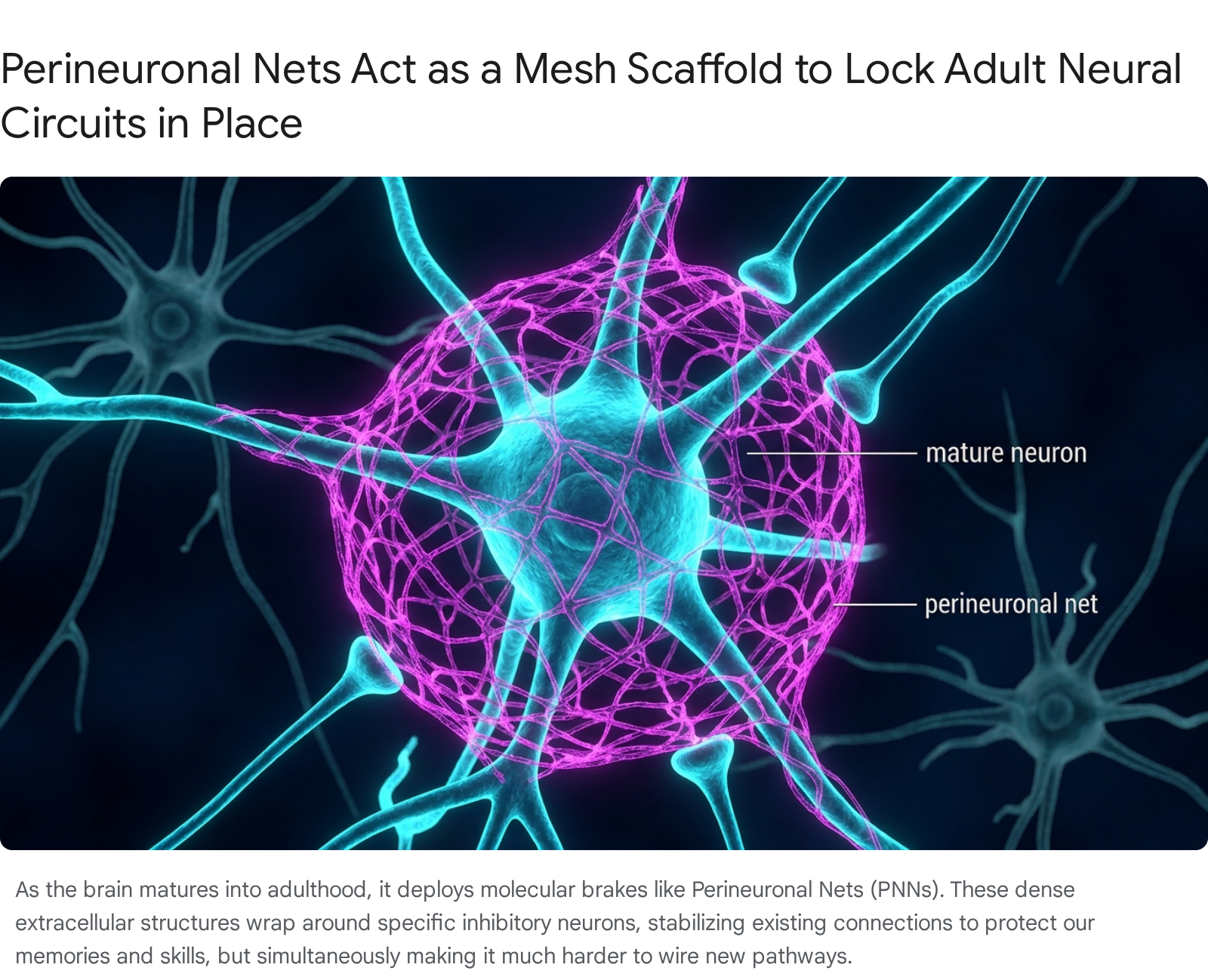
The transition from a highly plastic developmental state to a stabilized adult brain is orchestrated by a complex interplay of structural barriers and genetic regulators:
| The "Molecular Brake" | Anatomical / Chemical Function | Implication for Adult Neuroplasticity |
|---|---|---|
| Perineuronal Nets (PNNs) | Dense, cartilaginous structures of the extracellular matrix that wrap around the bodies of fast-spiking parvalbumin-positive interneurons 2425. | PNNs act as a physical chain-mail mesh, stopping new axonal sprouting and locking synapses in place. Experimentally dissolving PNNs in adult animals rapidly reopens childhood-like critical periods 2126. |
| Myelin and the SOX6 Protein | Myelin is the fatty insulation wrapping axons to speed up electrical transmission. A 2025 discovery revealed that the SOX6 protein acts as a brake on oligodendrocytes (myelin-producing cells) 27. | Heavily myelinated circuits are highly efficient but incredibly rigid. The SOX6 brake keeps repair cells in an immature state, preventing the spontaneous rewiring of deep pathways, which also complicates recovery from demyelinating diseases like MS 2127. |
| Setd8 Epigenetic Tags | A gene that controls the addition of chemical tags onto DNA-packaging histone proteins in neural stem cells 28. | By early adulthood, Setd8 expression drops sharply, drastically reducing the brain's ability to divide stem cells and generate new neurons in the hippocampus, thereby limiting regenerative plasticity 28. |
| Neuromodulator Dampeners (Lynx1) | A prototoxin protein naturally produced in the mature brain that actively binds to and dampens nicotinic receptors 2122. | Acetylcholine is the primary neurotransmitter for attention and learning. Lynx1 acts as a chemical muffler, making the adult brain resistant to everyday acetylcholine surges, requiring massive novelty or effort to trigger plasticity 2122. |
The Shift to Effort-Dependent Plasticity
Because of these pervasive biological brakes, adult neuroplasticity becomes strictly effort-dependent. While a child's brain reorganizes passively through mere exposure to the environment, an adult brain requires explicit chemical permission to rewire itself.
To overcome the friction of PNNs and Lynx1 dampeners, the adult brain must be flooded with specific neuromodulators: acetylcholine (to signal intense, unwavering attention) and dopamine or epinephrine (to signal novelty, reward, or acute stress) 152129. This is why passive routines - like driving the same route to work or doing a familiar hobby for the thousandth time - do not induce neuroplasticity. The brain has already built an efficient, myelinated circuit for that task, and it will default to that energy-saving pathway unless pushed significantly outside its comfort zone 1318.
The Fierce Debate Over Adult Neurogenesis
When discussing the brain's capacity to change, it is vital to draw a sharp line between rewiring existing cells (synaptic/structural plasticity) and growing entirely new brain cells (neurogenesis). While experience-dependent synaptic plasticity in adults is an undisputed scientific fact, the existence and extent of adult neurogenesis remains one of the most fiercely debated topics in modern neuroscience 930.
A History of Discoveries and Doubts
For the first half of the 20th century, scientists believed that neurogenesis ceased entirely after early childhood. This view was challenged in 1965 when researchers Joseph Altman and Gopal Das discovered newborn neurons in adult mice, followed by Fernando Nottebohm's 1983 discovery of neurogenesis in adult songbirds 31. By the late 1990s and early 2000s, studies using chemical markers like doublecortin (DCX) seemingly proved that the human hippocampus - the brain's command center for spatial learning, emotion, and memory - continued to mint new neurons well into old age 931.
However, the field was severely destabilized in 2018 when a landmark study by Arturo Alvarez-Buylla and colleagues at the University of California, San Francisco (UCSF) published findings in Nature. After analyzing postmortem human brain tissue, they demonstrated a sharp decline in neurogenesis in infants and concluded that the process drops to an undetectable absolute zero by the 13th year of life 3132.
The UCSF study sparked intense controversy. Skeptics pointed out that the traditional immunohistochemistry markers used to identify immature neurons degrade extraordinarily fast in human postmortem tissue. If brain tissue is not preserved within hours of death, the newborn neurons become invisible to traditional chemical staining, potentially leading to massive false negatives 303233.
The RNA Sequencing Revolution and Current Consensus
To bypass the flaws of chemical staining, researchers have recently turned to single-nucleus RNA sequencing (snRNA-seq), which allows scientists to read the exact genetic activity of individual cells.
In a pivotal 2022 study published in Cell Research, researchers successfully identified the genetic signatures of neural stem cells and active adult hippocampal neurogenesis (AHN) in both macaques and adult humans 30. The sequencing data revealed a nuanced reality: newborn neurons do exist in the adult human brain, but their numbers decline significantly with age. Crucially, the researchers discovered that the adult human hippocampus suffers from high levels of neuroinflammation, which creates a toxic local environment that actively suppresses the maturation and survival of these newborn cells 30.
The current scientific consensus is inherently cautious. While the human brain does appear to retain a highly localized, restricted reserve of neural stem cells in the dentate gyrus of the hippocampus, widespread, massive neurogenesis is not a defining feature of the adult brain 93234.
Fortunately, adults do not need to grow millions of new cells to fundamentally alter their behaviors, recover from trauma, or learn complex skills. The trillions of modifiable synaptic connections between the billions of cells we already possess provide virtually limitless capacity for structural and functional plasticity throughout the lifespan 9.
Proven Lifestyle Levers for Brain Rewiring
Because adult neuroplasticity is effort-dependent, individuals looking to actively leverage it to learn faster or stave off cognitive decline must take a holistic approach. The brain cannot physically remodel its synaptic connections without a concerted symphony of biological factors: increased blood flow to deliver oxygen, specific proteins to act as structural fertilizer, and rest periods to consolidate the changes.
The research consistently points to three non-pharmacological pillars that reliably induce neuroplasticity in the adult brain 113536.
1. Aerobic and Resistance Exercise
Physical exercise is arguably the most potent trigger for neuroplasticity known to science, fundamentally altering both the chemical and structural architecture of the brain 363738.
Aerobic exercise (such as running, cycling, or swimming) significantly increases cerebral blood flow and triggers the release of Brain-Derived Neurotrophic Factor (BDNF). BDNF acts as a molecular fertilizer in the brain; it promotes the growth of new dendritic spines, ensures the survival of existing neurons, and acts as the canonical synaptic "tag" that converts early-phase plasticity into long-term, protein-synthesis-dependent memory storage 373839.
Interestingly, resistance training (weightlifting) operates on distinct, highly complementary neurophysiological pathways. While aerobic exercise maximizes BDNF, resistance training uniquely elevates levels of Insulin-like Growth Factor 1 (IGF-1) and reduces systemic levels of Interleukin-6 (IL-6), a marker of chronic inflammation 11. This reduction in inflammation directly counters the neuroinflammatory environment that suppresses adult hippocampal plasticity 1130.
2. High-Quality Sleep and the Glymphatic System
Neuroplasticity does not occur instantaneously while you are learning a new skill; the actual physical remodeling of the neural architecture occurs while you sleep.
During the rapid-eye-movement (REM) and deep slow-wave stages of sleep, the brain replays the day's events, actively strengthening the synaptic pathways associated with new, important information while pruning away irrelevant connections to reduce synaptic noise 3537. Furthermore, sleep activates the glymphatic system - a macroscopic waste-clearance mechanism that flushes cerebrospinal fluid through the brain's interstitial spaces. This biological deep-clean removes toxic metabolic byproducts, including amyloid-beta plaques, creating the healthy cellular environment strictly required for structural plasticity to take hold 37.
3. Novelty, Diet, and Stress Management
Without the chemical signal of focused attention, the brain will not bother rewiring itself. Engaging in manageable, highly novel challenges - such as traveling to unfamiliar environments, learning a challenging musical instrument, or practicing complex spatial coordination - triggers the release of acetylcholine and dopamine, providing the chemical "permission" the adult brain needs to bypass its molecular brakes 183740.
Systemic health also profoundly dictates plastic potential. Chronic stress chronically elevates cortisol levels, which actively degrades hippocampal functioning and shrinks dendritic networks, severely impairing cognitive flexibility 137. Conversely, diets rich in specific nutrients have been shown to support plasticity. For instance, adequate Vitamin D supplementation has been shown to upregulate the transcription of BDNF, directly protecting the brain against age-related plasticity decline 39.
Do Brain Games Actually Work? What the Data Says
With global life expectancies rising and dementia rates soaring, the desire to harness neuroplasticity has spawned a multi-billion-dollar commercial "brain training" industry. For years, the scientific community maintained a healthy skepticism of these apps, warning that getting better at a mobile memory game simply makes a person better at that specific game, with little evidence that the skill transfers to real-world intelligence, driving safety, or memory retention.
However, recent long-term longitudinal studies have injected massive nuance into this debate, revealing that highly specific types of cognitive training can indeed alter brain chemistry and demonstrably delay the onset of clinical dementia.
The ACTIVE Study: A 20-Year Breakthrough
The Advanced Cognitive Training for Independent and Vital Elderly (ACTIVE) study is the largest and most significant clinical trial on cognitive training in history. Funded by the National Institutes of Health, the study began in 1998, enrolling over 2,800 healthy, independent adults aged 65 and older. Participants were randomized into four distinct groups: a memory training group, a reasoning training group, a computerized speed-of-processing training group, and a control group 414247.
The speed-of-processing intervention was highly specific: participants played an adaptive computer game that required them to identify an object in the center of the screen (like a car or a truck) while simultaneously tracking a distinct target in their peripheral vision, all while the game moved faster and faster to aggressively challenge divided attention 47.
In February 2026, researchers published the 20-year follow-up results, utilizing Medicare claims data to track which participants were eventually diagnosed with Alzheimer's disease and related dementias (ADRD). The findings were unprecedented in the field of non-pharmacological interventions.
Table 1: 20-Year Dementia Incidence in the ACTIVE Study (1999 - 2019)
| Study Cohort | Total Participants Tracked | Dementia Diagnoses (N) | Incidence Rate | Relative Risk Reduction |
|---|---|---|---|---|
| Control Group (No Training) | 491 | 239 | 49% | N/A (Baseline) |
| Speed-of-Processing Training (With Boosters) | 264 | 105 | 40% | ~25% Reduction |
Data indicates a notable decrease in clinical dementia incidence specifically linked to the speed-training intervention. Note: Participants in the boosted group completed approximately 23 total hours of training across a three-year span 4147.
The data demonstrates a statistically significant 25% lower risk of dementia over two decades for those who completed the speed training and subsequent booster sessions compared to the control group 41424349. Crucially, this protective effect was strictly specific to the speed-of-processing task. The cohorts that received traditional memory and reasoning training did not demonstrate a statistically significant reduction in long-term ADRD risk 474944.
Reversing the Chemical Clock: The 2025 McGill Study
Building on the framework of the ACTIVE study, a late-2025 clinical trial led by McGill University sought to find the biological mechanism behind these cognitive benefits. The researchers utilized rare, specialized Positron Emission Tomography (PET) imaging to observe the actual chemical changes inside the brains of 92 healthy older adults as they played specific cognitive games 514546.
Participants were randomly assigned to play either speed-based cognitive training games (specifically the BrainHQ app) or recreational entertainment games (like Solitaire or Candy Crush) for 30 minutes a day over 10 weeks 4046.
The results provided a biochemical explanation for the ACTIVE study's behavioral findings. After 10 weeks, the group playing the speed-based training showed a 2.3% increase in the production of acetylcholine in the anterior cingulate cortex - a brain region critical for executive function, error detection, and attention 4046. Acetylcholine naturally declines by about 2.5% every decade due to aging. Therefore, the 2.3% boost effectively restored the cholinergic system to levels typically seen in a brain 10 years younger, marking the first time a behavioral intervention successfully reversed this specific biomarker of neurological aging in humans 51454647. Participants who played casual entertainment games showed absolutely no change in acetylcholine levels 46.
The Crossword Puzzle Paradox
If specialized, high-speed cognitive apps are so effective, does this render traditional puzzles obsolete? Not entirely. A highly publicized 2022 randomized controlled trial published in NEJM Evidence tracked 107 adults, but with a critical distinction from the ACTIVE and McGill studies: these participants were already experiencing mild cognitive impairment (MCI), a precursor to dementia 4849.
Half of the MCI participants were assigned to computerized cognitive games, while the other half were assigned to digital crossword puzzles of medium difficulty. Over 78 weeks, the results deeply surprised researchers. The crossword puzzle group demonstrated significantly superior cognitive improvements on the primary cognitive outcome measure (ADAS-Cog), maintained better daily functioning, and most strikingly, exhibited less physical brain shrinkage (measured via MRI) compared to the computerized gaming group 4849.
The apparent contradiction between these studies reveals a highly nuanced truth about adult neuroplasticity based on the baseline neurological health of the individual.
Table 2: Efficacy of Cognitive Interventions Based on Neurological Baseline
| Intervention Type | Ideal Target Audience | Proven Neuroplastic Outcomes | Postulated Mechanism of Action |
|---|---|---|---|
| Speed-of-Processing Games | Healthy adults seeking long-term cognitive preservation 404143. | Restored acetylcholine levels 40; 25% lower risk of dementia over 20 years 41. | Forces the healthy brain into a high-alert state by dividing attention and continuously increasing the speed of visual stimuli, triggering adaptive, effort-dependent plasticity 4147. |
| Traditional Crossword Puzzles | Older adults already experiencing Mild Cognitive Impairment (MCI) 4849. | Less physical brain shrinkage over 18 months; stabilized daily functioning 49. | Relies on deep semantic memory networks. For a declining brain, learning a radically novel computer interface may induce counterproductive stress, whereas crosswords effectively stimulate familiar, resilient language pathways 49. |
The Frontier: Non-Invasive Brain Stimulation
While lifestyle adjustments and cognitive training rely on the individual to generate the internal chemical environment necessary for plasticity, some neurological conditions - such as severe depression, chronic pain, or acquired brain injuries (stroke, TBI) - create maladaptive neuroplastic loops that are incredibly difficult to break through behavioral effort alone 5051.
For these patients, the frontier of neuroscience lies in Non-Invasive Brain Stimulation (NIBS). Rather than implanting electrodes deep within the brain via highly invasive surgery (Deep Brain Stimulation), new technologies allow scientists to alter cortical excitability from the outside.
Techniques like Repetitive Transcranial Magnetic Stimulation (rTMS) use targeted magnetic fields to repeatedly pulse specific brain regions, actively forcing the induction of Long-Term Potentiation or Depression to rewire circuitry associated with treatment-resistant depression or motor impairment 5152.
Even more revolutionary is Transcranial Ultrasound Stimulation (TUS). In late 2025, researchers at the University of Plymouth demonstrated that tightly focused sound waves can be aimed at deep brain structures, such as the nucleus accumbens, which governs reward-seeking behavior and addiction. Applying ultrasound for just over a minute altered how participants learned and responded to rewards, proving that targeted sonic energy can safely manipulate the neuroplasticity of deep-brain circuits previously thought to be accessible only via surgical implants 53.
Bottom line
Adults possess a lifelong, profound biological capacity to physically and functionally rewire their brains, debunking decades of scientific dogma. However, this plasticity is heavily regulated; while children absorb information passively, the mature brain is locked down by molecular brakes that prioritize stability, meaning adult neuroplasticity strictly requires intense focus, novelty, and deliberate effort. While commercial brain training is not a universal cure-all, rigorous speed-of-processing exercises have proven uniquely capable of rejuvenating aging brain chemistry and significantly lowering long-term dementia risk. Ultimately, preserving a plastic, adaptable brain requires a holistic commitment to challenging cognitive tasks, aerobic exercise, and high-quality sleep to overcome the biological friction of aging.