
Neuroscience of Adolescent Brain Development
The transition from childhood to adulthood initiates one of the most dynamic periods of neural reorganization in the human lifespan. Historically, adolescent behavior was predominantly attributed to hormonal influxes or an overarching immaturity of the cognitive control systems. However, contemporary neurodevelopmental research, driven by high-resolution longitudinal neuroimaging and large-scale demographic consortia like the Adolescent Brain Cognitive Development (ABCD) Study, reveals a fundamentally different paradigm. Adolescence is not characterized by a deficit in neural architecture, but rather by highly specialized, evolutionarily conserved recalibrations in structural integrity, functional connectivity, and neurochemical sensitivity. These progressive changes optimize the central nervous system for environmental adaptation, social integration, and the acquisition of independent survival skills outside the familial unit.
Structural Reorganization and Tissue Maturation
The macroscopic and microscopic restructuring of the adolescent brain involves precisely sequenced processes of synaptogenesis, synaptic pruning, and axonal myelination. These overlapping developmental mechanisms manifest as distinct volumetric and morphometric trajectories across different tissue types and anatomical regions, ultimately establishing the physical framework for adult cognition.
Volumetric Trajectories of Gray and White Matter
A foundational principle of adolescent neurodevelopment is the divergent volumetric trajectory of gray and white matter. Magnetic resonance imaging (MRI) studies utilizing natural cubic spline modeling and generalized additive mixed-effects models (GAMM) demonstrate that total brain volume and cortical gray matter exhibit non-linear decreases throughout the second decade of life 123. This reduction in gray matter volume is primarily driven by synaptic pruning, a developmental process that systematically eliminates superfluous neural connections that were overproduced during early childhood 44. Synaptic pruning is heavily shaped by environmental interactions, adhering to an activity-dependent consolidation principle that strengthens frequently activated circuits while discarding redundant pathways, thereby increasing overall computational efficiency 45.
Conversely, cerebral white matter volume demonstrates concurrent increases through adolescence before stabilizing in early adulthood 124.
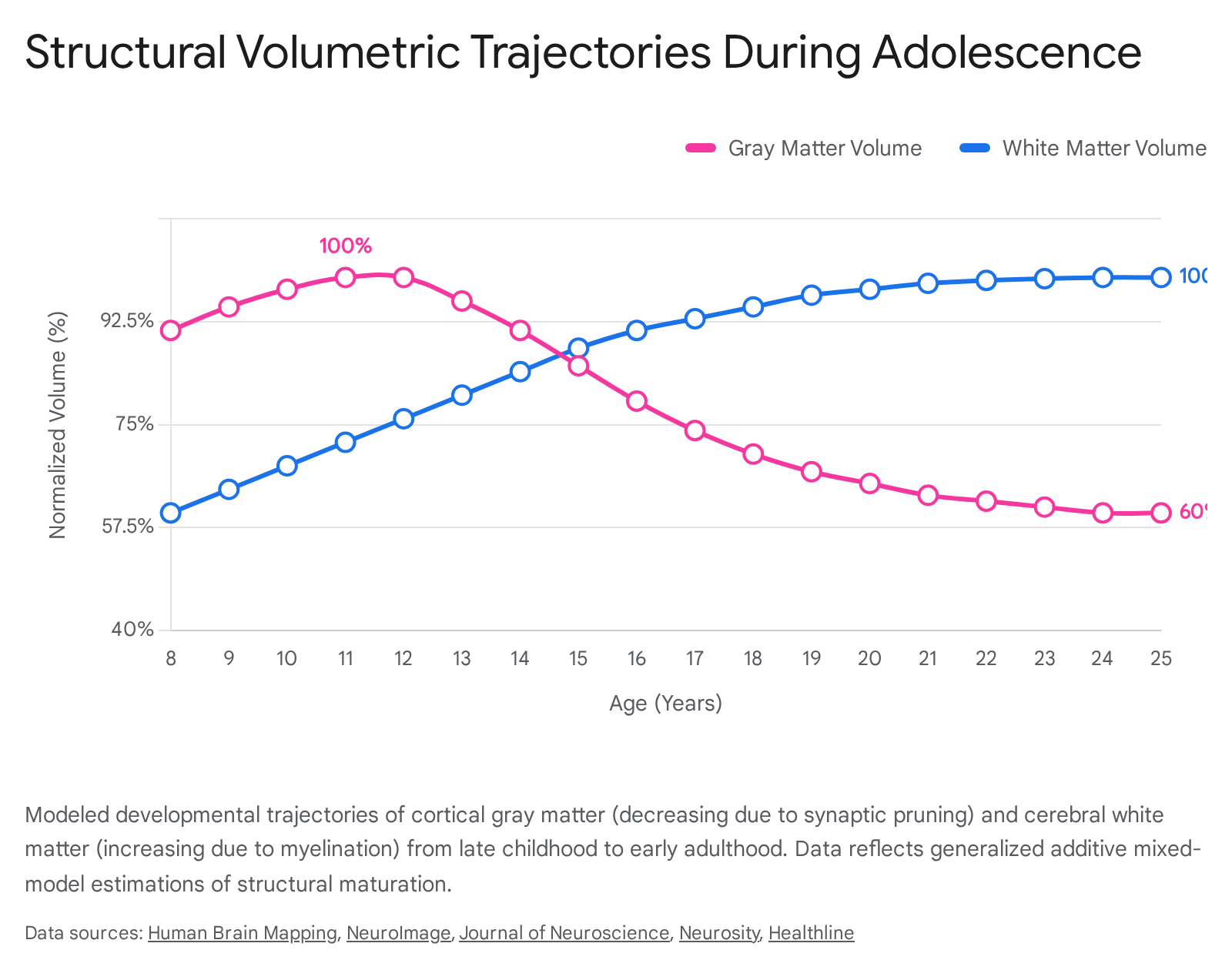
This increase reflects ongoing myelination - the progressive deposition of lipid sheaths around axons by oligodendrocytes - which substantially increases the propagation speed and coordination of action potentials across distributed neural networks 46.
Recent applications of novel biophysical diffusion MRI models, such as Restriction Spectrum Imaging (RSI), have provided highly granular insights into the microstructural properties of developing white matter. Longitudinal data indicates that intracellular isotropic diffusion (RNI) and directional diffusion (RND) metrics change significantly across early to mid-adolescence 8. These metrics, which index glial cellularity and axonal packing, suggest that white matter maturation is not simply a linear accumulation of myelin but involves complex, simultaneous alterations in axonal diameter and packing density 8. Inter-individual variability in these trajectories is substantial; for instance, longitudinal tracking reveals that the exact age at which cortical volumetric decline is most rapid can vary by up to 7.5 years among healthy individuals 17.
Cortical Dimensions and Regional Sequencing
Cortical volume is a composite geometric metric derived from two distinct physiological parameters: cortical thickness and cortical surface area, both of which exhibit independent genetic influences and discrete developmental timelines 8910. Widespread, non-linear decreases in both cortical volume and thickness occur during adolescence, whereas decreases in surface area are comparably smaller and follow a steadier, more linear decline 3811. Consequently, the dominant contributor to the overall reduction in cortical volume observed during the teenage years is cortical thinning 811. Vertexwise models estimating age associations across the cortical sheet reveal that the steepest decreases in cortical thickness occur in the medial frontal and parietal cortices during early adolescence, progressing toward the orbitofrontal cortices later in development 3.
Brain maturation does not occur uniformly across all anatomical regions. Reductions in neural plasticity and subsequent structural stabilization follow a defined spatiotemporal sequence. Plasticity reductions occur earliest in primary sensory-motor regions, such as the visual and auditory cortices, and much later in associative regions, including the prefrontal and temporoparietal cortices 12. This hierarchical maturation ensures that the higher-order cognitive systems responsible for mediating executive functions and complex social processing remain malleable and responsive to environmental shaping throughout the entirety of adolescence 1215.
| Developmental Phase | Approximate Age Range | Dominant Structural Changes | Regional Maturation Focus |
|---|---|---|---|
| Early Adolescence | 10 - 13 years | Peak gray matter volume; onset of rapid cortical thinning; steady surface area decline. | Maturation of primary sensory-motor regions; high plasticity in limbic system structures (e.g., amygdala). |
| Mid Adolescence | 14 - 17 years | Universal decreases in global cortical measurements; continued white matter volume increases. | Accelerated thinning in parietal and medial frontal cortices; strengthening of prefrontal-subcortical white matter tracts. |
| Late Adolescence | 18 - 25 years | Deceleration of gray matter loss; white matter volume approaches stabilization. | Final maturation of higher-order associative cortices (e.g., dorsolateral prefrontal cortex, anterior temporal cortex). |
Table 1: Summary of structural brain development metrics and regional maturation patterns from early through late adolescence based on longitudinal MRI research 348121314.
Subcortical regions also undergo protracted and highly specific developmental shifts. Group-level volumetric trajectories indicate that the volumes of the caudate, putamen, nucleus accumbens, and thalamus generally decrease during adolescence, whereas the volumes of the amygdala, hippocampus, and pallidum tend to increase before eventually stabilizing in early adulthood 37.
Microstructural and Gestational Factors
The initial biological conditions surrounding parturition cast a long shadow on subsequent adolescent brain development. Analyses of over 4,600 adolescents from the ABCD cohort revealed that premature birth persistently alters brain connectivity independent of postnatal environment 15. Measuring functional network energy - a metric of network stability and multiscale functional connectivity - researchers identified that youth born prematurely exhibit significantly reduced information organization flexibility 15. These energy deficits are localized primarily within three large-scale networks: the visual network (occipitotemporal and occipital subnetworks), the sensorimotor network, and high cognitive networks (temporoparietal and frontal subnetworks) 15. This highlights that structural reorganization during adolescence operates upon a foundational architecture established prior to full-term gestation.
Large-Scale Functional Network Architecture
As the physical structure of the brain matures through targeted pruning and myelination, its functional organization undergoes a corresponding shift. The system transitions from relying heavily on localized, short-range connections toward distributed, long-range networks. This functional reorganization is critical for the efficient integration of complex information across distant brain regions.
The analysis of resting-state functional magnetic resonance imaging (rs-fMRI) has isolated three primary large-scale networks whose dynamic interactions form the core of cognitive control, emotion regulation, and complex behavioral execution: the Default Mode Network (DMN), the Central Executive Network (CEN), and the Salience Network (SN) 1617.
The Triple Network Model
The DMN, comprising nodes such as the medial prefrontal cortex, posterior cingulate cortex, and precuneus, is metabolically active during internally directed cognition, self-referential thought, memory retrieval, and resting states 171819. In contrast, the CEN (frequently referred to as the frontoparietal network, anchored in the dorsolateral prefrontal cortex and posterior parietal cortex) governs externally directed attention, working memory, and goal-directed executive control 1718.
The Salience Network acts as the critical dynamic switchboard between these two opposing systems. Anchored primarily in the anterior insula and anterior cingulate cortex, the SN continuously monitors the internal and external environments for biologically, socially, or cognitively relevant stimuli 1720. Upon detecting salient information, the SN engages the CEN to allocate cognitive resources while simultaneously suppressing the DMN 1724.
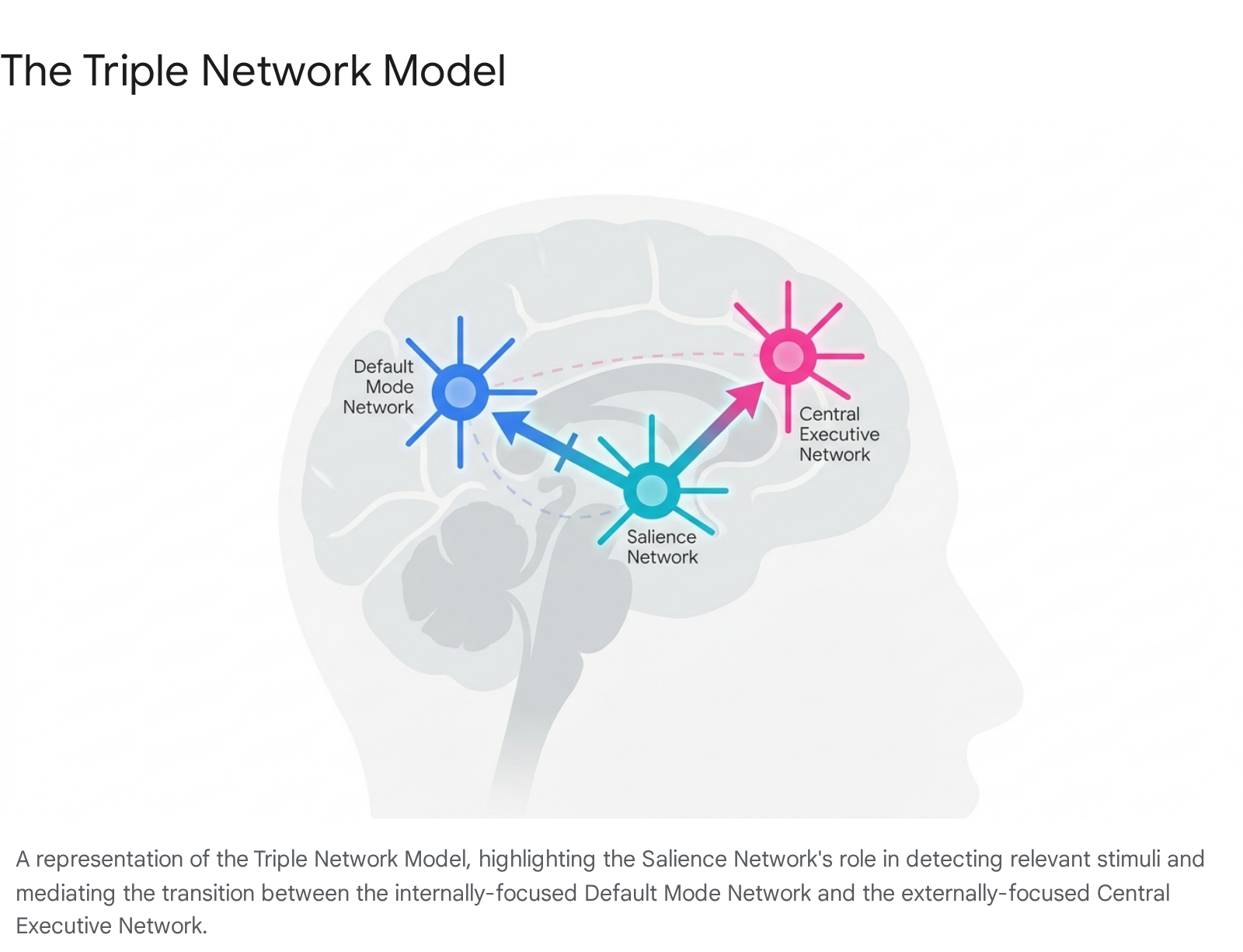
During adolescence, the precise calibration of functional connectivity both within these networks and across their boundaries continues to mature. Utilizing baseline RSFC data from over 11,000 children aged 9 - 11 in the ABCD study, researchers applying Leiden Community Detection algorithms have identified distinct resting-state functional connectivity subtypes that reliably predict differential patterns of cognitive and emotional functioning 21. The ability of the developing brain to effectively toggle between the DMN and CEN, mediated accurately by the SN, is an essential benchmark for adaptive psychological development 17. Disruptions in these evolving connectivity patterns are highly predictive of downstream clinical outcomes.
Psychopathology and Network Connectivity
Because the adolescent brain undergoes extensive functional rewiring, deviations in connectivity trajectories serve as primary biological correlates for the emergence of neurodevelopmental and psychiatric disorders. The topological signatures of various conditions map directly onto abnormalities within the triple network model and subcortical pathways.
ADHD and Neurodevelopmental Dimensions
Attention-deficit/hyperactivity disorder (ADHD) manifests with distinct topological signatures in resting-state functional connectivity. Penalized Poisson regression models applied to ABCD cohorts indicate that reduced magnitudes of anticorrelation between the default mode network and the dorsal attention network (a sub-component of the broader executive system) relate directly to increased attention problems 1922. When the DMN fails to appropriately deactivate during tasks requiring external attention, behavioral focus is inevitably compromised 22. At the microstructural level, longitudinal biophysical diffusion MRI confirms that ADHD status is associated with significant decreases in intracellular isotropic diffusion across 20 distinct white matter tracts during late childhood, indicating atypical glial cellularity that persists into adolescence 8. Furthermore, broader dimensions of general psychopathology (often referred to as the p-factor) and generalized neurodevelopmental symptoms correlate strongly with lower within-network connectivity in the DMN 19.
Anxiety, Psychosis, and Autism Phenotypes
Youth with generalized anxiety disorder (GAD) exhibit significant alterations in resting-state connectivity characterized primarily by hyperconnectivity. Systematic mapping reveals hyperconnectivity within the ventral attention network (VAN), a system involved in detecting unexpected but behaviorally relevant stimuli, alongside hyperconnectivity between subcortical structures (such as the amygdala and striatum) and the cingulo-opercular network (CON) 18. The strength of within-VAN hyperconnectivity has been observed to track dynamically with the remission or emergence of GAD symptoms across longitudinal follow-ups, presenting a specific target for early intervention 18.
The continuum of psychosis is similarly associated with profound network-level dysconnectivity. School-aged children experiencing subclinical psychotic-like experiences (PLEs) show decreased connectivity within both the CON and DMN, as well as altered connectivity between the cingulo-parietal network and the cerebellum 23. In clinical early-onset psychosis (EOP), adolescents display pronounced DMN and CEN overconnectivity paired with relatively intact SN connectivity 16. By contrast, adolescents diagnosed with autism spectrum disorder (ASD) demonstrate distinct systemic patterns characterized primarily by reduced SN connectivity and mixed disruptions in DMN connectivity. In ASD populations, this specific underconnectivity in the salience network correlates directly with poorer behavioral measures of social cognition and emotion recognition 16.
Evolutionary Perspectives on Neural Phenotypes
Historical paradigms frequently framed adolescent behavior - characterized by impulsivity, heightened emotionality, and risk-taking - as a problematic byproduct of an immature or defective neural architecture. Specifically, the "dual systems" model posited a temporal mismatch between an early-maturing socioemotional limbic system and a late-maturing prefrontal control system 424. While this model captures the basic asymmetry of regional development, an evolutionary developmental perspective argues that these traits are not cognitive failures. Rather, they represent highly adaptive functional states optimized to propel the adolescent away from familial dependence and toward self-sufficiency 252627.
Reward Sensitivity and Exploratory Mechanisms
Adolescents demonstrate a pronounced neurobiological sensitivity to rewards. During associative learning tasks and risk assessments, adolescents exhibit significantly greater activation in the striatum (specifically the nucleus accumbens) compared to both children and adults 272829. This dopaminergic hypersensitivity acts as a vital evolutionary "pull mechanism." By making novelty and potential rewards feel exponentially more satisfying, the brain intrinsically incentivizes the adolescent to leave the safety of the natal environment, explore new territories, and independently secure resources 2526.
Crucially, this heightened reward sensitivity directly enhances goal-directed learning. Research demonstrates that adolescents adapt more rapidly to volatile reward contingencies than adults do 25. In reversal learning paradigms - where the rules for acquiring rewards change unexpectedly - adolescent neural architecture allows for rapid behavioral updating. This specific neuroplastic profile is precisely the cognitive flexibility required for an organism navigating novel, unpredictable ecosystems 25.
Fear Regulation and Social Reorientation
The intense emotional landscape of adolescence is governed by the progressive maturation of frontolimbic connections. Early in adolescence, the amygdala matures rapidly, establishing highly potent fear and threat detection mechanisms 424. Concurrently, the functional connectivity between the ventromedial prefrontal cortex (infralimbic cortex) and the amygdala shifts from positive to negative functional coupling 26. This transition is required for the development of context-specific fear regulation and cued fear extinction 26. Evolutionary models suggest that the transient suppression of absolute contextual fear during early adolescence serves an adaptive function by preventing the individual from abandoning the exploration of a new territory following a single negative encounter 25.
Parallel to changes in fear processing, a universal hallmark of human adolescence is the pronounced shift in focus from parents to peers. This reorientation is deeply embedded in the brain's evolving social cognition circuitry. The mere presence of peers fundamentally alters adolescent brain function, significantly increasing activation in the reward and emotional centers 2534. The presentation of simple social cues, such as a peer's emotional facial expression, elicits greater impulsive actions and robust neural responses in teenagers compared to other age cohorts 2526.
Evolutionarily, this hyper-attunement to peers is essential. It facilitates the establishment of new social bonds and cooperative alliances that are necessary for survival and reproduction outside the immediate family unit 2526. The "social brain" network - encompassing regions like the medial prefrontal cortex, temporoparietal junction, and posterior superior temporal sulcus - undergoes prolonged structural refinement into the mid-twenties. This extended maturation window allows the individual extensive time to internalize complex social scripts and complex behavioral norms 13.
Sociocultural Modulation of Neurodevelopment
While the foundational mechanics of structural development (such as pruning and myelination) follow universal biological blueprints, the specific functional wiring of the adolescent brain is intensely modulated by the cultural environment. The emerging interdisciplinary field of developmental cultural neuroscience investigates how deeply ingrained cultural values, practices, and socioeconomic contexts shape neural processing 353031. This field specifically addresses the limitation that the majority of foundational neuroimaging research has historically relied on Western, educated, industrialized, rich, and democratic (WEIRD) populations 3530.
Socioeconomic Status and Environmental Context
Socioeconomic status (SES) operates as a macro-environmental variable that robustly influences neural architecture. The extended window of neuroplasticity renders the adolescent brain particularly sensitive to the socioeconomic environment, with the impact of this environment changing as developmental sequencing progresses 1232. Specifically, the late-maturing associative regions of the brain (which govern executive and higher-order social functions) exhibit the greatest sensitivity to socioeconomic impacts, and this environmental vulnerability reaches its peak during adolescence 12.
Analyses of large ABCD Study cohorts reveal that micro-environmental factors commonly associated with SES independently predict structural morphology. For example, higher levels of caregiving attentiveness and home environmental organization are consistently associated with optimized neural structure in the intraparietal sulcus (IPS), a key region for numerical processing and domain-general cognitive skills 33. Conversely, lower perceived subjective social status alters the way the adolescent brain processes racial outgroups, eliciting greater activity in mentalizing and salience networks during social perception tasks 30.
Cross-Cultural Reward and Social Feedback
Neural sensitivity to reward and social feedback exhibits significant variation across cultural boundaries, reflecting divergent societal values regarding individualism, interdependence, and emotional expression.
Functional MRI studies mapping reward processing demonstrate that European American adolescents consistently exhibit greater mesolimbic activation when acquiring personal, self-directed rewards. In distinct contrast, Latin American youth - who are frequently raised in contexts emphasizing familismo (family obligation and interconnectedness) - show heightened activation in identical mesolimbic reward circuits when making decisions that assist their families at a personal self-sacrifice 3034. This suggests the neurobiological reward system is successfully co-opted by cultural values.
Cultural norms also dictate ideal affect, or which emotional states a society highly values. European Americans generally place a higher value on high-arousal positive states (e.g., excitement) compared to East Asian populations, who more frequently value low-arousal positive states (e.g., calmness). This behavioral difference maps directly onto neural responses. European American young adults display significantly greater nucleus accumbens (NAcc) activation when viewing high-intensity, excited smiles compared to Chinese peers. Notably, this neural response is positively correlated with the actual intensity of facial expressions found among their real-world social networks on digital platforms 35.
Electroencephalogram (EEG) research examining the feedback-related negativity (FRN) component further highlights discrete cultural profiles in processing peer acceptance and rejection. Among White adolescents, greater FRN responses to social acceptance correlate directly with increased clinical social anxiety. For Asian American adolescents, FRN responses to both acceptance and rejection correlate with social anxiety 36. Notably, Latinx adolescents produce the highest baseline FRN responses to social feedback overall but endorse the lowest levels of clinical social anxiety. This divergence implies that a highly sensitive neural response to social context is not inherently maladaptive; rather, its psychological outcome is heavily dependent on the cultural framework utilized to interpret that sensitivity 3637.
Environmental Perturbations in Modern Contexts
The evolutionary programming of the adolescent brain is currently encountering unprecedented challenges in the contemporary digital and 24-hour global environment. The protracted neuroplasticity that evolved to absorb natural environmental cues is highly susceptible to modern artificial perturbations, specifically pervasive digital media engagement, chronic sleep deprivation, and psychosocial trauma.
Trauma, Polyvictimization, and Network Integrity
The extended malleability of higher-order cognitive networks renders them profoundly susceptible to traumatic environmental insults. Exposure to chronic trauma or polyvictimization (exposure to multiple categories of victimization) during early development fundamentally disrupts the maturation of the triple networks. During fMRI paradigms measuring acute stress responses, adolescents with histories of severe trauma exhibit maladaptive network toggling. Specifically, their network responses are characterized by pathological increases in functional connectivity between the DMN and CEN, accompanied by decreased connectivity between the SN and both the DMN and CEN 202438.
The insula, a core computational node of the SN, appears to mediate these structural changes. This suggests that repeated early trauma forces the brain into an inward-directed state of attention, compromising the SN's ability to effectively toggle networks to handle new, acute external stressors 2024. Furthermore, longitudinal whole-brain correlational tractography reveals that childhood adversity significantly moderates changes in quantitative anisotropy (QA) within threat and visual processing white matter tracts, including the cingulum bundle and the inferior fronto-occipital fasciculus (IFOF). Alterations in the microstructural integrity of these specific tracts are directly associated with longitudinal increases in posttraumatic stress disorder (PTSD) symptoms following subsequent trauma in later life, identifying a clear structural pathway for trauma susceptibility 3940.
Sleep Deprivation and Digital Media Interaction
Adolescence is defined by widespread chronic sleep restriction globally. Adequate sleep is an absolute biological prerequisite for the physical maintenance of the brain; it is the primary physiological state during which critical developmental processes - including synaptic pruning, memory consolidation, and myelin repair - occur 4142. Chronic sleep restriction disrupts the normative development of frontolimbic circuits, leading directly to impaired executive functions, emotional instability, and elevated risk-taking 41. Without sufficient sleep-dependent neural maintenance, the brain's ability to transition effectively from the emotionally driven responses of the amygdala to the regulatory control of the prefrontal cortex is severely compromised.
The interaction between restricted sleep and ubiquitous digital media creates a compounding neurodevelopmental effect. Social media architectures are explicitly designed to deliver variable ratio reinforcements - unpredictable notifications, likes, and social validations - which directly exploit the adolescent brain's evolutionary hypersensitivity to peer feedback and novel rewards 543.
Extensive functional neuroimaging from thousands of youth in ABCD cohorts indicates a bidirectional, synergistic relationship between short sleep duration and high social media engagement 4445. Poor sleep combined with high social media use alters neural reward sensitivity by modifying activation patterns within the frontolimbic network 4452. Specifically, interactions between sleep duration and social media use severely disrupt activation in the inferior frontal gyrus (responsible for inhibitory control and regulating engagement with rewarding stimuli) and the middle frontal gyrus (which governs complex executive decision-making and balancing immediate rewards against competing priorities like sleep) 454647. This dual interference delays the maturation of inhibitory control networks while simultaneously hyper-stimulating early-maturing emotion and reward centers.
Furthermore, frequent shifts in task stimuli associated with digital multitasking have been posited to interfere with the natural tempo of synaptic elimination. High social media usage demands continual, rapid decision-making and motor responses, which may accelerate the natural process of synaptic pruning or alter myelination trajectories in regions like the cerebellum 5.
Re-evaluation of Traditional Neurodevelopmental Paradigms
As high-resolution neuroimaging data accumulates across global cohorts, developmental cognitive neuroscience has systematically dismantled several deeply ingrained cultural, clinical, and pedagogical myths regarding the teenage brain.
The Fallacy of the "Undeveloped" Prefrontal Cortex
A pervasive pop-psychology narrative suggests that the adolescent brain is fundamentally "broken," "missing a steering wheel," or simply "undeveloped," frequently emphasizing the false claim that the prefrontal cortex does not function until age 25 485649. This is a severe misinterpretation of neurobiological data.
While it is accurate that the prefrontal cortex undergoes continuous structural refinement into the mid-twenties, foundational cognitive abilities - such as working memory, digit span, and verbal fluency - reach robust adult levels of performance by ages 16 or 17 34. Adolescents are entirely capable of utilizing their prefrontal cortices to plan complex, multi-step actions and evaluate risks objectively. In emotionally neutral environments (often termed "cold cognition"), adolescent decision-making and prefrontal activation frequently mirror that of adults 3449.
However, they evaluate the value of risks differently due to the heavy neurobiological weighting of peer presence and reward contexts. It is only in emotionally charged or peer-monitored environments ("hot cognition") that performance diverges. In these scenarios, the robustly activated striatum effectively overrides the regulatory prefrontal signals, leading to impulsive actions despite a functional capacity for logic 434.
Hormonal Remodeling and the Age 25 Myth
The traditional clinical and cultural attribution of adolescent mood swings and impulsive behavior solely to "raging hormones" is biologically inaccurate. Pubertal hormones - including testosterone, estrogen, and oxytocin - do rise significantly, but their primary function is structural and functional remodeling of the cortex, not acute behavioral deregulation 5051. These hormones directly sensitize the dopaminergic pathways, altering how the brain processes rewards and social relationships, which in turn leads to the characteristic intensity of adolescent emotion 450. The emotional intensity is an emergent property of the brain's changing network connectivity, mediated by hormones, rather than a direct toxic or "raging" effect of the hormones themselves 5051.
Furthermore, the widespread assertion that the brain abruptly "finishes" developing at age 25 is arbitrary. While age 25 represents a general statistical plateau for certain macroscopic structural metrics, such as total cortical volume stabilization, the brain's networks continuously adapt, learn, and structurally reorganize through synaptic plasticity throughout the entire adult lifespan based on experience 5652.
| Outdated Paradigm | Modern Neuroscientific Consensus | Implications for Intervention |
|---|---|---|
| The "Raging Hormones" Myth: Behavior is strictly driven by toxic spikes in pubertal sex hormones. | Hormonal Remodeling: Hormones act as developmental catalysts that sensitize dopamine pathways and initiate structural brain reorganization. | Interventions should focus on teaching emotional regulation skills rather than treating emotional intensity as a temporary biological dysfunction. |
| The "Missing Brakes" Fallacy: Adolescents lack a functioning prefrontal cortex and cannot assess risk. | Context-Dependent Control: Prefrontal logic is fully functional in neutral contexts, but is easily overridden by a hypersensitive reward/peer system in emotional ("hot") contexts. | Risk-reduction strategies must address the social context of the behavior (e.g., peer pressure dynamics), not just cognitive awareness of the risk. |
| "Storm and Stress": Adolescence is an inherently chaotic, negative phase to be survived. | Adaptive Neuroplasticity: The "chaos" is a highly conserved evolutionary adaptation promoting exploration, learning, and independence. | Society should actively channel this heightened learning capacity and drive for autonomy into prosocial, constructive risks (e.g., civic activism). |
| The "Age 25 Finish Line": The brain reaches a sudden, static state of "adult" maturity at precisely age 25. | Continuous Trajectory: Structural stabilization plateaus in the mid-20s, but neuroplasticity and micro-network refinement continue throughout the lifespan. | Educational and professional training environments should extend structured scaffolding and skill development well into early adulthood. |
Table 2: Comparison of historical cultural paradigms regarding adolescent behavior versus the current consensus in developmental cognitive neuroscience 27345649505152.
Ultimately, neuroscience definitively refutes the characterization of youth as a period of cognitive deficiency. The macroscopic volumetric shifts and changing network topologies serve to optimize neural efficiency for adult environments. While the late maturation of associative cortices and the hypersensitivity of the reward systems leave the adolescent brain uniquely susceptible to environmental insults like sleep deprivation and trauma, this same vulnerability is the engine of human adaptability. The adolescent brain's exquisite sensitivity to social cues and volatile rewards is a highly evolved mechanism designed to propel the individual toward independence. By recognizing that adolescence entails an adaptive, culturally responsive rewiring process, interventions can be better structured to harness this developmental window, fostering resilience, prosocial behavior, and long-term psychological well-being.