
What Happens to Your Brain When You Change Your Mind
Changing your mind is a profound neurological event that forces the brain to physically rewire established pathways while navigating the acute psychological pain of cognitive dissonance. Because human neurobiology evolved to treat intellectual challenges as physical threats to survival, updating a core belief requires actively overriding the brain's automatic defensive responses. Ultimately, shifting your worldview relies on moving from an emotional, reactive posture into a state of cognitive flexibility, allowing you to integrate new realities without fracturing your sense of identity.
The "Mushware" Metaphor: Hardware, Software, and Beliefs
To truly understand what happens inside the brain when a belief is altered, it is helpful to view the human mind through the lens of a computing metaphor - albeit with a distinct biological twist. Psychologists, psychiatrists, and neuroscientists frequently compare the brain's physical structure (its neurons, synapses, and regional networks) to computer hardware, while the mind, consciousness, and specific beliefs represent the software or operating system 123.
Just as a computer requires the correct software to open a specific file type, the human brain requires the correct mental frameworks to process specific experiences. If you lack the appropriate "software" (prior knowledge, emotional regulation, or conceptual understanding), your interpretation of an event - such as a stressful interaction at work - can result in an output or behavior you did not intend 13. You simply cannot process the data correctly.
However, the human brain is not a digital machine processing binary ones and zeros. It is an electro-biochemical organ. Therefore, the distinction between hardware and software in the human mind is heavily blurred 24.
Because the central nervous system is highly adaptive, changes in the "hardware" (such as a traumatic brain injury or chemical alteration) directly modify the "software" (your personality and beliefs). Much more interestingly, changes in the "software" (learning new information, adopting a new belief, or undergoing psychotherapy) literally force the "hardware" to change its physical structure through neuroplasticity 24. For this reason, experts often refer to the brain not as hardware, but as "mushware" 14. When you change your mind, you are not just updating a line of code; you are physically altering the structural routing of your brain's circuitry.
The Neurobiology of Belief Formation
Before a belief can be changed, it must first be formed. In the fields of neuroscience and psychology, a belief is not simply a philosophical stance; it is a fundamental representation of imaginative and emotional content that links an individual's prior experience with their future behavior 56.
Belief formation and updating involve rapidly evolving neural processes that initially operate on a pre-linguistic level. These processes include perception, valuation, sensorimotor control, mentalizing, and perceptive-emotional integration 5. You often only become consciously aware of a belief - and able to articulate it using language - after these complex neural networks have already established it as a reality 56.
The Bayesian Brain Hypothesis
A leading framework for understanding how the brain manages beliefs is the "Bayesian brain hypothesis." This theory suggests that the central function of the nervous system is to use sensory information to infer the causal structure of the external world using principles akin to Bayesian statistical inference 7.
According to Bayes' rule, the optimal way to interpret reality is to calculate the likelihood of new information and weight that likelihood against the strength of your "prior belief" 7. When new information is observed, the brain engages in "Bayesian belief updating," transforming the prior belief into a newly calibrated "posterior belief" 7.
The Neural Pathways of Updating
Physiologically, this updating process is not managed by a single control center, but by a distributed network of brain regions working in tandem to evaluate data, measure emotional resonance, and detect errors in expectation.
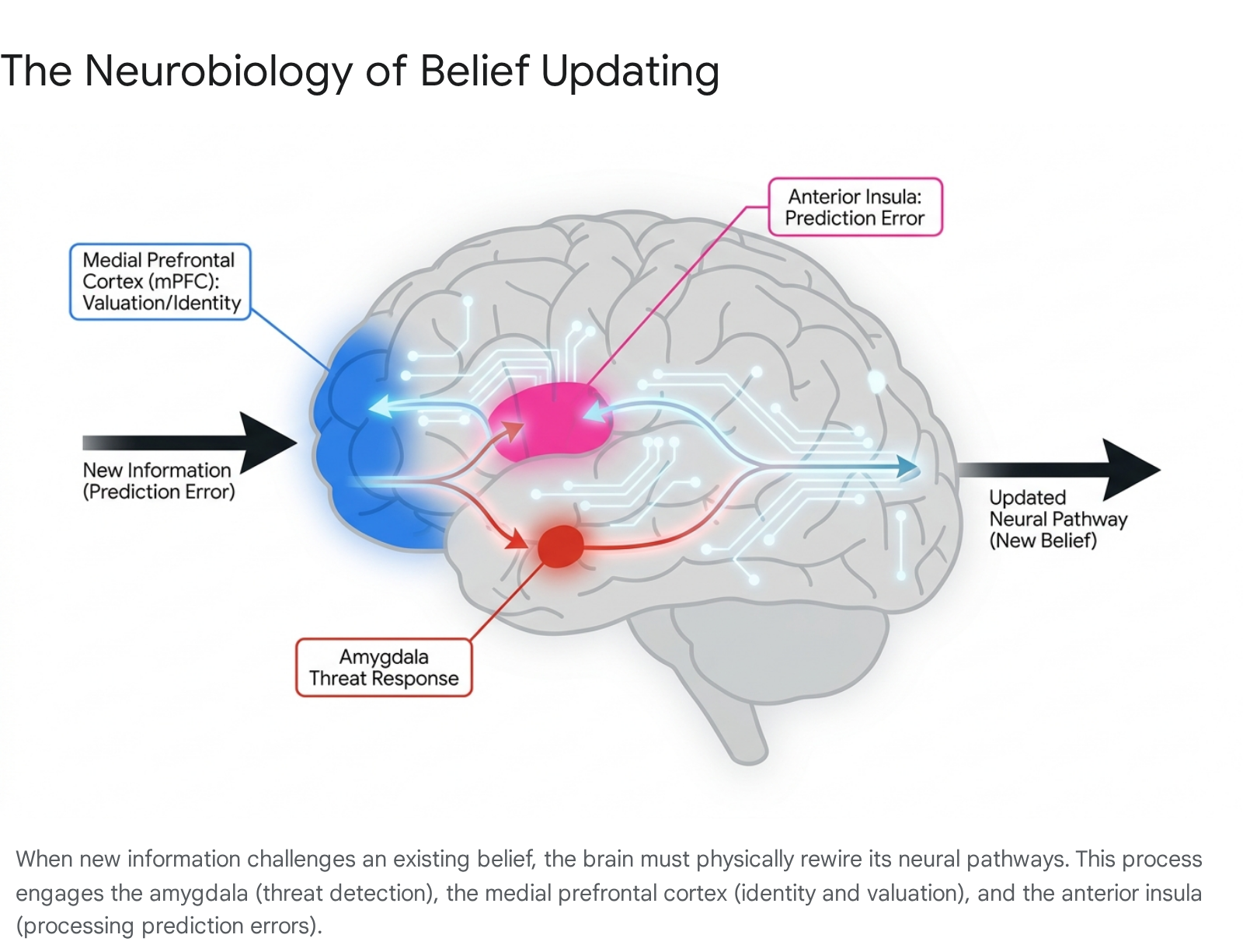
- The Right Fronto-Parietal Network: This specific neural network is heavily implicated in the literal act of updating a belief. It manages the cognitive appraisal of new information and plays a crucial role in "self-perspective inhibition" - the brain's ability to temporarily suppress its own ego and rigid viewpoint so that alternative facts can be viewed objectively 5.
- The Medial Prefrontal Cortex (mPFC): The mPFC is central to self-referential thinking, identity, and the subjective valuation of external information. When you encounter new data, the mPFC helps determine how "relevant" or "meaningful" this information is to your personal identity 58. Day-to-day decisions and subjective preference judgments are heavily mediated by the prefrontal cortex, often using preferences of which you are not even consciously aware 56.
- The Anterior Insula and Ventral Tegmental Area (VTA): These regions are responsible for processing "prediction errors." A prediction error occurs when there is a mismatch between what your prior belief expected to happen and what the environment actually delivered 9. The dopaminergically innervated VTA and the anterior insula generate signals that help the brain integrate the new affective state (the surprise or disappointment) with the new outcome information, forcing the belief to update 9.
The Agony of Cognitive Dissonance
Because beliefs form the foundational map by which we navigate reality, encountering information that contradicts our map does not result in a calm, logical recalculation. Instead, it triggers a state of psychological distress known as cognitive dissonance.
First introduced by social psychologist Leon Festinger in 1957, cognitive dissonance is defined as the severe mental discomfort experienced when a person unknowingly or subconsciously holds two or more conflicting beliefs, attitudes, values, or behaviors simultaneously 111013. Human beings are naturally driven by a deep need for psychological consistency; we require our internal narratives to align with our external actions to make sense of the world 111013.
When this consistency is shattered by new, contradictory information, the resulting mental friction can trigger intense negative emotions, including stress, guilt, shame, confusion, and anxiety 1314. The brain experiences this dissonance as an unsustainable state of disequilibrium and will automatically seek ways to resolve the conflict and restore balance 1014.
Festinger's Four Paradigms of Dissonance
According to cognitive dissonance theory, the psychological turmoil we experience generally falls into one of four theoretic paradigms, dictating how the brain will attempt to reduce the discomfort 10:
- Belief Disconfirmation: This occurs when people are exposed to information that is entirely inconsistent with their deeply held beliefs or values. If the belief is not changed, the dissonance leads to denial, rationalization, or the outright rejection of the new information 10.
- Induced Compliance: This happens when an individual is forced to act in a way that contradicts their private beliefs. To reduce the resulting discomfort, the individual will often unconsciously alter their private attitude to match the behavior they were forced to perform 10.
- Free Choice: After making a difficult decision between two equally appealing options, people experience dissonance because the chosen option has flaws and the rejected option has merits. To restore balance, the brain inflates the positive aspects of the chosen option and minimizes the rejected one 10.
- Effort Justification: When a person expends immense effort to achieve a goal that turns out to be lackluster, the dissonance is massive. To avoid feeling foolish, the brain will artificially elevate its valuation of the goal, convincing the person that the effort was entirely worthwhile 10.
Mechanisms of Conflict Resolution
When forced into a state of dissonance, human beings do not always choose the most logical path. Because rewiring the brain's "mushware" to establish a new belief requires immense cognitive energy, individuals frequently take the path of least psychological resistance.
Consider the example of an avid environmentalist who learns that their daily coffee habit is responsible for severe water pollution and biodiversity loss 11. The dissonance between their identity (eco-friendly) and their behavior (drinking coffee) creates a pit in their stomach 11. Similarly, a smoker who is fully aware that smoking causes cancer experiences daily friction between their habit and their desire to live 1314.
To relieve this tension, the brain relies on several standard mechanisms.
| Resolution Strategy | Description | Practical Example |
|---|---|---|
| Behavior / Belief Change | The most direct and healthy way to resolve dissonance. The individual aligns their actions with the new truth, eliminating the conflict entirely 1314. | The smoker throws away their cigarettes; the environmentalist switches to sustainably sourced tea 1113. |
| Rationalization & Justification | Creating explanations or excuses to make the conflicting behavior or belief seem acceptable. The individual alters how they think about the situation without changing their actions 1314. | The smoker claims, "The stress relief I get from smoking is better for my heart than quitting." 13. |
| Seeking Confirming Information | Actively searching for new data that outweighs or invalidates the conflicting belief, reinforcing the original stance 14. | The environmentalist decides the lecturer on coffee pollution "must not know what they are talking about" and ignores the data 11. |
| Minimization | Downplaying the importance of the dissonant thought or action so it no longer feels like a threat to the person's identity 1110. | The environmentalist tells themselves, "I drive an electric car, so my good deeds cancel out the coffee pollution." 11. |
The Threat Response: Why Ideas Feel Like Predators
The intense discomfort of cognitive dissonance explains why we rationalize, but it does not fully explain the sheer aggression, anger, and fear that often accompany debates over controversial topics. Why do people react to a differing political, religious, or scientific opinion as if their life is in danger?
The answer lies in the amygdala. Hidden deep inside the middle of the cerebrum, the amygdala (Greek for "almond") is a small structure that regulates the body's response to danger. Its primary role is to detect perceived threats in the environment and activate physiological survival mechanisms - triggering emotional responses such as fight, flight, freeze, or appease 1112.
Crucially, the evolution of neuroscience has revealed that the amygdala acts automatically, without being prompted by conscious intention, and it does not neatly distinguish between physical pain and social or intellectual pain 11. The exact same region of the brain is activated whether you are facing a physical predator or experiencing social rejection 11.
The Amygdala Hijack
When you encounter people who appear different from you, or who present information that challenges your foundational worldview, the amygdala frequently anticipates the worst and triggers a threat response 11. Within roughly 300 milliseconds of the amygdala being triggered, neurotransmitter signals are sent to the prefrontal cortex - the area responsible for rational decision-making, executive functioning, and memory 11.
Under normal circumstances, the prefrontal cortex regulates emotion. However, under chronic stress or acute threat, control shifts from the top-down executive networks to the bottom-up threat circuitry 8. During this "amygdala hijack," your reasoning capacity plummets. Studies have shown that exposure to rejection or severe social threat can cause an immediate drop in reasoning ability by 30% and a temporary drop in functional IQ by 25% 11.
The circuitry shifts toward faster threat detection and weaker regulation 12. This causes the brain to treat ambiguous signals as highly threatening 12. It is physically impossible to gracefully change your mind during an amygdala hijack because your brain is dedicating its resources to survival, not to Bayesian belief updating.
Social Identity and the Need for Closure
The severity of this threat response is tightly linked to social identity. Human survival has historically depended on group cohesion; being cast out of the tribe meant certain death. Today, our beliefs serve as tribal signifiers.
When a group has a salient political identity that overlaps with their religious, racial, or cultural identity, the activation of social identity threat becomes incredibly potent 13. Our belief in certain narratives is driven by our need to comprehend the world and maintain community membership 13. When our "team identity" is salient in our minds, it inevitably drives our sense-making processes 13.
The most efficient way to activate a group's social identity is to threaten it 13. Strategic disinformation relies heavily on this mechanism. Much of the false information disseminated online is not random; it is meticulously designed to weaponize social identity threat 13. When individuals feel that their way of life is under attack, their threat monitoring system flares up, resulting in a higher "need for cognitive closure" 13. This need for rapid, comforting certainty causes people to rely on fast heuristics and emotional judgments, thus fueling misperceptions that reinforce their team identities 13.
The Economic Utility of Beliefs
If changing a belief triggers psychological pain and existential threat responses, why do we ever change our minds at all? Recent literature in psychology and neuroscience frames belief change not as a purely logical deduction, but as an economic transaction 1415.
Researchers propose that the utility of any given belief is derived from the potential outcomes associated with holding it 1415. These outcomes can be internal (e.g., generating positive feelings, reducing anxiety, fostering a sense of safety) or external (e.g., gaining material wealth, securing social status, avoiding ostracization) 1415. Crucially, only some of these utility outcomes are actually dependent on whether the belief is factually accurate 1415.
Under this framework, belief change occurs when the multidimensional utility of the old belief is compared against the utility of the new belief 1415. We will form a new belief, or abandon an old one, when the potential outcomes alter across attributes - for instance, because our social environment has changed, making our old belief socially costly, or because the negative consequences of our false belief have been made overwhelmingly salient 1415.
Furthermore, belief triggers - specific internal or external cues like thoughts, emotions, and past outcomes - subconsciously activate certain beliefs in our minds 20. If a belief historically made us feel good, or if social conditioning reinforced it, the trigger will sustain the belief 2016. To change a belief, an effective strategy must alert the perceiver to the unexpected contradictions of their current mindset while simultaneously demonstrating the positive emotions and utility that can be experienced by adopting the alternative belief 16.
Updating Under Threat vs. The Optimism Bias
Interestingly, the environment dictates how successfully we process utility. Humans generally possess an "optimism bias," making us far better at integrating desirable, positive information into our beliefs than undesirable, negative information 17. This asymmetry allows us to maintain a positive outlook, but it poses an evolutionary puzzle, as ignoring bad news can lead to a dangerous underestimation of risk 17.
However, the brain's utility calculations change under stress. When individuals perceive an ongoing threat in their environment, this optimism bias vanishes. Physiological arousal in response to a threat (indexed by galvanic skin response and anxiety) heightens the precision of sensory encoding and forces the brain to enhance the integration of unfavorable, warning-based information into its beliefs 17. This arousal-dependent switch allows humans to abandon their rosy beliefs and respond to warnings with necessary caution when the environment is genuinely dangerous 17.
The Backfire Effect: Dispelling a Pop Psychology Myth
Given how fiercely the brain defends its beliefs, it is easy to assume that trying to change someone's mind with facts is a fool's errand. This exact assumption led to the widespread popularity of a concept known as the "backfire effect."
The backfire effect is defined as a cognitive phenomenon wherein a correction actually increases a person's belief in the very misconception the correction is attempting to debunk 1824. According to the theory, when people are exposed to opposing views or corrective facts, their predispositions are challenged so deeply that they double down, strengthening their original, false beliefs 1920.
When the backfire effect was first proposed in 2010, it captivated the public consciousness. It was heavily cited by the media as the definitive explanation for the prevalence and durability of political misperceptions, leading to a cynical consensus that fact-checking was not only useless but actively harmful 181921.
Contextualizing the Replication Crisis
To understand why the backfire effect became so popular - and why it is now heavily contested - it is necessary to contextualize it within the broader landscape of "pop psychology" and the scientific replication crisis.
Psychology research has historically had a relatively low barrier to entry, often relying on small sample sizes of university undergraduates 22. Consequently, many classic, headline-grabbing psychology theories have a "nice ring to them" and appeal to our desire to neatly explain the world, but they ultimately fail to hold up under rigorous scientific scrutiny 23.
During a massive reproducibility project in 2015, fewer than half of 100 major psychological findings studied were successfully reproduced 30. Dozens of widely believed myths have since been debunked or heavily nuanced: * The Learning Styles Myth: The pervasive belief that students learn better when taught via their preferred modality (visual, auditory, kinesthetic) has been consistently debunked. Carefully controlled studies show that people do not perform better when taught to their preference, yet over 96% of teachers in some surveys still believe the myth 222324. * The 10% Brain Myth: The hopeful truism that humans only use 10% of their brain capacity is entirely fictional; neuroimaging shows the entire brain is active, consuming 20% of the body's oxygen 25. * Power Posing: The viral claim that adopting expansive "superhero" postures meaningfully alters hormones and increases risk-taking failed massive replication efforts and meta-analyses 30. * Facial Feedback (Smiling for Happiness): The classic 1988 study claiming that forcing a smile makes you measurably happier failed to replicate across 17 different labs in 2016 30.
The Scientific Consensus on the Backfire Effect
Much like power posing and learning styles, the backfire effect has failed to stand up to rigorous replication 1824.
The current scientific consensus - solidified by extensive research between 2020 and 2025 - is that the backfire effect only occurs in incredibly limited circumstances and is "extremely rare in practice" 1819.
- In a massive follow-up study examining 52 distinct controversial issues, researchers found zero instances of a backfire effect 21.
- Even when testing highly charged, polarizing topics (such as statements made by political figures), exposure to corrective information consistently reduced misperceptions, regardless of which candidate the respondent supported 1921.
- Meta-analyses confirm that corrections, fact-checks, and social media labels are moderately effective at improving the accuracy of people's factual beliefs 19. People are, in fact, often willing to revise mistaken beliefs when given accurate information 1921.
So why did early studies document a backfire effect? Modern researchers suggest it was largely an artifact of measurement unreliability. When survey items have low "test-retest reliability" (meaning the questions are confusing or produce random error), they introduce noise into the data. Recent longitudinal studies have found that item-level variation in backfire rates is strongly and negatively correlated with the reliability of the measure 1824. In other words, when scientists use highly reliable, clear measures, the backfire effect practically vanishes 24.
While the "familiarity backfire effect" - the idea that repeating a myth to debunk it inadvertently makes the myth more familiar and believable over time - remains a topic of debate, recent studies on vaccine myths found that repeating false claims and labeling them as false did not increase misconceptions relative to a control group 24.
The bottom line for communicators and fact-checkers is clear: you should not avoid giving corrective information due to fears of a backfire effect 24. While individuals may experience cognitive dissonance, they are fundamentally correctable.
The Emotional Stages of Changing a Belief
Because belief change is an energy-intensive process requiring the physical rewiring of neural circuits and the management of deep emotional distress, it does not happen instantaneously. It is a slow, cyclical evolution.
In the late 1970s, researchers Prochaska and DiClemente developed the Transtheoretical Model (TTM), more commonly known as the Stages of Change model 262728. Originally designed to map behavioral changes in addiction, the model is now widely applied across psychology to conceptualize the mental states individuals experience as they modify their cognitive patterns and belief structures 2636.
The model emphasizes that changing your mind is not a single decision, but a progression through a series of distinct psychological stages, heavily influenced by cognitive, emotional, and environmental factors 2627. Individuals frequently bounce back and forth between these phases, experiencing an "upward spiral" where relapses into old beliefs eventually lead to higher levels of awareness 2737.
The Six Stages of Belief Change
| Stage | Psychological State & Awareness | Emotional & Cognitive Markers |
|---|---|---|
| 1. Precontemplation | The individual is completely unaware that their belief is flawed, or they are not intending to take action in the foreseeable future 2628. | High defensiveness, denial, and resistance. This is a position of psychological stability; the brain rejects prediction errors to maintain the status quo 2627. |
| 2. Contemplation | The individual begins to recognize that their belief is problematic and starts to weigh the pros and cons of their stance 2628. | Cognitive dissonance is at its peak. The person experiences ambivalence and procrastination as they struggle between the safety of the old belief and the reality of the new data 26. |
| 3. Preparation | The individual accepts the need for change and forms specific intentions to update their belief or behavior in the immediate future 2728. | The gap between intention and action begins to bridge. The individual gathers resources, seeks support, and begins taking small steps (e.g., self-liberation and commitment) 262837. |
| 4. Action | The person actively modifies their outward stance, behavior, experiences, or environment to align with the new belief 2728. | High cognitive load and vulnerability. The individual must utilize "counter-conditioning" (substituting healthy thoughts for old ones) to rewire their neural pathways 37. |
| 5. Maintenance | The new belief has been sustained (typically for at least six months). The person works actively to prevent a relapse into their old worldview 2728. | Increased cognitive flexibility. The individual uses stimulus control (managing their environment) and reinforcement to solidify the new mindset 2837. |
| 6. Termination | The new belief is fully integrated. The old belief no longer holds any temptation, emotional power, or threat-response trigger 2728. | Total confidence and internal consistency. The individual is sure they will not return to their old cognitive habits 2728. |
To successfully move an individual through these stages, different cognitive and affective processes must be triggered at different times. For example, moving someone out of Precontemplation requires "Consciousness Raising" (increasing awareness) and "Dramatic Relief" (triggering emotional arousal regarding the issue). Moving from Preparation to Action requires "Self-Reevaluation" (realizing the new belief aligns with who they want to be) and securing supportive social relationships 2837.
How Culture Rewires the Belief Updating Process
It is a common mistake in cognitive psychology to assume that the mechanics of the human mind operate identically across the globe. In reality, cross-cultural studies utilizing massive datasets from the last decade reveal that human cognition, perception, and belief formation are profoundly shaped by macro-cultural frameworks - most notably the spectrum of Individualism versus Collectivism 29304031.
These cultural operating systems dictate how people perceive the world, form preferences, and act within their social environments 30. Because culture acts as the "software of the mind," it fundamentally alters how the brain physically processes beliefs about the self and society 42.
The Independent vs. Interdependent Brain
- Individualistic Cultures: Predominant in North America, Western Europe, and Australia, these societies emphasize the uniqueness of the individual, personal autonomy, individual rights, self-expression, and privacy 294344. The self is viewed as a distinct, independent entity whose identity is derived from personal achievements rather than group affiliations 4432.
- Collectivistic Cultures: Predominant in East Asia, parts of Africa, and South America, these societies emphasize group harmony, interdependence, loyalty, and the well-being of the immediate family and community 29424346. The self is viewed as an interdependent knot in a broader social network; identity is defined by knowing one's place within the group 294332.
These differing concepts of self literally manifest in brain activity. Functional MRI (fMRI) studies have demonstrated that when Western (Danish) participants are asked to reflect on their own traits, they heavily activate the ventral Medial Prefrontal Cortex (mPFC) 32. When asked to reflect on a close family member, like their mother, this activation drops significantly, showcasing the brain's rigid boundary between self and other 32.
However, when Chinese participants undergo the same test, they show overlapping, highly active mPFC responses for both themselves and their mothers 32. Furthermore, when reflecting on social roles, individuals from collectivistic cultures show unique activation in the temporoparietal junction (TPJ) - an area associated with processing the minds and intentions of others 32.
Divergent Emotional Triggers for Belief Change
Because the neurological boundaries of identity differ, the emotional triggers that force a person to change their mind, or to abandon a problematic group belief, diverge wildly across cultures.
When a person realizes that their group holds a toxic or factually incorrect belief, they often employ a coping strategy called "disidentification" - psychologically distancing and detaching themselves from the group to alleviate cognitive dissonance 3334. Cross-cultural research reveals that the emotional catalyst for disidentification depends entirely on cultural values:
- Disidentification via Shame (Individualistic Cultures): In cultures like Canada and Germany, shame is an undesired, isolating emotion. If an individual feels their group's belief is wrong or immoral, they experience intense personal shame. To cope with this socially undesired emotion, they disidentify, changing their belief to distance their unique identity from the flawed collective and restore their personal moral standing 3334.
- Disidentification via Anger (Collectivistic Cultures): In cultures like Japan, shame is actually a highly valued, constructive emotion used to ensure social control and facilitate harmony by making people aware of their shortcomings 3334. Anger, conversely, is highly taboo. Expressing anger poses a serious threat to the central goal of relational harmony and embeddedness 34. Therefore, if a group conflict generates intense, unresolvable anger, a Japanese individual is more likely to disidentify from the group and its beliefs in order to escape the culturally unacceptable emotion of rage 3334.
Summary of Cultural Divergences in Belief Change
| Cultural Paradigm | Primary Identity Focus | Neurobiological Marker (mPFC) | Catalyst for Disidentifying from Group Belief | Conceptualization of Power and Status |
|---|---|---|---|---|
| Individualistic (e.g., USA, UK, Canada) | The Independent Self: Emphasizes autonomy, unique traits, self-sufficiency, and personal goals 424346. | Strict separation in neural activation between reflections on the 'Self' and 'Close Others' 32. | Shame. Distancing from the group's belief protects the individual's unique reputation and alleviates personal shame 3334. | Personal power; individuals who defy norms and show independence are viewed as strong 42. |
| Collectivistic (e.g., China, Japan, Indonesia) | The Interdependent Self: Emphasizes group harmony, family obligations, and shared responsibilities 294246. | Heavy overlap in neural activation between reflections on the 'Self' and 'Close Others' (e.g., Mother) 32. | Anger. Distancing from the group's belief occurs to avoid culturally taboo, harmony-destroying rage 3334. | Socialized power; individuals who adhere to norms and display warmth are viewed as strong 42. |
Cultivating Cognitive Flexibility
Given the immense neurobiological and emotional hurdles involved in changing one's mind - from managing prediction errors to calming the amygdala and resolving cognitive dissonance - how can individuals become better at updating their beliefs? The answer lies in actively cultivating "cognitive flexibility."
Cognitive flexibility is the mental skill that allows an individual to shift their thinking, adapt to new information, and see situations from multiple angles without defaulting to rigid, all-or-nothing perspectives 4950. Individuals with strong cognitive flexibility can adjust their beliefs when faced with new evidence, respond calmly to unexpected changes, and manage their emotions effectively by reframing their thoughts 50.
Crucially, cognitive flexibility is not an innate trait you are either born with or lack; it is a skill that can be practiced and strengthened 5152. Because the brain is plastic, repeatedly practicing flexibility actually weakens the amygdala's automatic threat-detection loop when encountering unfamiliar ideas, essentially training the brain to view uncertainty as a safe, manageable state 1250.
Evidence-Based Strategies for Developing Flexibility
If you wish to stop reacting defensively and start choosing your responses to new information, several evidence-based techniques can help re-engineer your mental hardware:
- Practice Emotional Distance Before Responding: Flexible thinkers do not suppress their emotions when their beliefs are challenged; instead, they create space between the emotion and the action 52. Pausing to take a breath, going for a walk, or delaying a conversation allows the prefrontal cortex time to catch up and override the amygdala's rapid survival response 1152. That space is where choice lives.
- Separate Facts from Interpretations: The human brain constantly fills in gaps with assumptions. For instance, if someone doesn't reply to a message, your brain might add the interpretation, "They don't respect me." Flexibility requires actively catching yourself before you conclude, recognizing the difference between objective reality and the narrative your brain invented to explain it 52.
- Challenge Extreme Thoughts: When you catch yourself locked in a rigid belief, ask yourself critical questions: Is this thought 100% true? What evidence contradicts it? What else could this mean? 5052. Actively seeking contradictory evidence helps to weaken the neural hold of old mindsets 53.
- Reframe Uncertainty as Opportunity: Instead of viewing a contradictory fact or a setback as a "problem" or a "threat," intentionally reframe it as a "challenge" or a "surprise" 35. This simple linguistic tweak to your internal self-talk alters your perspective instantly, reducing the cognitive load of dissonance and making the integration of new facts feel rewarding 5035.
- Build Unpredictability into Positive Experiences: Rigid thinking thrives on routine. You can build flexibility by intentionally mixing up your daily habits - taking a different route to work, trying a new hobby, or engaging with diverse viewpoints 495051. Frequent, low-stakes surprises help the brain practice adapting and prove that change can lead to positive outcomes 51.
Ultimately, changing your mind requires uncoupling your fundamental self-worth from your current set of opinions. When you cease viewing your intellectual beliefs as the structural, load-bearing pillars of your identity, the psychological threat of being "wrong" vanishes, clearing the path for genuine learning.
Bottom line
Changing your mind is a complex, neurobiological process that requires the brain to override its evolutionary threat-detection systems, manage the emotional agony of cognitive dissonance, and physically restructure its neural networks. While popular psychology myths long suggested that humans will stubbornly "backfire" when presented with contrary facts, recent scientific consensus proves that we are highly capable of updating our beliefs when provided with reliable information. What remains uncertain is exactly how our increasingly fragmented digital environments and algorithmically driven echo chambers will alter our baseline for "threat," potentially making the vital skill of cognitive flexibility much harder to practice in the future.