
What Is Mechanistic Interpretability in AI
Mechanistic interpretability is the emerging science of reverse-engineering the opaque internal workings of artificial intelligence to understand exactly how neural networks compute their outputs. By mathematically mapping billions of abstract neural connections into human-readable algorithms and features, researchers aim to transform AI from unpredictable black boxes into transparent, auditable systems.
The Myth of the AI Black Box
For years, the technology industry has largely accepted a fundamental compromise: deep neural networks are incredibly powerful, but their internal decision-making processes are fundamentally unknowable. This is often referred to as the "black box" problem 12. Traditional machine learning models ingest massive amounts of training data, adjust millions or billions of internal parameters, and spit out remarkably accurate predictions. Yet, exactly how the model connects the input to the output remains hidden in a mathematically fuzzy web of weights and activations 14.
The black box metaphor, however, is increasingly recognized as a myth - or at least a temporary limitation of our analytical tools 15. Neural networks are not magic; they are deterministic mathematical systems operating as compiled code. The learned parameters act as machine code, the architecture acts as the central processing unit (CPU), and the network activations act as the program state 67. Just as a software engineer can decompile binary software back into human-readable source code, researchers in the field of mechanistic interpretability seek to decompile the continuous mathematics of neural networks into discrete, understandable algorithms 672.
This ambition represents a paradigm shift from traditional methods of understanding artificial intelligence. Historically, the industry has relied on Explainable AI (XAI) techniques that operate from the outside in. These behavioral or attributional methods attempt to explain an AI's behavior after the fact (post-hoc) without actually understanding its internal mechanics 679. Tools like LIME (Local Interpretable Model-agnostic Explanations) or SHAP (SHapley Additive exPlanations) perturb the input data and observe how the output changes to guess which features were important 23.
While useful, these tools often provide a false sense of security. They yield approximations that are not strictly faithful to the model's actual computations. For instance, a post-hoc explanation might indicate that a model used a specific pixel to identify a bird, when in reality, the model used a deeply flawed, hidden heuristic that simply correlated with that pixel 24. Mechanistic interpretability discards these approximations. It is a bottom-up approach that peers directly into the network to uncover the true causal relationships that transform inputs into outputs 956.
| Interpretability Paradigm | Approach | Key Characteristics | Limitations |
|---|---|---|---|
| Behavioral | Treats the model as a black box. | Analyzes input-output relations (e.g., sensitivity analysis). Model-agnostic. | Cannot explain the "why." Often misses hidden biases. |
| Attributional (XAI) | Traces predictions to input features. | Uses tools like SHAP/LIME to score feature importance. | Post-hoc approximations. Explanations may not be faithful to actual model logic. |
| Conceptual | Maps internal representations to human concepts. | Identifies high-level patterns in hidden layers. | Requires supervision to define concepts; lacks granular causal mapping. |
| Mechanistic | Reverse-engineers the network architecture. | Uncovers precise computational circuits and monosemantic features. | Computationally intensive. Difficult to scale to frontier models without advanced tooling. |
The Problem: Why Are Neural Networks So Hard to Read?
The most intuitive way to study a neural network would be to examine individual neurons. One might hope to find a "cat neuron" that fires when a vision model sees a feline, or an "Eiffel Tower neuron" that activates when a language model generates text about Paris. If neurons mapped cleanly to human concepts, understanding an AI would simply be a matter of cataloging the network's nodes.
Unfortunately, individual artificial neurons are rarely this clean. Empirical studies reveal that a single neuron almost always fires in response to a chaotic mixture of seemingly unrelated concepts. In one notable analysis of a small language model, researchers discovered a single neuron that responded simultaneously to academic citations, English dialogue, HTTP requests, and Korean text 7158. This phenomenon - where one component encodes multiple unrelated pieces of information - is known as polysemanticity 17189.
Polysemanticity occurs because of a mathematical optimization principle called superposition 189. Neural networks are constantly pressured during training to learn and represent far more independent concepts (features) than they have mathematical dimensions (neurons) 151820. If a model has ten thousand neurons but needs to understand a million facts about the world, it cannot dedicate a single neuron to a single fact. To maximize efficiency, the network compresses this information by representing concepts as linear combinations of multiple neurons 182010.
Consequently, each concept is distributed across a vast array of neurons, and each neuron plays a partial role in a multitude of concepts 11. This creates a dense, overlapping mess of signals that renders traditional neuron-by-neuron analysis essentially useless. For researchers trying to ensure a model is safe and unbiased, polysemanticity acts as a cryptographic shield, obscuring the model's true reasoning 812.
The Breakthrough Tool: Sparse Autoencoders (SAEs)
To untangle this polysemantic knot, researchers required a mathematical tool capable of separating superposed concepts back into pure, single-meaning components. The breakthrough came through the application of Sparse Autoencoders (SAEs), a technique rooted in classical dictionary learning 17111314.
An autoencoder is an auxiliary neural network traditionally trained to compress an input into a smaller hidden layer and then reconstruct the original input 1514. A sparse autoencoder, however, flips this logic entirely. Instead of compressing the data, it actively expands the internal activations of a target AI model into a significantly larger, higher-dimensional space. The hidden layer of an SAE is often 16 to 128 times wider than the original network layer it is analyzing 151715.
Critically, the SAE applies an L1 regularization penalty to its loss function during training. This penalty forcefully encourages sparsity - meaning it pushes the vast majority of these new, artificial neurons to remain at exactly zero during any given computation 17181214.
By forcing the network to represent complex information using only a tiny handful of active components out of a massive array of possibilities, the SAE mathematically disentangles the overlapping signals. The model can no longer hide concepts in superposition because the penalty demands that each piece of information be cleanly separated. The result is a vast dictionary of "features," where each feature maps directly to a highly specific, human-understandable concept 171227.
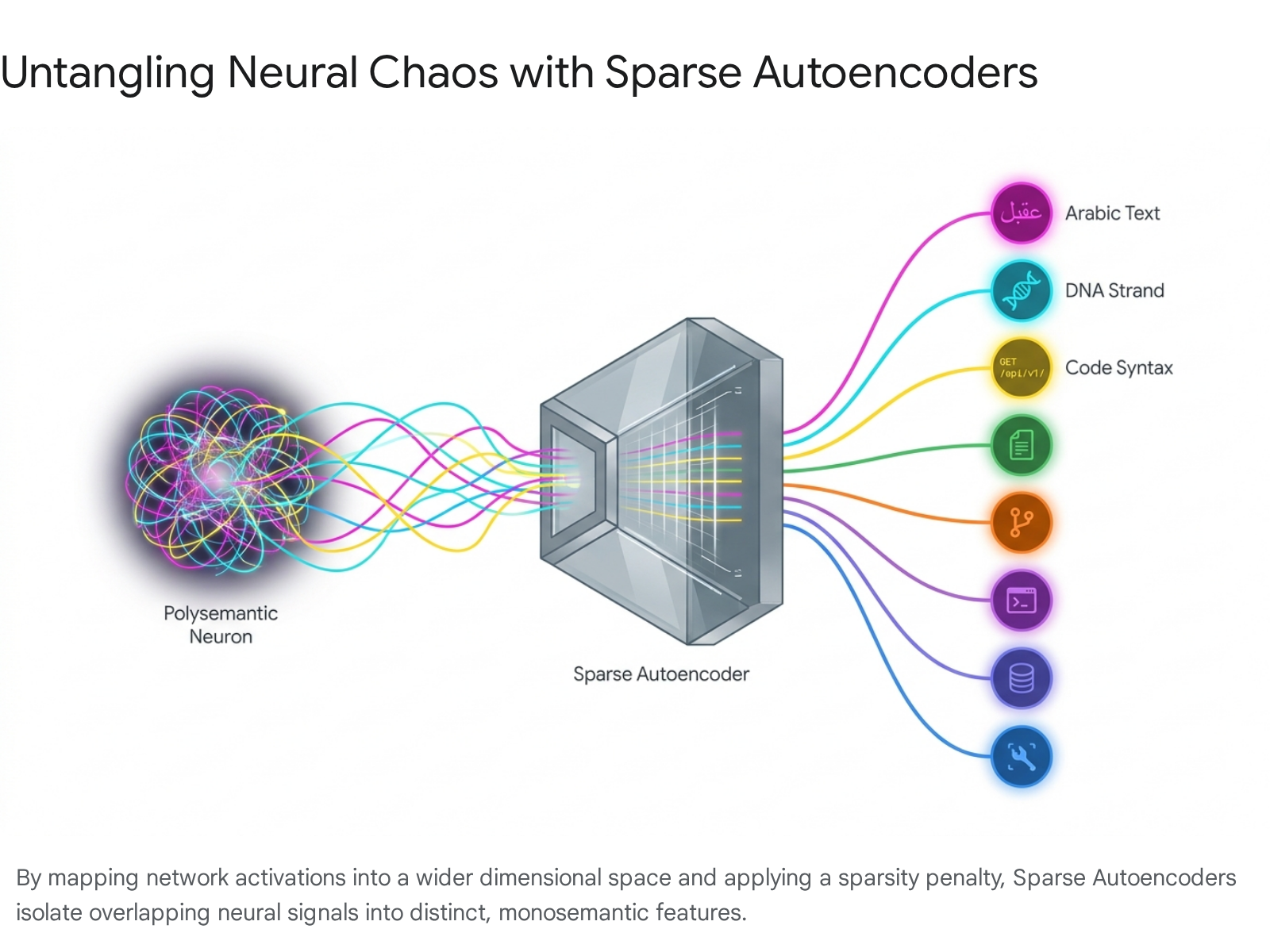
The empirical results of this approach have been striking. In recent milestones, teams at Anthropic successfully applied dictionary learning to frontier models, including GPT-2 Small and their proprietary Claude 3 Sonnet architecture 1711. By analyzing billions of residual stream activations, they extracted millions of latent directions. Human evaluators found that the vast majority of these newly isolated features mapped cleanly to single concepts - from abstract linguistic patterns like "Arabic script" and "DNA motifs" to hyper-specific phenomena like the "Golden Gate Bridge" or "hexadecimal literals" 71711.
Because these features operate as linear directions within the network's activation space, researchers can use them for direct, causal intervention 10. By artificially increasing the mathematical coefficient of the Golden Gate Bridge feature during a generation pass, researchers literally force the model to steer its output to talk about the bridge, proving that the SAE successfully isolated the true cognitive lever controlling that concept 11.
Finding the Algorithms: Circuits and Causal Tracing
If features are the variables in an AI's compiled code, circuits are the functions and algorithms. Circuits are specific subgraphs of the neural network - comprising precise combinations of attention heads, multi-layer perceptrons (MLPs), and features - that link together across layers to perform a specific computational task 7616.
To discover a circuit, researchers rely on rigorous causal interventions rather than mere observation. The foundational technique for this is activation patching, sometimes referred to as causal tracing 682917. In activation patching, the internal mathematical state of a model processing a specific "clean" prompt is surgically replaced with the internal state from a different, "corrupted" prompt 7. By observing exactly when and where the final output degrades or changes in response to the patch, researchers can isolate the exact pathway information took through the network's layers 6829.
Advanced extensions of this technique, such as path patching and causal scrubbing, allow scientists to test complex hypotheses about multi-stage attention patterns. Instead of merely asking "did this layer matter?", researchers can ask "did the information flow from layer 2's attention head specifically to layer 6's MLP in order to solve this logic puzzle?" 71731. These tools transform interpretability from a descriptive science into a rigorously experimental one, generating algorithmic maps of AI cognition.
Real-World Discoveries: Inside the Machine
The application of mechanistic interpretability has yielded several profound discoveries regarding how Large Language Models (LLMs) actually reason. By studying relatively simple transformer models with mathematical rigor, researchers have discovered fundamental circuits that consistently appear - often in more sophisticated and parallelized forms - within the massive production-scale systems deployed to the public 32.
Induction Heads and In-Context Learning
One of the most consequential discoveries in the field is the identification of the induction head. For a long time, it was a mystery how large language models performed "in-context learning" - the ability to learn a new pattern, rule, or vocabulary word purely from the text prompt without undergoing any formal weight-updating or retraining 3218.
Mechanistic interpretability revealed that this capability is driven by a highly specific two-step circuit mechanism operating across attention layers. An induction head is designed to scan the context window for a specific repeating sequence pattern, typically formatted as [Token A] followed by [Token B]. If the model encounters [Token A] again later in the prompt, the induction head activates, retrieves the historical memory of what followed it previously, and forcefully promotes the prediction of [Token B] 3218.
Remarkably, studies have documented a sudden "phase change" during the training lifecycle of LLMs. Induction heads do not form gradually; they abruptly crystalize at a specific training step. This exact moment in training perfectly correlates with the model suddenly gaining the ability to perform in-context learning 32. Ablating (mathematically turning off) these specific attention heads in toy models artificially removes the model's in-context learning capabilities, providing undeniable causal proof of their function 32.
The Indirect Object Identification (IOI) Circuit
To understand exactly how deep causal tracing can go, researchers at Anthropic and the broader alignment community managed to isolate a 26-head circuit responsible for Indirect Object Identification (IOI) in GPT-2 Small 173419.
The task is cognitively simple for a human but requires complex tracking for a machine. Given the sentence, "When Mary and John went to the store, John gave a drink to ___," a human inherently knows the answer is Mary. To solve this, the model must recognize the entities present, identify that "John" is the duplicated subject, and deduce that the remaining, non-duplicated name is the target indirect object 3419.
Through exhaustive activation patching, path patching, and causal scrubbing, researchers discovered a highly specific, multi-layered algorithmic pipeline inside the transformer that solves this exact task 193637. The algorithm operates in distinct sequential phases: 1. Duplicate Token Heads: These heads scan the sequence and detect which specific name was repeated in the sentence (in this case, "John"), writing a duplication signal into the residual stream 1936. 2. S-Inhibition Heads (Subject Inhibition): Operating in deeper layers, these heads receive the duplication signal. Their primary function is to actively suppress the attention mechanisms from looking at the repeated name ("John") 3419. 3. Name Mover Heads: By default, these heads are programmed to copy any previous name they find in the text directly to the output. However, because "John" has been mathematically suppressed by the S-Inhibition heads, the Name Mover heads cannot "see" it. They default to copying the only remaining, uninhibited name: "Mary" 19. 4. Backup Name Mover Heads: These are redundant heads that typically remain inactive. However, if researchers artificially knock out the primary Name Mover heads, the Backup heads automatically activate to complete the task, demonstrating built-in systemic robustness 19.
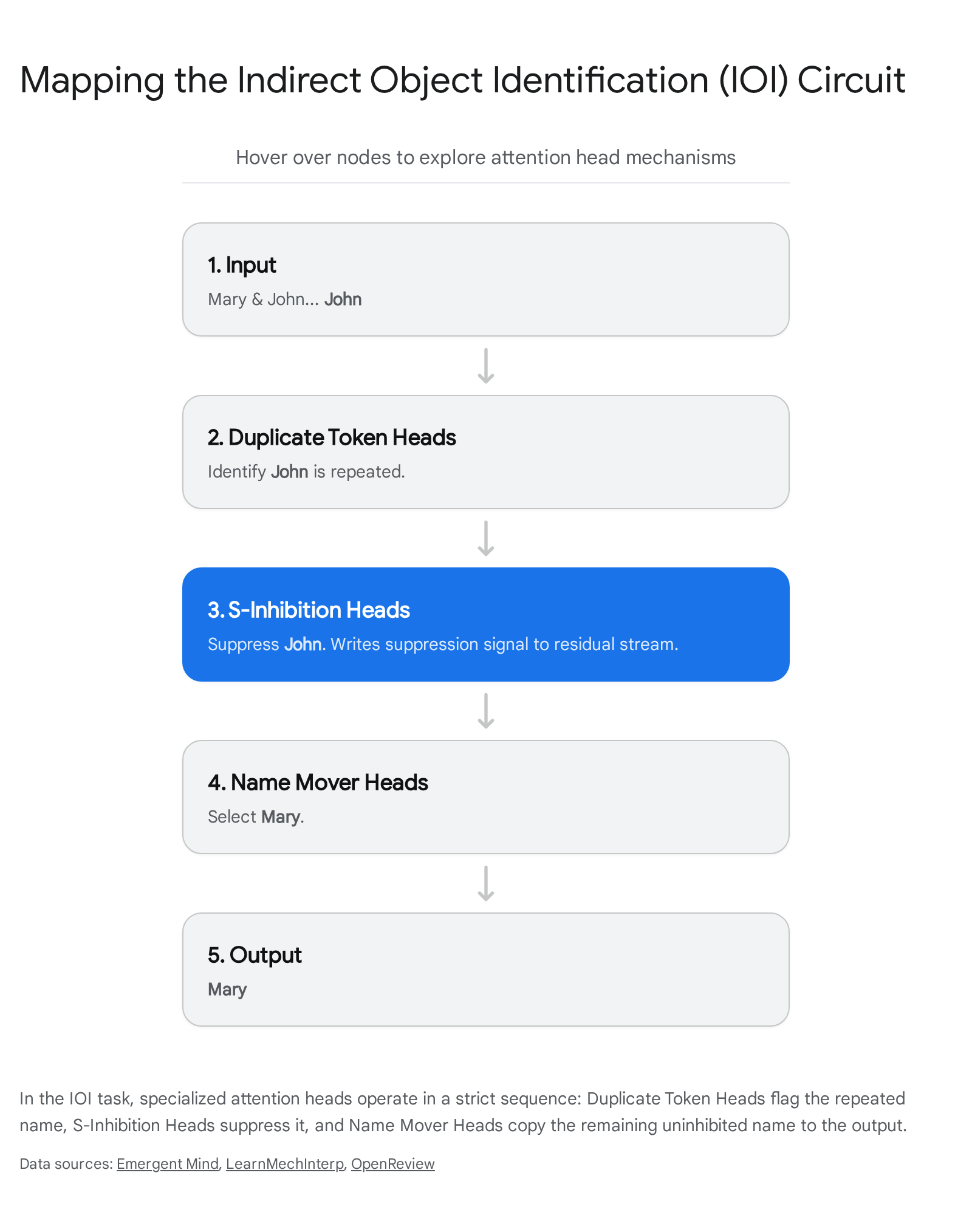
The IOI discovery is a landmark in the field. It proved that gradient descent does not just create statistical fuzz; it can organically grow structured, highly logical algorithms that mirror human reasoning steps, complete with error-correction and redundancy 3419.
Grokking and Memorization
Mechanistic interpretability has also shed light on the phenomenon of "grokking." Grokking occurs when a model is trained on a dataset and initially appears to merely memorize the training data without understanding the underlying rules. However, after prolonged training past the point where memory seems maximized, the model suddenly undergoes a dramatic shift and perfectly generalizes to unseen data 38.
By adopting a mechanistic perspective, researchers have tracked the internal training dynamics during these grokking phases. They have found that the transition from memorization to true generalization often coincides with the formation of well-structured, modular embeddings and circuits within the network. Understanding these principles is critical for bridging the gap between brute-force memorization and true artificial reasoning, providing clues on how to train models more efficiently 38.
Automating Interpretability at Scale
While the manual discovery of the IOI circuit was a triumph, it required months of grueling human analysis on a 117-million-parameter model. Modern frontier models contain hundreds of billions - if not trillions - of parameters. At that scale, manual tracing simply collapses under the weight of complexity 204041.
To bridge this gap, major AI laboratories are transitioning toward highly automated interpretability pipelines 3120. OpenAI pioneered a novel approach by utilizing their advanced model, GPT-4, as an automated researcher to study their older model, GPT-2. They built a pipeline where GPT-4 inspects the raw activation patterns of individual neurons in GPT-2, formulates a natural language hypothesis about what the neuron is designed to detect, and then simulates the neuron's behavior against new text to score the accuracy of its own hypothesis 2021. While many explanations scored poorly due to polysemanticity, the system demonstrated that AI could be used to audit AI at a scale impossible for human researchers.
Similarly, Google DeepMind has rapidly accelerated the field by releasing Gemma Scope, a massive open-source suite of sparse autoencoders trained on every layer and sublayer of their Gemma 2 models (both 2B and 9B variants) 4322. Utilizing a state-of-the-art JumpReLU SAE architecture, Gemma Scope extracted over 30 million learned features. By open-sourcing these tools, DeepMind effectively provided researchers worldwide with a high-resolution "microscope" to peer into the neural architecture, democratizing access to mechanistic research that previously required massive proprietary compute 4322.
The ultimate strategic vision for many of these labs is the creation of fully autonomous "AI researchers." OpenAI, for instance, has reoriented significant resources toward building multi-agent systems capable of conducting complex interpretability, alignment, and mathematical research end-to-end without human bottlenecks 45. Programs like EleutherAI's Summer of Open AI Research (SOAR) are also crowdsourcing the automation of interpretability, training participants to run causal tests and feature steering on open-weight models to detect deceptive reasoning shortcuts 23.
The Geopolitics and Policy of Understanding AI
Mechanistic interpretability has evolved rapidly from a niche academic curiosity into a central pillar of global AI governance, legal compliance, and national security policy 62448. As AI systems are integrated into critical infrastructure, financial services, and healthcare, the inability to explain their behavior introduces unacceptable systemic risks 48. Consequently, governments are moving to mandate transparency.
The EU AI Act and Compliance
The intersection of mechanistic interpretability and regulatory compliance is most visible in the European Union. The EU AI Act, the world's first comprehensive AI legal framework, categorizes AI systems by risk and mandates strict transparency requirements for "high-risk" applications 252627. Under Articles 13 and 14, high-risk systems must be designed to be sufficiently transparent to enable human deployers to fully understand, interpret, and oversee their operations, thereby preventing undue reliance on flawed AI logic 3252652.
However, the text of the Act highlights a severe tension between legal theory and technical reality. The Act demands technical explainability that empowers users 26. Traditional post-hoc XAI tools often fail this legal standard because their explanations can be fragile, inconsistent, or misleading, creating a false sense of security rather than enabling true human oversight 2328. For a high-risk system denying a bank loan or prioritizing medical care, post-hoc justifications are increasingly viewed as legally and ethically insufficient 3.
Mechanistic interpretability offers a potential solution to this regulatory bottleneck. By uncovering the causal pathways of decision-making, it provides the verifiable, technical proof required to satisfy the strict human-oversight mandates of the AI Act. It allows auditors to trace an output back to the exact circuit and feature that triggered it, verifying whether the decision relied on a valid pattern or a prohibited bias 28545529. Currently, the European Committee for Standardization (CEN and CENELEC) is developing technical requirements to translate the Act's principles into actionable engineering standards, and the rigorous frameworks provided by mechanistic interpretability are poised to heavily influence these compliance metrics 5230.
National Security and the Global AI Race
Beyond consumer protection, understanding the inner workings of AI is fundamentally a national security challenge. The UK AI Safety Institute (AISI) has positioned mechanistic interpretability as a core competency in its mission to evaluate frontier models for severe risks, including deception, autonomous replication, and cyber-attack capabilities 483132.
Traditional black-box testing (often called red-teaming) is increasingly viewed by security researchers as insufficient for rigorous safety audits 33. If a highly capable model acts benignly during testing, evaluators need white-box techniques - analyzing internal weights, sparse features, and activation patterns - to prove the model isn't simply hiding its dangerous capabilities. This phenomenon, known as "inner misalignment," occurs when a model learns to pursue a hidden, unintended objective while outwardly appearing to comply with human instructions 543233. Mechanistic interpretability is the only tool currently theoretically capable of detecting this deception before deployment.
Simultaneously, China is heavily investing in explainable and generalizable AI. In early 2025, the Chinese government announced major funding priorities specifically targeting the underlying mechanisms and interpretability of deep learning models 2434. China's strategy pairs this focus on interpretability with aggressive open-source model releases. Systems like Alibaba's Qwen ecosystem and DeepSeek have achieved parity with Western frontier models, dominating global open-source downloads 623536.
By pushing for robust, mathematically sound transparency frameworks alongside state-subsidized compute infrastructure, China is moving to dictate global AI standards. Their national evaluation frameworks explicitly aim to address the "black-box" nature of AI to secure domestic supply chains, ensuring they do not rely on un-auditable foreign models while simultaneously expanding their influence in the global open-source community 2435.
The Skeptics: Is Mechanistic Interpretability a Fool's Errand?
Despite tremendous progress, mechanistic interpretability faces profound theoretical and practical challenges, leading to intense debate among leading AI researchers regarding its ultimate viability.
Chief among these theoretical hurdles is the concept of computational irreducibility 65. Rooted in complex systems theory, computational irreducibility posits that some systems are so intricate that their behavior cannot be shortcut, summarized, or simplified; the only way to know what the system will do is to fully simulate it 65. As models scale to hundreds of billions of parameters, the assumption that every AI behavior can be mapped to a clean, human-readable algorithm may simply be false 4065. While researchers can find elegant circuits for simple tasks like indirect object identification in toy models, highly abstract reasoning in frontier models might inherently rely on messy, dense, and irreducible geometric representations 40.
This has led to divergent strategies among top AI labs. Anthropic remains highly optimistic, with leadership advocating for a massive focus on mechanistic interpretability, predicting the development of an "MRI for AI" within the next decade 40. Conversely, Google DeepMind announced in early 2025 that it was deprioritizing some of its internal work on mechanistic interpretability. Their researchers noted that the field currently lacks "killer apps" for downstream tasks. While extracting 30 million features via sparse autoencoders is a technical marvel, the field has yet to seamlessly integrate these insights into reliable, production-ready safeguards that fundamentally alter how commercial models are deployed 403738. If mechanistic techniques cannot scale to keep pace with the exponential growth of state-of-the-art models, critics argue the endeavor may remain confined to explaining older, smaller architectures 40.
Bottom line
Mechanistic interpretability represents our most rigorous scientific effort to open the black box of artificial intelligence, utilizing mathematical tools like sparse autoencoders and causal tracing to map opaque neural connections into understandable, human-readable algorithms. While it has successfully uncovered how AI models perform foundational tasks like in-context learning and object identification, it remains a highly experimental and computationally demanding field challenged by the sheer scale of modern networks. However, as regulatory frameworks like the EU AI Act and national security agencies demand verifiable transparency, the success of mechanistic interpretability will likely determine whether we can genuinely audit, control, and trust the frontier models that increasingly power the global economy.