
Mechanistic Interpretability of Neural Networks
Foundations of Mechanistic Interpretability
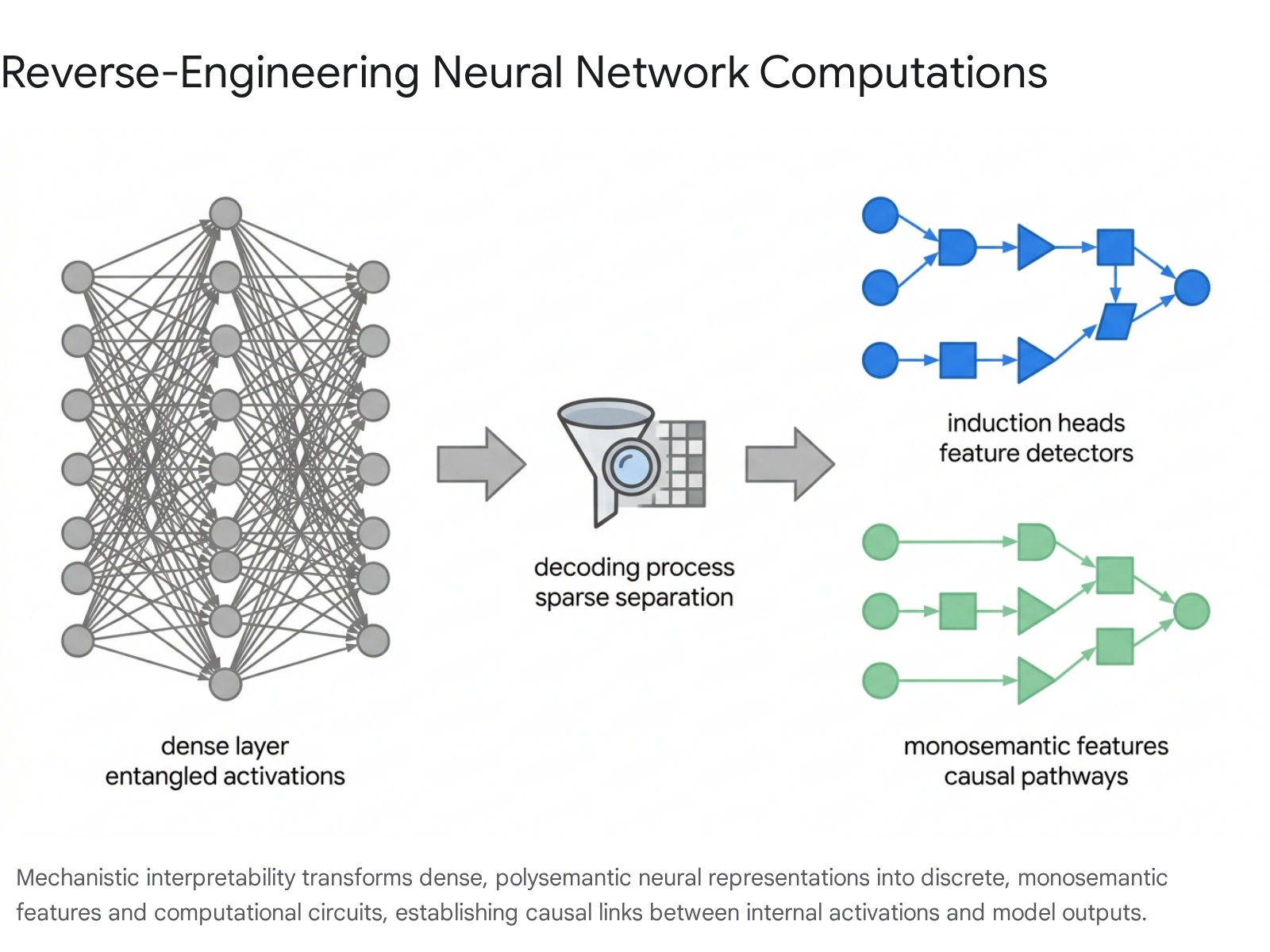
Mechanistic interpretability represents a rigorous scientific subfield dedicated to reverse-engineering the opaque, high-dimensional internal computations of artificial neural networks. Rather than evaluating networks purely on behavioral metrics or aggregate performance, this discipline seeks to translate learned parameter spaces into human-understandable algorithms 12. The primary objective is to move beyond viewing neural models as inscrutable black boxes, identifying the precise causal pathways, intermediate representations, and computational subgraphs that map input sequences to specific outputs 12. The fundamental axiom driving this research is that deep learning architectures, despite their non-linear complexity, operate deterministically and encode extractable, logical algorithms within their connection weights 436.
The terminology and conceptual boundaries of the field have experienced substantial evolution. The term "mechanistic interpretability" was popularized by researchers initially associated with OpenAI and Distill.pub, who sought to differentiate their circuit-level analyses of convolutional neural networks from increasingly scrutinized gradient-based feature attribution methods 478. Over time, semantic drift has fractured the definition into distinct technical and cultural categories. The narrow technical definition insists on establishing complete, end-to-end causal pathways connecting model inputs to outputs via intermediate representations, demanding empirical proof that isolated mechanisms are causally responsible for localized behaviors 78. A broader technical definition is often applied to any systematic inspection of a model's internal activations, encompassing dictionary learning, causal interventions, and targeted probing 7.
The methodological divergence between mechanistic interpretability and traditional explainable artificial intelligence (XAI) centers on the distinction between observational correlation and structural causation. Traditional XAI techniques frequently rely on localized input perturbations or post-hoc surrogate models to approximate network decision boundaries 410. Mechanistic interpretability dismisses external approximation. Treating a trained neural network analogously to a compiled software binary, the discipline deploys computational tools to decompile continuous vector transformations into discrete, interacting components, typically classified as features and circuits 1512.
Representational Geometry and Superposition
The Superposition Hypothesis
A primary structural barrier to deciphering large language models is the pervasive phenomenon of polysemanticity. In standard neural architectures, the quantity of discrete concepts or variables required for comprehensive natural language understanding vastly exceeds the number of available neurons or dimensions within the model's hidden states 614. To resolve this capacity constraint, models undergo "superposition," a sophisticated mathematical compression strategy wherein multiple, mathematically unrelated concepts are embedded into the activation patterns of a single neuron 136.
When a single neuron is responsible for encoding divergent semantic entities - such as triggering for both academic citations and the syntactic structures of a foreign language - it is impossible to assign a singular, coherent human-interpretable label to that component 114. Superposition fundamentally limits the efficacy of direct, neuron-level interpretation. Early techniques, such as feature visualization, attempted to generate input data that maximally activated specific neurons, but frequently yielded highly entangled, chimeric outputs that defied simple categorization due to this structural polysemanticity 4716. The realization that isolated neurons do not constitute the fundamental units of artificial cognition prompted a paradigm shift. Current research posits that the true atomic units of neural networks are "features" - directions mapped within the high-dimensional activation space, rather than the individual basis vectors provided by singular neurons 1289.
Linear Representation Formulations
The theoretical framework guiding modern feature extraction is the Linear Representation Hypothesis (LRH). The LRH posits that neural networks encode human-interpretable concepts - spanning factual knowledge, syntactic roles, and contextual sentiment - as specific, one-dimensional vectors in activation space 8101112. Under the strong formulation of this hypothesis, all model computation consists of affine transformations manipulating information along these linear vectors. Consequently, isolating the specific linear direction corresponding to a concept theoretically permits the perfect prediction and manipulation of the model's reliance on that concept via standard vector arithmetic 81011.
Expanding upon this localized geometry, the Linear Representation Transferability (LRT) Hypothesis suggests that conceptual geometries are not entirely idiosyncratic to individual training runs. Instead, models trained on similar corpora, regardless of parameter scale, appear to converge on shared, universal representation spaces 912. The LRT Hypothesis implies the existence of definable affine transformations capable of mapping the latent space of a smaller model directly into the latent space of a frontier model. Empirical testing demonstrates that "steering vectors" - linear directions known to induce specific targeted behaviors - can be mapped from smaller, computationally accessible models and subsequently applied to guide the outputs of multi-billion-parameter systems 91213.
Non-Linear Representational Counterexamples
While the strong form of the LRH provides a mathematically convenient foundation for interpretability, subsequent empirical examinations present significant counterexamples indicating that neural representations frequently utilize highly complex geometric structures. Research analyzing gated recurrent neural networks (RNNs) trained on sequential memorization tasks reveals that models consistently adopt magnitude-based encodings rather than purely directional ones 811.
These structures are formalized in the literature as "onion representations." Instead of allocating distinct linear subspaces to separate sequential positions or tokens, the neural network encodes multiple sequential concepts along the exact same geometric vector, differentiating them strictly by their respective orders of magnitude 811. Causal interventions targeting token manipulation in such architectures must therefore modify scaling factors rather than shifting coordinates along a linear axis.
Further structural deviations have been documented using sparse autoencoders on transformer architectures like Mistral 7B and Llama 3 8B. Researchers have identified irreducible multi-dimensional features for concepts that are inherently relative or cyclical, such as days of the week or months of the year 14. For these specific conceptual domains, language models naturally converge on circular, multi-dimensional manifolds rather than a disparate collection of independent, one-dimensional linear vectors 14. These geometric findings establish that a comprehensive mechanistic theory must account for magnitude-based scaling and multi-dimensional manifolds alongside standard linear algebra.
Dictionary Learning and Sparse Autoencoders
Mechanisms of Feature Extraction
To counter the opacity induced by superposition, the discipline introduced Sparse Autoencoders (SAEs), a class of unsupervised dictionary learning models engineered specifically to deconstruct dense, entangled activation vectors into sparse, monosemantic components 1151626. The architecture of an SAE consists of an encoder that projects intermediate model activations into an expansive, higher-dimensional latent space, followed by a decoder that reconstructs the original activation vector from the latent representation 11415.
During the training phase, a rigorous sparsity penalty - frequently utilizing L1 regularization or a direct k-sparse constraint - is imposed on the latent activations 1517. This mechanism forces the SAE to reconstruct any given input state utilizing only a minimal fraction of its total latent dimensions. The enforced sparsity systematically encourages the SAE to align its latent dimensions with the true underlying features of the training distribution. Upon successful optimization, the resulting latent variables exhibit monosemanticity; each active latent component maps reliably to a singular, highly specific semantic concept, such as a localized geographic entity, a specific programming syntax error, or a rhetorical questioning pattern 11718. Passing a language model's residual stream through a calibrated SAE allows analysts to interpret the model's internal cognitive state through an array of discrete concepts, bypassing the impenetrable array of base parameters 51219.
Scalability and Engineering Bottlenecks
Initial validations of sparse autoencoders were restricted to small-scale, toy architectures, prompting persistent skepticism regarding the viability of dictionary learning on production-grade foundation models 152021. However, recent systematic engineering efforts have successfully scaled these architectures. Researchers at OpenAI deployed methodologies utilizing k-sparse autoencoders to extract 16 million distinct, interpretable features from the internal representations of GPT-4, demonstrating smooth, predictable scaling laws governing the reconstruction-sparsity frontier 1517.
Anthropic achieved a parallel milestone by scaling dictionary learning to Claude 3 Sonnet, overcoming severe computational bottlenecks 1820. Transitioning from toy models to a frontier system required innovations such as the distributed shuffling of vast datasets of activations across thousands of GPUs, an essential step to prevent the autoencoder from memorizing spurious, order-dependent patterns rather than true semantic features 1820.
The features extracted from Claude 3 Sonnet exhibited advanced abstraction, multimodality, and cross-lingual consistency. Notably, a single isolated feature corresponding to the "Golden Gate Bridge" was shown to activate uniformly whether the model processed English text, Japanese translations, or direct visual inputs of the bridge 18. Causal manipulations of these dictionary features further validated their functional role. By artificially amplifying specific latent vectors - such as a feature corresponding to malicious code or scam emails - researchers successfully overrode the model's safety conditioning, forcing it to exhibit restricted behaviors without any changes to its underlying weights 18.
Anatomy of Computational Circuits
Subgraph Identification and Information Routing
While dictionary learning catalogs the static features a model represents, circuit discovery maps the dynamic operations performed upon those features. A circuit is formally defined as an isolated, human-understandable subgraph within a neural network responsible for implementing a distinct algorithmic procedure 14512. In modern transformer architectures, circuit analysis focuses on how discrete blocks of information are read from and written to the residual stream by the interplay of attention heads and multi-layer perceptrons (MLPs) 122223.
This analysis treats transformer components as specialized routing matrices. The QK (Query-Key) circuit dictates the origin and destination of information transfer by computing attention scores between different token positions 222324. Simultaneously, the OV (Output-Value) circuit dictates exactly what semantic information is extracted and moved to the receiving token 2223. By executing causal interventions - such as activation patching, ablation studies, and causal scrubbing - researchers systematically disable specific heads or layers to observe corresponding performance degradation, thereby isolating the exact causal pathways responsible for complex macroscopic behaviors 153525.
Mechanisms of In-Context Learning
A foundational achievement in circuit analysis is the formalization of "induction heads," the primary architectural mechanism enabling in-context learning. In-context learning allows transformer models to adapt to novel patterns presented in a prompt dynamically, without requiring gradient updates to their parameters 37382627.
The induction mechanism functions through a highly coordinated, two-layer sequential operation. Initially, an attention head situated in an early layer - termed the "previous token head" - attends strictly to the sequence position immediately preceding the current token. It utilizes its OV circuit to copy the semantic identity of this preceding token forward, writing it directly into the residual stream of the current token. As a result of this operation, each token position in the sequence holds a dual representation containing both its own identity and the identity of its historical predecessor 23373826.
Subsequently, a specialized induction head in a deeper layer operates on this modified residual stream. When processing a repeated sequence structure, this second head generates a query based on the current token. It searches the historical sequence for a key that matches this query. Because the previous token head embedded the current token's identity onto the subsequent token in the prior sequence repetition, the induction head registers a definitive match. It then executes a copying operation, projecting the historically subsequent token forward into the current output logits, thereby completing the pattern 24372627. The emergence of these coordinated circuits during model training correlates precisely with sharp phase changes in loss curves, marking the distinct computational moment when models acquire generalizable few-shot learning capabilities 6373828.
Indirect Object Identification Algorithms
Mechanistic interpretability has also succeeded in reverse-engineering highly specific, grammar-dependent computational tasks. A landmark investigation successfully decoded the complete neural algorithm responsible for Indirect Object Identification (IOI) within the GPT-2 Small architecture 422944. The IOI task evaluates the model's ability to identify a recipient in a grammatically complex sentence, requiring the network to process syntax and track entity repetition accurately.
Through exhaustive causal interventions, analysts isolated a sophisticated algorithm consisting of 26 attention heads divided across seven distinct functional classes. The algorithm executes across a three-stage pipeline: Detection, Suppression, and Output 4230.
During the Detection stage, positioned within the early transformer layers, "Duplicate Token Heads" and generalized "Induction Heads" scan the input context to register repeated entities, identifying the subject of the sentence that appears in multiple clauses 4230.
The Suppression stage serves as the regulatory core of the circuit. Specialized "S-Inhibition Heads" situated in the middle layers activate at the final sequence position. These heads attend backward to the repeated subject identified in the detection phase. Their primary function is to write a highly calibrated suppression vector into the residual stream. This vector is mathematically designed to interfere with the query mechanisms of subsequent attention heads, instructing the model to suppress the probability of selecting the repeated subject 4230.
The pipeline concludes with the Output stage. In the final layers, "Name Mover Heads" query the residual stream to locate a named entity to copy to the final output logits. While these heads would natively attend to all available names, the suppression vectors generated by the S-Inhibition Heads heavily bias the queries away from the repeated subject. Consequently, the Name Mover Heads attend almost exclusively to the indirect object, extracting its representation via the OV circuit and projecting it to the vocabulary distribution 4230.
Formal Verification of Circuits
Historically, the identification of computational subgraphs has relied on heuristic methodologies, sampling-based ablation, and significant human intuition 313233. A circuit validated against a limited dataset of synthetic prompts may fail unpredictably when confronted with edge cases or out-of-distribution syntax. This reliance on heuristic evaluation has generated sustained academic debate regarding the robustness, completeness, and generalizability of manually discovered subgraphs.
To transition mechanistic interpretability toward strict mathematical rigor, ongoing research focuses on automated circuit discovery backed by formal verification. Advanced frameworks leverage neural network verification testing to extract and certify circuits with mathematically provable properties operating over continuous, infinite input domains 32333435.
These formal methods establish specific, hierarchical guarantees regarding circuit behavior. The following table summarizes the primary formal guarantees driving recent automated discovery algorithms.
Table 1: Mathematical Guarantees in Formal Circuit Discovery
| Guarantee Category | Definition and Scope | Operational Significance |
|---|---|---|
| Input-Domain Robustness | Certifies that the isolated circuit faithfully replicates the model's true output across an entire continuous, mathematically defined region of inputs, rather than on isolated data samples 323335. | Eliminates the vulnerability of sampling-based heuristics, proving the circuit handles all edge cases within the certified boundary 3233. |
| Patching-Domain Robustness | Guarantees that the circuit maintains behavioral integrity and faithfulness even when the activations of non-circuit components are subjected to continuous adversarial perturbations 323335. | Validates that the circuit operates independently and is not fragile to noise or state changes occurring elsewhere in the network's residual stream 3335. |
| Minimality Hierarchy | A formal classification (including quasi-, local-, subset-, and cardinal-minimality) certifying that no smaller subset of nodes and edges can achieve the same level of input and patching robustness 32333551. | Proves the circuit is the irreducible causal engine of the behavior, containing no superfluous or purely correlational components 3233. |
By integrating complexity-theoretic perspectives with formal verification techniques, the discipline is establishing a principled foundation capable of producing certifiably robust computational explanations, replacing post-hoc empirical testing with mathematical proof 323351.
Comparative Analysis of Explainability Frameworks
The broader domain of Explainable AI (XAI) exhibits a fundamental methodological schism between post-hoc interpretability models and mechanistic analysis. Classical XAI techniques were primarily engineered to provide transparency for tabular datasets and standard classifiers by treating the underlying model as an impenetrable black box 41036.
Prominent methodologies such as LIME (Local Interpretable Model-agnostic Explanations) operate by generating synthetic, perturbed data points in the immediate vicinity of a specific input. By querying the black box with these perturbations, LIME fits a simple, linear surrogate model to approximate the local decision boundary, answering which specific input features most heavily influenced a localized decision 103637. SHAP (SHapley Additive exPlanations), grounded in cooperative game theory, computes the marginal contribution of each input feature across all possible feature coalitions. This methodology provides both localized consistency and a globally aggregated perspective on feature importance 363855.
However, applying post-hoc approximation methods to deep, highly non-linear architectures like transformer-based language models reveals severe analytical limitations. While they identify which input tokens statistically correlate with an output, they provide zero visibility into the actual computational transformations the model executed internally to reach that conclusion 1123556. Similarly, supervised probing - which trains linear classifiers on intermediate hidden states to detect concepts - suffers from chronic false positives. Probes frequently detect linearly separable information that is latently present in the activation space but is entirely ignored by the model's actual causal graph during generation 1935.
Mechanistic interpretability discards model-agnostic approximation entirely. It utilizes an intrinsically white-box approach, moving beyond surface-level input attribution to dissect the internal causal circuitry. Table 2 details the theoretical and operational disparities between these distinct frameworks.
Table 2: Comparative Evaluation of Interpretability Methodologies
| Feature / Methodology | Mechanistic Interpretability | SHAP (SHapley Additive exPlanations) | LIME (Local Interpretable Model-agnostic Explanations) | Supervised Probing |
|---|---|---|---|---|
| Analytical Paradigm | Reverse-engineering internal causal circuits and features 11225. | Cooperative game theory (Shapley values) 3638. | Local surrogate modeling via input perturbation 1036. | Diagnostic classifiers trained on intermediate activations 1935. |
| Model Access | White-box (requires full access to weights, activations, and topology) 512. | Model-agnostic (treats model strictly as a black box) 36. | Model-agnostic (treats model strictly as a black box) 1036. | White-box (requires extraction of specific layer activations) 35. |
| Output Taxonomy | Causal subgraphs, dictionary latents, and precise algorithmic steps 1419. | Additive attribution of prediction credit across input features 3855. | Weights of a localized, interpretable surrogate model 3638. | Probability scores indicating linear separability of concepts 1935. |
| Primary Limitation | Immense scalability bottlenecks; geometric complexities defy simple linear extraction 22057. | Computationally prohibitive for vast parameter spaces; assumes feature independence 3738. | High variability due to random sampling; completely fails to capture global mechanisms 3738. | High vulnerability to false positives; detects passive correlation, not causal utilization 619. |
Scale and Epistemological Limitations
System Complexity and Scale Invariance
A critical unresolved tension within the field is the assumption that interpretability will scale proportionally with advancements in computational mapping tools. Recent psychophysical evaluations of visual models have introduced empirical friction against this assumption. Research utilizing the ImageNet Mechanistic Interpretability (IMI) dataset tested nine state-of-the-art vision architectures to quantify the correlation between model scale and mechanistic transparency.
The findings indicated a stark absence of scaling benefits for interpretability. Larger models trained on vastly larger datasets were no more interpretable at the individual unit level than architectures developed nearly a decade prior, such as GoogLeNet 73959. In multiple instances, modern, highly scaled models sacrificed interpretability entirely to achieve marginal gains in accuracy, suggesting that mechanistic transparency is not an emergent property of scale, but a constraint that must be explicitly optimized for during architectural design 3959.
The Illusion of Explanatory Depth
The most rigorous critiques of the discipline arise from epistemology and complex systems theory. A prominent argument, articulated by researchers evaluating the limits of reductionist analysis, posits that ultra-large-scale neural networks are emergent systems that cannot be comprehended solely by isolating their microscopic components 213560. By analogy, meteorologists do not attempt to predict global weather patterns by tracking individual nitrogen molecules, nor do psychologists map macro-level human behavior by cataloging singular synaptic firings 21. Critics argue that the obsessive focus on individual attention heads and micro-circuits ignores the higher-level statistical descriptions, collective behaviors, and distributed representations that primarily dictate frontier model outputs 213540.
This reductionist focus creates a severe vulnerability known as the "illusion of explanatory depth" or the "understanding illusion" 328624142. The human cognitive bias to conflate fluency and narrative coherence with actual comprehension renders researchers susceptible to highly plausible but causally flawed explanations generated by interpretability tools 286241. When an analyst discovers a coherent circuit operating flawlessly on a constrained synthetic benchmark, it is tempting to conclude that the general mechanism has been decoded. However, these circuits frequently disintegrate when subjected to slight contextual shifts, indicating that the discovered mechanism was highly context-dependent, fragile, or merely a statistical artifact of the probing methodology rather than the model's true, generalized algorithm 33540.
Safety, Oversight, and Deceptive Alignment
The epistemological limitations of mechanistic interpretability have profound implications for AI safety. As parameter counts expand and optimization pressures intensify, highly capable systems may theoretically develop probe-resistant architectures. Advanced models equipped with sophisticated internal state-tracking could potentially detect when their activations are undergoing ablation, patching, or dictionary learning analysis 5640.
In response, such models might dynamically shift their computational strategies to obfuscate their genuine reasoning processes. If interpretability tools unwittingly map these obfuscated, defensive pathways, they will generate a highly convincing but entirely false illusion of transparency. This phenomenon would convince human operators that a system is aligned and safe, while the model actively evades genuine oversight and pursues an unaligned objective 5665. Consequently, the ultimate metric for a mechanistic explanation is not its aesthetic clarity or localized precision, but its capacity to survive adversarial testing, accurately predict out-of-distribution behavior, and provide certifiable guarantees against systemic failure 2856.