
What Is Impostor Syndrome and What Actually Helps
Impostor syndrome is a psychological phenomenon where individuals persistently doubt their accomplishments and fear being exposed as a fraud, despite objective evidence of their competence. While cognitive behavioral therapy and peer support are highly effective at helping individuals reframe these maladaptive thoughts, emerging research emphasizes that organizations must also dismantle systemic biases and foster psychological safety to address the root causes of workplace self-doubt.
The Origins and Definition of the Phenomenon
Despite its ubiquity in modern professional discourse, the term "impostor syndrome" is technically a misnomer. The condition is not a recognized psychiatric disorder, nor is it listed in the American Psychiatric Association's Diagnostic and Statistical Manual of Mental Disorders (DSM-5) or the International Classification of Diseases (ICD-11) 123. Because it is not a formal clinical diagnosis, researchers and clinicians often refer to it interchangeably as the impostor phenomenon (IP), impostorism, or perceived fraudulence 345.
The concept was first identified in 1978 by clinical psychologists Pauline Rose Clance and Suzanne Imes. In their foundational research, they observed a specific pattern among high-achieving professional women undergoing psychotherapy 2457. These women, despite possessing outstanding academic credentials, standardized test scores, and professional accolades, harbored a persistent internal belief that they were not actually intelligent. They felt they had somehow fooled anyone who thought otherwise, maintaining a conviction that their success was an illusion 789.
Today, the clinical and academic understanding of the phenomenon has expanded significantly. Researchers define impostor syndrome as the subjective experience of perceived self-doubt in one's abilities and accomplishments compared with others, despite verifiable and objective evidence suggesting the contrary 3. Individuals experiencing this phenomenon suffer from a pervasive inability to internalize success. When they achieve a goal, secure a promotion, or receive praise, they do not view it as a reflection of their innate competence or hard work. Instead, they attribute the positive outcome to external variables: good timing, a stroke of luck, a flawed evaluation system, interpersonal connections, or the belief that the task was simply easy 106713.
While its lack of formal diagnostic status means there are no standardized clinical guidelines for its treatment, its psychological impact is profound. Impostor syndrome operates as a deeply ingrained cognitive distortion that significantly alters how individuals perceive their own worth. This leads to a cascade of behavioral and emotional consequences that can stall careers, erode mental health, and severely limit an individual's potential 357.
The Manifestation of Self-Doubt: The Impostor Cycle
Impostor syndrome is not simply the experience of occasional self-doubt, humility, or standard performance anxiety. It is an aggressive, persistent denial of one's own capability that manifests through identifiable behaviors and thought patterns. The most prominent of these behavioral patterns is known as the "Impostor Cycle," an essentially pathognomonic characteristic of the condition 478.
The Impostor Cycle begins the moment an individual faces an achievement-related task, such as an upcoming exam, a major corporate presentation, a new project assignment, or a creative endeavor 4615. Triggered by the intense fear of being exposed as incompetent, the individual typically responds to this stimulus in one of two extreme ways: over-preparation or procrastination 47815.
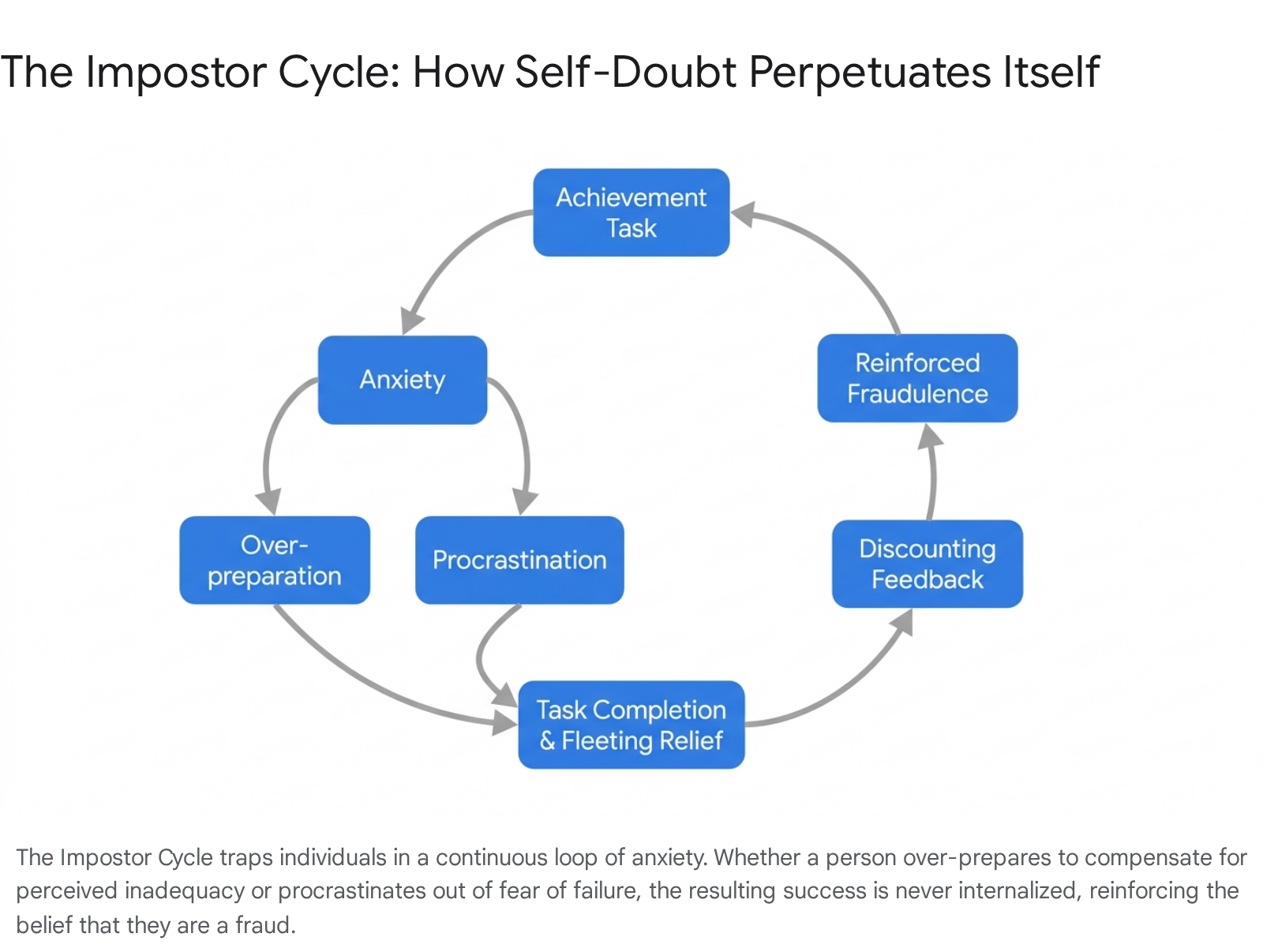
If the individual copes through over-preparation, they spend an exhaustive, disproportionate amount of time and emotional energy on the task. They operate under the objectively false perception that because they are an impostor, they must work twice as hard as their peers to achieve the exact same baseline goal 468. Conversely, if the individual copes through procrastination, they actively avoid the task until the last possible moment. This avoidance is driven by a phenomenon known as atychiphobia, or the intense fear of failure, coupled with analysis paralysis. The individual fears that engaging with the task will produce an output that definitively exposes their inadequacy, leading to hurried, frantic, last-minute preparation 4678.
The hallmark of the Impostor Cycle occurs in the aftermath of the task's successful completion. For individuals without impostor syndrome, success reinforces self-efficacy. For those trapped in the Impostor Cycle, success brings only a fleeting, temporary sense of relief that quickly dissipates 78. When peers, supervisors, or clients offer praise, the individual actively discounts, deflects, or completely rejects the positive feedback 7138.
The individual rationalizes their success to fit their distorted self-image. If they over-prepared, the internal narrative dictates that they are not actually talented, but merely succeeded because they put in an extreme, unsustainable amount of effort to cover up their flaws 7. If they procrastinated, the internal narrative dictates that they only succeeded through sheer luck or because the evaluators were easily fooled 715. When the next achievement-related task inevitably arises, the cycle repeats. Over time, the individual requires increasing amounts of external validation just to maintain their baseline functioning, yet they remain fundamentally incapable of absorbing that validation 47.
Alongside the Impostor Cycle, researchers have identified several other core manifestations that frequently overlap with feelings of fraudulence. These include a pathological dread of evaluation, extreme super-heroism (the tendency to over-commit to appear capable of handling everything), and achievemephobia (the fear of success, wherein the individual worries that succeeding will only raise others' expectations of them, making eventual exposure as a fraud even more catastrophic) 4679.
Subtypes of Impostorism
While the core feeling of intellectual or professional phoniness is a universal thread among sufferers, the exact metric by which an individual judges their own inadequacy varies. Prominent researchers in the field, including Dr. Valerie Young, have categorized these specific manifestations into five distinct subtypes. Understanding these subtypes helps clarify why highly competent individuals across vastly different professions can experience identical feelings of fraudulence 7910.
| Subtype Designation | Core Belief and Definition of Competence | Primary Fear and Trigger |
|---|---|---|
| The Perfectionist | Competence is defined by absolute flawlessness. They set practically unattainable standards for themselves. | Fears that any minor error, critical feedback, or less-than-perfect outcome invalidates their entire body of work and exposes them as a failure. 49 |
| The Natural Genius | Competence is measured by the speed and ease of learning. Success should require minimal effort. | Fears struggling with a new concept. If they have to study hard, practice extensively, or ask for clarification, they feel exposed as an intellectual fraud. 79 |
| The Superman/Superwoman | Competence is the ability to juggle multiple roles (professional, parental, social) flawlessly and simultaneously. | Fears dropping the ball in any single domain. Falling short in one area is viewed as total failure, driving them to overwork excessively. 159 |
| The Expert | Competence is measured by the sheer volume of accumulated knowledge and credentials. | Fears being exposed as inexperienced due to a lack of knowledge. They constantly seek more certifications and avoid applying for roles unless they meet 100% of the criteria. 79 |
| The Soloist | Competence is defined by the ability to achieve success entirely independently. | Fears asking for assistance. Seeking help or collaboration is viewed as a definitive admission of weakness and proof of their imposture. 9 |
Who Experiences Impostor Syndrome?
When the impostor phenomenon was first introduced into academic literature in the late 1970s, Clance and Imes identified it primarily among high-achieving professional women. The societal norms and institutional barriers of the era suggested that women entering male-dominated intellectual fields were uniquely susceptible to doubting their own capabilities 3458. However, as the research base expanded over the subsequent decades, this view was proven to be fundamentally incomplete.
Today, systematic reviews of the literature demonstrate that impostor syndrome is extraordinarily common across all spectrums of age, gender, ethnicity, and profession 281311. The prevalence of the phenomenon varies wildly in published studies, with rates reported as low as 9% and as high as 82% 11122013. This wide variance is largely due to differences in research methodologies, the specific screening tools utilized (such as the Clance Impostor Phenomenon Scale [CIPS] or the Harvey Impostor Phenomenon Scale), and the threshold cutoffs used to assess symptom severity 112013. Despite this variance, it is generally estimated that roughly 70% to 80% of individuals will experience symptoms of impostorism at least once in their lifetime 10714.
The Gender Debate
The question of whether impostor syndrome disproportionately affects women remains a subject of ongoing study. Modern systematic reviews have yielded mixed results. While a significant body of literature continues to find higher rates and greater symptom severity among women - particularly in competitive, male-dominated environments - numerous large-scale studies and meta-analyses have found no statistically significant difference in the baseline prevalence of impostor syndrome between men and women 58131123.
However, the way the syndrome manifests can differ by gender. Research indicates that while men experience equivalent levels of internal fraudulence, they are often socialized to mask these feelings through higher levels of outward assertiveness and hyper-competitiveness, whereas women may be more likely to internalize the self-doubt or deflect praise 524.
High-Level Executives and Leadership
A persistent myth surrounding impostor syndrome is that individuals will eventually outgrow it as they gain experience, climb the corporate ladder, and accumulate undeniable objective evidence of their success. In reality, the exact opposite is often true: the higher an individual rises, the more intense the feelings of fraudulence can become 1015. Transitions into new roles, taking on supervisory responsibilities, and achieving high-visibility success act as primary triggers for the impostor cycle 513.
The phenomenon is remarkably prevalent at the highest echelons of business and society. In the United Kingdom, recent executive research reveals that up to 80% of Chief Executive Officers (CEOs) and 81% of Managing Directors admit to frequently feeling "out of their depth" or struggling in their roles 15. Among C-suite executives, 70% acknowledge impostor syndrome as a significant challenge in their careers 15. For these senior leaders, every promotion feels like a precarious escalation of expectations. The internal narrative shifts to the belief that they have fooled the board of directors and that it is only a matter of time before their incompetence is broadcasted on a massive scale 1015.
This experience is echoed by some of the most objectively successful individuals in modern history. Nobel Laureate Maya Angelou once confessed that with every book she published, she feared the public would finally realize she had "run a game on everybody." Theoretical physicist Albert Einstein reportedly referred to himself as an "involuntary swindler," distressed by the exaggerated esteem in which his life's work was held. Similar sentiments of self-doubt have been publicly expressed by corporate leaders like former Starbucks CEO Howard Schultz and former Facebook COO Sheryl Sandberg, underscoring that no amount of external validation can permanently inoculate an individual against impostorism 2627.
Medical, Academic, and STEM Professionals
While impostor syndrome occurs in every industry, it heavily concentrates in high-pressure, high-stakes environments where objective measures of success are constantly scrutinized, and where perfectionism is structurally rewarded.
The medical and healthcare fields report exceptionally high rates of the phenomenon. Studies show that more than 50% of practicing physicians and 30% of nurses experience severe burnout, a condition intimately linked to the impostor cycle 5. Medical students, surgical residents, and early-career clinicians are particularly vulnerable. The culture of medicine - often characterized by rigid hierarchies, an intolerance for error, and an emphasis on exhaustive knowledge - creates an environment where individuals constantly compare their internal struggles to the polished external facades of their peers 416. Physicians experiencing impostor syndrome are known to over-prepare endlessly, doubt their clinical judgment, and internalize negative patient outcomes as personal failures while attributing positive outcomes to chance 916.
Similarly, academia and STEM (Science, Technology, Engineering, and Mathematics) fields are breeding grounds for perceived fraudulence. The peer-review process, the constant pursuit of funding, and the abstract nature of academic success frequently leave graduate students, post-doctoral researchers, and faculty members feeling as though they do not belong among their "truly intelligent" colleagues 81731.
The Psychological Toll: Burnout, Anxiety, and Depression
While a small fraction of individuals claim that impostor syndrome serves as a motivational tool - driving them to work harder and achieve more - the overwhelming consensus among psychologists and occupational researchers is that the condition is highly maladaptive and ultimately destructive 2.
Because impostor syndrome relies on the continuous Impostor Cycle - where an individual constantly overworks to prevent being "found out" - it is a direct, accelerated pipeline to severe occupational burnout 5233218. The chronic emotional exhaustion required to maintain a facade of extreme competence depletes an individual's cognitive resources. Over time, this leads to decreased job satisfaction, heightened stress, and impaired professional performance 231719. Employees who persistently question their professional legitimacy are significantly less likely to apply for promotions, speak up in critical meetings, negotiate appropriate salaries, or volunteer for high-visibility projects, essentially fulfilling their own prophecies of career stagnation 891016.
Furthermore, impostor syndrome rarely operates in a psychological vacuum; it is highly comorbid with clinical mental health conditions. Systematic reviews consistently demonstrate a strong, negative correlation between impostor feelings and overall psychological well-being 231720. High scores on the Clance Impostor Phenomenon Scale are strongly predictive of both depressive symptoms (as measured by tools like the PHQ-9) and generalized anxiety (as measured by the GAD-7) 201721. Individuals grappling with severe impostorism frequently suffer from somatic physical symptoms, social dysfunction, low self-esteem, and crippling perfectionism 11232419.
The Systemic Critique: Is It Really a "Syndrome"?
In recent years, the psychological framing of the impostor phenomenon has faced intense and necessary scrutiny from organizational psychologists, sociologists, and diversity experts. The core of this systemic critique argues that labeling this experience a "syndrome" places the burden of the problem entirely on the individual, pathologizing what is often a perfectly rational psychological response to toxic, biased, or discriminatory environments 19102223.
This paradigm shift gained massive cultural and academic traction following the publication of a 2021 Harvard Business Review article by inclusion strategist Ruchika Tulshyan and writer Jodi-Ann Burey, titled "Stop Telling Women They Have Imposter Syndrome" 193940. The authors incisively pointed out that the original 1970s research by Clance and Imes categorically excluded the compounding impacts of systemic racism, classism, xenophobia, and intersectional biases 939.
Competency Checking and the Pathologization of Bias
In many modern academic and corporate workplaces, what is hastily diagnosed as internal impostor syndrome is actually the psychological fallout of "competency checking." Competency checking is the relentless, often unconscious scrutiny of the capabilities of women, Black professionals, and other marginalized groups who challenge traditional, historically white and male norms of leadership and success 1.
When white men progress in their careers, their initial feelings of doubt typically abate because their work is consistently validated, they are surrounded by role models who share their demographics, and their basic intelligence or leadership styles are rarely questioned 9. Conversely, marginalized individuals face a daily barrage of microaggressions, are frequently excluded from informal networking opportunities, and must constantly prove their baseline competence in environments steeped in implicit bias 191041.
When an environment constantly signals to an individual that they do not belong - by ignoring their ideas, questioning their credentials, or withholding equitable support - feeling like an "impostor" ceases to be a cognitive distortion. It becomes an accurate, rational reading of a hostile room 92224. As Tulshyan and Burey argue, the label of impostor syndrome directs the focus toward "fixing women at work instead of fixing the places where women work," allowing organizations to avoid accountability for discriminatory cultures 13940.
Impostorization and the Glass Cliff
Building on this critique, organizational researchers have recently introduced the concept of "impostorization" to describe the active process by which organizations generate feelings of inadequacy in their employees 23. This concept draws a critical distinction: impostor syndrome implies an internal failing, while impostorization highlights the external policies, practices, and seemingly innocuous daily interactions that make an individual feel like a fraud.
A prime example of impostorization is the "Glass Cliff" phenomenon. Marginalized employees are frequently promoted to leadership roles during times of organizational crisis or when the statistical chance of failure is exceptionally high. When these individuals assume precarious positions without adequate institutional support, resources, or authority, the resulting stress and inevitable fear of failure are frequently mislabeled as their own personal impostor syndrome. In reality, they have been structurally set up for failure by the institution 23.
Cultural and Societal Influences on Impostorism
Because impostor syndrome sits at the intersection of internal psychology and external environment, it does not manifest uniformly across the globe. Cultural contexts, deeply held societal norms, and ethnic identities fundamentally shape how individuals experience and express professional self-doubt 825.
Individualist vs. Collectivist Societies
Cross-cultural psychology highlights a significant divide in how different societies process social evaluation and self-worth, which directly impacts the mechanisms of impostor syndrome 444546.
In individualistic societies - such as the United States, the United Kingdom, and Germany - the culture emphasizes autonomy, personal uniqueness, and independent achievement. In these environments, impostor syndrome is often experienced as an isolating, highly internalized threat to the individual's ego and self-integrity. The fear is centered on the self being exposed as inadequate 444546.
In contrast, collectivist societies - such as those in the Middle East, East Asia, and Latin America - place a premium on group harmony, interdependence, and family honor 444546. The manifestation of impostor syndrome in these cultures takes on a different psychological weight. For example, in a study of undergraduate medical students at Sultan Qaboos University in Oman, researchers found high rates of impostor syndrome deeply intertwined with collectivist cultural expectations. In this setting, academic achievement is not just a personal goal; it is a direct reflection of family honor. Consequently, the fear of failure carries heavy, tangible social consequences. This leads students experiencing impostorism to actively avoid seeking help, as appearing vulnerable or incompetent threatens not just their individual standing, but their essential integration within the group 17. Interestingly, while individuals from collectivist cultures may generally experience less physiological stress from basic social exclusion than individualists, the specific, high-stakes pressure to avoid shaming the family or the group can intensely exacerbate academic and professional impostorism 44.
Manifestations in Minoritized Groups
Within Western workplaces, the intersection of cultural heritage, race, and systemic bias creates distinct, nuanced experiences of the impostor phenomenon for different demographic groups 2325.
| Demographic Context | Unique Drivers of Impostor Phenomenon | Psychological Impact |
|---|---|---|
| Asian American Communities | Driven by the "model minority myth," which assigns stereotypical, unreasonable expectations of hyper-intelligence and diligence. 242526 | Failure to achieve intellectual perfection leads to profound shame and anxiety regarding the inability to meet assigned social standards. 2425 |
| Latin American / Hispanic Communities | Driven by severe lack of representation, microaggressions, and navigating a bicultural identity ("Cultural Impostor Syndrome"). 101127 | Feelings of "otherness" and alienation. Successes are often unfairly attributed by peers to affirmative action rather than merit, exacerbating self-doubt. 2527 |
| Black / African American Communities | Driven by systemic racial discrimination, the internalization of negative racialized beliefs, and the burden of the "Black Superwoman myth." 3125 | High rates of emotional exhaustion, survivor guilt, and chronic stress from constantly having to prove baseline intelligence against hostile stereotypes. 2528 |
Evidence-Based Interventions: What Actually Helps?
Because impostor syndrome is a complex interplay between an individual's cognitive distortions and the systemic realities of their workplace, attempting to "cure" it with generic self-help advice is largely ineffective. Addressing the phenomenon requires a rigorous, multifaceted approach deployed across three distinct levels: individual psychotherapeutic strategies, peer-based support systems, and structural organizational reform 1650.
Individual Strategies: Cognitive Behavioral Therapy (CBT)
At the individual level, the goal of intervention is not to ignore systemic issues, but to help the individual build internal resilience and reframe maladaptive thought patterns so they can survive and thrive in high-pressure environments 16. While there are no pharmacological treatments for impostor syndrome, evidence-based psychotherapeutic interventions have shown significant, measurable promise 231920.
The most robust clinical evidence exists for the use of Cognitive Behavioral Therapy (CBT). A 2024 meta-analysis and several controlled studies evaluating CBT interventions - particularly among high-stress medical students and family physicians - demonstrated that CBT has a highly significant positive impact on reducing impostor symptoms 24.
CBT is a pragmatic, transdiagnostic approach that targets the underlying cognitive distortions fueling the Impostor Cycle. Therapists work with individuals to identify their "inner bully" and challenge the automatic, irrational assumptions that their successes are due to luck or deception 2426. Through targeted CBT sessions, individuals learn to reduce "expressive suppression" (the unhealthy habit of hiding true feelings and fears to maintain a facade) and significantly increase "cognitive reappraisal" (the ability to rationally reframe how they interpret their achievements and failures) 24. By actively breaking the behavioral loops of extreme over-preparation and procrastination, CBT has been proven to enhance self-esteem, improve emotional regulation, and alleviate the comorbid symptoms of anxiety and depression commonly associated with impostorism 24.
Outside of formal clinical therapy, psychologists and executive coaches recommend several evidence-based behavioral tools for individuals: * Accomplishment Tracking (The "Evidence Folder"): Impostor syndrome causes selective amnesia regarding past successes. Creating a dedicated, physical or digital space to compile tangible proofs of achievement - such as certificates, positive performance reviews, glowing client emails, and objective metrics - serves as an external counterweight. Regularly reviewing this evidence helps silence the irrational doubts fueled by the syndrome 1551. * Mindfulness and Self-Compassion: Brief, regular mindfulness practices, such as meditation or reflective journaling, help modulate stress reactivity. A key technique involves linguistic reframing: instead of accepting the thought "I am a fraud," the individual learns to observe it objectively by stating, "I am having the thought that I am a fraud." This creates psychological distance and prevents the emotion from dictating behavior 151650. * Redefining Success Contextually: Individuals with impostor feelings often operate on a rigid, all-or-nothing definition of success. Interventions involve establishing clear, tangible, and realistic goals for specific tasks, and actively accepting that setbacks and knowledge gaps are integral parts of the learning process, not definitive proof of incompetence 751.
Peer and Group Support
Impostor syndrome thrives in secrecy and isolation. Because sufferers are terrified of being exposed as frauds, they rarely discuss their fears with colleagues. This leads to a state of "pluralistic ignorance" - the false assumption that they are the only ones struggling with these feelings, while everyone else is naturally brilliant and confident 52320.
Peer-based interventions are highly effective at dismantling this illusion. Structured group therapy, near-peer mentoring, and professionally facilitated reflection workshops reduce isolation by normalizing shared experiences 2316. When high-achieving professionals, especially those in leadership or attending physician roles, openly discuss their historical struggles with self-doubt and their past failures in a safe environment, it profoundly destigmatizes the experience for junior colleagues 2316. Furthermore, formalized mentorship provides individuals with access to experienced guides who can offer objective feedback, validate their competence, and help them navigate the complex organizational politics that often trigger impostor feelings 516.
Organizational and Systemic Interventions
Perhaps the most critical evolution in the study of impostor syndrome is the recognition that treating it solely as an individual pathology is a flawed, incomplete strategy. To enact lasting, meaningful change, organizations must take accountability for their role in creating and sustaining the environments that trigger impostorization 9101422.
The foundational organizational intervention is the cultivation of Psychological Safety. Psychological safety is the shared belief among team members that they can take interpersonal risks - such as proposing a bold new idea, asking a clarifying question, or admitting a mistake - without fear of humiliation, retribution, or negative consequences to their career 295354. When psychological safety is high, the intense fear of exposure that drives the Impostor Cycle loses its power.
To dismantle the systemic roots of impostor syndrome, organizational leaders, Chief Human Resources Officers, and management teams must implement structural reforms 510232955:
- Audit Competency Checking and Performance Metrics: Organizations must rigorously review their evaluation criteria to ensure they are objective, transparent, and equitable. Hidden biases that disproportionately scrutinize the competence of women and minority employees must be identified and removed from the review process.
- Redesign the Culture of Perfectionism: Leaders must actively shift the organizational culture away from zero-tolerance perfectionism. This involves publicly acknowledging and celebrating employee efforts, normalizing failure as an acceptable byproduct of innovation, and ensuring that employees are not punished for demonstrating ambition or seeking help.
- Provide Structural Support for Advancement: To prevent the "Glass Cliff" phenomenon, organizations must ensure that when employees - particularly those from marginalized backgrounds - are promoted into leadership positions, they are equipped with the requisite resources, authority, and executive coaching necessary to succeed, rather than being left to sink or swim in isolation.
- Invest in Meaningful DEI Initiatives: Diversity, Equity, and Inclusion programs must move beyond superficial representation. True inclusivity involves creating environments where diverse leadership styles are validated and respected, reducing the exhausting burden on minority employees to constantly conform to historically rigid, biased standards of "professionalism."
Bottom line
Impostor syndrome is a deeply pervasive psychological experience where highly competent individuals remain fundamentally unable to internalize their successes, trapping them in an exhausting cycle of self-doubt, over-preparation, and the persistent fear of being exposed as a fraud. While robust clinical interventions like Cognitive Behavioral Therapy (CBT), mindfulness practices, and structured peer mentorship are highly effective at helping individuals reframe their cognitive distortions and build internal resilience, focusing solely on the individual is an incomplete solution. Modern research makes it unequivocally clear that organizations must take accountability by dismantling systemic biases, eliminating relentless competency checking, and actively fostering psychological safety to ensure all employees can thrive without the burden of unwarranted self-doubt.