
Definition and prevalence of the impostor phenomenon
Construct Definition and Historical Origins
The concept of the "impostor phenomenon" was formally introduced into psychological literature in 1978 by clinical psychologists Pauline Rose Clance and Suzanne Imes. Based on clinical observations of 150 highly successful, high-achieving women, the researchers identified a pervasive internal experience of intellectual phoniness 123. The core mechanism of the construct is a cognitive discrepancy: individuals experiencing the phenomenon possess a fundamental belief that others overestimate their competence, intelligence, or qualifications 4.
Despite possessing objective, verifiable evidence of their capabilities - manifested through academic degrees, professional promotions, and peer recognition - these individuals fail to internalize their success. Instead, they consistently attribute their achievements to external variables such as serendipity, advantageous timing, interpersonal charm, or extraordinary, unsustainable effort 56. This externalization of success fosters a persistent, low-level anxiety that they will eventually be "found out" and exposed as intellectual frauds to their colleagues and superiors 56.
Initially, Clance and Imes hypothesized that the phenomenon was unique to women, theorizing that societal pressures, pervasive gender biases, and traditional gender-role expectations uniquely shaped female self-perception in professional environments 12. However, subsequent decades of empirical research have demonstrated that the phenomenon is a widespread cognitive distortion affecting individuals across all gender identities, racial demographics, cultural backgrounds, and occupational sectors 17.
Lexical Evolution and Construct Clarity
In contemporary popular culture, the term has widely morphed into "impostor syndrome." However, organizational psychologists and clinical researchers increasingly reject this terminology. The word "syndrome" inadvertently medicalizes and pathologizes a normative psychological experience, suggesting a clinical disorder rather than a context-dependent cognitive state 889.
A comprehensive 2025 integrative review published in the Academy of Management Annals by Tewfik, Yip, and Martin systematically analyzed 316 peer-reviewed articles and books, identifying a significant definitional drift within the literature 41011. The researchers noted that since the late 1980s, the construct has suffered from "affective creep" 4. While Clance and Imes originally defined the phenomenon strictly as a cognitive belief - the mismatch between perceived external expectations and internal self-assessments - modern literature frequently conflates the construct with generalized affective states such as a lack of belonging, generalized fear, low self-esteem, or inauthenticity 4.
To restore methodological rigor, researchers advocate for recentering the phenomenon around its defining cognitive feature and utilizing precise terminology, such as "workplace impostor thoughts," to differentiate the core cognitive dissonance from generalized professional anxiety 4. Furthermore, the 2025 review debunked several foundational myths pervasive in the literature, demonstrating that the impostor phenomenon is not a permanent personality trait but a fluid, state-like experience triggered by specific contextual environments; it is not uniformly harmful; and it is not exclusively driven by negatively valenced psychological mechanisms 4.
Clinical Status and Diagnostic Frameworks
Despite its widespread recognition, the impostor phenomenon is not classified as an official psychiatric disorder in the Diagnostic and Statistical Manual of Mental Disorders (DSM-5) or the International Classification of Diseases (ICD) 679. It lacks standardized, universally accepted consensus criteria required for formal clinical diagnosis 6.
Instead, mental health professionals observe impostorism as a behavioral pattern and a symptom that frequently overlaps with or exacerbates formalized psychiatric conditions. When evaluating patients presenting with profound intellectual self-doubt, clinicians must navigate a complex differential diagnosis, distinguishing impostor feelings from generalized anxiety disorder, social anxiety disorder, obsessive-compulsive disorder (OCD), post-traumatic stress disorder (PTSD), major depressive disorder, and maladaptive personality disorders 613.
Psychometric Assessment Tools
In the absence of DSM-5 criteria, researchers rely on self-reported psychometric scales to measure the prevalence and intensity of impostor feelings. The most widely utilized instrument is the Clance Impostor Phenomenon Scale (CIPS), developed in 1985 61213. The CIPS consists of 20 items rated on a 5-point Likert scale, assessing an individual's fear of evaluation, inability to internalize success, and feelings of fraudulence 13.
Scores on the CIPS range from 0 to 100. Values between 0 and 40 indicate few impostor characteristics, 41 to 60 suggest moderate experiences, 61 to 80 indicate frequent impostor feelings, and scores above 80 denote intense, severe impostor phenomenon 13. Meta-analytic data indicates that the CIPS yields the highest reported prevalence rates in epidemiological studies (approximately 64.5%), compared to alternative tools like the Young Impostor Scale (YIS), which yields an average prevalence of 39.9%, and the Harvey Impostor Phenomenon Scale 1415.
Comparative Cognitive Mechanisms
To fully grasp the mechanics of the impostor phenomenon, it is highly instructive to compare it against its cognitive inverse: the Dunning-Kruger effect. Formulated by social psychologists David Dunning and Justin Kruger in 1999, the Dunning-Kruger effect describes a cognitive bias in which individuals possessing low ability, limited knowledge, or insufficient expertise in a specific domain drastically overestimate their competence 31819.
Learning progresses through distinct stages: from unconscious incompetence (not knowing what one does not know) to conscious incompetence, followed by conscious competence, and ultimately unconscious competence (mastery) 20. The Dunning-Kruger effect acts as a barrier in the initial stages of this continuum. Because novice individuals lack the metacognitive ability to recognize their own deficits or to accurately assess competency in others, they operate with uncalibrated, illusory superiority 1219.
Conversely, the impostor phenomenon afflicts individuals operating at the highest levels of conscious competence or unconscious competence. These experts possess such deep domain knowledge that they become hyper-aware of the vastness of what remains unknown 18. Their advanced self-awareness morphs into over-scrutiny, leading them to erroneously assume that tasks they find easy must also be effortless for everyone else, thereby discounting their own specialized expertise 18.
Table: Mechanistic Differences in Self-Appraisal
| Cognitive Dimension | Impostor Phenomenon | Dunning-Kruger Effect |
|---|---|---|
| Objective Competence Level | Highly competent; domain experts and high-achievers. | Low competence; novices and low-performers. |
| Self-Assessment Error | Severe underestimation of personal ability and intelligence. | Severe overestimation of personal ability and intelligence. |
| Attribution of Outcomes | Success is attributed to external factors (luck, timing). | Success is attributed to internal factors; failure is externalized. |
| Metacognitive Awareness | Hyper-awareness of shortcomings; excessive self-monitoring. | Ignorance of one's own ignorance; lack of self-awareness. |
| Behavioral Impact | Hesitancy to seize opportunities; chronic over-preparation. | Unwarranted confidence; taking on tasks beyond capability. |
| Response to Feedback | Rejection of positive feedback; suspicion of praise. | Resistance to constructive criticism and corrective feedback. |
Epidemiological Data and Global Prevalence
Epidemiological research demonstrates that the impostor phenomenon is a highly prevalent condition affecting a significant majority of the global workforce. Various studies estimate that roughly 70% of individuals will experience acute impostor feelings at least once during their professional lives 1617.
To quantify this burden rigorously, a 2020 systematic review conducted by Bravata et al. analyzed 62 peer-reviewed studies published between 1966 and 2018, encompassing a total of 14,161 participants 1418. The review found that prevalence rates fluctuated widely, from 9% to 82%, contingent upon the specific demographic sampled, the diagnostic tool deployed, and the statistical cutoff criteria utilized to define the presence of the phenomenon 1418.
A subsequent and more focused meta-analysis published in 2025 by Mohammadi et al. aggregated data from 30 cross-sectional studies involving 11,483 health service professionals and students 719. Utilizing a random-effects model to account for high study heterogeneity, the researchers determined a pooled global prevalence rate of 62% (95% CI: 52.6 - 70.6) 1519. The researchers noted an inverse relationship with sample size - studies with larger populations tended to report slightly lower prevalence rates - but a positive correlation with time, indicating that reported rates of the impostor phenomenon are increasing in more recent years 1519.
Prevalence by Career Stage and Seniority
A pervasive assumption in organizational development is that impostor feelings naturally dissipate as professionals acquire experience, achieve objective success, and ascend the corporate hierarchy. However, workforce data explicitly contradicts this narrative; the phenomenon often intensifies with seniority 16.
A comprehensive 2024 global insights report by the organizational consulting firm Korn Ferry, which surveyed 10,000 employees across multiple industries, revealed an acute crisis of confidence among senior leadership 20. The data indicated that 71% of US Chief Executive Officers (CEOs) and 65% of other senior executives experienced symptoms of impostor syndrome in their roles 20. This prevalence rate is more than double the 33% reported among early-stage, junior professionals in the same survey 20.
This data highlights a profound psychological paradox at the executive level: while 85% of surveyed CEOs expressed that they felt "totally competent" in their ability to perform the technical functions of their job, they simultaneously harbored deep-seated feelings of intellectual fraudulence regarding their overarching leadership mandate 20. Executive isolation, the high stakes of strategic decision-making, and the lack of peer feedback at the pinnacle of organizational structures create an environment where self-doubt thrives unchecked 16. Similar metrics are reflected specifically among female executives; a KPMG survey of 750 female corporate leaders found that 75% had experienced impostor syndrome during their ascent to leadership 16.
Generational cohorts also display distinct vulnerability profiles. Research indicates that Millennials (workers aged 25 to 39) represent the most acutely affected generation, with 27% reporting frequent or constant feelings of being a fraud, compared to a mere 3% among workers aged 65 and older 16. Sociologists posit that Millennials entered the workforce during periods of severe macroeconomic instability, operate in hyper-competitive globalized markets, and are uniquely subjected to constant, metric-driven social comparison via digital platforms - all of which serve as fertile ground for chronic self-doubt 16.
Demographic Distribution and Intersectional Vulnerability
While the impostor phenomenon impacts the general population, empirical evidence overwhelmingly demonstrates that the burden is not distributed equally. Intersecting identities - encompassing gender, race, and sexual orientation - dramatically amplify both the frequency and the severity of impostor experiences.
Gender Disparities in Occupational Contexts
The question of whether women experience impostorism at higher rates than men has been subject to rigorous statistical inquiry. While some specific workplace surveys find comparable rates across genders, broad meta-analytic data consistently points to a measurable gender disparity. A robust 2024 meta-analytic review encompassing 108 studies and over 42,000 participants calculated a weighted mean effect size (Cohen's $d$) of 0.27 2621. This indicates a statistically significant, small-to-moderate gender difference, with women consistently scoring higher on impostor scales than men across various regions and occupational fields 2622.
This gender gap expands significantly within highly competitive, historically male-dominated sectors. A 2026 study published in the Social Psychology of Education investigated impostorism among graduate women enrolled in Science, Technology, Engineering, and Mathematics (STEM) programs 2324. The findings were stark: 97.5% of women in STEM graduate programs reported at least moderate levels of impostor feelings. The intensity was severe, with 41.3% reporting above-moderate levels and 26.3% reporting intense impostor experiences 24. The hyper-competitive nature of STEM cohorts, where peers continually project high confidence and successes are highly visible, heavily contributes to this near-universal feeling of fraudulence among female scholars 31.
Racial and Ethnic Vulnerabilities
Individuals from racially and ethnically minoritized groups face compounding environmental stressors that exacerbate impostor feelings. Within academic and professional settings, the impostor phenomenon frequently intertwines with the psychological burdens of minority stress, stereotype threat, and direct experiences of racial discrimination 2526.
Statistical outcomes vary notably between different racial and ethnic cohorts. Multiple studies indicate that Asian American students report higher mean scores for impostor feelings compared to their African American and Latino/a peers 2728. For Asian American populations, impostor feelings are strongly mediated by "interpersonal shame" - a culturally specific construct involving the fear of dishonoring one's family or being viewed negatively by the collective community due to perceived personal academic or professional deficits 27.
Conversely, research demonstrates that when African American women report high levels of impostorism, they face a disproportionately higher risk of severe mental health outcomes compared to other demographic groups 2628. This heightened vulnerability is often directly linked to navigating predominantly white institutions where they face higher frequencies of racial discrimination, forcing them to expend immense psychological energy proving their competence 26.
Intersectional Statistics: The Amplification Effect
When demographic factors are combined, the prevalence of impostor syndrome spikes dramatically. Data gathered from multiple large-scale diversity surveys (including McKinsey, Catalyst, and the Human Rights Campaign) illustrates how marginalized identities compound the experience of professional self-doubt 1736.
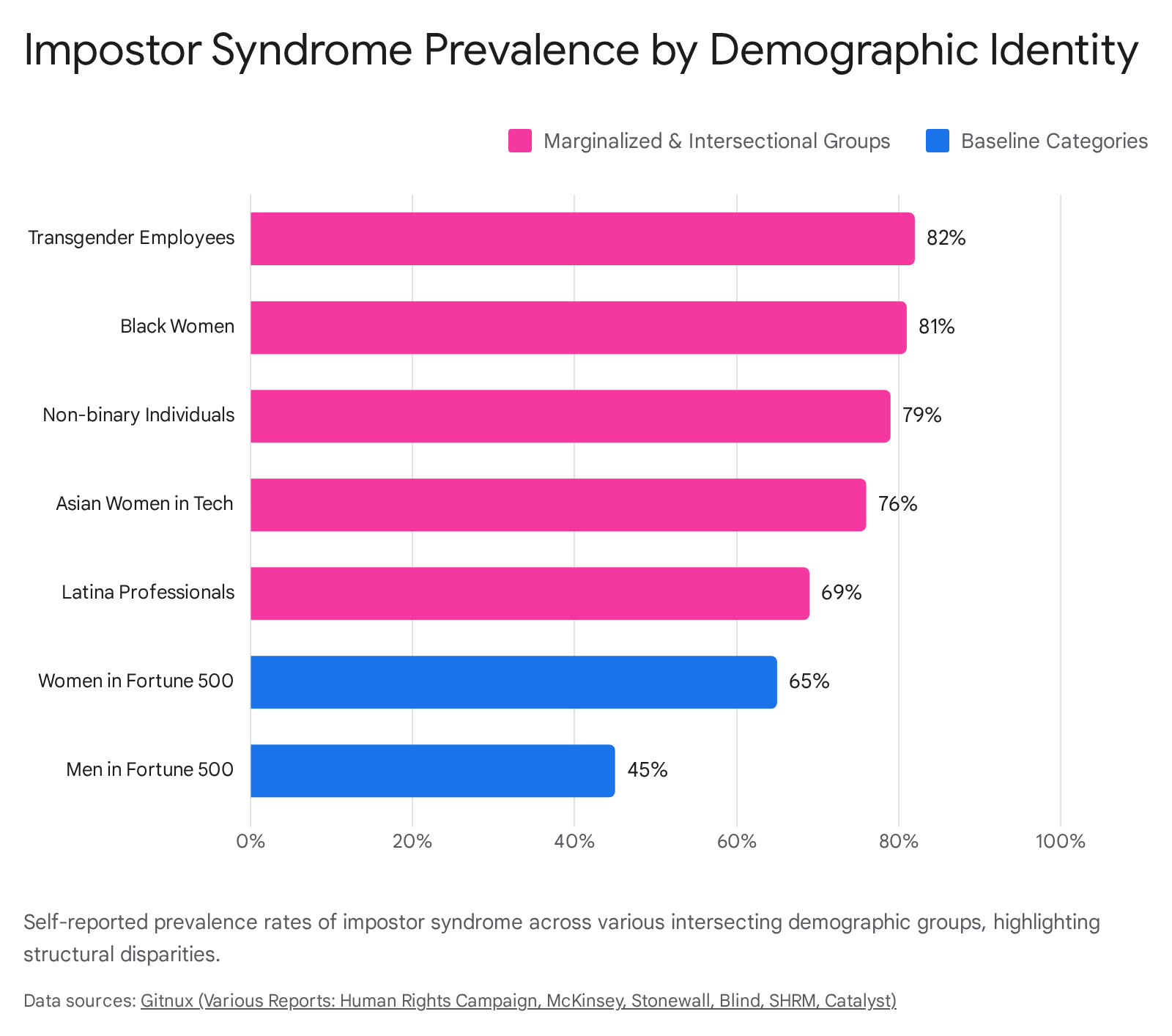
Table: Self-Reported Impostor Syndrome Prevalence by Intersecting Identities
| Demographic Group | Prevalence Rate | Source Context |
|---|---|---|
| Transgender Employees | 82% | Human Rights Campaign survey (2022) |
| Black Women | 81% | McKinsey Women in the Workplace (2021) |
| Non-binary Individuals | 79% | Stonewall UK LGBTQ+ survey (2022) |
| Asian Women in Tech | 76% | Blind tech industry poll (2023) |
| Latina Professionals | 69% | SHRM diversity survey (2022) |
| White Women | 67% | McKinsey Women in the Workplace (2021) |
| Men in Fortune 500 | 45% | Catalyst Fortune 500 study (2022) |
The data indicates that sexual orientation and gender non-conformity are massive predictors of impostor experiences. Non-binary individuals (79%) and transgender employees (82%) report the highest rates of intellectual and professional fraudulence 1736. Similarly, bisexual (69%) and queer (68%) individuals report significantly higher baseline averages than their heterosexual peers 36. Sociologists attribute these elevated metrics to the psychological burden of navigating corporate environments that lack inclusive representation, where LGBTQ+ professionals frequently feel pressured to mask their authentic identities or conform to heteronormative leadership archetypes 2930.
Structural and Environmental Drivers
For decades, psychological literature predominantly framed the impostor phenomenon as a personal, internal deficit - a failure of the individual's confidence that required cognitive behavioral therapy, executive coaching, or "mindset shifts" to cure 313241. However, modern organizational sociology heavily critiques this individualistic model, arguing that it ignores the hostile external environments that actively manufacture self-doubt 42.
The Systemic Disenfranchisement Model
In a seminal 2021 Harvard Business Review article titled "Stop Telling Women They Have Imposter Syndrome," Ruchika Tulshyan and Jodi-Ann Burey argued that the label inherently pathologizes a rational, natural psychological response to systemic bias, racism, and sexism 324133. The authors posited that diagnosing marginalized individuals with a "syndrome" reframes systemic corporate inequality as an individual pathology, placing the burden of adjustment entirely on the victim rather than the organization 3241.
Under this structural model, feelings of fraudulence thrive because organizational cultures are historically designed by and for dominant cultural groups 8. When women and people of color enter these spaces, they face persistent microaggressions, unequal scrutiny, slower promotion rates, and exclusion from informal networks 162931. These external social evaluative cues continuously signal to the individual that they do not belong and are not valued 31. Consequently, researchers advocate that organizations must stop attempting to "fix" women and minorities at work, and instead focus on fixing the exclusionary corporate structures that precipitate impostor feelings 294134.
Tall Poppy Syndrome and Cultural Penalties
The environmental generation of impostorism is vividly illustrated by "Tall Poppy Syndrome" (TPS), a sociological phenomenon widely documented in Australia, New Zealand, Canada, and the United Kingdom 5304535. TPS refers to a cultural pattern where individuals who achieve conspicuous success - the "tall poppies" - are actively undermined, resented, criticized, or professionally sabotaged by peers and superiors to enforce egalitarianism and group conformity 53047.
A comprehensive 2023 international study titled The Tallest Poppy, led by Dr. Rumeet Billan, surveyed 4,710 women across 103 countries and exposed the severe organizational consequences of TPS 354736. The study revealed that 86.8% of respondents had their achievements actively undermined at work, and 60.5% explicitly felt they would be penalized if they were perceived as ambitious 3537.
The presence of TPS in an organization directly synthesizes impostor feelings. When a high-performing employee realizes that visible competence attracts hostility rather than reward, they engage in protective behaviors: masking their abilities, downplaying their successes, and withdrawing from leadership opportunities 303638. Over time, this external pressure to shrink oneself morphs into the internal belief of inadequacy that characterizes the impostor phenomenon 3035.
Table: Comparing the Impostor Phenomenon and Tall Poppy Syndrome
| Feature | Impostor Phenomenon | Tall Poppy Syndrome |
|---|---|---|
| Origin of Distress | Internal cognitive distortion regarding personal worth. | External social retaliation against visible success. |
| Primary Mechanism | Failure to internalize objective evidence of success. | Active sabotage or minimization of success by peers/superiors. |
| Individual Behavior | Over-preparation, procrastination, attributing success to luck. | Downplaying achievements, hiding ambition, masking abilities to avoid attack. |
| Organizational Impact | High risk of internal burnout and individual career stalling. | Toxic culture, loss of trust, and attrition of high-performers (75% report productivity loss). |
| Locus of Intervention | Cognitive behavioral therapy, structural inclusion efforts. | Leadership accountability, zero-tolerance for workplace bullying, cultural reform. |
Cross-Cultural Variances and Social Orientation
Because the foundational theories of the impostor phenomenon were developed in the United States, they are heavily influenced by Western epistemologies, which default to strong cultural individualism 3940. However, global psychological research reveals that a society's position on the spectrum between individualism and collectivism fundamentally alters how self-evaluation, achievement, and self-doubt are conceptualized.
Deconstructing the East-West Binary
Individualist cultures (e.g., the US, UK, Sweden) prioritize autonomy, personal freedom, unique achievement, and the maintenance of high self-esteem 404142. The cultural default emphasizes the independent self; success is viewed as a personal conquest, and individuals are encouraged to see themselves as exceptional 4143. Conversely, collectivist cultures prioritize interdependence, group harmony, social roles, and the suppression of the ego to benefit the community 39404244.
However, recent extensive research challenges the strict "East versus West" binary. A 2025 international study analyzing data from 102 countries (covering 88% of the global population) demonstrated that individualism is deeply linked to socioeconomic development rather than mere geography 42. The study found that prosperous East Asian societies, such as Japan and South Korea, now score highly on individualism - with Japan and the United States differing by only 2.2 points on a 100-point individualism scale 42. The most collectivist societies were instead identified in the Global South, including Bangladesh, Egypt, and Myanmar 42.
Cultural Manifestations of Impostor Thoughts
These cultural orientations dictate how the impostor phenomenon is experienced. In highly individualistic societies, where self-worth is inextricably tethered to personal agency and exceptionalism, the impostor phenomenon manifests as a painful rupture in identity 4144. Because the individual self is the core of self-integrity, the threat of being exposed as a fraud triggers severe psychological distress and physiological stress responses 44.
In collectivist orientations, self-appraisal operates differently. Collectivists possess an "interdependent self" and are statistically less likely to engage in the self-aggrandizing enhancement biases common in individualist cultures 4041. Instead of seeking to stand out, the primary social goal is maintaining interpersonal harmony and accurately understanding one's role within the group 4041. Consequently, what Western psychologists might measure as "impostor feelings" - such as downplaying achievements or expressing extreme modesty - may sometimes represent culturally mandated behavior rather than pathological self-doubt 3041. Nevertheless, when genuine impostorism does strike in collectivist contexts, it is often tied to the fear of failing the group. For example, high impostor scores among students in Oman were deeply linked to the fear of bringing social consequences or shame to their families, reinforcing avoidance behaviors 13.
Psychological Correlates and Clinical Outcomes
The impostor phenomenon rarely operates in a vacuum; it acts as a central catalyst in a network of maladaptive psychological conditions, most prominently perfectionism, occupational burnout, and clinical mood disorders.
Maladaptive Perfectionism and the Impostor Cycle
Impostorism is inextricably linked to perfectionism 4546. However, it is vital to distinguish between adaptive perfectionism (which allows for flexibility and satisfaction in effort) and maladaptive perfectionism (characterized by impossibly rigid standards, intense fear of failure, and chronic self-criticism) 4748.
Individuals with the impostor phenomenon consistently exhibit maladaptive, self-critical perfectionism 147. Because they believe their innate abilities are deficient, they enter the "impostor cycle" upon facing an achievement-related task. The cycle begins with severe anxiety, which triggers either debilitating procrastination or frenetic over-preparation 646. Even when the task is completed flawlessly, the individual refuses to internalize the success, attributing it solely to their exhaustive effort or blind luck 646. The relief is transient, and the core belief of inadequacy remains intact, resetting the cycle for the next challenge 6.
Occupational Burnout and Compassion Fatigue
This relentless cycle of over-preparation and inability to derive satisfaction from success makes impostorism a primary predictor of occupational burnout 4748.
A 2026 study analyzing psychiatrists demonstrated a strong, positive correlation between the impostor phenomenon and all three major components of burnout: emotional exhaustion, depersonalization (cynicism), and decreased feelings of personal accomplishment 4547. Individuals caught in the impostor cycle adopt long-term workaholism to mask their perceived incompetence, gradually draining their cognitive and emotional resources 15. In healthcare settings, this depletion manifests as compassion fatigue, where professionals lose the capacity to empathize with patients due to the overwhelming internal stress of maintaining their professional facade 347.
Comorbidity with Anxiety and Depression
While the impostor phenomenon is not a formal DSM-5 diagnosis, it is a robust vector for clinical mood disorders. Systematic reviews consistently demonstrate that impostor scores are positively correlated with psychological distress, low self-esteem, and clinical anxiety and depression 141548.
A 2025 cross-sectional study evaluating 504 undergraduate students in Oman utilized the Patient Health Questionnaire-9 (PHQ-9) and the Generalized Anxiety Disorder-7 (GAD-7) scale alongside the CIPS 1349. The research revealed that 56% of the cohort experienced impostor syndrome 13. Among those with the phenomenon, 69% experienced significant clinical depressive symptoms (compared to 38.8% of the non-impostor group) and 63.2% experienced significant clinical anxiety (compared to 37.5% of the non-impostor group) 13.
Logistic regression from the study indicated that each unit increase in depressive and anxiety scores significantly predicted the presence of impostor feelings, highlighting a vicious, bidirectional cycle where self-doubt triggers mood disorders, which in turn erode self-confidence further 49. Additional research indicates that the impostor phenomenon acts as a complete mediator between perfectionism and anxiety, meaning that perfectionism only results in clinical anxiety when the individual also harbors impostor thoughts 62.
Potential Interpersonal Upsides
Despite the vast body of literature detailing the psychological toll of impostorism, emerging perspectives in organizational psychology suggest the phenomenon may harbor counterintuitive benefits regarding interpersonal team dynamics.
In their 2025 review, Tewfik, Yip, and Martin highlighted that workplace impostor thoughts are not uniformly detrimental to performance 4. Because individuals experiencing impostorism are acutely, painfully aware of their perceived technical or intellectual deficits, they frequently engage in compensatory behaviors 4. This often takes the form of an "other-focused orientation" 4.
To make up for their perceived lack of intelligence, they over-index on collaboration, careful active listening, empathy, and humility 442. In team settings, these individuals are less likely to dominate conversations and more likely to seek consensus. In medical environments, physicians with moderate impostor thoughts may spend more time consulting with peers, double-checking complex differential diagnoses, and exhibiting heightened empathy during patient interactions, behaviors that can directly reduce medical errors and improve patient satisfaction 442. Therefore, while the internal cognitive experience of impostorism degrades the individual's mental health, the external behavioral manifestations can, paradoxically, foster higher interpersonal effectiveness and benefit the broader organization 4.
Conclusion
The impostor phenomenon represents a highly complex intersection of individual cognitive distortion, environmental hostility, and cultural framing. Originally conceptualized in 1978 as a unique psychological deficit afflicting high-achieving women, decades of rigorous empirical research have redefined the construct. It is now understood to be a pervasive, global occupational hazard, affecting approximately 70% of the workforce, with notable prevalence among senior executives and early-career professionals alike 11620.
However, the burden of impostorism is profoundly unequal. Data unequivocally demonstrates that marginalized groups - particularly women of color, transgender, and non-binary professionals, and women operating in hyper-competitive STEM fields - bear the most intense brunt of intellectual self-doubt 1724. Modern sociological analysis heavily critiques the historical tendency to treat the phenomenon merely as a personal pathology that requires individual therapy. Instead, it highlights how systemic disenfranchisement, microaggressions, and toxic corporate environments (such as those fostering Tall Poppy Syndrome) actively manufacture and sustain feelings of fraudulence 3235.
To mitigate the devastating clinical and occupational outcomes of impostorism - such as chronic burnout, clinical anxiety, depression, and the attrition of high-performing talent - an ideological shift is imperative. Organizations must pivot away from individual-centric interventions aimed at "fixing" the confidence of marginalized employees, and focus instead on dismantling the structural biases, exclusionary practices, and hostile cultural norms that make competence feel like a crime.