Causes of procrastination and intervention effectiveness
Definitional Framework and Psychological Drivers
Procrastination is formally defined in psychological literature as the voluntary, irrational delay of an intended course of action, despite the individual anticipating negative consequences as a result of that delay 12. While it is frequently conflated with laziness in popular discourse, the two phenomena are clinically and psychologically distinct. Laziness is characterized by a fundamental lack of initiative, ambition, or motivation to engage in an activity 34. Conversely, procrastination typically involves high initial motivation that is ultimately derailed by a failure in self-regulation and executive control 35. This regulatory failure affects an estimated 50% to 95% of university students and disrupts the daily functioning of approximately 20% of the adult population chronically 36.
Epidemiological data illustrates the pervasive nature of this behavior. A comprehensive cross-sectional study of 1,093 adults in Saudi Arabia found that 69.9% of participants reported frequent procrastination 17. Within this cohort, academic and study tasks were the most frequently delayed (56.6%), followed by household chores (13.9%) and health-related activities (10.6%) 17. The behavior is particularly acute among young adults; 75% of individuals aged 25 to 34 reported frequent procrastination, compared to only 28.6% of individuals aged 45 to 55 1. Furthermore, the study highlighted significant regional variations, with 78.5% of residents in the Eastern region reporting procrastination compared to 66.1% in the Central region 17.
| Demographic / Task Variable | Procrastination Prevalence / Frequency |
|---|---|
| Age: 25 - 34 years | 75.0% |
| Age: 45 - 55 years | 28.6% |
| Occupational Status: Students | 70.7% |
| Occupational Status: Retired | 40.0% |
| Task Delayed: Academic/Study | 56.6% |
| Task Delayed: Household Chores | 13.9% |
| Task Delayed: Health-related | 10.6% |
Temporal Discounting and the Intention-Action Gap
The persistence of procrastination is heavily influenced by temporal discounting, a cognitive bias wherein the perceived value of a reward diminishes the further it is projected into the future 34. When an individual is faced with a task requiring sustained effort for a delayed outcome, the immediate gratification of an alternative activity (such as scrolling through social media or watching television) appears subjectively more valuable 3. The Saudi Arabian study noted that over 53.4% of participants spent more than four hours daily on activities conducive to procrastination, directly substituting long-term goal pursuit for immediate behavioral rewards 1.
This dynamic creates an "intention-action gap." Because the rewards for completing complex, long-horizon tasks are relegated to the distant future, temporal discounting severely diminishes the immediate motivation to begin 2. Without intermediate sub-goals or externally imposed pacing, individuals consistently underestimate the time required to complete a task and overestimate their future motivation to execute it.
Emotion Regulation and Neural Circuitry
Contemporary psychological models increasingly conceptualize procrastination not merely as a deficit in time management, but as an emotion-focused coping strategy 89. When faced with tasks that elicit negative affective states - such as anxiety, boredom, frustration, or fear of failure - individuals delay task engagement to temporarily escape these aversive emotions 238.
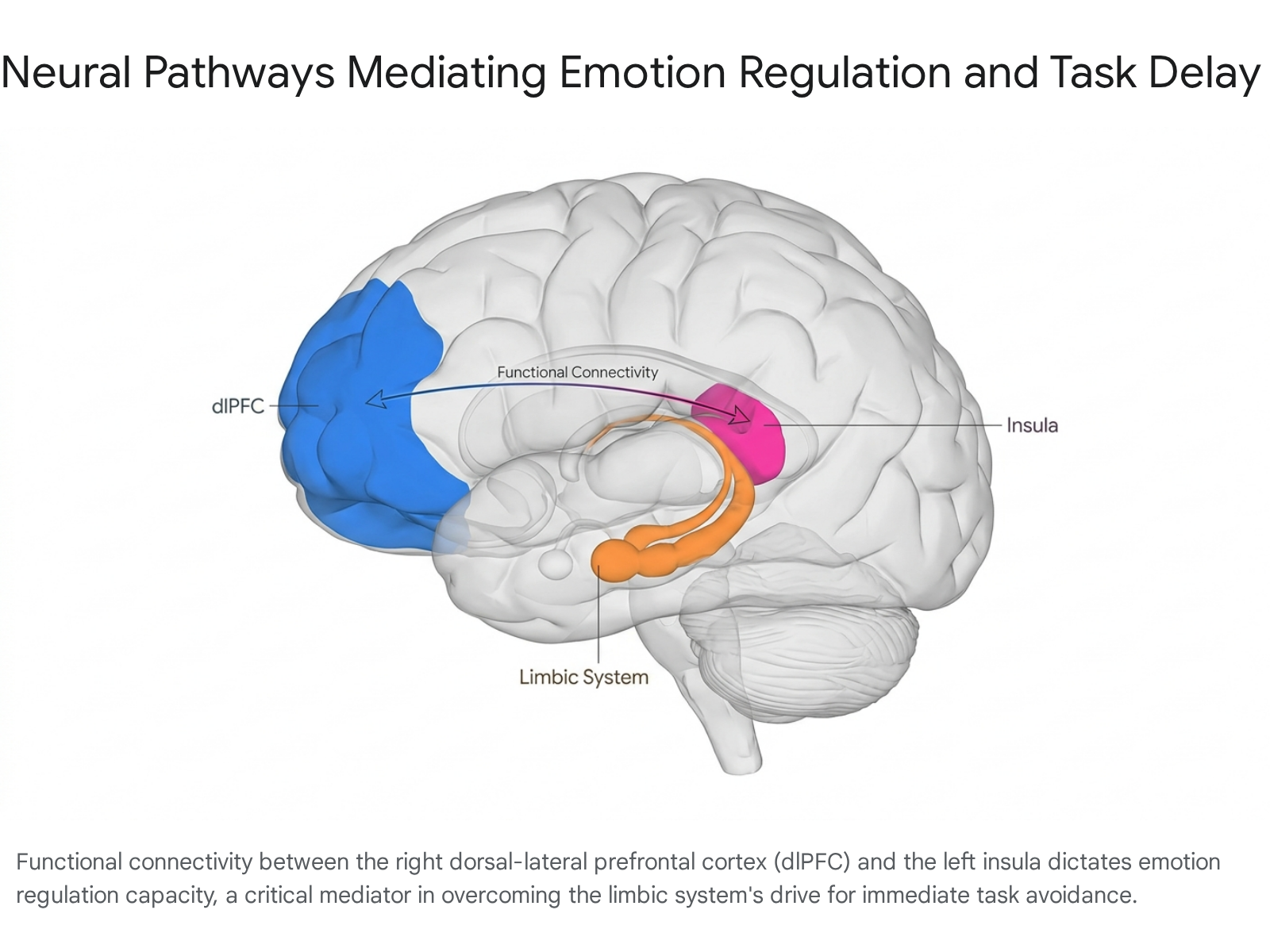
Neurobiological research has identified specific anatomical and functional correlates for this behavior. Functional imbalances between the limbic system, which processes immediate emotional and reward-based stimuli, and the prefrontal cortex, which governs executive function, impulse control, and long-term planning, are central to the procrastinatory cycle 3. When a task is perceived as highly aversive, the limbic system's demand for immediate mood repair overrides the prefrontal cortex's pursuit of delayed rewards.
Resting-state functional connectivity (RSFC) studies provide granular insights into the brain networks mediating this failure. There is a documented functional connection between the right dorsal-lateral prefrontal cortex (dlPFC) and the left insula that positively correlates with an individual's capacity for emotion regulation 10. Emotion regulation ability acts as a direct mediator in the relationship between the functional connectivity of the right dlPFC-left insula and procrastinatory behavior 10. Structural correlations further support this mechanism; gray matter volume in the right dlPFC is positively correlated with emotion regulation capacity, which in turn predicts the likelihood of an individual engaging in procrastination 10. These findings situate procrastination fundamentally within the realm of cognitive control over aversive emotions.
Personality Traits and Academic Self-Efficacy
Individual differences in procrastination are strongly linked to specific traits within the Big Five personality model. Across diverse cultural environments, conscientiousness consistently demonstrates the strongest negative correlation with procrastination 3. Individuals scoring high in conscientiousness exhibit traits such as reliability, robust organization, and self-discipline, which buffer against temporal discounting and emotional reactivity 3. Conversely, neuroticism is positively correlated with procrastination, largely because individuals with high neuroticism are more prone to experiencing the negative affective states that trigger task avoidance 34.
Academic self-efficacy - the belief in one's capability to organize and execute the courses of action required to produce given academic attainments - also plays a critical mediating role. Low self-efficacy and low self-esteem leave individuals vulnerable to task aversiveness, as they doubt their competence to succeed 2311. A cross-cultural study involving university students from Honduras and Spain confirmed that high self-esteem consistently correlates with lower levels of procrastination, as confidence in one's abilities reduces the emotional threat posed by challenging tasks 3. Consequently, individuals with internalizing disorders, neurodevelopmental conditions, or historically low self-esteem are disproportionately vulnerable to chronic procrastination, utilizing delay to temporarily escape feelings of inadequacy 34.
Sociocultural and Demographic Determinants
While procrastination is universally experienced, its prevalence, social interpretation, and the stigma attached to it vary significantly across cultural dimensions and socioeconomic strata.
Cross-Cultural Perspectives on Social Norms
The cultural dimension of individualism versus collectivism significantly shapes how procrastination is internalized and punished socially. In individualistic cultures (e.g., the United States, the United Kingdom, Germany), success is primarily measured by personal growth, achievement, and self-sufficiency 3. Time orientation in many Western cultures is heavily monochronic, viewing time as a linear resource 12. Consequently, procrastination in these societies is largely perceived as a personal failure, a deficit of individual willpower, or a personal time-management flaw 313. Interventions in these environments heavily favor individualized technological solutions and personal accountability frameworks 13.
In contrast, collectivist cultures (e.g., East Asian, Latin American, and certain African societies) prioritize group harmony, loyalty, and collective obligations 312. Procrastination in these contexts is frequently evaluated based on its impact on the community, family, or workgroup rather than the individual 13. In Japan, for example, procrastination that affects others is viewed through the lens of meiwaku, a concept denoting the causing of trouble or discomfort to others 131414. Because collective harmony is paramount, being perceived as someone who causes meiwaku due to laziness or delay carries a severe social stigma, often equated to a profound breach of social trust 1416.
This acute social pressure serves as an external regulatory mechanism. As a result, students from collectivist cultures often report lower levels of active procrastination on group-dependent tasks to avoid letting down their peers 3. However, when an individual's personal tasks conflict with familial or group obligations, delay on the personal task is not viewed as a failure of time management, but rather an adherence to cultural priorities 12. Similarly, in Latin American contexts, procrastination that impacts family obligations carries a weight of collective disappointment rather than merely a personal setback 13. Despite these differences, cross-cultural studies utilizing meta-analytic effects suggest that while the social penalties differ, the fundamental trait of procrastination remains relatively stable across global contexts, though specific manifestations fluctuate 15.
Perceptions of Social Mobility and Marginalization
Beyond macro-cultural dimensions, an individual's perception of their socioeconomic environment heavily influences procrastinatory behavior. Research indicates that marginalized populations, including first-generation college students and students from underrepresented racial and ethnic backgrounds, often exhibit different procrastination patterns due to systemic challenges and the "hidden curriculum" of higher education 16. A large-scale analysis of over 2,000 courses at a U.S. university demonstrated that marginalized students submit assignments later, on average, than their non-marginalized peers, and this procrastination gap explains approximately 20% of the broader academic achievement gap 16.
A critical driver of this variance is the perception of social mobility. In highly stratified environments, if an individual perceives social mobility to be low - believing that upward movement is highly improbable regardless of effort - they may lose confidence in their agency 19. When faced with challenging tasks and tight deadlines, this lack of belief in systemic fairness strips away motivation, resulting in "passive procrastination" (an inability to regulate behavior and engage with the task) rather than active, intentional delay 19. Studies spanning both American and Chinese demographics confirm that lower social mobility beliefs are strongly associated with higher passive procrastination tendencies 19.
Furthermore, the Internalized Stigma Model suggests that perceived discrimination leads to the internalization of negative societal attitudes, fostering deep-seated feelings of shame and personal inadequacy 17. Among marginalized students, including those with physical disabilities, perceived discrimination is positively associated with academic procrastination, mediated serially by heightened feelings of shame and increased self-handicapping behaviors 17.
Environmental Architecture and Digital Distraction
While procrastination is often analyzed as an internal trait or self-regulatory failure, external environments act as powerful catalysts or inhibitors of the behavior. Environments that lack clear structure, offer distant deadlines, and present high cognitive loads can render individuals highly susceptible to delay.
Contextual Factors in Academic and Professional Settings
Educational and professional environments routinely, if unintentionally, foster procrastination through their structural designs 218. Literature reviews have identified nine specific contextual factors reliably associated with an increase in task delay. Prominent among these is a large degree of freedom in the study or work situation 2. When long-term planning is entirely delegated to the individual without intermediate scaffolding, the cognitive demand of structuring the work exacerbates task aversiveness 2.
Similarly, long deadlines increase the likelihood of procrastination. As deadlines extend into the distant future, the perceived value of the reward drops, allowing more immediate, gratifying tasks to take precedence 2. Additionally, environments lacking efficacy-building opportunities - where tasks are not broken down into manageable segments that provide mastery experiences - diminish self-efficacy and increase avoidance 2.
Ineffective group work also serves as a structural catalyst. Group assignments characterized by poor design and a lack of member interdependence often lead to social loafing 2. Conversely, structured group tasks with sequential dependencies, where each member contributes unique skills, reliably mitigate procrastination through social accountability 2.
Digital Devices and Smartphone Addiction
The proliferation of digital devices has fundamentally altered the environmental triggers for procrastination. Mobile phones and social media platforms are engineered to exploit the brain's dopamine reward system, providing instant gratification that sharply competes with the delayed rewards of complex tasks 3.
High screen time is empirically linked to lower levels of self-regulation, reduced self-efficacy, and elevated anxiety, all of which are antecedents to procrastination 619. An investigation into the behavior of college students demonstrated that smartphone addiction (SA) indirectly increases academic procrastination through sequential mediation: high SA impairs self-control, which subsequently diminishes academic self-efficacy, ultimately resulting in severe task delay 1120. The ubiquitous presence of digital distractions requires constant, active self-regulation to ignore, which depletes cognitive resources over time and makes task initiation increasingly difficult 6. In a quantitative cross-sectional design of high school students, a significant positive correlation was found between raw screen time and procrastination, with 52% reporting that smartphone use negatively impacted their ability to complete homework 24.
In addition to academic and occupational delays, digital distractions have given rise to specific behavioral subsets, such as bedtime procrastination - the volitional delay of sleep without external circumstances necessitating it 21. Pre-sleep electronic device use is a ubiquitous mechanism of bedtime procrastination that directly impairs sleep duration and quality 2223.
The Conservation of Procrastination Hypothesis
A common concern in digital behavioral modification is whether removing one distraction merely causes the user to substitute it with another. A study utilizing "HabitLab," a behavior change browser extension and phone application, tested this "Conservation of Procrastination" hypothesis 24. Researchers manipulated the frequency of interventions on a focal goal (e.g., reducing time on Facebook) and measured the effects on time spent on other applications and platforms. The findings indicated that when intervention frequency increased on the focal goal, time spent on other applications was held constant or even reduced 24. Furthermore, time was not redistributed across platforms from browser to mobile phone 24. These results suggest that productivity interventions can successfully save time without causing substantial negative second-order redistribution effects.
Psychological and Behavioral Interventions
Given the severe impact of chronic procrastination on academic performance, occupational success, and psychological well-being, various intervention modalities have been rigorously tested. Empirical data highlights significant variance in the efficacy of differing therapeutic and structural approaches.
Cognitive Behavioral Therapy
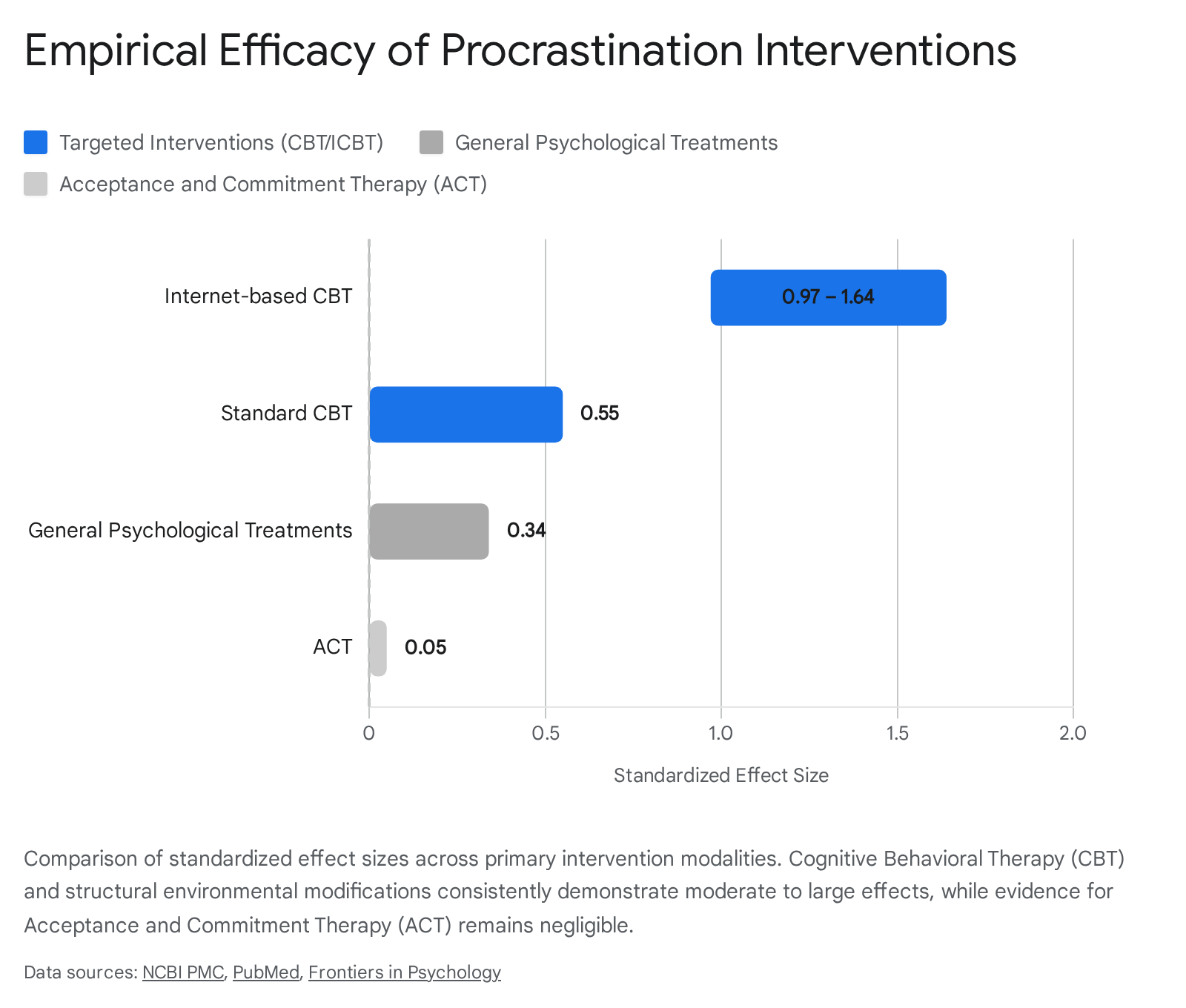
Cognitive Behavior Therapy (CBT) remains one of the most established psychological treatments for procrastination. CBT targets the irrational beliefs, catastrophic thinking, and perfectionism that render tasks aversive, while concurrently establishing behavioral routines for task initiation. A meta-analysis of psychological treatments for procrastination revealed that CBT yields a moderate between-group effect size (Hedge's g = 0.55) when compared to inactive controls 2526.
Specific trials evaluating Internet-based CBT (ICBT) have demonstrated robust outcomes. In a randomized controlled trial assessing guided versus unguided ICBT, researchers found large within-group effect sizes for self-report measures of procrastination (Cohen's d = 0.97 - 1.64), alongside moderate improvements in secondary symptoms of depression and anxiety (Cohen's d = 0.56 - 0.66) 27. Notably, follow-up assessments at one year indicated that the therapeutic gains were largely maintained or improved over time, providing rare evidence for the long-term durability of cognitive-behavioral interventions 27.
Conversely, Acceptance and Commitment Therapy (ACT), a third-wave cognitive therapy focusing on psychological flexibility and value-based action, yielded only negligible effects on procrastination in isolated controlled trials (Hedge's g = 0.05) 2526. Implementations targeting specific intentions (e.g., setting strict "if-then" plans) have shown stronger average effect sizes (Cohen's d = 0.65) for general goal achievement, though these are not exclusive to procrastination 25.
Mindfulness-Based Interventions
Because poor emotion regulation is a primary driver of procrastination, Mindfulness-Based Interventions (MBIs) have gained traction as a countermeasure. By cultivating a non-judgmental awareness of present-moment experiences, mindfulness allows individuals to observe aversive emotions (like task anxiety) without automatically reacting through avoidance 928.
A meta-analysis synthesizing 33 studies (comprising 11,817 participants) demonstrated a significant negative association between trait mindfulness and procrastination (r = -0.38) 29. A separate three-level meta-analysis analyzing 36 effect sizes from 19 studies similarly found a significant negative relationship (r = -0.365) 30. Experimental data aligns with these correlational findings; participation in brief mindfulness exercises has been shown to increase the intention to initiate aversive tasks, provided the participant actively engages with the training 31. Mindfulness-based cognitive therapy (MBCT) trials indicate significant reductions in academic procrastination (η2 = 0.773) and improvements in self-efficacy (η2 = 0.686) alongside reductions in negative emotions such as anxiety, shame, and disappointment 3233.
However, the longitudinal efficacy of MBIs remains mixed. A randomized controlled trial evaluating a combined face-to-face mindfulness intervention and an app-based intervention (7Mind) tracked university students over a 12-month period 34. At post-intervention and during 4-month and 12-month follow-ups, students in the mindfulness interventions did not demonstrate statistically significant superiority over the active control group across the measures, although both the intervention and control groups exhibited general improvements in emotion regulation and stress over the long term 34. These results suggest that while mindfulness reduces acute avoidance, its long-term superiority over other active treatments requires further validation.
Structural and Contextual Modifications
Environmental and structural design interventions - which bypass individual therapeutic work in favor of modifying the context in which tasks are performed - are highly scalable and effective. Structuring the academic or work environment to remove procrastination triggers reduces the reliance on individual willpower.
Systematic reviews of academic interventions identify structural modifications as highly reliable. Instructors who break distant, long-horizon assignments into multi-step, sequentially dependent tasks with firm, proximate deadlines consistently promote earlier task initiation and improved performance 23940. Conversely, interventions relying on punitive measures (e.g., severe grade docking) are less effective than supportive structural designs 3940. In computing education, interventions that introduce clear temporal structures and continuous feedback loops act as key mediators for performance gains, particularly for multi-step assignments 39.
Classroom interventions that demand active student reflection also show promise. A study evaluating scalable interventions in large computer science courses found that utilizing automated email alerts to inform students of their progress relative to their peers significantly reduced late assignment submissions and increased the likelihood of assignments being completed early, despite students subjectively rating the emails as only marginally useful 35.
Digital interventions designed to restructure choice architecture also show strong practical efficacy. The REST-O (Reducing Evening Screen Time Online) program, which targeted bedtime procrastination by having participants either prevent access to devices or substitute device use with other activities, resulted in significant reductions in pre-sleep device use (mean reduction of 23.4 minutes) and corresponding increases in sleep duration (12.7 minutes per day) post-intervention 2223.
Pharmacological Interventions and Cognitive Enhancers
Given the executive functioning deficits associated with chronic procrastination, pharmacological interventions are occasionally sought by individuals attempting to bypass behavioral training. However, the efficacy of these substances is highly contingent upon the presence of an underlying neurodevelopmental diagnosis.
Clinical Applications for Executive Dysfunction
For individuals diagnosed with Attention-Deficit/Hyperactivity Disorder (ADHD), severe procrastination is fundamentally a neurobiological symptom of inattention and executive dysfunction rather than a purely behavioral flaw 36. In these clinical populations, long-acting stimulant medications (such as methylphenidate or lisdexamfetamine) are established as the first-line pharmacological treatment 3637. Stimulants directly address the dopamine and norepinephrine deficits in the prefrontal cortex, resulting in large effect sizes (frequently approaching 1.0) for symptom reduction, including the mitigation of inattention-driven procrastination 3638. A meta-review confirmed that pharmacological treatments for adult ADHD are significantly more efficacious than placebos (standardized mean difference of 0.45), though they are associated with lower tolerability profiles 38.
For populations suffering from Major Depressive Disorder (MDD) where severe procrastination is a byproduct of anhedonia and low motivation, non-stimulant medications are indicated. Standard SSRIs target serotonin, but medications that influence dopaminergic activity, such as bupropion, show demonstrable efficacy in restoring task initiation capabilities and addressing motivational deficits 3738. Atomoxetine, a non-stimulant norepinephrine reuptake inhibitor, is also efficacious for ADHD-related executive dysfunction, though it requires a 6-to-12-week titration period to achieve full therapeutic effect 3637.
Stimulant Misuse Among Neurotypical Adults
Despite the efficacy of stimulants in clinical cohorts, there is widespread off-label misuse of prescription stimulants (often termed "smart drugs") among healthy university students and professionals seeking cognitive enhancement and the elimination of procrastination 3940. Empirical data strongly contradicts the utility of this practice.
While stimulant administration in non-ADHD adults reliably increases subjective arousal, motivation, and the feeling of productivity, it does not reliably enhance high-order cognitive processes 404142. A systematic review and meta-analysis of modafinil administration in non-sleep-deprived adults across 19 placebo-controlled trials (generating 67 cognitive domain-specific effect sizes) found only a negligible overall positive effect on cognitive domains (g = 0.10) 4943. Similarly, a randomized, double-blind trial evaluating a low dose of methylphenidate in healthy adults found modest improvements only in numeric working memory, with no corresponding enhancement in general working memory, reaction time, or visual scanning efficiency 51.
Impact on Neurotypical Productivity and Task Efficiency
More critically, rigorous double-blind, placebo-controlled trials utilizing computationally complex tasks that mimic real-world problem-solving reveal that stimulants may actually impair performance in neurotypical individuals. In a study conducted by the University of Cambridge and the University of Melbourne, 40 healthy participants were administered methylphenidate, modafinil, dextroamphetamine, or a placebo, and tested on the Knapsack Optimization Problem - a complex resource-allocation task 404144.
The researchers observed that participants under the influence of stimulants exhibited small decreases in accuracy and efficiency paired with large increases in time and effort 404144. Participants medicated with methylphenidate took approximately 50% longer on average to complete the tasks compared to their performance on a placebo 40. Furthermore, above-average baseline performers exhibited the most significant declines in productivity when medicated. Participants ranking in the top 25% for productivity under a placebo frequently dropped into the bottom 25% when administered methylphenidate 4044. Conversely, participants with lower baseline performance only occasionally exhibited slight improvements 4144.
| Pharmacological Agent | Population | Observed Cognitive / Behavioral Effect | Primary Efficacy Outcome |
|---|---|---|---|
| Methylphenidate / Lisdexamfetamine | ADHD Diagnosed | Addresses core dopaminergic/norepinephrine deficits; improves executive function. | High efficacy; significant symptom reduction (SMD 0.45 to ~1.0). |
| Bupropion | MDD Diagnosed | Enhances dopaminergic activity to combat anhedonia and restore task initiation. | Moderate to High efficacy for motivation restoration. |
| Modafinil | Neurotypical (Non-sleep deprived) | Minor subjective arousal; limited objective cognitive benefit. | Negligible efficacy (Meta-analysis g = 0.10). |
| Methylphenidate / Dextroamphetamine | Neurotypical Adults | Increased effort and time spent, but erratic thinking and reduced accuracy on complex tasks. | Negative efficacy; top performers drop to bottom quartiles in optimization tasks. |
The pharmacological induction of dopamine increases motivation and effort, but in healthy brains, this forced exertion leads to "erratic thinking" and a severe loss of task efficiency in complex scenarios 4044. Consequently, there is no clinical or empirical justification for utilizing pharmacological agents to treat procrastination in otherwise healthy adults 3753. For the general population, the sustainable mitigation of procrastination is best achieved through structural environmental design, cognitive-behavioral realignment, and the active regulation of digital distractions.